
Chapter 10 Warehousing Management Learning Objectives To understand
Chapter 10 Warehousing Management
Learning Objectives • To understand the role of warehouses and distribution centers in a logistics system • To identify the various types and functions of warehouses • To distinguish the various alternatives available in warehouse design • To examine the different types of handling equipment available • To analyze the issue of employee safety in warehousing © 2008 Prentice Hall 10 -2
Warehousing Management • Key Terms – Accumulating (bulkmaking) – Allocating (bulkbreaking) – Assorting – Bonded storage – Contract (3 rd party) warehousing – Cross-docking © 2008 Prentice Hall – Distribution centers – Dunnage – Field warehousing – Fixed slot location – Multi-client warehousing – Occupational Safety & Health Administration (OSHA) 10 -3
Warehousing Management • Key Terms – Paperless warehousing – Private warehousing – Public warehousing – Regrouping function – Sorting out – Throughput – Variable slot location – Warehouse © 2008 Prentice Hall • Key Terms – Warehouse management system (WMS) – Warehousing 10 -4
Warehousing Management • Warehousing refers to “that part of the firm’s logistics system that stores products (raw materials, part, goodin-process, finished goods) at an between points of origin and point of consumption. ” Source: Douglas M. Lambert, James R. Stock, and Lisa M. Ellram, Fundamentals of Logistics Management (New York: Irwin Mc. Graw-Hill, 1998), Chapter 8. • Warehousing management has evolved to include value-adding services – – – Custom labeling Promotional pack Grouping and sorting of products Kitting for production Display building and packaging Price marking © Pearson Education, Inc. publishing as Prentice Hall 10 -5
Warehousing Management • Warehousing and transportation are substitutes for each other, with warehousing having been referred to as “transportation at zero miles per hour. ” © Pearson Education, Inc. publishing as Prentice Hall 10 -6
Warehousing Management • Warehousing serves to match different rates or volumes of flow when patterns of production and consumption do not coincide • Distribution centers emphasize rapid movement of products through the facility • Throughput is the amount of product entering and leaving a facility in a given time period • Regrouping function – – Accumulating (increasing quantity) Allocating (reducing quantity) Assorting (building up a variety of products) Sorting (separating products into grades and qualities) © 2008 Prentice Hall 10 -7
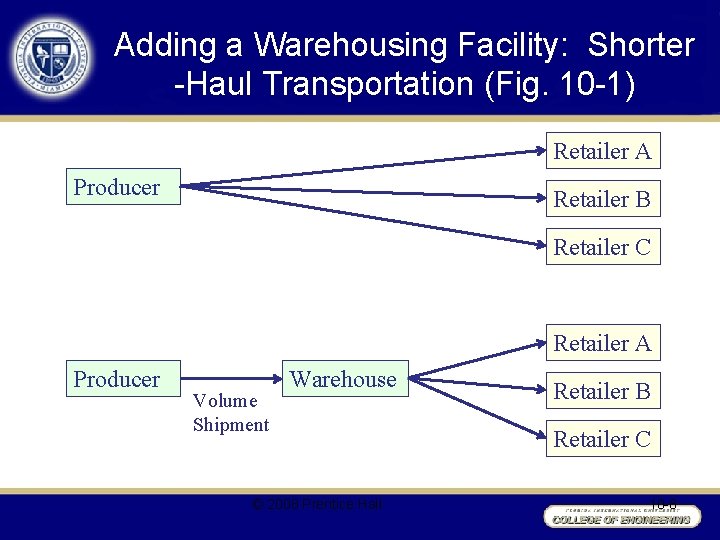
Adding a Warehousing Facility: Shorter -Haul Transportation (Fig. 10 -1) Retailer A Producer Retailer B Retailer C Retailer A Producer Volume Shipment Warehouse © 2008 Prentice Hall Retailer B Retailer C 10 -8
Public Warehousing • Public warehouses – – – Serve all legitimate users Require no capital investment on the user’s part Allows users to rent space as needed Can be rented on a month-to-month basis Offers more locational flexibility May provide specialized services • Potential drawback of public warehouses – Lack of control by the user • Warehousing labor safety practices monitored by Occupational Safety and Health Administration (OSHA) © 2008 Prentice Hall 10 -9
Private Warehousing • Private warehousing – is owned or occupied on a long-term lease – Offers control to owner – Assumes both sufficient demand volume and stability so that warehouse remains full • Potential drawbacks of private warehouses: – High fixed cost – Necessity of having high and steady demand volumes – May reduce an organization’s flexibility © 2008 Prentice Hall 10 -10
Contract Warehousing • Contract warehousing (3 PL warehousing) is a long-term arrangement providing unique warehousing services to one client • Both vendor and client share the risks associated with the warehousing • Less costly than private warehousing and more costly than public warehousing © 2008 Prentice Hall 10 -11
Multiclient Warehousing • Multiclient warehousing – Mixes attributes of contract and public warehouses – Services are more differentiated than those in a public facility – Services are less customized than those in a private facility – Services are purchased through minimum 1 year contracts – Are attractive to smaller organizations © Pearson Education, Inc. publishing as Prentice Hall 10 -12
Design Considerations in Warehousing • General considerations – Quantity and character of goods must be known—product profiling – Know the purpose to be served • Storage • Distribution • Cross-docking © 2008 Prentice Hall 10 -13
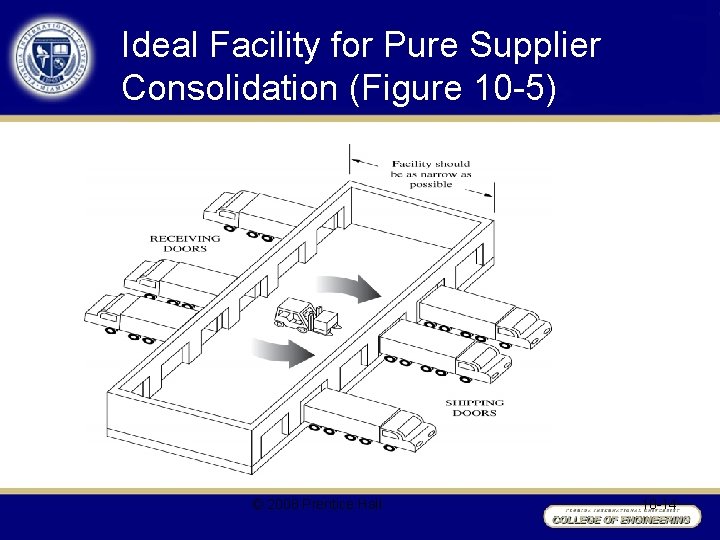
Ideal Facility for Pure Supplier Consolidation (Figure 10 -5) © 2008 Prentice Hall 10 -14
Warehousing Trade-offs • Fixed versus variable slot locations for merchandise • Build out (horizontal) versus build up (vertical) • Order-picking versus stock-replenishing functions • Two-dock versus single-dock layout © 2008 Prentice Hall 10 -15
Warehousing Trade-offs • Labor-intensive versus mechanization versus automation • Space devoted to aisles versus space devoted to storage • Picker-to-part versus part-to-picker systems © 2008 Prentice Hall 10 -16
Warehousing Trade-offs • Paperless warehousing versus traditional paper-oriented warehousing operations • Virtual warehouse versus real warehouse • Other space needs • Retail storerooms © 2008 Prentice Hall 10 -17
Warehousing Operations • Storage and handling equipment • Warehouse management systems • Employee safety – OSHA oversees – Proper handling of waste materials • Dunnage – Proper handling of breakage © 2008 Prentice Hall 10 -18
Warehousing Operations • • Warehousing security Hazardous materials Sanitation issues Stock controls © 2008 Prentice Hall 10 -19
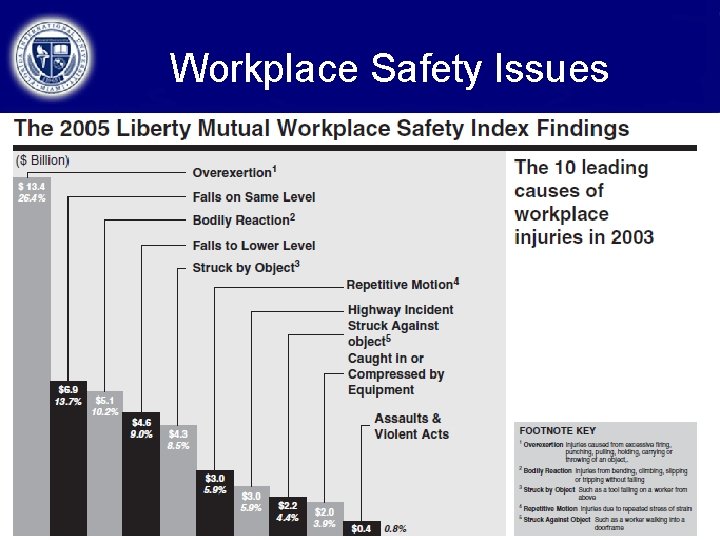
Workplace Safety Issues
Case 10 -1 Sandy’s Candy Company Facts: • Mannix Model Markets - Omaha, Nebraska Company Information: • 55 stores, served by daily deliveries (5 days/week) • Member of a buying cooperative • Some items are delivered directly by vendors Decisions: • Schoenecker’s candies 1 -21
Case 10 -1 Sandy’s Candy Company Facts: • Mannix Model Markets - Omaha, Nebraska Company Information: • 55 stores, served by daily deliveries (5 days/week) • Member of a buying cooperative • Some items are delivered directly by vendors Decisions: • Schoenecker’s candies 1 -22
Case 10 -1 Sandy’s Candy Discussion: #1: Using those items of comparison for which costs can be calculated, determine the cost difference between the two delivery systems. #2: List and compare those factors for which it is difficult to assign precise costs. #3: Given the data that Sandy has, do you believe that Mannix Model Markets should get its Schoenecker candy through the buying cooperative or continue to rely on direct deliveries by Schoenecker’s drivers-salespeople? Give your reasons. #4: If you were Sandy, what additional information would you like to have before being asked to make such a recommendation? 1 -23
Case 10 -1 Sandy’s Candy Discussion: #5: Candy sales increase during holiday seasons. Which of the two candy distribution systems do you think would do a better job of anticipating and supplying these seasonal increases? Why? #6: Assume you are in charge of labor relations for Mannix Model Markets. Would you like to see continued reliance on drivers-salespeople to supply the markets’ candy needs? Why or why not? 1 -24
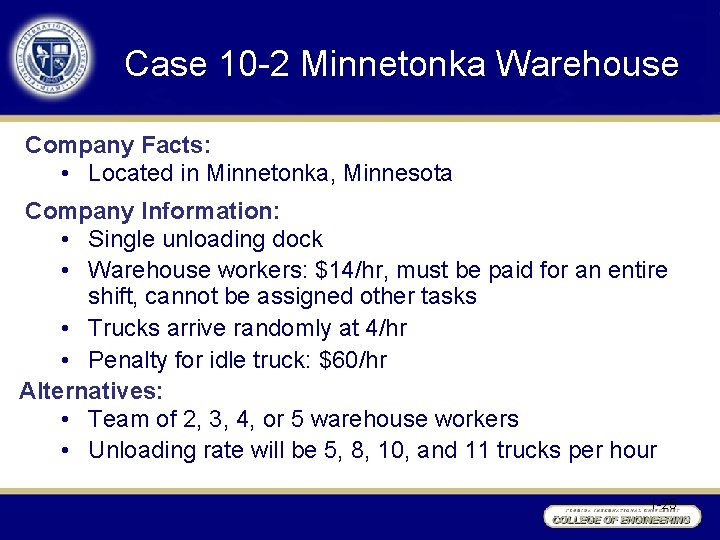
Case 10 -2 Minnetonka Warehouse Company Facts: • Located in Minnetonka, Minnesota Company Information: • Single unloading dock • Warehouse workers: $14/hr, must be paid for an entire shift, cannot be assigned other tasks • Trucks arrive randomly at 4/hr • Penalty for idle truck: $60/hr Alternatives: • Team of 2, 3, 4, or 5 warehouse workers • Unloading rate will be 5, 8, 10, and 11 trucks per hour 1 -25
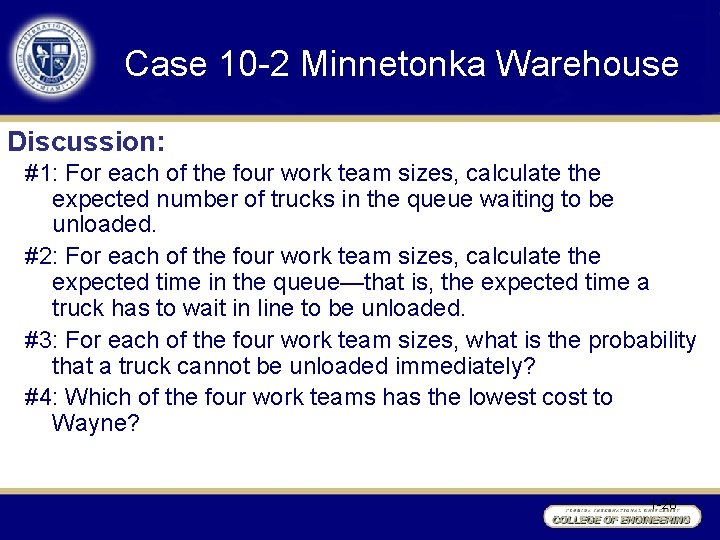
Case 10 -2 Minnetonka Warehouse Discussion: #1: For each of the four work team sizes, calculate the expected number of trucks in the queue waiting to be unloaded. #2: For each of the four work team sizes, calculate the expected time in the queue—that is, the expected time a truck has to wait in line to be unloaded. #3: For each of the four work team sizes, what is the probability that a truck cannot be unloaded immediately? #4: Which of the four work teams has the lowest cost to Wayne? 1 -26
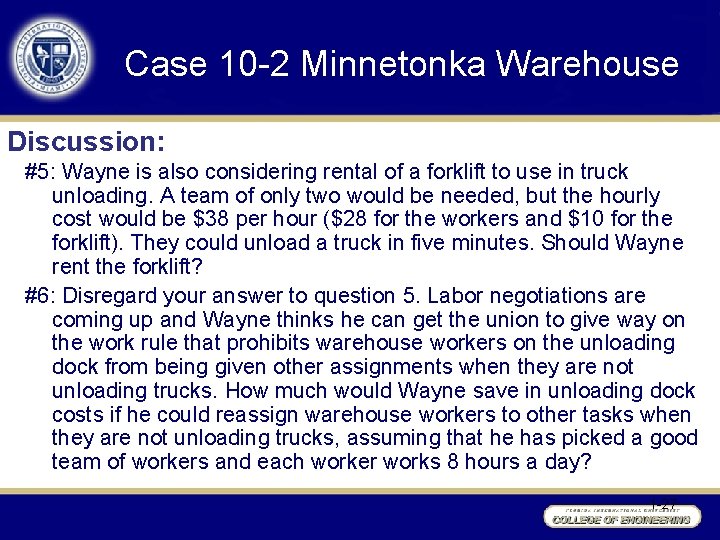
Case 10 -2 Minnetonka Warehouse Discussion: #5: Wayne is also considering rental of a forklift to use in truck unloading. A team of only two would be needed, but the hourly cost would be $38 per hour ($28 for the workers and $10 for the forklift). They could unload a truck in five minutes. Should Wayne rent the forklift? #6: Disregard your answer to question 5. Labor negotiations are coming up and Wayne thinks he can get the union to give way on the work rule that prohibits warehouse workers on the unloading dock from being given other assignments when they are not unloading trucks. How much would Wayne save in unloading dock costs if he could reassign warehouse workers to other tasks when they are not unloading trucks, assuming that he has picked a good team of workers and each worker works 8 hours a day? 1 -27
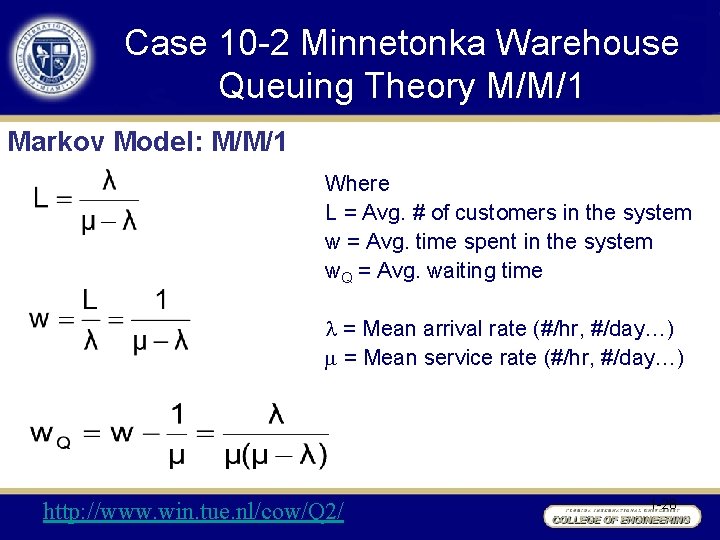
Case 10 -2 Minnetonka Warehouse Queuing Theory M/M/1 Markov Model: M/M/1 Where L = Avg. # of customers in the system w = Avg. time spent in the system w. Q = Avg. waiting time = Mean arrival rate (#/hr, #/day…) = Mean service rate (#/hr, #/day…) http: //www. win. tue. nl/cow/Q 2/ 1 -28
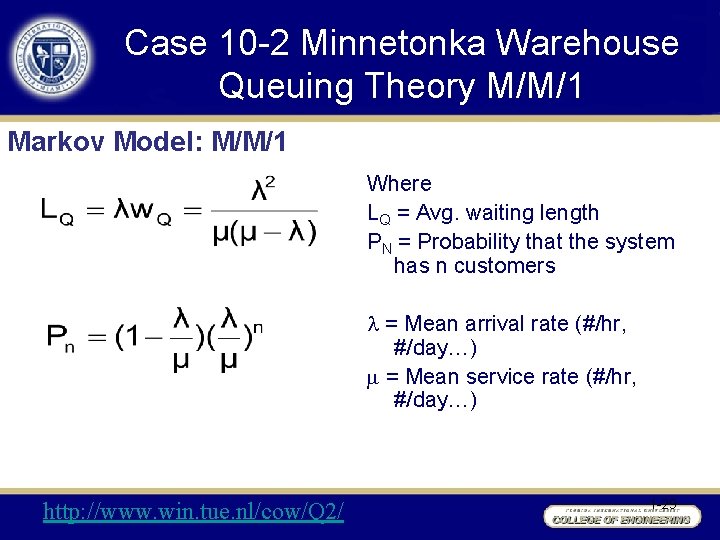
Case 10 -2 Minnetonka Warehouse Queuing Theory M/M/1 Markov Model: M/M/1 Where LQ = Avg. waiting length PN = Probability that the system has n customers = Mean arrival rate (#/hr, #/day…) = Mean service rate (#/hr, #/day…) http: //www. win. tue. nl/cow/Q 2/ 1 -29
- Slides: 29