
Chapter 10 w Decentralization Mc GrawHill Irwin The
- Slides: 53
Chapter 10 w Decentralization Mc. Graw-Hill /Irwin © The Mc. Graw-Hill Companies, Inc. , 2007
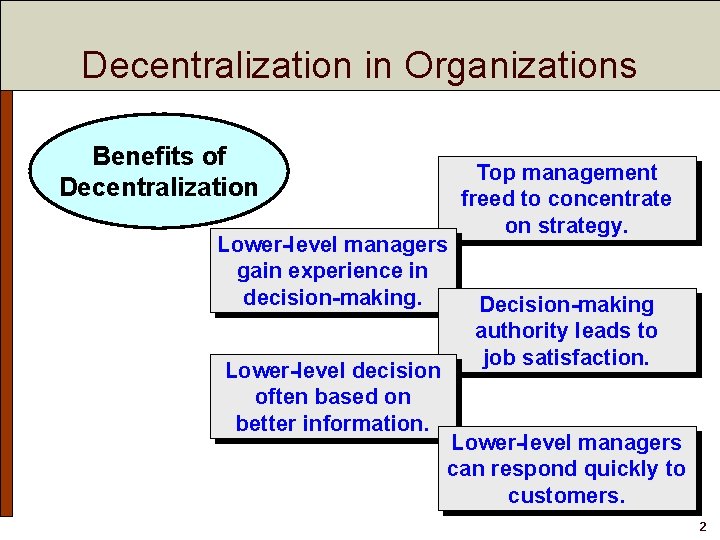
Decentralization in Organizations Benefits of Decentralization Lower-level managers gain experience in decision-making. Lower-level decision often based on better information. Top management freed to concentrate on strategy. Decision-making authority leads to job satisfaction. Lower-level managers can respond quickly to customers. 2
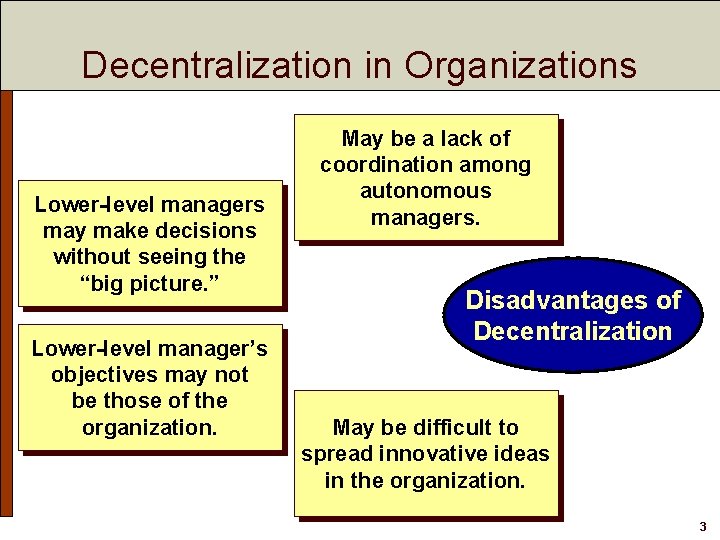
Decentralization in Organizations Lower-level managers may make decisions without seeing the “big picture. ” Lower-level manager’s objectives may not be those of the organization. May be a lack of coordination among autonomous managers. Disadvantages of Decentralization May be difficult to spread innovative ideas in the organization. 3
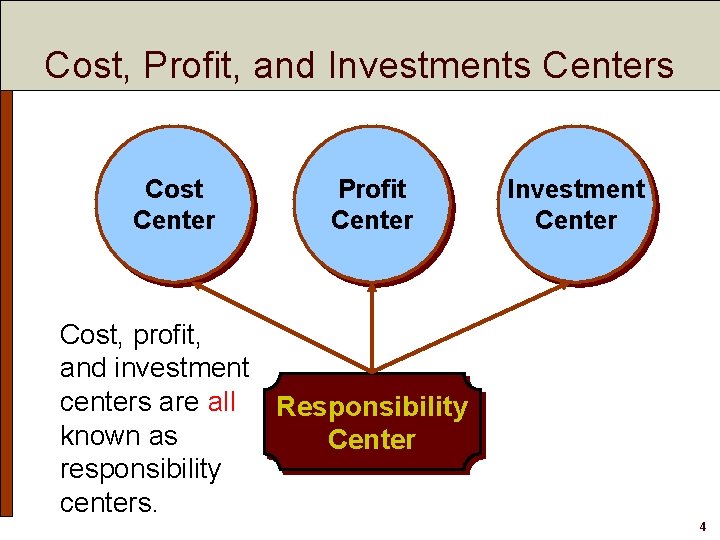
Cost, Profit, and Investments Centers Cost Center Profit Center Investment Center Cost, profit, and investment centers are all Responsibility known as Center responsibility centers. 4
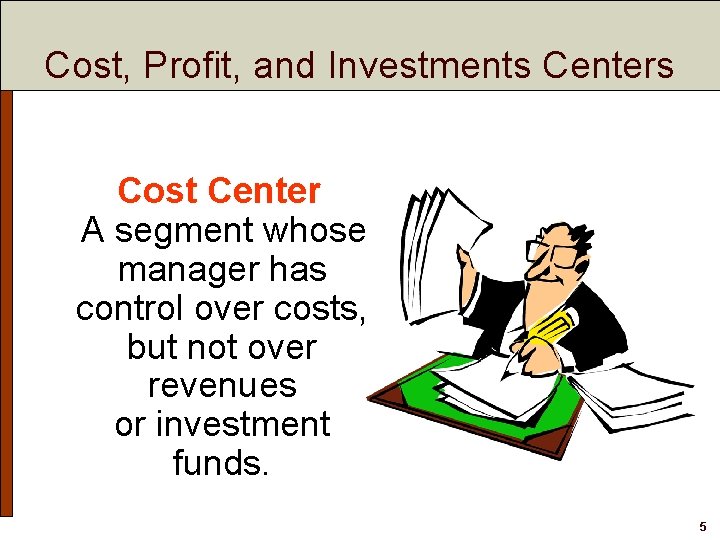
Cost, Profit, and Investments Centers Cost Center A segment whose manager has control over costs, but not over revenues or investment funds. 5
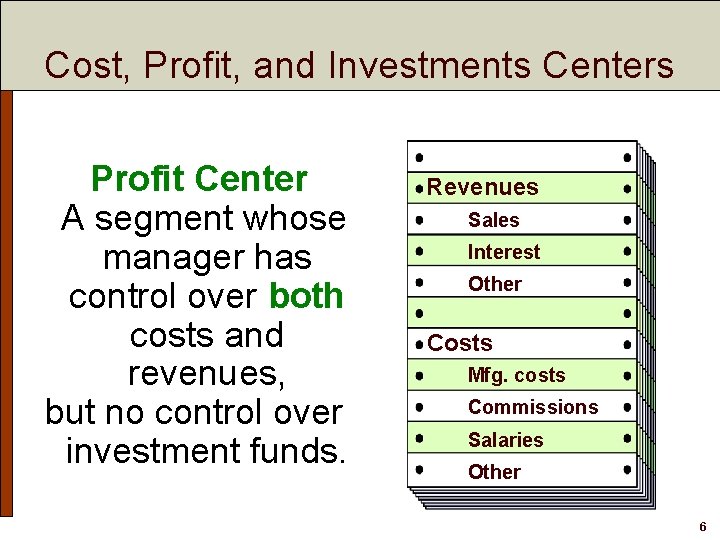
Cost, Profit, and Investments Centers Profit Center A segment whose manager has control over both costs and revenues, but no control over investment funds. Revenues Sales Interest Other Costs Mfg. costs Commissions Salaries Other 6
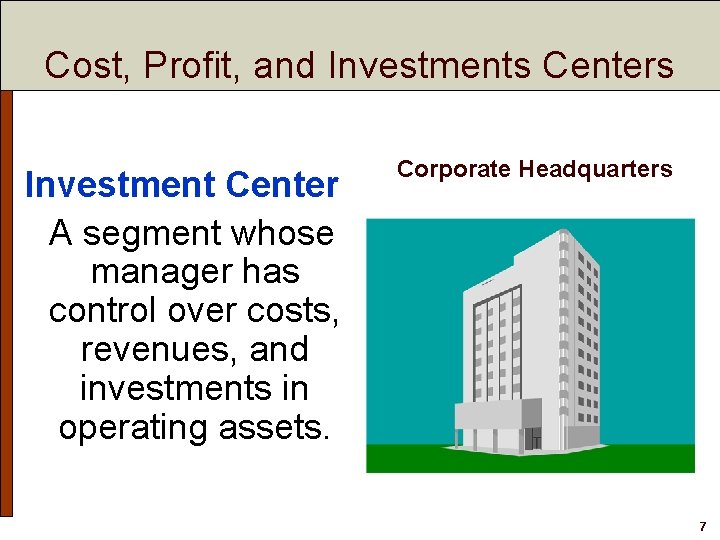
Cost, Profit, and Investments Centers Investment Center A segment whose manager has control over costs, revenues, and investments in operating assets. Corporate Headquarters 7
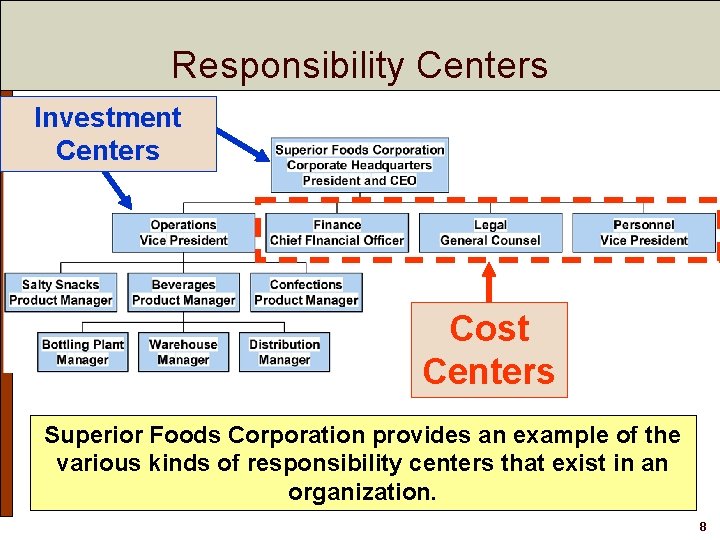
Responsibility Centers Investment Centers Cost Centers Superior Foods Corporation provides an example of the various kinds of responsibility centers that exist in an organization. 8
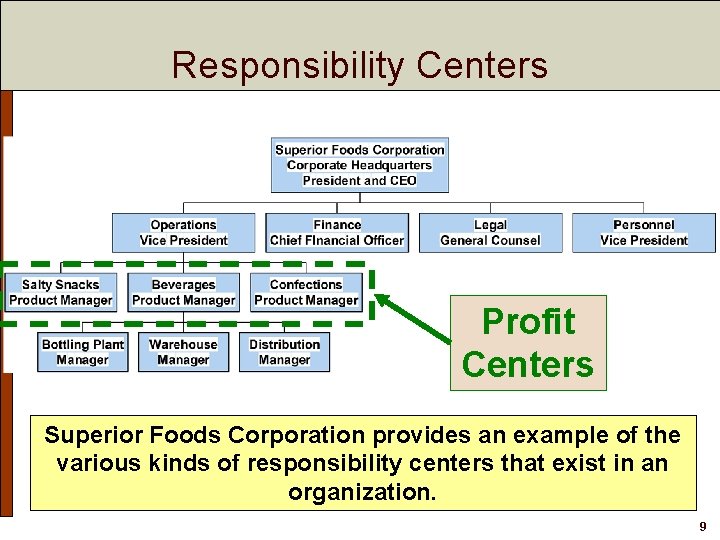
Responsibility Centers Profit Centers Superior Foods Corporation provides an example of the various kinds of responsibility centers that exist in an organization. 9
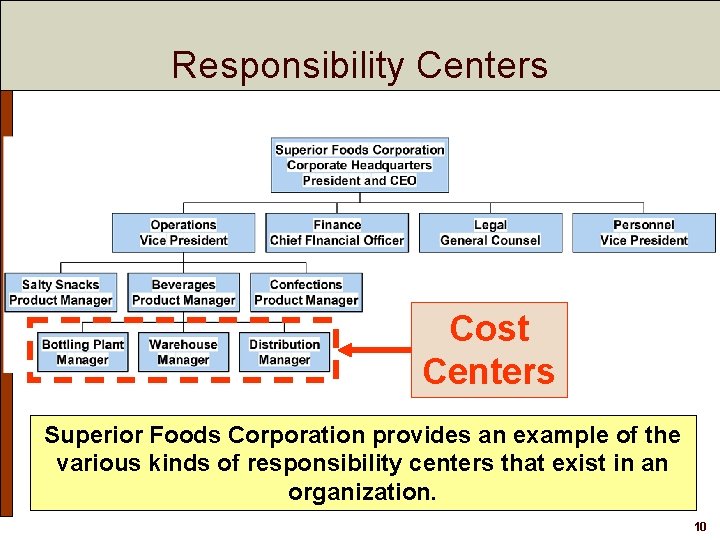
Responsibility Centers Cost Centers Superior Foods Corporation provides an example of the various kinds of responsibility centers that exist in an organization. 10
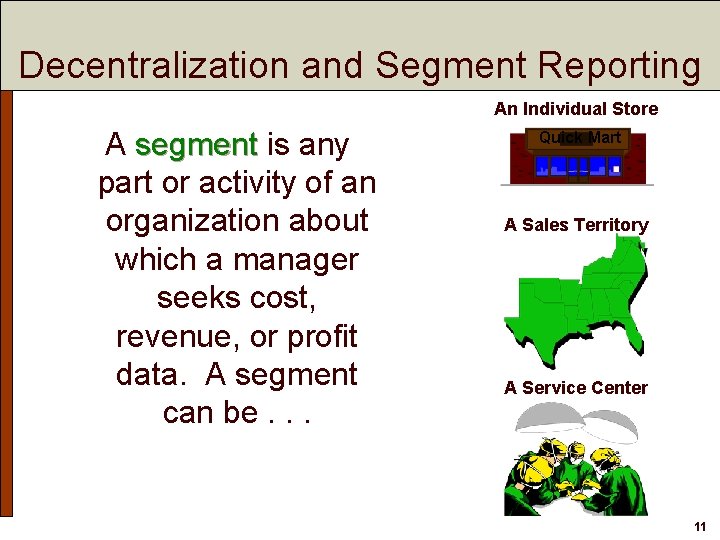
Decentralization and Segment Reporting An Individual Store A segment is any part or activity of an organization about which a manager seeks cost, revenue, or profit data. A segment can be. . . Quick Mart A Sales Territory A Service Center 11
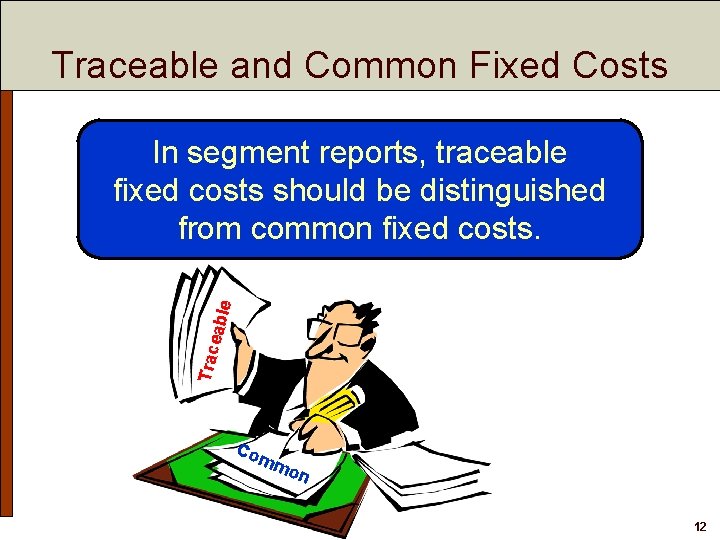
Traceable and Common Fixed Costs Trac eabl e In segment reports, traceable fixed costs should be distinguished from common fixed costs. Co mm on 12
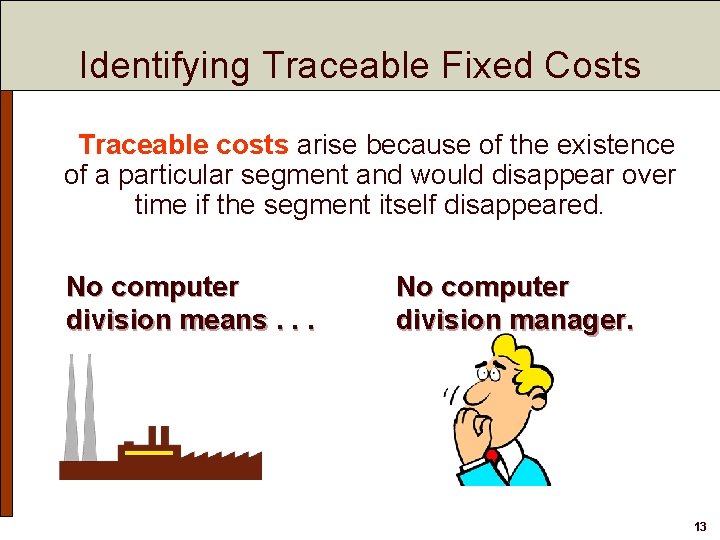
Identifying Traceable Fixed Costs Traceable costs arise because of the existence of a particular segment and would disappear over time if the segment itself disappeared. No computer division means. . . No computer division manager. 13
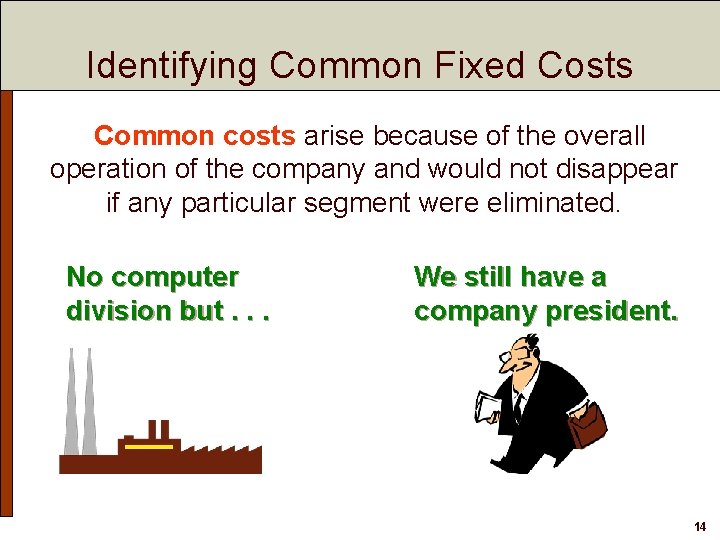
Identifying Common Fixed Costs Common costs arise because of the overall operation of the company and would not disappear if any particular segment were eliminated. No computer division but. . . We still have a company president. 14
Learning Objective LO 1 To compute the return on investment (ROI) and show changes in sales, expenses, and assets affect an organization’s ROI. 15
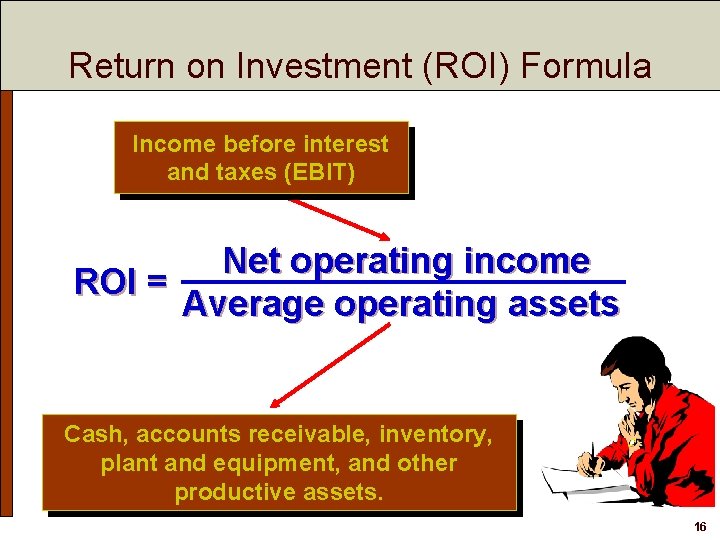
Return on Investment (ROI) Formula Income before interest and taxes (EBIT) Net operating income ROI = Average operating assets Cash, accounts receivable, inventory, plant and equipment, and other productive assets. 16
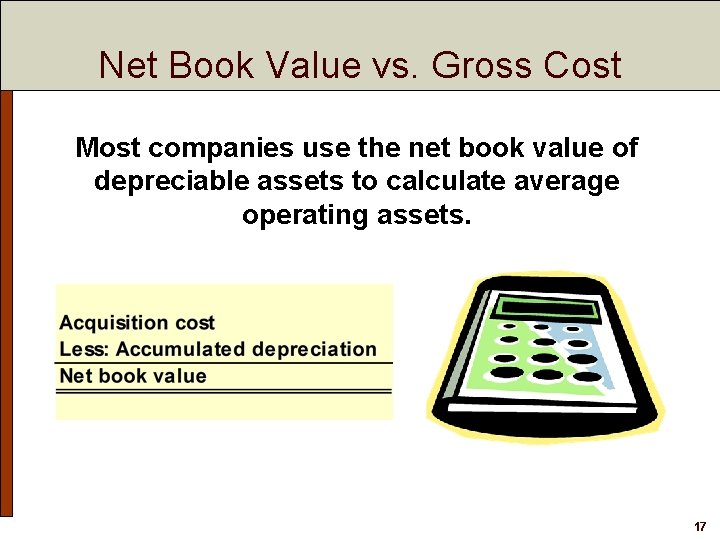
Net Book Value vs. Gross Cost Most companies use the net book value of depreciable assets to calculate average operating assets. 17
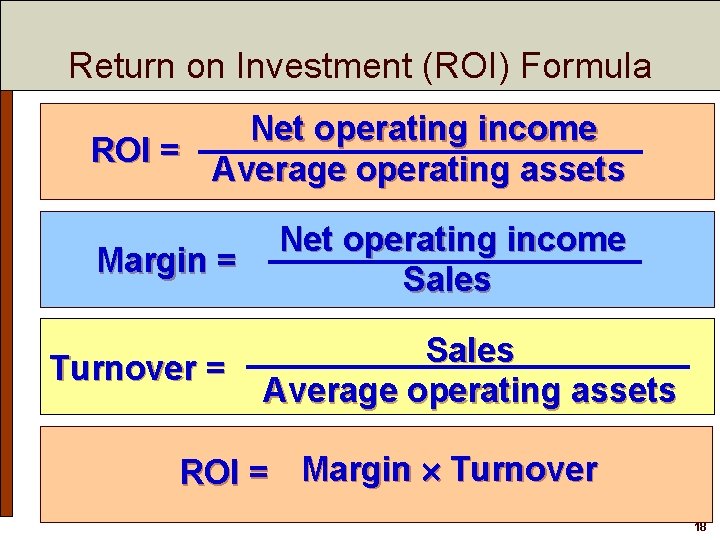
Return on Investment (ROI) Formula Net operating income ROI = Average operating assets Margin = Turnover = Net operating income Sales Average operating assets ROI = Margin Turnover 18
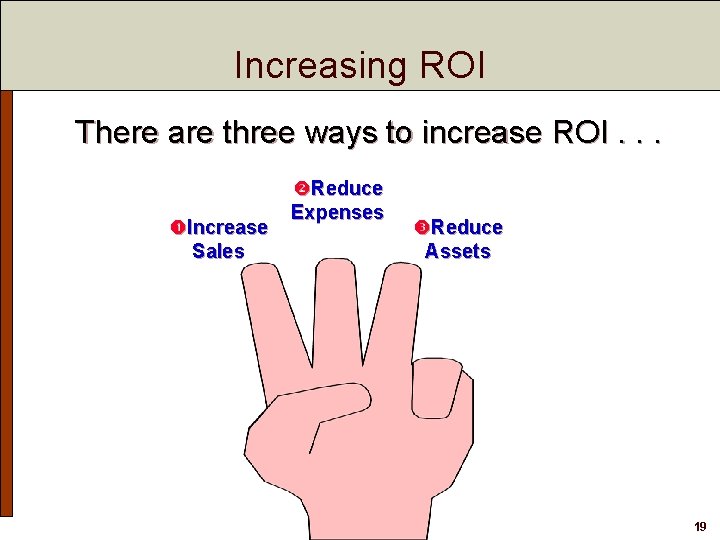
Increasing ROI There are three ways to increase ROI. . . Increase Sales Reduce Expenses Reduce Assets 19
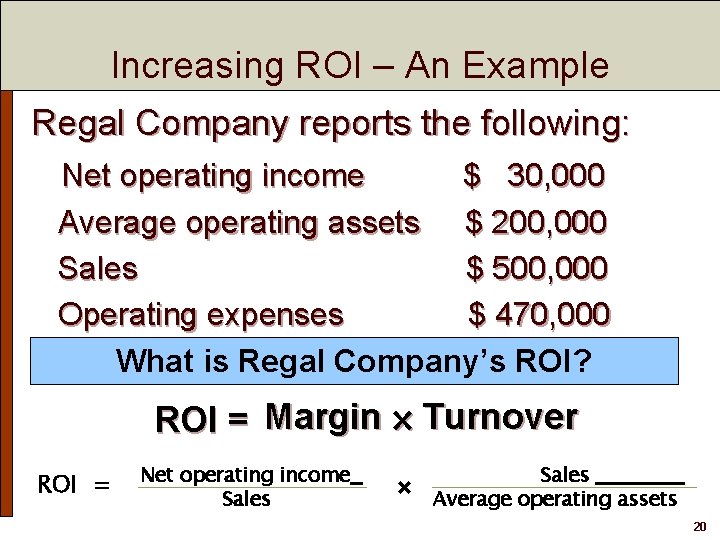
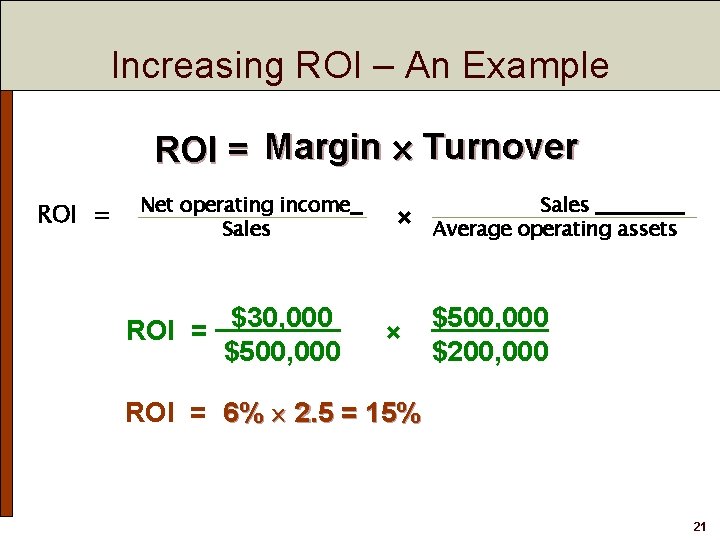
Increasing ROI – An Example Regal Company reports the following: Net operating income $ 30, 000 Average operating assets $ 200, 000 Sales $ 500, 000 Operating expenses $ 470, 000 What is Regal Company’s ROI? ROI = Margin Turnover ROI = Net operating income Sales × Sales Average operating assets 20
Increasing ROI – An Example ROI = Margin Turnover ROI = Net operating income Sales $30, 000 ROI = $500, 000 × × Sales Average operating assets $500, 000 $200, 000 ROI = 6% 2. 5 = 15% 21
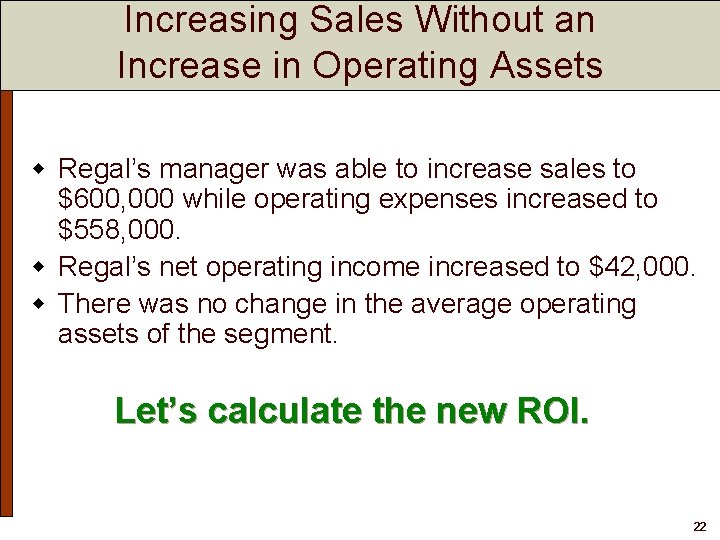
Increasing Sales Without an Increase in Operating Assets w Regal’s manager was able to increase sales to $600, 000 while operating expenses increased to $558, 000. w Regal’s net operating income increased to $42, 000. w There was no change in the average operating assets of the segment. Let’s calculate the new ROI. 22
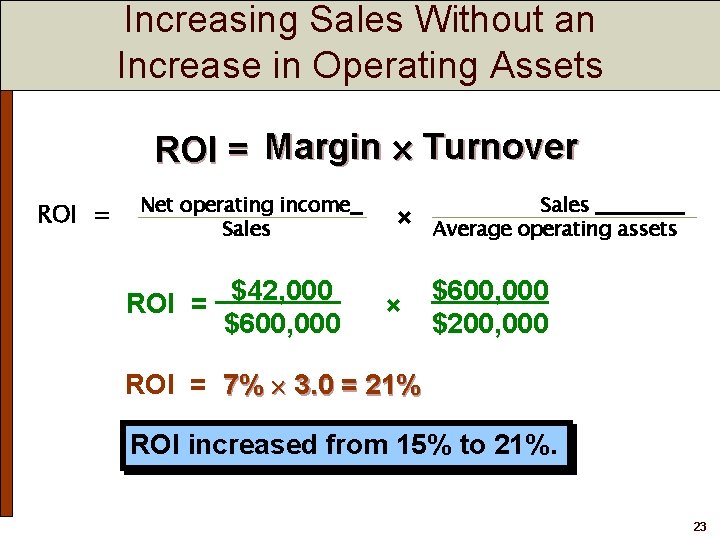
Increasing Sales Without an Increase in Operating Assets ROI = Margin Turnover ROI = Net operating income Sales $42, 000 ROI = $600, 000 × × Sales Average operating assets $600, 000 $200, 000 ROI = 7% 3. 0 = 21% ROI increased from 15% to 21%. 23
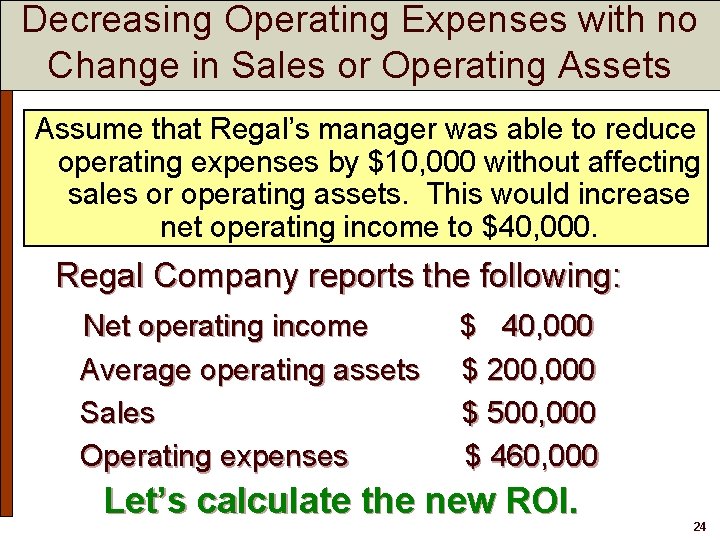
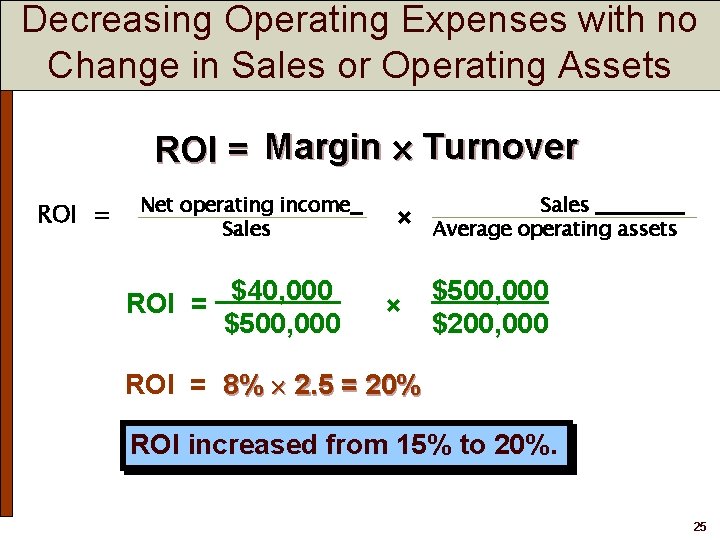
Decreasing Operating Expenses with no Change in Sales or Operating Assets Assume that Regal’s manager was able to reduce operating expenses by $10, 000 without affecting sales or operating assets. This would increase net operating income to $40, 000. Regal Company reports the following: Net operating income Average operating assets Sales Operating expenses $ 40, 000 $ 200, 000 $ 500, 000 $ 460, 000 Let’s calculate the new ROI. 24
Decreasing Operating Expenses with no Change in Sales or Operating Assets ROI = Margin Turnover ROI = Net operating income Sales $40, 000 ROI = $500, 000 × × Sales Average operating assets $500, 000 $200, 000 ROI = 8% 2. 5 = 20% ROI increased from 15% to 20%. 25
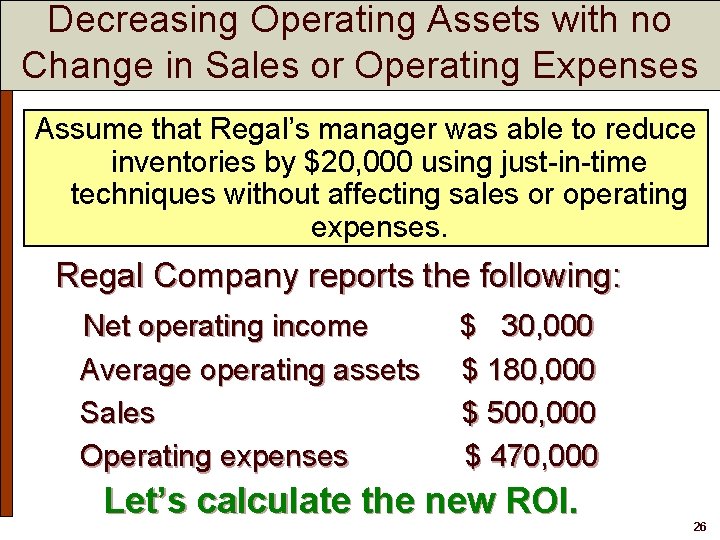
Decreasing Operating Assets with no Change in Sales or Operating Expenses Assume that Regal’s manager was able to reduce inventories by $20, 000 using just-in-time techniques without affecting sales or operating expenses. Regal Company reports the following: Net operating income Average operating assets Sales Operating expenses $ 30, 000 $ 180, 000 $ 500, 000 $ 470, 000 Let’s calculate the new ROI. 26
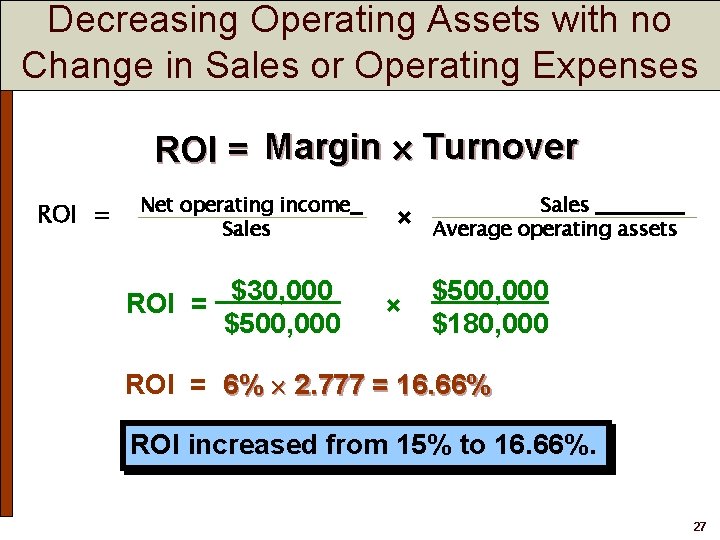
Decreasing Operating Assets with no Change in Sales or Operating Expenses ROI = Margin Turnover ROI = Net operating income Sales $30, 000 ROI = $500, 000 × × Sales Average operating assets $500, 000 $180, 000 ROI = 6% 2. 777 = 16. 66% ROI increased from 15% to 16. 66%. 27
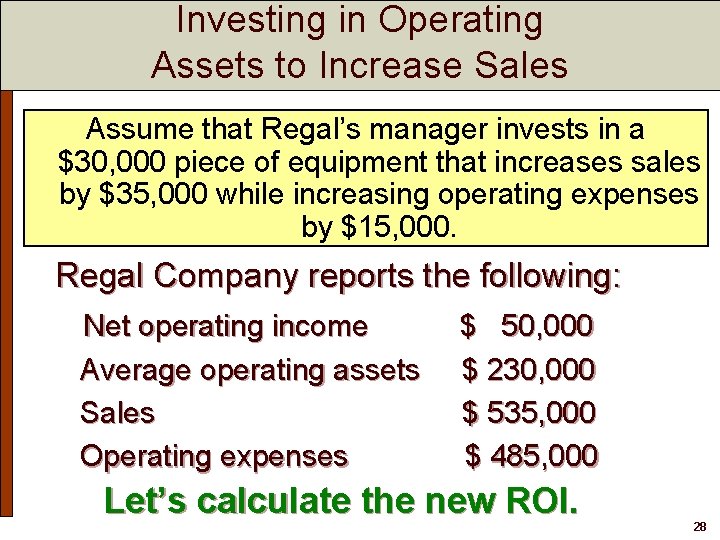
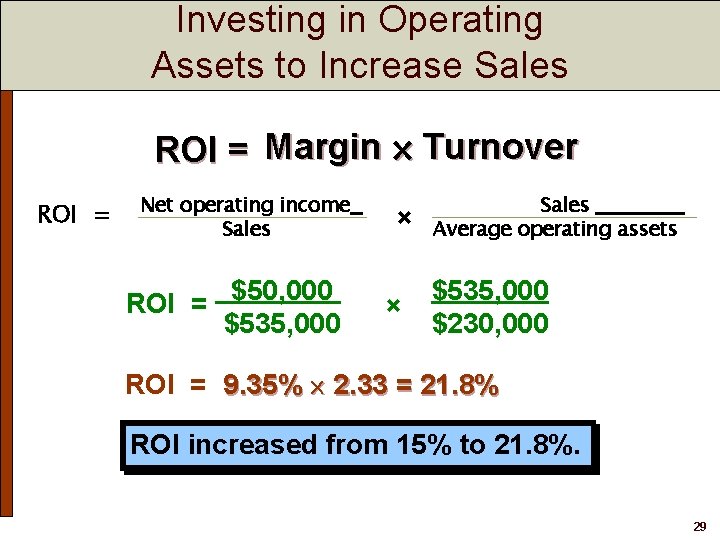
Investing in Operating Assets to Increase Sales Assume that Regal’s manager invests in a $30, 000 piece of equipment that increases sales by $35, 000 while increasing operating expenses by $15, 000. Regal Company reports the following: Net operating income Average operating assets Sales Operating expenses $ 50, 000 $ 230, 000 $ 535, 000 $ 485, 000 Let’s calculate the new ROI. 28
Investing in Operating Assets to Increase Sales ROI = Margin Turnover ROI = Net operating income Sales $50, 000 ROI = $535, 000 × × Sales Average operating assets $535, 000 $230, 000 ROI = 9. 35% 2. 33 = 21. 8% ROI increased from 15% to 21. 8%. 29
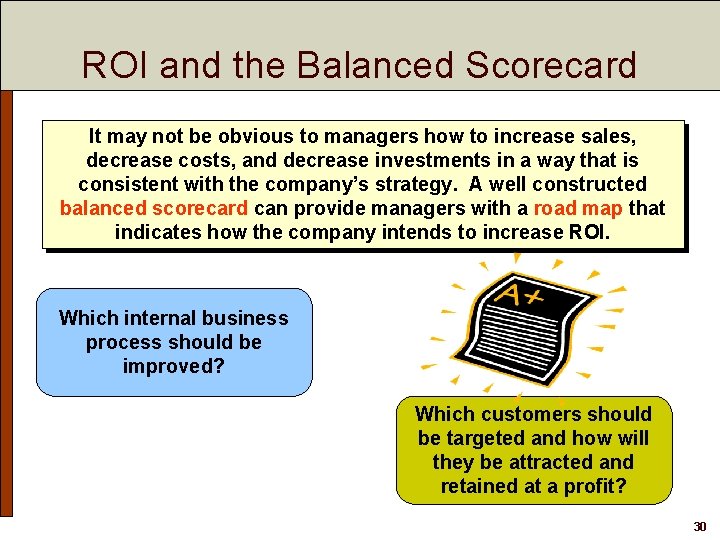
ROI and the Balanced Scorecard It may not be obvious to managers how to increase sales, decrease costs, and decrease investments in a way that is consistent with the company’s strategy. A well constructed balanced scorecard can provide managers with a road map that indicates how the company intends to increase ROI. Which internal business process should be improved? Which customers should be targeted and how will they be attracted and retained at a profit? 30
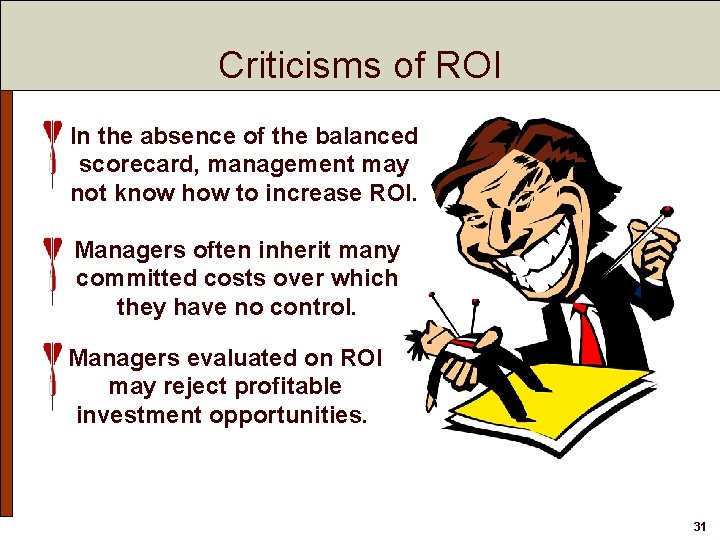
Criticisms of ROI In the absence of the balanced scorecard, management may not know how to increase ROI. Managers often inherit many committed costs over which they have no control. Managers evaluated on ROI may reject profitable investment opportunities. 31
Learning Objective LO 2 To compute residual income and understand the strengths and weaknesses of this method of measuring performance. 32
Residual Income – Another Measure of Performance Net operating income above some minimum return on operating assets 33
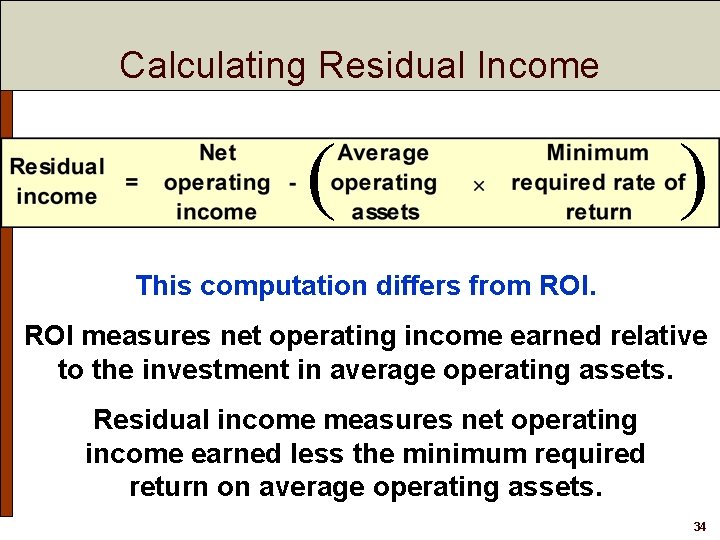
Calculating Residual Income ( ) This computation differs from ROI measures net operating income earned relative to the investment in average operating assets. Residual income measures net operating income earned less the minimum required return on average operating assets. 34
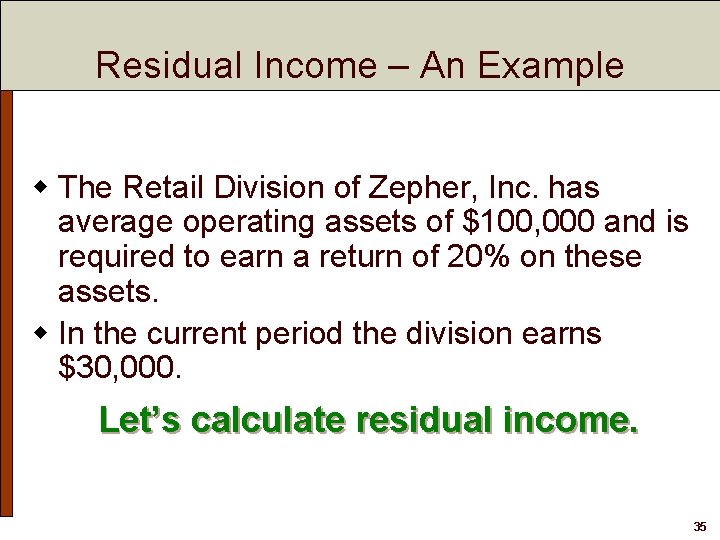
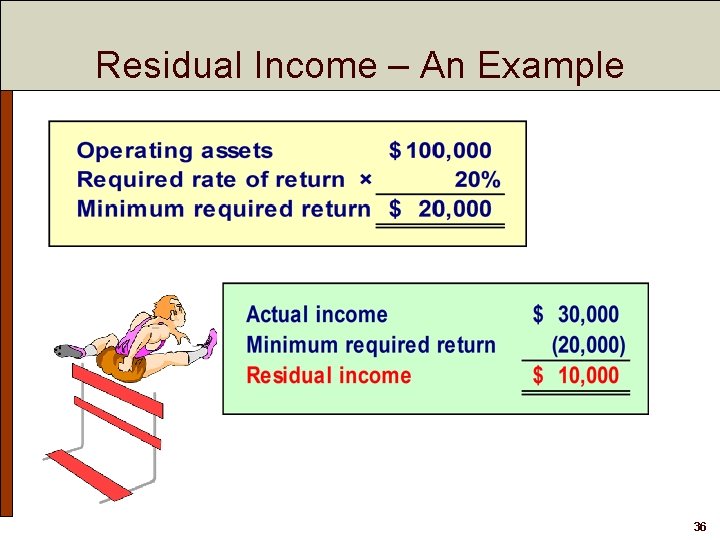
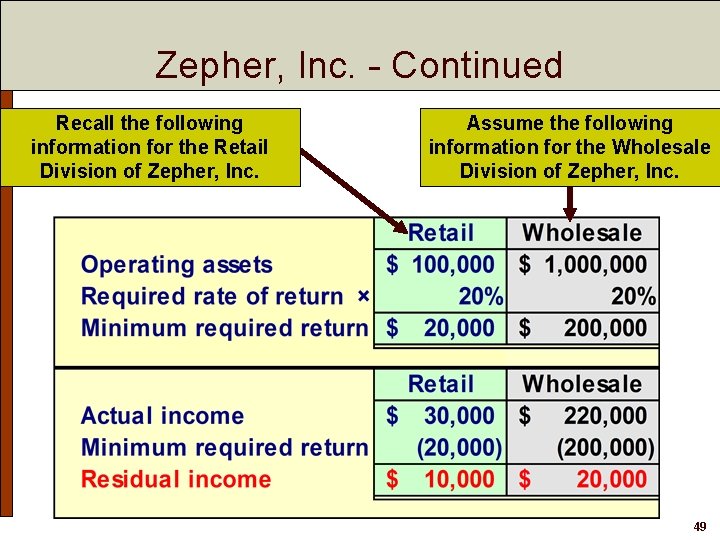
Residual Income – An Example w The Retail Division of Zepher, Inc. has average operating assets of $100, 000 and is required to earn a return of 20% on these assets. w In the current period the division earns $30, 000. Let’s calculate residual income. 35
Residual Income – An Example 36
Motivation and Residual Income Residual income encourages managers to make profitable investments that would be rejected by managers using ROI. 37
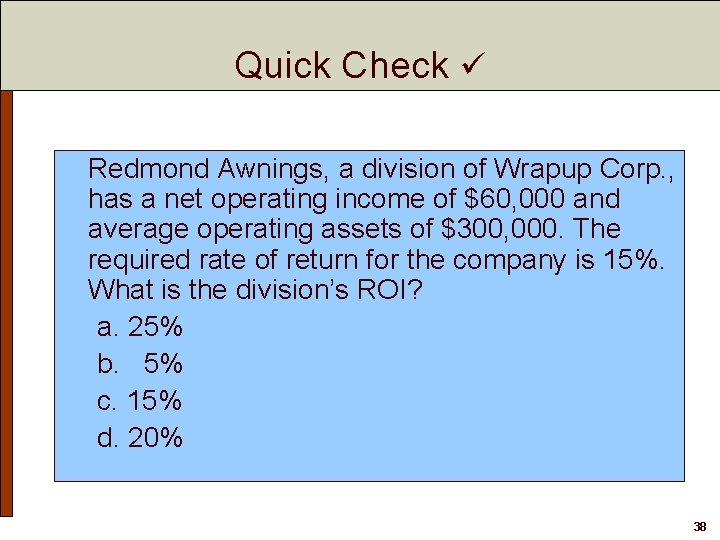
Quick Check Redmond Awnings, a division of Wrapup Corp. , has a net operating income of $60, 000 and average operating assets of $300, 000. The required rate of return for the company is 15%. What is the division’s ROI? a. 25% b. 5% c. 15% d. 20% 38
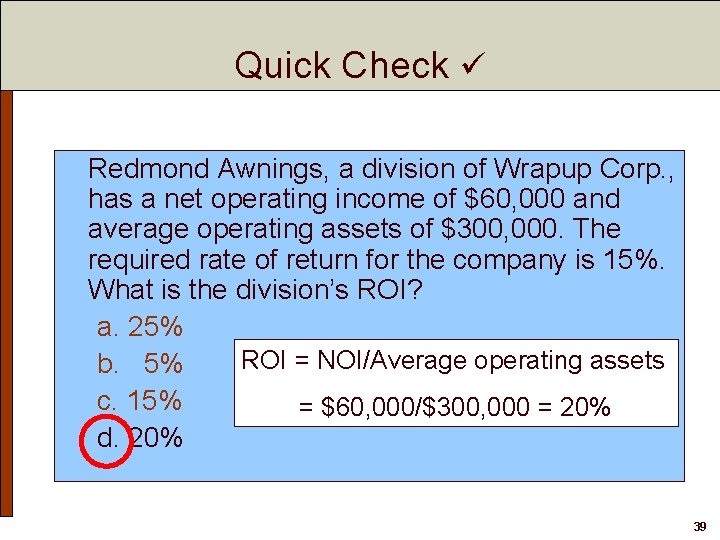
Quick Check Redmond Awnings, a division of Wrapup Corp. , has a net operating income of $60, 000 and average operating assets of $300, 000. The required rate of return for the company is 15%. What is the division’s ROI? a. 25% ROI = NOI/Average operating assets b. 5% c. 15% = $60, 000/$300, 000 = 20% d. 20% 39
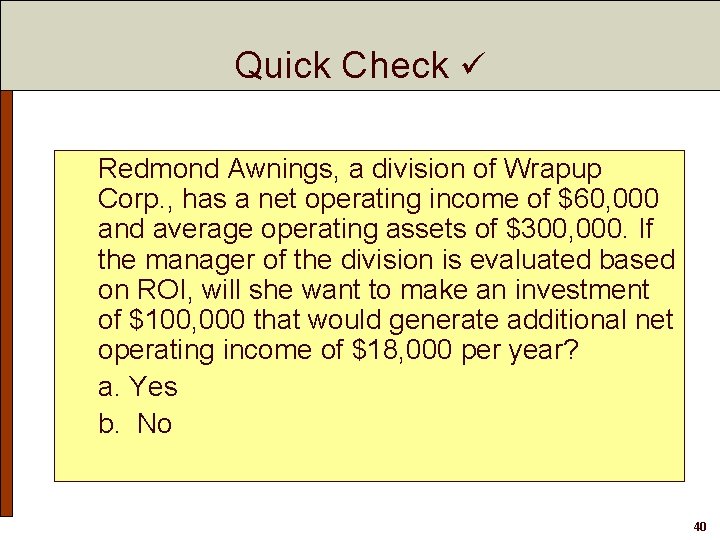
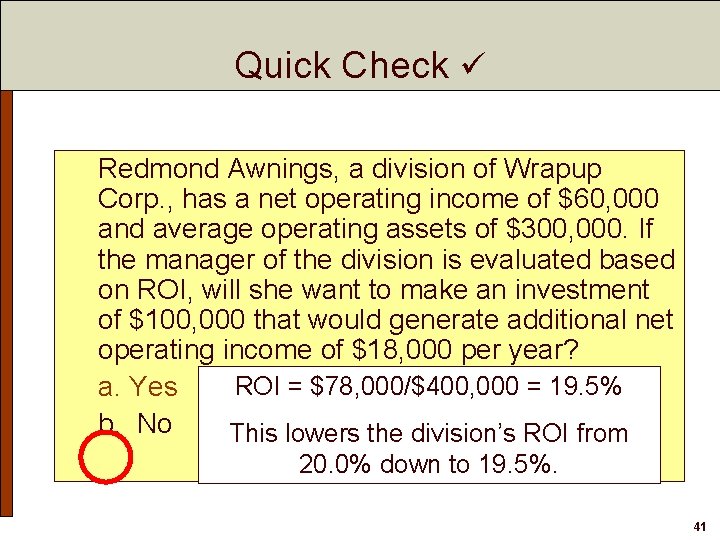
Quick Check Redmond Awnings, a division of Wrapup Corp. , has a net operating income of $60, 000 and average operating assets of $300, 000. If the manager of the division is evaluated based on ROI, will she want to make an investment of $100, 000 that would generate additional net operating income of $18, 000 per year? a. Yes b. No 40
Quick Check Redmond Awnings, a division of Wrapup Corp. , has a net operating income of $60, 000 and average operating assets of $300, 000. If the manager of the division is evaluated based on ROI, will she want to make an investment of $100, 000 that would generate additional net operating income of $18, 000 per year? ROI = $78, 000/$400, 000 = 19. 5% a. Yes b. No This lowers the division’s ROI from 20. 0% down to 19. 5%. 41
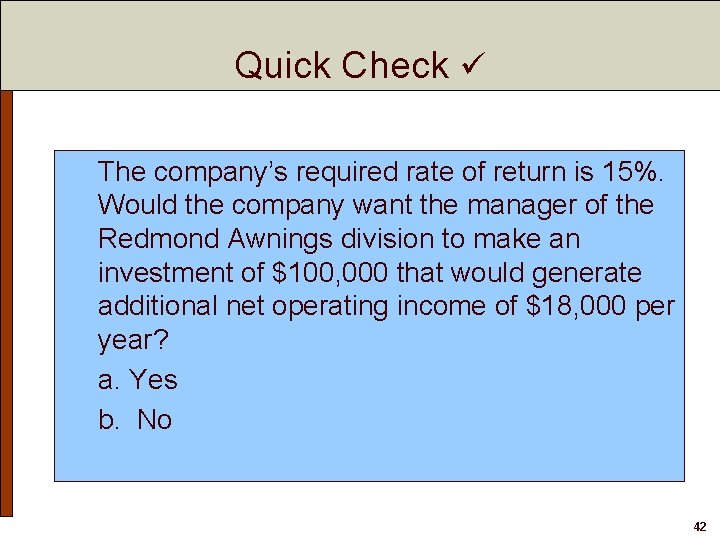
Quick Check The company’s required rate of return is 15%. Would the company want the manager of the Redmond Awnings division to make an investment of $100, 000 that would generate additional net operating income of $18, 000 per year? a. Yes b. No 42
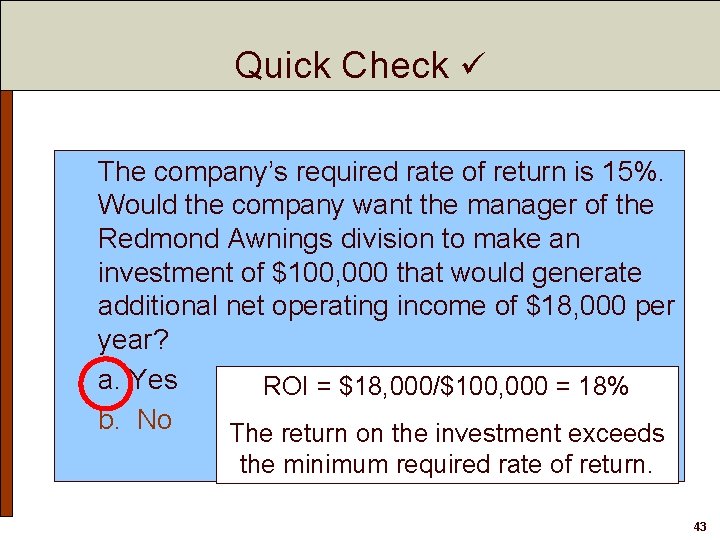
Quick Check The company’s required rate of return is 15%. Would the company want the manager of the Redmond Awnings division to make an investment of $100, 000 that would generate additional net operating income of $18, 000 per year? a. Yes ROI = $18, 000/$100, 000 = 18% b. No The return on the investment exceeds the minimum required rate of return. 43
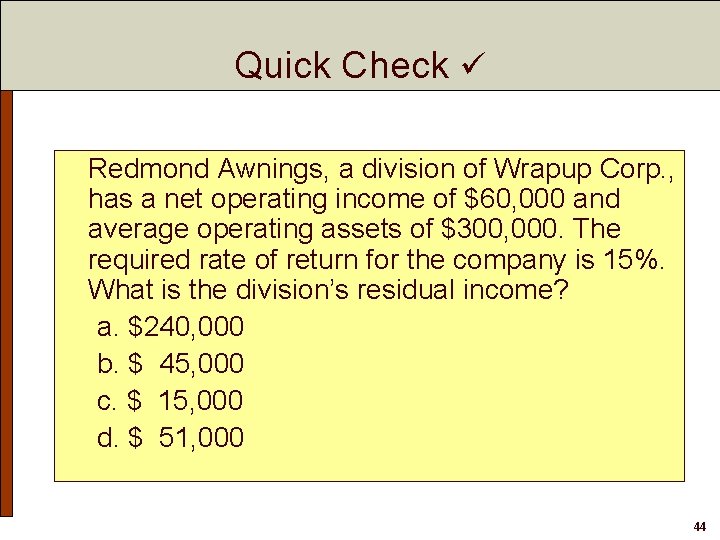
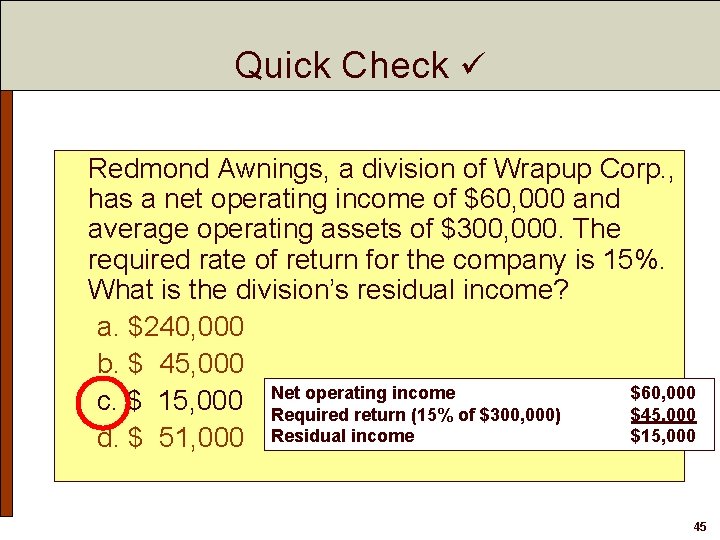
Quick Check Redmond Awnings, a division of Wrapup Corp. , has a net operating income of $60, 000 and average operating assets of $300, 000. The required rate of return for the company is 15%. What is the division’s residual income? a. $240, 000 b. $ 45, 000 c. $ 15, 000 d. $ 51, 000 44
Quick Check Redmond Awnings, a division of Wrapup Corp. , has a net operating income of $60, 000 and average operating assets of $300, 000. The required rate of return for the company is 15%. What is the division’s residual income? a. $240, 000 b. $ 45, 000 operating income $60, 000 c. $ 15, 000 Net Required return (15% of $300, 000) $45, 000 $15, 000 d. $ 51, 000 Residual income 45
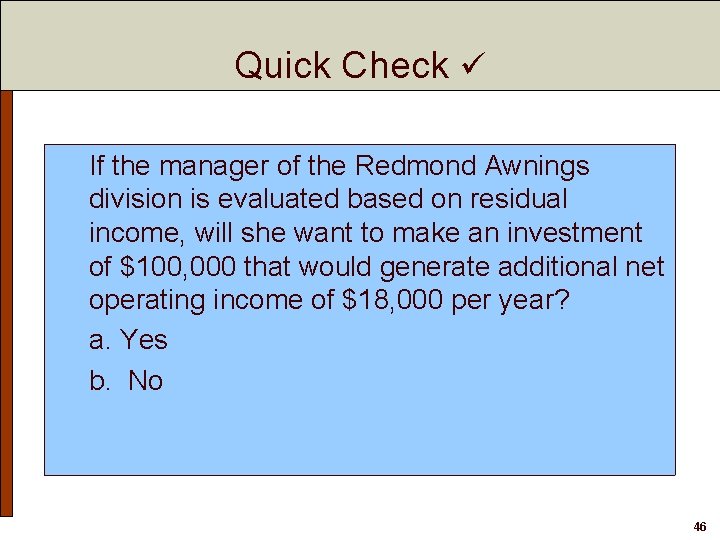
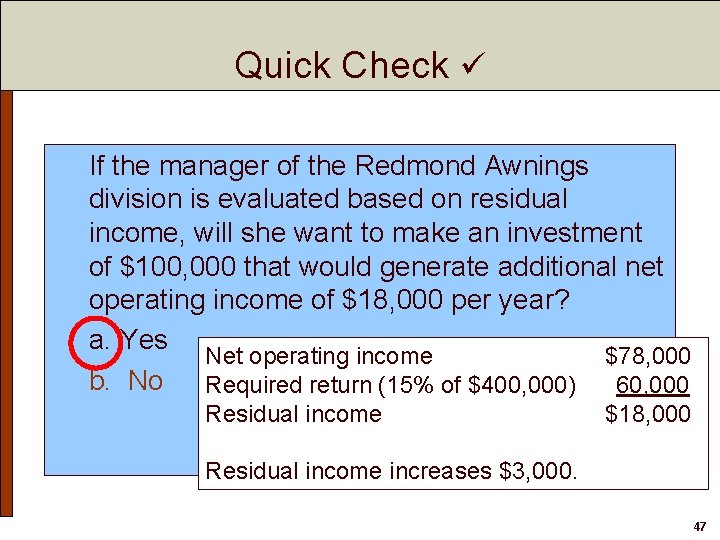
Quick Check If the manager of the Redmond Awnings division is evaluated based on residual income, will she want to make an investment of $100, 000 that would generate additional net operating income of $18, 000 per year? a. Yes b. No 46
Quick Check If the manager of the Redmond Awnings division is evaluated based on residual income, will she want to make an investment of $100, 000 that would generate additional net operating income of $18, 000 per year? a. Yes Net operating income $78, 000 b. No Required return (15% of $400, 000) 60, 000 Residual income $18, 000 Residual income increases $3, 000. 47
Divisional Comparisons and Residual Income The residual income approach has one major disadvantage. It cannot be used to compare performance of divisions of different sizes. 48
Zepher, Inc. - Continued Recall the following information for the Retail Division of Zepher, Inc. Assume the following information for the Wholesale Division of Zepher, Inc. 49
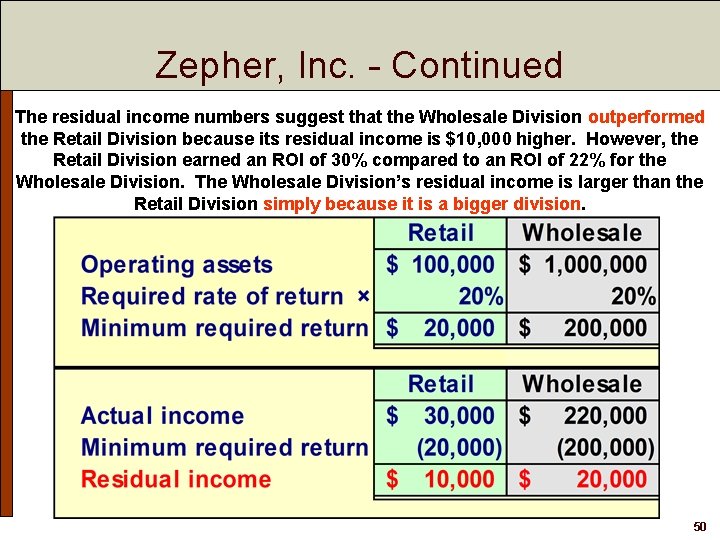
Zepher, Inc. - Continued The residual income numbers suggest that the Wholesale Division outperformed the Retail Division because its residual income is $10, 000 higher. However, the Retail Division earned an ROI of 30% compared to an ROI of 22% for the Wholesale Division. The Wholesale Division’s residual income is larger than the Retail Division simply because it is a bigger division. 50
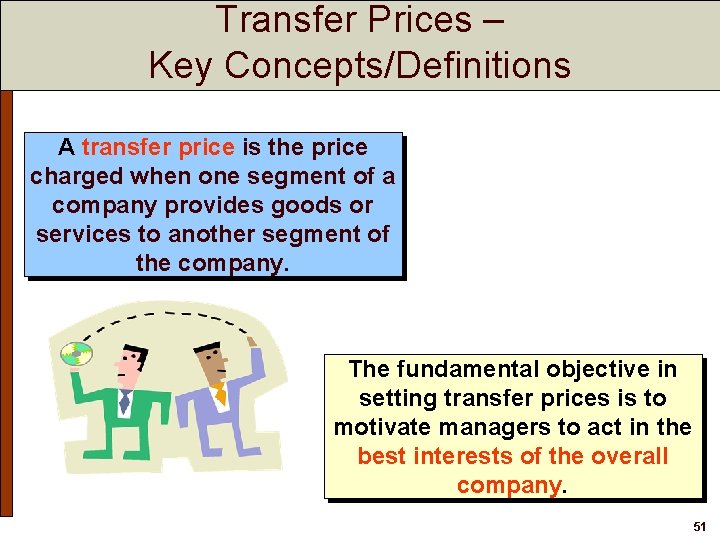
Transfer Prices – Key Concepts/Definitions A transfer price is the price charged when one segment of a company provides goods or services to another segment of the company. The fundamental objective in setting transfer prices is to motivate managers to act in the best interests of the overall company. 51
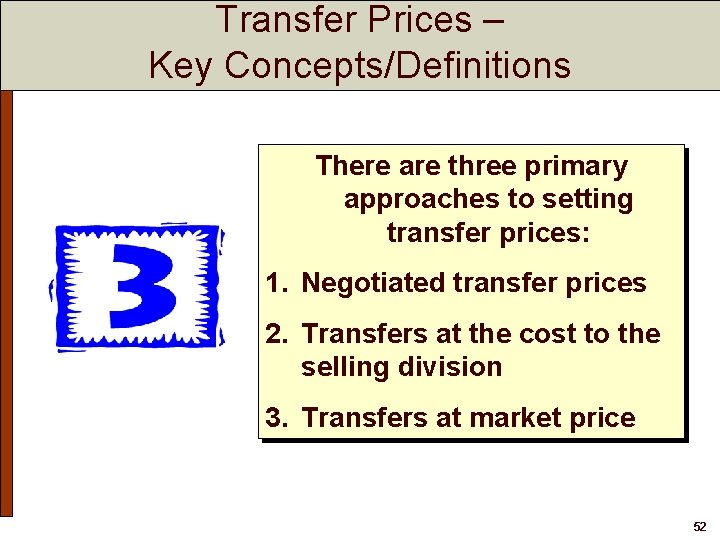
Transfer Prices – Key Concepts/Definitions There are three primary approaches to setting transfer prices: 1. Negotiated transfer prices 2. Transfers at the cost to the selling division 3. Transfers at market price 52
End of Chapter 10 53