
Chapter 10 Various Topics User defined Types Enumerated
- Slides: 22
Chapter 10 Various Topics • • • User defined Types Enumerated Types Type Casting Syntactic Sugar Type Coercion 1
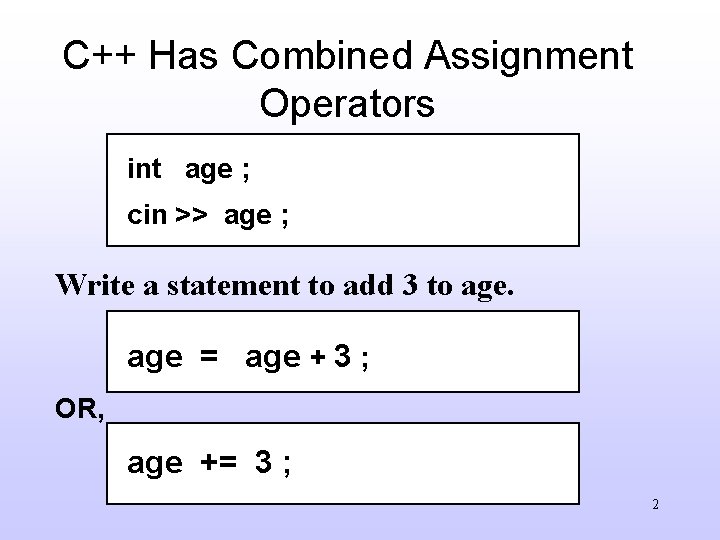
C++ Has Combined Assignment Operators int age ; cin >> age ; Write a statement to add 3 to age = age + 3 ; OR, age += 3 ; 2
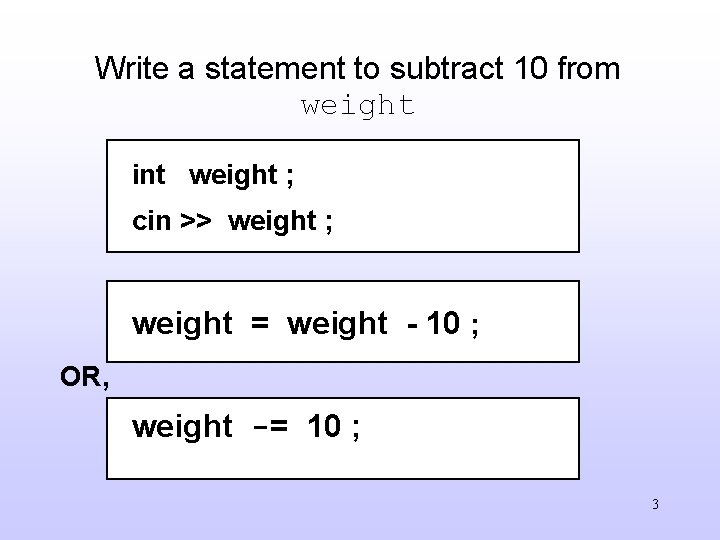
Write a statement to subtract 10 from weight int weight ; cin >> weight ; weight = weight - 10 ; OR, weight -= 10 ; 3
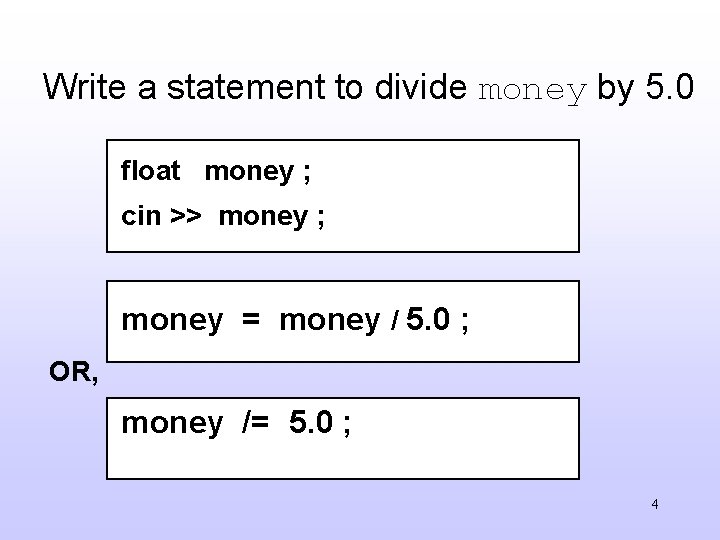
Write a statement to divide money by 5. 0 float money ; cin >> money ; money = money / 5. 0 ; OR, money /= 5. 0 ; 4
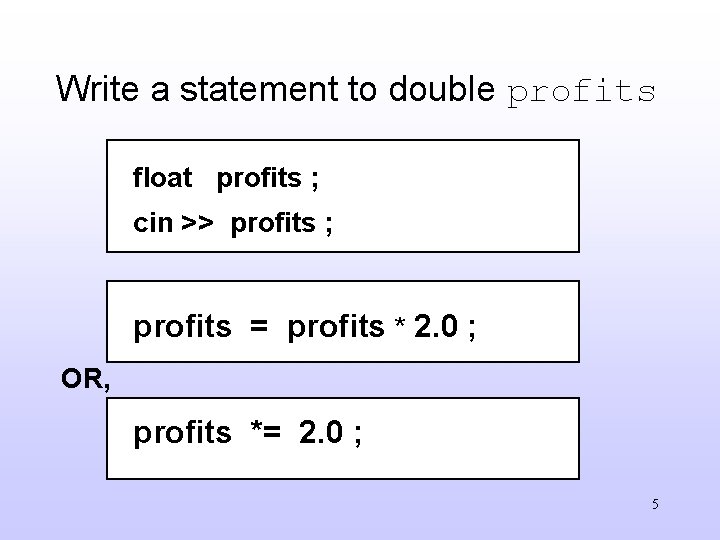
Write a statement to double profits float profits ; cin >> profits ; profits = profits * 2. 0 ; OR, profits *= 2. 0 ; 5
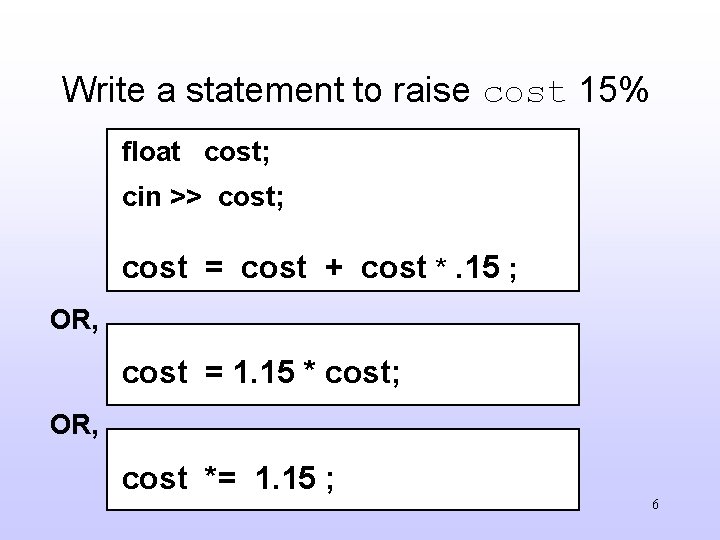
Write a statement to raise cost 15% float cost; cin >> cost; cost = cost + cost *. 15 ; OR, cost = 1. 15 * cost; OR, cost *= 1. 15 ; 6
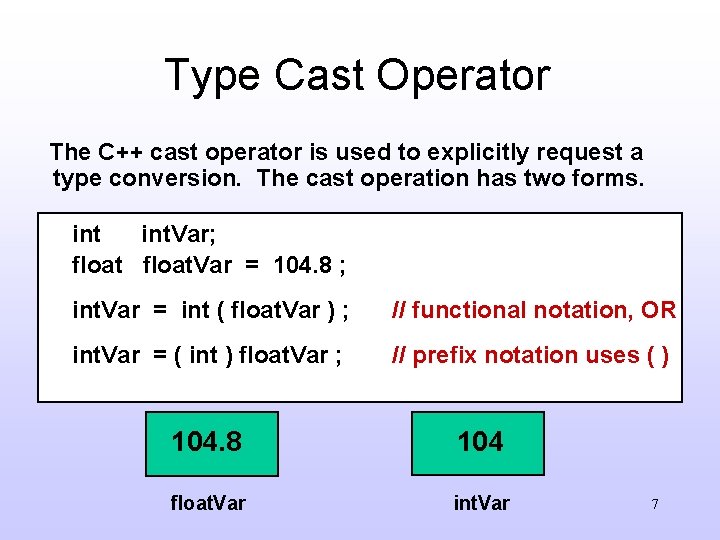
Type Cast Operator The C++ cast operator is used to explicitly request a type conversion. The cast operation has two forms. int. Var; float. Var = 104. 8 ; int. Var = int ( float. Var ) ; // functional notation, OR int. Var = ( int ) float. Var ; // prefix notation uses ( ) 104. 8 104 float. Var int. Var 7
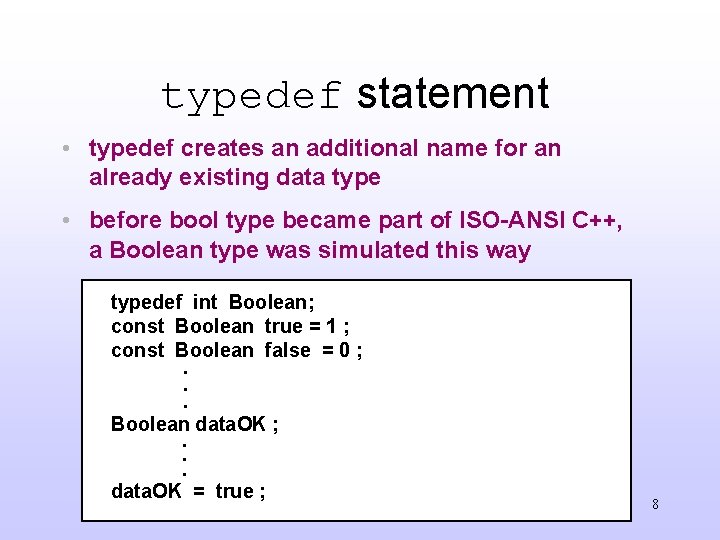
typedef statement • typedef creates an additional name for an already existing data type • before bool type became part of ISO-ANSI C++, a Boolean type was simulated this way typedef int Boolean; const Boolean true = 1 ; const Boolean false = 0 ; . . . Boolean data. OK ; . . . data. OK = true ; 8
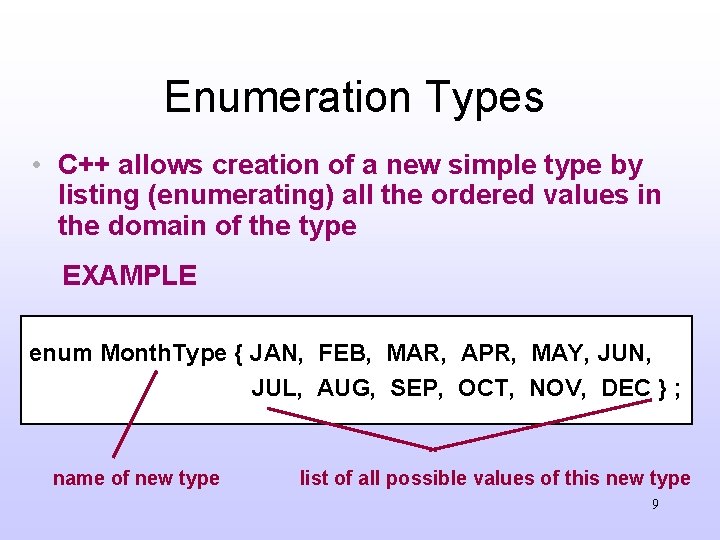
Enumeration Types • C++ allows creation of a new simple type by listing (enumerating) all the ordered values in the domain of the type EXAMPLE enum Month. Type { JAN, FEB, MAR, APR, MAY, JUN, JUL, AUG, SEP, OCT, NOV, DEC } ; name of new type list of all possible values of this new type 9
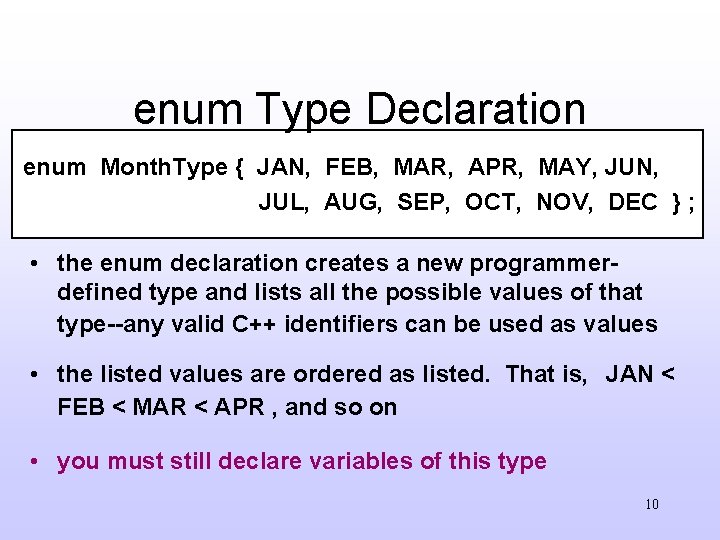
enum Type Declaration enum Month. Type { JAN, FEB, MAR, APR, MAY, JUN, JUL, AUG, SEP, OCT, NOV, DEC } ; • the enum declaration creates a new programmerdefined type and lists all the possible values of that type--any valid C++ identifiers can be used as values • the listed values are ordered as listed. That is, JAN < FEB < MAR < APR , and so on • you must still declare variables of this type 10
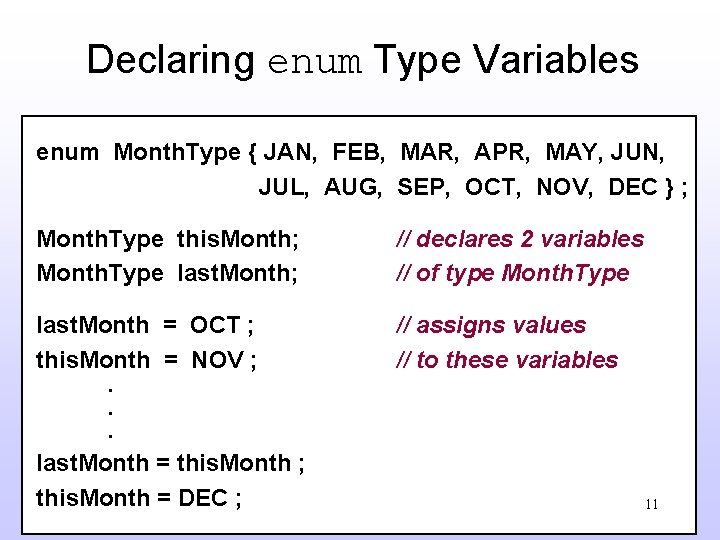
Declaring enum Type Variables enum Month. Type { JAN, FEB, MAR, APR, MAY, JUN, JUL, AUG, SEP, OCT, NOV, DEC } ; Month. Type this. Month; Month. Type last. Month; // declares 2 variables // of type Month. Type last. Month = OCT ; this. Month = NOV ; // assigns values // to these variables . . . last. Month = this. Month ; this. Month = DEC ; 11
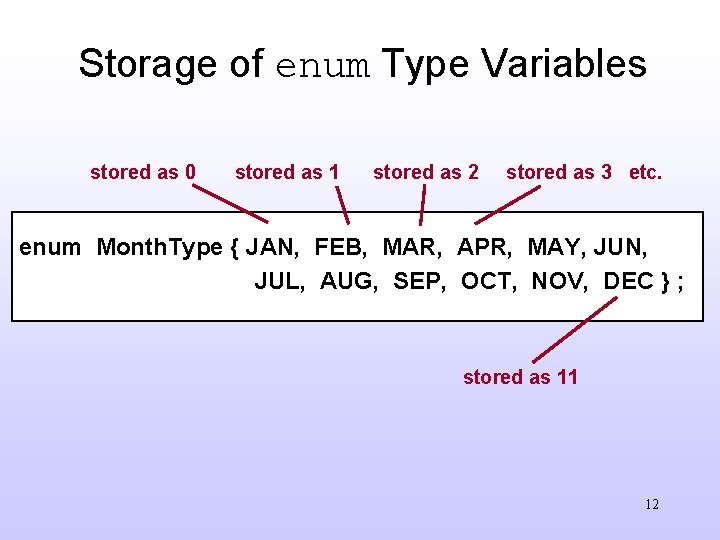
Storage of enum Type Variables stored as 0 stored as 1 stored as 2 stored as 3 etc. enum Month. Type { JAN, FEB, MAR, APR, MAY, JUN, JUL, AUG, SEP, OCT, NOV, DEC } ; stored as 11 12
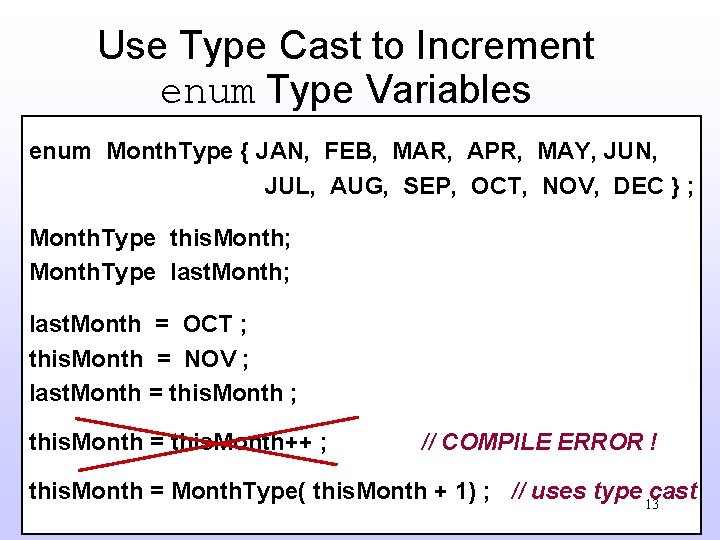
Use Type Cast to Increment enum Type Variables enum Month. Type { JAN, FEB, MAR, APR, MAY, JUN, JUL, AUG, SEP, OCT, NOV, DEC } ; Month. Type this. Month; Month. Type last. Month; last. Month = OCT ; this. Month = NOV ; last. Month = this. Month ; this. Month = this. Month++ ; // COMPILE ERROR ! this. Month = Month. Type( this. Month + 1) ; // uses type 13 cast
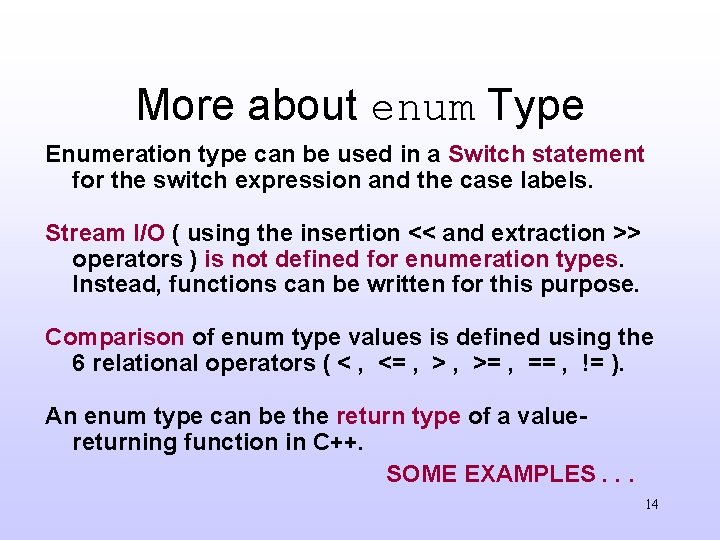
More about enum Type Enumeration type can be used in a Switch statement for the switch expression and the case labels. Stream I/O ( using the insertion << and extraction >> operators ) is not defined for enumeration types. Instead, functions can be written for this purpose. Comparison of enum type values is defined using the 6 relational operators ( < , <= , >= , == , != ). An enum type can be the return type of a valuereturning function in C++. SOME EXAMPLES. . . 14
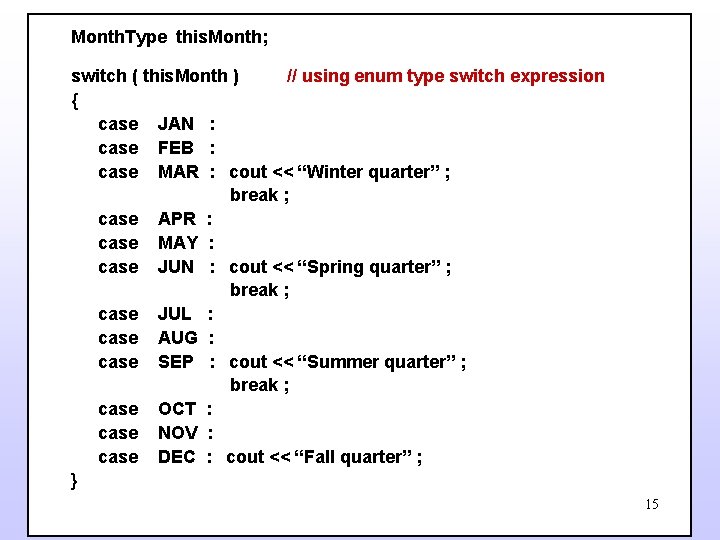
Month. Type this. Month; switch ( this. Month ) // using enum type switch expression { case JAN : case FEB : case MAR : cout << “Winter quarter” ; break ; case APR : case MAY : case JUN : cout << “Spring quarter” ; break ; case JUL : case AUG : case SEP : cout << “Summer quarter” ; break ; case OCT : case NOV : case DEC : cout << “Fall quarter” ; } 15
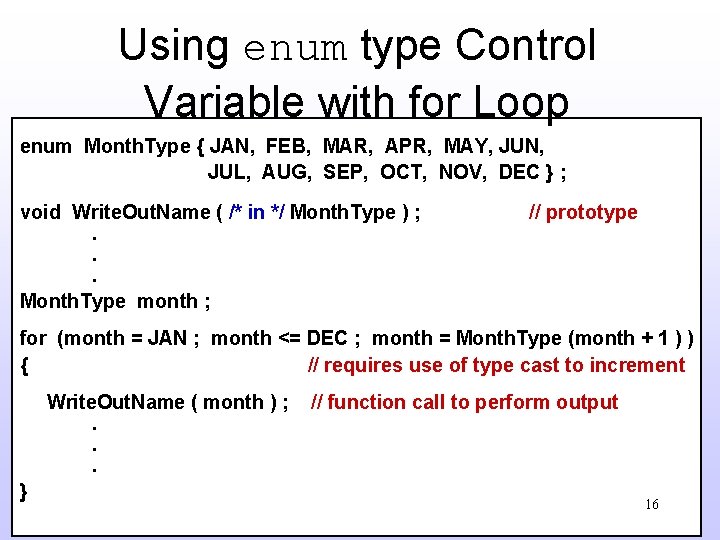
Using enum type Control Variable with for Loop enum Month. Type { JAN, FEB, MAR, APR, MAY, JUN, JUL, AUG, SEP, OCT, NOV, DEC } ; void Write. Out. Name ( /* in */ Month. Type ) ; . . . // prototype Month. Type month ; for (month = JAN ; month <= DEC ; month = Month. Type (month + 1 ) ) { // requires use of type cast to increment Write. Out. Name ( month ) ; . . . } // function call to perform output 16
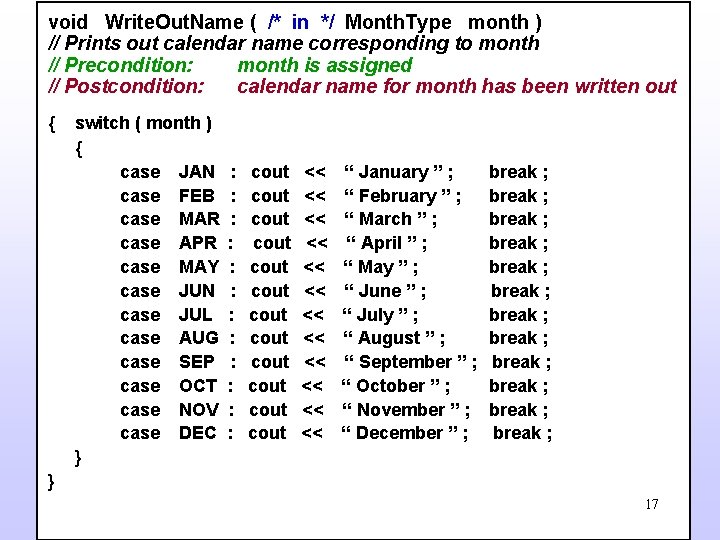
void Write. Out. Name ( /* in */ Month. Type month ) // Prints out calendar name corresponding to month // Precondition: month is assigned // Postcondition: calendar name for month has been written out { switch ( month ) { case JAN case FEB case MAR case APR case MAY case JUN case JUL case AUG case SEP case OCT case NOV case DEC } : : : cout cout cout << << << “ January ” ; “ February ” ; “ March ” ; “ April ” ; “ May ” ; “ June ” ; “ July ” ; “ August ” ; “ September ” ; “ October ” ; “ November ” ; “ December ” ; break ; break ; break ; } 17
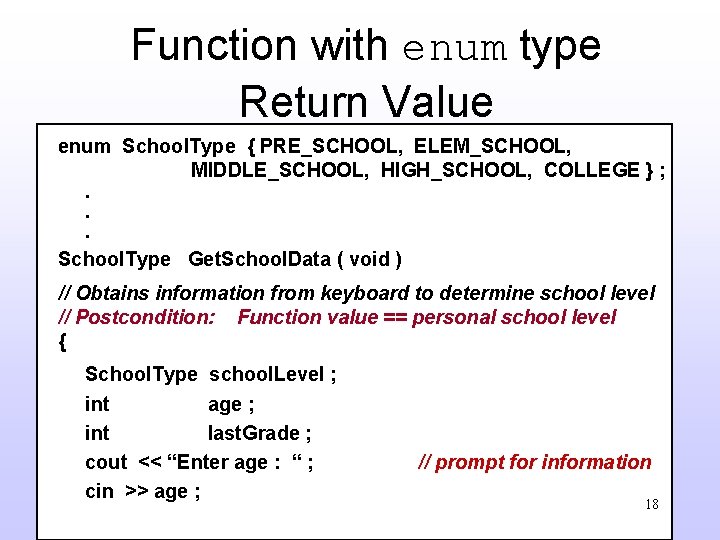
Function with enum type Return Value enum School. Type { PRE_SCHOOL, ELEM_SCHOOL, MIDDLE_SCHOOL, HIGH_SCHOOL, COLLEGE } ; . . . School. Type Get. School. Data ( void ) // Obtains information from keyboard to determine school level // Postcondition: Function value == personal school level { School. Type school. Level ; int age ; int last. Grade ; cout << “Enter age : “ ; cin >> age ; // prompt for information 18
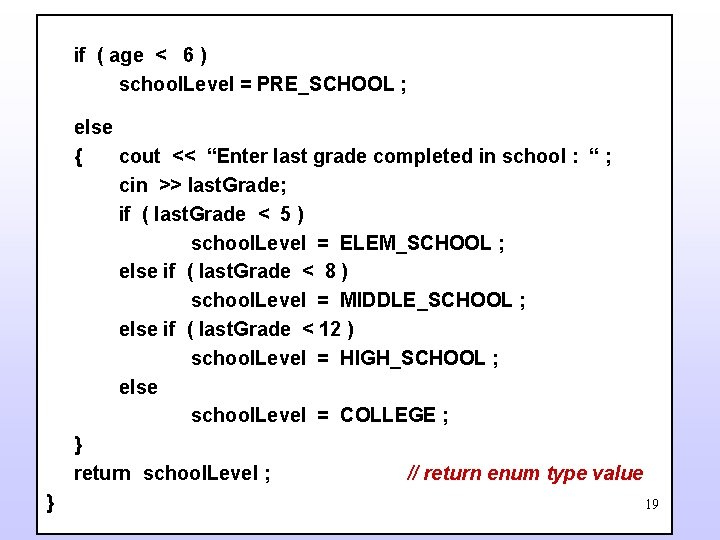
if ( age < 6 ) school. Level = PRE_SCHOOL ; else { cout << “Enter last grade completed in school : “ ; cin >> last. Grade; if ( last. Grade < 5 ) school. Level = ELEM_SCHOOL ; else if ( last. Grade < 8 ) school. Level = MIDDLE_SCHOOL ; else if ( last. Grade < 12 ) school. Level = HIGH_SCHOOL ; else school. Level = COLLEGE ; } return school. Level ; // return enum type value } 19
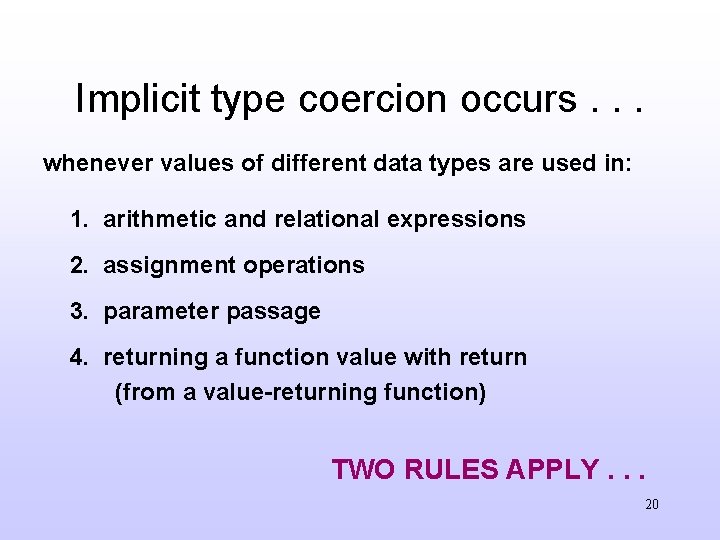
Implicit type coercion occurs. . . whenever values of different data types are used in: 1. arithmetic and relational expressions 2. assignment operations 3. parameter passage 4. returning a function value with return (from a value-returning function) TWO RULES APPLY. . . 20
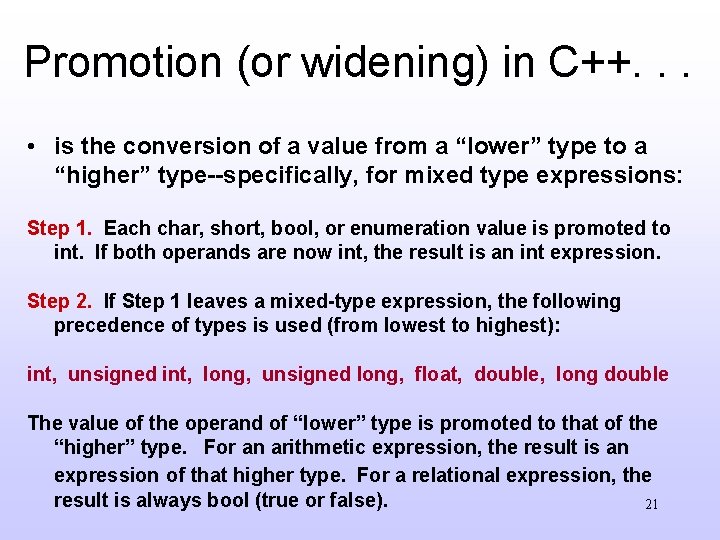
Promotion (or widening) in C++. . . • is the conversion of a value from a “lower” type to a “higher” type--specifically, for mixed type expressions: Step 1. Each char, short, bool, or enumeration value is promoted to int. If both operands are now int, the result is an int expression. Step 2. If Step 1 leaves a mixed-type expression, the following precedence of types is used (from lowest to highest): int, unsigned int, long, unsigned long, float, double, long double The value of the operand of “lower” type is promoted to that of the “higher” type. For an arithmetic expression, the result is an expression of that higher type. For a relational expression, the result is always bool (true or false). 21
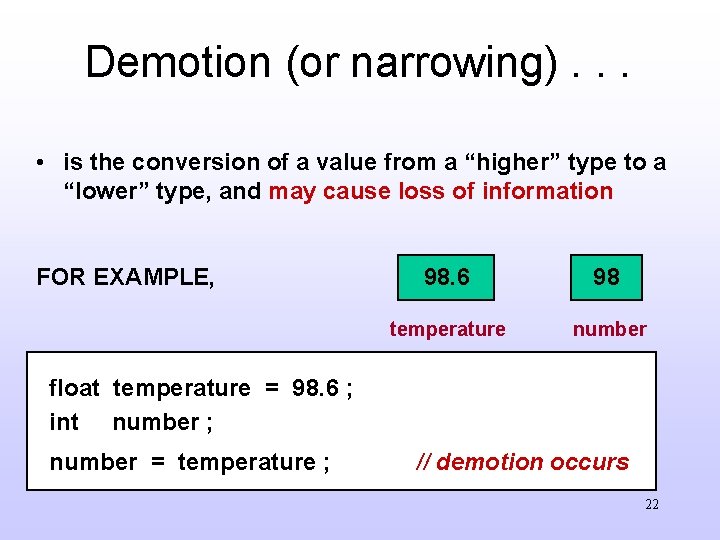
Demotion (or narrowing). . . • is the conversion of a value from a “higher” type to a “lower” type, and may cause loss of information FOR EXAMPLE, 98. 6 98 temperature number float temperature = 98. 6 ; int number ; number = temperature ; // demotion occurs 22