
Chapter 10 Understanding the Potential Dangers of Adverse
- Slides: 36
Chapter 10: Understanding the Potential Dangers of Adverse Environmental Conditions © 2007 Mc. Graw-Hill Higher Education. All rights reserved.
• Environmental stress can adversely impact an athlete’s performance and pose serious health threats • Areas of concern – Hyperthermia – Hypothermia – Lightening storms – Over exposure to the sun © 2007 Mc. Graw-Hill Higher Education. All rights reserved.
Hyperthermia • Has caused a number of deaths over the years • Must manage heat stress appropriately • Hyperthermia = increase in body temperature © 2007 Mc. Graw-Hill Higher Education. All rights reserved.
• An individual does not have to be in the south to experience a heat-related illness © 2007 Mc. Graw-Hill Higher Education. All rights reserved.
Heat Stress • Extreme caution should be used when training in the heat (overexposure could result heat stress) • It is preventable • Athletes that train under these extreme conditions are at risk • Physiologically the body will continue to function if body temperature is maintained • Body must dissipate heat to maintain homeostasis © 2007 Mc. Graw-Hill Higher Education. All rights reserved.
• Heat can be dissipated from the body through 4 mechanisms – Conduction (direct contact) – Convection ( contact with cool air or water mass) – Radiation (heat generated from metabolism) – Evaporation (sweat evaporating from the skin) • Majority of body heat is dissipated through evaporation – * Heat can also be gained via these four mechanisms © 2007 Mc. Graw-Hill Higher Education. All rights reserved.
• Evaporative Heat Loss – Sweat glands allow water transport to surface – Evaporation of water takes heat with it – When radiant heat and environment temperature are higher than body temperature, loss of heat through evaporation is key – Lose 1 quart of water per hour for up to 2 hours – Air must be relatively water free for evaporation to occur • relative humidity of 65% impairs evaporation • relative humidity of 75% stops evaporation – Heat illness can still occur in cold environment if body is unable to dissipate heat • Caused by dehydration and inability to sweat © 2007 Mc. Graw-Hill Higher Education. All rights reserved.
Monitoring Heat Index • Heat, sunshine and humidity must be monitored closely • Wet bulb globe temperature index (WBGT) provides objective measure for determining precautions concerning participation in hot – WGBT incorporates different thermometer readings • Dry bulb (standard mercury temperature) • Wet bulb (thermometer with wet gauze that is swung around in air) • Black bulb (black casing that measures radiant heat) • Formula yields WBGT index © 2007 Mc. Graw-Hill Higher Education. All rights reserved.
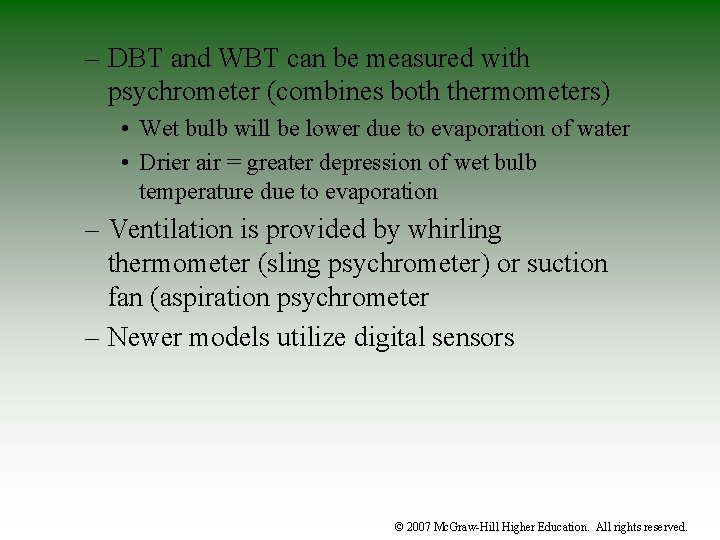
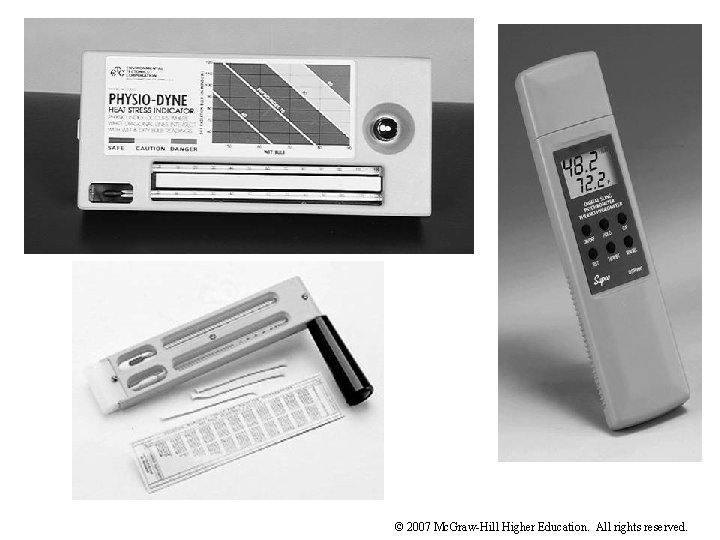
– DBT and WBT can be measured with psychrometer (combines both thermometers) • Wet bulb will be lower due to evaporation of water • Drier air = greater depression of wet bulb temperature due to evaporation – Ventilation is provided by whirling thermometer (sling psychrometer) or suction fan (aspiration psychrometer – Newer models utilize digital sensors © 2007 Mc. Graw-Hill Higher Education. All rights reserved.
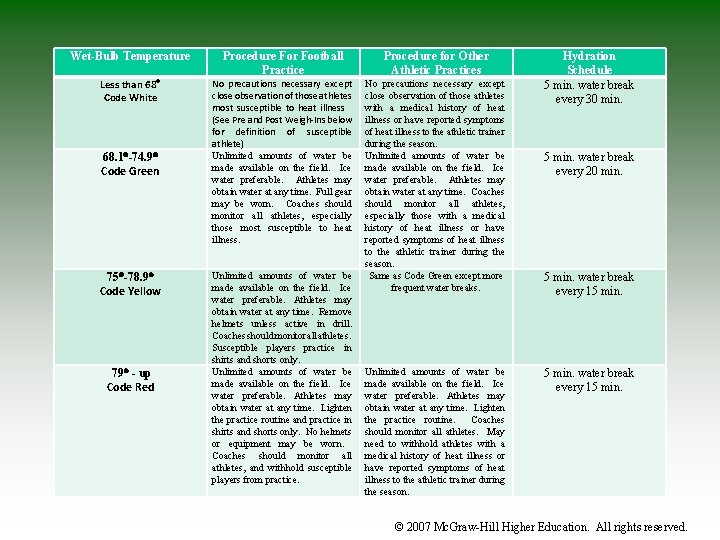
Wet-Bulb Temperature Procedure For Football Practice Procedure for Other Athletic Practices Less than 68 Code White No precautions necessary except close observation of those athletes most susceptible to heat illness (See Pre and Post Weigh-Ins below for definition of susceptible athlete) Unlimited amounts of water be made available on the field. Ice water preferable. Athletes may obtain water at any time. Full gear may be worn. Coaches should monitor all athletes, especially those most susceptible to heat illness. No precautions necessary except close observation of those athletes with a medical history of heat illness or have reported symptoms of heat illness to the athletic trainer during the season. Unlimited amounts of water be made available on the field. Ice water preferable. Athletes may obtain water at any time. Coaches should monitor all athletes, especially those with a medical history of heat illness or have reported symptoms of heat illness to the athletic trainer during the season. Same as Code Green except more frequent water breaks. 68. 1 -74. 9 Code Green 75 -78. 9 Code Yellow 79 - up Code Red Unlimited amounts of water be made available on the field. Ice water preferable. Athletes may obtain water at any time. Remove helmets unless active in drill. Coaches should monitor all athletes. Susceptible players practice in shirts and shorts only. Unlimited amounts of water be made available on the field. Ice water preferable. Athletes may obtain water at any time. Lighten the practice routine and practice in shirts and shorts only. No helmets or equipment may be worn. Coaches should monitor all athletes, and withhold susceptible players from practice. Unlimited amounts of water be made available on the field. Ice water preferable. Athletes may obtain water at any time. Lighten the practice routine. Coaches should monitor all athletes. May need to withhold athletes with a medical history of heat illness or have reported symptoms of heat illness to the athletic trainer during the season. Hydration Schedule 5 min. water break every 30 min. 5 min. water break every 20 min. 5 min. water break every 15 min. © 2007 Mc. Graw-Hill Higher Education. All rights reserved.
© 2007 Mc. Graw-Hill Higher Education. All rights reserved.
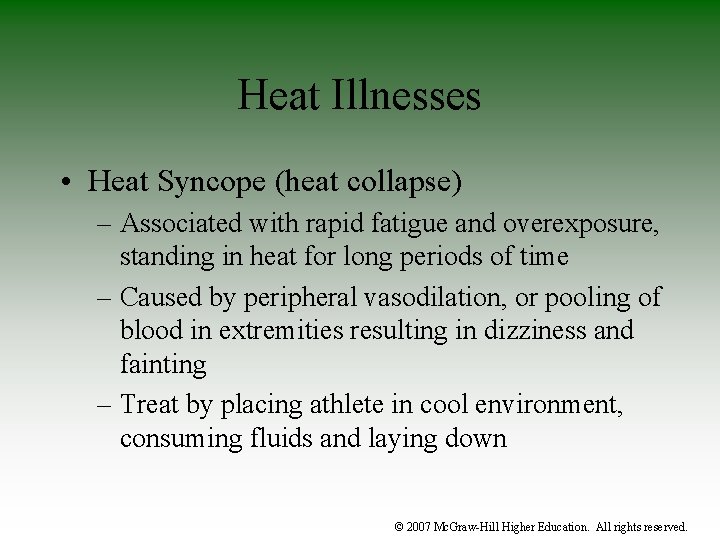
Heat Illnesses • Heat Syncope (heat collapse) – Associated with rapid fatigue and overexposure, standing in heat for long periods of time – Caused by peripheral vasodilation, or pooling of blood in extremities resulting in dizziness and fainting – Treat by placing athlete in cool environment, consuming fluids and laying down © 2007 Mc. Graw-Hill Higher Education. All rights reserved.
• Heat Cramps – Painful muscle spasms (calf, abdominal) due to excessive water loss and electrolyte imbalance – Occurs in individual in good shape that overexert themselves – Treatment • Prevent by consuming extra fluids and maintaining electrolyte balance • Treat with fluid ingestion, light stretching with ice massage • Return to play unlikely due to continued cramping © 2007 Mc. Graw-Hill Higher Education. All rights reserved.
• Heat Exhaustion – Result of inadequate fluid replacement – Will exhibit signs of profuse sweating, pale skin, mildly elevated temperature, dizziness, hyperventilation and rapid pulse – May develop heat cramps or become faint/dizzy – Core temperature will be ~102 o • Critical to obtain accurate core temperature – Performance may decrease – Immediate treatment includes fluid ingestion (intravenous replacement, ultimately), place in cool environment © 2007 Mc. Graw-Hill Higher Education. All rights reserved.
• Heatstroke – Serious life-threatening condition, with unknown specific cause – Characterized by sudden onset - sudden collapse, LOC, flushed hot skin, minimal sweating, shallow breathing, strong rapid pulse, and core temperature of > 104 o F – Temperature must be lowered within 45 minutes – Drastic measures must be taken to cool athlete • • Strip clothing Sponge with cool water Immerse in water Transport to hospital immediately © 2007 Mc. Graw-Hill Higher Education. All rights reserved.
Preventing Heat Illness • Must exercise common sense and precaution – Consume fluids and stay cool • Fluid and Electrolyte Replacement – Single most important step taken by a coach to minimize the chance of heat illnesses – Continual re-hydration is critically important – Generally only 50% of fluid is ever replaced and should therefore be replaced before, during and after exercise © 2007 Mc. Graw-Hill Higher Education. All rights reserved.
– Fluid replacement should match sweat loss • Most effectively replaced at regular intervals (15 minutes) – Time of stomach emptying is critical • Water is absorbed rapidly from intestine • Drink with 6% CHO is eliminated at the same rate if the individual is hydrated • Cold drinks tend to empty rapidly and will not induce cramping or put heart at risk • Drinks with caffeine and alcohol will promote dehydration – Hydration levels can be monitored via urine color and volume • Appropriate hydration = clear urine at normal or abovenormal output level 60 minutes following exercise © 2007 Mc. Graw-Hill Higher Education. All rights reserved.
• Using Sports Drinks – More effective than just replacing fluids with water – Flavoring results in increased desire to consume – Replaces fluids and electrolytes – Water alone can prematurely stop thirst response and initiate fluid removal by kidneys – Small amounts of sodium help in retention of water – Different drinks have different nutrient levels – Optimal CHO level is 14 g per 8 ounces of water – More CHO results in slower absorption – Effective for both short term and endurance activities © 2007 Mc. Graw-Hill Higher Education. All rights reserved.
• Gradual Acclimatization – Most effective method of avoiding heat stress – Involves becoming accustomed to heat and exercising in heat – Early pre-season training and graded intensity changes are recommended with progressive exposure over 7 -10 day period – 80% of acclimatization can be achieved during first 5 -6 days with 2 hour morning and afternoon practice sessions © 2007 Mc. Graw-Hill Higher Education. All rights reserved.
• Identifying Susceptible Individuals – Athletes with large muscle mass – Overweight athletes are at an increased risk • Related to proportionality of metabolic heat production to surface area – Athlete with increased fluid loss – While slight differences exist, precautionary measures apply to both males and females – Athletes consuming medications or supplements may have impaired sweating and may predispose them to injury – Athletes with poor fitness levels, a history of heat-related illnesses or anyone with febrile conditions are at increased risk © 2007 Mc. Graw-Hill Higher Education. All rights reserved.
• Uniform Selection – Base on temperature and humidity – Dress for the weather and temperature – Avoid rubberized suits • Weight Records – Keep track of before and after measures for first two weeks – If increase in temperature and humidity occurs during the season, weights should again be recorded – A loss of 3 -5% = reduced blood volume and could be a health threat © 2007 Mc. Graw-Hill Higher Education. All rights reserved.
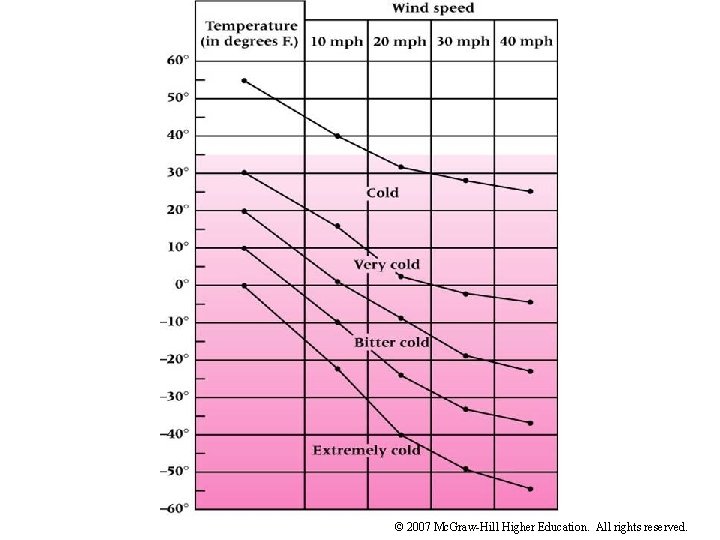
Hypothermia • Most activity allows for adequate heat production (increased metabolism) and dissipation, allowing for sufficient functioning • Impact on warm-up and “down time” • Temperature in conjunction with wind chill and dampness or wetness can increase chances of hypothermia © 2007 Mc. Graw-Hill Higher Education. All rights reserved.
• Drop in core stimulates shivering but stops after temp. drops below 85 -90 o. F • Death is imminent when temp falls below 7785 o. F. © 2007 Mc. Graw-Hill Higher Education. All rights reserved.
Cold Disorders • Fluid replacement is critical even under colder environmental conditions – Dehydration = decreased blood volume = less fluid available for tissue warming © 2007 Mc. Graw-Hill Higher Education. All rights reserved.
• Frost nip – Involves, ears, nose, chin, fingers, and toes – Occurs with high wind and/or severe cold – Skin appears firm with cold painless areas that may peel and blister (24 -72 hours) – Treat with firm pressure, blowing warm air or hands in armpits (if fingers involved) – Do not rub © 2007 Mc. Graw-Hill Higher Education. All rights reserved.
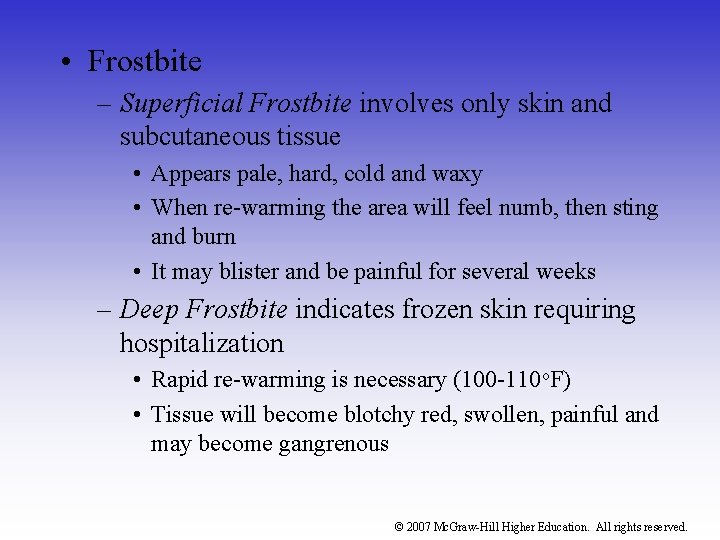
• Frostbite – Superficial Frostbite involves only skin and subcutaneous tissue • Appears pale, hard, cold and waxy • When re-warming the area will feel numb, then sting and burn • It may blister and be painful for several weeks – Deep Frostbite indicates frozen skin requiring hospitalization • Rapid re-warming is necessary (100 -110 o. F) • Tissue will become blotchy red, swollen, painful and may become gangrenous © 2007 Mc. Graw-Hill Higher Education. All rights reserved.
© 2007 Mc. Graw-Hill Higher Education. All rights reserved.
• Prevention – Apparel geared for weather to provide semitropical microclimate for body and prevent chilling – Waterproof and windproof fabrics that allow passage of heat and sweat and allow movement – Layers and adjusting them are key to maintaining body temperature (during period of (in)activity) – Inadequate clothing, improper warm-up and chill factor can lead to injury, frostbite, and/or minor respiratory problems © 2007 Mc. Graw-Hill Higher Education. All rights reserved.
Overexposure to Sun • Precautions must be taken to protect athletes, coaches, athletic trainers and support staff • Long Term Effects on Skin – Premature aging and skin cancer due to ultraviolet exposure – Premature aging is characterized by dryness, cracking and inelasticity of the skin – Skin cancer is the most common malignant tumor found in humans © 2007 Mc. Graw-Hill Higher Education. All rights reserved.
• Using Sunscreen – Can help prevent damaging effects of UV radiation – Sunscreen effectiveness is expressed as SPF (sun protection factor) • Indicates how many times longer an individual can be exposed to the sun with vs. without sunscreen before skin turns red. • Greater the susceptibility the higher the SPF should be used – Should be worn by athletes, coaches and athletic trainers who are outside a considerable amount, and/or have fair complexion, light hair, blue eyes or skin that burns easily © 2007 Mc. Graw-Hill Higher Education. All rights reserved.
– Sunscreen use is at its highest March November but should be used year round (particularly between the hours of 10 am-4 pm) – It should be applied 15 -30 minutes before exposure and re-applied after exposure to water, excess sweating, rubbing skin with clothing or a towel © 2007 Mc. Graw-Hill Higher Education. All rights reserved.
Safety in Lightening and Thunderstorms • #2 cause of death by weather phenomena • Emergency action plans must be set for this type of event – Involving chain of command, monitoring of weather service, decision making regarding removal and return to field © 2007 Mc. Graw-Hill Higher Education. All rights reserved.
• In the event of a storm, shelter indoors should be obtained • Other guidelines – Avoid large trees, flag/light poles, standing water, telephones, pools, showers, and metal objects (bleachers, equipment, umbrellas) – Last resorts find car, ravine, ditch or valley for safety – If hair stands up on hand you are in imminent danger and should get down on the ground but not flat as that increases surface area © 2007 Mc. Graw-Hill Higher Education. All rights reserved.
• Additional Guidelines – Lightening is generally accompanied by thunder (except 20 -40% of the time due to atmospheric disturbances) – Flash-to-bang methods estimates distance away for the storm • From time lightening is sighted to the clap of thunder count, divide by 5 to calculate the number of mile away • Count of 30 indicates inherent danger • Count of 15 seconds everyone should leave the field © 2007 Mc. Graw-Hill Higher Education. All rights reserved.
– NATA and National Weather Service recommend returning to the field 30 minutes following the last clap of thunder or lightening strike – Major misconception is that lightening that is seen striking is coming down • In actuality it is the return stroke of the lightening going back up after it has already hit the ground © 2007 Mc. Graw-Hill Higher Education. All rights reserved.
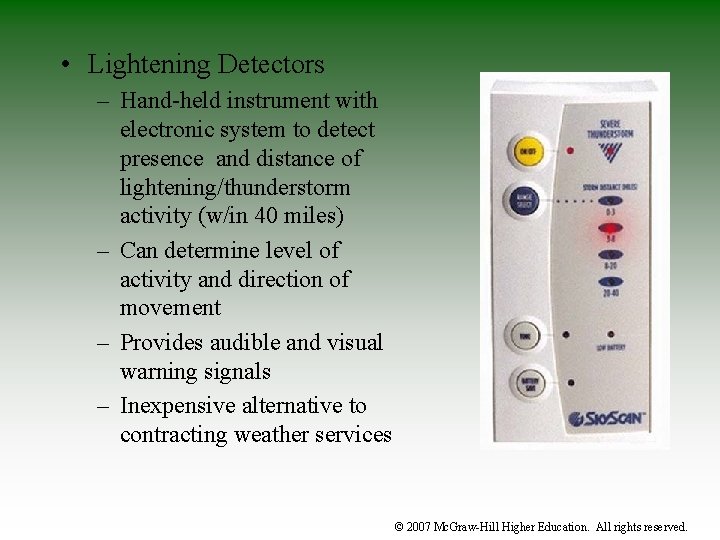
• Lightening Detectors – Hand-held instrument with electronic system to detect presence and distance of lightening/thunderstorm activity (w/in 40 miles) – Can determine level of activity and direction of movement – Provides audible and visual warning signals – Inexpensive alternative to contracting weather services © 2007 Mc. Graw-Hill Higher Education. All rights reserved.