
Chapter 10 Transport in Plants Transport in plants








- Slides: 56
Chapter 10 – Transport in Plants
Transport in plants Water and mineral nutrients must be absorbed by the roots and transported throughout the plant Sugars must be transported from site of production, throughout the plant, and stored
Cellular transport mechanisms
Osmotic potential, solutes, and water movement
Water potential influences water movement Water potential (Ψ) of a cell: Ψcell = ΨΡ + ΨΟ Ρ = pressure potential Ο = osmotic (solute) potential
Ψp - Pressure potential (turgor) Low Ψp High Ψp
ΨΟ – Osmotic (Solute) potential Pure water ΨΟ = 0 All solutions, ΨΟ < 0 As solute concentration increases, Ψcell …
Water movement in plants Movement from high Ψcell to low Ψcell Occurs in the xylem Involves adhesion, cohesion, and pressure
Adhesion and cohesion
Water transport
Tension-cohesion theory explains xylem transport Water is drawn up the plant by transpiration of water from stomata
A water potential gradient creates tension
higher ψ higherψψ lower ψ ψ higher Transpiration creates tension low ψ cohesion lower ψ highest ψ
Water transport animation
Transpiration & water transport
Importance of stomata Regulate transpiration rate – Controls rate of water uptake Water required for photosynthesis Water required to maintain turgor pressure Influences nutrient uptake Regulate gas exchange – CO 2 required for photosynthesis
Turgid guard cells open stomata
Guard cells & osmotic potential
Transpiration & photosynthesis
Ψ and transpiration rate In terms of ψ, can you explain how transpiration rate is influenced by: – Atmospheric humidity? – Wind? – Air temperature? – Light intensity?
Which of the following explains why water moves into the root from the soil? 1. 2. 3. 4. 5. The water potential of the root is lower than the water potential of the soil The roots exist in a hypertonic environment The pressure potential of the soil forces water into the root Water is actively transported into the root The soil has a higher solute concentration than the roots, causing
Stomata close when 1. 2. 3. 4. 5. Photosynthesis lowers CO 2 concentrations in the leaves Potassium ions are pumped into guard cells Abscisic acid levels increase Guard cells become turgid All of these occur
A guard cell with a high internal concentration of K+ 1. 2. 3. 4. 5. Is in a hypertonic condition Has a low water potential relative to outside of the cell Has a higher water potential than outside the cell Both 1 and 2 Both 2 and 3
Water transport
Sugar transport
Source to sink sugar transport
Pressure-flow hypothesis explains sugar transport
Phloem loading
Sugar transport can be explained by water potential
Transport in plants Water and mineral nutrients are absorbed by the roots and transported throughout the plant by tension-cohesion Sugars are transported from site of production (source), throughout the plant, and stored (sinks) by pressure-flow
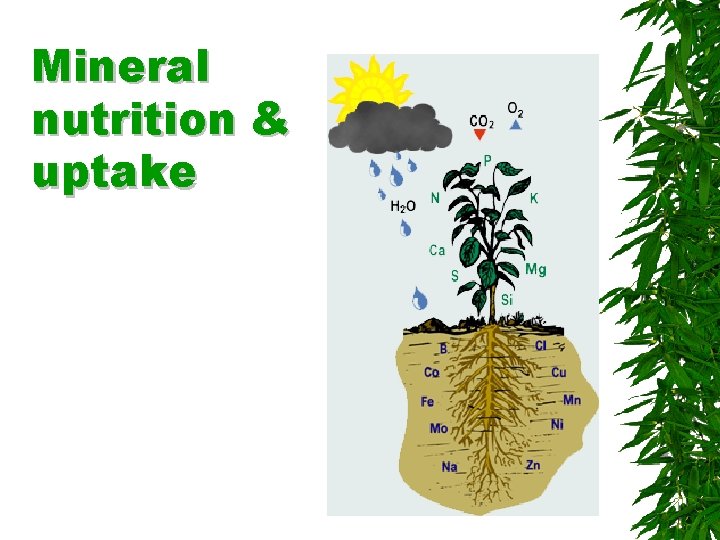
Mineral nutrition & uptake
Soils and plant nutrition 14 essential mineral nutrients – N, P, K, S, Ca, Mg, Fe, Cl, Mn, B, Zn, Cu, Mo, Ni 3 essential non-mineral nutrients – C, H, O – What makes these nutrients essential?
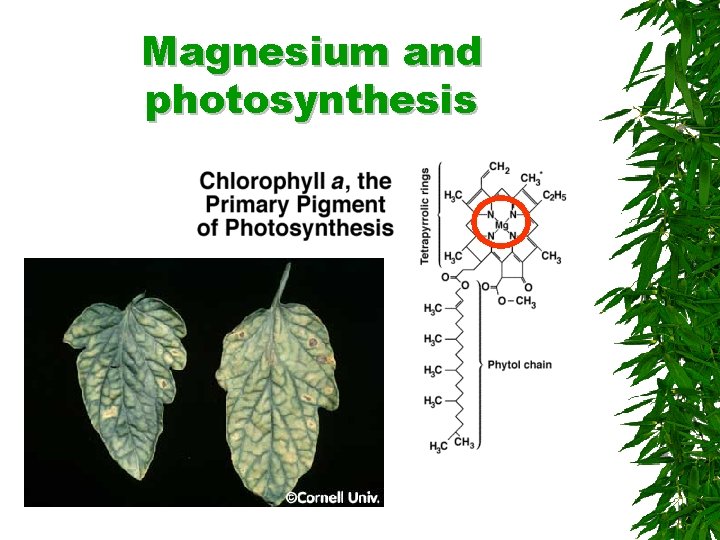
Magnesium and photosynthesis
Nitrogen and amino acids
Nitrogen, phosphorus & DNA
Potassium and cell function
Macronutrients vs. micronutrients
Fertilizers Fertilizer analysis (N-P-K) Analysis varies depending on growth objectives
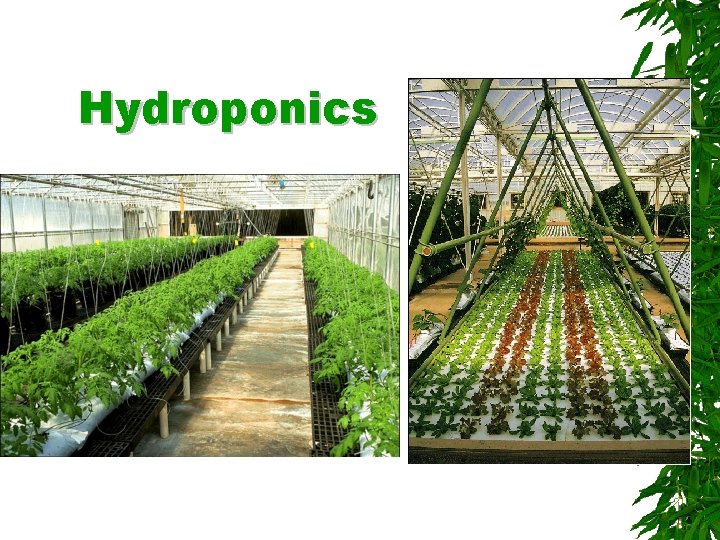
How can essential elements be determined?
Hydroponics
Recreational hydroponics Home hydroponics systems
A soil profile Soil composition – Sand, silt, clay – Humus – Microorganisms – Animals
Mineral nutrients exist as ions
Cation exchange allows mineral ions to be absorbed by roots
Cation exchange and H+
Mineral nutrient transport
How does cation exchange affect soil p. H? Raising soil p. H with lime Ca(OH)2 + 2 H+ Ca 2+ + 2 H 2 O
Soil p. H and mineral nutrition Different types of plants have different soil p. H requirements (ex. truffles, filbert trees, and alkaline soils)
Which of the following statements concerning plant nutrition is/are true? 1. 2. 3. 4. 5. Macronutrients are large elements and micronutrients are small elements Macronutrients are essential to plant growth and micronutrients are not essential Macronutrients are absorbed from the atmosphere and micronutrients are absorbed from the soil All of these are true None of these are true
Cation exchange 1. 2. 3. 4. Occurs when plants release O 2 and absorb CO 2 through their stomata Involves plants releasing Ca 2+ into the soil in order to absorb H+ ions Involves the release of H+ ions from roots to displace mineral nutrient ions from soil particles Allows plant roots to absorb C, H, and O through their roots by converting these atoms to cations