
Chapter 10 TRACE EVIDENCE HAIRS AND Trace Evidence
- Slides: 58
Chapter 10 TRACE EVIDENCE : HAIRS AND
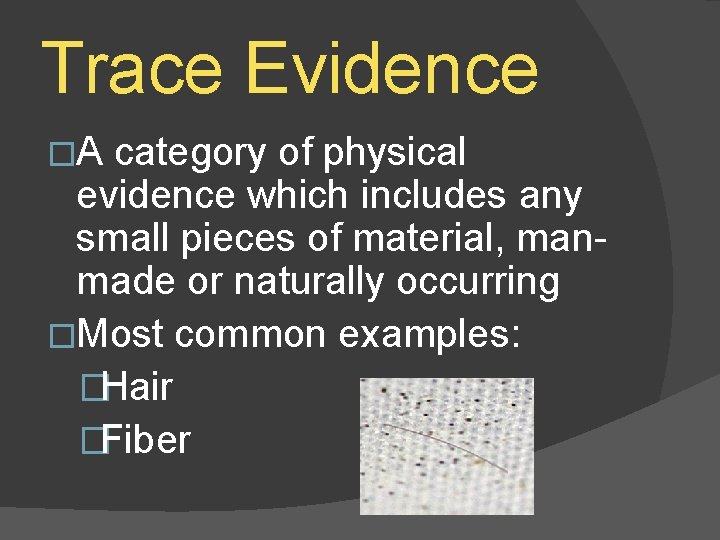
Trace Evidence �A category of physical evidence which includes any small pieces of material, manmade or naturally occurring �Most common examples: �Hair �Fiber
Forensic Use of Hair � Although it is not yet possible to individualize a human hair to any single head or body through its morphology, it still has great value as physical evidence. � When properly collected and submitted to the laboratory accompanied by an adequate number of standard/reference samples, hair can provide strong corroborative evidence for placing an individual at a crime scene.
Forensic Use of Hair cont…. � Human hair is one of the most frequently found pieces of evidence at the scene of a violent crime. It can provide a link between the criminal and the act. � From hair one can determine: � Human or animal � Race � Origin �Manner in which hair was removed �Treated hair �Drugs ingested
Morphology of Hair � The length of a hair extends from its root or bulb embedded in the follicle, continues into a shaft, and terminates at a tip end. � It is the shaft, which is composed of three layers—the cuticle, cortex, and medulla—that is subjected to the most intense examination by the forensic scientist.
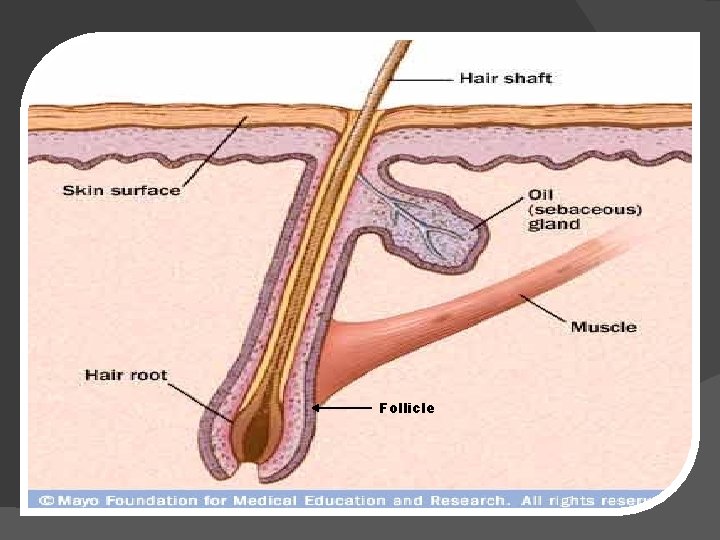
Hair Morphology � Morphology is the Study of Structure and Form � Parts of the hair: �Shaft--part of the hair that sticks out of the skin �Root--lies below the epidermis �Follicle--structure from which the hair grows
Follicle
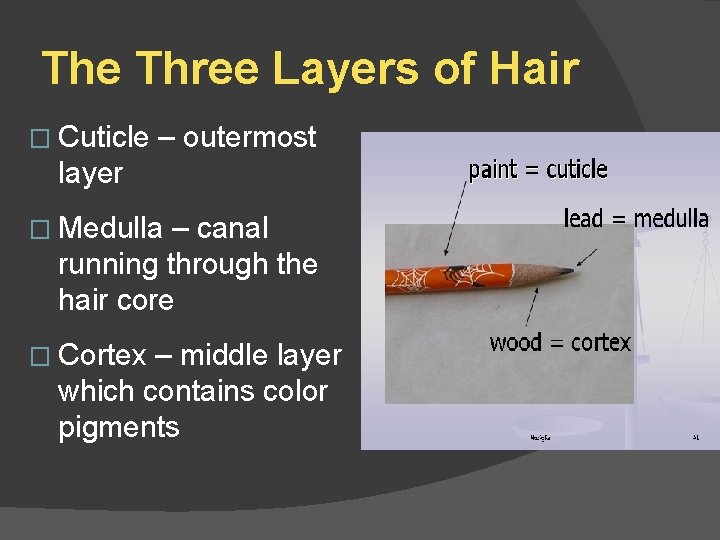
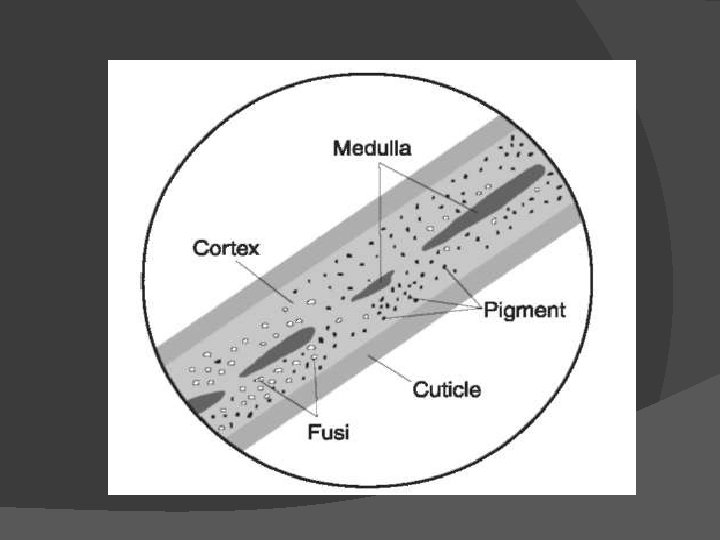
The Three Layers of Hair � Cuticle – outermost layer � Medulla – canal running through the hair core � Cortex – middle layer which contains color pigments
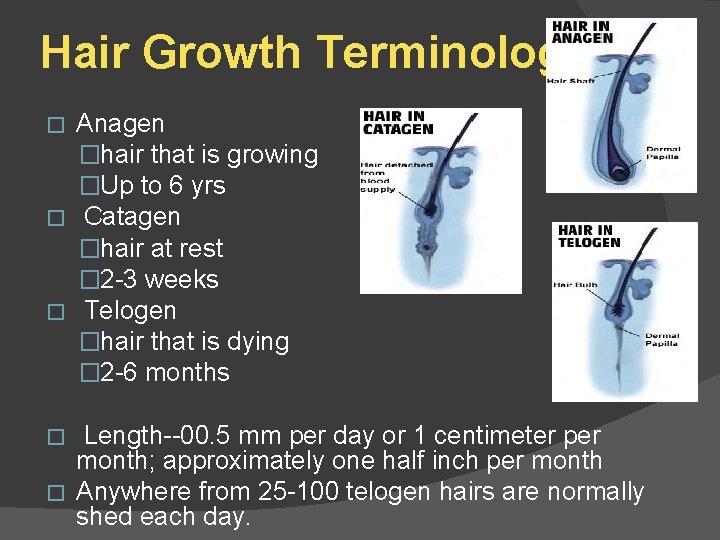
Hair Growth Terminology Anagen �hair that is growing �Up to 6 yrs � Catagen �hair at rest � 2 -3 weeks � Telogen �hair that is dying � 2 -6 months � Length--00. 5 mm per day or 1 centimeter per month; approximately one half inch per month � Anywhere from 25 -100 telogen hairs are normally shed each day. �
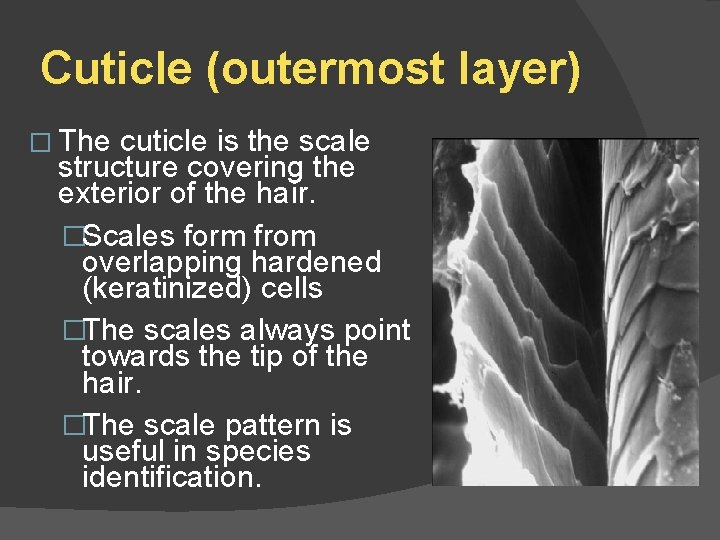
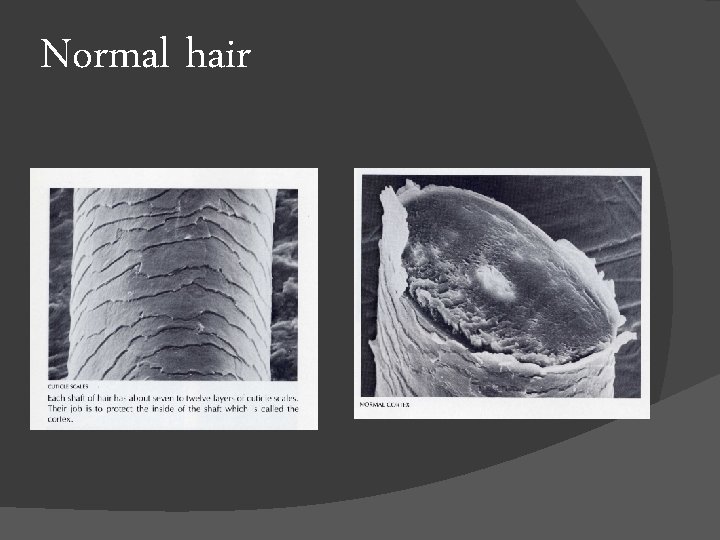
Cuticle (outermost layer) � The cuticle is the scale structure covering the exterior of the hair. �Scales form from overlapping hardened (keratinized) cells �The scales always point towards the tip of the hair. �The scale pattern is useful in species identification.
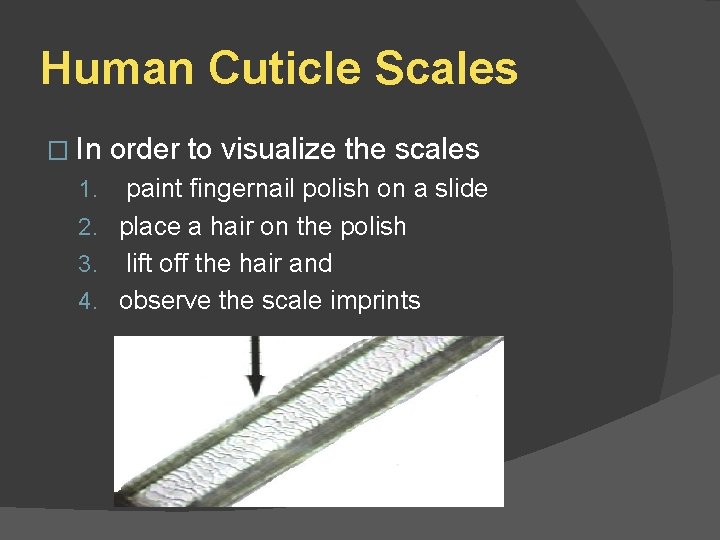
Human Cuticle Scales � In order to visualize the scales paint fingernail polish on a slide 2. place a hair on the polish 3. lift off the hair and 4. observe the scale imprints 1.
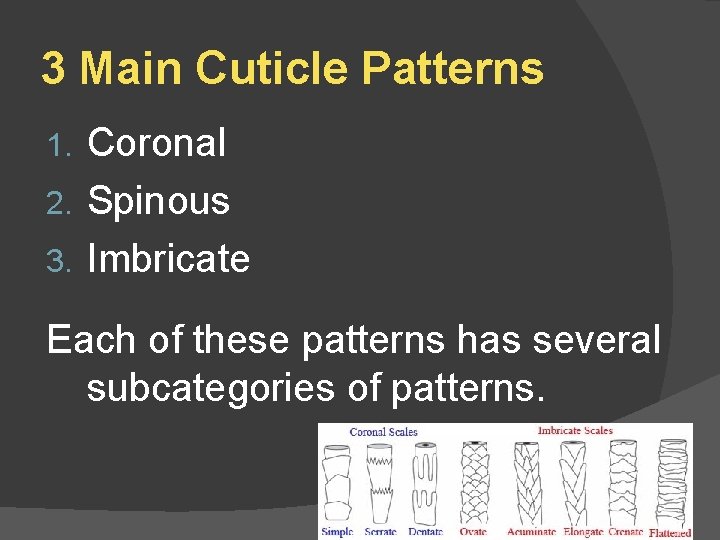
3 Main Cuticle Patterns Coronal 2. Spinous 3. Imbricate 1. Each of these patterns has several subcategories of patterns.
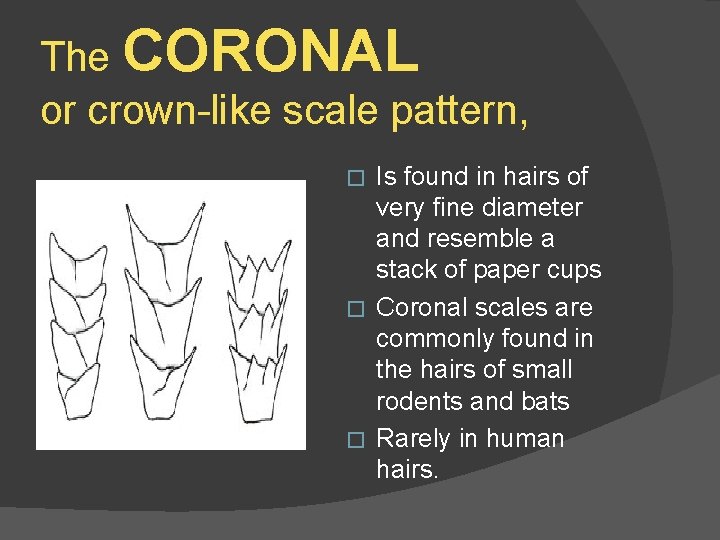
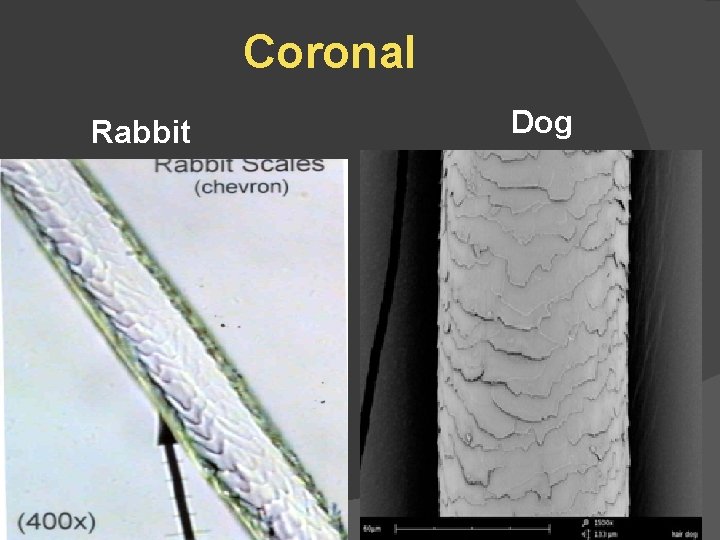
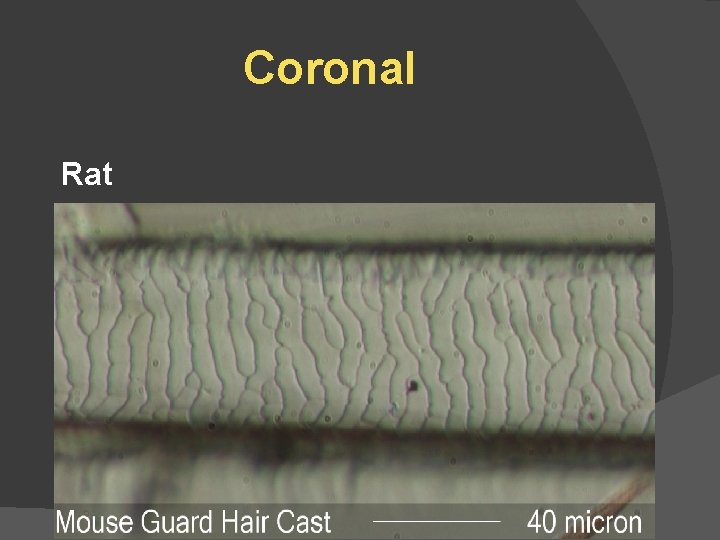
The CORONAL or crown-like scale pattern, Is found in hairs of very fine diameter and resemble a stack of paper cups � Coronal scales are commonly found in the hairs of small rodents and bats � Rarely in human hairs. �
Coronal Rabbit Dog
Coronal Rat
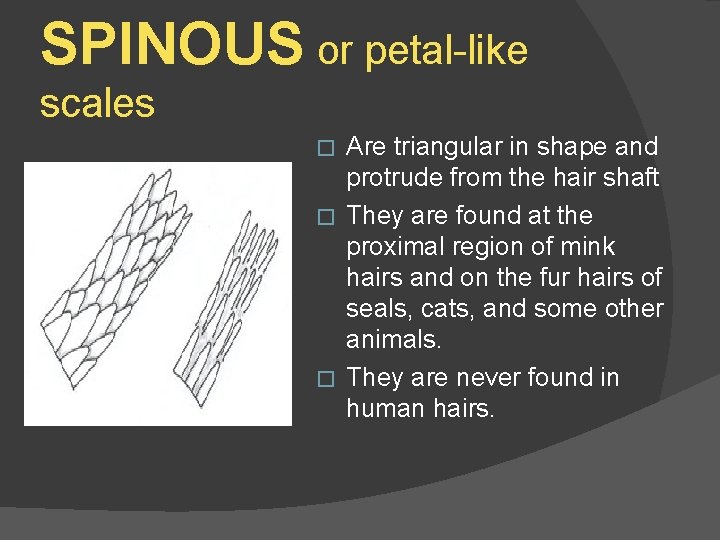
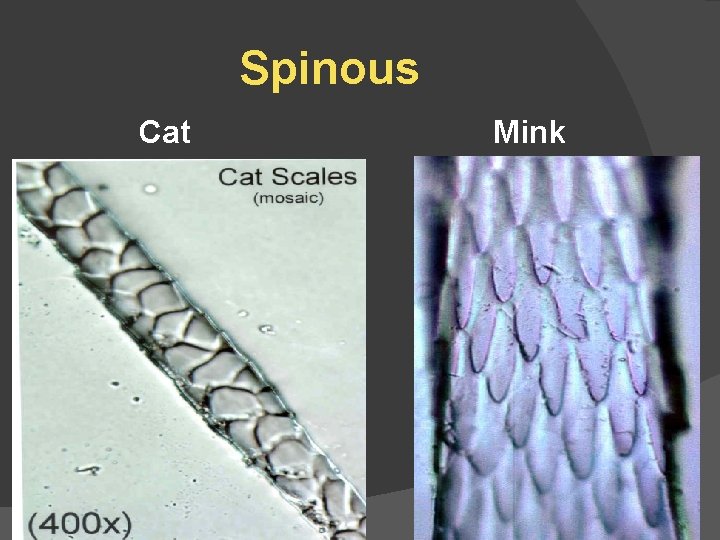
SPINOUS or petal-like scales Are triangular in shape and protrude from the hair shaft � They are found at the proximal region of mink hairs and on the fur hairs of seals, cats, and some other animals. � They are never found in human hairs. �
Spinous Cat Mink
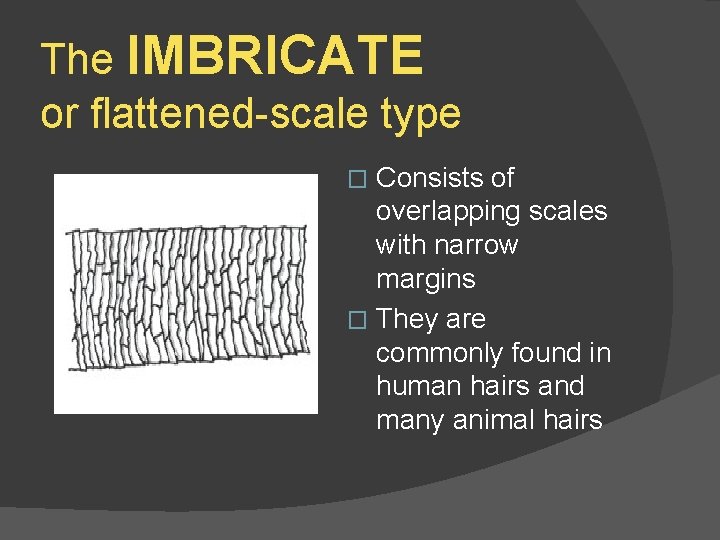
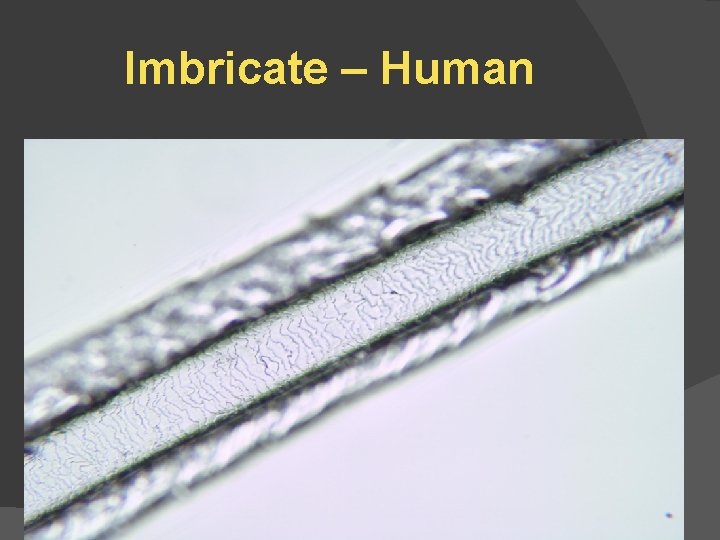
The IMBRICATE or flattened-scale type Consists of overlapping scales with narrow margins � They are commonly found in human hairs and many animal hairs �
Imbricate – Human
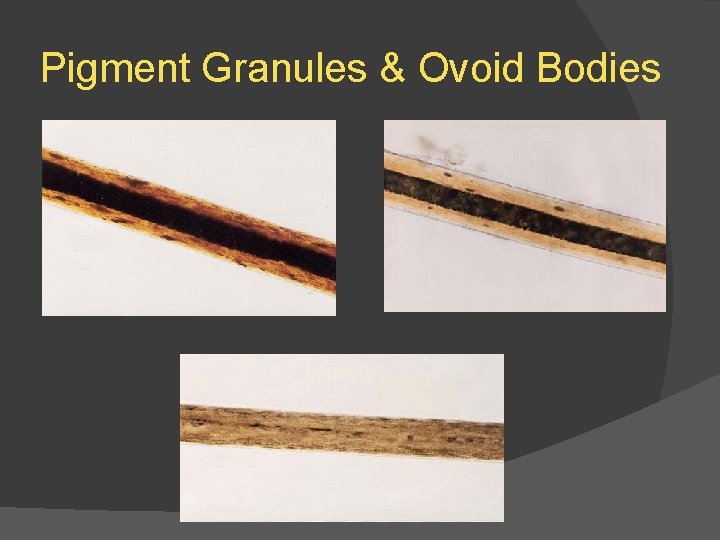
Hair Cortex (middle layer) � The cortex is the main body of the hair shaft. � The cortex gives the hair its shape. � It has two major characteristics: 1. Melanin--pigment granules that give hair its color 2. Cortical fusi--air spaces, usually found near the root but may be found throughout the hair shaft � Ovoid bodies larger round or oval shaped solid structures present in some species.
Pigment Granules & Ovoid Bodies
Cortex � Its major forensic importance is the fact that it is embedded with the pigment granules that impart hair with color. � The color, shape, and distribution of these granules provide the criminalist with important points of comparison among the hairs of different individuals.
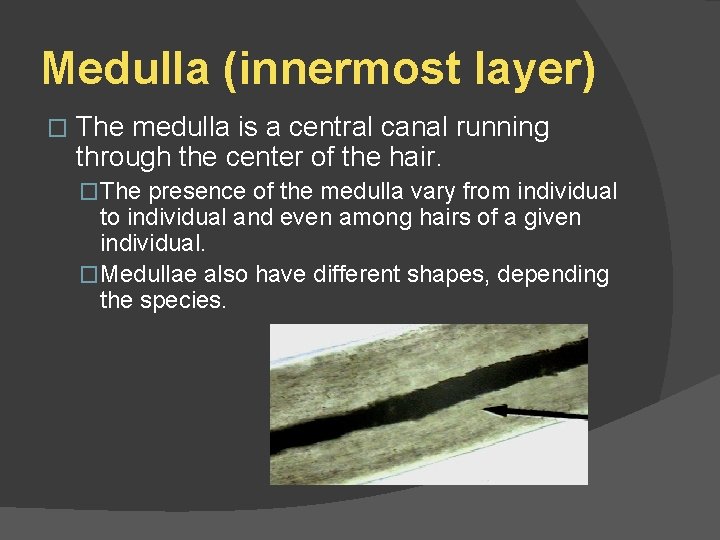
Medulla (innermost layer) � The medulla is a central canal running through the center of the hair. �The presence of the medulla vary from individual to individual and even among hairs of a given individual. �Medullae also have different shapes, depending the species.
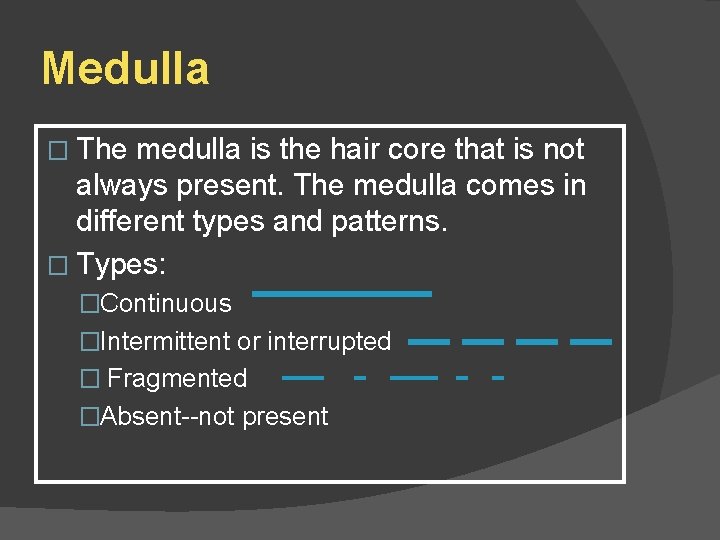
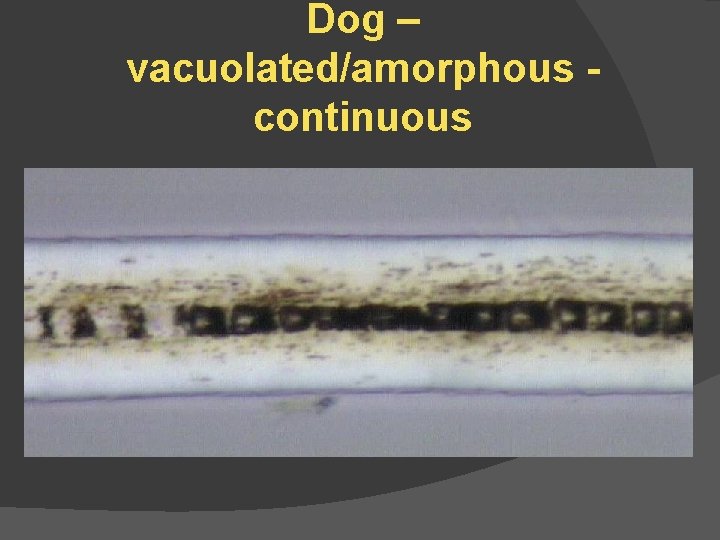
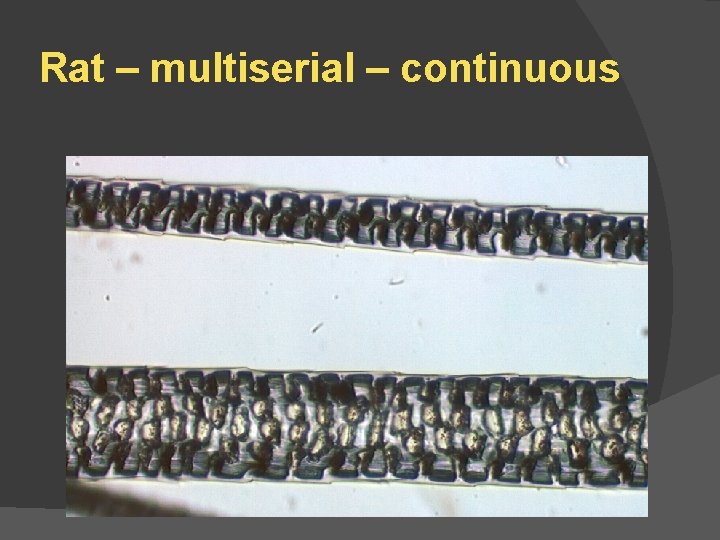
Medulla � The medulla is the hair core that is not always present. The medulla comes in different types and patterns. � Types: �Continuous �Intermittent or interrupted � Fragmented �Absent--not present
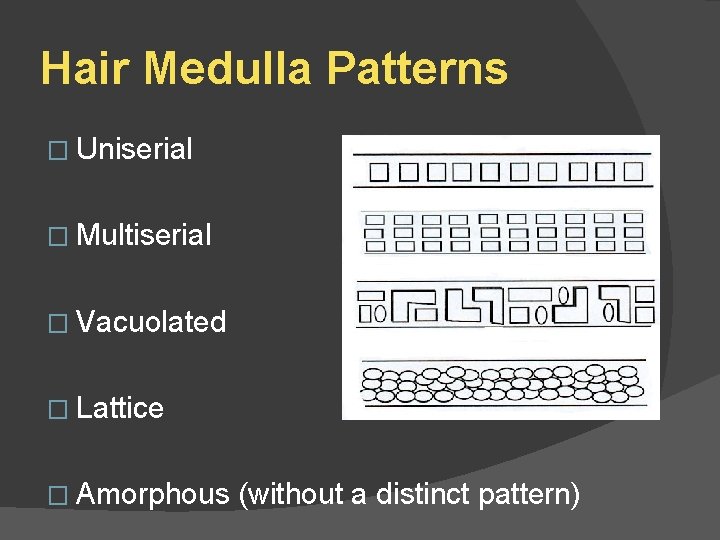
Hair Medulla Patterns � Uniserial � Multiserial � Vacuolated � Lattice � Amorphous (without a distinct pattern)
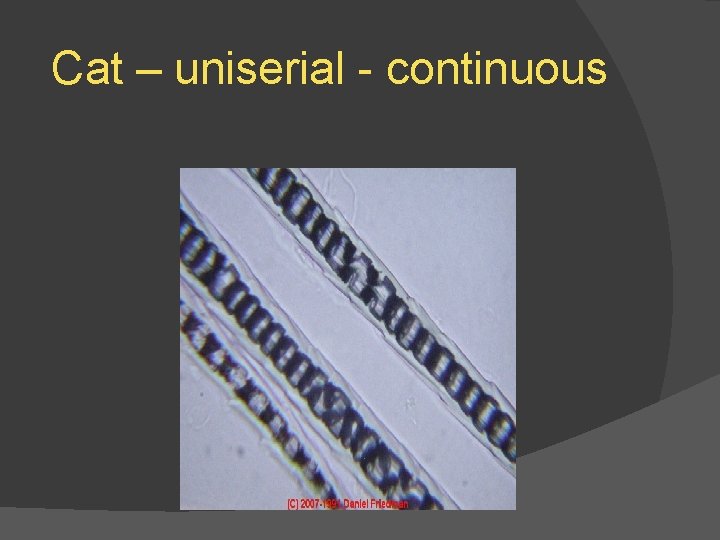
Cat – uniserial - continuous
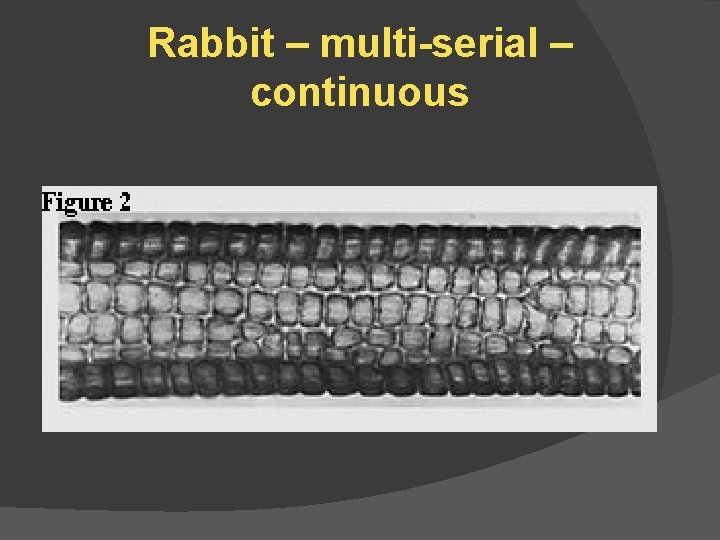
Rabbit – multi-serial – continuous
Dog – vacuolated/amorphous continuous
Rat – multiserial – continuous
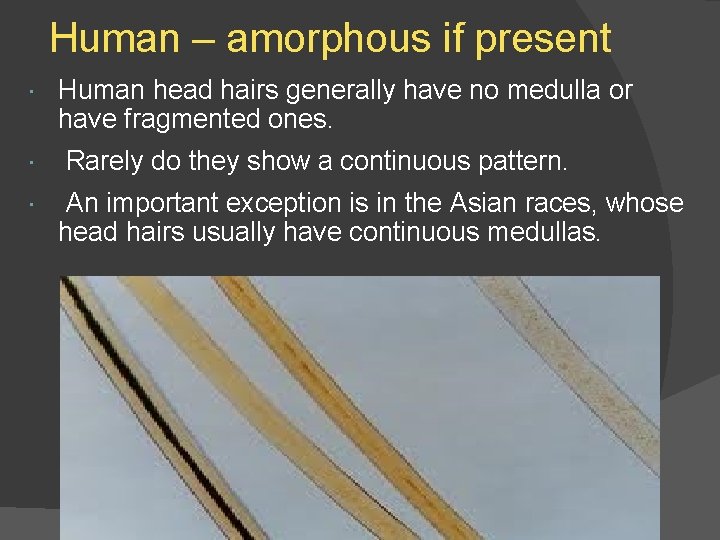
Human – amorphous if present Human head hairs generally have no medulla or have fragmented ones. Rarely do they show a continuous pattern. An important exception is in the Asian races, whose head hairs usually have continuous medullas.
Medullary Index � Determined by measuring the diameter of the medulla and dividing it by the diameter of the hair. � Medullary Index for human hair is generally less than 1/3. � For 1/2. animal hair, it is usually greater than
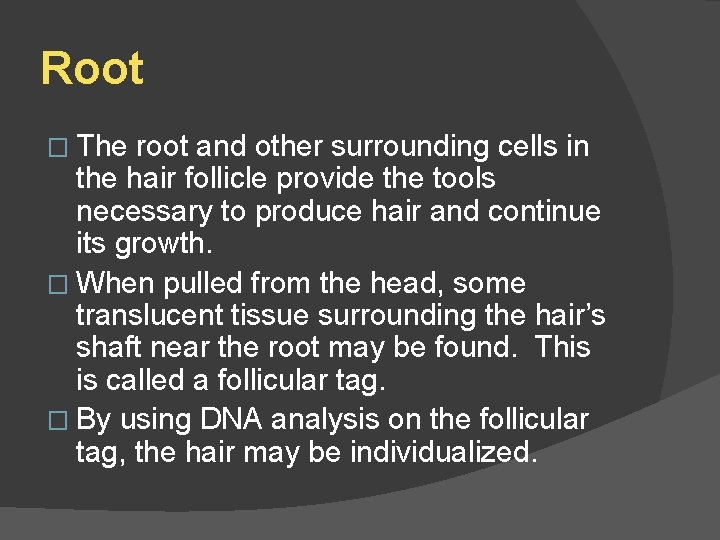
Root � The root and other surrounding cells in the hair follicle provide the tools necessary to produce hair and continue its growth. � When pulled from the head, some translucent tissue surrounding the hair’s shaft near the root may be found. This is called a follicular tag. � By using DNA analysis on the follicular tag, the hair may be individualized.
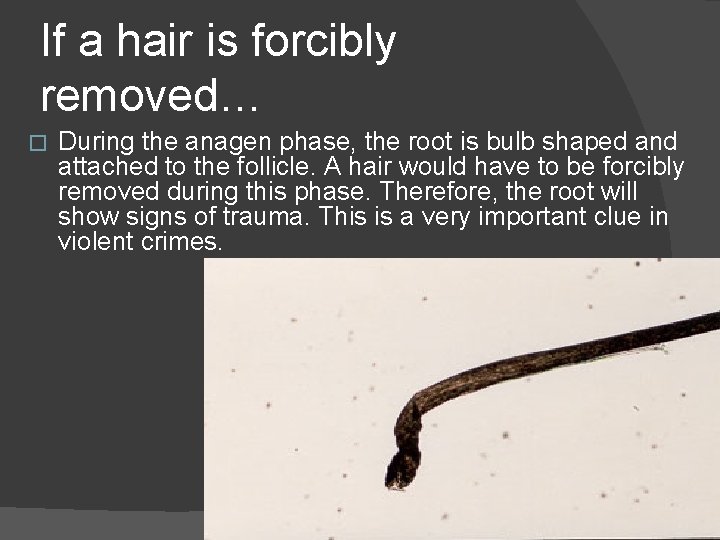
If a hair is forcibly removed… � During the anagen phase, the root is bulb shaped and attached to the follicle. A hair would have to be forcibly removed during this phase. Therefore, the root will show signs of trauma. This is a very important clue in violent crimes.
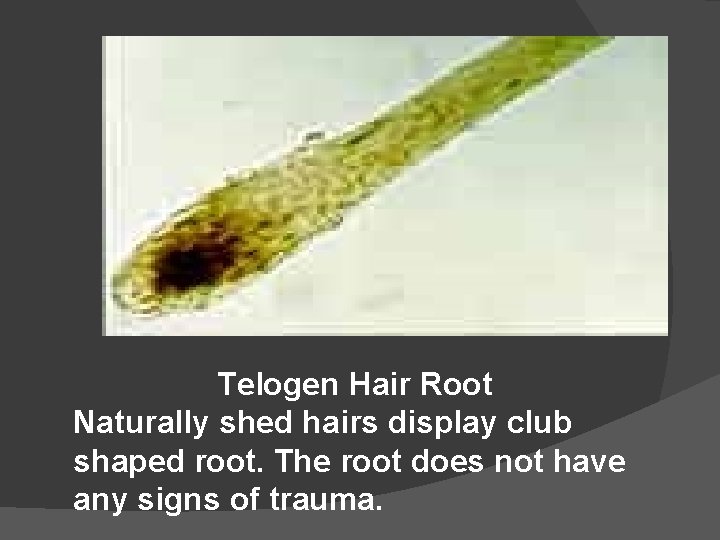
Telogen Hair Root Naturally shed hairs display club shaped root. The root does not have any signs of trauma.
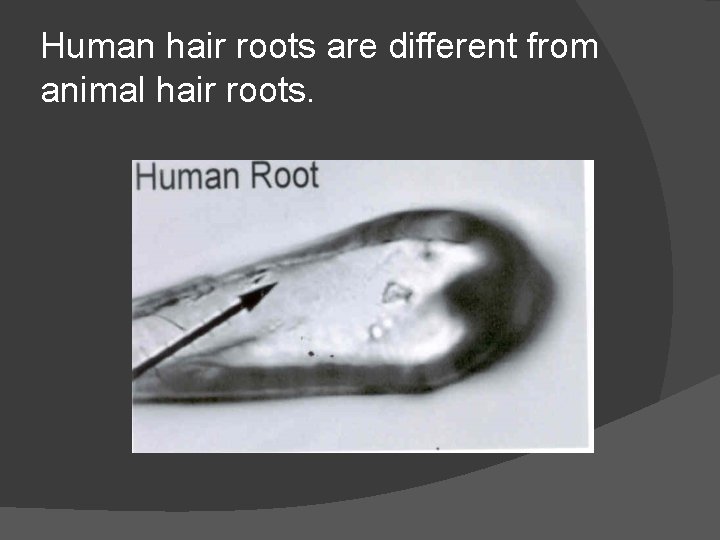
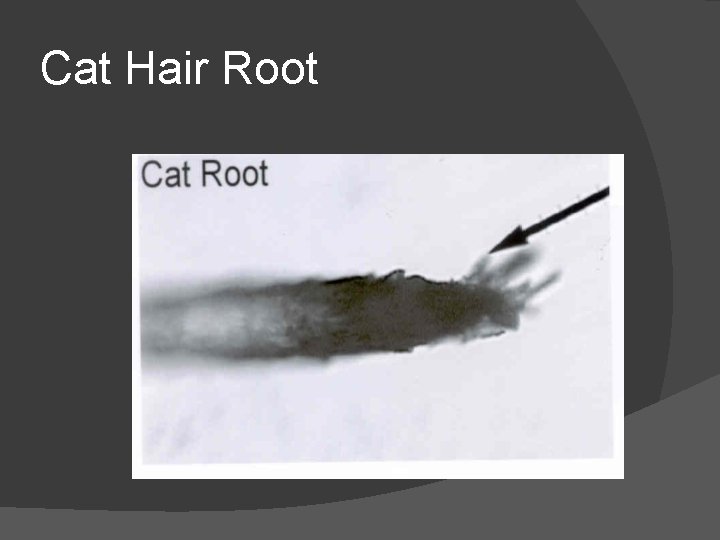
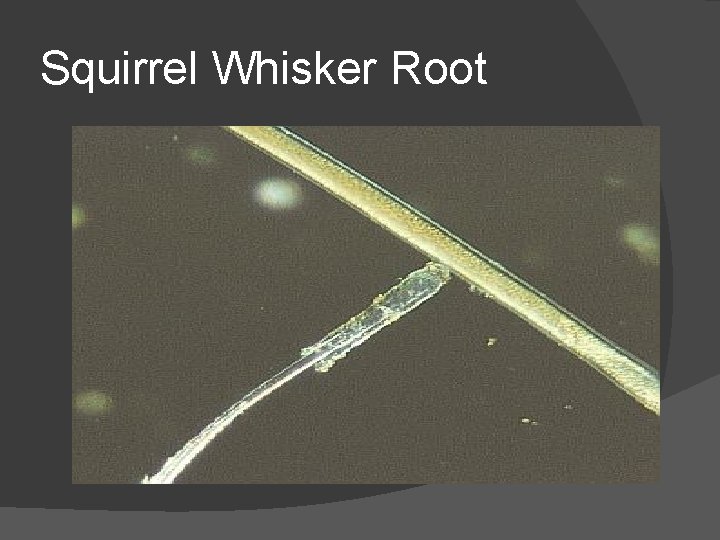
Human hair roots are different from animal hair roots.
Cat Hair Root
Squirrel Whisker Root
DNA Evidence from Hair � The hair shaft contains abundant mitochondrial DNA--inherited only from our mothers. It can be typed by comparing relatives if no DNA from the body is available. � Only the root contains nuclear DNA � The probability of detecting DNA in hair roots is more likely for hair being examined in its anagen or early growth phase as opposed to its catagen (middle) or telogen (final) phases.
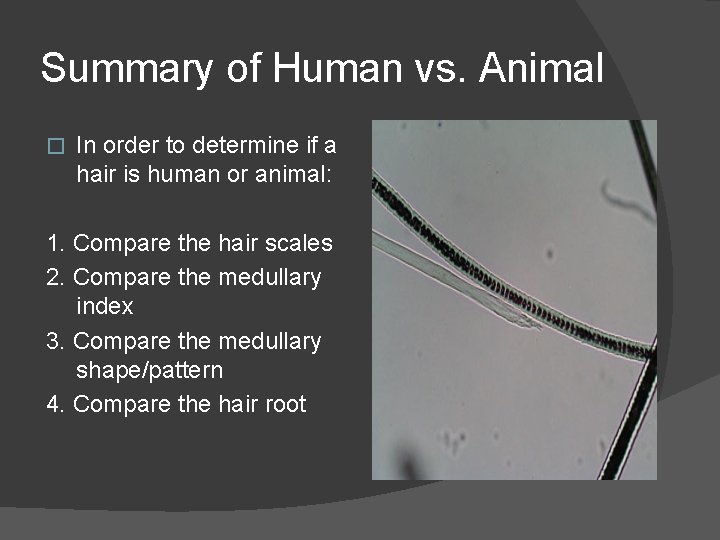
Summary of Human vs. Animal � In order to determine if a hair is human or animal: 1. Compare the hair scales 2. Compare the medullary index 3. Compare the medullary shape/pattern 4. Compare the hair root
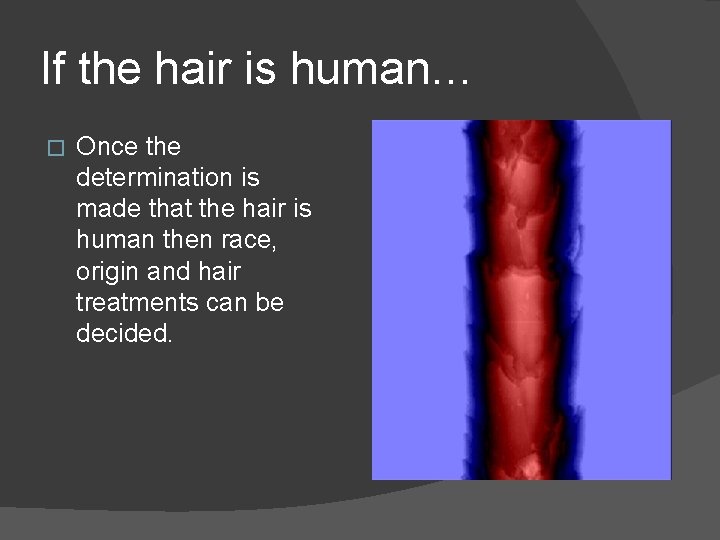
If the hair is human… � Once the determination is made that the hair is human then race, origin and hair treatments can be decided.
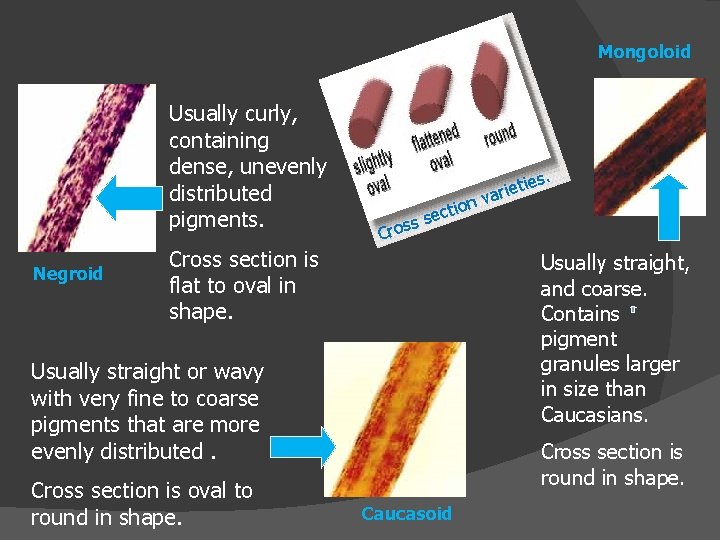
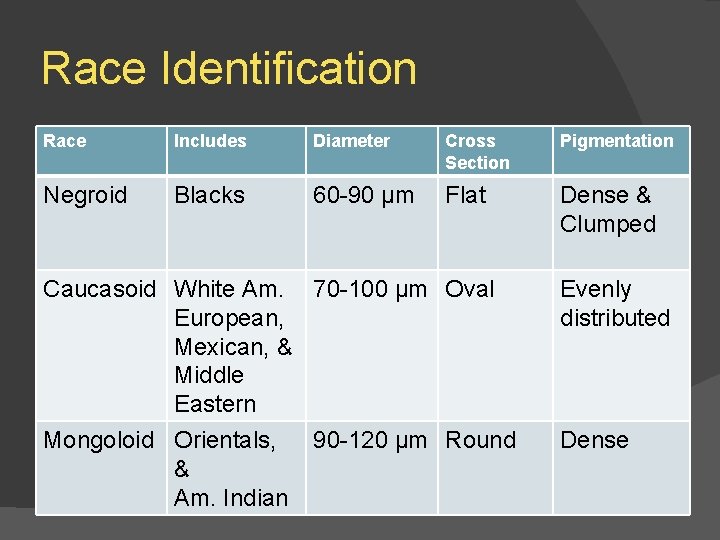
Mongoloid Usually curly, containing dense, unevenly distributed pigments. Negroid Cross section is flat to oval in shape. Cros s ion t c e s v Usually straight, and coarse. Contains pigment granules larger in size than Caucasians. Usually straight or wavy with very fine to coarse pigments that are more evenly distributed. Cross section is oval to round in shape. s. tie arie Cross section is round in shape. Caucasoid
Race Identification Race Includes Diameter Cross Section Pigmentation Negroid Blacks 60 -90 µm Flat Dense & Clumped Caucasoid White Am. 70 -100 µm Oval European, Mexican, & Middle Eastern Mongoloid Orientals, 90 -120 µm Round & Am. Indian Evenly distributed Dense
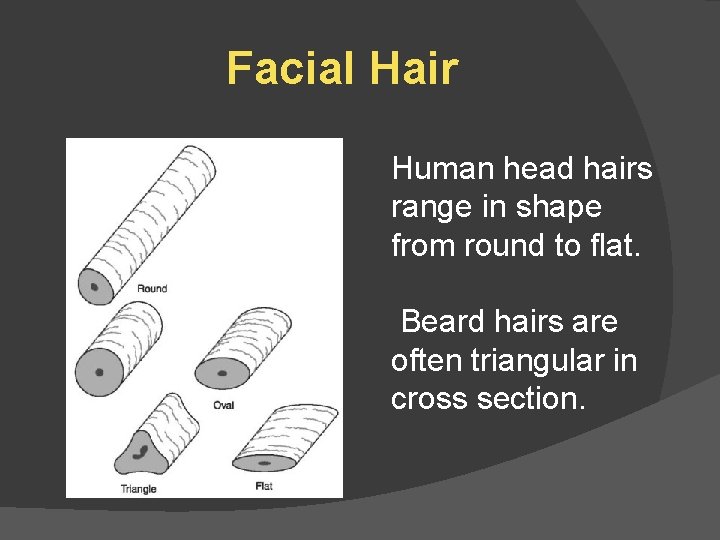
Facial Hair Human head hairs range in shape from round to flat. Beard hairs are often triangular in cross section.
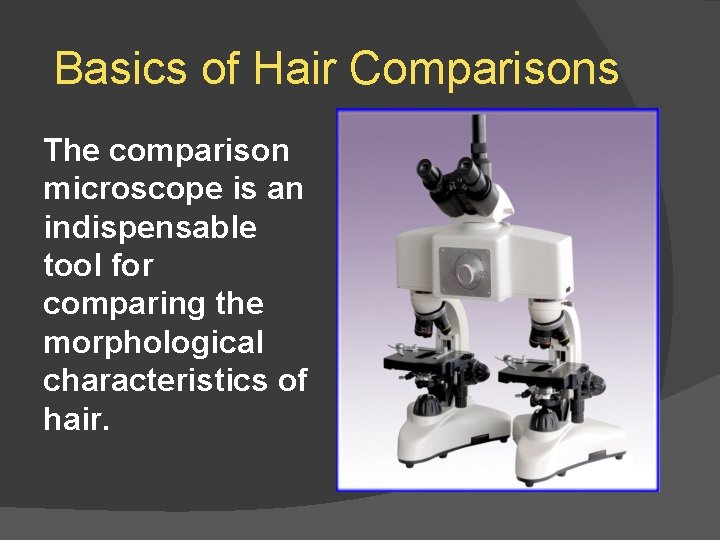
Basics of Hair Comparisons The comparison microscope is an indispensable tool for comparing the morphological characteristics of hair.
Basics of Hair Comparisons cont… 1. 2. 3. 4. 5. 6. 7. 8. 9. Color, Length, & diameter Distribution, shape and color intensity of pigments granules Dyed hair has color in cuticle and cortex Bleaching removes pigment and gives yellow tint Scale types Presence or absence of medulla Medullary type Medullary pattern Medullary index
Reliability of Hair Analysis � Hair is class evidence � Microscopic hair examinations tend to be subjective and highly dependant on the skills and integrity of the analyst. � As a rule, all positive microscopical hair comparisons must be confirmed by DNA analysis.
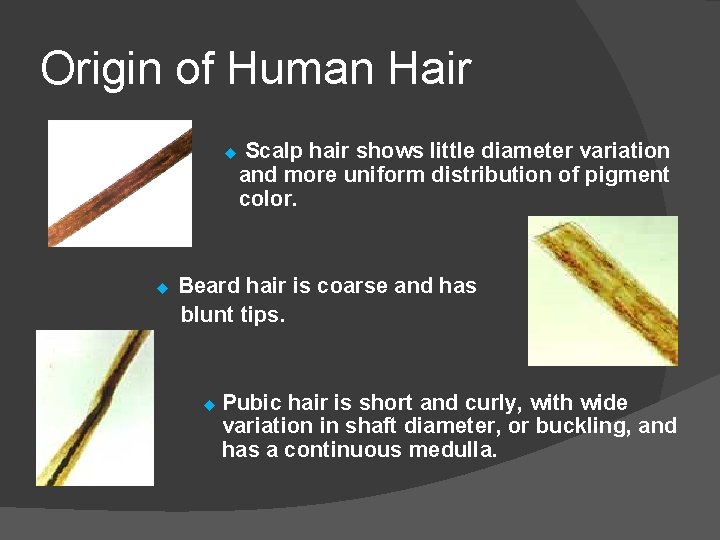
Origin of Human Hair u u Scalp hair shows little diameter variation and more uniform distribution of pigment color. Beard hair is coarse and has blunt tips. u Pubic hair is short and curly, with wide variation in shaft diameter, or buckling, and has a continuous medulla.
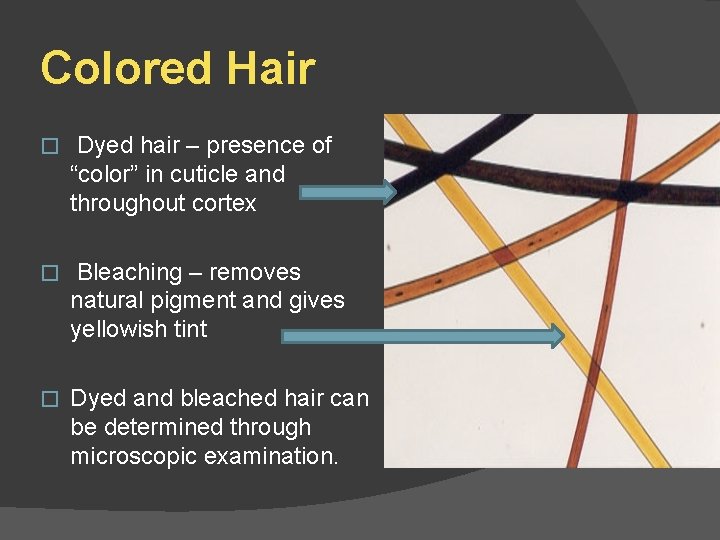
Colored Hair � Dyed hair – presence of “color” in cuticle and throughout cortex � Bleaching – removes natural pigment and gives yellowish tint � Dyed and bleached hair can be determined through microscopic examination.
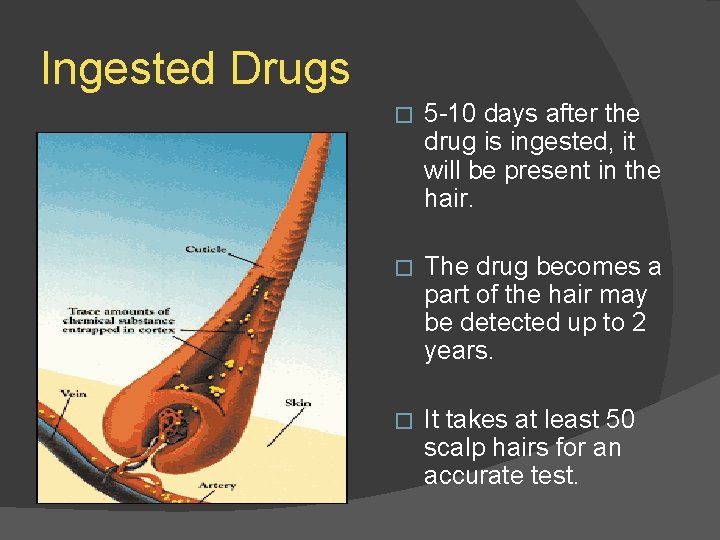
Ingested Drugs � 5 -10 days after the drug is ingested, it will be present in the hair. � The drug becomes a part of the hair may be detected up to 2 years. � It takes at least 50 scalp hairs for an accurate test.
Other Types of Identification u u Age - only infant’s hair can be determined because it is so fine. Sex- sex cannot be determined from hair. Manner- can determine if hair was forcibly removed. The follicle tag will still be attached. Individualization- through positive microscopic comparison and mitochondrial DNA analysis a link from questioned hair to standard hair can be proven.
Collection of Hair Evidence � Questioned hairs given to the lab for analysis must be accompanied by an adequate number of control samples. �from victim �possible suspects �others who may have deposited hair at the scene � The Control Sample should include: � 50 full-length hairs from all areas of scalp � 24 full-length pubic hairs �The full hair is needed so the control samples will be pulled out or cut as close as possible to the skin.
Bill Cosby’s son � Ennis Cosby was stranded on the side of a highway due to a flat tire. As Ennis waited for help, Mikail Markhasev robbed and murdered him. � The police found the murder weapon wrapped in a blue cap. Hair was also recovered from the cap. Markhasev was convicted on the murder based on the hair evidence. He later confessed to the crime.
Normal hair
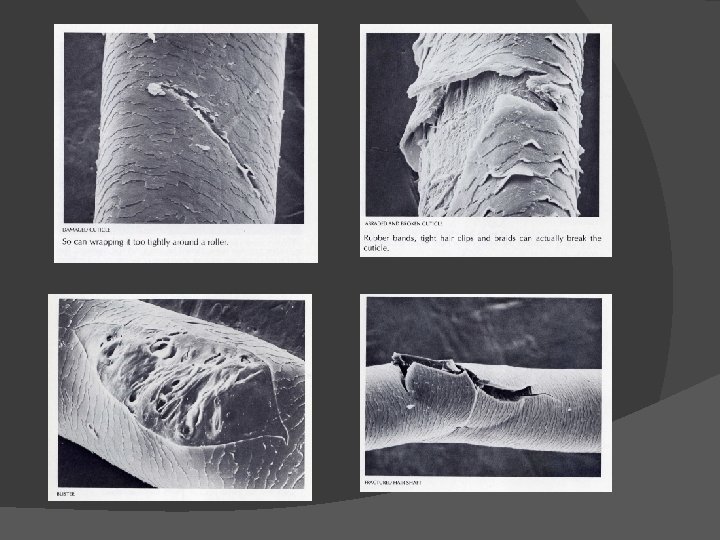
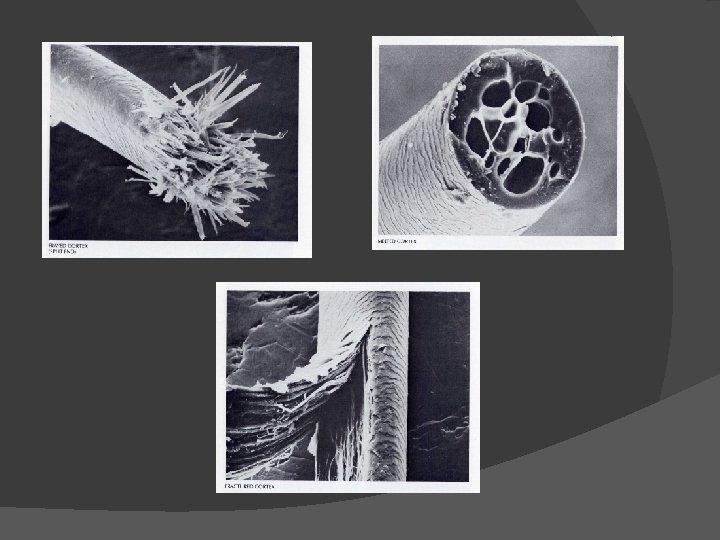
THE FOLLOWING SLIDES ARE JUST FOR OBSERVATION:
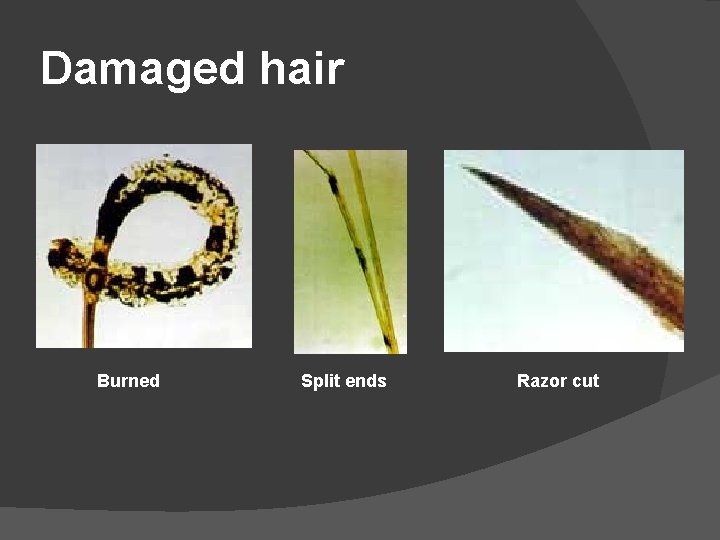
Damaged hair Burned Split ends Razor cut