
Chapter 10 The Shapes of Molecules Copyright The
- Slides: 46
Chapter 10 The Shapes of Molecules
Copyright ©The Mc. Graw-Hill Companies, Inc. Permission required for reproduction or display. Lewis Structures Mostly using the Octet Rule, but there are exceptions The best rules are in your handouts as well as in your lecture notes and following. Use them! 10 -2
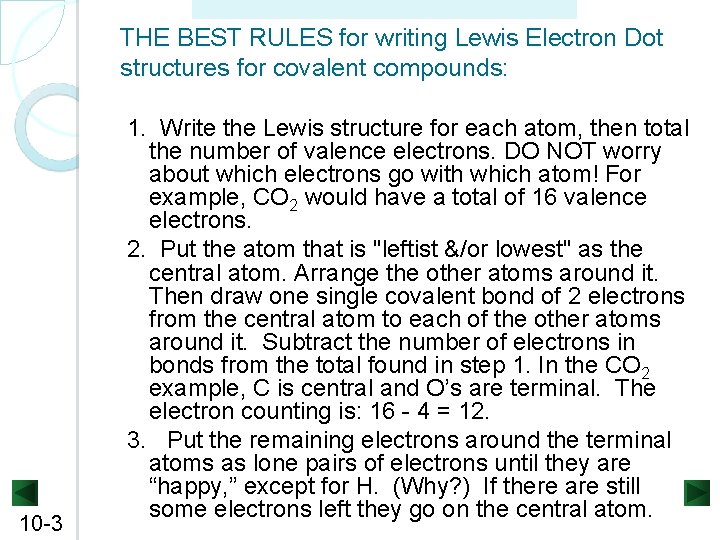
Copyright ©The Mc. Graw-Hill Companies, Inc. Permission required for reproduction or display. THE BEST RULES for writing Lewis Electron Dot structures for covalent compounds: 10 -3 1. Write the Lewis structure for each atom, then total the number of valence electrons. DO NOT worry about which electrons go with which atom! For example, CO 2 would have a total of 16 valence electrons. 2. Put the atom that is "leftist &/or lowest" as the central atom. Arrange the other atoms around it. Then draw one single covalent bond of 2 electrons from the central atom to each of the other atoms around it. Subtract the number of electrons in bonds from the total found in step 1. In the CO 2 example, C is central and O’s are terminal. The electron counting is: 16 - 4 = 12. 3. Put the remaining electrons around the terminal atoms as lone pairs of electrons until they are “happy, ” except for H. (Why? ) If there are still some electrons left they go on the central atom.
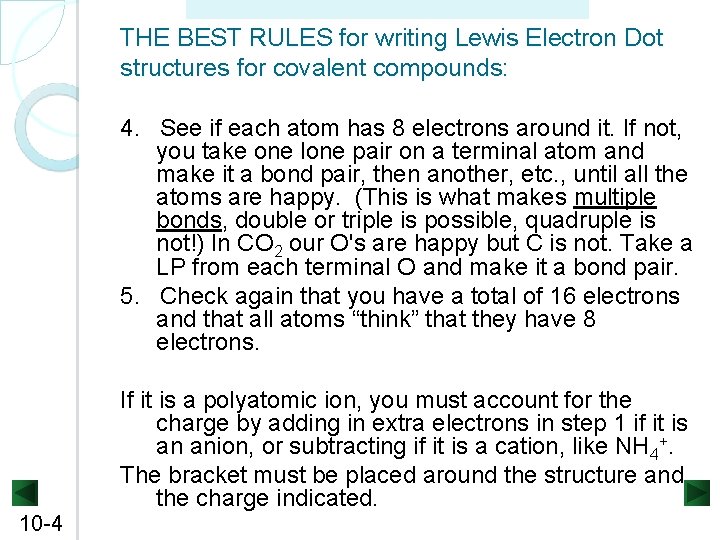
Copyright ©The Mc. Graw-Hill Companies, Inc. Permission required for reproduction or display. THE BEST RULES for writing Lewis Electron Dot structures for covalent compounds: 4. See if each atom has 8 electrons around it. If not, you take one lone pair on a terminal atom and make it a bond pair, then another, etc. , until all the atoms are happy. (This is what makes multiple bonds, double or triple is possible, quadruple is not!) In CO 2 our O's are happy but C is not. Take a LP from each terminal O and make it a bond pair. 5. Check again that you have a total of 16 electrons and that all atoms “think” that they have 8 electrons. If it is a polyatomic ion, you must account for the charge by adding in extra electrons in step 1 if it is an anion, or subtracting if it is a cation, like NH 4+. The bracket must be placed around the structure and the charge indicated. 10 -4
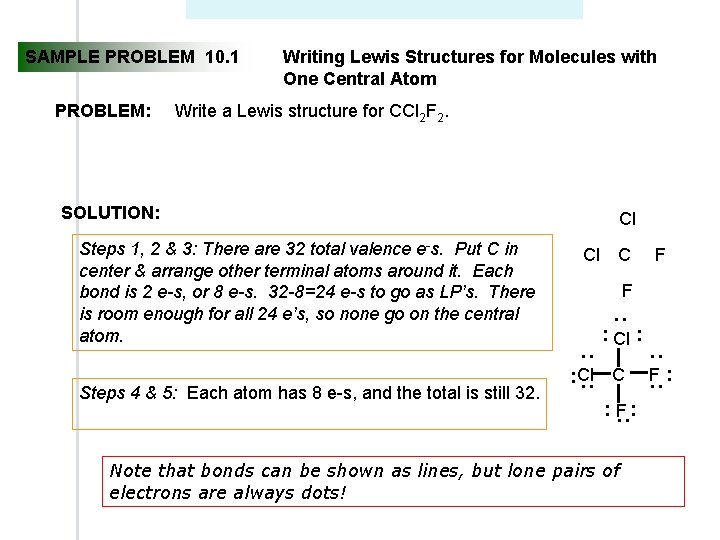
SAMPLE PROBLEM 10. 1 Write a Lewis structure for CCl 2 F 2. SOLUTION: F : : Cl : : : Cl C F: : F: : Steps 4 & 5: Each atom has 8 e-s, and the total is still 32. Cl C : Steps 1, 2 & 3: There are 32 total valence e-s. Put C in center & arrange other terminal atoms around it. Each bond is 2 e-s, or 8 e-s. 32 -8=24 e-s to go as LP’s. There is room enough for all 24 e’s, so none go on the central atom. Cl Note that bonds can be shown as lines, but lone pairs of electrons are always dots! : PROBLEM: Writing Lewis Structures for Molecules with One Central Atom
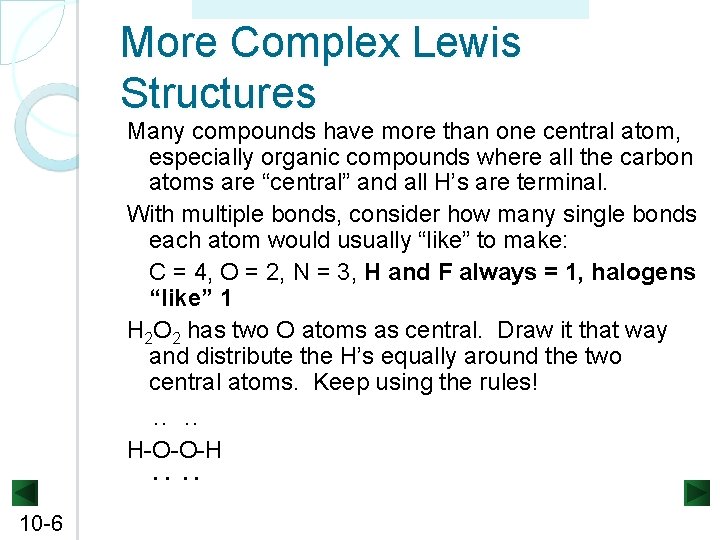
Copyright ©The Mc. Graw-Hill Companies, Inc. Permission required for reproduction or display. More Complex Lewis Structures Many compounds have more than one central atom, especially organic compounds where all the carbon atoms are “central” and all H’s are terminal. With multiple bonds, consider how many single bonds each atom would usually “like” to make: C = 4, O = 2, N = 3, H and F always = 1, halogens “like” 1 H 2 O 2 has two O atoms as central. Draw it that way and distribute the H’s equally around the two central atoms. Keep using the rules! . . H-O-O-H . . 10 -6
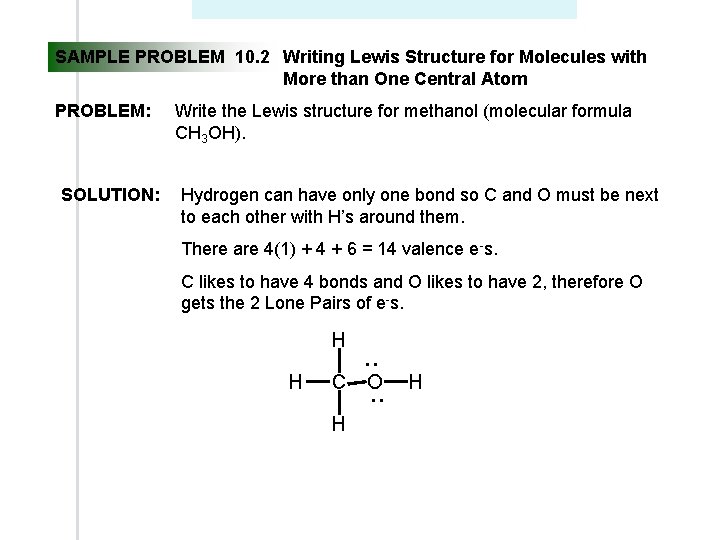
SAMPLE PROBLEM 10. 2 Writing Lewis Structure for Molecules with More than One Central Atom Hydrogen can have only one bond so C and O must be next to each other with H’s around them. There are 4(1) + 4 + 6 = 14 valence e-s. C likes to have 4 bonds and O likes to have 2, therefore O gets the 2 Lone Pairs of e-s. H : SOLUTION: Write the Lewis structure for methanol (molecular formula CH 3 OH). H C O : PROBLEM: H H
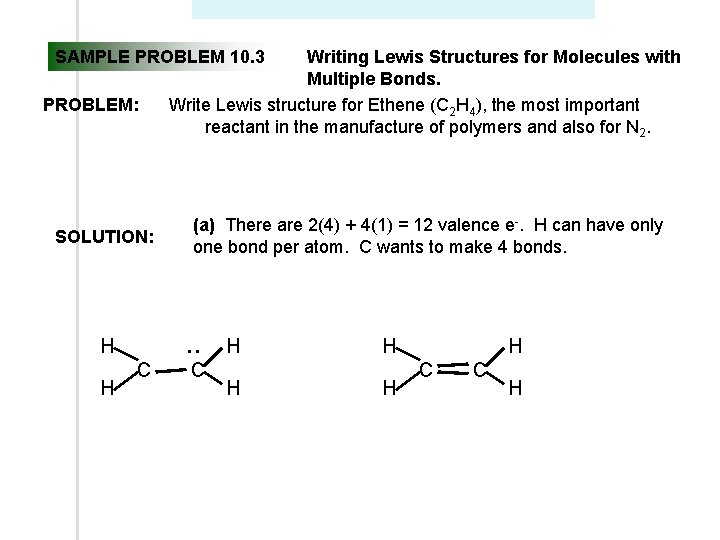
SAMPLE PROBLEM 10. 3 PROBLEM: SOLUTION: H (a) There are 2(4) + 4(1) = 12 valence e-. H can have only one bond per atom. C wants to make 4 bonds. : H Writing Lewis Structures for Molecules with Multiple Bonds. Write Lewis structure for Ethene (C 2 H 4), the most important reactant in the manufacture of polymers and also for N 2. C C H H H C C H
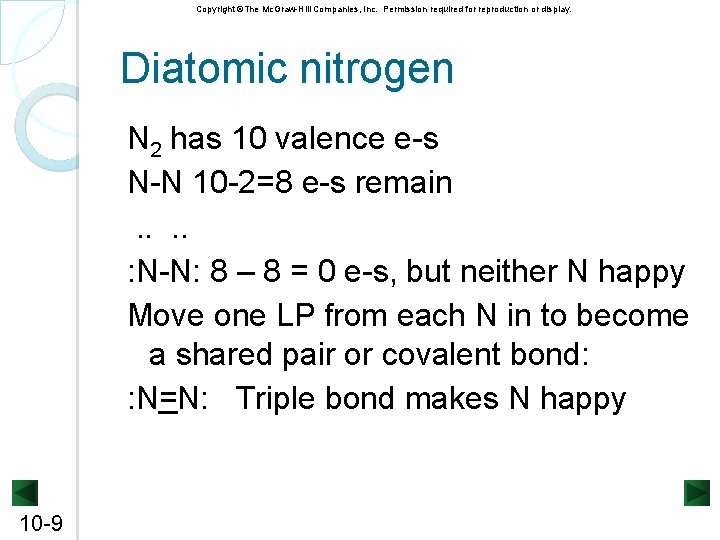
Copyright ©The Mc. Graw-Hill Companies, Inc. Permission required for reproduction or display. Diatomic nitrogen N 2 has 10 valence e-s N-N 10 -2=8 e-s remain . . : N-N: 8 – 8 = 0 e-s, but neither N happy Move one LP from each N in to become a shared pair or covalent bond: : N=N: Triple bond makes N happy 10 -9
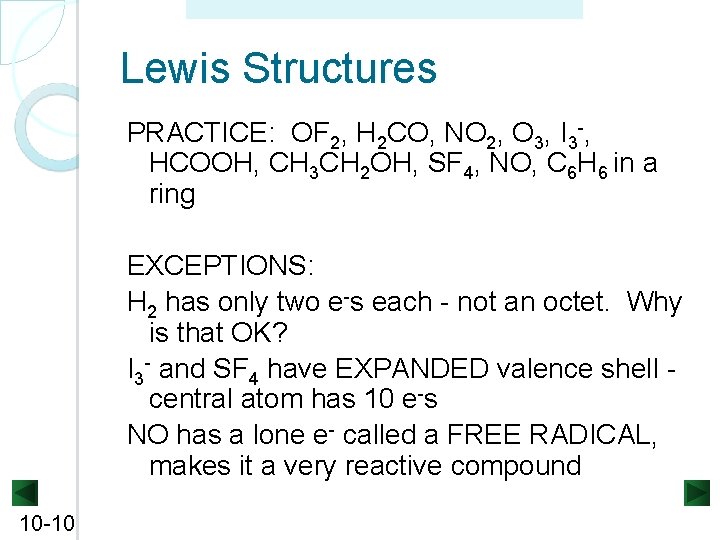
Copyright ©The Mc. Graw-Hill Companies, Inc. Permission required for reproduction or display. Lewis Structures PRACTICE: OF 2, H 2 CO, NO 2, O 3, I 3 -, HCOOH, CH 3 CH 2 OH, SF 4, NO, C 6 H 6 in a ring EXCEPTIONS: H 2 has only two e-s each - not an octet. Why is that OK? I 3 - and SF 4 have EXPANDED valence shell - central atom has 10 e-s NO has a lone e- called a FREE RADICAL, makes it a very reactive compound 10 -10
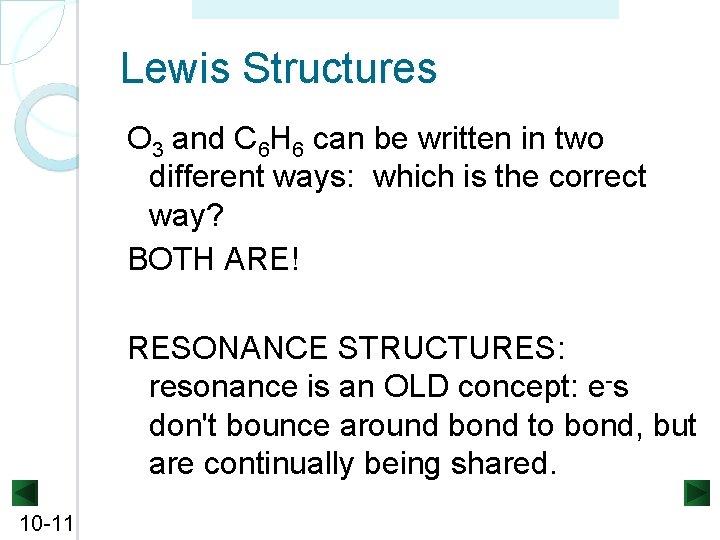
Copyright ©The Mc. Graw-Hill Companies, Inc. Permission required for reproduction or display. Lewis Structures O 3 and C 6 H 6 can be written in two different ways: which is the correct way? BOTH ARE! RESONANCE STRUCTURES: resonance is an OLD concept: e-s don't bounce around bond to bond, but are continually being shared. 10 -11
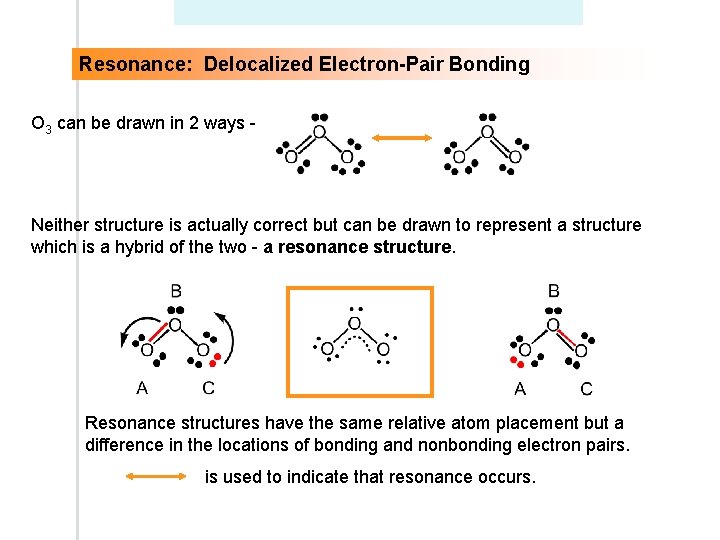
Resonance: Delocalized Electron-Pair Bonding O 3 can be drawn in 2 ways - Neither structure is actually correct but can be drawn to represent a structure which is a hybrid of the two - a resonance structure. Resonance structures have the same relative atom placement but a difference in the locations of bonding and nonbonding electron pairs. is used to indicate that resonance occurs.
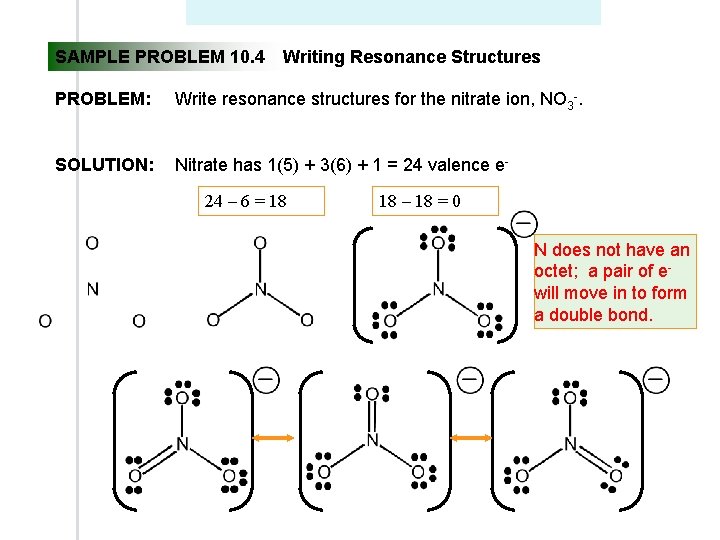
SAMPLE PROBLEM 10. 4 Writing Resonance Structures PROBLEM: Write resonance structures for the nitrate ion, NO 3 -. SOLUTION: Nitrate has 1(5) + 3(6) + 1 = 24 valence e 24 – 6 = 18 18 – 18 = 0 N does not have an octet; a pair of e- will move in to form a double bond.
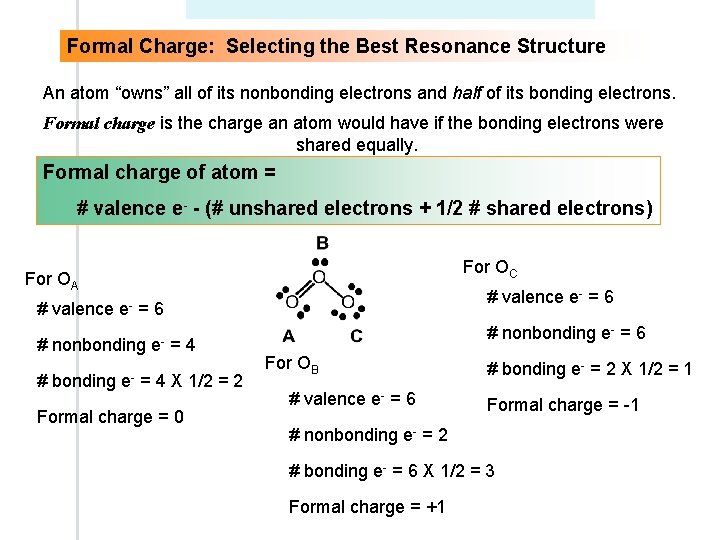
Formal Charge: Selecting the Best Resonance Structure An atom “owns” all of its nonbonding electrons and half of its bonding electrons. Formal charge is the charge an atom would have if the bonding electrons were shared equally. Formal charge of atom = # valence e- - (# unshared electrons + 1/2 # shared electrons) For OC For OA # valence e- = 6 # nonbonding e- = 4 # bonding e- = 4 X 1/2 = 2 Formal charge = 0 # nonbonding e- = 6 For OB # valence e- = 6 # bonding e- = 2 X 1/2 = 1 Formal charge = -1 # nonbonding e- = 2 # bonding e- = 6 X 1/2 = 3 Formal charge = +1
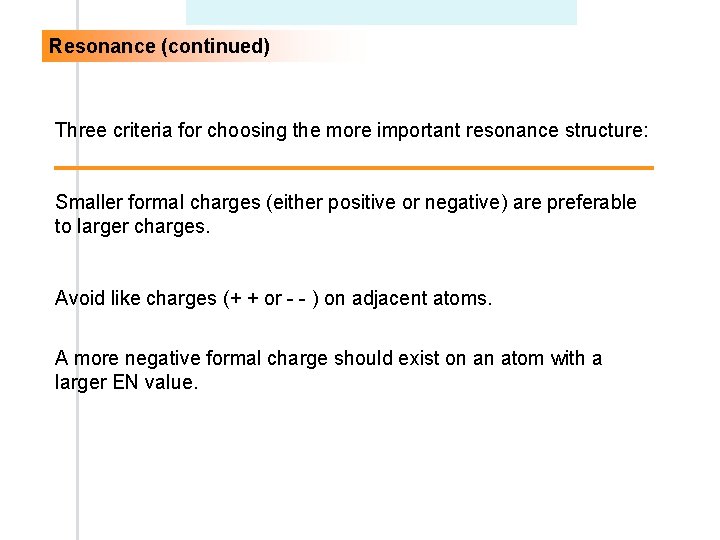
Resonance (continued) Three criteria for choosing the more important resonance structure: Smaller formal charges (either positive or negative) are preferable to larger charges. Avoid like charges (+ + or - - ) on adjacent atoms. A more negative formal charge should exist on an atom with a larger EN value.
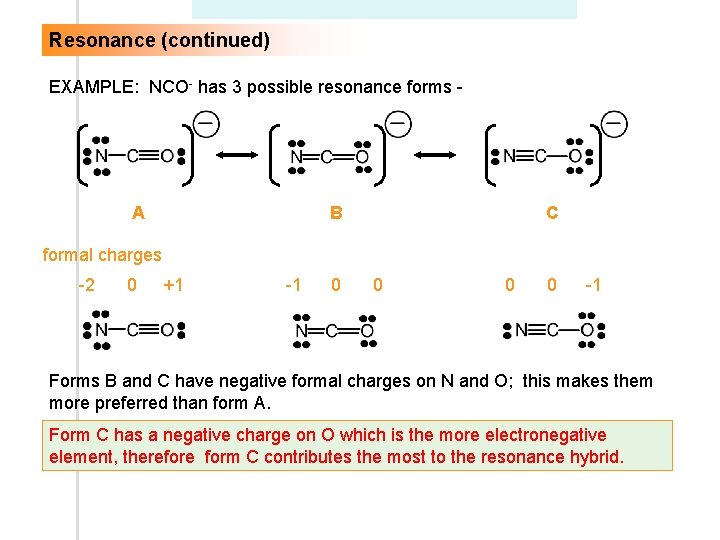
Resonance (continued) EXAMPLE: NCO- has 3 possible resonance forms - A B C formal charges -2 0 +1 -1 0 0 -1 Forms B and C have negative formal charges on N and O; this makes them more preferred than form A. Form C has a negative charge on O which is the more electronegative element, therefore form C contributes the most to the resonance hybrid.
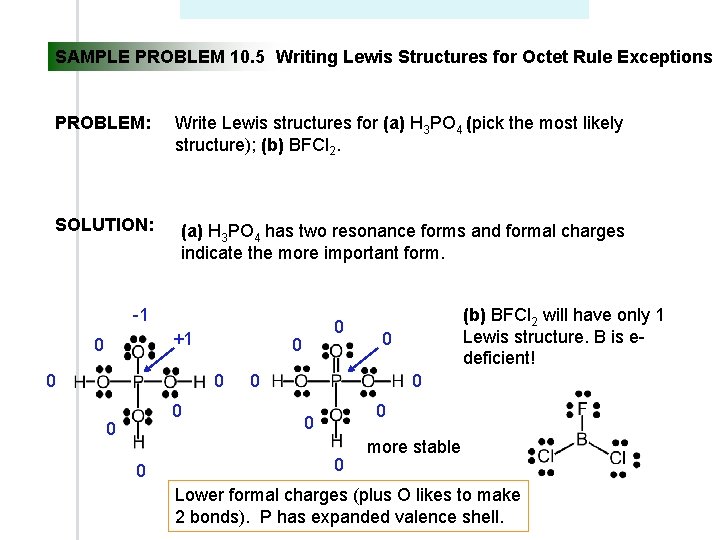
SAMPLE PROBLEM 10. 5 Writing Lewis Structures for Octet Rule Exceptions PROBLEM: Write Lewis structures for (a) H 3 PO 4 (pick the most likely structure); (b) BFCl 2. SOLUTION: (a) H 3 PO 4 has two resonance forms and formal charges indicate the more important form. -1 +1 0 0 0 0 (b) BFCl 2 will have only 1 Lewis structure. B is e- deficient! 0 0 0 more stable Lower formal charges (plus O likes to make 2 bonds). P has expanded valence shell.
Copyright ©The Mc. Graw-Hill Companies, Inc. Permission required for reproduction or display. Localized electron bonding model: Assumes that a molecule is composed of atoms that are bound together by sharing pairs of e-s using the atomic orbitals of the bound atoms - shared pairs are called bonding pairs - those found on one atom are called lone pairs This basic model was seen with our drawing of Lewis structures 10 -18 It is also the basis of VSEPR Theory
Copyright ©The Mc. Graw-Hill Companies, Inc. Permission required for reproduction or display. VSEPR THEORY: VALENCE SHELL ELECTRON PAIR REPULSION THEORY Methane’s Lewis dot structure is 2 -D and looks flat with 90 o bond angles. Methane in reality, in 3 -D, is a regular tetrahedron with bond angles = 109° Are CH 3 Cl and CH 2 Cl 2 equivalent geometric structures? Molecular Shape = function of repulsion of electron pairs in valence shell of central atom(s) Electron pairs try to arrange themselves as far apart as possible to minimize repulsions - this includes LP's as well as BP's - to minimize electrostatic repulsion. 10 -19
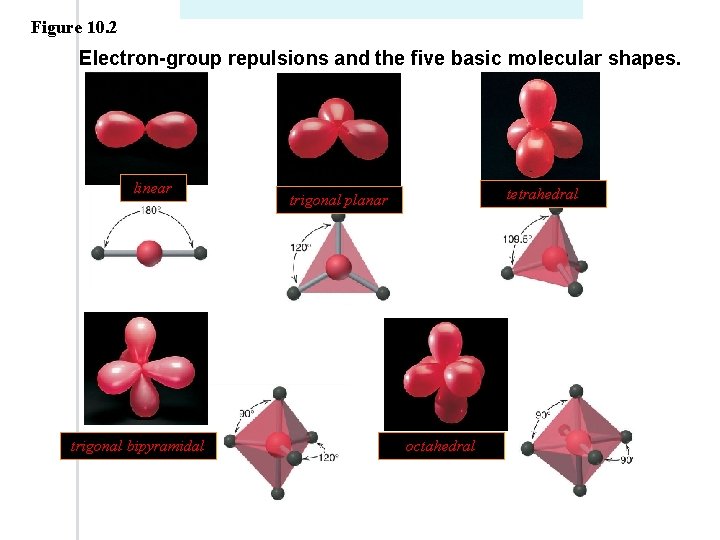
Copyright ©The Mc. Graw-Hill Companies, Inc. Permission required for reproduction or display. VSEPR THEORY: VALENCE SHELL ELECTRON PAIR REPULSION THEORY 10 -20 This leads to five major families of e- pair arrangements: linear, trigonal planar, tetrahedral, trigonal bipyramidal, octahedral. When drawing these we use AXb. Ec where: A= central atom X (or B) = surrounding atom(s) E = nonbonding valence e- group (lone pair)
Figure 10. 2 Electron-group repulsions and the five basic molecular shapes. linear trigonal bipyramidal tetrahedral trigonal planar octahedral
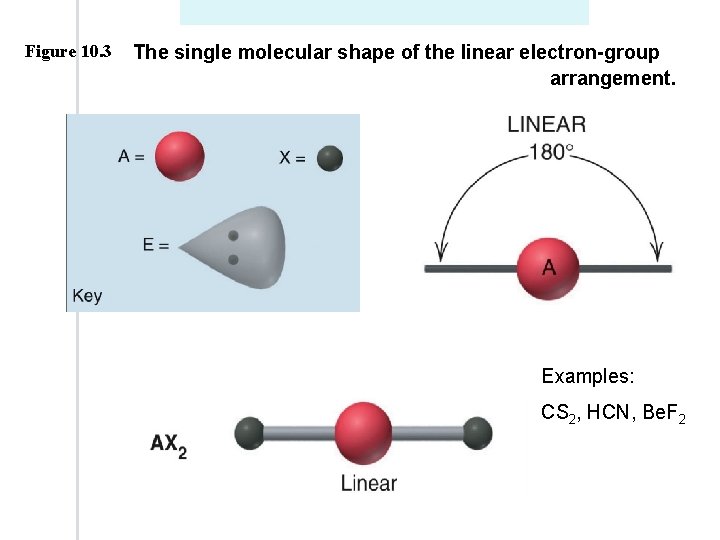
Figure 10. 3 The single molecular shape of the linear electron-group arrangement. Examples: CS 2, HCN, Be. F 2
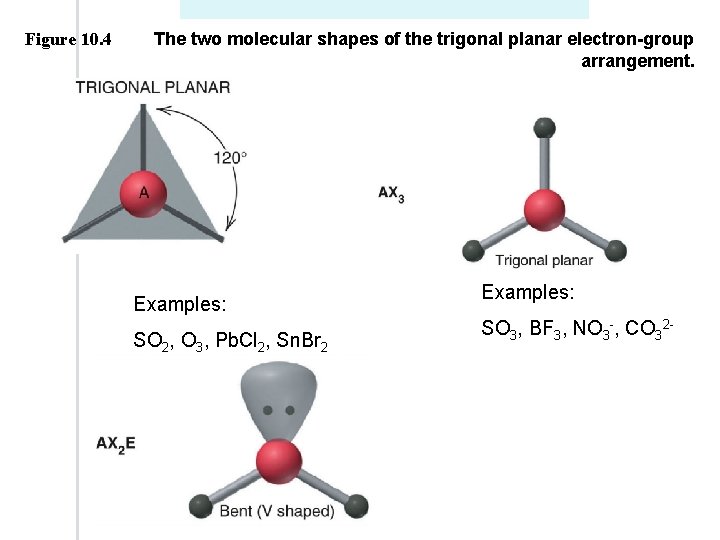
Figure 10. 4 The two molecular shapes of the trigonal planar electron-group arrangement. Examples: SO 2, O 3, Pb. Cl 2, Sn. Br 2 Examples: SO 3, BF 3, NO 3 -, CO 32 -
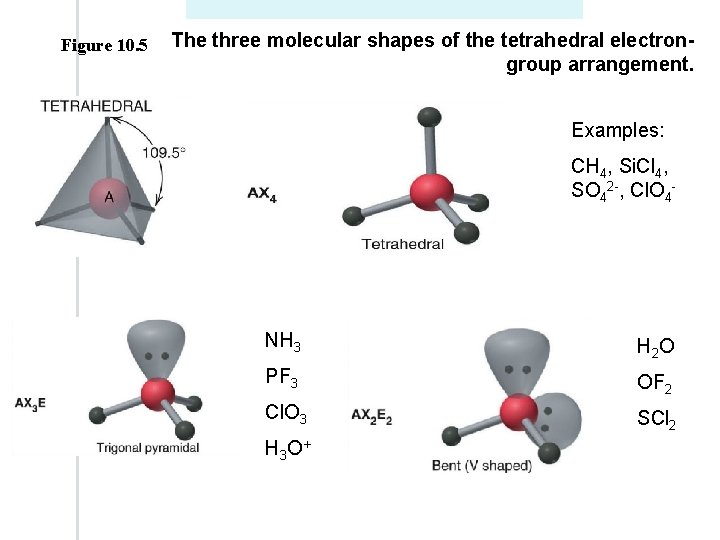
Figure 10. 5 The three molecular shapes of the tetrahedral electrongroup arrangement. Examples: CH 4, Si. Cl 4, SO 42 -, Cl. O 4 - NH 3 H 2 O PF 3 OF 2 Cl. O 3 SCl 2 H 3 O +
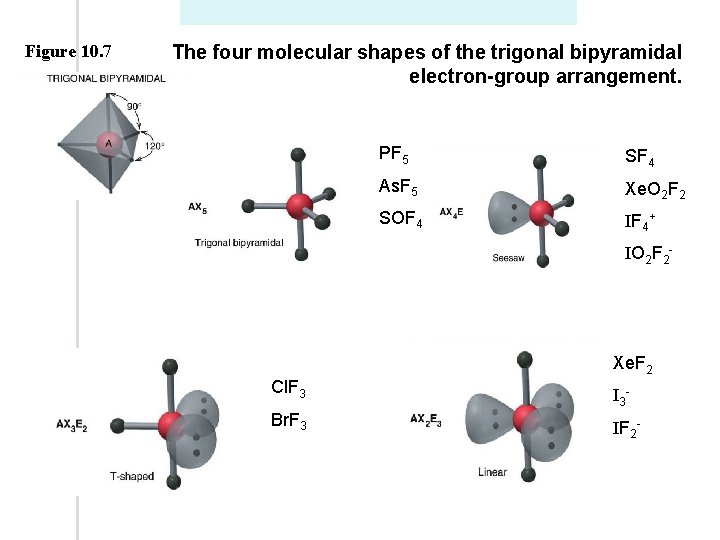
Figure 10. 7 The four molecular shapes of the trigonal bipyramidal electron-group arrangement. PF 5 SF 4 As. F 5 Xe. O 2 F 2 SOF 4 IF 4+ IO 2 F 2 - Xe. F 2 Cl. F 3 I 3 - Br. F 3 IF 2 -
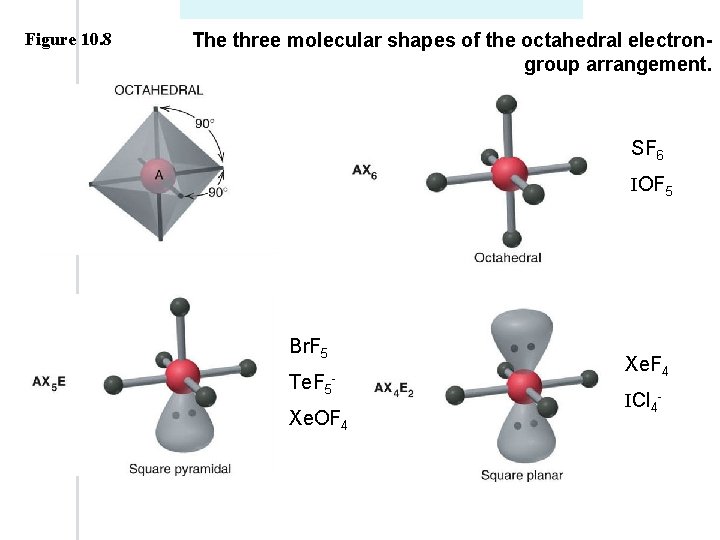
Figure 10. 8 The three molecular shapes of the octahedral electrongroup arrangement. SF 6 IOF 5 Br. F 5 Te. F 5 - Xe. OF 4 Xe. F 4 ICl 4 -
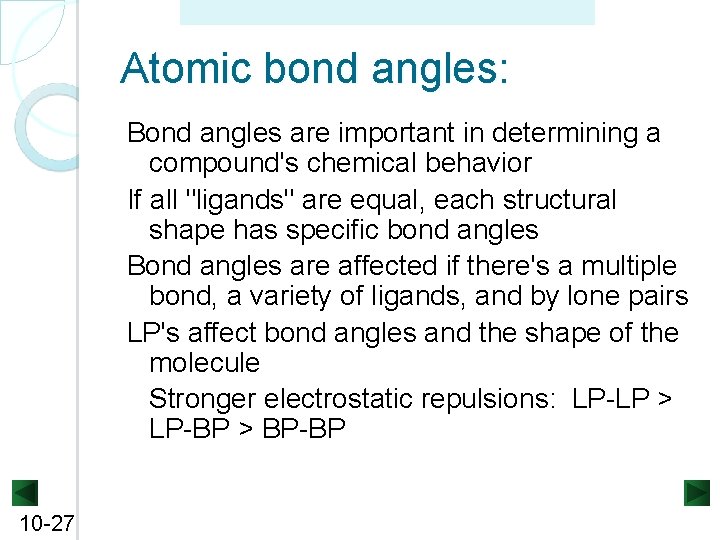
Copyright ©The Mc. Graw-Hill Companies, Inc. Permission required for reproduction or display. Atomic bond angles: Bond angles are important in determining a compound's chemical behavior If all "ligands" are equal, each structural shape has specific bond angles Bond angles are affected if there's a multiple bond, a variety of ligands, and by lone pairs LP's affect bond angles and the shape of the molecule Stronger electrostatic repulsions: LP-LP > LP-BP > BP-BP 10 -27
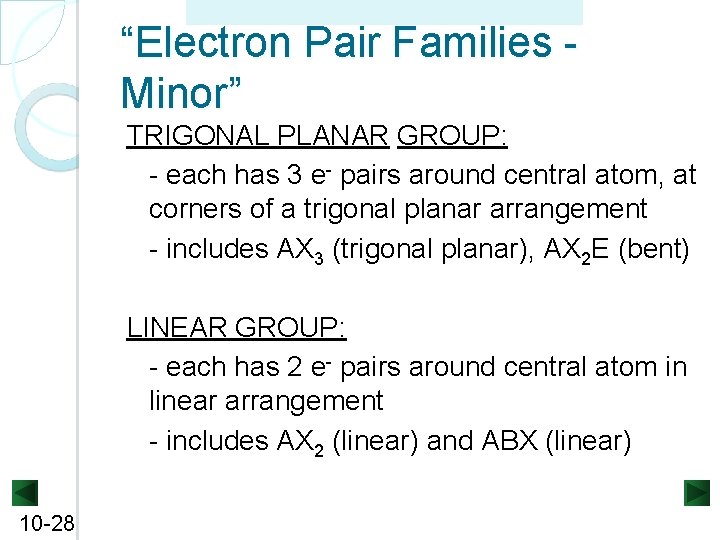
Copyright ©The Mc. Graw-Hill Companies, Inc. Permission required for reproduction or display. “Electron Pair Families - Minor” TRIGONAL PLANAR GROUP: - each has 3 e- pairs around central atom, at corners of a trigonal planar arrangement - includes AX 3 (trigonal planar), AX 2 E (bent) LINEAR GROUP: - each has 2 e- pairs around central atom in linear arrangement - includes AX 2 (linear) and ABX (linear) 10 -28
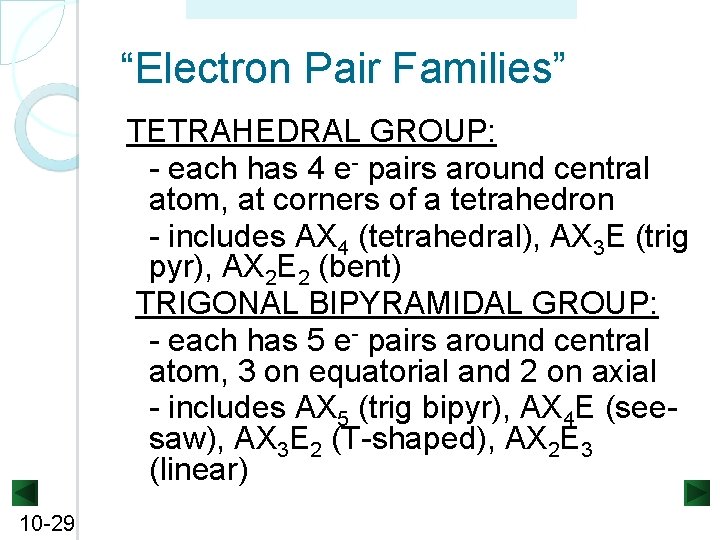
Copyright ©The Mc. Graw-Hill Companies, Inc. Permission required for reproduction or display. “Electron Pair Families” 10 -29 TETRAHEDRAL GROUP: - each has 4 e- pairs around central atom, at corners of a tetrahedron - includes AX 4 (tetrahedral), AX 3 E (trig pyr), AX 2 E 2 (bent) TRIGONAL BIPYRAMIDAL GROUP: - each has 5 e- pairs around central atom, 3 on equatorial and 2 on axial - includes AX 5 (trig bipyr), AX 4 E (seesaw), AX 3 E 2 (T-shaped), AX 2 E 3 (linear)
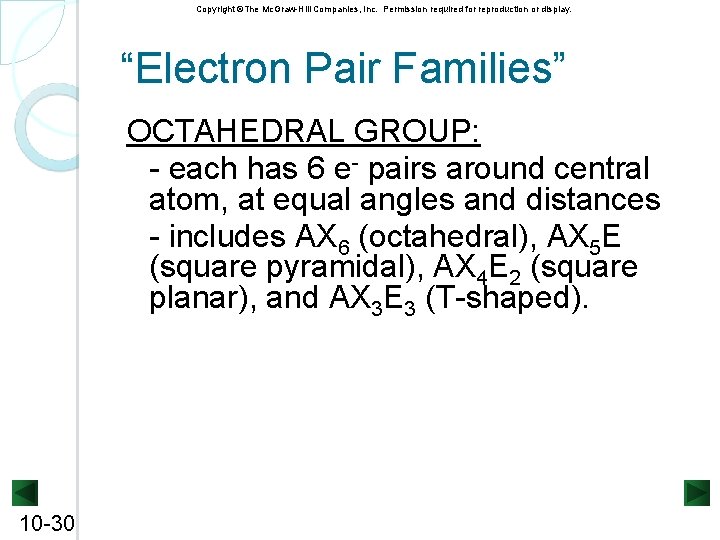
Copyright ©The Mc. Graw-Hill Companies, Inc. Permission required for reproduction or display. “Electron Pair Families” OCTAHEDRAL GROUP: - each has 6 e- pairs around central atom, at equal angles and distances - includes AX 6 (octahedral), AX 5 E (square pyramidal), AX 4 E 2 (square planar), and AX 3 E 3 (T-shaped). 10 -30
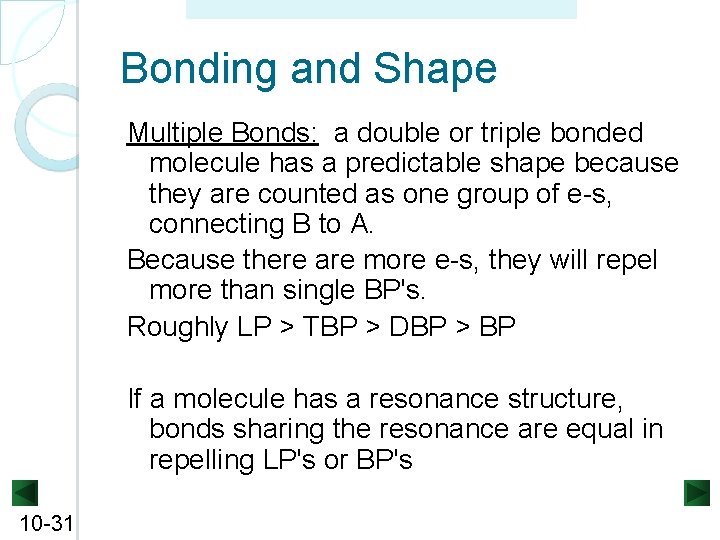
Copyright ©The Mc. Graw-Hill Companies, Inc. Permission required for reproduction or display. Bonding and Shape Multiple Bonds: a double or triple bonded molecule has a predictable shape because they are counted as one group of e-s, connecting B to A. Because there are more e-s, they will repel more than single BP's. Roughly LP > TBP > DBP > BP If a molecule has a resonance structure, bonds sharing the resonance are equal in repelling LP's or BP's 10 -31
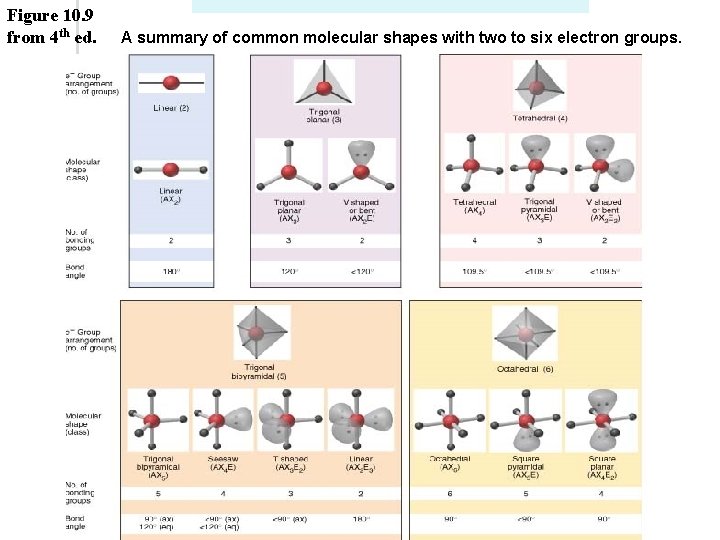
Figure 10. 9 from 4 th ed. A summary of common molecular shapes with two to six electron groups.
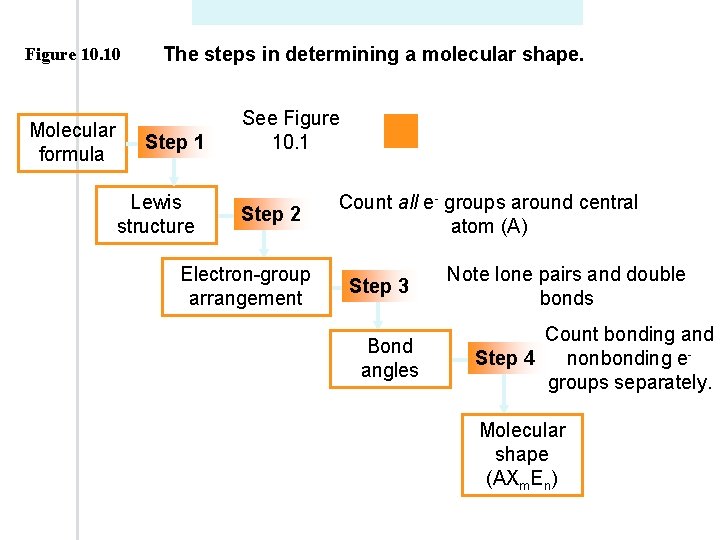
Figure 10. 10 Molecular formula The steps in determining a molecular shape. Step 1 Lewis structure See Figure 10. 1 Step 2 Electron-group arrangement Count all e- groups around central atom (A) Step 3 Bond angles Note lone pairs and double bonds Count bonding and Step 4 nonbonding e- groups separately. Molecular shape (AXm. En)
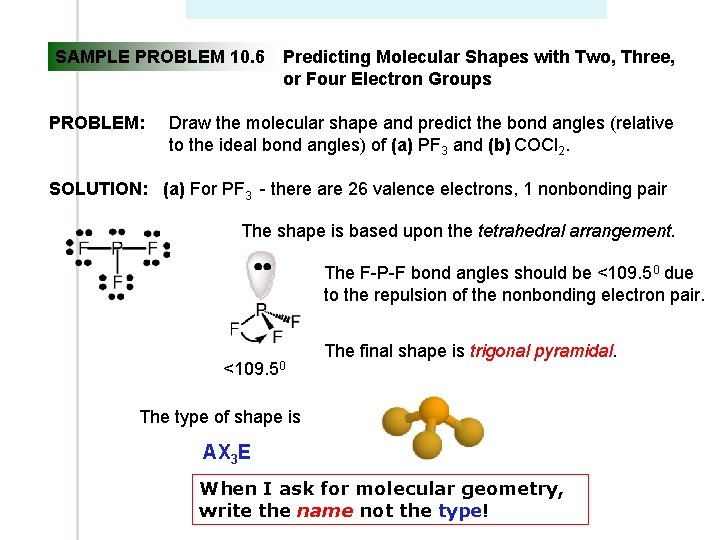
SAMPLE PROBLEM 10. 6 PROBLEM: Predicting Molecular Shapes with Two, Three, or Four Electron Groups Draw the molecular shape and predict the bond angles (relative to the ideal bond angles) of (a) PF 3 and (b) COCl 2. SOLUTION: (a) For PF 3 - there are 26 valence electrons, 1 nonbonding pair The shape is based upon the tetrahedral arrangement. The F-P-F bond angles should be <109. 50 due to the repulsion of the nonbonding electron pair. <109. 50 The final shape is trigonal pyramidal. The type of shape is AX 3 E When I ask for molecular geometry, write the name not the type!
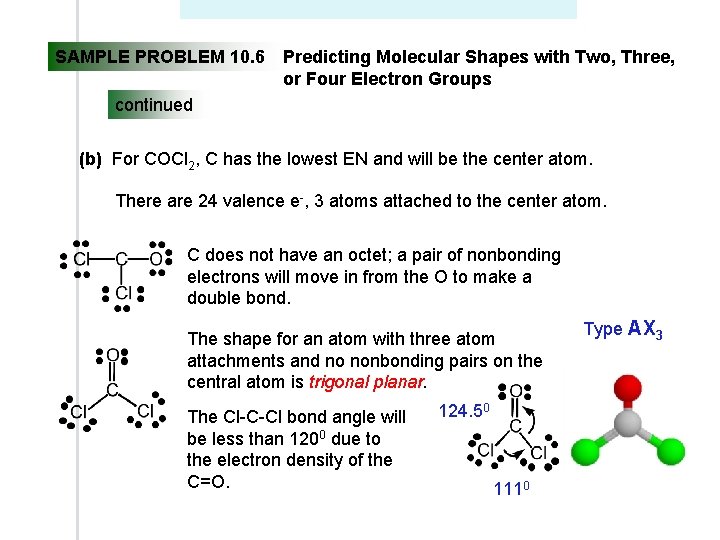
SAMPLE PROBLEM 10. 6 Predicting Molecular Shapes with Two, Three, or Four Electron Groups continued (b) For COCl 2, C has the lowest EN and will be the center atom. There are 24 valence e-, 3 atoms attached to the center atom. C does not have an octet; a pair of nonbonding electrons will move in from the O to make a double bond. The shape for an atom with three atom attachments and no nonbonding pairs on the central atom is trigonal planar. The Cl-C-Cl bond angle will be less than 1200 due to the electron density of the C=O. 124. 50 1110 Type AX 3
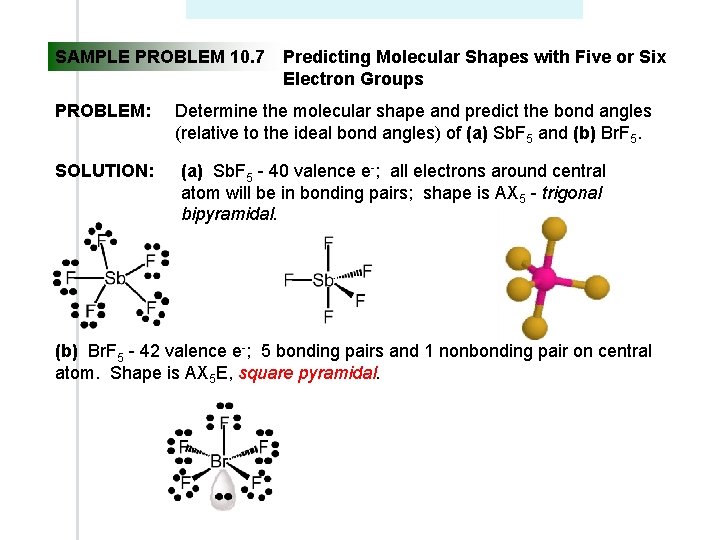
SAMPLE PROBLEM 10. 7 PROBLEM: SOLUTION: Predicting Molecular Shapes with Five or Six Electron Groups Determine the molecular shape and predict the bond angles (relative to the ideal bond angles) of (a) Sb. F 5 and (b) Br. F 5. (a) Sb. F 5 - 40 valence e-; all electrons around central atom will be in bonding pairs; shape is AX 5 - trigonal bipyramidal. (b) Br. F 5 - 42 valence e-; 5 bonding pairs and 1 nonbonding pair on central atom. Shape is AX 5 E, square pyramidal.
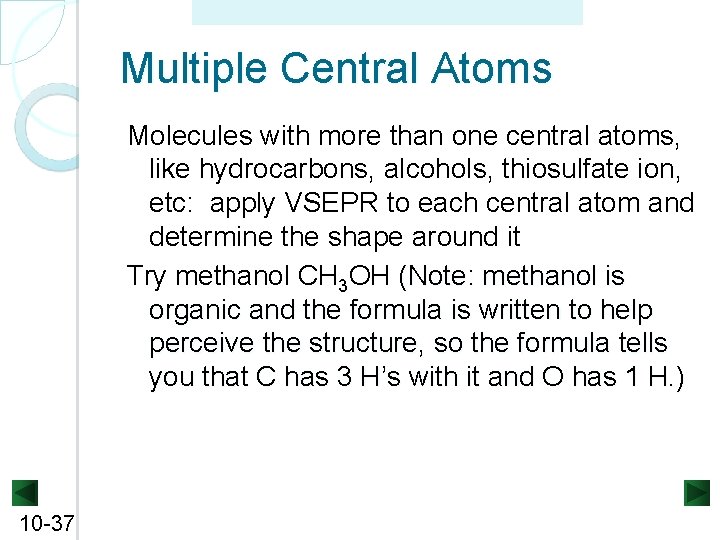
Copyright ©The Mc. Graw-Hill Companies, Inc. Permission required for reproduction or display. Multiple Central Atoms Molecules with more than one central atoms, like hydrocarbons, alcohols, thiosulfate ion, etc: apply VSEPR to each central atom and determine the shape around it Try methanol CH 3 OH (Note: methanol is organic and the formula is written to help perceive the structure, so the formula tells you that C has 3 H’s with it and O has 1 H. ) 10 -37
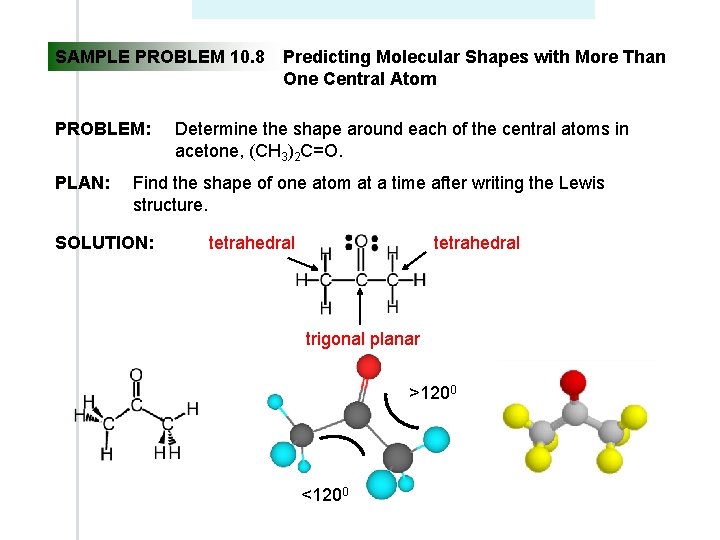
SAMPLE PROBLEM 10. 8 PROBLEM: PLAN: Predicting Molecular Shapes with More Than One Central Atom Determine the shape around each of the central atoms in acetone, (CH 3)2 C=O. Find the shape of one atom at a time after writing the Lewis structure. SOLUTION: tetrahedral trigonal planar >1200 <1200
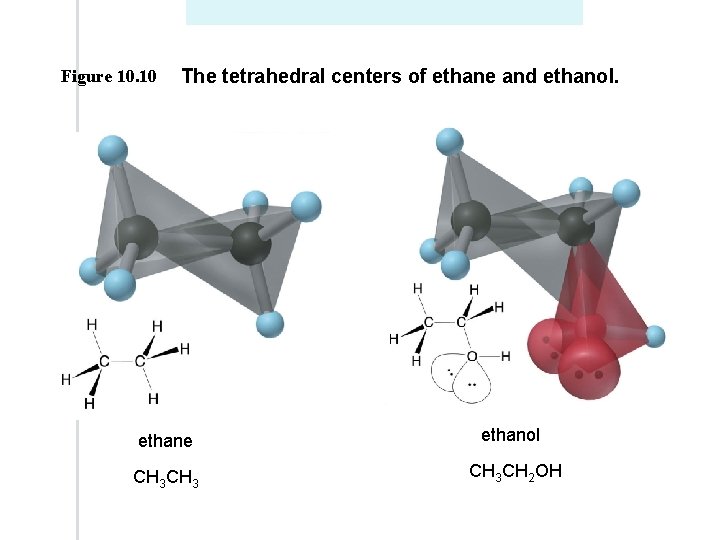
Figure 10. 10 The tetrahedral centers of ethane and ethanol. ethane ethanol CH 3 CH 2 OH
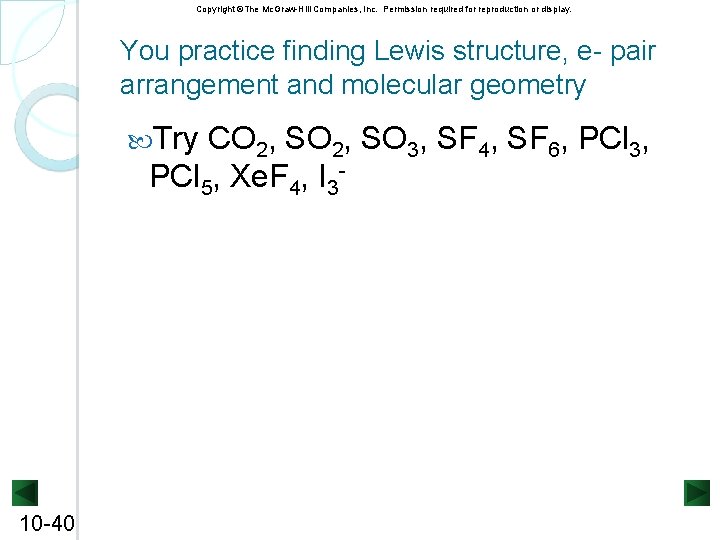
Copyright ©The Mc. Graw-Hill Companies, Inc. Permission required for reproduction or display. You practice finding Lewis structure, e- pair arrangement and molecular geometry Try CO 2, SO 3, SF 4, SF 6, PCl 3, PCl 5, Xe. F 4, I 3 - 10 -40
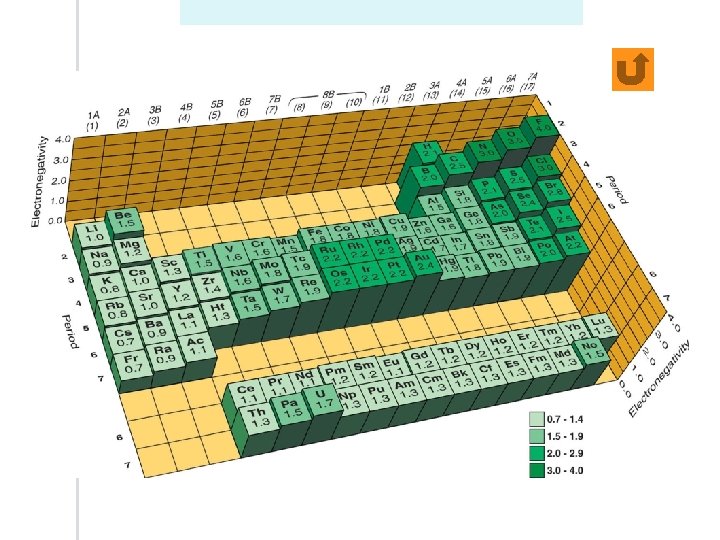
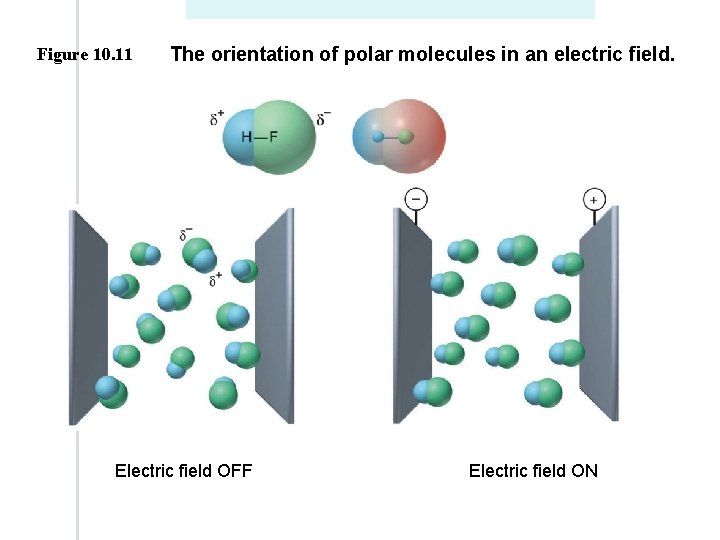
Copyright ©The Mc. Graw-Hill Companies, Inc. Permission required for reproduction or display. Dipole Moments & Electronegativity Refer to handout and recall electronegativity and polar covalent bonding from last chapter If a bond is polar covalent, one end is slightly negative and the other is slightly positive Leads to a dipole moment, which can respond to an external electrical field 10 -41
Figure 10. 11 The orientation of polar molecules in an electric field. Electric field OFF Electric field ON
Copyright ©The Mc. Graw-Hill Companies, Inc. Permission required for reproduction or display. Molecular Dipole Moment DIPOLE MOMENT: polar covalent bonds cause a molecule to have a dipole moment, unless the polarity vectors cancel each other in a symmetrical arrangement (see handout) Nonpolar (CCl 4, PCl 5, SF 6) 10 -44 If a molecule is not symmetric, it will probably have a dipole moment (Br. F 3, OF 2, NH 3, SF 4)
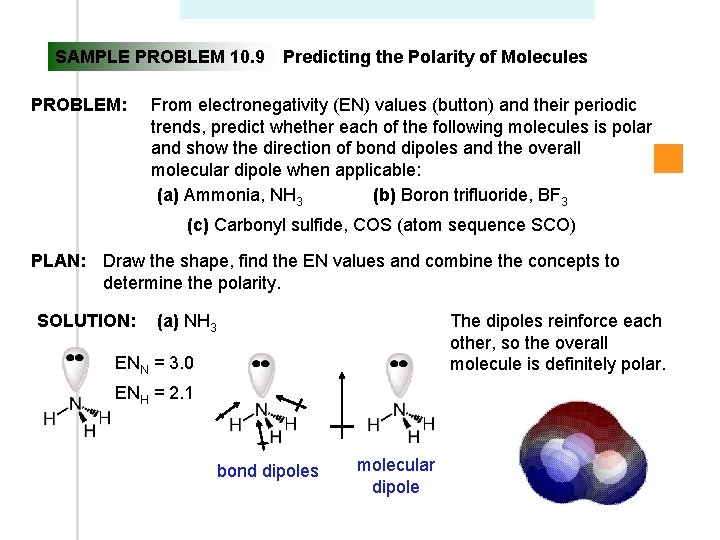
SAMPLE PROBLEM 10. 9 PROBLEM: Predicting the Polarity of Molecules From electronegativity (EN) values (button) and their periodic trends, predict whether each of the following molecules is polar and show the direction of bond dipoles and the overall molecular dipole when applicable: (a) Ammonia, NH 3 (b) Boron trifluoride, BF 3 (c) Carbonyl sulfide, COS (atom sequence SCO) PLAN: Draw the shape, find the EN values and combine the concepts to determine the polarity. SOLUTION: (a) NH 3 The dipoles reinforce each other, so the overall molecule is definitely polar. ENN = 3. 0 ENH = 2. 1 bond dipoles molecular dipole
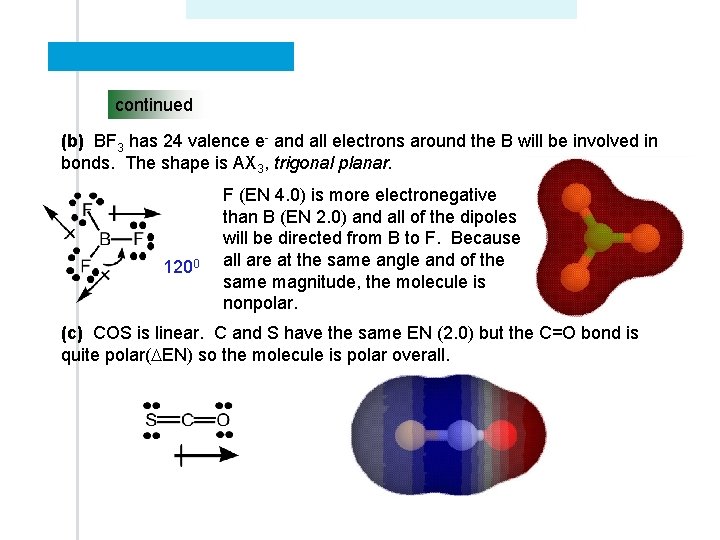
continued (b) BF 3 has 24 valence e- and all electrons around the B will be involved in bonds. The shape is AX 3, trigonal planar. 1200 F (EN 4. 0) is more electronegative than B (EN 2. 0) and all of the dipoles will be directed from B to F. Because all are at the same angle and of the same magnitude, the molecule is nonpolar. (c) COS is linear. C and S have the same EN (2. 0) but the C=O bond is quite polar(DEN) so the molecule is polar overall.