
Chapter 10 The Muscular System 1 The Muscular


- Slides: 60
Chapter 10 The Muscular System 1
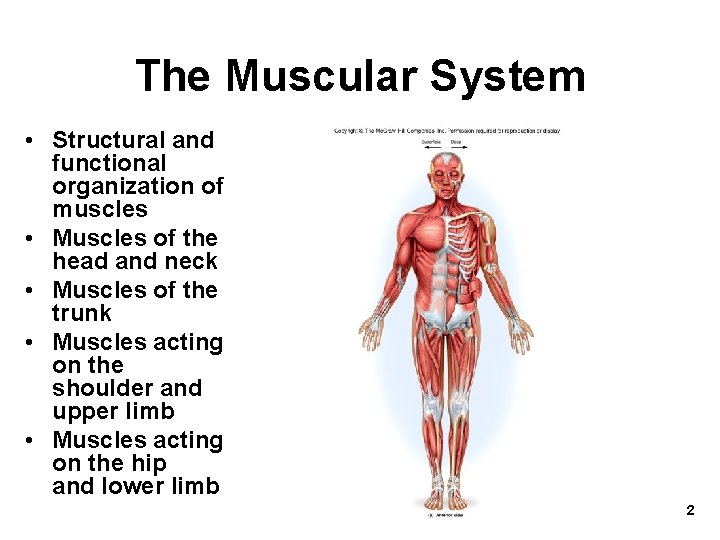
The Muscular System • Structural and functional organization of muscles • Muscles of the head and neck • Muscles of the trunk • Muscles acting on the shoulder and upper limb • Muscles acting on the hip and lower limb 2
Organization of Muscles • 600 Human skeletal muscles • General structural and functional topics – muscle shape and function – connective tissues of muscle – coordinated actions of muscle groups – intrinsic and extrinsic muscles – muscle innervation • Regional descriptions 3
The Functions of Muscles • Movement of body parts and organ contents • Maintain posture and prevent movement • Communication - speech, expression and writing • Control of openings and passageways • Heat production 4
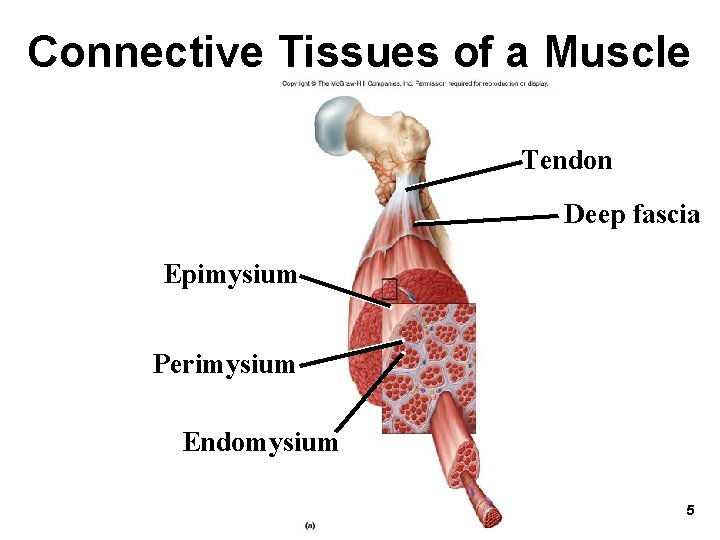
Connective Tissues of a Muscle Tendon Deep fascia Epimysium Perimysium Endomysium 5
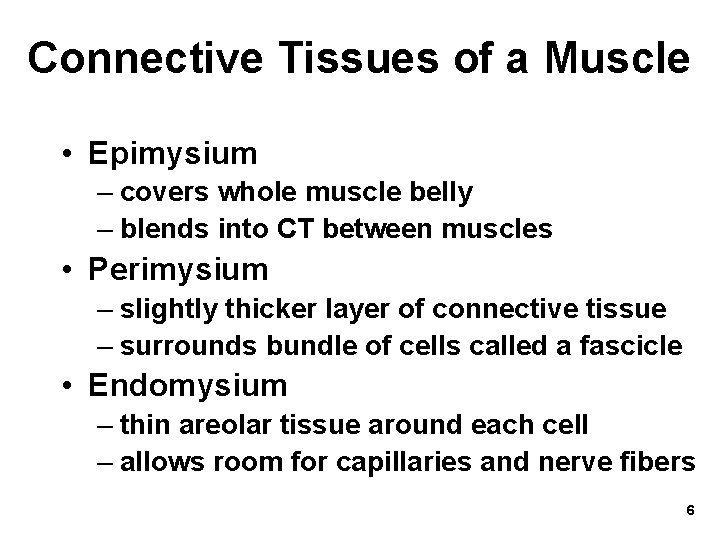
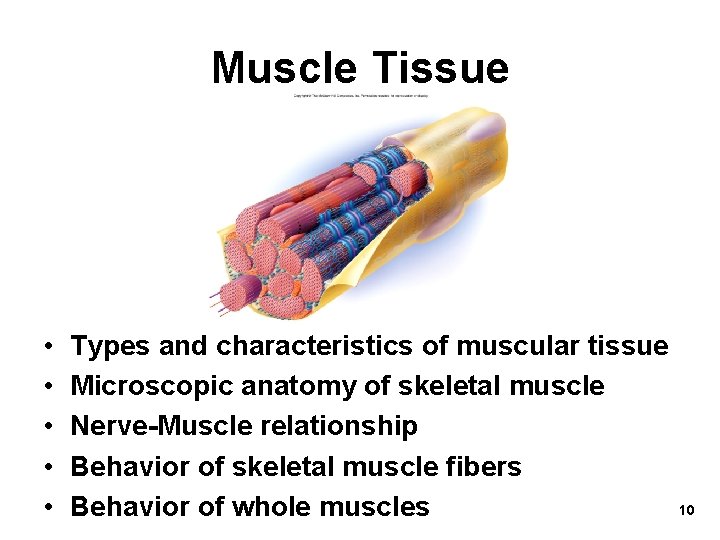
Connective Tissues of a Muscle • Epimysium – covers whole muscle belly – blends into CT between muscles • Perimysium – slightly thicker layer of connective tissue – surrounds bundle of cells called a fascicle • Endomysium – thin areolar tissue around each cell – allows room for capillaries and nerve fibers 6
Location of Fascia • Deep fascia – found between adjacent muscles • Superficial fascia (hypodermis) – adipose between skin and muscles Superficial Fascia Deep Fascia 7
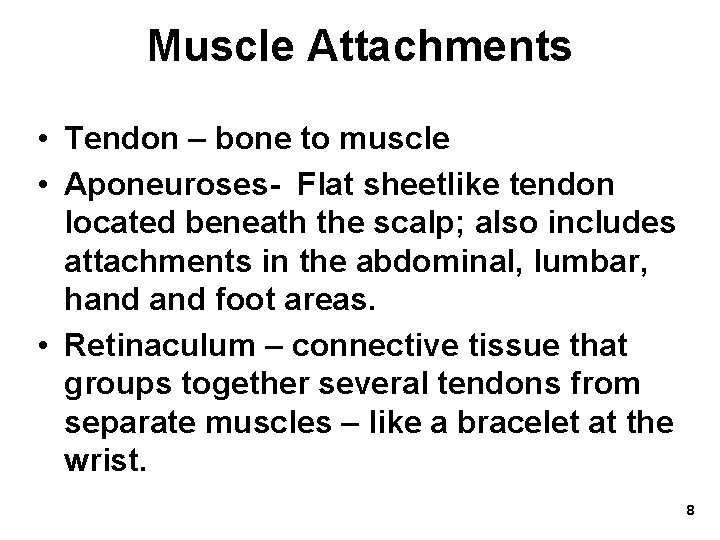
Muscle Attachments • Tendon – bone to muscle • Aponeuroses- Flat sheetlike tendon located beneath the scalp; also includes attachments in the abdominal, lumbar, hand foot areas. • Retinaculum – connective tissue that groups together several tendons from separate muscles – like a bracelet at the wrist. 8
Chapter 11 Muscle Tissue 9
Muscle Tissue • • • Types and characteristics of muscular tissue Microscopic anatomy of skeletal muscle Nerve-Muscle relationship Behavior of skeletal muscle fibers Behavior of whole muscles 10
Introduction to Muscle • Movement is a fundamental characteristic of all living things • Cells capable of shortening and converting the chemical energy of ATP into mechanical energy • Types of muscle – skeletal, cardiac and smooth • Physiology of skeletal muscle – basis of warm-up, strength, endurance and fatigue 11
Characteristics of Muscle • Responsiveness (excitability) – to chemical signals, stretch and electrical changes across the plasma membrane • Conductivity – local electrical change triggers a wave of excitation that travels along the muscle fiber • Contractility -- shortens when stimulated • Extensibility -- capable of being stretched • Elasticity -- returns to its original resting length after being stretched 12
Skeletal Muscle • Voluntary striated muscle attached to bones • Muscle fibers (myofibers) as long as 30 cm • Exhibits alternating light and dark transverse bands or striations – reflects overlapping arrangement of internal contractile proteins • Under conscious control (voluntary) 13
Connective Tissue Elements • Attachments between muscle and bone – endomysium, perimysium, epimysium, fascia, tendon • Collagen is extensible and elastic – stretches slightly under tension and recoils when released • protects muscle from injury • returns muscle to its resting length • Elastic components – parallel components parallel muscle cells – series components joined to ends of muscle 14
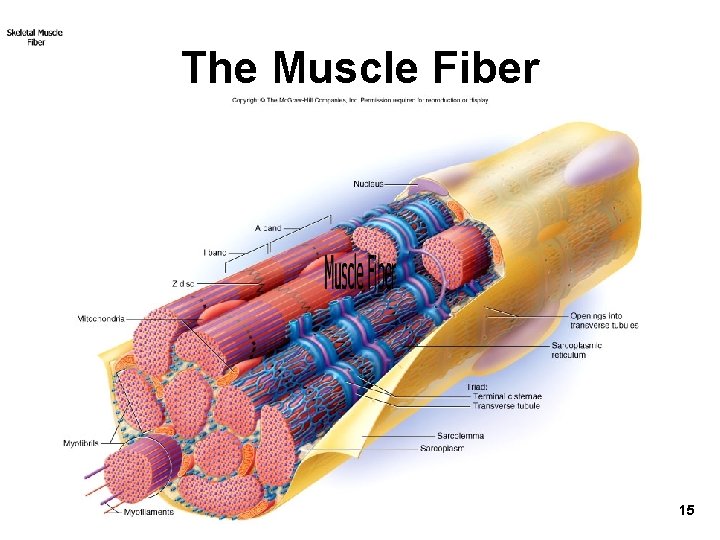
The Muscle Fiber 15
Muscle Fibers • Multiple flattened nuclei inside cell membrane – fusion of multiple myoblasts during development – unfused satellite cells nearby can multiply to produce a small number of new myofibers • Sarcolemma has tunnel-like infoldings or transverse (T) tubules that penetrate the cell – carry electric current to cell interior 16
Muscle Fibers 2 • Sarcoplasm is filled with – myofibrils (bundles of myofilaments) – glycogen for stored energy and myoglobin for binding oxygen • Sarcoplasmic reticulum = smooth ER – network around each myofibril – dilated end-sacs (terminal cisternea) store calcium – triad = T tubule and 2 terminal cisternea 17
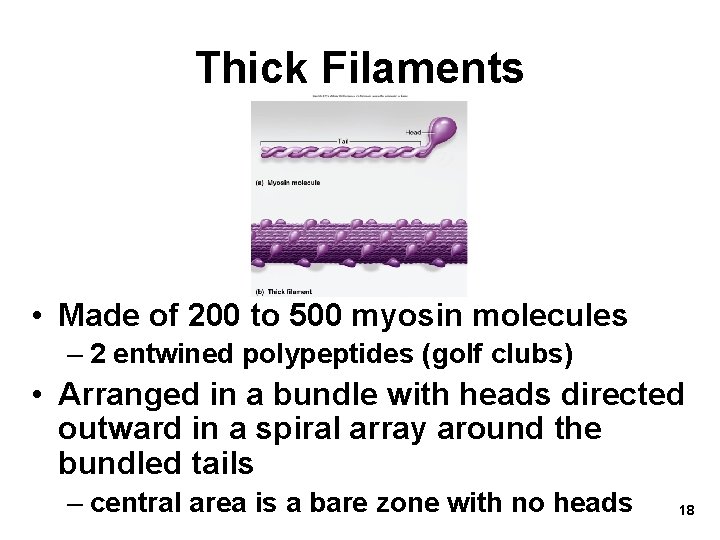
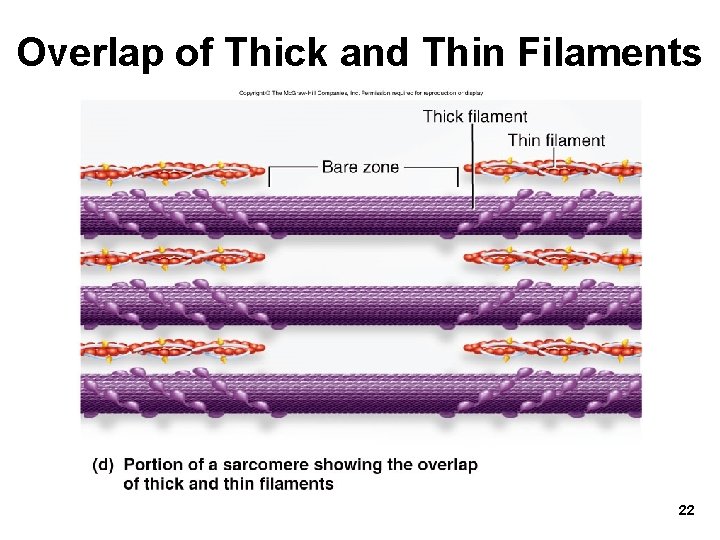
Thick Filaments • Made of 200 to 500 myosin molecules – 2 entwined polypeptides (golf clubs) • Arranged in a bundle with heads directed outward in a spiral array around the bundled tails – central area is a bare zone with no heads 18
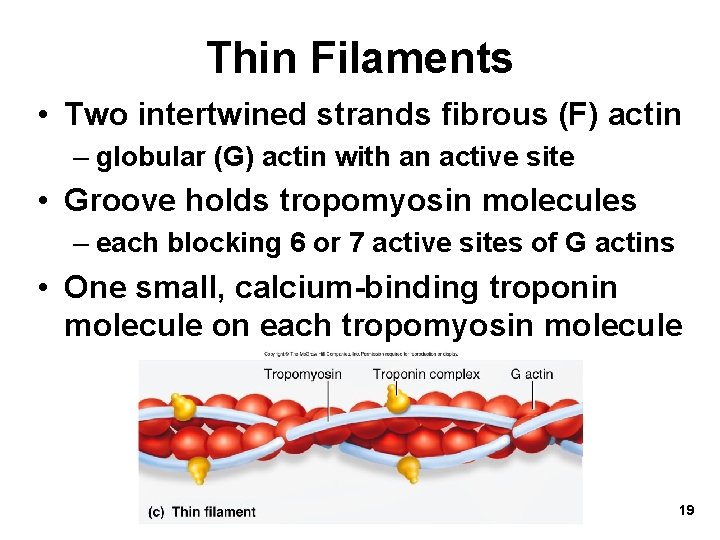
Thin Filaments • Two intertwined strands fibrous (F) actin – globular (G) actin with an active site • Groove holds tropomyosin molecules – each blocking 6 or 7 active sites of G actins • One small, calcium-binding troponin molecule on each tropomyosin molecule 19
Elastic Filaments • Springy proteins called titin • Anchor each thick filament to Z disc • Prevents overstretching of sarcomere 20
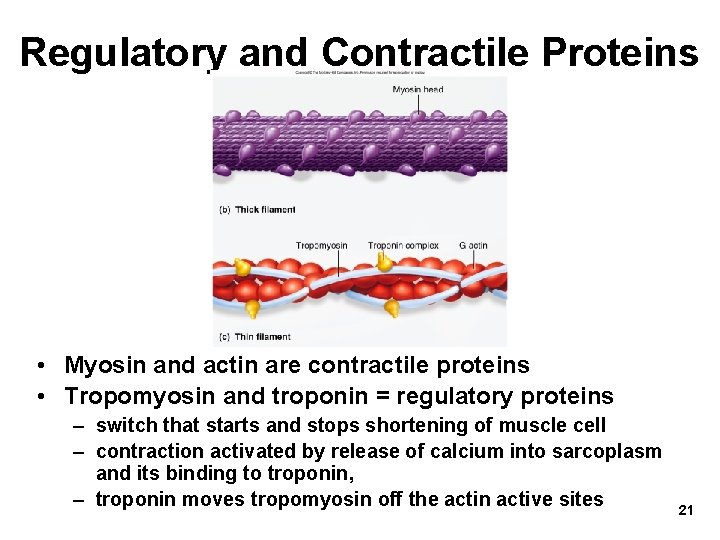
Regulatory and Contractile Proteins • Myosin and actin are contractile proteins • Tropomyosin and troponin = regulatory proteins – switch that starts and stops shortening of muscle cell – contraction activated by release of calcium into sarcoplasm and its binding to troponin, – troponin moves tropomyosin off the actin active sites 21
Overlap of Thick and Thin Filaments 22
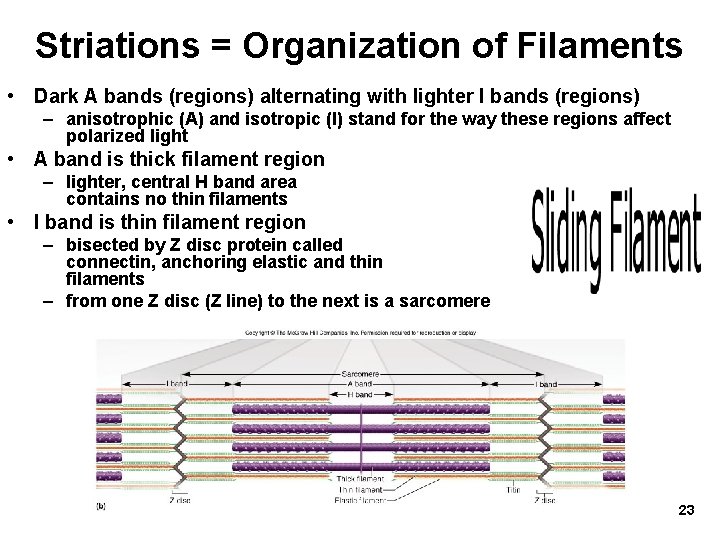
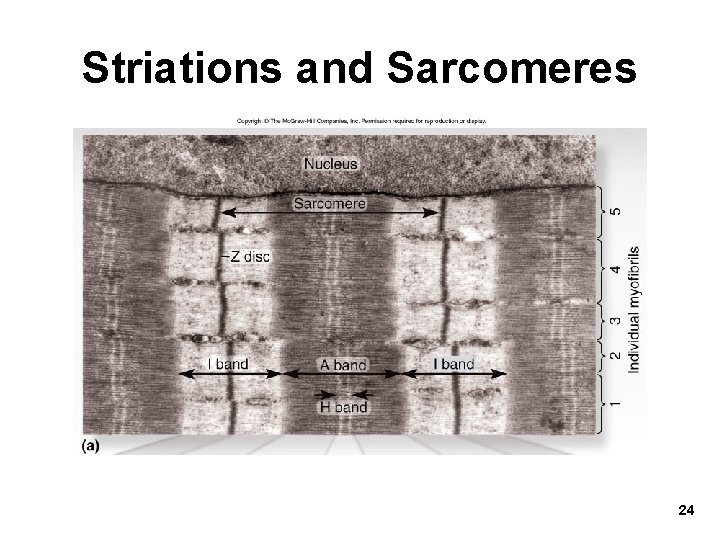
Striations = Organization of Filaments • Dark A bands (regions) alternating with lighter I bands (regions) – anisotrophic (A) and isotropic (I) stand for the way these regions affect polarized light • A band is thick filament region – lighter, central H band area contains no thin filaments • I band is thin filament region – bisected by Z disc protein called connectin, anchoring elastic and thin filaments – from one Z disc (Z line) to the next is a sarcomere 23
Striations and Sarcomeres 24
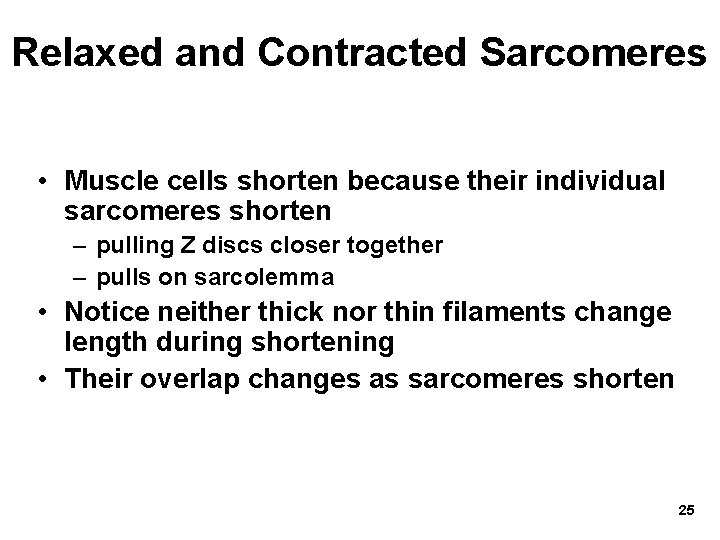
Relaxed and Contracted Sarcomeres • Muscle cells shorten because their individual sarcomeres shorten – pulling Z discs closer together – pulls on sarcolemma • Notice neither thick nor thin filaments change length during shortening • Their overlap changes as sarcomeres shorten 25
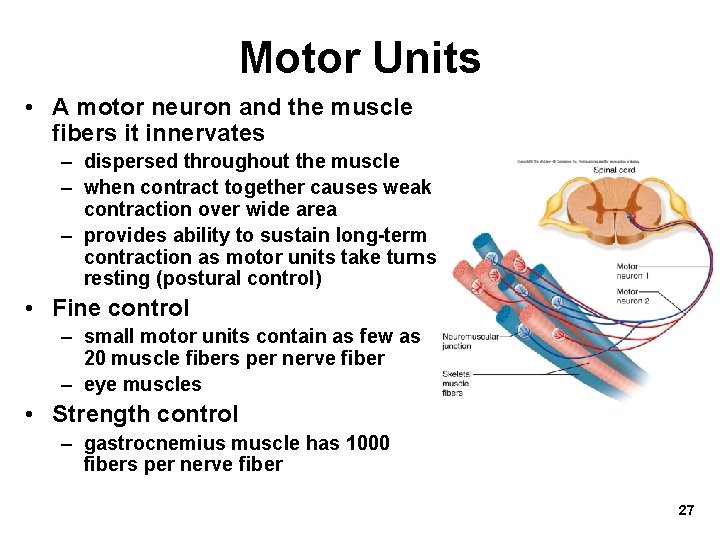
Nerve-Muscle Relationships • Skeletal muscle must be stimulated by a nerve or it will not contract • Cell bodies of somatic motor neurons in brainstem or spinal cord • Axons of somatic motor neurons = somatic motor fibers – terminal branches supply one muscle fiber • Each motor neuron and all the muscle fibers it innervates = motor unit 26
Motor Units • A motor neuron and the muscle fibers it innervates – dispersed throughout the muscle – when contract together causes weak contraction over wide area – provides ability to sustain long-term contraction as motor units take turns resting (postural control) • Fine control – small motor units contain as few as 20 muscle fibers per nerve fiber – eye muscles • Strength control – gastrocnemius muscle has 1000 fibers per nerve fiber 27
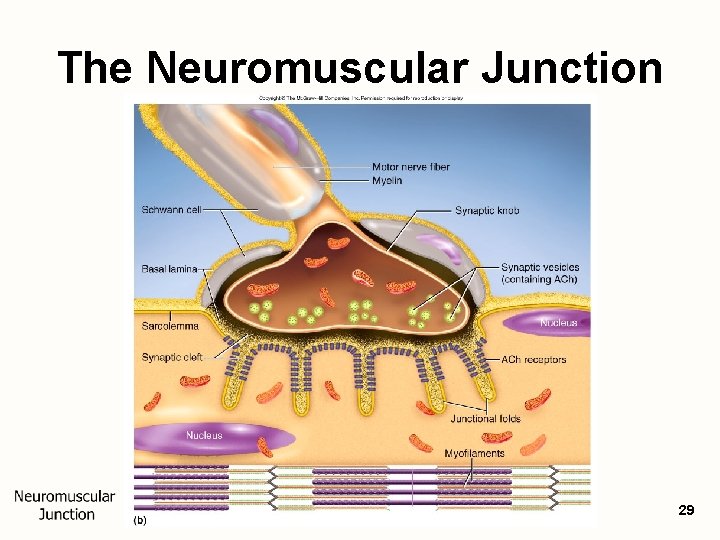
Neuromuscular Junctions (Synapse) • Functional connection between nerve fiber and muscle cell • Neurotransmitter (acetylcholine/ACh) released from nerve fiber stimulates muscle cell • Components of synapse (NMJ) – synaptic knob is swollen end of nerve fiber (contains ACh) – junctional folds region of sarcolemma • increases surface area for ACh receptors • contains acetylcholinesterase that breaks down ACh and causes relaxation – synaptic cleft = tiny gap between nerve and muscle cells – Basal lamina = thin layer of collagen and glycoprotein 28 over all of muscle fiber
The Neuromuscular Junction 29
Neuromuscular Toxins • Pesticides (cholinesterase inhibitors) – bind to acetylcholinesterase and prevent it from degrading ACh – spastic paralysis and possible suffocation • Tetanus or lockjaw is spastic paralysis caused by toxin of Clostridium bacteria – blocks glycine release in the spinal cord and causes overstimulation of the muscles • Flaccid paralysis (limp muscles) due to curare that competes with ACh – respiratory arrest 30
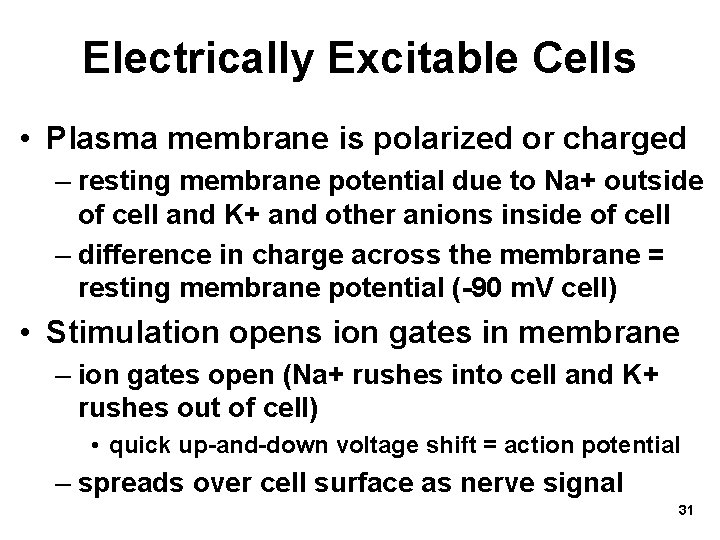
Electrically Excitable Cells • Plasma membrane is polarized or charged – resting membrane potential due to Na+ outside of cell and K+ and other anions inside of cell – difference in charge across the membrane = resting membrane potential (-90 m. V cell) • Stimulation opens ion gates in membrane – ion gates open (Na+ rushes into cell and K+ rushes out of cell) • quick up-and-down voltage shift = action potential – spreads over cell surface as nerve signal 31
Muscle Contraction and Relaxation • Four actions involved in this process – excitation = nerve action potentials lead to action potentials in muscle fiber – excitation-contraction coupling = action potentials on the sarcolemma activate myofilaments – contraction = shortening of muscle fiber – relaxation = return to resting length • Images will be used to demonstrate the steps of each of these actions 32
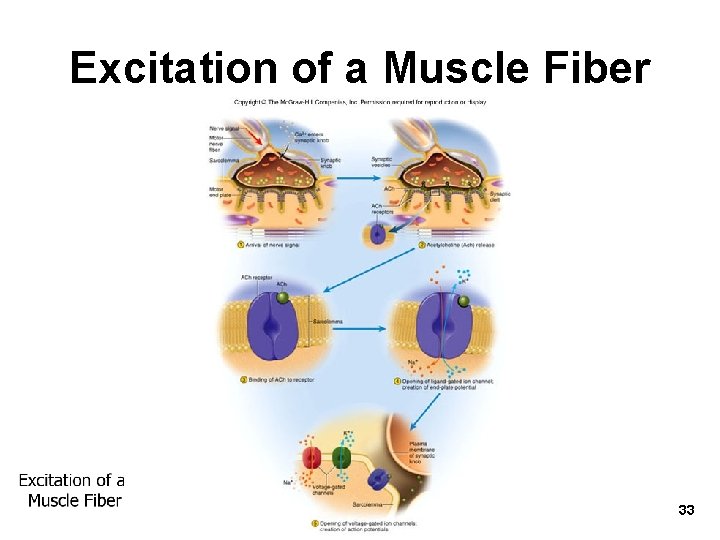
Excitation of a Muscle Fiber 33
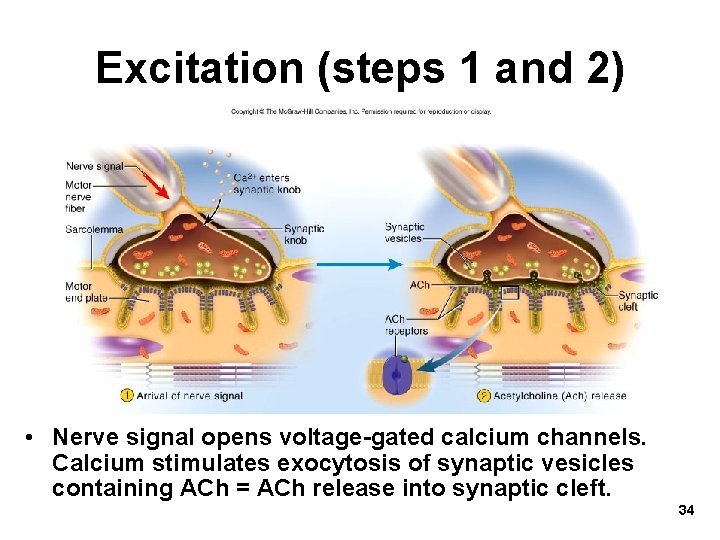
Excitation (steps 1 and 2) • Nerve signal opens voltage-gated calcium channels. Calcium stimulates exocytosis of synaptic vesicles containing ACh = ACh release into synaptic cleft. 34
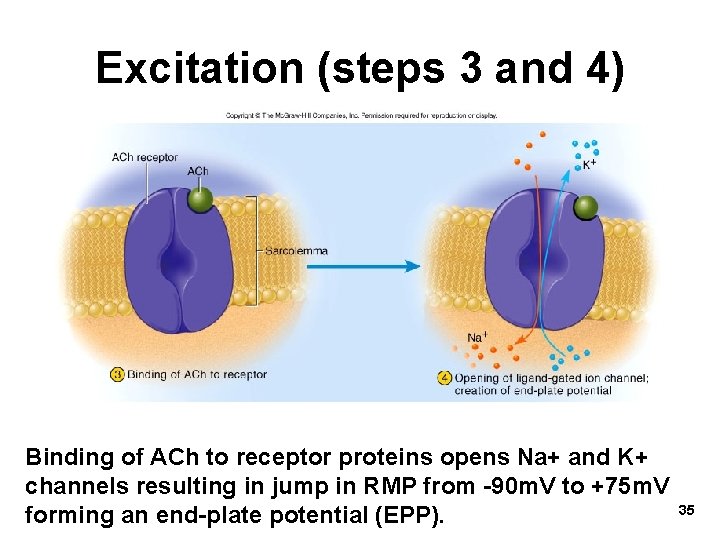
Excitation (steps 3 and 4) Binding of ACh to receptor proteins opens Na+ and K+ channels resulting in jump in RMP from -90 m. V to +75 m. V forming an end-plate potential (EPP). 35
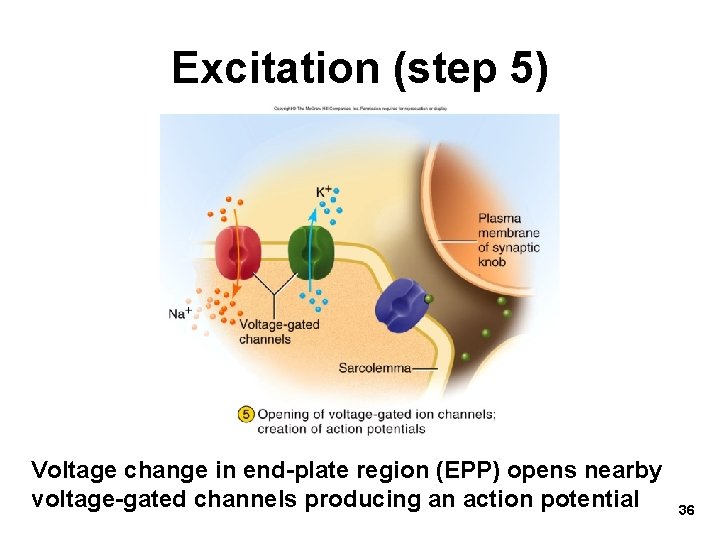
Excitation (step 5) Voltage change in end-plate region (EPP) opens nearby voltage-gated channels producing an action potential 36
Excitation-Contraction Coupling 37
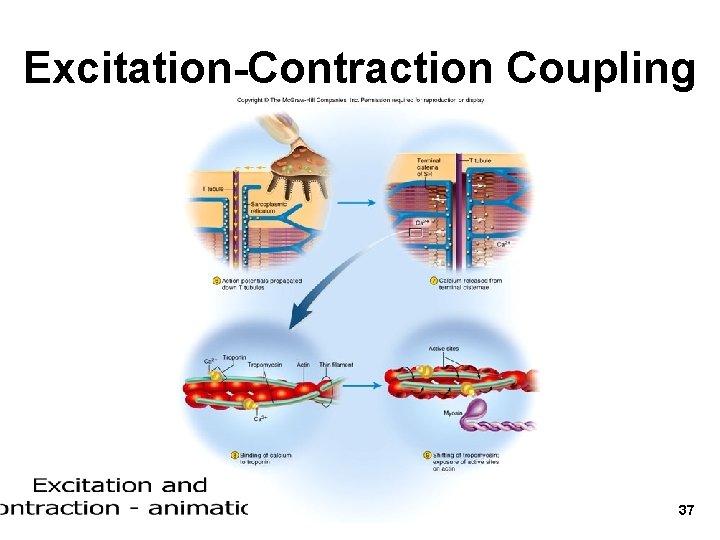
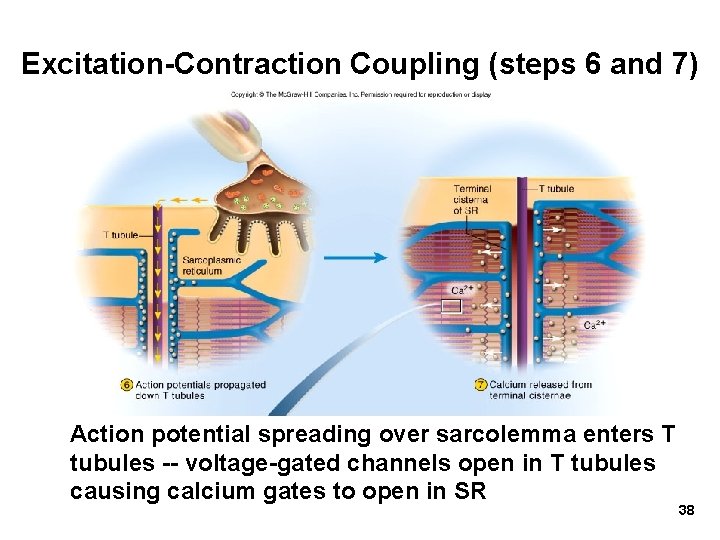
Excitation-Contraction Coupling (steps 6 and 7) Action potential spreading over sarcolemma enters T tubules -- voltage-gated channels open in T tubules causing calcium gates to open in SR 38
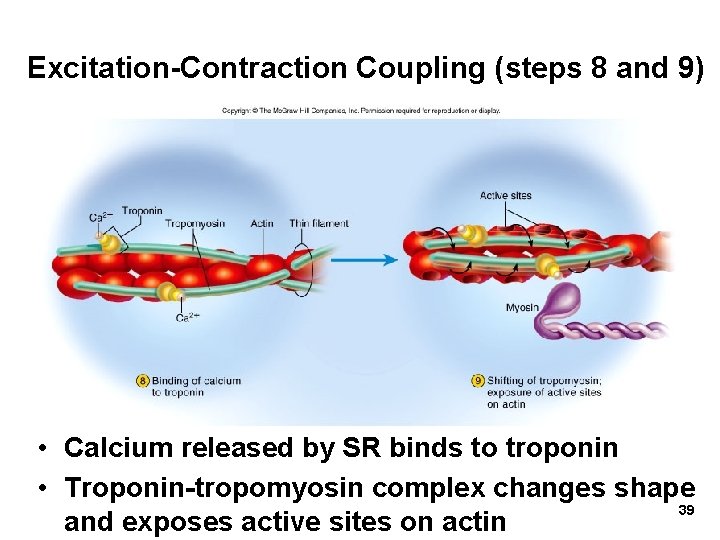
Excitation-Contraction Coupling (steps 8 and 9) • Calcium released by SR binds to troponin • Troponin-tropomyosin complex changes shape 39 and exposes active sites on actin
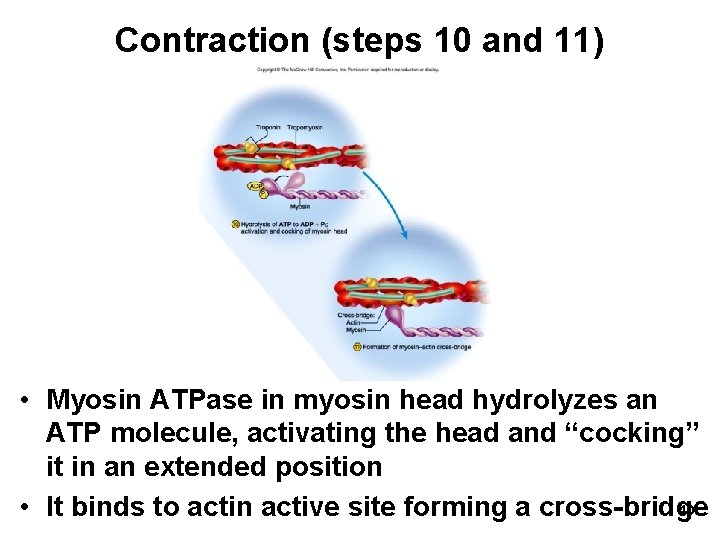
Contraction (steps 10 and 11) • Myosin ATPase in myosin head hydrolyzes an ATP molecule, activating the head and “cocking” it in an extended position 40 • It binds to actin active site forming a cross-bridge
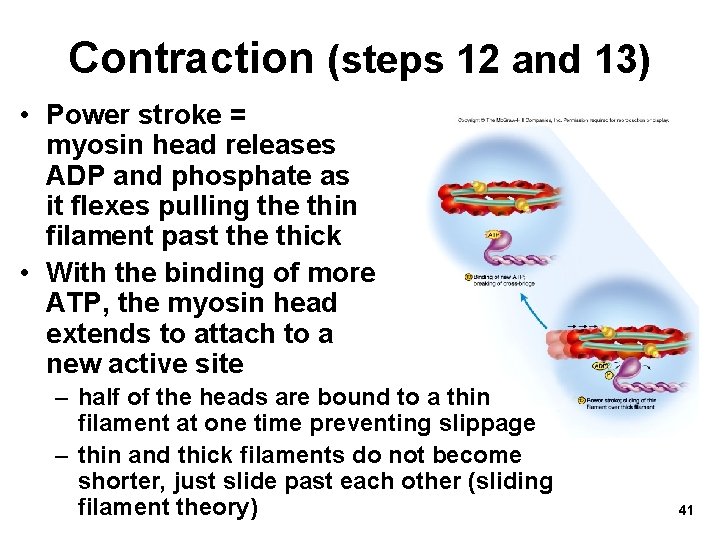
Contraction (steps 12 and 13) • Power stroke = myosin head releases ADP and phosphate as it flexes pulling the thin filament past the thick • With the binding of more ATP, the myosin head extends to attach to a new active site – half of the heads are bound to a thin filament at one time preventing slippage – thin and thick filaments do not become shorter, just slide past each other (sliding filament theory) 41
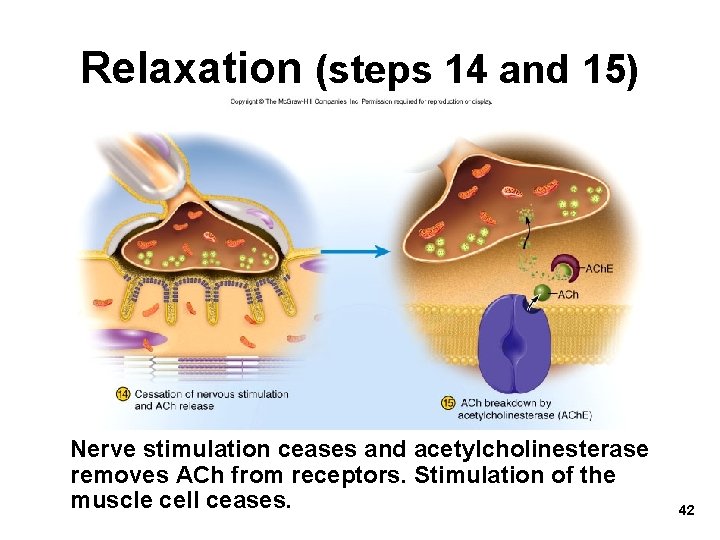
Relaxation (steps 14 and 15) Nerve stimulation ceases and acetylcholinesterase removes ACh from receptors. Stimulation of the muscle cell ceases. 42
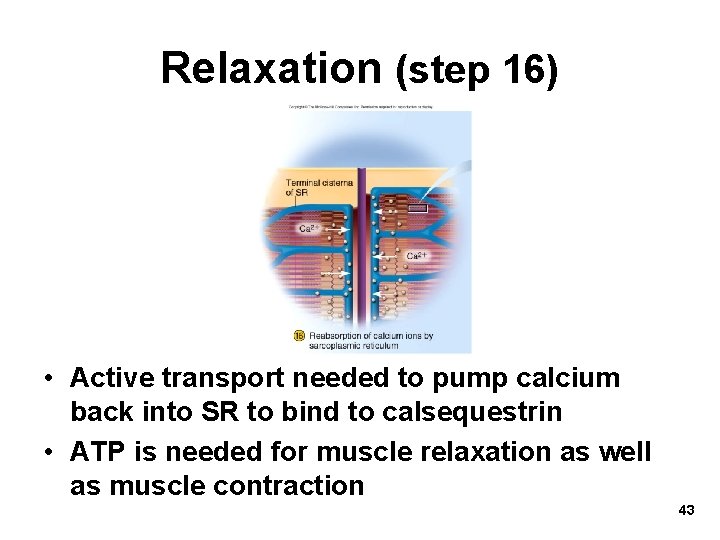
Relaxation (step 16) • Active transport needed to pump calcium back into SR to bind to calsequestrin • ATP is needed for muscle relaxation as well as muscle contraction 43
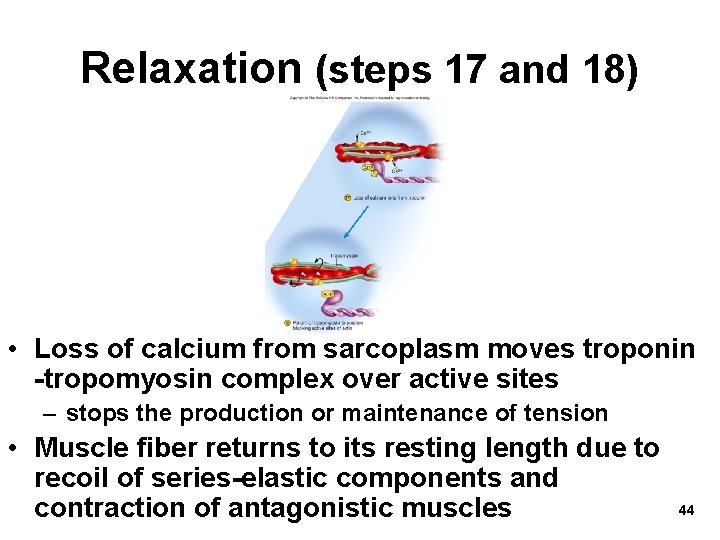
Relaxation (steps 17 and 18) • Loss of calcium from sarcoplasm moves troponin -tropomyosin complex over active sites – stops the production or maintenance of tension • Muscle fiber returns to its resting length due to recoil of series-elastic components and contraction of antagonistic muscles 44
Rigor Mortis • Stiffening of the body beginning 3 to 4 hours after death • Deteriorating sarcoplasmic reticulum releases calcium • Calcium activates myosin-actin cross-bridging and muscle contracts, but can not relax. • Muscle relaxation requires ATP and ATP production is no longer produced after death • Fibers remain contracted until myofilaments decay 45
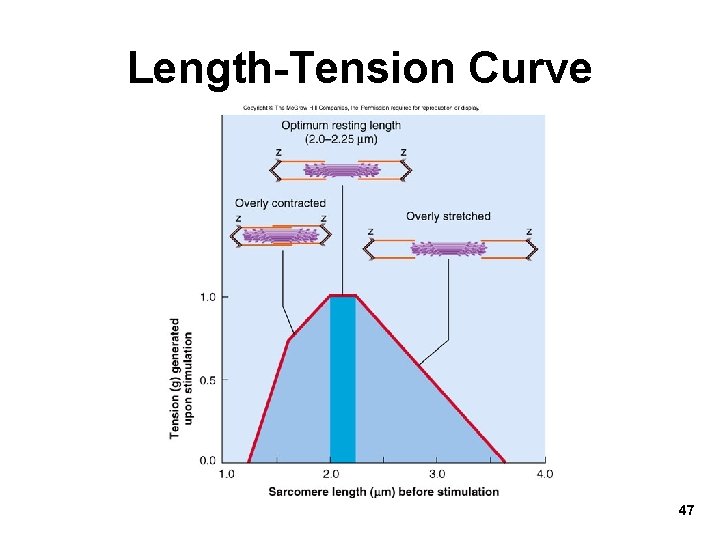
Length-Tension Relationship • Amount of tension generated depends on length of muscle before it was stimulated – length-tension relationship (see graph next slide) • Overly contracted (weak contraction results) – thick filaments too close to Z discs and can’t slide • Too stretched (weak contraction results) – little overlap of thin and thick does not allow for very many cross bridges too form • Optimum resting length produces greatest force when muscle contracts – central nervous system maintains optimal length producing muscle tone or partial contraction 46
Length-Tension Curve 47
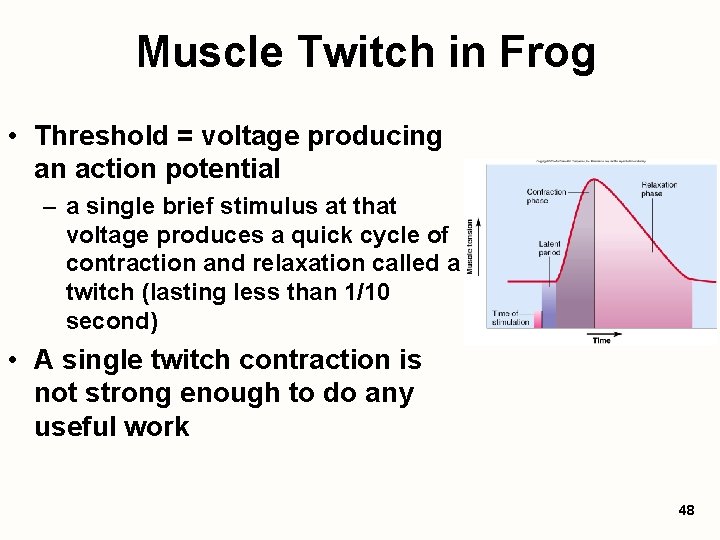
Muscle Twitch in Frog • Threshold = voltage producing an action potential – a single brief stimulus at that voltage produces a quick cycle of contraction and relaxation called a twitch (lasting less than 1/10 second) • A single twitch contraction is not strong enough to do any useful work 48
Muscle Twitch in Frog 2 • Phases of a twitch contraction – latent period (2 msec delay) • only internal tension is generated • no visible contraction occurs since only elastic components are being stretched – contraction phase • external tension develops as muscle shortens – relaxation phase • loss of tension and return to resting length as calcium returns to SR 49
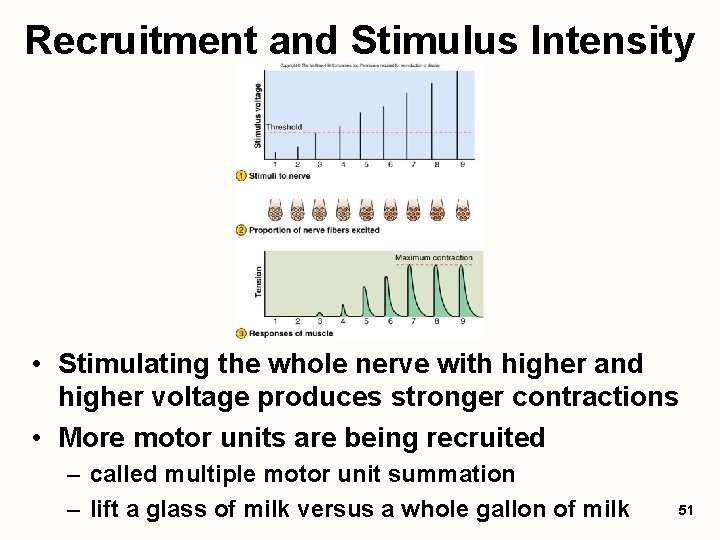
Contraction Strength of Twitches • Threshold stimuli produces twitches • Twitches unchanged despite increased voltage • “Muscle fiber obeys an all-or-none law” contracting to its maximum or not at all – not a true statement since twitches vary in strength • depending upon, Ca 2+ concentration, previous stretch of the muscle, temperature, p. H and hydration • Closer stimuli produce stronger twitches 50
Recruitment and Stimulus Intensity • Stimulating the whole nerve with higher and higher voltage produces stronger contractions • More motor units are being recruited – called multiple motor unit summation – lift a glass of milk versus a whole gallon of milk 51
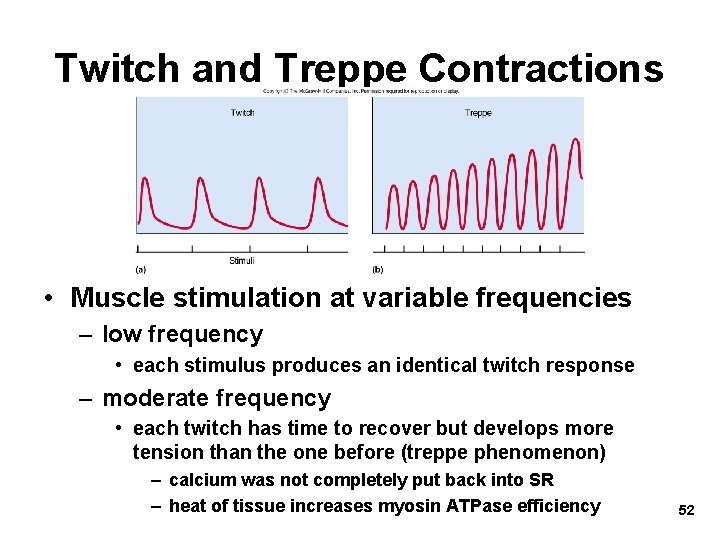
Twitch and Treppe Contractions • Muscle stimulation at variable frequencies – low frequency • each stimulus produces an identical twitch response – moderate frequency • each twitch has time to recover but develops more tension than the one before (treppe phenomenon) – calcium was not completely put back into SR – heat of tissue increases myosin ATPase efficiency 52
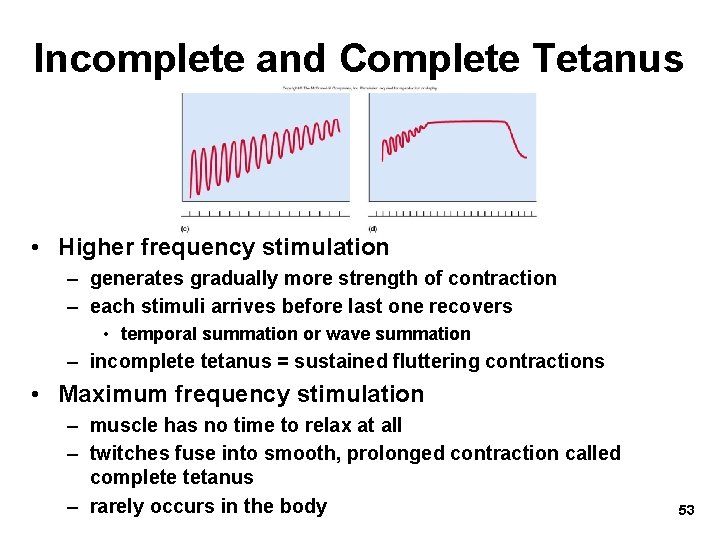
Incomplete and Complete Tetanus • Higher frequency stimulation – generates gradually more strength of contraction – each stimuli arrives before last one recovers • temporal summation or wave summation – incomplete tetanus = sustained fluttering contractions • Maximum frequency stimulation – muscle has no time to relax at all – twitches fuse into smooth, prolonged contraction called complete tetanus – rarely occurs in the body 53
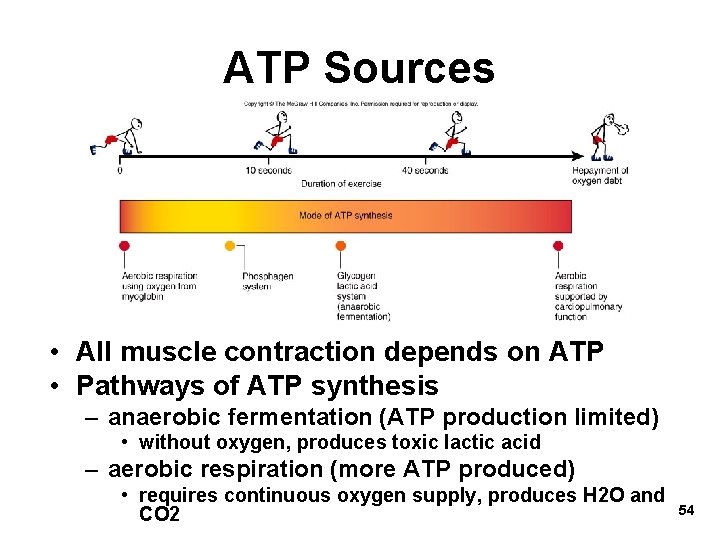
ATP Sources • All muscle contraction depends on ATP • Pathways of ATP synthesis – anaerobic fermentation (ATP production limited) • without oxygen, produces toxic lactic acid – aerobic respiration (more ATP produced) • requires continuous oxygen supply, produces H 2 O and CO 2 54
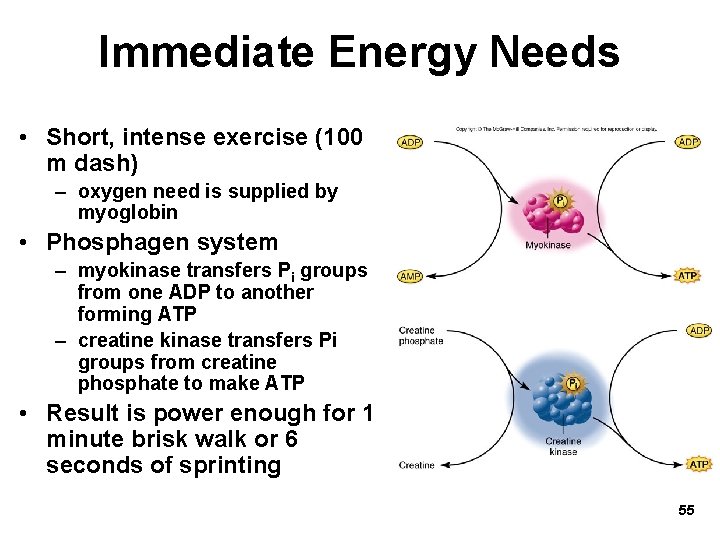
Immediate Energy Needs • Short, intense exercise (100 m dash) – oxygen need is supplied by myoglobin • Phosphagen system – myokinase transfers Pi groups from one ADP to another forming ATP – creatine kinase transfers Pi groups from creatine phosphate to make ATP • Result is power enough for 1 minute brisk walk or 6 seconds of sprinting 55
Short-Term Energy Needs • Glycogen-lactic acid system takes over – produces ATP for 30 -40 seconds of maximum activity • playing basketball or running around baseball diamonds – muscles obtain glucose from blood and stored glycogen 56
Long-Term Energy Needs • Aerobic respiration needed for prolonged exercise – Produces 36 ATPs/glucose molecule • After 40 seconds of exercise, respiratory and cardiovascular systems must deliver enough oxygen for aerobic respiration – oxygen consumption rate increases for first 3 -4 minutes and then levels off to a steady state • Limits are set by depletion of glycogen and blood glucose, loss of fluid and electrolytes 57
Oxygen Debt • Heavy breathing after strenuous exercise – known as excess postexercise oxygen consumption (EPOC) – typically about 11 liters extra is consumed • Purposes for extra oxygen – replace oxygen reserves (myoglobin, blood hemoglobin, in air in the lungs and dissolved in plasma) – replenishing the phosphagen system – reconverting lactic acid to glucose in kidneys and liver – serving the elevated metabolic rate that occurs as long as the body temperature remains elevated by exercise 58
Slow- and Fast-Twitch Fibers • Slow oxidative, slow-twitch fibers – more mitochondria, myoglobin and capillaries – adapted for aerobic respiration and resistant to fatigue – soleus and postural muscles of the back (100 msec/twitch) 59
Slow and Fast-Twitch Fibers • Fast glycolytic, fast-twitch fibers – rich in enzymes for phosphagen and glycogen-lactic acid systems – sarcoplasmic reticulum releases calcium quickly so contractions are quicker (7. 5 msec/twitch) – extraocular eye muscles, gastrocnemius and biceps brachii • Proportions genetically determined 60