
Chapter 10 The Middle Ages in Western Europe
- Slides: 35
Chapter 10: The Middle Ages in Western Europe
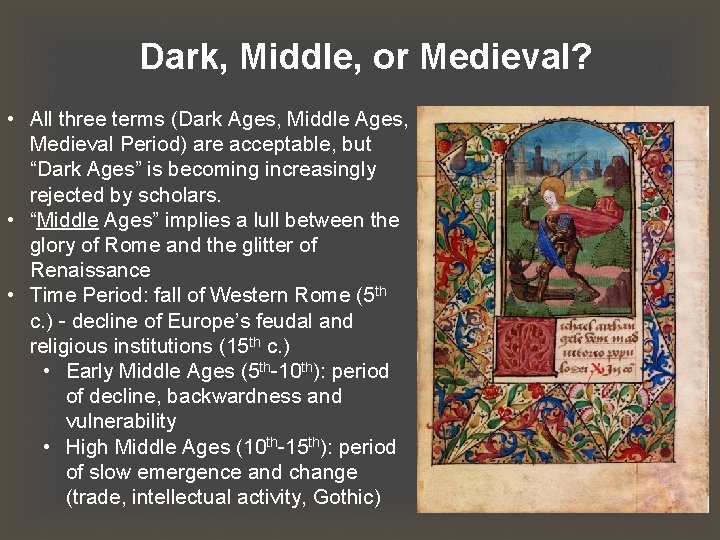
Dark, Middle, or Medieval? • All three terms (Dark Ages, Middle Ages, Medieval Period) are acceptable, but “Dark Ages” is becoming increasingly rejected by scholars. • “Middle Ages” implies a lull between the glory of Rome and the glitter of Renaissance • Time Period: fall of Western Rome (5 th c. ) - decline of Europe’s feudal and religious institutions (15 th c. ) • Early Middle Ages (5 th-10 th): period of decline, backwardness and vulnerability • High Middle Ages (10 th-15 th): period of slow emergence and change (trade, intellectual activity, Gothic)
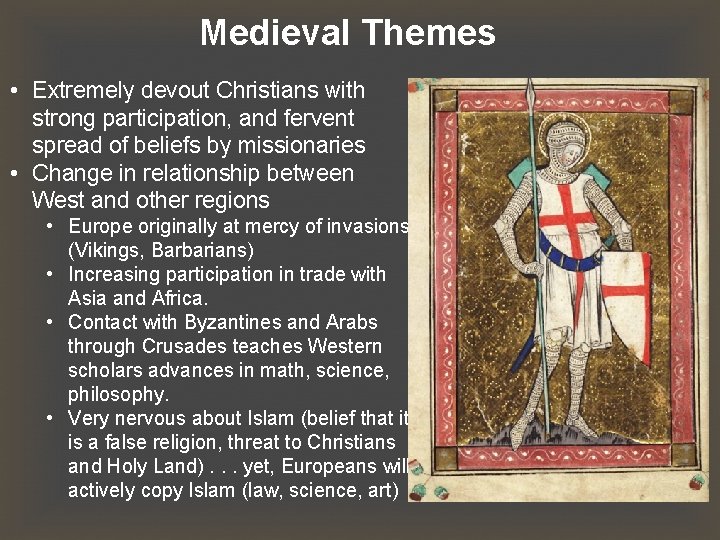
Medieval Themes • Extremely devout Christians with strong participation, and fervent spread of beliefs by missionaries • Change in relationship between West and other regions • Europe originally at mercy of invasions (Vikings, Barbarians) • Increasing participation in trade with Asia and Africa. • Contact with Byzantines and Arabs through Crusades teaches Western scholars advances in math, science, philosophy. • Very nervous about Islam (belief that it is a false religion, threat to Christians and Holy Land). . . yet, Europeans will actively copy Islam (law, science, art)
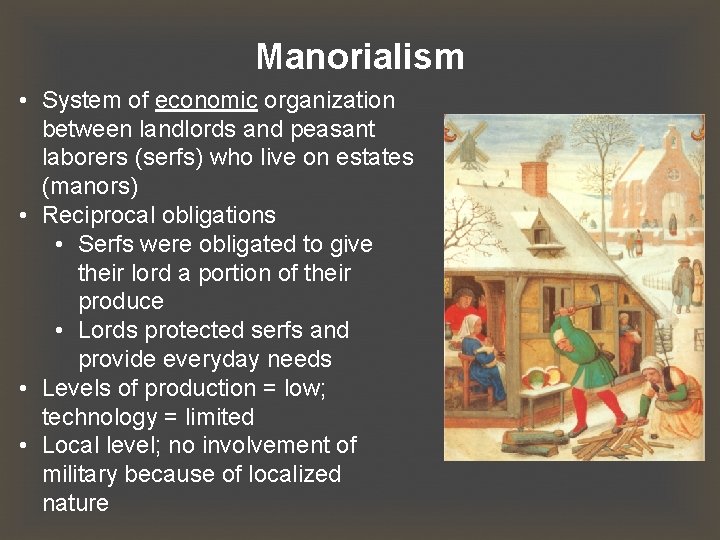
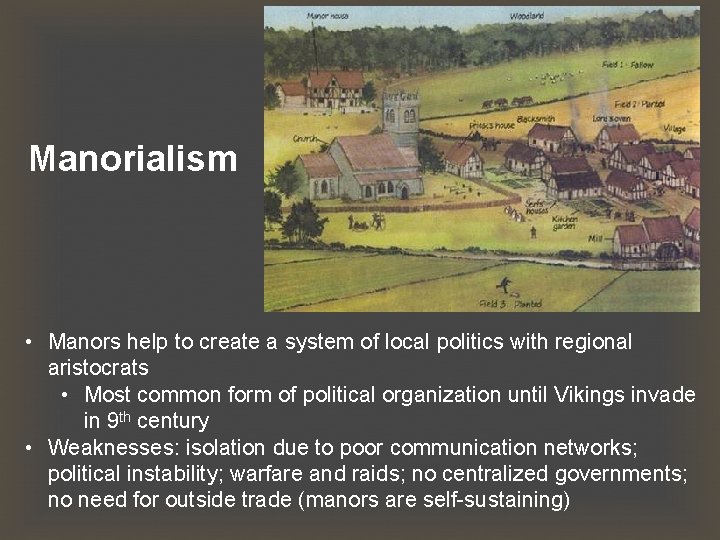
Manorialism • System of economic organization between landlords and peasant laborers (serfs) who live on estates (manors) • Reciprocal obligations • Serfs were obligated to give their lord a portion of their produce • Lords protected serfs and provide everyday needs • Levels of production = low; technology = limited • Local level; no involvement of military because of localized nature
Manorialism • Manors help to create a system of local politics with regional aristocrats • Most common form of political organization until Vikings invade in 9 th century • Weaknesses: isolation due to poor communication networks; political instability; warfare and raids; no centralized governments; no need for outside trade (manors are self-sustaining)
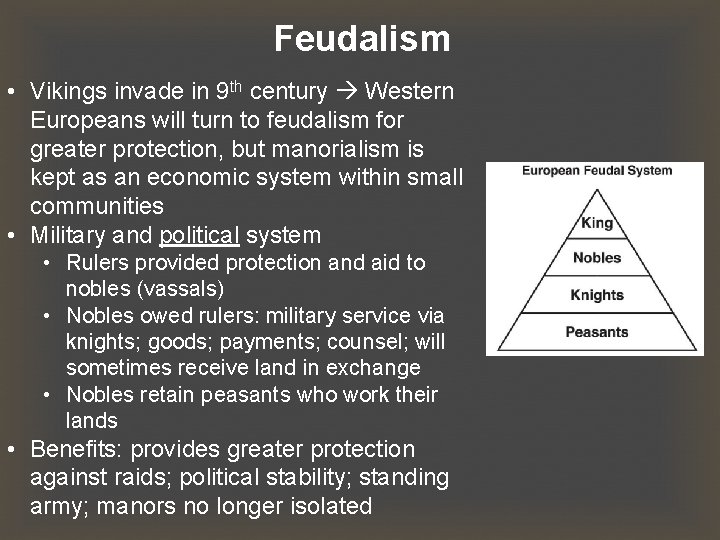
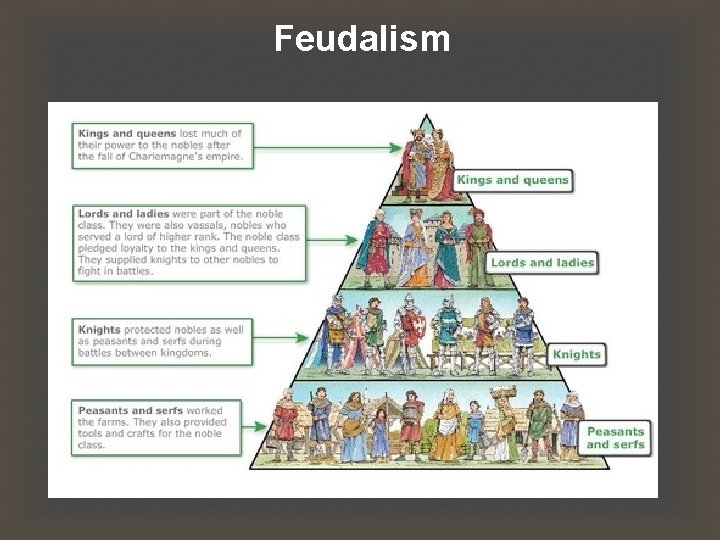
Feudalism • Vikings invade in 9 th century Western Europeans will turn to feudalism for greater protection, but manorialism is kept as an economic system within small communities • Military and political system • Rulers provided protection and aid to nobles (vassals) • Nobles owed rulers: military service via knights; goods; payments; counsel; will sometimes receive land in exchange • Nobles retain peasants who work their lands • Benefits: provides greater protection against raids; political stability; standing army; manors no longer isolated
Feudalism
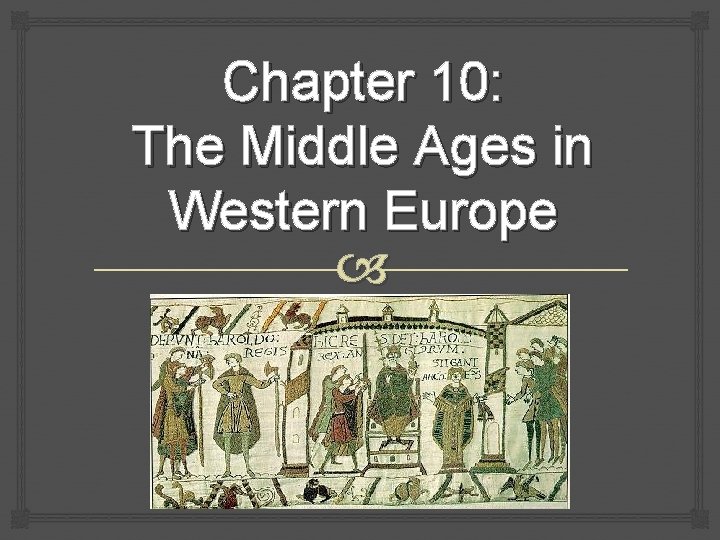
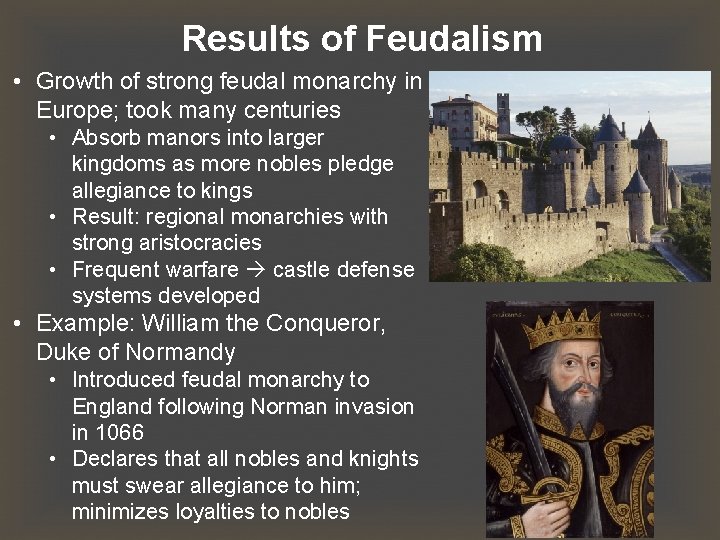
Results of Feudalism • Growth of strong feudal monarchy in Europe; took many centuries • Absorb manors into larger kingdoms as more nobles pledge allegiance to kings • Result: regional monarchies with strong aristocracies • Frequent warfare castle defense systems developed • Example: William the Conqueror, Duke of Normandy • Introduced feudal monarchy to England following Norman invasion in 1066 • Declares that all nobles and knights must swear allegiance to him; minimizes loyalties to nobles
Quick Review Question What are the differences between manorialism and feudalism? What causes European communities to develop feudalism?
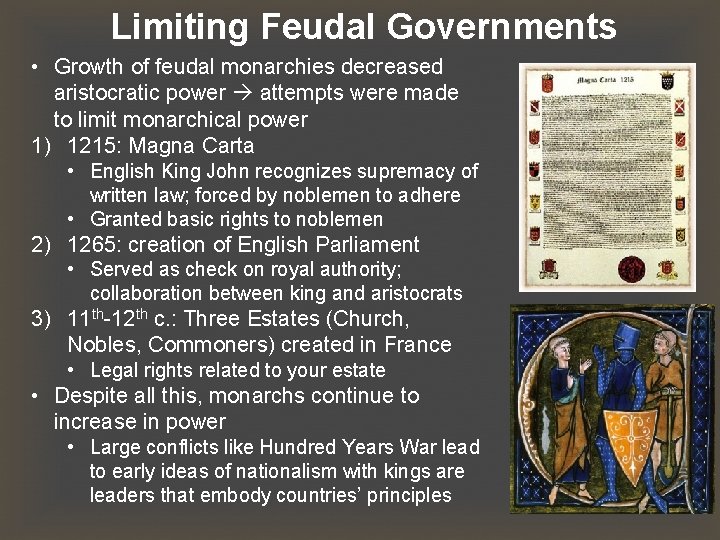
Limiting Feudal Governments • Growth of feudal monarchies decreased aristocratic power attempts were made to limit monarchical power 1) 1215: Magna Carta • English King John recognizes supremacy of written law; forced by noblemen to adhere • Granted basic rights to noblemen 2) 1265: creation of English Parliament • Served as check on royal authority; collaboration between king and aristocrats 3) 11 th-12 th c. : Three Estates (Church, Nobles, Commoners) created in France • Legal rights related to your estate • Despite all this, monarchs continue to increase in power • Large conflicts like Hundred Years War lead to early ideas of nationalism with kings are leaders that embody countries’ principles
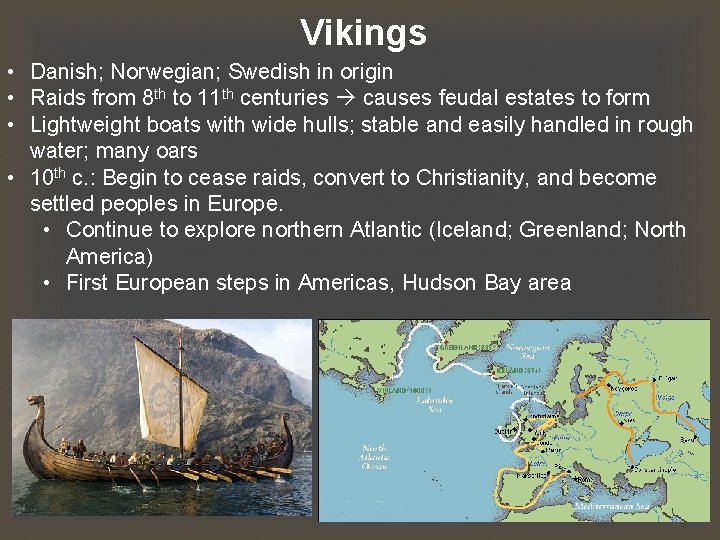
Vikings • Danish; Norwegian; Swedish in origin • Raids from 8 th to 11 th centuries causes feudal estates to form • Lightweight boats with wide hulls; stable and easily handled in rough water; many oars • 10 th c. : Begin to cease raids, convert to Christianity, and become settled peoples in Europe. • Continue to explore northern Atlantic (Iceland; Greenland; North America) • First European steps in Americas, Hudson Bay area
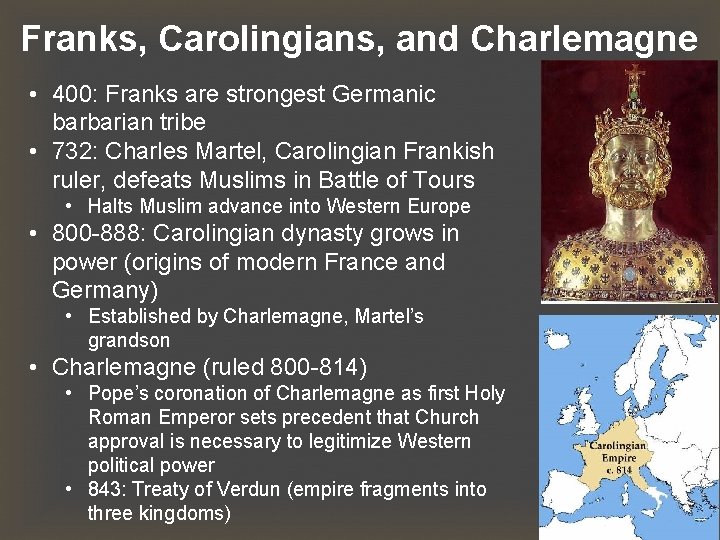
Franks, Carolingians, and Charlemagne • 400: Franks are strongest Germanic barbarian tribe • 732: Charles Martel, Carolingian Frankish ruler, defeats Muslims in Battle of Tours • Halts Muslim advance into Western Europe • 800 -888: Carolingian dynasty grows in power (origins of modern France and Germany) • Established by Charlemagne, Martel’s grandson • Charlemagne (ruled 800 -814) • Pope’s coronation of Charlemagne as first Holy Roman Emperor sets precedent that Church approval is necessary to legitimize Western political power • 843: Treaty of Verdun (empire fragments into three kingdoms)
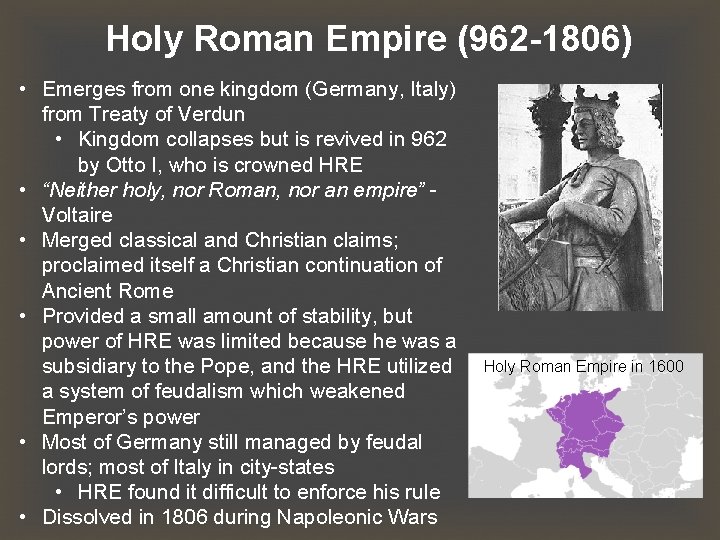
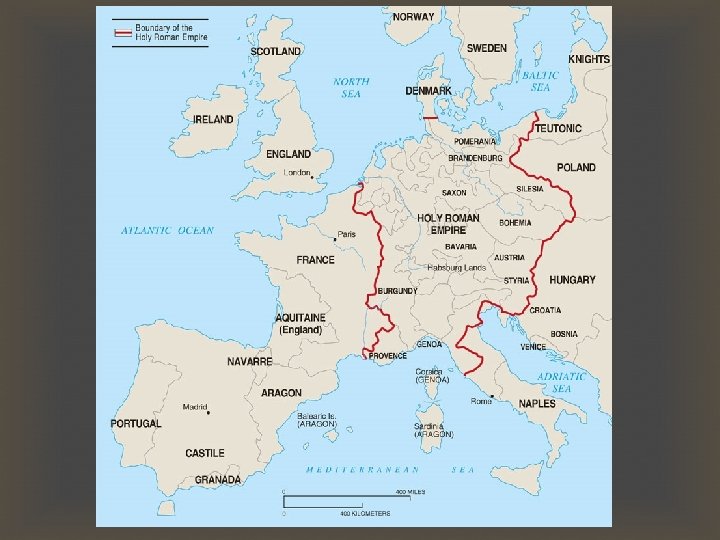
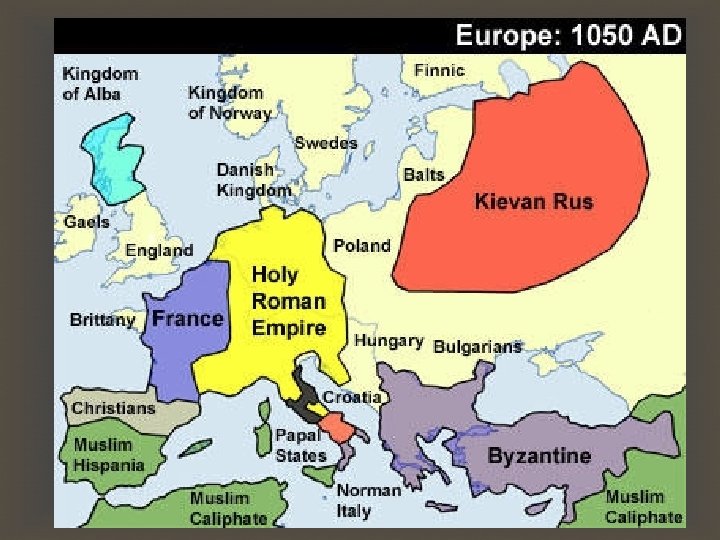
Holy Roman Empire (962 -1806) • Emerges from one kingdom (Germany, Italy) from Treaty of Verdun • Kingdom collapses but is revived in 962 by Otto I, who is crowned HRE • “Neither holy, nor Roman, nor an empire” Voltaire • Merged classical and Christian claims; proclaimed itself a Christian continuation of Ancient Rome • Provided a small amount of stability, but power of HRE was limited because he was a subsidiary to the Pope, and the HRE utilized a system of feudalism which weakened Emperor’s power • Most of Germany still managed by feudal lords; most of Italy in city-states • HRE found it difficult to enforce his rule • Dissolved in 1806 during Napoleonic Wars Holy Roman Empire in 1600
Quick Review Question What were some of the steps European aristocrats took to limit monarchical power? What precedent does Charlemagne create for European rulers?
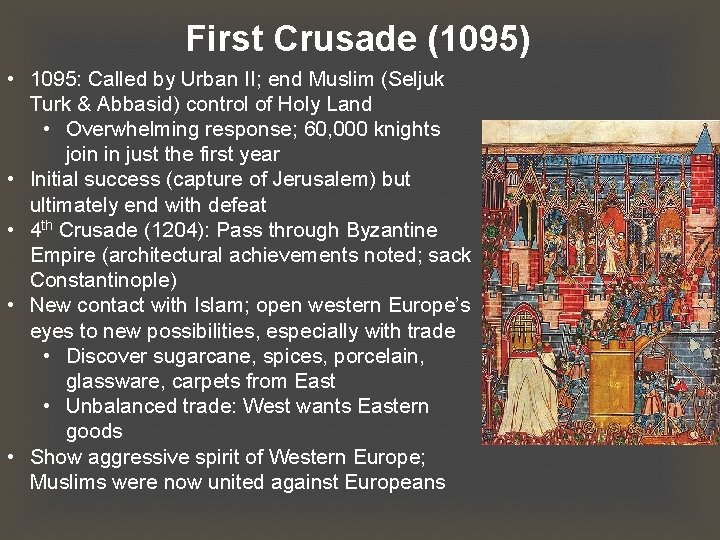
First Crusade (1095) • 1095: Called by Urban II; end Muslim (Seljuk Turk & Abbasid) control of Holy Land • Overwhelming response; 60, 000 knights join in just the first year • Initial success (capture of Jerusalem) but ultimately end with defeat • 4 th Crusade (1204): Pass through Byzantine Empire (architectural achievements noted; sack Constantinople) • New contact with Islam; open western Europe’s eyes to new possibilities, especially with trade • Discover sugarcane, spices, porcelain, glassware, carpets from East • Unbalanced trade: West wants Eastern goods • Show aggressive spirit of Western Europe; Muslims were now united against Europeans
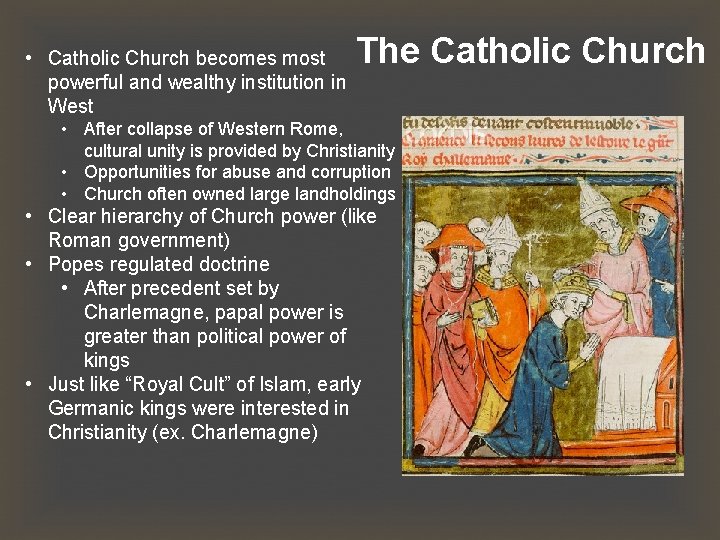
• Catholic Church becomes most powerful and wealthy institution in West The Catholic Church • After collapse of Western Rome, cultural unity is provided by Christianity • Opportunities for abuse and corruption • Church often owned large landholdings • Clear hierarchy of Church power (like Roman government) • Popes regulated doctrine • After precedent set by Charlemagne, papal power is greater than political power of kings • Just like “Royal Cult” of Islam, early Germanic kings were interested in Christianity (ex. Charlemagne)
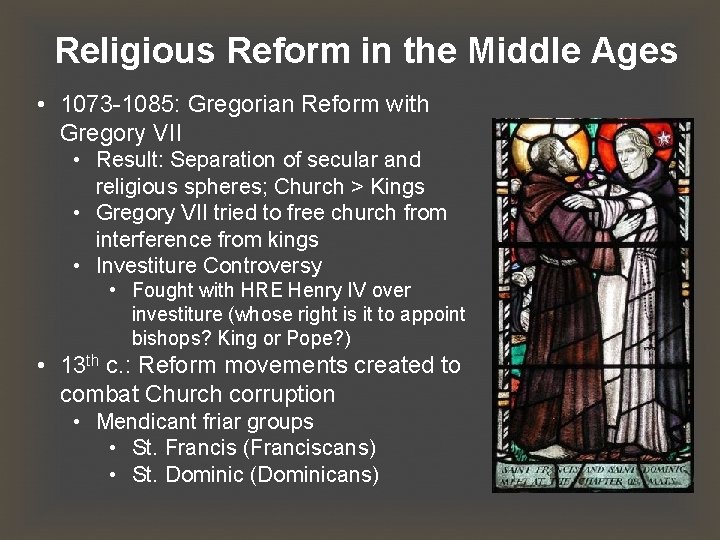
Religious Reform in the Middle Ages • 1073 -1085: Gregorian Reform with Gregory VII • Result: Separation of secular and religious spheres; Church > Kings • Gregory VII tried to free church from interference from kings • Investiture Controversy • Fought with HRE Henry IV over investiture (whose right is it to appoint bishops? King or Pope? ) • 13 th c. : Reform movements created to combat Church corruption • Mendicant friar groups • St. Francis (Franciscans) • St. Dominic (Dominicans)
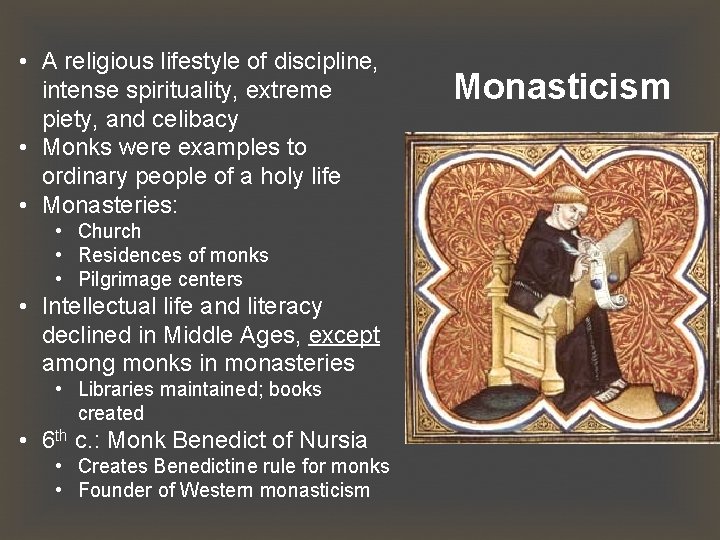
• A religious lifestyle of discipline, intense spirituality, extreme piety, and celibacy • Monks were examples to ordinary people of a holy life • Monasteries: • Church • Residences of monks • Pilgrimage centers • Intellectual life and literacy declined in Middle Ages, except among monks in monasteries • Libraries maintained; books created • 6 th c. : Monk Benedict of Nursia • Creates Benedictine rule for monks • Founder of Western monasticism Monasticism
Quick Review Question What are some of the responses to Catholic and papal corruption? What is monasticism? Why are they significant in Medieval history?
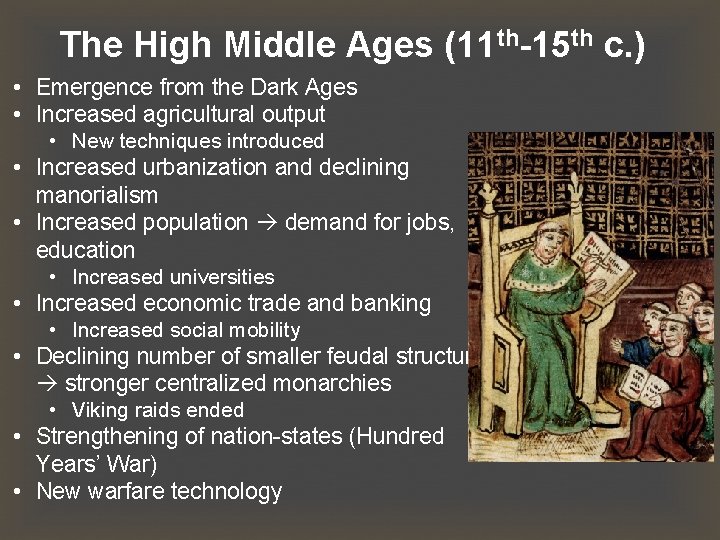
The High Middle Ages (11 th-15 th c. ) • Emergence from the Dark Ages • Increased agricultural output • New techniques introduced • Increased urbanization and declining manorialism • Increased population demand for jobs, education • Increased universities • Increased economic trade and banking • Increased social mobility • Declining number of smaller feudal structures stronger centralized monarchies • Viking raids ended • Strengthening of nation-states (Hundred Years’ War) • New warfare technology
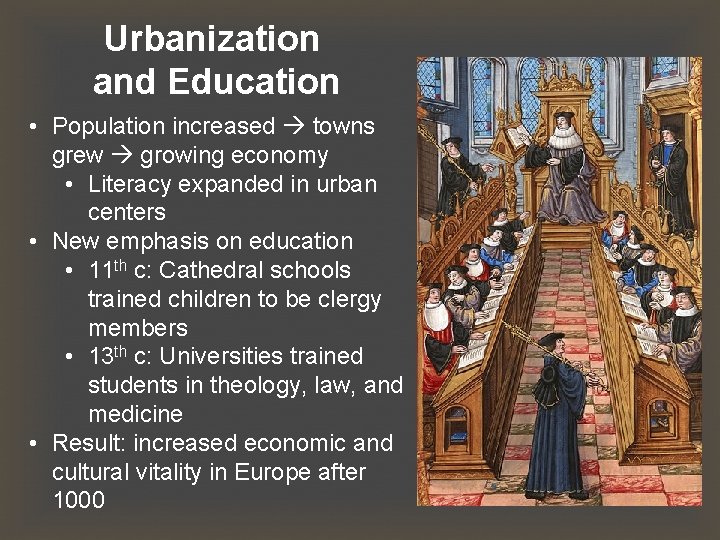
Urbanization and Education • Population increased towns grew growing economy • Literacy expanded in urban centers • New emphasis on education • 11 th c: Cathedral schools trained children to be clergy members • 13 th c: Universities trained students in theology, law, and medicine • Result: increased economic and cultural vitality in Europe after 1000
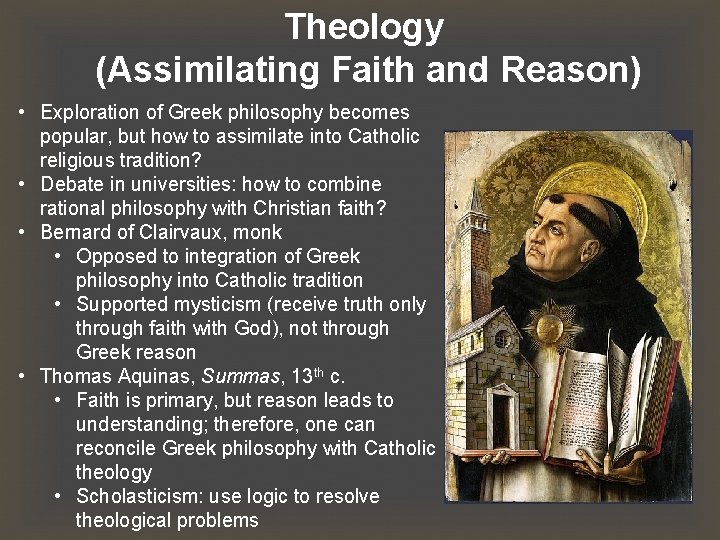
Theology (Assimilating Faith and Reason) • Exploration of Greek philosophy becomes popular, but how to assimilate into Catholic religious tradition? • Debate in universities: how to combine rational philosophy with Christian faith? • Bernard of Clairvaux, monk • Opposed to integration of Greek philosophy into Catholic tradition • Supported mysticism (receive truth only through faith with God), not through Greek reason • Thomas Aquinas, Summas, 13 th c. • Faith is primary, but reason leads to understanding; therefore, one can reconcile Greek philosophy with Catholic theology • Scholasticism: use logic to resolve theological problems
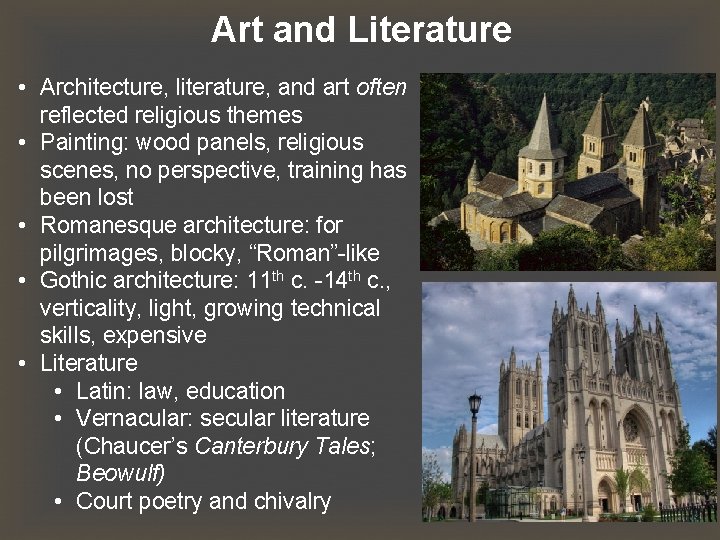
Art and Literature • Architecture, literature, and art often reflected religious themes • Painting: wood panels, religious scenes, no perspective, training has been lost • Romanesque architecture: for pilgrimages, blocky, “Roman”-like • Gothic architecture: 11 th c. -14 th c. , verticality, light, growing technical skills, expensive • Literature • Latin: law, education • Vernacular: secular literature (Chaucer’s Canterbury Tales; Beowulf) • Court poetry and chivalry
Quick Review Question What are some of the changes that the High Middle Ages bring? What was the main concern for Medieval theologians? What is a solution to this dilemma?
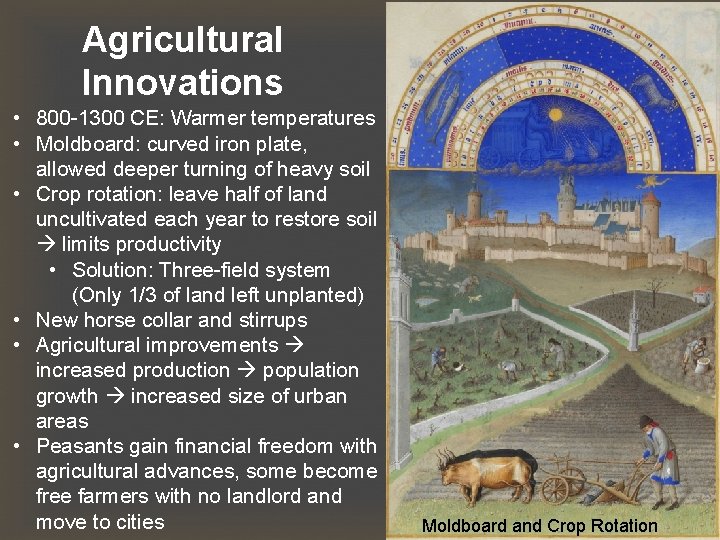
Agricultural Innovations • 800 -1300 CE: Warmer temperatures • Moldboard: curved iron plate, allowed deeper turning of heavy soil • Crop rotation: leave half of land uncultivated each year to restore soil limits productivity • Solution: Three-field system (Only 1/3 of land left unplanted) • New horse collar and stirrups • Agricultural improvements increased production population growth increased size of urban areas • Peasants gain financial freedom with agricultural advances, some become free farmers with no landlord and move to cities Moldboard and Crop Rotation
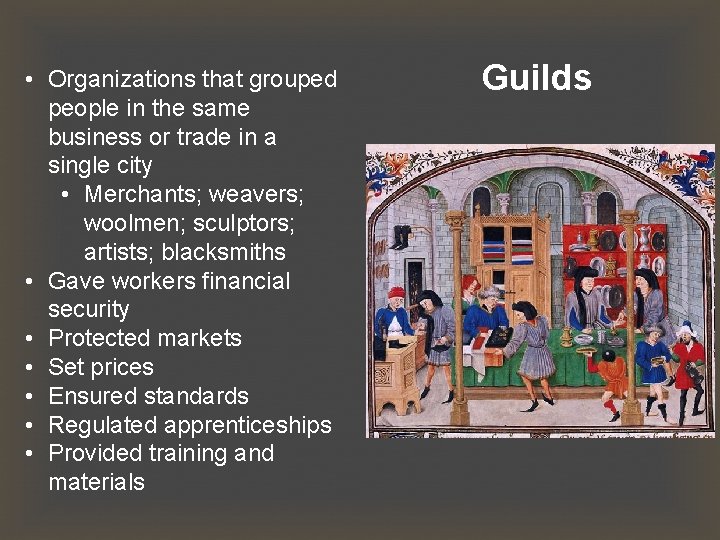
• Organizations that grouped people in the same business or trade in a single city • Merchants; weavers; woolmen; sculptors; artists; blacksmiths • Gave workers financial security • Protected markets • Set prices • Ensured standards • Regulated apprenticeships • Provided training and materials Guilds
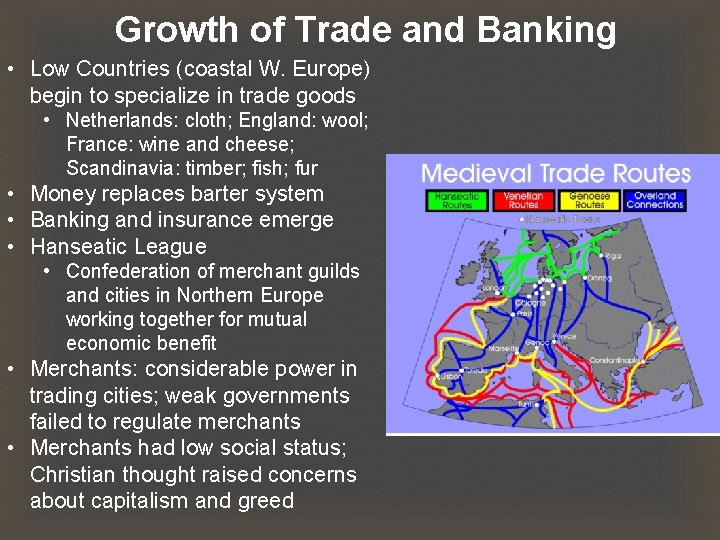
Growth of Trade and Banking • Low Countries (coastal W. Europe) begin to specialize in trade goods • Netherlands: cloth; England: wool; France: wine and cheese; Scandinavia: timber; fish; fur • Money replaces barter system • Banking and insurance emerge • Hanseatic League • Confederation of merchant guilds and cities in Northern Europe working together for mutual economic benefit • Merchants: considerable power in trading cities; weak governments failed to regulate merchants • Merchants had low social status; Christian thought raised concerns about capitalism and greed
Quick Review Question Describe some of the economic and technological changes in the High Middle Ages.
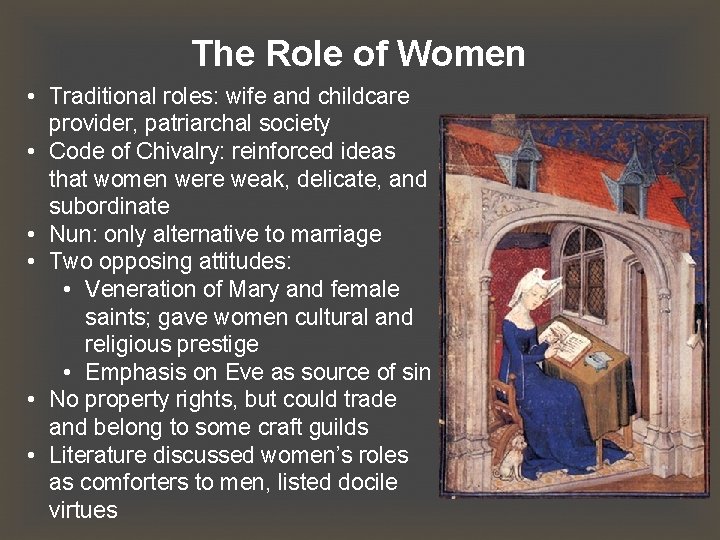
The Role of Women • Traditional roles: wife and childcare provider, patriarchal society • Code of Chivalry: reinforced ideas that women were weak, delicate, and subordinate • Nun: only alternative to marriage • Two opposing attitudes: • Veneration of Mary and female saints; gave women cultural and religious prestige • Emphasis on Eve as source of sin • No property rights, but could trade and belong to some craft guilds • Literature discussed women’s roles as comforters to men, listed docile virtues
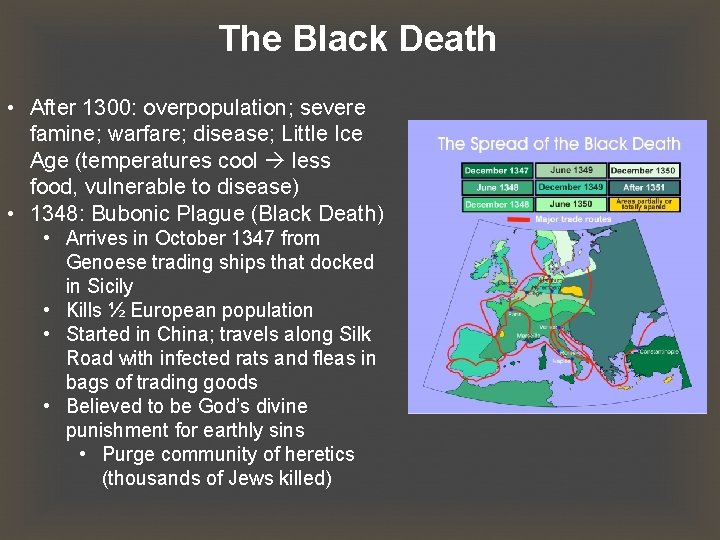
The Black Death • After 1300: overpopulation; severe famine; warfare; disease; Little Ice Age (temperatures cool less food, vulnerable to disease) • 1348: Bubonic Plague (Black Death) • Arrives in October 1347 from Genoese trading ships that docked in Sicily • Kills ½ European population • Started in China; travels along Silk Road with infected rats and fleas in bags of trading goods • Believed to be God’s divine punishment for earthly sins • Purge community of heretics (thousands of Jews killed)
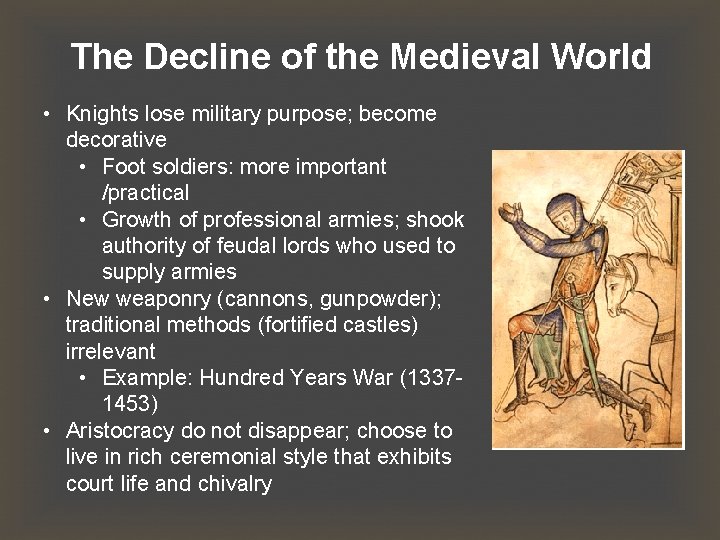
The Decline of the Medieval World • Knights lose military purpose; become decorative • Foot soldiers: more important /practical • Growth of professional armies; shook authority of feudal lords who used to supply armies • New weaponry (cannons, gunpowder); traditional methods (fortified castles) irrelevant • Example: Hundred Years War (13371453) • Aristocracy do not disappear; choose to live in rich ceremonial style that exhibits court life and chivalry
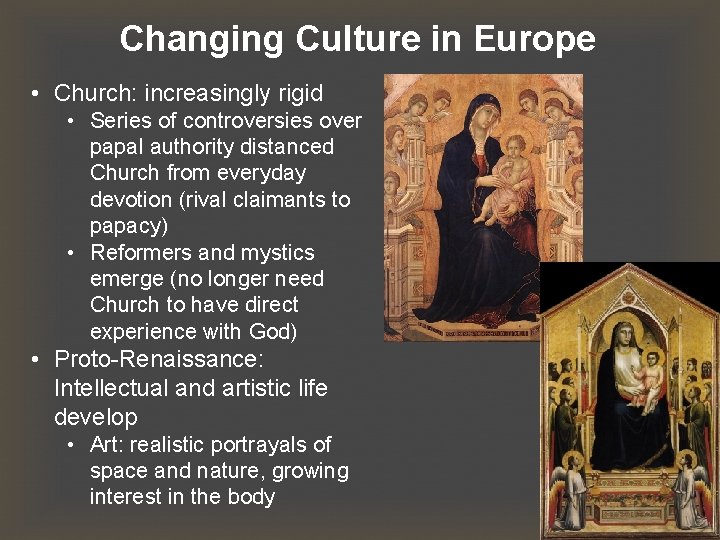
Changing Culture in Europe • Church: increasingly rigid • Series of controversies over papal authority distanced Church from everyday devotion (rival claimants to papacy) • Reformers and mystics emerge (no longer need Church to have direct experience with God) • Proto-Renaissance: Intellectual and artistic life develop • Art: realistic portrayals of space and nature, growing interest in the body
Quick Review Question How does the Medieval world decline towards the end of the High Middle Ages?