
Chapter 10 The Jefferson Era 1800 1816 Jeffersonian
- Slides: 15
Chapter 10 The Jefferson Era (1800 – 1816)
Jeffersonian Democracy: � The election of 1800, was again between Federalists, John Adams, and Democratic-Republican, Thomas Jefferson � Each side believed that the other was a threat to the Constitution � The Democratic-Republicans warned that the Alien and Sedition Acts went against the Bill of Rights � The Federalists thought the nation would be ruined by radicals – people who take extreme political positions � The elections were held, and 73 votes for Jefferson, Adams had 65, and Aaron Burr, whom Democratic. Republicans wanted as vice-president received 73 as well � By the Constitution, the House of Representatives had to choose between Jefferson and Burr � The House was still controlled by the Federalist, and they were split on whom to elect � In February, after voting 35 times, Jefferson won finally on the 36 ballot, thanks to Alexander Hamilton and James A. Bayard who persuaded several Federalist to vote for Jefferson
Jefferson and Democracy: � On inauguration day Jefferson had no guards, no coach, not even a horse, he strolled down the street of Washington D. C. accompanied by a few friends � Americans would learn that Jefferson’s humble behavior on inauguration day would reflect his ideas about the government � He sought to heal political wounds, by promoting a common way of life, and believed in limited governmental interference, the people should be able to govern themselves � His presidency reflected these beliefs � Under Jefferson, he limited the number of federal employees, the size of the military, ended the Alien and Sedition Acts, freed people convicted from them, and ended many taxes, such as the whiskey tax � Under the Judiciary Act of 1801 – Adams appointed as many federalists judges before Jefferson inauguration, because judges were appointed for life � Chief Justice – John Marshall, the Supreme Court upheld federal authority and strengthened federal courts � In 1803, Marbury VS. Madison, Marshall affirmed the principle of judicial review – the final authority of the Supreme Court on the meaning of the Constitution
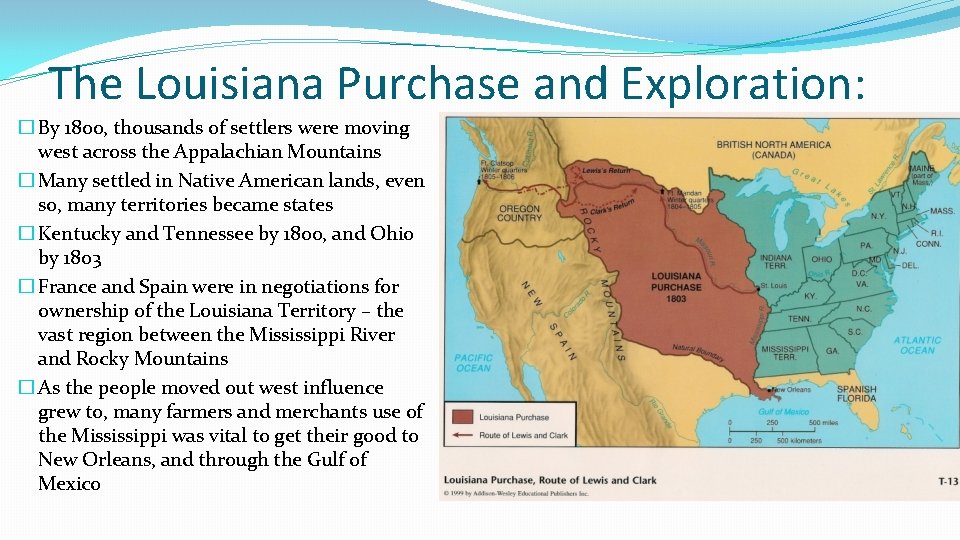
The Louisiana Purchase and Exploration: � By 1800, thousands of settlers were moving west across the Appalachian Mountains � Many settled in Native American lands, even so, many territories became states � Kentucky and Tennessee by 1800, and Ohio by 1803 � France and Spain were in negotiations for ownership of the Louisiana Territory – the vast region between the Mississippi River and Rocky Mountains � As the people moved out west influence grew to, many farmers and merchants use of the Mississippi was vital to get their good to New Orleans, and through the Gulf of Mexico
The Louisiana Purchase and Exploration Cont…: � New Orleans port originally claimed by the French, turned over to Spain after the French Indian War, but in a secret treaty in 1800, Spain returned the New Orleans to France’s powerful leader, Napoleon � Napoleon planned on colonizing the American Territory, which brought America closer to war again � In 1802, before turning Louisiana over to France, Spain closed New Orleans to Americans, which angered western Americans � Jefferson quickly offered to buy New Orleans from France, and surprising France asked if he wanted all of the Louisiana Territory � Many reasons for Napoleon to have not wanted the land, a revolt in Haiti, a French colony, the war debt after war with Britain � Jefferson a strict interpreter of the Constitution, made sure the Constitution wouldn’t prohibit him from buying it, but the Constitution said nothing of buying land � In 1803, the Louisiana Purchase – was approved for $15 million, about $0. 03 per acre � The size of the United Stated doubled, but most of the land was unknown
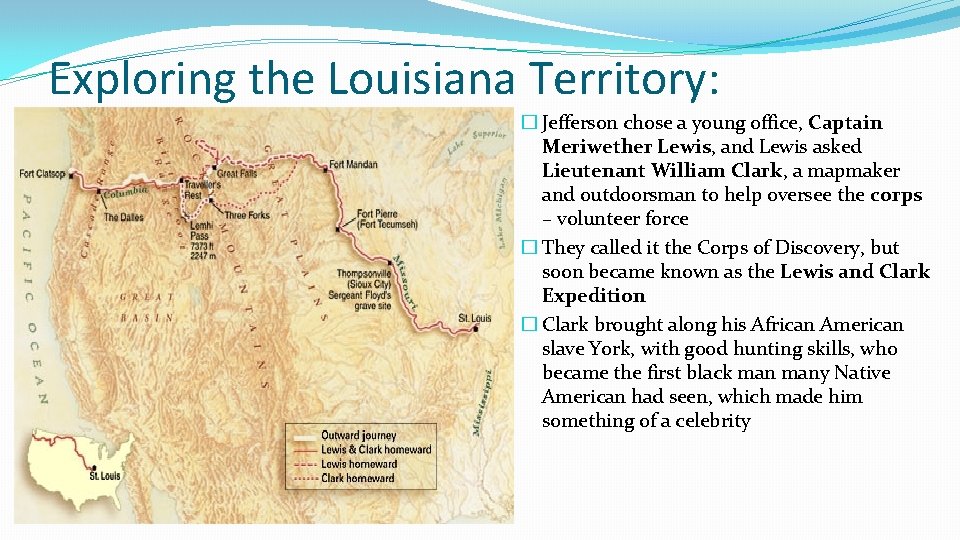
Exploring the Louisiana Territory: � Jefferson chose a young office, Captain Meriwether Lewis, and Lewis asked Lieutenant William Clark, a mapmaker and outdoorsman to help oversee the corps – volunteer force � They called it the Corps of Discovery, but soon became known as the Lewis and Clark Expedition � Clark brought along his African American slave York, with good hunting skills, who became the first black many Native American had seen, which made him something of a celebrity
Lewis and Clarks Expedition: � Their journey began in the summer of 1803, and by winter they had reached St. Louis � Located on the western banks of the Mississippi River, St. Louis, was soon to become the gateway to the west � They spent the winter there awaiting official transfer of Louisiana to the United States � In March of 1804, it was the first time the United States flag had flown in St. Louis � The expedition had about 40, Jefferson instructed them to explore the Missouri River in hopes of finding a water route across the continent � Jefferson also told them to make good relations with the Native Americans, to describe the landscape, plants, and animals they came across � After reaching what now it North Dakota, the expedition spent the winter with the Mandan people � In the spring of 1805, they set out again, joined by Sacagawea, a Shoshone Indian, she knew sign language, and several Native American languages, and her knowledge of the geography would be useful to the expedition
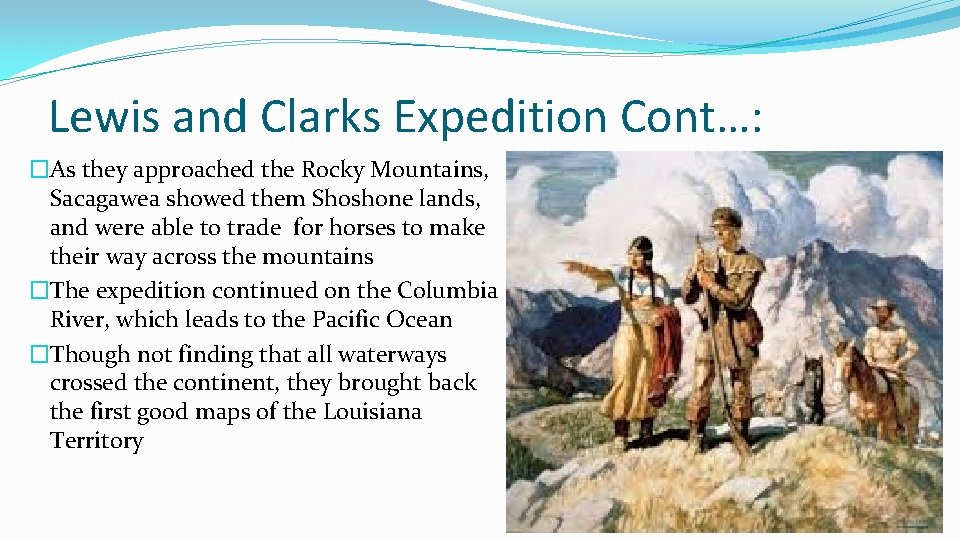
Lewis and Clarks Expedition Cont…: �As they approached the Rocky Mountains, Sacagawea showed them Shoshone lands, and were able to trade for horses to make their way across the mountains �The expedition continued on the Columbia River, which leads to the Pacific Ocean �Though not finding that all waterways crossed the continent, they brought back the first good maps of the Louisiana Territory
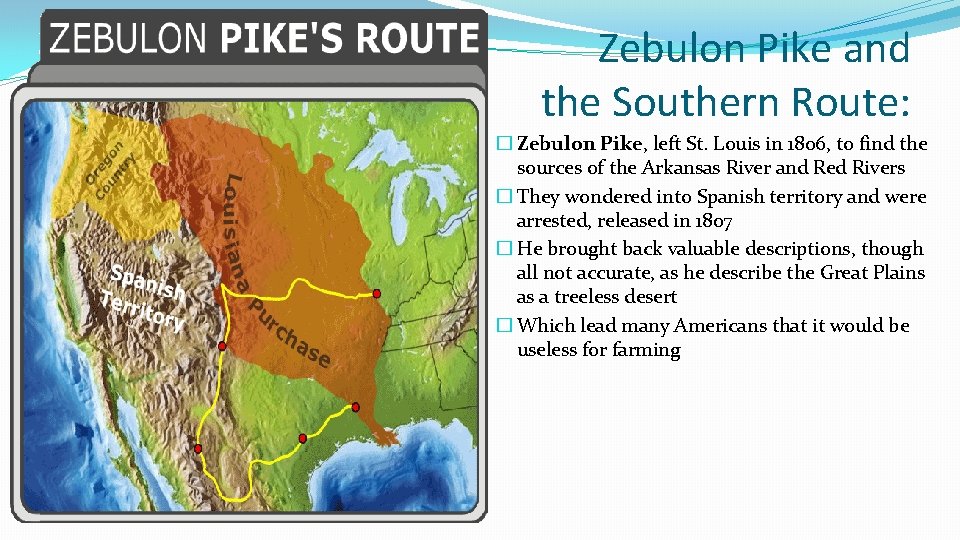
Zebulon Pike and the Southern Route: � Zebulon Pike, left St. Louis in 1806, to find the sources of the Arkansas River and Red Rivers � They wondered into Spanish territory and were arrested, released in 1807 � He brought back valuable descriptions, though all not accurate, as he describe the Great Plains as a treeless desert � Which lead many Americans that it would be useless for farming
The Path to War: � Jefferson wanted the United States to seek friendship of all nations, but have “entangled alliances with none” � His desire to stay out of conflict was doomed from the start as he could not control the actions over foreign powers � War broke out between France and Britain in 1803, France stopped any trading ships with Britain, and British ships did the same to France � Britain had a shortage of sailors, and started using the policy on impressment – or kidnapping, of American sailors, between 1803 to 1812, 6, 000 Americans were impressed to work on British ships � Jefferson, instead of declaring war, asked Congress to stop all foreign trade, a policy of “peaceable coercion” – forcing someone to act in certain way by pressure or threats � Congress passed the Embargo Act of 1807 – which forbade American ships from sailing to foreign ports, also closing American ports to the British � The issues was huge in the election of 1808, which James Madison won, because of huge losses of income Americans faced � Madison’s approach to the situation, was to trade with other countries except France and Britain until they learned to respect U. S. ship
The Path to War Cont…: � Since the Battle of Fallen Timbers, Native American continued to lose their lands � Tecumseh, a Shawnee chief, vowed to stop this, and wanted Native Americans to unite � In 1809, William Henry Harrison, governor if the Indiana Territory signed the Treaty of Fort Wayne with the Delaware, Miami, and Potawatomie chiefs � Tecumseh, saw it null and void unless all Native American tribes signed � Harrison’s forces attacked the Shawnee in 1811, at the Battle of Tippecanoe
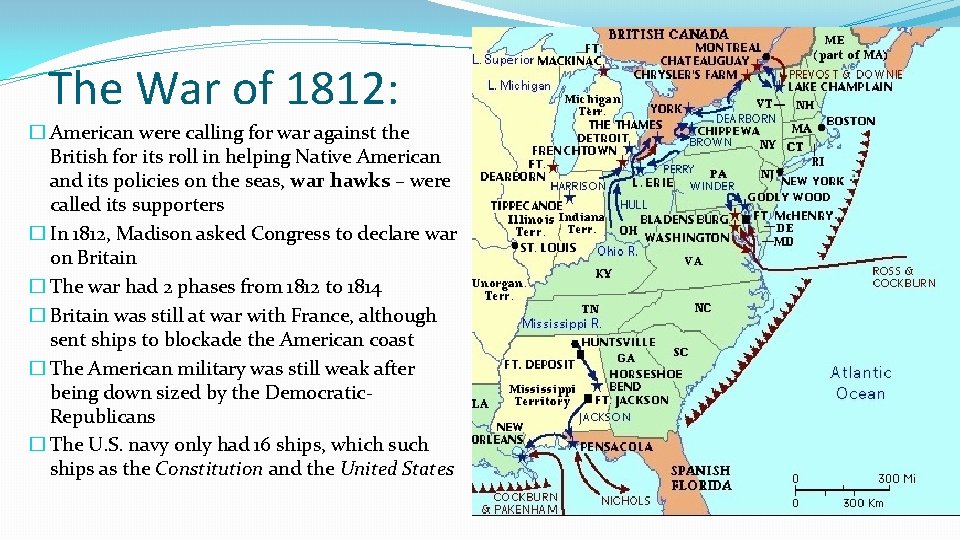
The War of 1812: � American were calling for war against the British for its roll in helping Native American and its policies on the seas, war hawks – were called its supporters � In 1812, Madison asked Congress to declare war on Britain � The war had 2 phases from 1812 to 1814 � Britain was still at war with France, although sent ships to blockade the American coast � The American military was still weak after being down sized by the Democratic. Republicans � The U. S. navy only had 16 ships, which such ships as the Constitution and the United States
Triumph on Lake Erie: � The most important victory took place on Lake Erie in 1813 � Commodore Oliver Hazard Perry, sailed out to meet the British on the Lawrence, flying a banner that said “Don’t give up the ship” � After 2 hours of fighting, Perry’s ship was demolished, Perry and 4 companies escaped to a near by ship and soon forced the British to surrender � Sending word to General William Henry Harrison, “We have met the enemy and they are ours” � Harrison receiving Perry’s word, crossed Lake Erie to Detroit, and discovered the British had already retreated to Canada � Harrison followed, the Battle of Thanes, in 1813, where Harrison defeated the British and Tecumseh � The northwest was free from threat
The Second Phase of the War: � After the British defeated Napoleon of France, they were now free to send their flee to America � In 1814, British ships and troops attached Washington D. C. , President Madison and other officials fled the capitol � Madison’s wife stay behind to rescue important valuable objects in the White House, and narrowly escaped before it was burned it and the Capitol building � The British then attacked fort Mc. Henry at Baltimore � The commander of fort Mc. Henry requested a flag so big that the British could have no difficulty seeing it � Francis Scott, a lawyer detained on a British ship, watched all night as the battle raged on, and at dawn still saw the flag still flying, which he expressed in a poem that is know as the Star-Spangled Banner, which became the American national anthem � Meanwhile, British troop tried to cut off New England, crossing Lake Champlain, but were unsuccessful in the Battle of Lake Champlain
The Battle of New Orleans: � In December 1814, British ship approached the port of New Orleans, Louisiana, with 7, 500 soldiers and dozen of ships � Under command of General Andrew Jackson, troops defeated the advancing British troops, by building defenses out of earth, American lost 71 men compared to British loses, 2, 000 � Do to slow mail to Europe, the battle didn’t matter, the Treaty of Ghent had been signed 2 weeks earlier ending the war � The Treaty changed nothing, no land was traded, trade disputes still existed � Though heroic exploits of Jackson and Perry, increase American patriotism, and with the blockade, American were forced to make the goods themselves which they previously imported, which encouraged growth of the American manufacturing � The American victory also showed that the United States could defend itself against one of the world most powerful militaries of its era � Americans believed that their young nation would survive and prosper