
Chapter 10 Team Leadership Power Point Presentation by
Chapter 10 Team Leadership Power. Point Presentation by Charlie Cook Copyright © 2003 South-Western/Thomson Learning. All rights reserved.
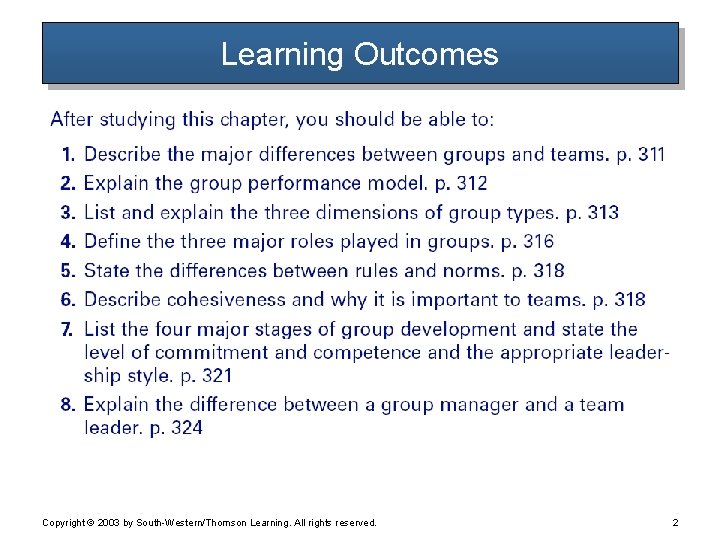
Learning Outcomes Copyright © 2003 by South-Western/Thomson Learning. All rights reserved. 2

Learning Outcomes (cont’d) Copyright © 2003 by South-Western/Thomson Learning. All rights reserved. 3
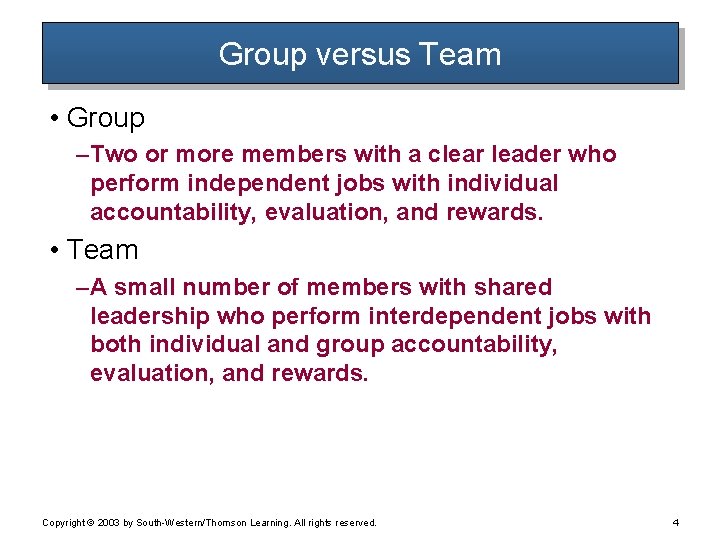
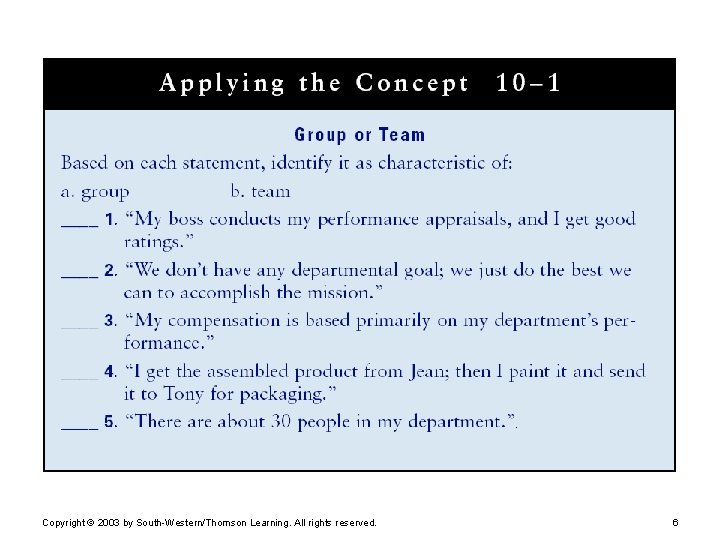
Group versus Team • Group – Two or more members with a clear leader who perform independent jobs with individual accountability, evaluation, and rewards. • Team – A small number of members with shared leadership who perform interdependent jobs with both individual and group accountability, evaluation, and rewards. Copyright © 2003 by South-Western/Thomson Learning. All rights reserved. 4

Groups versus Teams Exhibit 10– 1 Copyright © 2003 by South-Western/Thomson Learning. All rights reserved. 5
Copyright © 2003 by South-Western/Thomson Learning. All rights reserved. 6
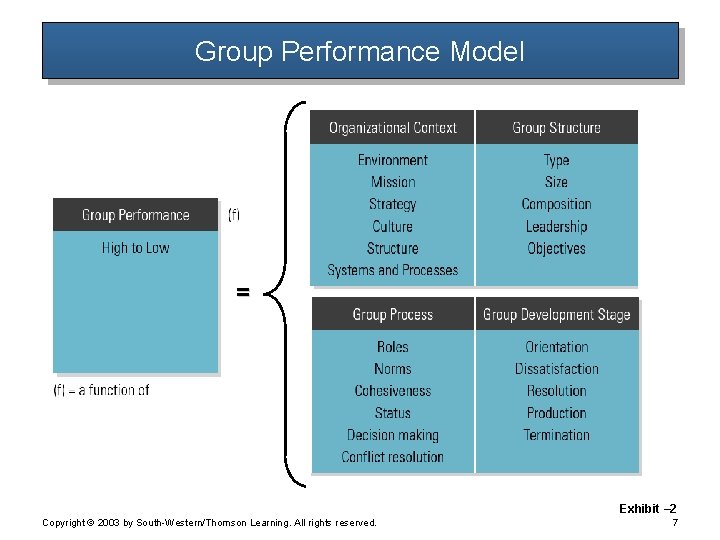
Group Performance Model = Exhibit – 2 Copyright © 2003 by South-Western/Thomson Learning. All rights reserved. 7
Group Types • Formal – Recognized (and established) by the organization. • Informal – Self-formed, not officially recognized by the organization. • Functional Groups – Members from a limited organizational area. • Cross-Functional Groups – Members from different organizational areas and/or levels. Copyright © 2003 by South-Western/Thomson Learning. All rights reserved. 8
Group Types (cont’d) • Command – Consists of managers and their employees. • Task Groups – Consists of employees selected to work on a specific objective. • Task Force – Temporary group formed for a specific purpose. • Standing Committee – A permanent group that works on continuing organizational issues. Copyright © 2003 by South-Western/Thomson Learning. All rights reserved. 9
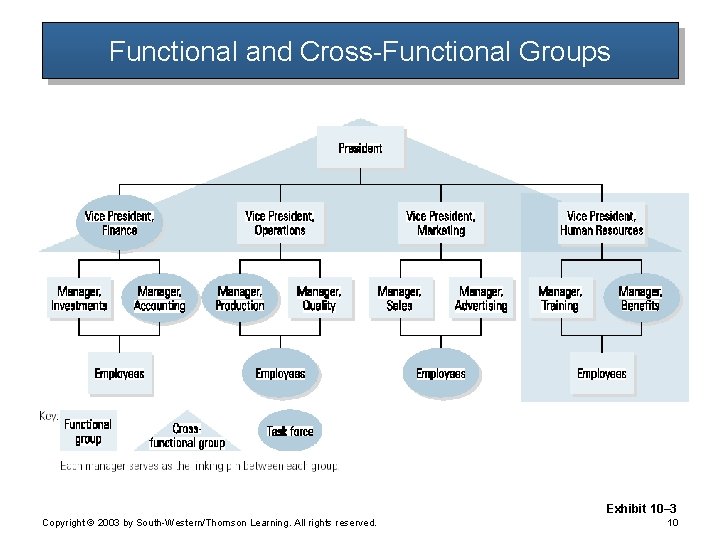
Functional and Cross-Functional Groups Exhibit 10– 3 Copyright © 2003 by South-Western/Thomson Learning. All rights reserved. 10
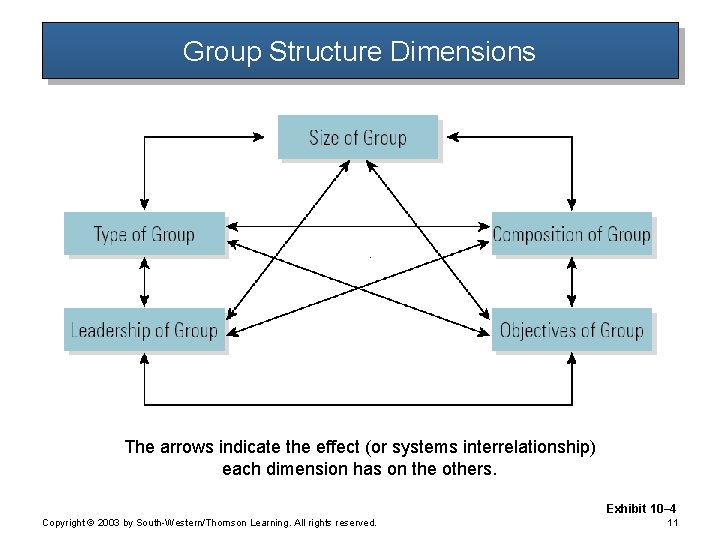
Group Structure Dimensions The arrows indicate the effect (or systems interrelationship) each dimension has on the others. Exhibit 10– 4 Copyright © 2003 by South-Western/Thomson Learning. All rights reserved. 11
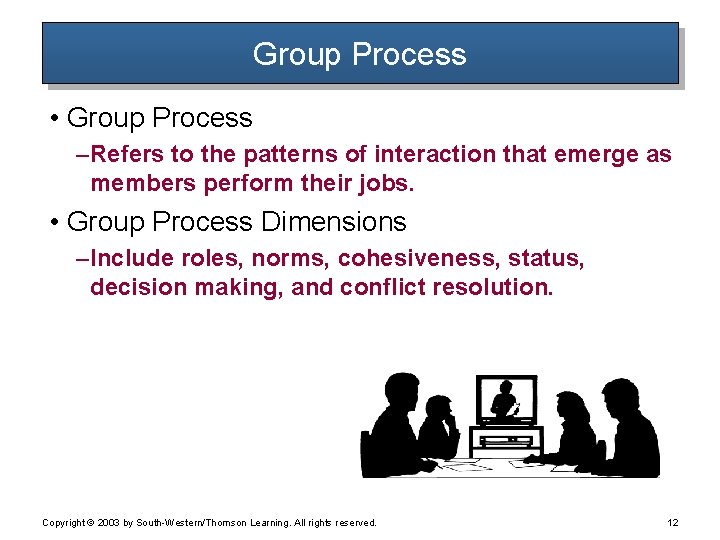
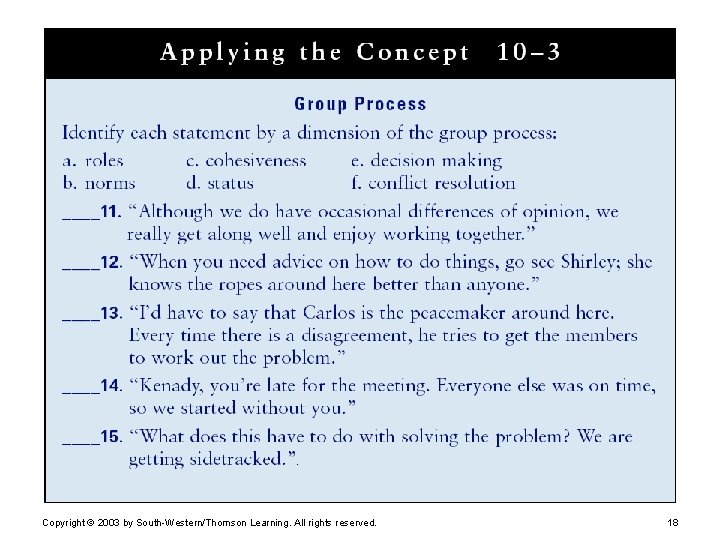
Group Process • Group Process – Refers to the patterns of interaction that emerge as members perform their jobs. • Group Process Dimensions – Include roles, norms, cohesiveness, status, decision making, and conflict resolution. Copyright © 2003 by South-Western/Thomson Learning. All rights reserved. 12
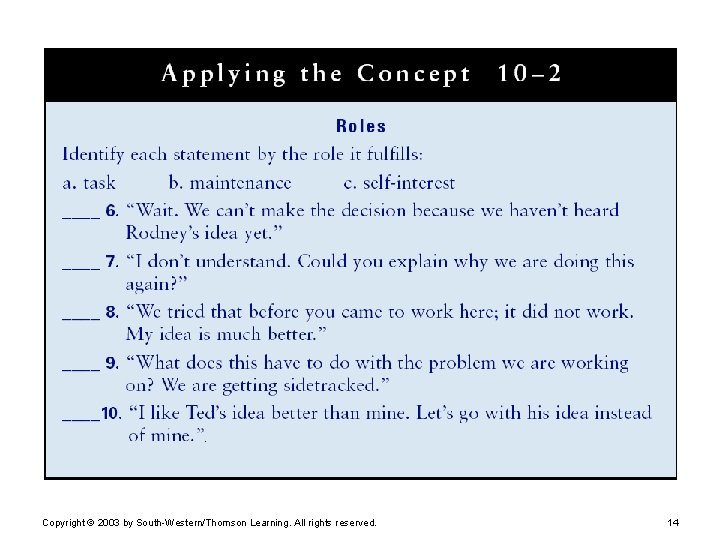
Group Process (cont’d) • Group Roles – Task roles • Do and say things that directly aid the accomplishment of the group’s objectives. – Maintenance roles • Do and say things to develop and sustain the group process. – Self-interest roles • Do and say things to hurt the group and help the individual. Copyright © 2003 by South-Western/Thomson Learning. All rights reserved. 13
Copyright © 2003 by South-Western/Thomson Learning. All rights reserved. 14
Group Process (cont’d) • Group Norms – The group’s shared expectations of its members’ behavior. – Norms develop spontaneously through the interactions of group members. – Compliance with norms is enforced by the group. – Leaders should work toward maintaining and developing positive norms. Copyright © 2003 by South-Western/Thomson Learning. All rights reserved. 15
Group Process (cont’d) • Group Cohesiveness – The extent to which members stick together. – Factors positively influencing cohesiveness: • Agreement with and commitment to objectives • Small size • Homogeneity among group members • Equal member participation • Focus on external competition • A successful group Copyright © 2003 by South-Western/Thomson Learning. All rights reserved. 16
Group Process (cont’d) • Status within the Group – Status is the perceived ranking of one member relative to other members in the group. • Based on performance, job title, wage or salary, seniority, knowledge or expertise, interpersonal skills. – High status members have a strong influence on the group and its performance. Copyright © 2003 by South-Western/Thomson Learning. All rights reserved. 17
Copyright © 2003 by South-Western/Thomson Learning. All rights reserved. 18
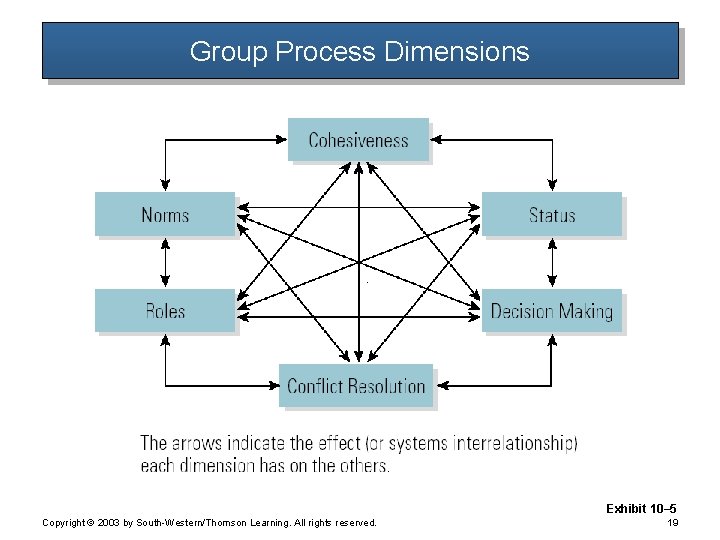
Group Process Dimensions Exhibit 10– 5 Copyright © 2003 by South-Western/Thomson Learning. All rights reserved. 19
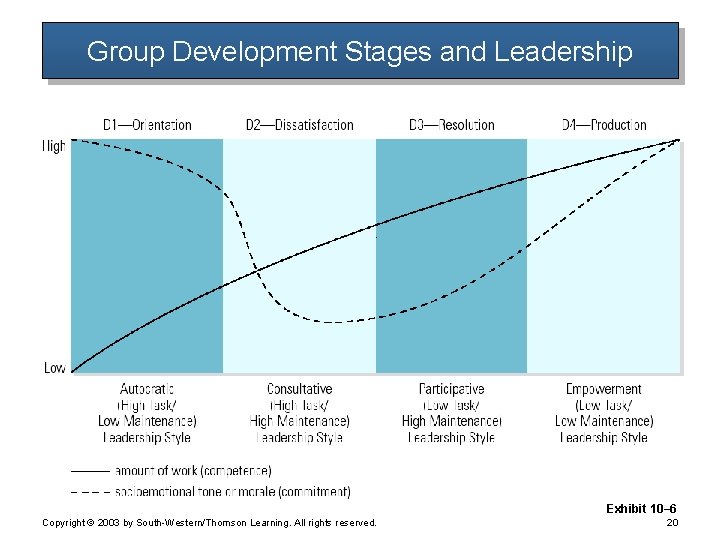
Group Development Stages and Leadership Exhibit 10– 6 Copyright © 2003 by South-Western/Thomson Learning. All rights reserved. 20
Meeting Leadership Skills • Planning Meetings • Conducting Meetings – Objectives – Participants and Assignments – Agenda – Date, Place and Time – Leadership – Technology Copyright © 2003 by South-Western/Thomson Learning. All rights reserved. – Three Parts of Meetings • Identify Objectives • Cover agenda items • Summarize and review assignments 21
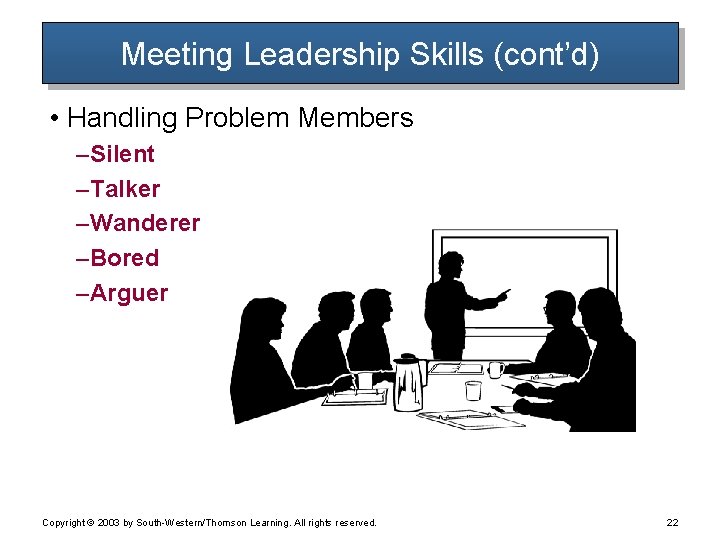
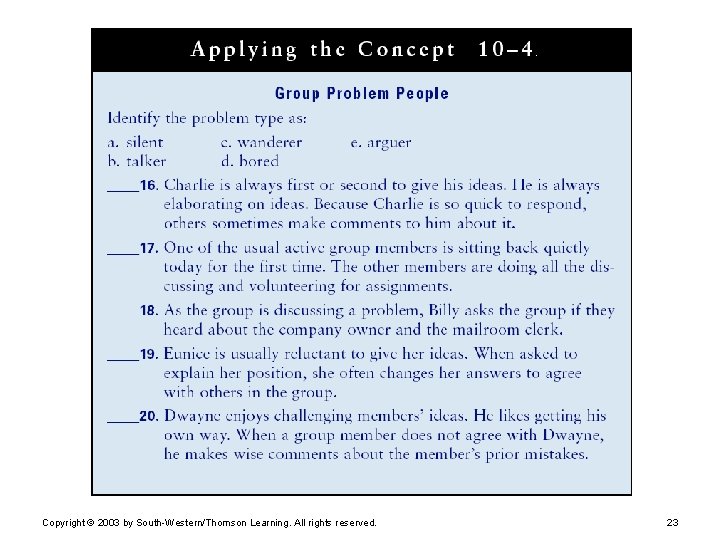
Meeting Leadership Skills (cont’d) • Handling Problem Members – Silent – Talker – Wanderer – Bored – Arguer Copyright © 2003 by South-Western/Thomson Learning. All rights reserved. 22
Copyright © 2003 by South-Western/Thomson Learning. All rights reserved. 23
- Slides: 23