
Chapter 10 Sustaining Terrestrial Biodiversity The Ecosystem Approach
Chapter 10 Sustaining Terrestrial Biodiversity: The Ecosystem Approach
National Parks System v America’s v Parks sizes “crown jewel” are diverse and come in many different v Purchases have been made by government or private individuals/companies v Yellowstone NP was the first (1872)

Important People v John Muir – S 16 & S 17 v Henry v Aldo David Thoreau Leopold v President Teddy Roosevelt
Clubs & Organizations � Sierra Club (1892) � Audubon � The Society Nature Conservancy (1951) – has created the world’s largest system of private natural areas and wildlife sanctuaries in 30 countries.
Services � � National Park Service (1916) – manages the National Parks System; falls under the Dept. of Interior US Forest Service (1905) – manages and protects the forest reserves. US Fish and Wildlife Service (1940) – ◦ responsible for identification and listing of, ◦ and monitoring the import of threatened and endangered species. ◦ Responsible for administering the Endangered Species Act National Wildlife Refuges – areas that have been set aside for the protection of threatened or endangered species.
Threatened by 1. Air, noise and water pollution 2. Invasion of non-native species 3. Tourism – high number of park visitors can degrade natural areas 4. LACK OF FUNDING 5. Pressure from developers, lumber and mining companies
Fragmented Habitats � Parks can be viewed as habitat islands surrounded by: 1. Logging 2. Industrial activity 3. Energy extraction (minerals, oil, coal) 4. Agriculture 5. Dissected by roads (very detrimental)

Legislation and Policy � Forest Reserve Act (1891) � Lacey Act (1900) � National Parks and Services Act (1916) � Migratory Bird Act (1918) � Taylor Grazing Act (1934) � Federal Aid in Wildlife Restoration Act (1937) � Wilderness Act (1964) � Smokey Bear Campaign (1970 s) � Healthy Forests Restoration Act (2003)
National Wild & Scenic River System � Allows activities such as camping, kayaking, canoeing and fishing; NOT motor boating � Offers protection to rivers or segments of rivers with ◦ Cultural and historical value ◦ Wildlife and scenic value ◦ Recreational value
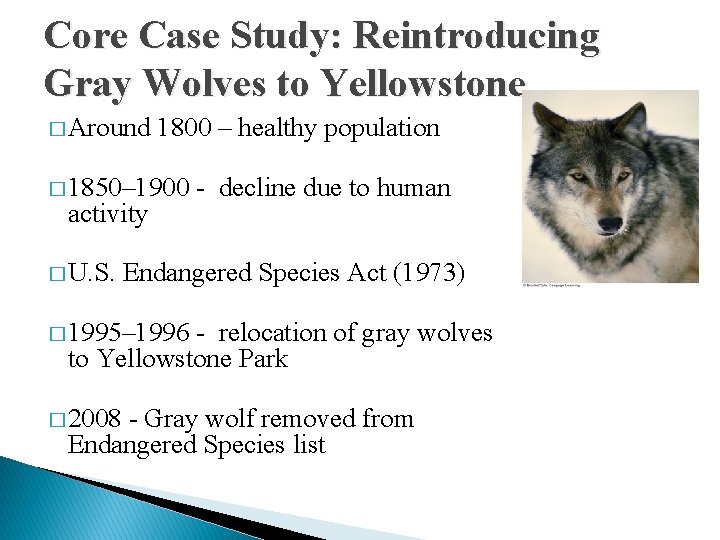
Core Case Study: Reintroducing Gray Wolves to Yellowstone � Around 1800 – healthy population � 1850– 1900 activity � U. S. - decline due to human Endangered Species Act (1973) � 1995– 1996 - relocation of gray wolves to Yellowstone Park � 2008 - Gray wolf removed from Endangered Species list
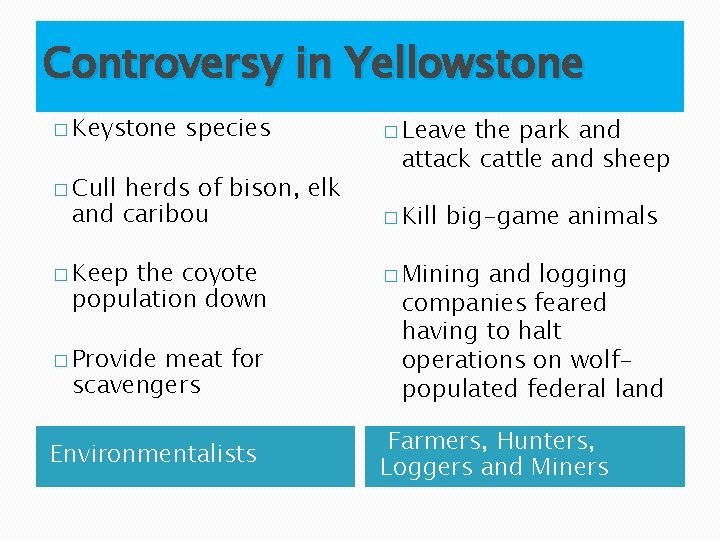
Controversy in Yellowstone � Keystone species � Cull herds of bison, elk and caribou � Keep the coyote population down � Provide meat for scavengers Environmentalists � Leave the park and attack cattle and sheep � Kill big-game animals � Mining and logging companies feared having to halt operations on wolfpopulated federal land Farmers, Hunters, Loggers and Miners
What Are the Major Threats to Forest Ecosystems? � Forest ecosystems provide ecological services far greater in value than the value of raw materials obtained from forests. � Unsustainable cutting and burning of forests, along with diseases and insects, are the chief threats to forest ecosystems. � Tropical deforestation is a potentially catastrophic problem because of the vital ecological services at risk, the high rate of tropical deforestation, and its growing contribution to global warming.
Statistics � About 5% of Earth’s remaining areas are protected either strictly or partially by law. � About 20% of Earth’s land area is needed to adequately preserve biodiversity. Wilderness � Forests cover about 30% of the United States. � About 40% of the forests in the US are protected. Forests
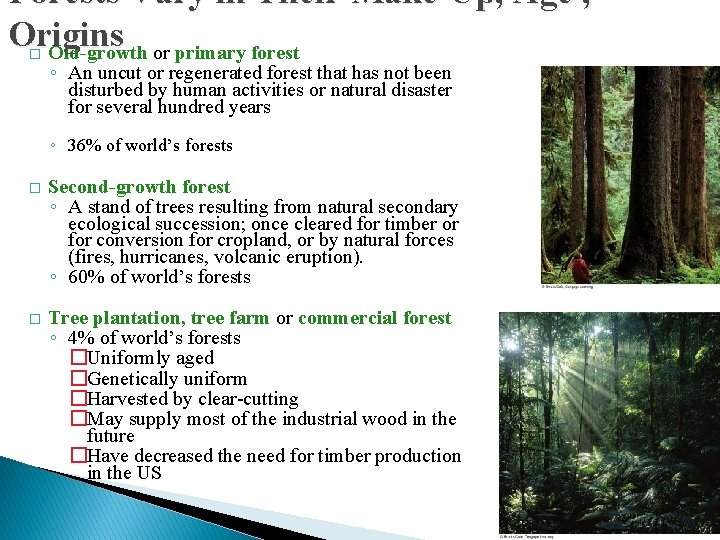
Forests Vary in Their Make-Up, Age , Origins Old-growth or primary forest � ◦ An uncut or regenerated forest that has not been disturbed by human activities or natural disaster for several hundred years ◦ 36% of world’s forests � Second-growth forest ◦ A stand of trees resulting from natural secondary ecological succession; once cleared for timber or for conversion for cropland, or by natural forces (fires, hurricanes, volcanic eruption). ◦ 60% of world’s forests � Tree plantation, tree farm or commercial forest ◦ 4% of world’s forests �Uniformly aged �Genetically uniform �Harvested by clear-cutting �May supply most of the industrial wood in the future �Have decreased the need for timber production in the US

Rotation Cycle of Cutting and Regrowth of a Monoculture Tree Plantation Short rotation cycle of cutting and re growth of a monoculture tree plantation
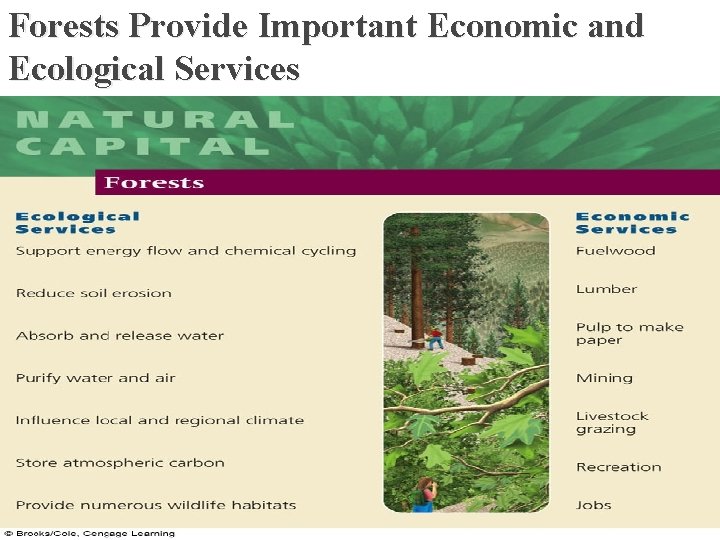
Forests Provide Important Economic and Ecological Services � Support energy flow and chemical cycling � Reduce soil erosion � Absorb and release water � Purify water and air � Influence local and regional climate � Store atmospheric carbon � Habitats
Putting a Price Tag on Nature’s Ecological Services � Forests valued for ecological services ◦ Nutrient cycling ◦ Climate regulation ◦ Erosion control ◦ Waste treatment ◦ Recreation ◦ Raw materials � $4. 7 Trillion per year
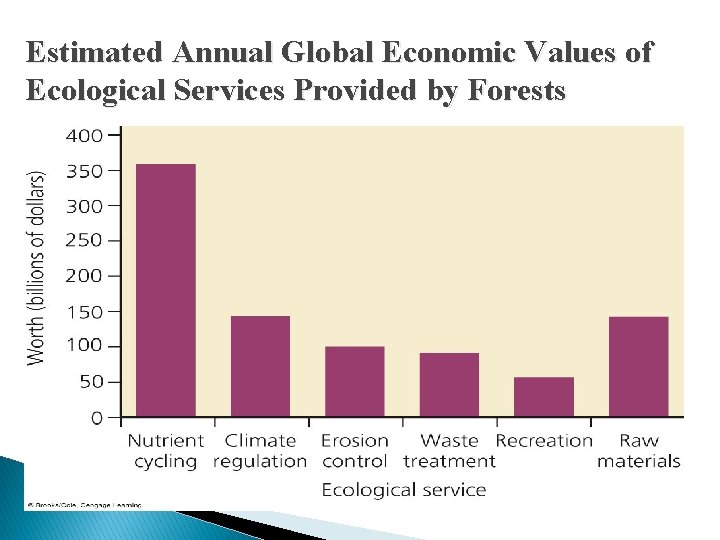
Estimated Annual Global Economic Values of Ecological Services Provided by Forests
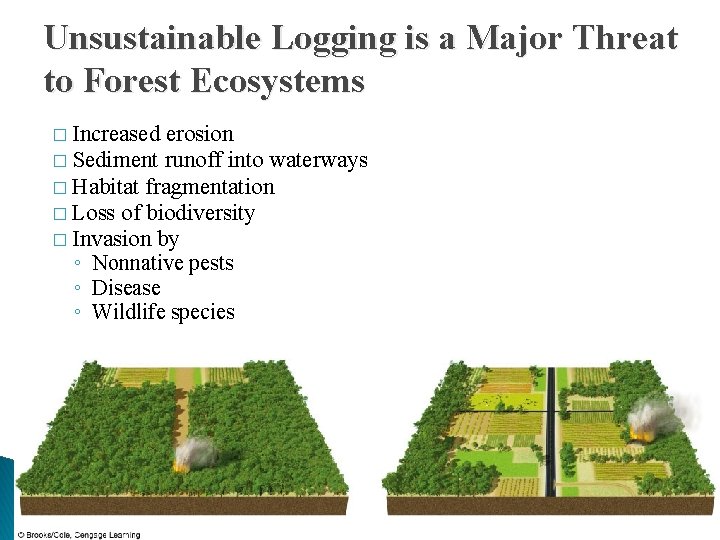
Unsustainable Logging is a Major Threat to Forest Ecosystems � Increased erosion � Sediment runoff into waterways � Habitat fragmentation � Loss of biodiversity � Invasion by ◦ Nonnative pests ◦ Disease ◦ Wildlife species

Major Tree Harvesting Methods � Clear cutting ◦ Removal of all trees from an area ◦ Allows for maximum profit in shortest amount of time ◦ Results in �Erosion and water pollution �Increased flooding �Habitat fragmentation �Loss of biodiversity
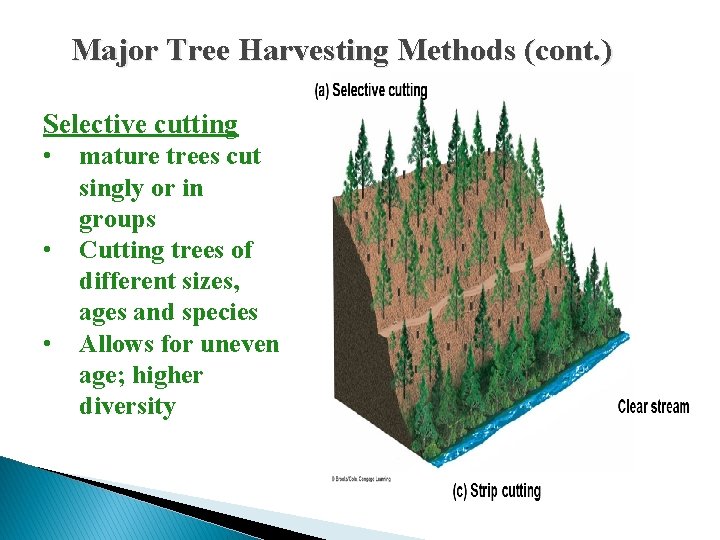
Major Tree Harvesting Methods (cont. ) Selective cutting • • • mature trees cut singly or in groups Cutting trees of different sizes, ages and species Allows for uneven age; higher diversity

Major Tree Harvesting Methods (cont. ) Strip-cutting • A variation clearcutting • Involves clear-cutting a narrow corridor of land, allowing a few years for regeneration, then logging another strip above the previous strip(s).
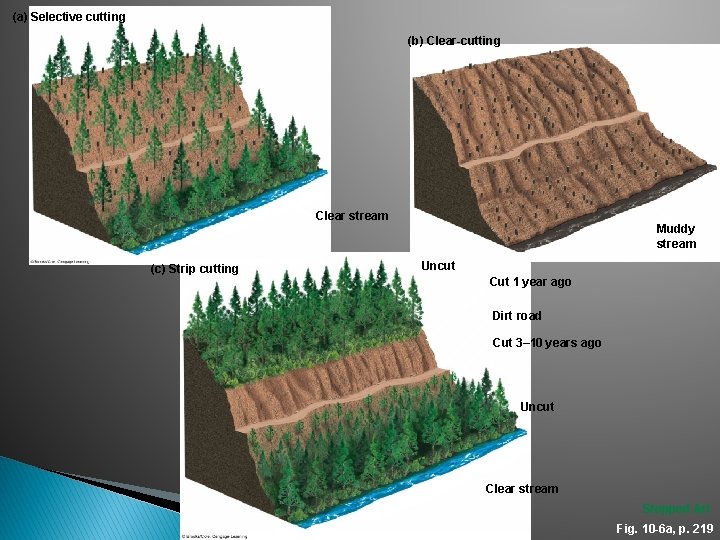
(a) Selective cutting (b) Clear-cutting Clear stream (c) Strip cutting Muddy stream Uncut Cut 1 year ago Dirt road Cut 3– 10 years ago Uncut Clear stream Stepped Art Fig. 10 -6 a, p. 219
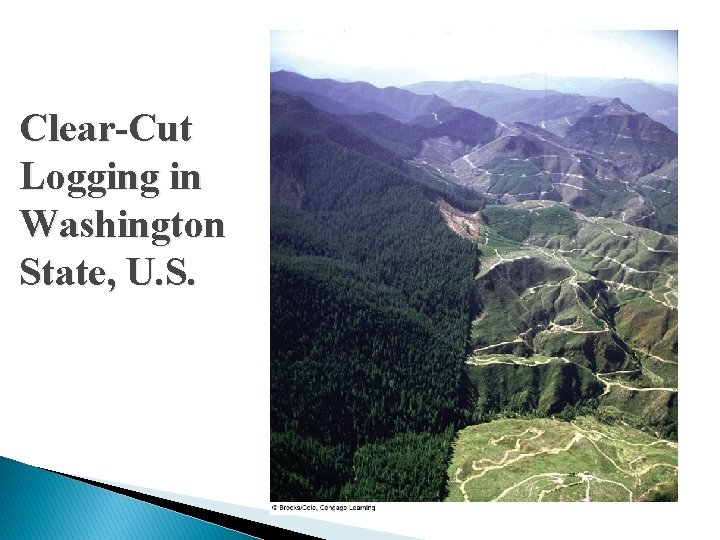
Clear-Cut Logging in Washington State, U. S.
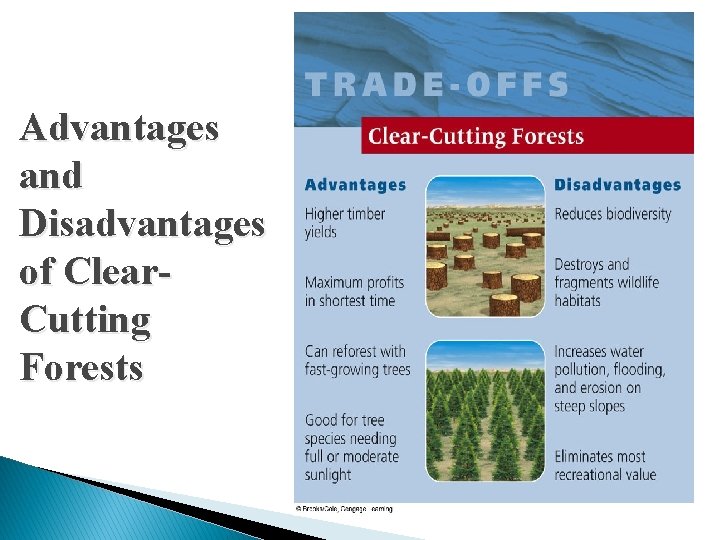
Advantages and Disadvantages of Clear. Cutting Forests
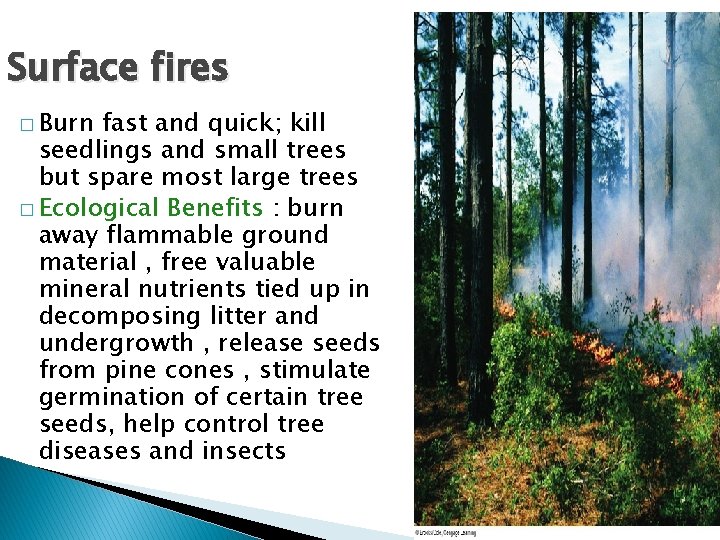
Surface fires � Burn fast and quick; kill seedlings and small trees but spare most large trees � Ecological Benefits : burn away flammable ground material , free valuable mineral nutrients tied up in decomposing litter and undergrowth , release seeds from pine cones , stimulate germination of certain tree seeds, help control tree diseases and insects
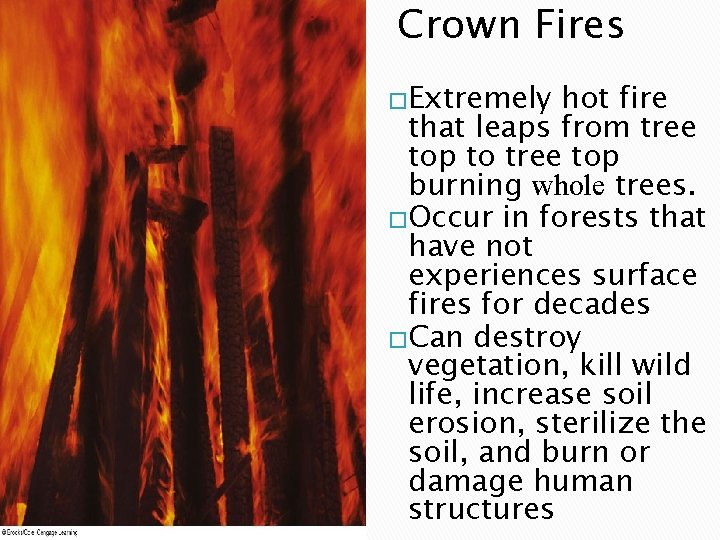
Crown Fires �Extremely hot fire that leaps from tree top to tree top burning whole trees. �Occur in forests that have not experiences surface fires for decades �Can destroy vegetation, kill wild life, increase soil erosion, sterilize the soil, and burn or damage human structures
We Can Improve the Management of Forest Fires �The Smokey Bear educational campaign �Prescribed fires �Allow fires on public lands to burn �Protect structures in fire-prone areas �Thin forests in fire-prone areas � 2003 Healthy Forests Restoration Act ◦ Pros – clear away fire prone trees and underbrush ◦ Cons – cut down economically valuable medium-sized and large trees in 71% of the country’s national forests
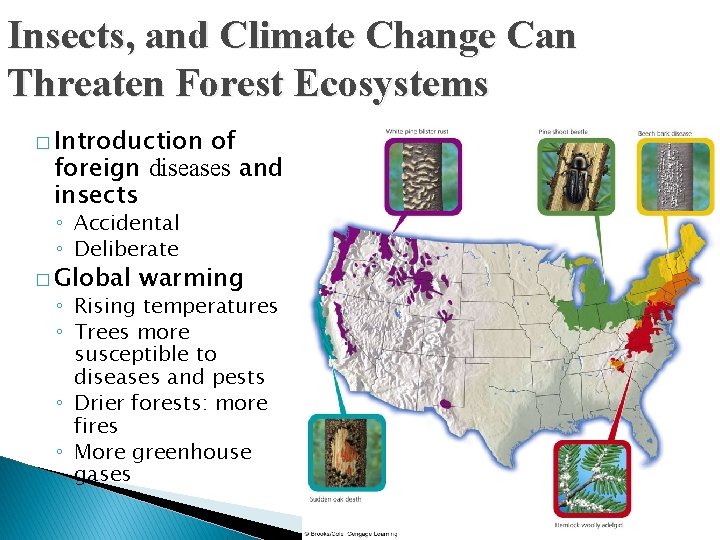
Insects, and Climate Change Can Threaten Forest Ecosystems � Introduction of foreign diseases and insects ◦ Accidental ◦ Deliberate � Global warming ◦ Rising temperatures ◦ Trees more susceptible to diseases and pests ◦ Drier forests: more fires ◦ More greenhouse gases
Tropical Rainforests � Cover about 6% of Earth’s area � More than ½ of the world’s tropical forests are located in Brazil, Indonesia, Zaire and Peru � More than ½ have already been cleared or degraded
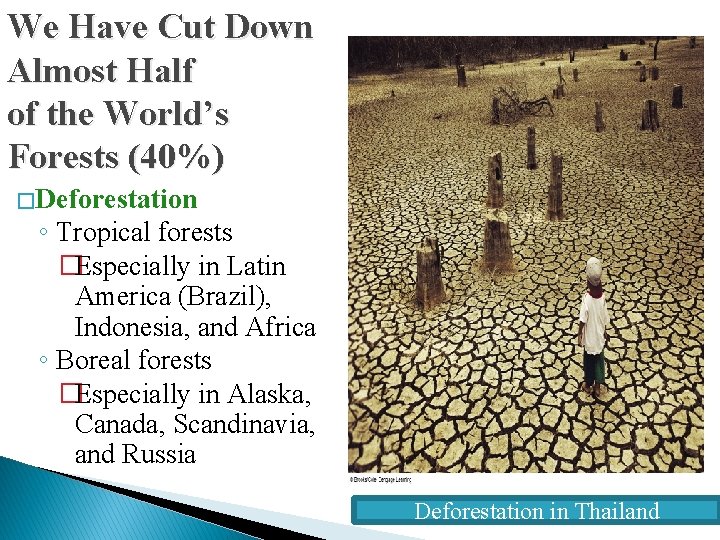
We Have Cut Down Almost Half of the World’s Forests (40%) � Deforestation ◦ Tropical forests �Especially in Latin America (Brazil), Indonesia, and Africa ◦ Boreal forests �Especially in Alaska, Canada, Scandinavia, and Russia Deforestation in Thailand
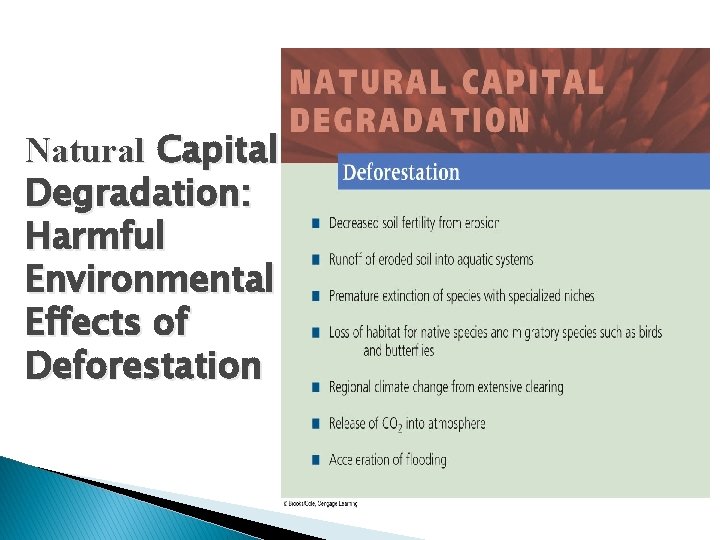
Natural Capital Degradation: Harmful Environmental Effects of Deforestation
Case Study: Many Cleared Forests in the United States Have Grown Back � Forests of the eastern United States decimated between 1620 and 1920 � Grown back naturally through secondary ecological succession � Biologically simplified tree plantations reduce biodiversity
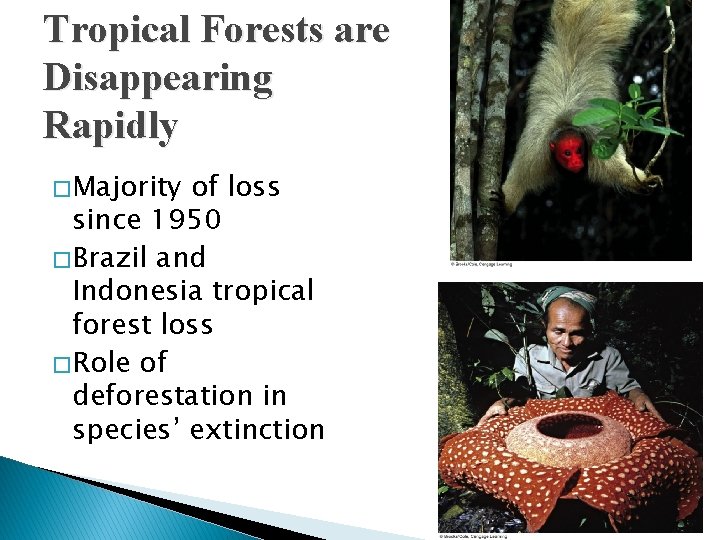
Tropical Forests are Disappearing Rapidly � Majority of loss since 1950 � Brazil and Indonesia tropical forest loss � Role of deforestation in species’ extinction
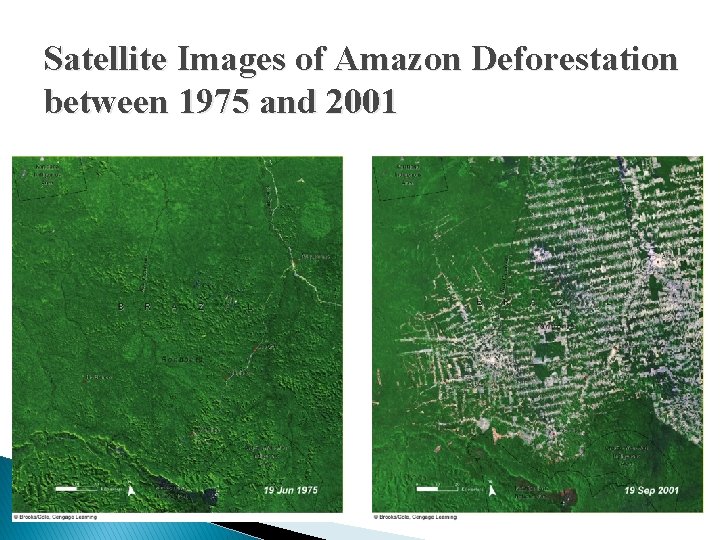
Satellite Images of Amazon Deforestation between 1975 and 2001
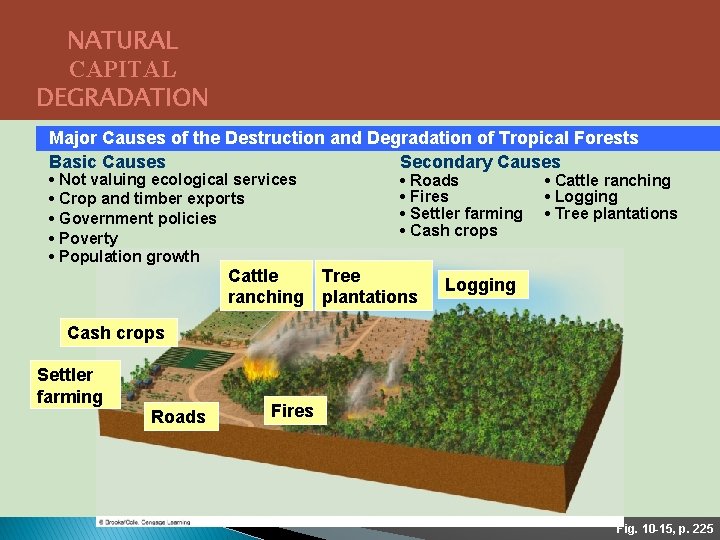
NATURAL CAPITAL DEGRADATION Major Causes of the Destruction and Degradation of Tropical Forests Basic Causes Secondary Causes • Not valuing ecological services • Crop and timber exports • Government policies • Poverty • Population growth Cattle ranching • Roads • Fires • Settler farming • Cash crops Tree plantations • Cattle ranching • Logging • Tree plantations Logging Cash crops Settler farming Roads Fires Fig. 10 -15, p. 225
Some Major Factors for Destruction � Population growth � Poverty � Oil extraction � Massive foreign debt
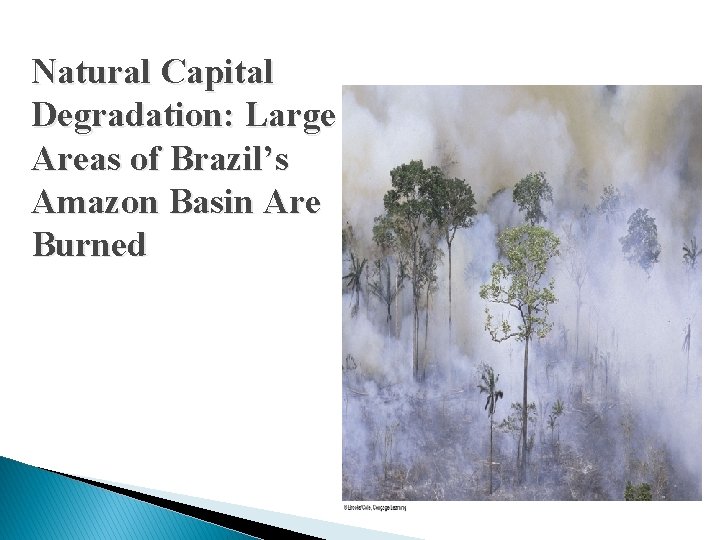
Natural Capital Degradation: Large Areas of Brazil’s Amazon Basin Are Burned
How Should We Manage and Sustain Forests? � We can sustain forests by emphasizing the economic value of their ecological services, protecting old-growth forests, harvesting trees no faster than they are replenished, and using sustainable substitute resources.
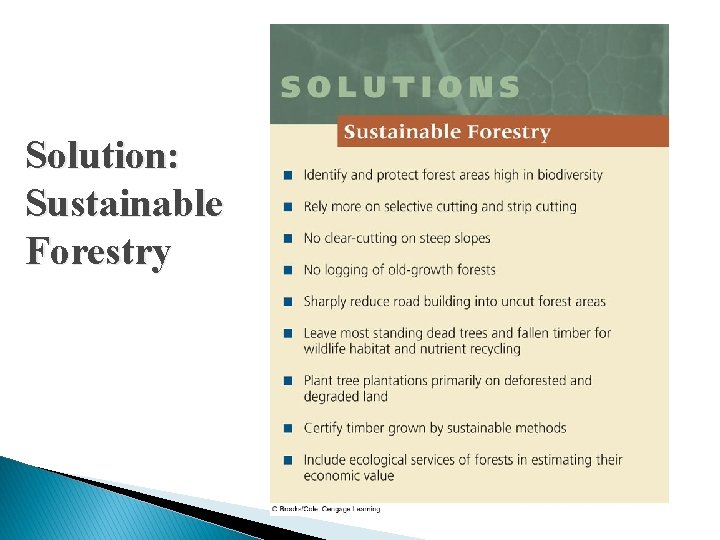
Solution: Sustainable Forestry
Science Focus: Certifying Sustainably Grown Timber � Collins Pine ◦ Owns and manages protective timberland � Forest Stewardship Council ◦ Nonprofit ◦ Developed list of environmentally sound practices ◦ Certifies timber and products
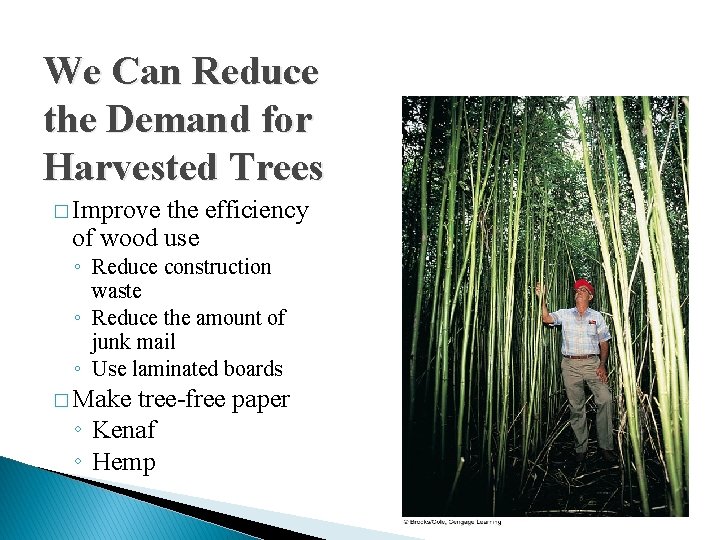
We Can Reduce the Demand for Harvested Trees � Improve the efficiency of wood use ◦ Reduce construction waste ◦ Reduce the amount of junk mail ◦ Use laminated boards � Make tree-free paper ◦ Kenaf ◦ Hemp
Case Study: Deforestation and the Fuelwood Crisis � Fuelwood – most common use of trees worldwide � Possible solutions ◦ Establish small plantations of fast-growing fuelwood trees and shrubs ◦ Burn wood more efficiently ◦ Solar or wind-generated electricity � Haiti: ecological disaster � South Korea: model for successful reforestation
Governments Can Act to Reduce Tropical Deforestation � Reduce � Practice fuelwood demand small-scale sustainable agriculture and forestry in tropical forest � Debt-for-nature � Conservation swaps concessions � Use gentler logging methods � Buy certified lumber and wood products
Individuals Matter: Wangari Maathai and Kenya’s Green Belt Movement �Green Belt Movement: 1977 ◦ Self-help group of women in Kenya ◦ Success of tree planting �Nobel Peace Prize: 2004
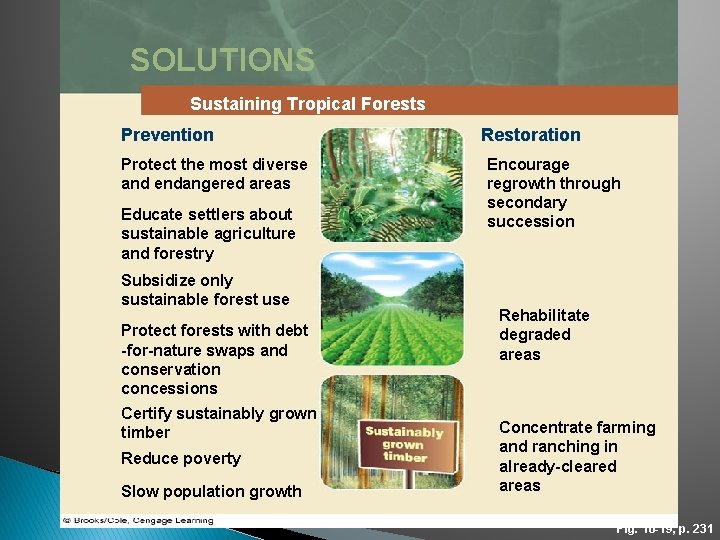
SOLUTIONS Sustaining Tropical Forests Prevention Protect the most diverse and endangered areas Educate settlers about sustainable agriculture and forestry Subsidize only sustainable forest use Protect forests with debt -for-nature swaps and conservation concessions Certify sustainably grown timber Reduce poverty Slow population growth Restoration Encourage regrowth through secondary succession Rehabilitate degraded areas Concentrate farming and ranching in already-cleared areas Fig. 10 -19, p. 231
How Should We Manage and Sustain Grasslands? � We can sustain the productivity of grasslands by controlling the number and distribution of grazing livestock and restoring degraded grasslands.
Some Rangelands Are Overgrazed � Important ecological services of grasslands ◦ Soil formation ◦ Erosion control ◦ Nutrient cycling ◦ Storage of atmospheric carbon dioxide in biomass ◦ Maintenance of diversity
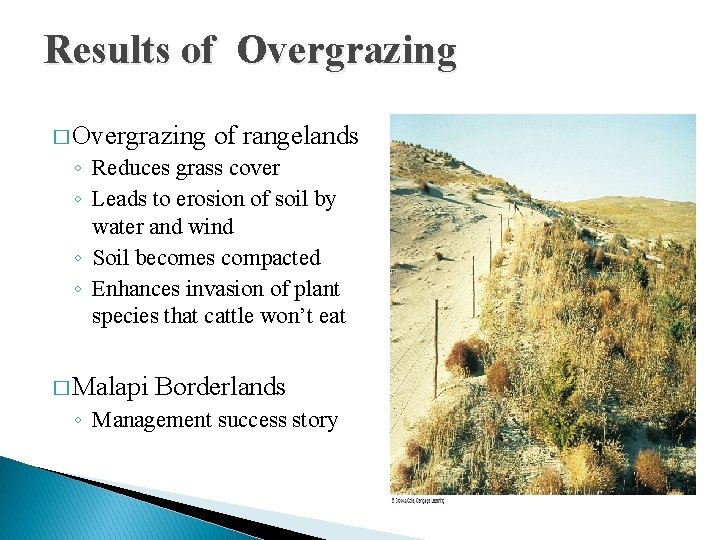
Results of Overgrazing � Overgrazing of rangelands ◦ Reduces grass cover ◦ Leads to erosion of soil by water and wind ◦ Soil becomes compacted ◦ Enhances invasion of plant species that cattle won’t eat � Malapi Borderlands ◦ Management success story
We Can Manage Rangelands More Sustainably The most widely used method for sustainable management of rangeland is controlling the number of grazing animals and the duration of their grazing. � Rotational grazing at water holes and feeding areas � Suppress growth of invasive species ◦ Herbicides ◦ Mechanical removal ◦ Controlled burning ◦ Controlled short-term trampling � Replant barren areas with native grass seeds and fertilizer � Protect riparian areas from overgrazing � Reduce soil erosion
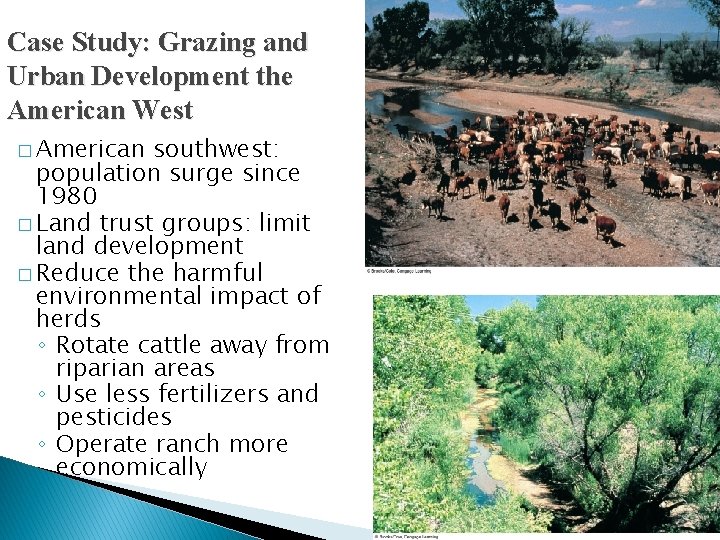
Case Study: Grazing and Urban Development the American West � American southwest: population surge since 1980 � Land trust groups: limit land development � Reduce the harmful environmental impact of herds ◦ Rotate cattle away from riparian areas ◦ Use less fertilizers and pesticides ◦ Operate ranch more economically

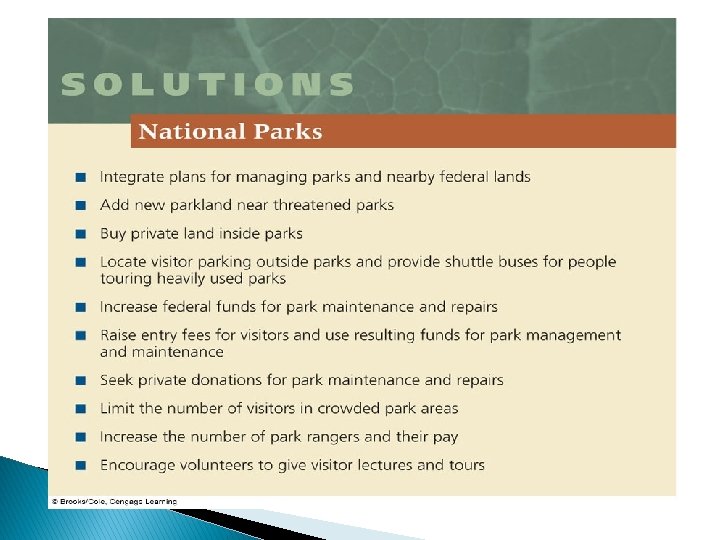
How Should We Manage and Sustain Parks and Natural Reserves? � Sustaining biodiversity will require protecting much more of the earth’s remaining undisturbed land area as parks and nature reserves.
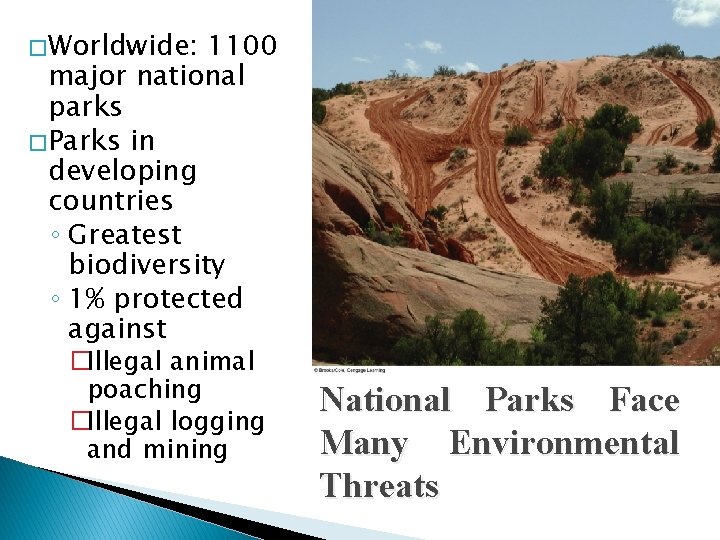
� Worldwide: 1100 major national parks � Parks in developing countries ◦ Greatest biodiversity ◦ 1% protected against �Illegal animal poaching �Illegal logging and mining National Parks Face Many Environmental Threats
Case Study: Stresses on U. S. Public Parks � 58 Major national parks in the U. S. � Biggest problem may be popularity ◦ Noise ◦ Congestion ◦ Pollution ◦ Damage or destruction to vegetation and wildlife � Repairs needed to trails and buildings
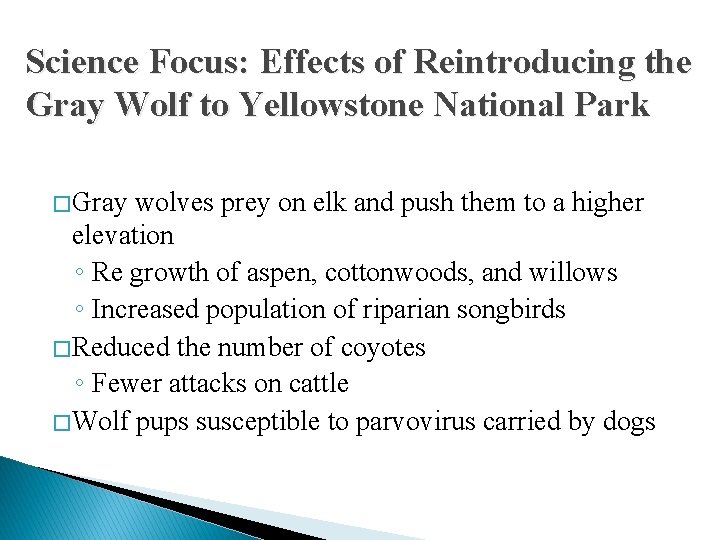
Science Focus: Effects of Reintroducing the Gray Wolf to Yellowstone National Park � Gray wolves prey on elk and push them to a higher elevation ◦ Re growth of aspen, cottonwoods, and willows ◦ Increased population of riparian songbirds � Reduced the number of coyotes ◦ Fewer attacks on cattle � Wolf pups susceptible to parvovirus carried by dogs
Nature Reserves Occupy Only a Small Part of the Earth’s Land �Conservationists’ goal: protect 20% of the earth’s land �Cooperation between government and private groups �Nature Conservancy �Eco-philanthropists �Developers and resource extractors opposition
Designing and Connecting Natural Reserves � Large versus small reserves � The buffer zone concept ◦ United Nations: 529 biosphere reserves in 105 countries � Habitat corridors between isolated reserves ◦ Advantages – allows migration by vertebrates that need large ranges, migration of populations when environment deteriorate ◦ Disadvantages – can threaten isolated populations
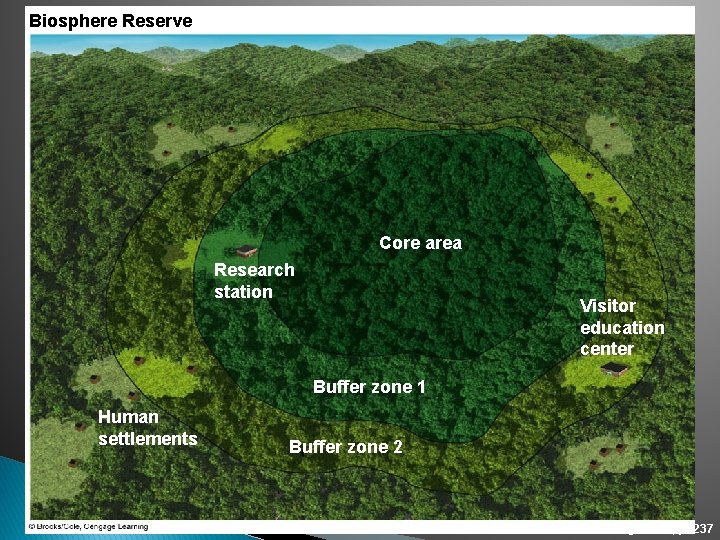
Biosphere Reserve Core area Research station Visitor education center Buffer zone 1 Human settlements Buffer zone 2 Fig. 10 -24, p. 237
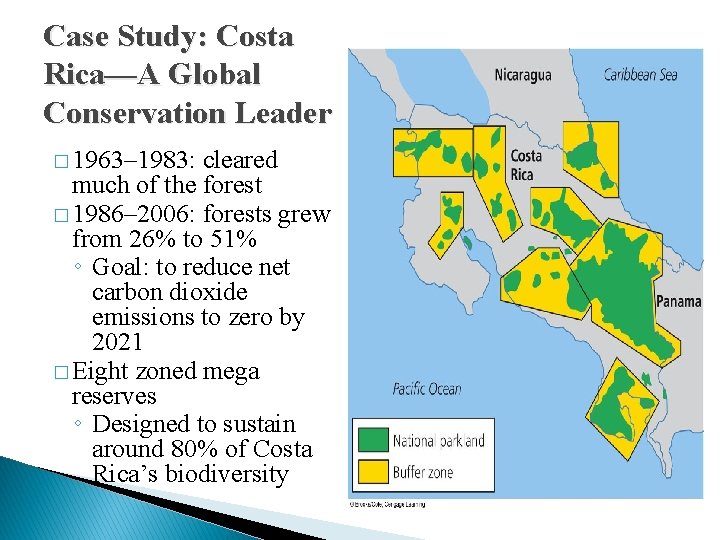
Case Study: Costa Rica—A Global Conservation Leader � 1963– 1983: cleared much of the forest � 1986– 2006: forests grew from 26% to 51% ◦ Goal: to reduce net carbon dioxide emissions to zero by 2021 � Eight zoned mega reserves ◦ Designed to sustain around 80% of Costa Rica’s biodiversity
Case Study: Controversy over Wilderness Protection in the United States �Wilderness Act of 1964 �How much of the United States is protected land? �Road Less Rule � 2005: End of “Road Less areas” within the national forest system
What is the Ecosystem Approach to Sustaining Biodiversity ? We can help sustain biodiversity by identifying severely threatened areas and protecting those with high plant diversity and those where ecosystem services are being impaired. Sustaining biodiversity will require a global effort to rehabilitate and restore damaged ecosystems. Humans dominate most of the earth’s land, and preserving biodiversity will require sharing as much of it as possible with other species.
We Can Use a Four-Point Strategy to Protect Ecosystems �Map global ecosystems; identify species �Locate and protect most endangered species �Restore degraded ecosystems �Development must be biodiversity-friendly �Are new laws needed?
Hot Spots � Areas especially rich in plant and animal species that are found nowhere else and are in great danger of extinction or serious ecological disruption. � These areas cover only a little over 2% of the earth’s land surface but contain 52% of the world’s plant species and 36% of all terrestrial vertebrates. � These areas are the only homes for more than 1/3 of the planet’s known terrestrial plant and animal species.
Protecting Global Biodiversity Hot Spots Is an Urgent Priority � 1988: Norman Myers ◦ Identify biodiversity hot spots rich in plant species �Not sufficient public support and funding �Drawbacks of this approach ◦ May not be rich in animal diversity ◦ People may be displaced and/or lose access to important resources
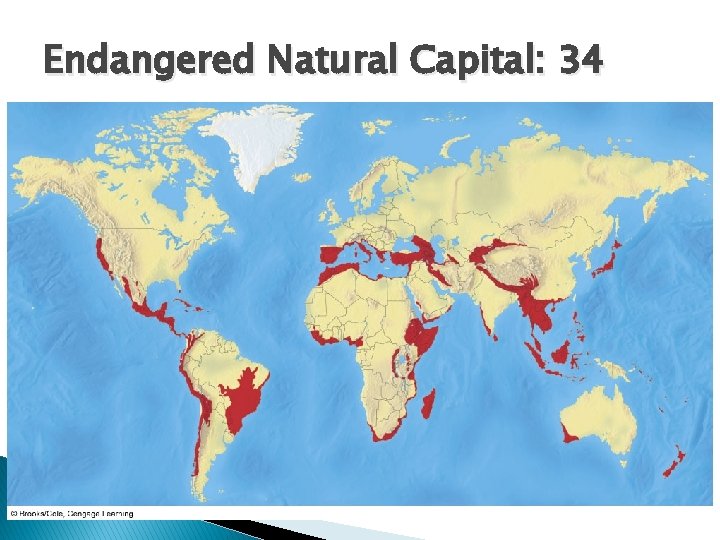
Endangered Natural Capital: 34
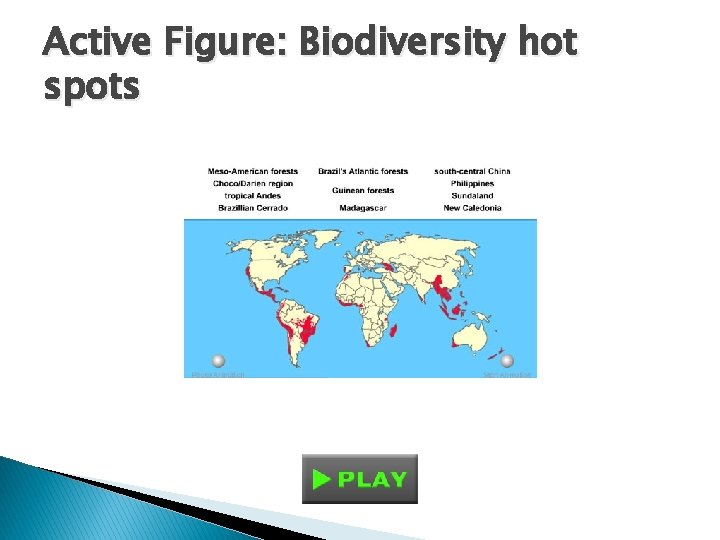
Active Figure: Biodiversity hot spots
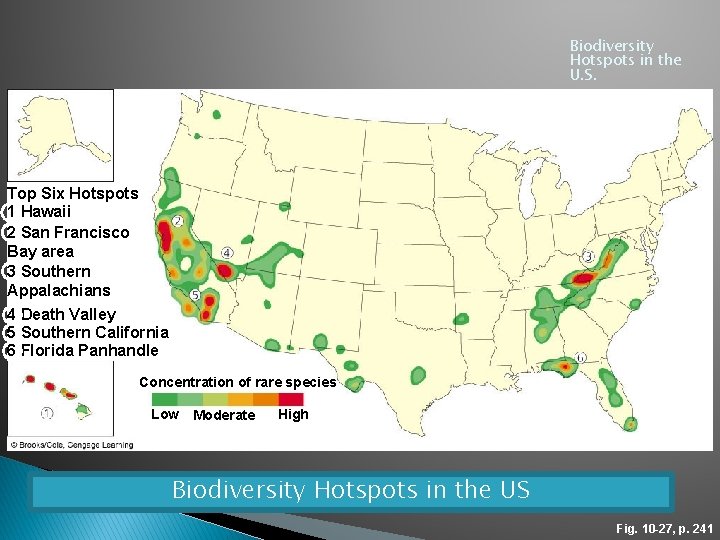
Biodiversity Hotspots in the U. S. Top Six Hotspots 1 Hawaii 2 San Francisco Bay area 3 Southern Appalachians 4 Death Valley 5 Southern California 6 Florida Panhandle Concentration of rare species Low Moderate High Biodiversity Hotspots in the US Fig. 10 -27, p. 241
A Biodiversity Hot Spot in East Africa � Eastern Arc Mountains of Tanzania, Africa ◦ Highest concentration of endangered species on earth � Threatened due to ◦ Killing of forests by farmers and loggers ◦ Hunting ◦ Fires
Protecting Ecosystem Services Is Also an Urgent Priority � U. N. Millennium Ecosystem Assessment: 2005 ◦ Identify key ecosystem services ◦ Human activities degrade or overuse 62% of the earth’s natural services � Identify highly stressed life raft ecosystems
We Can Rehabilitate and Restore Ecosystems That We Have Damaged � Study ◦ ◦ how natural ecosystems recover Restoration Rehabilitation Replacement Creating artificial ecosystems � How to carry out most forms of ecological restoration and rehabilitation ◦ ◦ Identify what caused the degradation Stop the abuse Reintroduce species, if possible Protect from further degradation
Science Focus: Ecological Restoration of a Tropical Dry Forest in Costa Rica � Guanacaste National Park restoration project ◦ Relinked to adjacent rain forest ◦ Bring in cattle and horses – aid in seed dispersal ◦ Local residents – actively involved
Will Restoration Encourage Further Destruction? �Preventing ecosystem damage is cheaper than restoration �About 5% of the earth’s land is preserved from the effects of human activities
We Can Share Areas We Dominate With Other Species � Win-Win Ecology: How Earth’s Species Can Survive in the Midst of Human Enterprise, by Michael L. Rozenweig, 2003 ◦ Reconciliation or applied ecology ◦ Community-based conservation �Belize and the black howler monkeys �Protect vital insect pollinators �Bluebird protection with special housing boxes �Berlin, Germany: rooftop gardens �San Francisco: Golden Gate Park
Case Study: The Blackfoot Challenge— Reconciliation Ecology in Action � 1970 s: Blackfoot River Valley in Montana threatened by ◦ Poor mining, logging, and grazing practices ◦ Water and air pollution ◦ Unsustainable commercial and residential development � Community meetings led to ◦ Weed-pulling parties ◦ Nesting structures for waterfowl ◦ Developed sustainable grazing systems
What Can You Do? Sustaining Terrestrial Biodiversity � Adopt a forest � Plant trees and take care of them � Recycle paper and but recycled products � Buy sustainably produced wood products � Choose wood substitutes- bamboo � Help to restore a degraded forest or grassland � Landscape your yard with a diversity of plants natural to the area
- Slides: 76