
Chapter 10 SubstanceRelated and ImpulseControl Disorders Perspectives on
Chapter 10 Substance-Related and Impulse-Control Disorders
Perspectives on Substance-Related Disorders • The Nature of Substance-Related Disorders – Use and abuse of psychoactive substances – Wide-ranging physiological, psychological, and behavioral effects – Associated with impairment and significant costs
Perspectives on Substance-Related Disorders (continued) • Some Important Terms and Distinctions – Substance use vs. substance intoxication – Substance abuse vs. substance dependence – Tolerance vs. withdrawal

Five Main Categories of Substances • Depressants – Behavioral sedation (e. g. , alcohol, sedative, anxiolytic drugs) • Stimulants – Increase alertness and elevate mood (e. g. , cocaine, nicotine)

Five Main Categories of Substances (continued) • Opiates – Produce analgesia and euphoria (e. g. , heroin, morphine, codeine) • Hallucinogens – Alter sensory perception (e. g. , marijuana, LSD) • Other drugs of abuse – Include inhalants, anabolic steroids, medications
The Depressants: Alcohol Use Disorders • Psychological and Physiological Effects of Alcohol – Central Nervous system depressant – Influences several neurotransmitter systems – Specific target is GABA
The Depressants: Alcohol Use Disorders (continued) • Effects of Chronic Alcohol Use – Alcohol intoxication and withdrawal – Associated brain conditions – Dementia and Wernicke’s disease – Fetal alcohol syndrome • DSM-IV-TR Criteria for Disordered Alcohol Use
Alcohol: Some Facts and Statistics • In the United States – Most adults consider themselves light drinkers or abstainers – Over 50% of the U. S. (> 12 years age) report current use – Alcohol use is highest among Caucasian Americans – Males use and abuse alcohol more so than females
Alcohol: Some Facts and Statistics (continued) – Violence is associated with alcohol • Alcohol alone does not cause aggression • Statistics on Abuse and Dependence – 15 million Americans are alcohol dependent – 20% with alcohol problems experience spontaneous recovery
Sedative, Hypnotic, or Anxiolytic Substance use Disorders: An Overview • The Nature of Drugs in This Class – Sedatives – Calming (e. g. , barbiturates) – Hypnotic – Sleep inducing – Anxiolytic – Anxiety reducing (e. g. , benzodiazepines)
Sedative, Hypnotic, or Anxiolytic Substance use Disorders: An Overview (continued) • Effects Are Similar to Large Doses of Alcohol – Combining such drugs with alcohol is synergistic • All Exert Their Influence via the GABA Neurotransmitter System • DSM-IV-TR Criteria for this Class of Disorders – Main criteria and distinguishing features
Stimulants: An Overview • Nature of Stimulants – Most widely consumed drug in the United States – Such drugs increase alertness and increase energy – Examples include amphetamines, cocaine, nicotine, and caffeine
Stimulants: Amphetamine Use Disorders • Effects of Amphetamines – Produce elation, vigor, reduce fatigue – Such effects are followed by extreme fatigue and depression • Amphetamines stimulate CNS by – Enhancing release of norepinephrine and dopamine – Reuptake is subsequently blocked
Stimulants: Amphetamine Use Disorders (continued) • DSM-IV-TR Criteria for Amphetamine Intoxication • Ecstasy and Ice – Produces effects similar to speed, but without the crash – Both drugs have a high risk of dependence
Stimulants: Cocaine Use Disorders • Effects of Cocaine – Short lived sensations of elation, vigor, reduce fatigue – Effects result from blocking the reuptake of dopamine – Highly addictive, but addiction develops slowly • Most Cycle Through Patterns of Tolerance and Withdrawal • DSM-IV-TR Criteria for Cocaine Intoxication and Withdrawal
Stimulants: Nicotine Use Disorders • Effects of Nicotine – Stimulates nicotinic acetylcholine receptors in CNS – Results in sensations of relaxation, wellness, pleasure – Highly addictive – Relapse rates equal those seen with alcohol and heroin • DSM-IV-TR Criteria for Nicotine Withdrawal
Stimulants: Nicotine Use Disorders (continued) • Nicotine users dose themselves to maintain a steady state of nicotine • Smoking has complex relationship to negative affect – Appears to help improve mood in shortterm – Depression occurs more in those with nicotine dependence
Stimulants: Caffeine Use Disorders • Effects of Caffeine – The “Gentle” Stimulant – Used by over 90% of Americans – Found in tea, coffee, cola drinks, and cocoa products – Small doses elevate mood and reduce fatigue – Regular use can result in tolerance and dependence – Caffeine blocks the reuptake of the neurotransmitter adenosine • DSM-IV-TR Criteria for Caffeine Intoxication
Opiods: An Overview • The Nature of Opiates and Opiods – Opiate – Natural chemical in the opium poppy with narcotic effects – Opiods – Natural and synthetic substances with narcotic effects – Often referred to as analgesics
Opiods: An Overview (continued) • Effects of Opiods – Activate body’s enkephalins and endorphins – Low doses induce euphoria, drowsiness, and slowed breathing – High doses can result in death – Withdrawal symptoms can be lasting and severe
Opiods: An Overview (continued) • DSM-IV-TR Criteria for Opiod Intoxication and Withdrawal • Mortality rates are high for opiod addicts – High risk for HIV infection
Hallucinogens: An Overview • Nature of Hallucinogens – Change the way the user perceives the world – May produce • Delusions, paranoia, hallucinations, altered sensory perception • Examples include marijuana, LSD
Hallucinogens: Marijuana and LSD • Marijuana – Active chemical is tetrahydrocannabinol (THC) – Symptoms - mood swings, paranoia, hallucinations – Impairment in motivation not uncommon – Withdrawal and dependence are uncommon
Hallucinogens: Marijuana and LSD • LSD and Other Hallucinogens – LSD is most common form of hallucinogenic drug – Tolerance is rapid and withdrawal symptoms are uncommon – Can produce psychotic delusions and hallucinations • DSM-IV-TR Criteria for Marijuana and Hallucinogen Intoxication – Psychological and physiological symptoms are similar
Other Drugs of Abuse: Inhalants • Nature of Inhalants – Substances found in volatile solvents – Breathed directly into lungs • Examples – Spray paint, hair spray, paint thinner, gasoline, nitrous oxide
Other Drugs of Abuse: Inhalants • Properties and Consequences – Rapidly absorbed – Effects similar to alcohol intoxication – Tolerance and prolonged symptoms of withdrawal are common
Other Drugs of Abuse: Anabolic Steroids • Nature of Anabolic-Androgenic Steroids – Steroids are derived or synthesized from testosterone – Used medicinally or to increase body mass – Users may engage in cycling or stacking – Do not produce a high – Can result in long-term mood disturbances and physical problems
Other Drugs of Abuse: Designer Drugs • Designer Drugs – Drugs produced by pharmaceutical companies for diseases • Ecstasy, • MDEA (“eve”), • BDMPEA (“nexus”), • Ketamine (“special K”)
Other Drugs of Abuse: Designer Drugs (continued) – All heighten auditory and visual perception, sense of taste/touch – Becoming popular • Nightclubs, raves, or large social gatherings – All designer drugs • Produce tolerance and dependence
Causes of Substance-Related Disorders: Family and Genetic Influences • Results of Family, Twin, and Adoption Studies – Substance abuse has a genetic component – Much of the focus has been on alcoholism – Genetic differences in alcohol metabolism – Multiple genes are involved in substance abuse
Causes of Substance-Related Disorders: Neurobiological Influences • Results of Neurobiological Research – Drugs affect the pleasure or reward centers in the brain – The pleasure centers • Dopamine, midbrain, frontal cortex – GABA turns off reward-pleasure system – Inhibition of neurotransmitters for anxiety/negative affect
Causes of Substance-Related Disorders: Psychological Dimensions • Role of Positive and Negative Reinforcement – Substance abuse as a means to cope with negative affect • The self-medication and the tension reduction hypotheses
Causes of Substance-Related Disorders: Psychological Dimensions (continued) • Opponent-Process Theory – Why the crash after drug use fails to keep people from using • Role of Expectancy Effects – Expectancies influence drug use and relapse • Cravings
Causes of Substance-Related Disorders: Social and Cultural Dimensions • Exposure to Drugs in a Prerequisite for Use of Drugs – Media, family, peers – Parents and the family appear critical • Societal Views About Drug Abuse – Sign of moral weakness – Failure of selfcontrol – Sign of a disease – Caused by some underlying process
Causes of Substance-Related Disorders: Social and Cultural Dimensions (continued) • The Role of Cultural Factors – Influence the manifestation of substance abuse
An Integrative Model of Substance-Related Disorders • Exposure or Access to a Drug – Is a necessary, but not sufficient • Drug Use Depends – Social and cultural expectations – The pleasurable consequences
An Integrative Model of Substance-Related Disorders (continued) • Drugs Are Abused – For many complex reasons – The premise of equifinality – Consider psychological, genetic, social, and learning factors
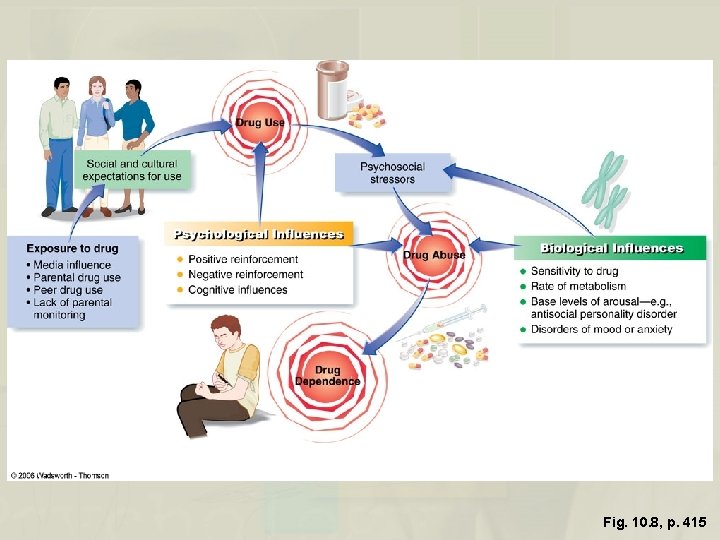
Fig. 10. 8, p. 415
Biological Treatment of Substance-Related Disorders • Agonist Substitution – Safe drug with a similar chemical composition as the abused drug – Examples include methadone and nicotine gum or patch • Antagonistic Treatment – Drugs that block or counteract the positive effects of substances – Examples include naltrexone for opiate and alcohol problems
Biological Treatment of Substance-Related Disorders (continued) • Aversive Treatment – Drugs that make use of substances extremely unpleasant – Examples include antabuse and silver nitrate • Efficacy of Biological Treatment – Generally ineffective when used alone
Psychosocial Treatment of Substance. Related Disorders • Inpatient vs. Outpatient Care – Little difference in effectiveness • Community Support Programs – Alcoholics Anonymous (AA) and related groups (e. g. , NA) – Seem helpful and are strongly encouraged • Balancing Treatment Goals – Controlled use vs. complete abstinence
Psychosocial Treatment of Substance. Related Disorders • Comprehensive Treatment and Prevention Programs – Individual and group therapy – Aversion therapy and convert sensitization – Contingency management – Community reinforcement – Relapse prevention – Preventative efforts via education
Summary of Substance-Related Disorders • DSM-IV-TR Substance Related Disorders – Cover Four Classes • Depressants, stimulants, opiates, and hallucinogens – Diagnoses include dependence, abuse, intoxication, or withdrawal
Summary of Substance-Related Disorders • Most Substances Activate the Dopaminergic Pleasure Pathway – Psychosocial Factors Interact with Biological Influences • Treatment of Substance Dependence – Largely unsuccessful – Highly motivated persons do best – Important to use comprehensive approach
Impulse-Control Disorders • DSM-IV-TR – Intermittent explosive disorder – Kleptomania – Pyromania – Pathological gambling – Trichotillomania
Impulse-Control Disorders (continued) • Each is Characterized by – Increased tension/anxiety prior to the act – A sense of relief following the act – Impairment of social and occupational functioning
Impulse-control Disorders: Intermittent Explosive Disorder • Intermittent Explosive Disorder – Rare condition – Characterized by frequent aggressive outbursts – Leads to injury and/or destruction of property – Few controlled treatment studies
Impulse-control Disorders: Kleptomania • Kleptomania – Failure to resist urge to steal unnecessary items – Seems rare, but it is not well studied – Highly comorbid with mood disorders – Also co-occurs with substance-related problems
Impulse-control Disorders: Pyromania, Pathological Gambling • Pyromania – Involves having an irresistible urge to set fires – Diagnosed in less than 4% of arsonists – Little etiological and treatment research • Pathological Gambling – Affect 3 -5% adult Americans – Treatment is similar to that for substance dependence
Trichotillomania (continued) • Trichotillomania – Inability to resist the urge to pull hair – Observed in 1 -5% of college students, mostly female – Clomipramine and CBT have been shown to be helpful
- Slides: 50