
Chapter 10 Stockholders Equity Stockholders Equity Stockholders equity

- Slides: 31
Chapter 10 Stockholders’ Equity
Stockholders’ Equity § Stockholders’ equity, which also is called equity, represents the owners’ claims against the assets of a corporation after all liabilities have been deducted. § The stockholders’ equity section of the balance sheet clearly identifies various elements of equity according to their source. The most common sources are: § capital stock - split between (1) preferred and common stock and (2) the associated additional paid-in capital § retained earnings or deficit § accumulated other comprehensive income § treasury stock LO-1 © 2014 Cengage Learning. All Rights Reserved. May not be copied, scanned, or duplicated, in whole or in part, except for use as permitted in a license distributed with a certain product or service or otherwise on a password-protected website for classroom use.
Authorization to Issue Stock § Most large businesses are organized as corporations because incorporation increases the company’s ability to raise cash (or capital) by easing the transfer of ownership and limiting the liability of owners. § Corporations are authorized, or chartered, in accordance with the provisions of state laws that govern the structure and operation of corporations. § These laws differ from state to state and a corporation can charter in any state. § All states require persons who wish to form a corporation to apply to a prescribed state official for the issuance of a charter. LO-1 © 2014 Cengage Learning. All Rights Reserved. May not be copied, scanned, or duplicated, in whole or in part, except for use as permitted in a license distributed with a certain product or service or otherwise on a password-protected website for classroom use.
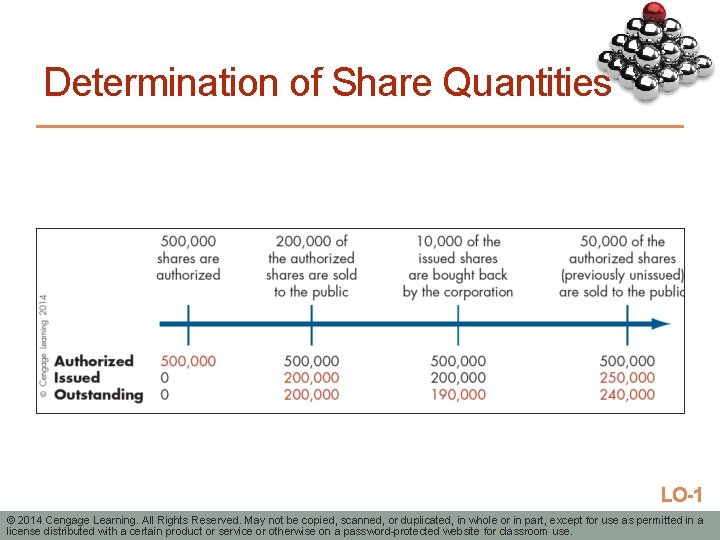
Authorization to Issue Stock § The corporate charter, which is sometimes called the articles of incorporation, is a document that authorizes the creation of the corporation, setting forth its name and purpose and the names of the incorporators. § The maximum number of shares the business may issue in each class of stock is referred to as the number of authorized shares. § This must be distinguished from the number of issued shares, which is the number of shares actually sold to stockholders. § The number of issued shares is further distinguished from the number of outstanding shares - which is the number of issued shares actually in the hands of stockholders. When firms reacquire their own stock, the reacquired shares are not considered to be outstanding. LO-1 © 2014 Cengage Learning. All Rights Reserved. May not be copied, scanned, or duplicated, in whole or in part, except for use as permitted in a license distributed with a certain product or service or otherwise on a password-protected website for classroom use.
Determination of Share Quantities LO-1 © 2014 Cengage Learning. All Rights Reserved. May not be copied, scanned, or duplicated, in whole or in part, except for use as permitted in a license distributed with a certain product or service or otherwise on a password-protected website for classroom use.
Common Stock § All classes of stock are designated as either common stock or preferred stock. § These come with different financial benefits and provide different rights regarding the governance of the corporation. LO-1 © 2014 Cengage Learning. All Rights Reserved. May not be copied, scanned, or duplicated, in whole or in part, except for use as permitted in a license distributed with a certain product or service or otherwise on a password-protected website for classroom use.
Common Stock § The primary rights for owners of common stock are: § Voting in the election of the board of directors. You will recall that the board controls the operating and financial policies of the company. § Sharing in the profits and dividends of the company. We will talk more about this below. § Keeping the same percentage of ownership if new stock is issued (preemptive right). § Sharing in the assets in liquidation in proportion to their holdings. This is referred to as the ‘‘residual claim’’ because common stockholders are only paid after all creditors and preferred stockholders are paid in full (which is very rare in liquidation). LO-1 © 2014 Cengage Learning. All Rights Reserved. May not be copied, scanned, or duplicated, in whole or in part, except for use as permitted in a license distributed with a certain product or service or otherwise on a password-protected website for classroom use.
Common Stock § Common stockholders receive the bulk of the financial gain from a profitable company through stock appreciation and dividends: § Stock Appreciation: The value of the stock increases above the price initially paid (of course, it is also possible that the stock’s value decreases if the company is unprofitable - this is a risk of owning stock). § Dividends: Dividends are payments to a company’s shareholders from earnings. These payments are usually in the form of cash, but noncash assets and stock can also be given as dividends. Payment of dividends to common shareholders, however, depends on a company’s alternatives. LO-1 © 2014 Cengage Learning. All Rights Reserved. May not be copied, scanned, or duplicated, in whole or in part, except for use as permitted in a license distributed with a certain product or service or otherwise on a password-protected website for classroom use.
Preferred Stock § Preferred stock generally pays a regular dividend. In this regard, preferred stock is similar to debt, with the preferred stock dividend equating to interest payments. § In this respect, preferred stock is a less risky investment than common stock. § Preferred shareholders also receive priority over common shareholders in the payment of dividends and the distribution of assets in the event of liquidation. LO-1 © 2014 Cengage Learning. All Rights Reserved. May not be copied, scanned, or duplicated, in whole or in part, except for use as permitted in a license distributed with a certain product or service or otherwise on a password-protected website for classroom use.
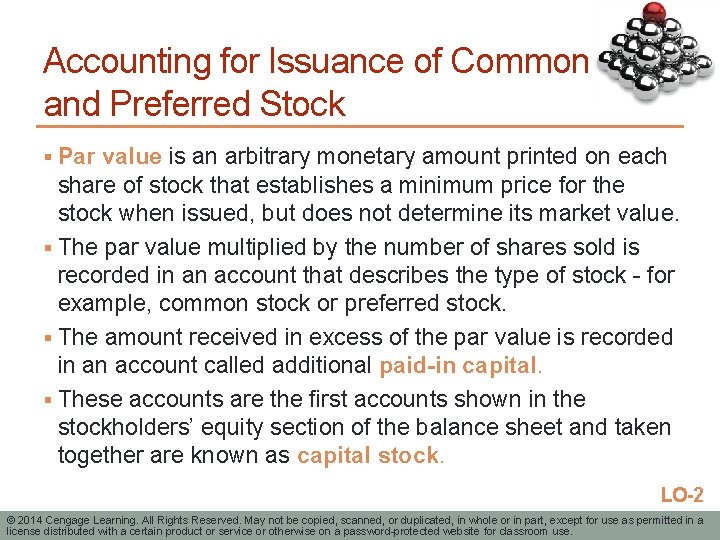
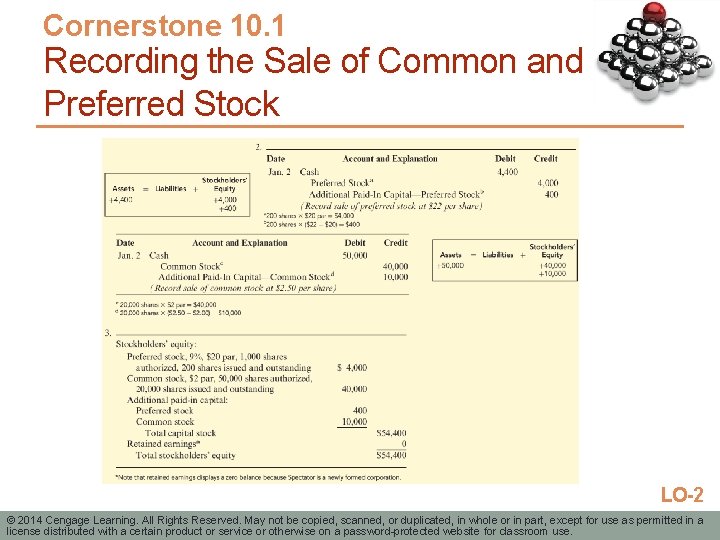
Accounting for Issuance of Common and Preferred Stock § Par value is an arbitrary monetary amount printed on each share of stock that establishes a minimum price for the stock when issued, but does not determine its market value. § The par value multiplied by the number of shares sold is recorded in an account that describes the type of stock - for example, common stock or preferred stock. § The amount received in excess of the par value is recorded in an account called additional paid-in capital. § These accounts are the first accounts shown in the stockholders’ equity section of the balance sheet and taken together are known as capital stock. LO-2 © 2014 Cengage Learning. All Rights Reserved. May not be copied, scanned, or duplicated, in whole or in part, except for use as permitted in a license distributed with a certain product or service or otherwise on a password-protected website for classroom use.
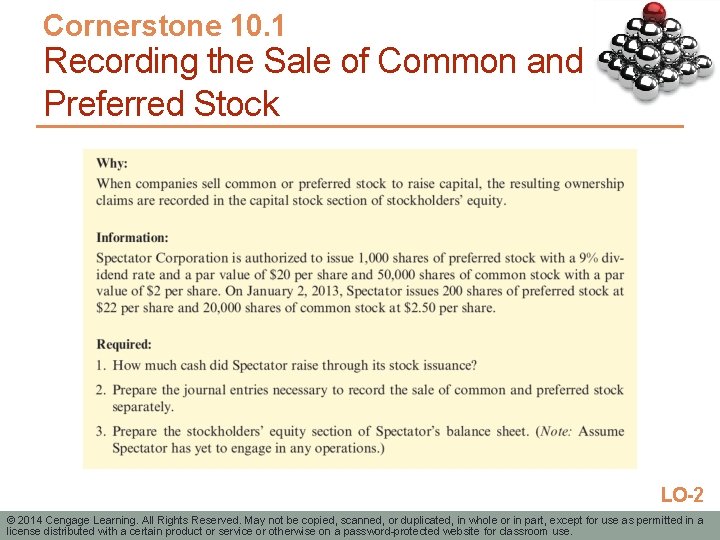
Cornerstone 10. 1 Recording the Sale of Common and Preferred Stock LO-2 © 2014 Cengage Learning. All Rights Reserved. May not be copied, scanned, or duplicated, in whole or in part, except for use as permitted in a license distributed with a certain product or service or otherwise on a password-protected website for classroom use.
Cornerstone 10. 1 Recording the Sale of Common and Preferred Stock LO-2 © 2014 Cengage Learning. All Rights Reserved. May not be copied, scanned, or duplicated, in whole or in part, except for use as permitted in a license distributed with a certain product or service or otherwise on a password-protected website for classroom use.
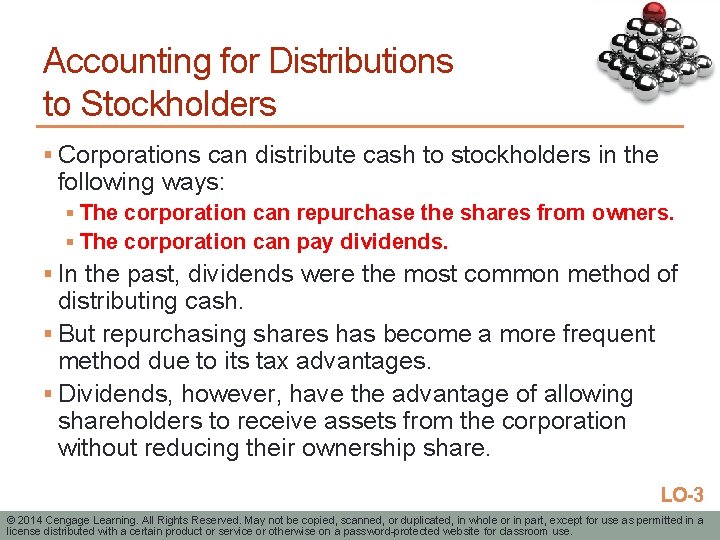
Accounting for Distributions to Stockholders § Corporations can distribute cash to stockholders in the following ways: § The corporation can repurchase the shares from owners. § The corporation can pay dividends. § In the past, dividends were the most common method of distributing cash. § But repurchasing shares has become a more frequent method due to its tax advantages. § Dividends, however, have the advantage of allowing shareholders to receive assets from the corporation without reducing their ownership share. LO-3 © 2014 Cengage Learning. All Rights Reserved. May not be copied, scanned, or duplicated, in whole or in part, except for use as permitted in a license distributed with a certain product or service or otherwise on a password-protected website for classroom use.
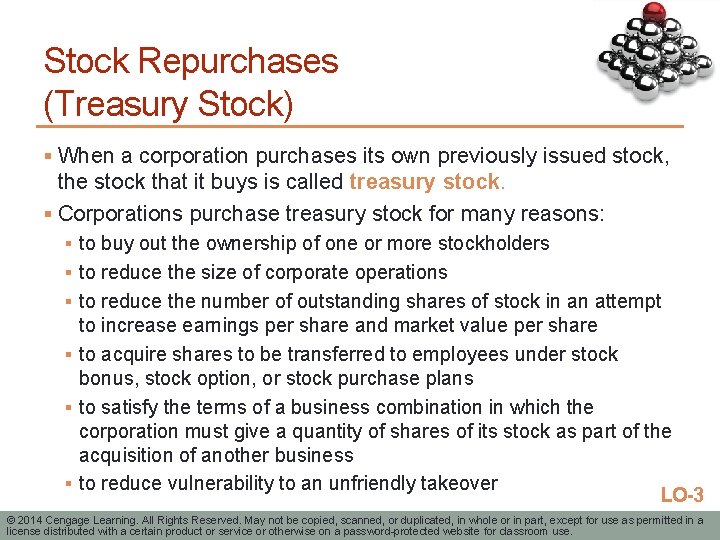
Stock Repurchases (Treasury Stock) § When a corporation purchases its own previously issued stock, the stock that it buys is called treasury stock. § Corporations purchase treasury stock for many reasons: § to buy out the ownership of one or more stockholders § to reduce the size of corporate operations § to reduce the number of outstanding shares of stock in an attempt to increase earnings per share and market value per share § to acquire shares to be transferred to employees under stock bonus, stock option, or stock purchase plans § to satisfy the terms of a business combination in which the corporation must give a quantity of shares of its stock as part of the acquisition of another business § to reduce vulnerability to an unfriendly takeover LO-3 © 2014 Cengage Learning. All Rights Reserved. May not be copied, scanned, or duplicated, in whole or in part, except for use as permitted in a license distributed with a certain product or service or otherwise on a password-protected website for classroom use.
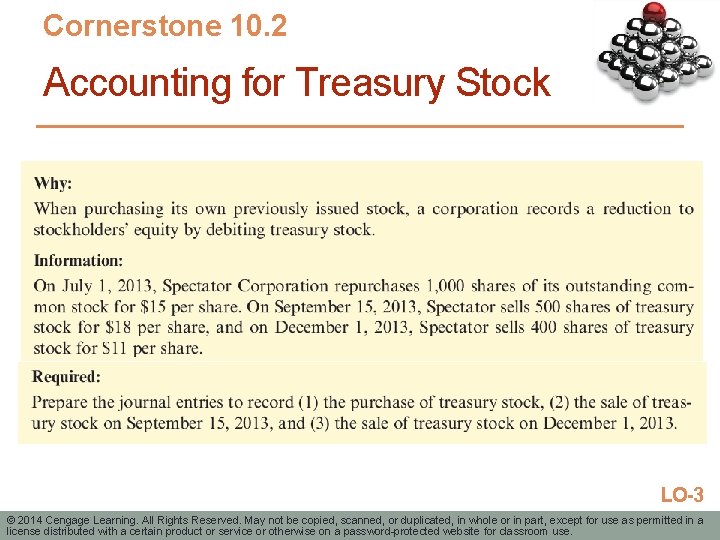
Cornerstone 10. 2 Accounting for Treasury Stock LO-3 © 2014 Cengage Learning. All Rights Reserved. May not be copied, scanned, or duplicated, in whole or in part, except for use as permitted in a license distributed with a certain product or service or otherwise on a password-protected website for classroom use.
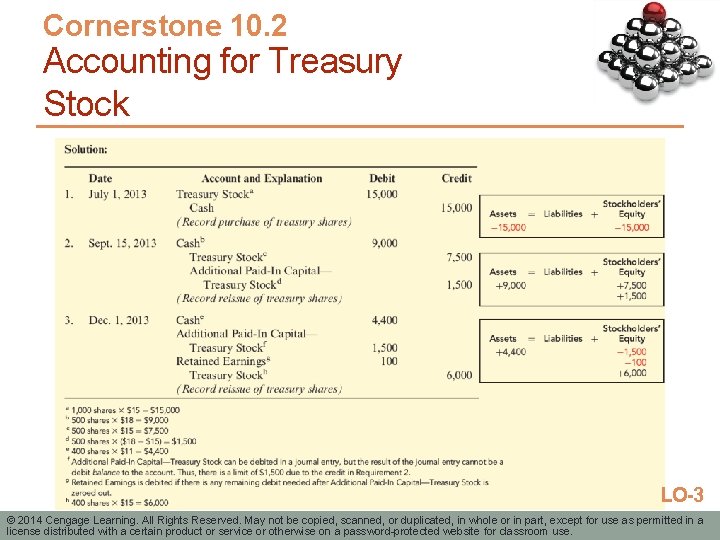
Cornerstone 10. 2 Accounting for Treasury Stock LO-3 © 2014 Cengage Learning. All Rights Reserved. May not be copied, scanned, or duplicated, in whole or in part, except for use as permitted in a license distributed with a certain product or service or otherwise on a password-protected website for classroom use.
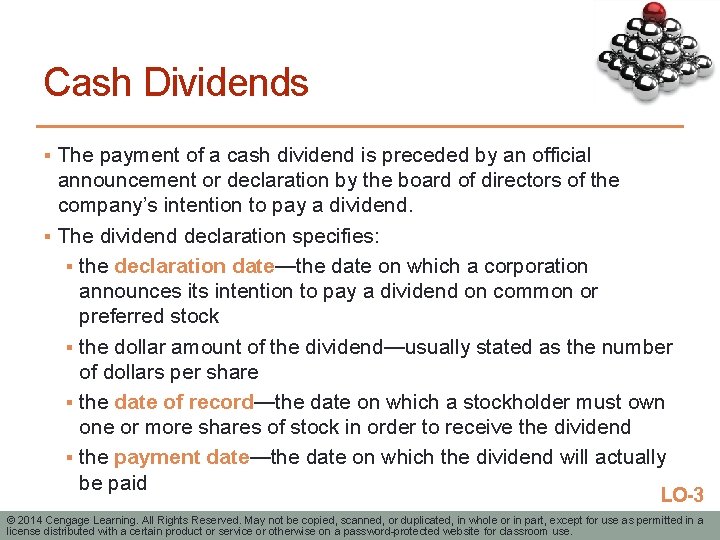
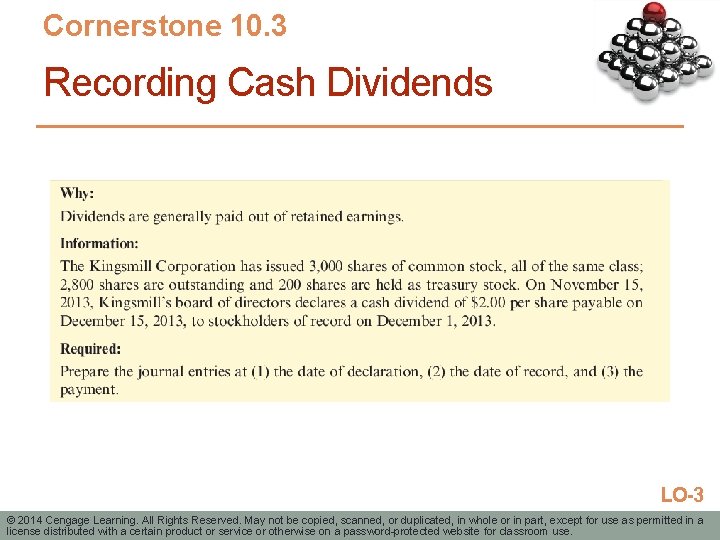
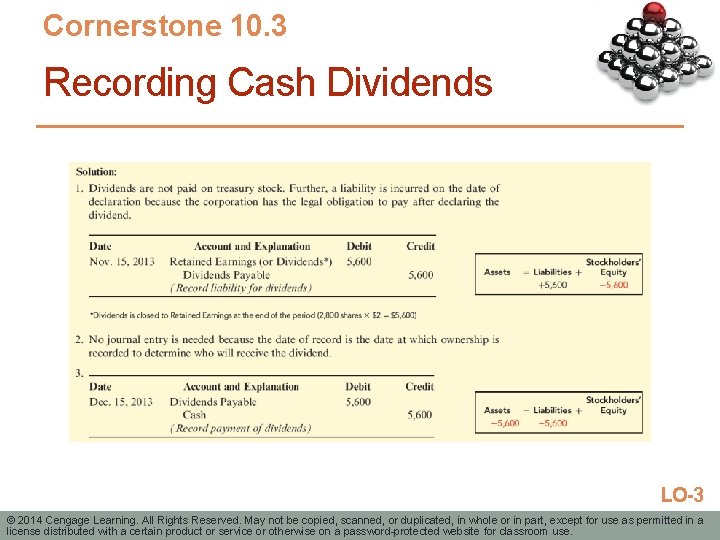
Cash Dividends § The payment of a cash dividend is preceded by an official announcement or declaration by the board of directors of the company’s intention to pay a dividend. § The dividend declaration specifies: § the declaration date—the date on which a corporation announces its intention to pay a dividend on common or preferred stock § the dollar amount of the dividend—usually stated as the number of dollars per share § the date of record—the date on which a stockholder must own one or more shares of stock in order to receive the dividend § the payment date—the date on which the dividend will actually be paid LO-3 © 2014 Cengage Learning. All Rights Reserved. May not be copied, scanned, or duplicated, in whole or in part, except for use as permitted in a license distributed with a certain product or service or otherwise on a password-protected website for classroom use.
Cornerstone 10. 3 Recording Cash Dividends LO-3 © 2014 Cengage Learning. All Rights Reserved. May not be copied, scanned, or duplicated, in whole or in part, except for use as permitted in a license distributed with a certain product or service or otherwise on a password-protected website for classroom use.
Cornerstone 10. 3 Recording Cash Dividends LO-3 © 2014 Cengage Learning. All Rights Reserved. May not be copied, scanned, or duplicated, in whole or in part, except for use as permitted in a license distributed with a certain product or service or otherwise on a password-protected website for classroom use.
Stock Dividends § A stock dividend transfers shares of stock from the corporation to its stockholders—additional shares of the corporation’s own stock. § For each share outstanding, a fixed number of new shares is issued, and an amount of retained earnings is transferred to contributed capital accounts in a process known as capitalization of retained earnings. LO-3 © 2014 Cengage Learning. All Rights Reserved. May not be copied, scanned, or duplicated, in whole or in part, except for use as permitted in a license distributed with a certain product or service or otherwise on a password-protected website for classroom use.
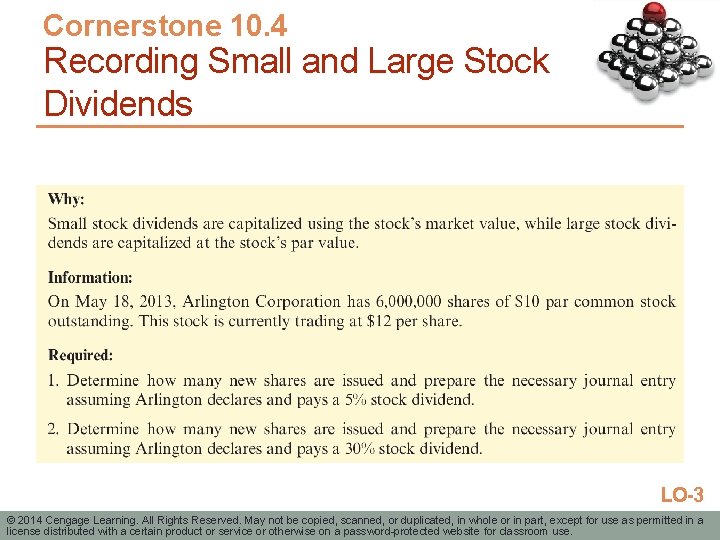
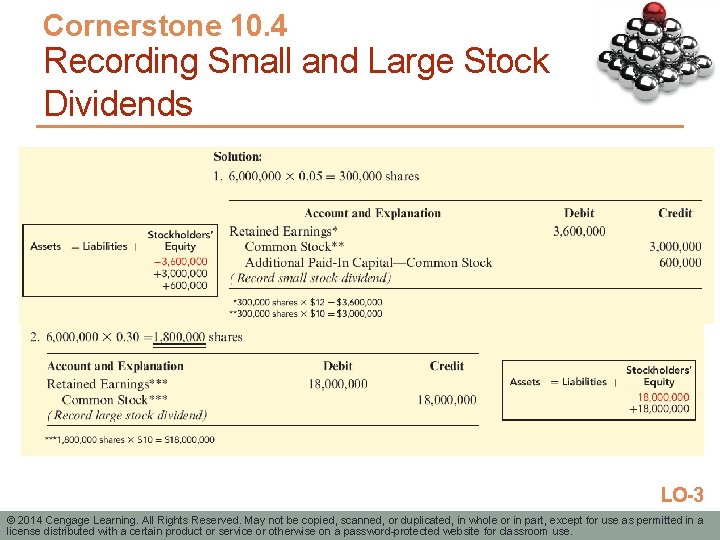
Stock Dividends § The amount of retained earnings capitalized for each new share depends on the size of the stock dividend: § Small stock dividends increase the number of outstanding shares by less than 25%; they are capitalized using the stock’s market value just before the dividend. § Large stock dividends increase the number of outstanding shares by 25% or more and are capitalized at par. LO-3 © 2014 Cengage Learning. All Rights Reserved. May not be copied, scanned, or duplicated, in whole or in part, except for use as permitted in a license distributed with a certain product or service or otherwise on a password-protected website for classroom use.
Cornerstone 10. 4 Recording Small and Large Stock Dividends LO-3 © 2014 Cengage Learning. All Rights Reserved. May not be copied, scanned, or duplicated, in whole or in part, except for use as permitted in a license distributed with a certain product or service or otherwise on a password-protected website for classroom use.
Cornerstone 10. 4 Recording Small and Large Stock Dividends LO-3 © 2014 Cengage Learning. All Rights Reserved. May not be copied, scanned, or duplicated, in whole or in part, except for use as permitted in a license distributed with a certain product or service or otherwise on a password-protected website for classroom use.
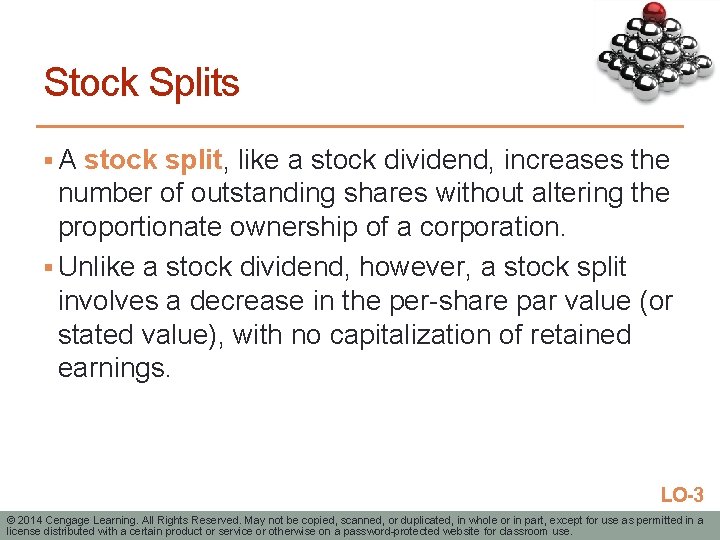
Stock Splits § A stock split, like a stock dividend, increases the number of outstanding shares without altering the proportionate ownership of a corporation. § Unlike a stock dividend, however, a stock split involves a decrease in the per-share par value (or stated value), with no capitalization of retained earnings. LO-3 © 2014 Cengage Learning. All Rights Reserved. May not be copied, scanned, or duplicated, in whole or in part, except for use as permitted in a license distributed with a certain product or service or otherwise on a password-protected website for classroom use.
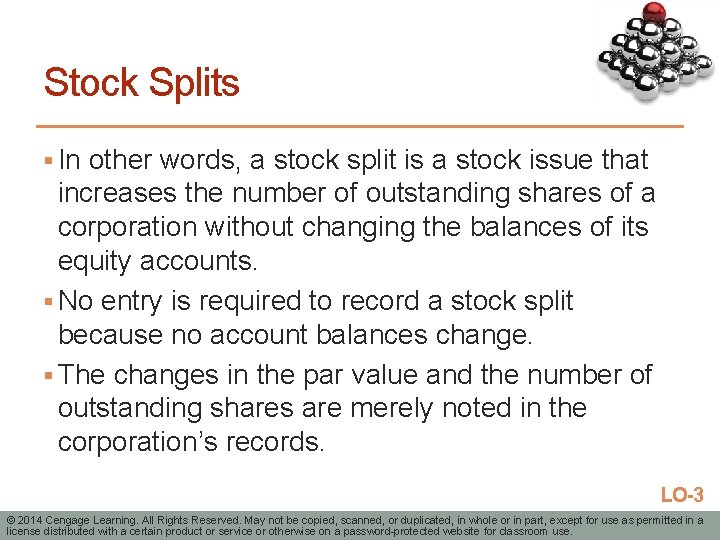
Stock Splits § In other words, a stock split is a stock issue that increases the number of outstanding shares of a corporation without changing the balances of its equity accounts. § No entry is required to record a stock split because no account balances change. § The changes in the par value and the number of outstanding shares are merely noted in the corporation’s records. LO-3 © 2014 Cengage Learning. All Rights Reserved. May not be copied, scanned, or duplicated, in whole or in part, except for use as permitted in a license distributed with a certain product or service or otherwise on a password-protected website for classroom use.
Preferred Dividend Preferences § Preferred dividend preferences can take three forms: § current dividend preference § cumulative dividend preference § participating dividend preference LO-3 © 2014 Cengage Learning. All Rights Reserved. May not be copied, scanned, or duplicated, in whole or in part, except for use as permitted in a license distributed with a certain product or service or otherwise on a password-protected website for classroom use.
Current Dividend Preference § Preferred stock always has a current dividend preference, which provides that current dividends must be paid to preferred stockholders before any dividends are paid to common stockholders. § However, the current dividend preference does not guarantee payment of preferred dividends. § In lean years, both common and preferred stockholders may fail to receive dividends. LO-3 © 2014 Cengage Learning. All Rights Reserved. May not be copied, scanned, or duplicated, in whole or in part, except for use as permitted in a license distributed with a certain product or service or otherwise on a password-protected website for classroom use.
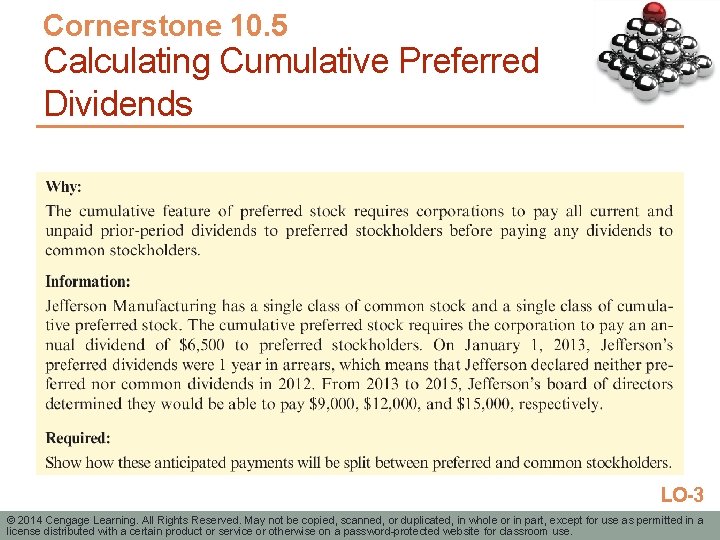
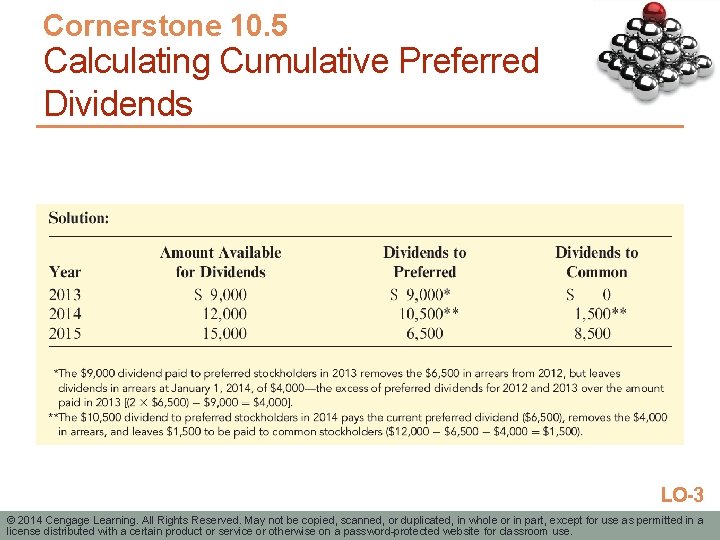
Cumulative Dividend Preference § The cumulative dividend preference requires the eventual payment of all preferred dividends—both dividends in arrears and current dividends—before any dividends are paid to common stockholders. (Preferred stock dividends remaining unpaid for one or more years are considered to be in arrears. ) § In other words, no dividends can be paid to common stockholders until all prior and current preferred dividends have been paid. § The cumulative dividend preference thus includes the current dividend preference. LO-3 © 2014 Cengage Learning. All Rights Reserved. May not be copied, scanned, or duplicated, in whole or in part, except for use as permitted in a license distributed with a certain product or service or otherwise on a password-protected website for classroom use.
Cornerstone 10. 5 Calculating Cumulative Preferred Dividends LO-3 © 2014 Cengage Learning. All Rights Reserved. May not be copied, scanned, or duplicated, in whole or in part, except for use as permitted in a license distributed with a certain product or service or otherwise on a password-protected website for classroom use.
Cornerstone 10. 5 Calculating Cumulative Preferred Dividends LO-3 © 2014 Cengage Learning. All Rights Reserved. May not be copied, scanned, or duplicated, in whole or in part, except for use as permitted in a license distributed with a certain product or service or otherwise on a password-protected website for classroom use.
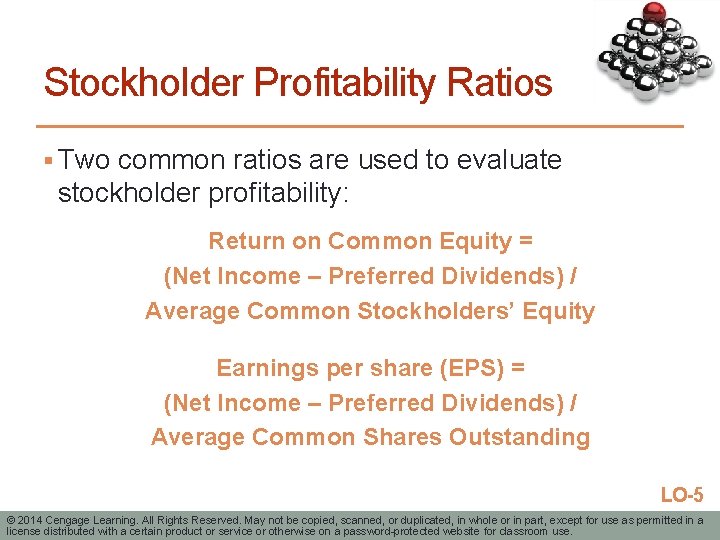
Stockholder Profitability Ratios § Two common ratios are used to evaluate stockholder profitability: Return on Common Equity = (Net Income – Preferred Dividends) / Average Common Stockholders’ Equity Earnings per share (EPS) = (Net Income – Preferred Dividends) / Average Common Shares Outstanding LO-5 © 2014 Cengage Learning. All Rights Reserved. May not be copied, scanned, or duplicated, in whole or in part, except for use as permitted in a license distributed with a certain product or service or otherwise on a password-protected website for classroom use.