
Chapter 10 States of Matter KMT Kinetic Molecular







- Slides: 31
Chapter 10 States of Matter & KMT • Kinetic Molecular Theory (KMT) • Is based on the idea that particles of matter are always in motion • This theory is used to explain properties of a s, l, and g. • We will focus on gases.
Chapter 10 States of Matter and KMT • Ideal Gas: Conditions are low pressure and high temp. • They have no volume. (particles are very far apart) • Collisions are elastic. (particle to particle & particle to container wall) • Gas particles are in continuous, rapid, random straight motion. • There are no forces of attraction between gas particles. • Avg. temp. depends on the avg. KE of the particles.
Chapter 10 States of Matter and KMT • KE = ½ m v 2 • m = mass and v = velocity • For any gas, as the temp. increases, the avg. speed and KE will increase. If the temp. decreases, the avg. speed and KE will decrease. • All gases at the same temp. and pressure have the same avg. KE.
Chapter 10 States of Matter and KMT • Characteristics of Gases • Particles expand to fill any container (assumption#3) • Gases are fluids, like liquids (assumption#4) • Have very low densities & can be compressed (assumption#1)
Chapter 10 States of Matter and KMT • Diffusion is the random and continuous mixing of the particles of two substances. • Effusion is the process by which gas particles pass through a tiny opening.
Chapter 10 States of Matter and KMT • Real gas: Conditions high pressure, low temp. and nonpolar atoms/molecules • Does not behave completely according to the assumptions of the KMT. • Have their own volume • Attract each other
Chapter 10 States of Matter and KMT Temperature Always use absolute temperature (Kelvin) when working with gases. 0 C = 5/9(0 F-32) K = 0 C + 273 ºF -459 ºC -273 K 0 32 212 0 100 273 373
Chapter 11 Gases • Pressure (P) • The force per unit area on a surface. • P = Force/Area • In which picture does the ballet dancer apply more pressure? • What changes? The force applied by the dancer or the area over which the force was applied.
Chapter 11 Gases • Measuring Pressure • Barometer measures atmospheric pressure (force applies by a gas) • Torricelli: Water pumps could only raise water 34 ft. He concluded that this was due to the weight of water compare to weight of air. • Used mercury (14 times as dense as water and would only rise 1/14 the height of water) to make the first barometer.
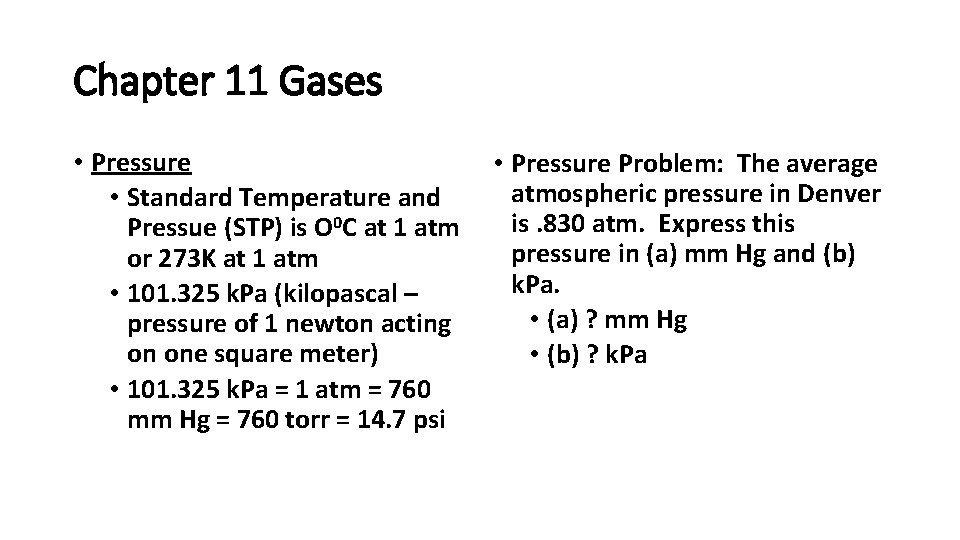
Chapter 11 Gases • Pressure • Standard Temperature and Pressue (STP) is O 0 C at 1 atm or 273 K at 1 atm • 101. 325 k. Pa (kilopascal – pressure of 1 newton acting on one square meter) • 101. 325 k. Pa = 1 atm = 760 mm Hg = 760 torr = 14. 7 psi • Pressure Problem: The average atmospheric pressure in Denver is. 830 atm. Express this pressure in (a) mm Hg and (b) k. Pa. • (a) ? mm Hg • (b) ? k. Pa
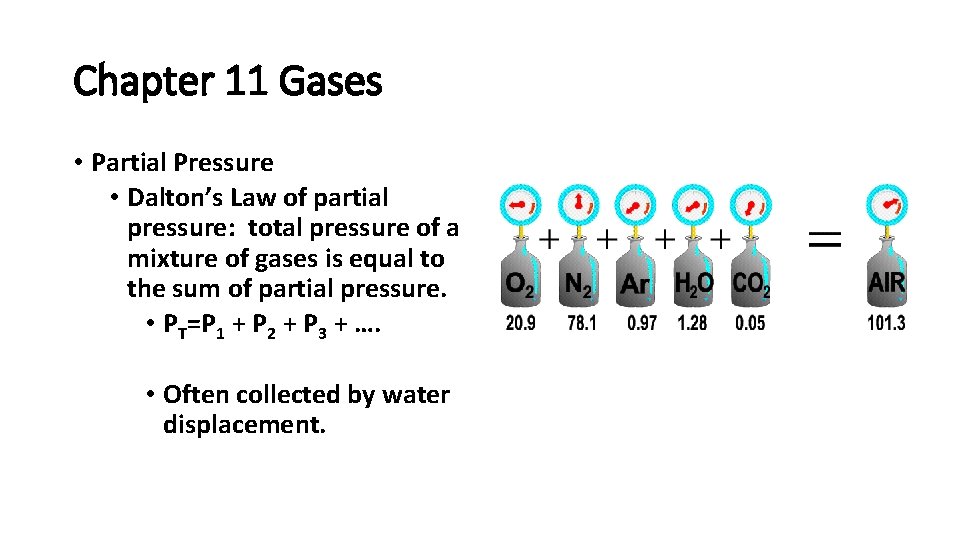
Chapter 11 Gases • Partial Pressure • Dalton’s Law of partial pressure: total pressure of a mixture of gases is equal to the sum of partial pressure. • PT=P 1 + P 2 + P 3 + …. • Often collected by water displacement.
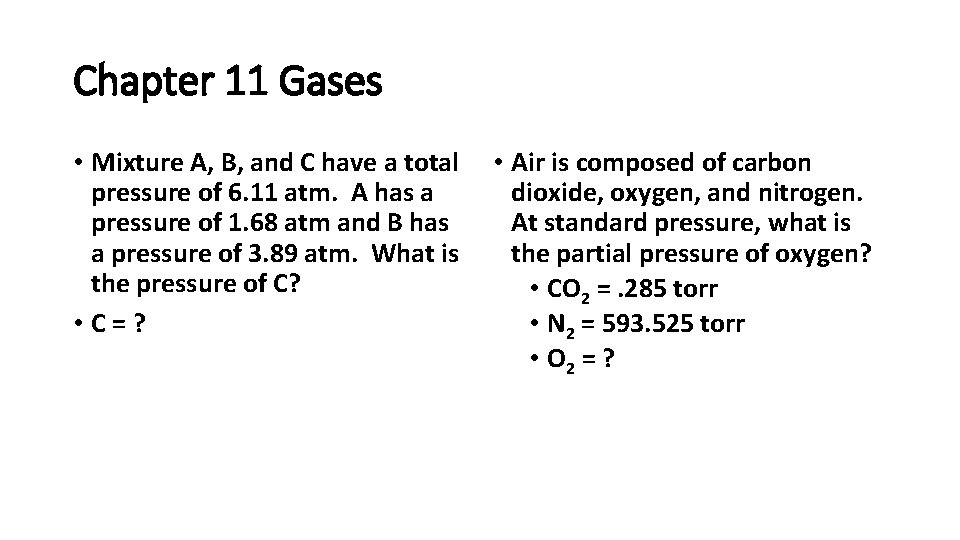
Chapter 11 Gases • Mixture A, B, and C have a total pressure of 6. 11 atm. A has a pressure of 1. 68 atm and B has a pressure of 3. 89 atm. What is the pressure of C? • C=? • Air is composed of carbon dioxide, oxygen, and nitrogen. At standard pressure, what is the partial pressure of oxygen? • CO 2 =. 285 torr • N 2 = 593. 525 torr • O 2 = ?
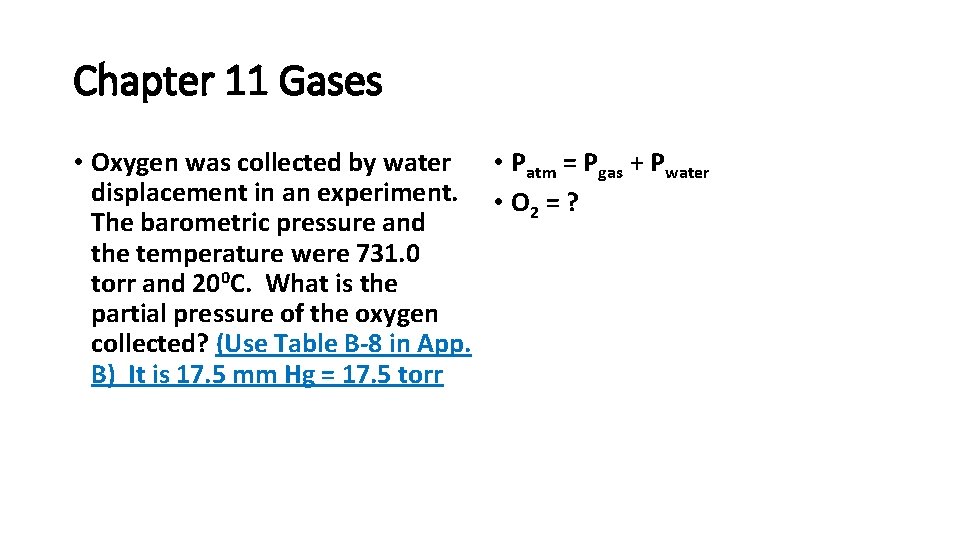
Chapter 11 Gases • Oxygen was collected by water • Patm = Pgas + Pwater displacement in an experiment. • O = ? 2 The barometric pressure and the temperature were 731. 0 torr and 200 C. What is the partial pressure of the oxygen collected? (Use Table B-8 in App. B) It is 17. 5 mm Hg = 17. 5 torr
Chapter 11 Gases • Gas laws: • Boyle’s law • Charles’s law • Gay-Lussac’s law • Combined gas law.
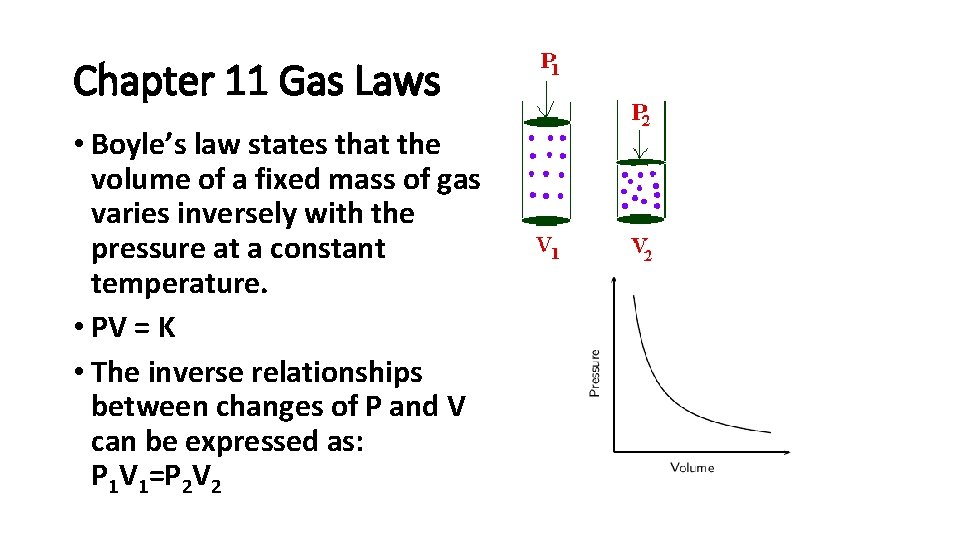
Chapter 11 Gas Laws • Boyle’s law states that the volume of a fixed mass of gas varies inversely with the pressure at a constant temperature. • PV = K • The inverse relationships between changes of P and V can be expressed as: P 1 V 1=P 2 V 2
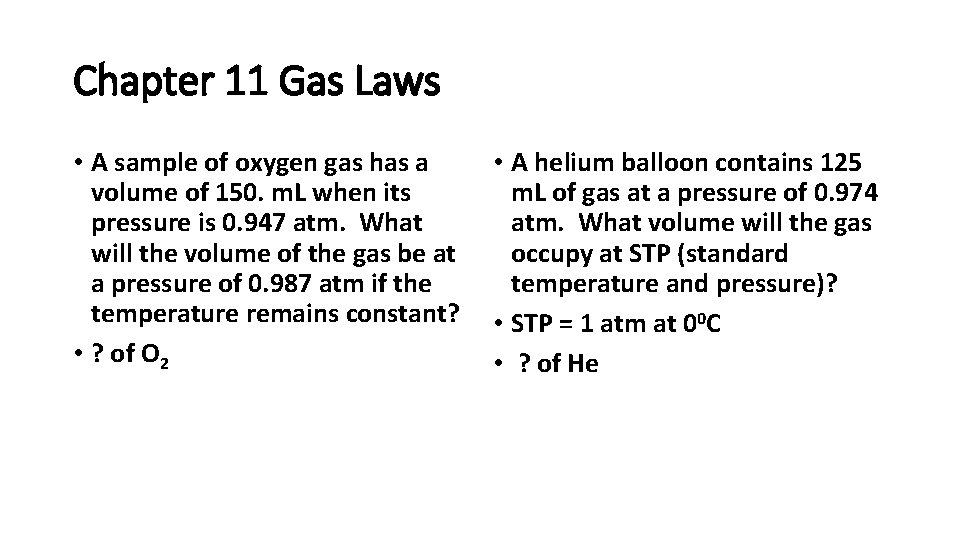
Chapter 11 Gas Laws • A sample of oxygen gas has a volume of 150. m. L when its pressure is 0. 947 atm. What will the volume of the gas be at a pressure of 0. 987 atm if the temperature remains constant? • ? of O 2 • A helium balloon contains 125 m. L of gas at a pressure of 0. 974 atm. What volume will the gas occupy at STP (standard temperature and pressure)? • STP = 1 atm at 00 C • ? of He
Chapter 11 Gas Laws • Charles’s law states that the volume of a fixed mass of gas at constant pressure varies directly with the temperature in kelvins. • V=k. T or k=V/T • The relationships between the changes of V and T can be expressed as: V 1/T 1=V 2/T 2
Side Note • He found that when he plotted the V of a gas against its T in degrees C 0, it produced a straight line that extrapolated to zero V at -273 0 C • This became know as Absolute zero, the lowest possible achievable temperature. It is assigned a value of zero on the K temperature scale. • The K temperature scale had advantages. When the K temperature of a gas doubles, the volume doubles. The same occurs when the K temperature decrease.
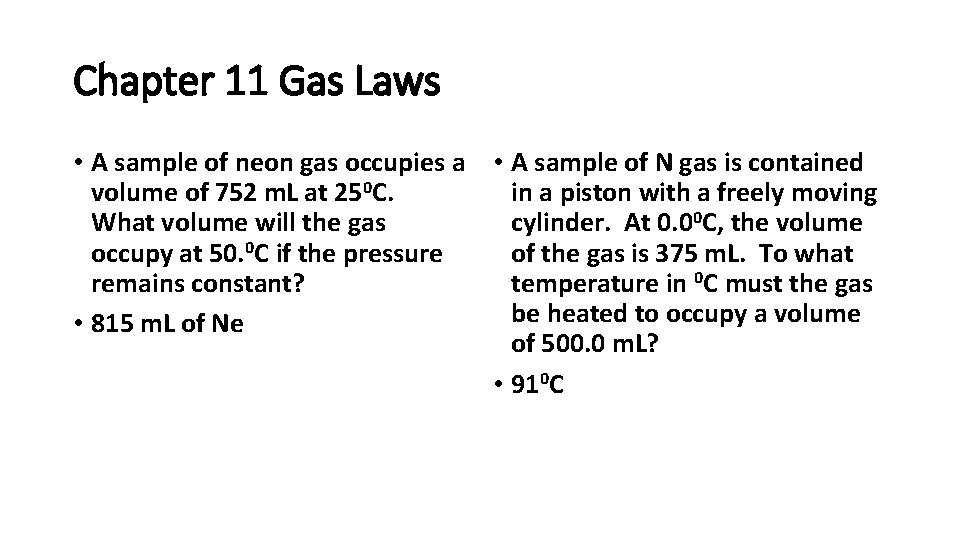
Chapter 11 Gas Laws • A sample of neon gas occupies a • A sample of N gas is contained volume of 752 m. L at 250 C. in a piston with a freely moving What volume will the gas cylinder. At 0. 00 C, the volume occupy at 50. 0 C if the pressure of the gas is 375 m. L. To what remains constant? temperature in 0 C must the gas be heated to occupy a volume • 815 m. L of Ne of 500. 0 m. L? • 910 C
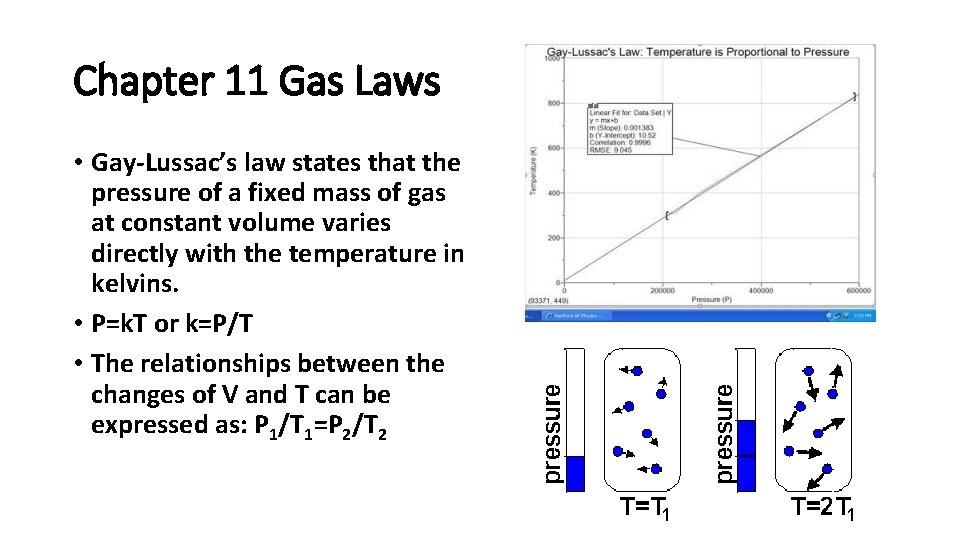
Chapter 11 Gas Laws • Gay-Lussac’s law states that the pressure of a fixed mass of gas at constant volume varies directly with the temperature in kelvins. • P=k. T or k=P/T • The relationships between the changes of V and T can be expressed as: P 1/T 1=P 2/T 2
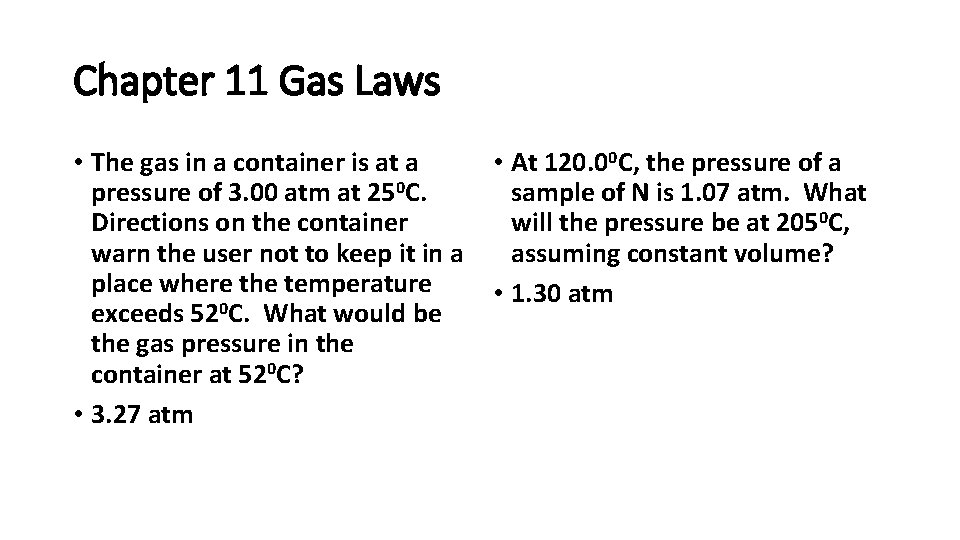
Chapter 11 Gas Laws • The gas in a container is at a pressure of 3. 00 atm at 250 C. Directions on the container warn the user not to keep it in a place where the temperature exceeds 520 C. What would be the gas pressure in the container at 520 C? • 3. 27 atm • At 120. 00 C, the pressure of a sample of N is 1. 07 atm. What will the pressure be at 2050 C, assuming constant volume? • 1. 30 atm
Chapter 11 Gas Laws • Combined gas law expresses the • A gas often undergoes changes relationship between pressure, in temp, pressure, and volume, and temperature of a all at the same time. fixed amount of gas. • When this happens you deal • PV/T = k with all three variables at once. In these situations we combine • The relationships between the all three gas laws together to in changes of P, V, and T can be a single expression, the expressed as: P 1 V 1/T 1=P 2 V 2/T 2 combined gas law.
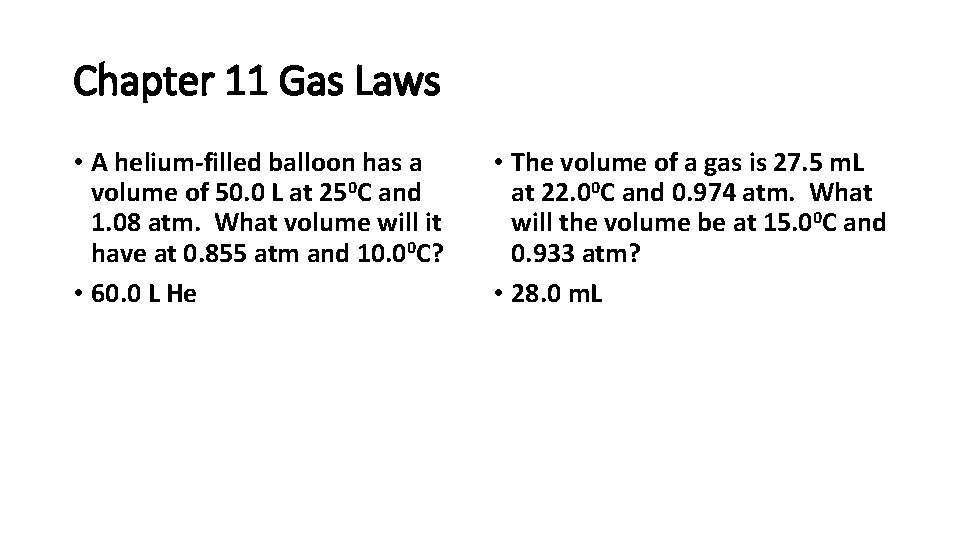
Chapter 11 Gas Laws • A helium-filled balloon has a volume of 50. 0 L at 250 C and 1. 08 atm. What volume will it have at 0. 855 atm and 10. 00 C? • 60. 0 L He • The volume of a gas is 27. 5 m. L at 22. 00 C and 0. 974 atm. What will the volume be at 15. 00 C and 0. 933 atm? • 28. 0 m. L
Chapter 11 Gas Laws • In this section, you will study the reaction between the volume of gases that react with each other. • We will learn about the relationship between molar amount of gas and volume. • And the law that unifies all the basic gas laws. • It will be important to remember the diatomic molecules: H 2, N 2, O 2, F 2, Cl 2, Br 2, and I 2 • I mole of any gas = 22. 4 L at STP
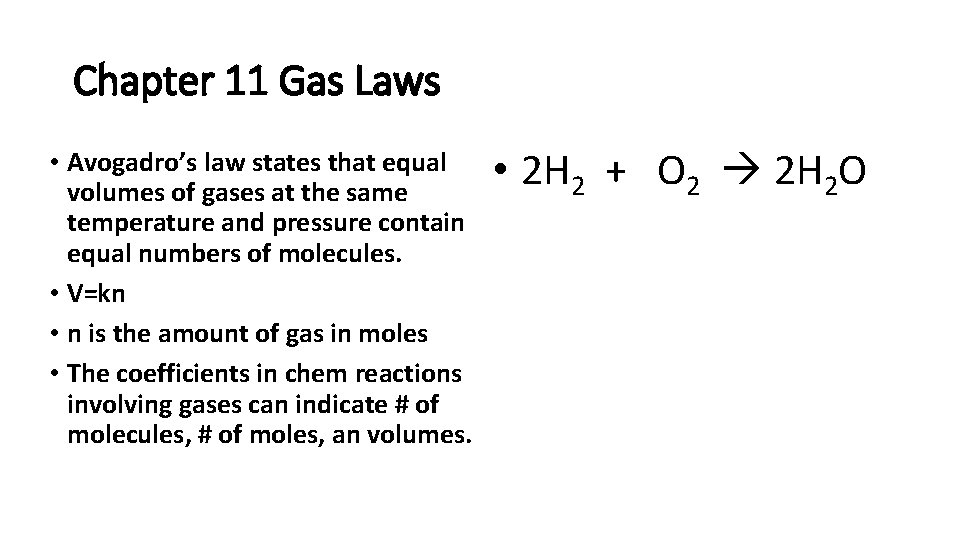
Chapter 11 Gas Laws • Avogadro’s law states that equal volumes of gases at the same temperature and pressure contain equal numbers of molecules. • V=kn • n is the amount of gas in moles • The coefficients in chem reactions involving gases can indicate # of molecules, # of moles, an volumes. • 2 H 2 + O 2 2 H 2 O
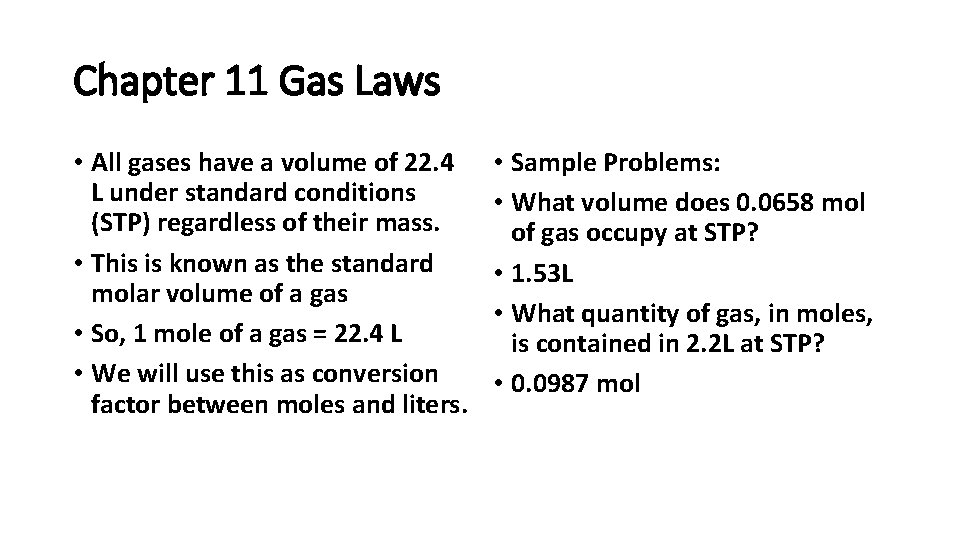
Chapter 11 Gas Laws • All gases have a volume of 22. 4 L under standard conditions (STP) regardless of their mass. • This is known as the standard molar volume of a gas • So, 1 mole of a gas = 22. 4 L • We will use this as conversion factor between moles and liters. • Sample Problems: • What volume does 0. 0658 mol of gas occupy at STP? • 1. 53 L • What quantity of gas, in moles, is contained in 2. 2 L at STP? • 0. 0987 mol
Chapter 11 Gas Laws • Ideal gas law is a mathematical relationship among, pressure, volume, temperature, and the number of moles of a gas. • PV=n. RT • Merge this with the combined gas law and you get • R=PV/n. T - R is the Ideal gas constant • Its value is 0. 0821 L*atm/mol*K or 8. 315 dm 3*k. Pa/mol*K
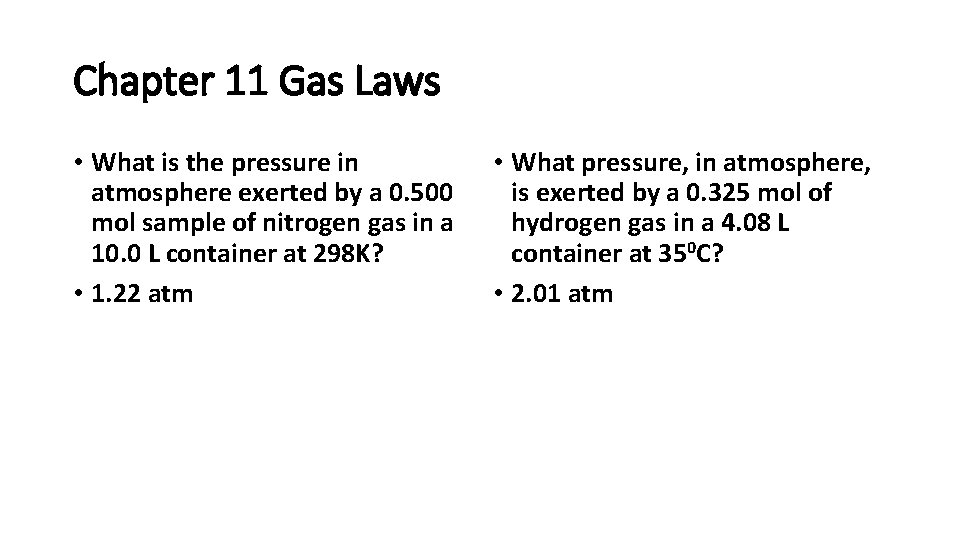
Chapter 11 Gas Laws • What is the pressure in atmosphere exerted by a 0. 500 mol sample of nitrogen gas in a 10. 0 L container at 298 K? • 1. 22 atm • What pressure, in atmosphere, is exerted by a 0. 325 mol of hydrogen gas in a 4. 08 L container at 350 C? • 2. 01 atm
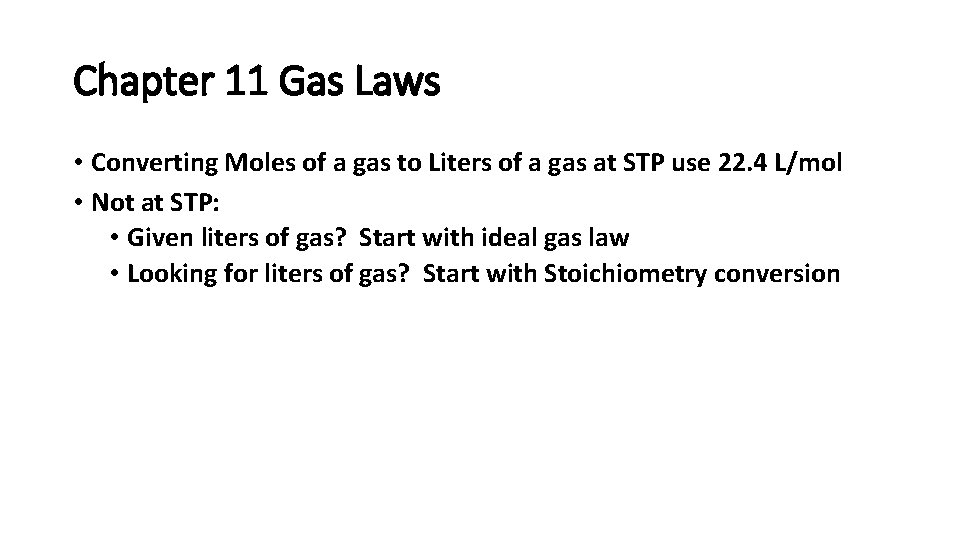
Chapter 11 Gas Laws • Converting Moles of a gas to Liters of a gas at STP use 22. 4 L/mol • Not at STP: • Given liters of gas? Start with ideal gas law • Looking for liters of gas? Start with Stoichiometry conversion
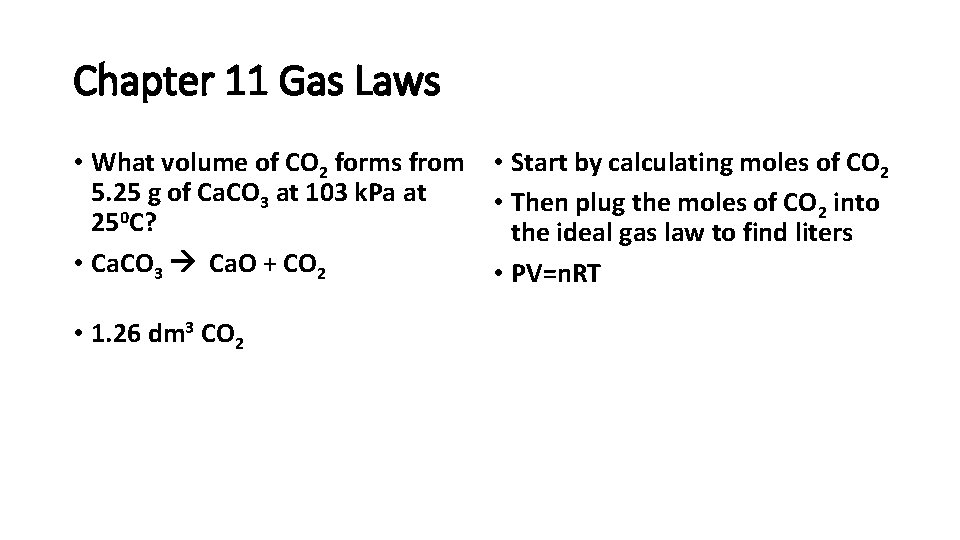
Chapter 11 Gas Laws • What volume of CO 2 forms from • Start by calculating moles of CO 2 5. 25 g of Ca. CO 3 at 103 k. Pa at • Then plug the moles of CO 2 into 0 25 C? the ideal gas law to find liters • Ca. CO 3 Ca. O + CO 2 • PV=n. RT • 1. 26 dm 3 CO 2
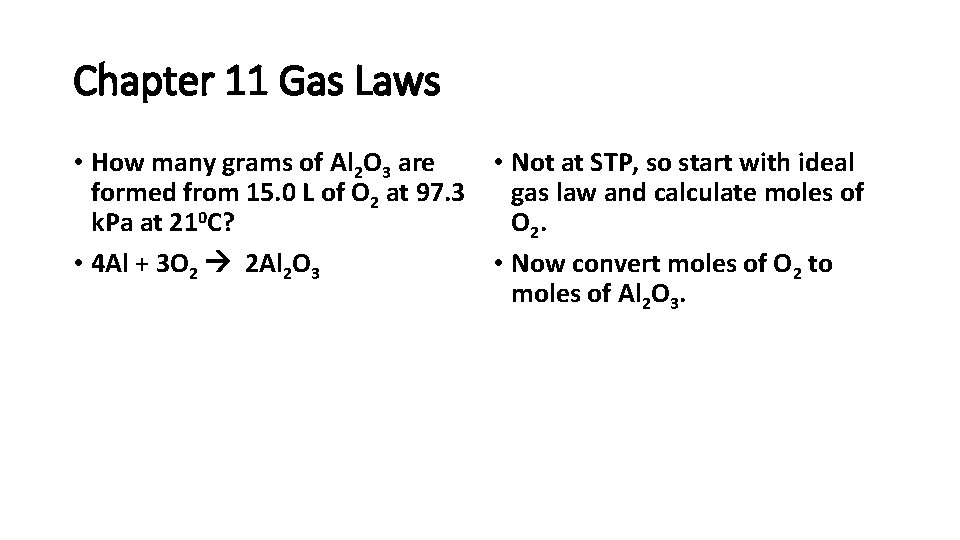
Chapter 11 Gas Laws • How many grams of Al 2 O 3 are • Not at STP, so start with ideal formed from 15. 0 L of O 2 at 97. 3 gas law and calculate moles of k. Pa at 210 C? O 2. • 4 Al + 3 O 2 2 Al 2 O 3 • Now convert moles of O 2 to moles of Al 2 O 3.