
Chapter 10 Sexual Reproduction and Genetics Chapter 10



















- Slides: 53
Chapter 10: Sexual Reproduction and Genetics Chapter 10
Why does an organism look like it does? �For a long time, people have observed that offspring look like their parents.
Even before we knew about genes, people were breeding livestock to get certain traits in the offspring. They knew that something caused babies to look like their parents. Most thought that traits of parents were blended in the offspring.
10. 2: Mendelian Genetics Chapter 10
Gregor Mendel � Gregor Mendel – “Father of Modern Genetics” � Austrian Monk � Work occurred in 1850 s � His work provides framework of what we know today � Traits are distinguishing characteristics that are inherited. � Mendel Laid the groundwork for genetics. � Genetics is the study of biological inheritance patterns and variation. � Gregor Mendel showed that traits are inherited as discrete units. � Many in Mendel’s day thought traits were blended.
�Mendel studied pea plants � Why study pea plants? �Reproduces quickly (14 days!) �Self-pollinating or sexually reproduce �Many varying traits �Makes lots of offspring (100+!) �Easy to grow �Understood basic plant reproduction � Pollen ♂ & egg ♀ fused when fertilized � One plant has ♀&♂ structures � Most plants are self-fertilizing (purebred) �Studied the traits of the plants � Traits = characteristics �Mendel cross fertilized plants with contrasting traits (tall and short)
Mendel’s Garden
Seven Traits of Mendel’s Pea
�If allowed to self-pollinate, true-breeding plants produce offspring identical to themselves. � Self-pollination – pollen and ovum come from the same plant. � True-breeding – always produce offspring with the same trait. �He wondered what plants would look like if male sex cells in the pollen of one plant fertilize the egg cells on another plant = cross-pollination. � Cross-pollination - using the pollen of one plant to fertilize the ovum of another plant
Mendel’s Experiment �He systematically cross-pollinated two different true-breeding plants called the Parent generation (P).
� Mendel systematically cross-pollinated two different true- breeding plants called the Parent generation (P). � His data revealed patterns of inheritance. � Mendel made three key decisions in his experiments. � use of purebred plants � control over breeding � observation of seven “either-or” traits
Cross Fertilizing � Cross Fertilize = taking pollen from one plant and fertilizing the egg of another • Offspring is called a Hybrid • This caused odd outcomes • Tall plant + short plant = tall plant • Mendel used pollen to fertilize selected pea plants. • P generation crossed to produce F 1 generation Mendel controlled the fertilization of his pea plants by removing the male parts, or stamens. He then fertilized the female part, or pistil, with pollen from a different pea plant.
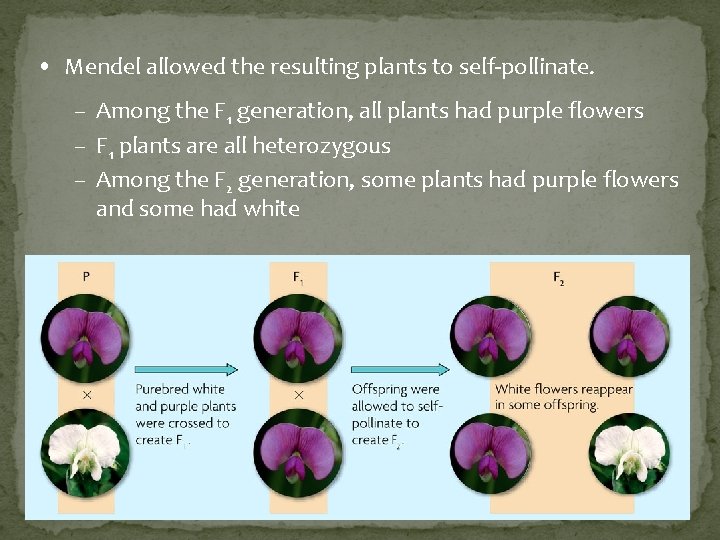
• Mendel allowed the resulting plants to self-pollinate. – Among the F 1 generation, all plants had purple flowers – F 1 plants are all heterozygous – Among the F 2 generation, some plants had purple flowers and some had white
• Mendel observed patterns in the first and second generations of his crosses. • What patterns do you observe?
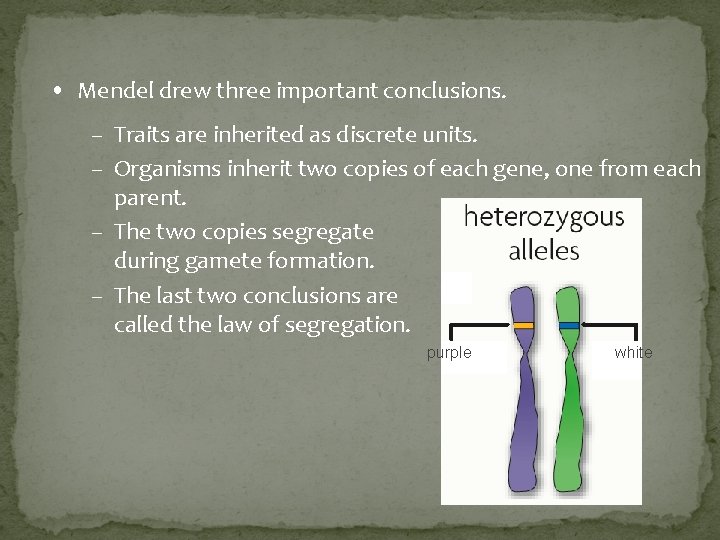
• Mendel drew three important conclusions. – Traits are inherited as discrete units. – Organisms inherit two copies of each gene, one from each parent. – The two copies segregate during gamete formation. – The last two conclusions are called the law of segregation. purple white
Genes � Genes encode proteins that produce a diverse range of traits. � The same gene can have many versions. � A gene is a piece of DNA that directs a cell to make a certain protein. � Each gene has a locus, a specific position on a pair of homologous chromosomes.
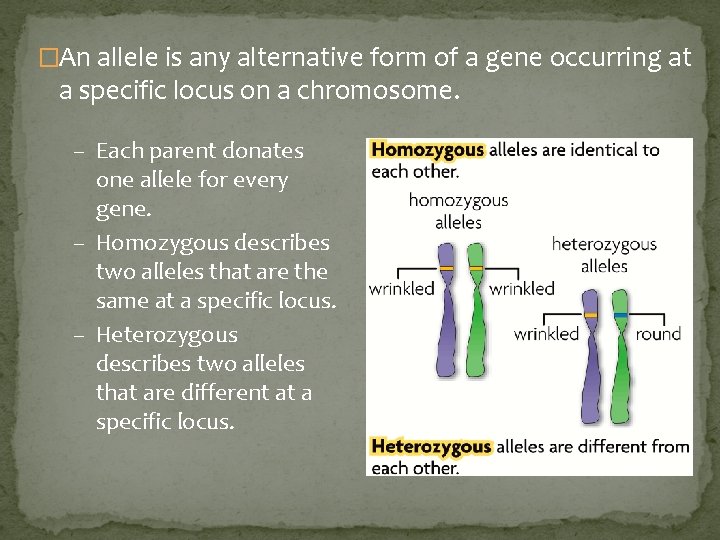
�An allele is any alternative form of a gene occurring at a specific locus on a chromosome. – Each parent donates one allele for every gene. – Homozygous describes two alleles that are the same at a specific locus. – Heterozygous describes two alleles that are different at a specific locus.
Genotype vs. Phenotype �Genes influence the development of traits. �All of an organism’s genetic material is called the genome. • A genotype refers to the makeup of a specific set of genes. • A phenotype is the physical expression of a trait.
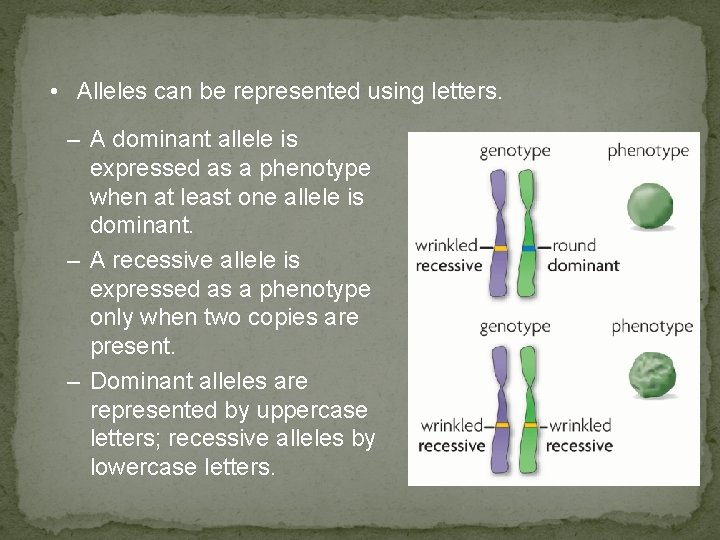
• Alleles can be represented using letters. – A dominant allele is expressed as a phenotype when at least one allele is dominant. – A recessive allele is expressed as a phenotype only when two copies are present. – Dominant alleles are represented by uppercase letters; recessive alleles by lowercase letters.
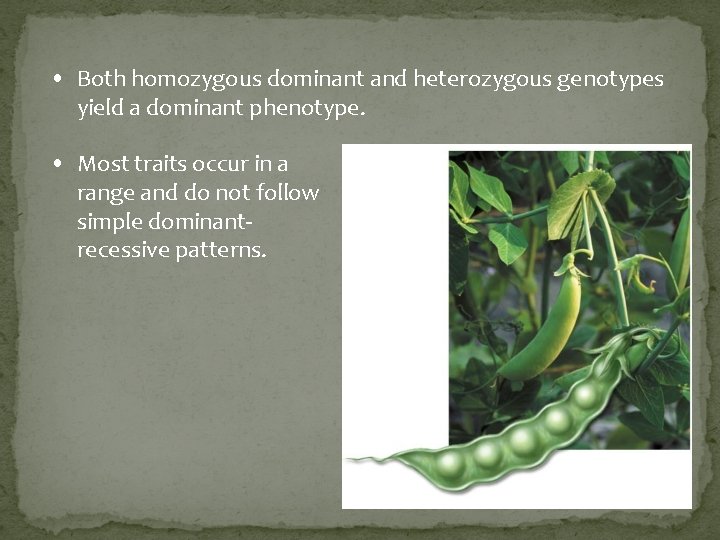
• Both homozygous dominant and heterozygous genotypes yield a dominant phenotype. • Most traits occur in a range and do not follow simple dominantrecessive patterns.
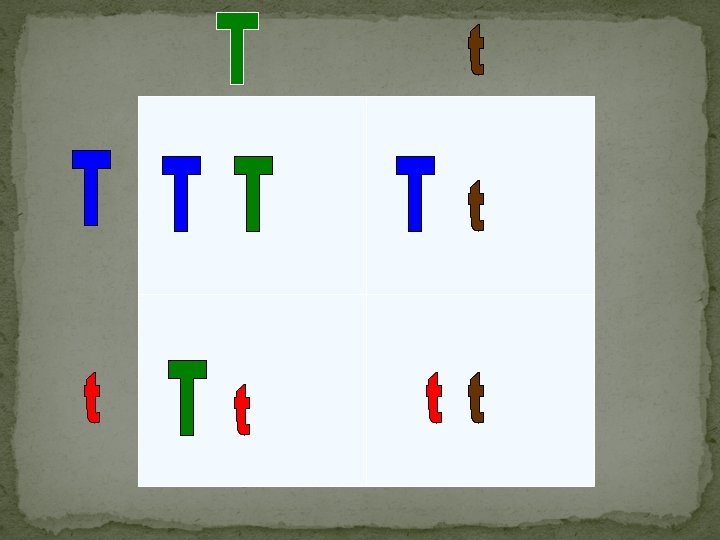
Punnett squares � Punnett squares illustrate genetic crosses. � The Punnett square is a grid system for predicting all possible genotypes resulting from a cross. � The axes represent the possible gametes of each parent. � The boxes show the possible genotypes of the offspring. • The Punnett square yields the ratio of possible genotypes and phenotypes. The inheritance of traits follows the rules of probability.
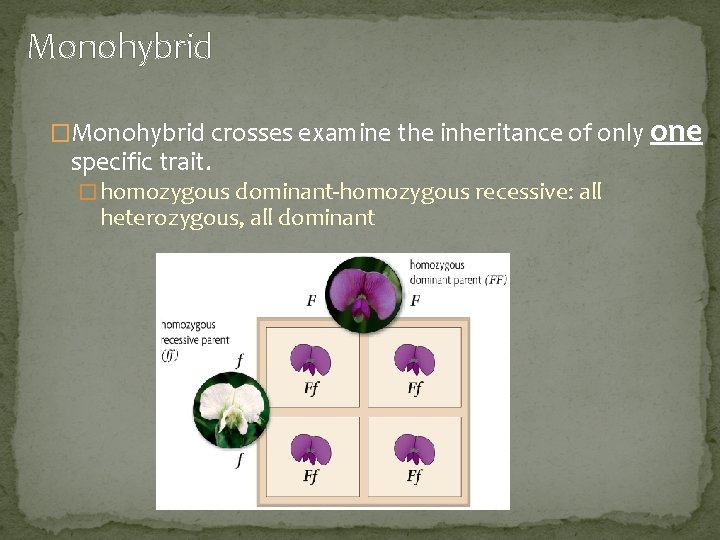
Monohybrid �Monohybrid crosses examine the inheritance of only one specific trait. � homozygous dominant-homozygous recessive: all heterozygous, all dominant
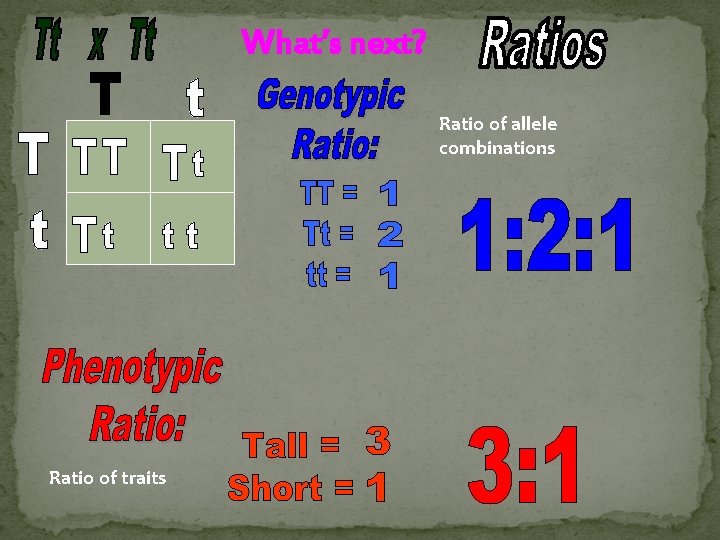
– heterozygous-heterozygous – 1: 2: 1 homozygous dominant: heterozygous: homozygous recessive – 3: 1 dominant: recessive
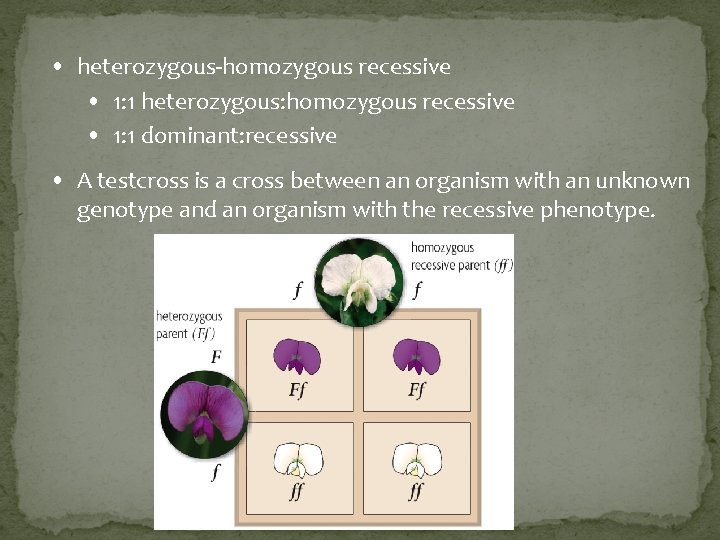
• heterozygous-homozygous recessive • 1: 1 heterozygous: homozygous recessive • 1: 1 dominant: recessive • A testcross is a cross between an organism with an unknown genotype and an organism with the recessive phenotype.
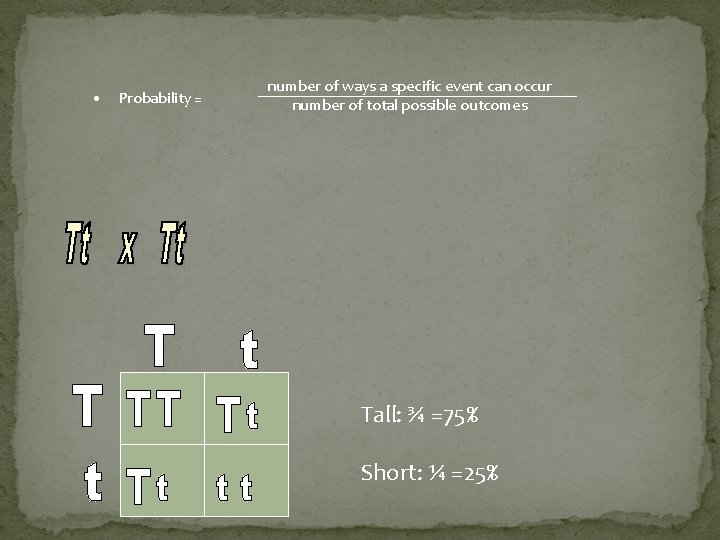
Probability � Heredity patterns can be calculated with probability. � Probability is the likelihood that something will happen. � Probability predicts an average number of occurrences, not an exact number of occurrences. • Probability = number of ways a specific event can occur number of total possible outcomes • Probability applies to random events such as meiosis and fertilization.
Human Sex Determination What is the probability that a baby will be a girl? A boy?
Probabilities Predict Averages �The larger the number of individuals, the closer the resulting offspring numbers will get to expected values. �Probabilities do not guarantee outcomes!!!!
• Probability = number of ways a specific event can occur number of total possible outcomes Tall: ¾ =75% Short: ¼ =25%
Punnett Squares Step by step how to guide
Putting it together �Alleles represented by letters � Capital letters = dominant (T) � Lowercase letters = recessive (t) � Dominant letter goes before the recessive letter within Punnett square �Two letters combined = trait � TT, Tt, tt �One from mom and one from dad �Homozygous = both letters same � TT or tt �Heterozygous = both letters differ � Tt
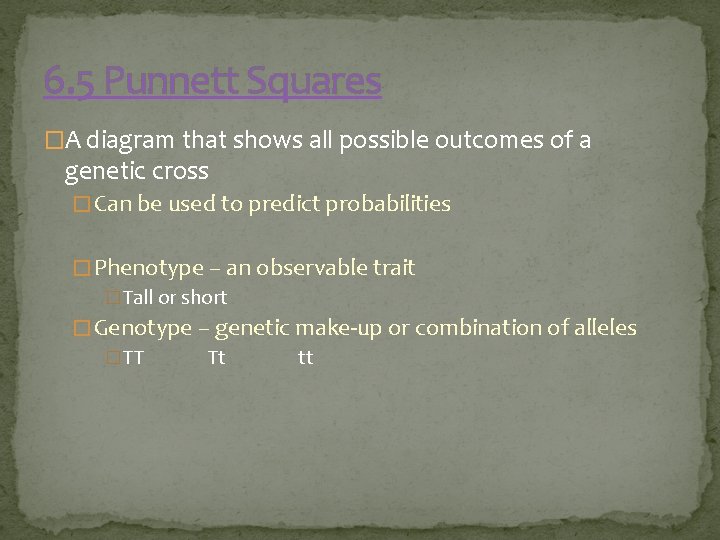
6. 5 Punnett Squares �A diagram that shows all possible outcomes of a genetic cross � Can be used to predict probabilities � Phenotype – an observable trait �Tall or short � Genotype – genetic make-up or combination of alleles �TT Tt tt
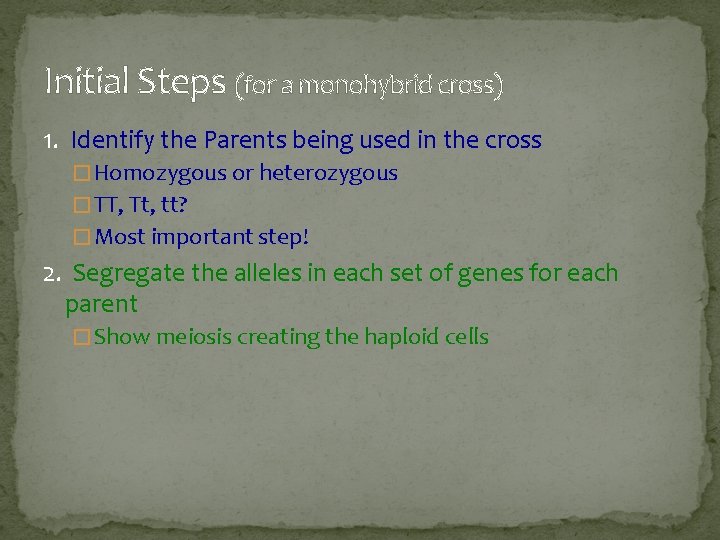
Initial Steps (for a monohybrid cross) 1. Identify the Parents being used in the cross � Homozygous or heterozygous � TT, Tt, tt? � Most important step! 2. Segregate the alleles in each set of genes for each parent � Show meiosis creating the haploid cells
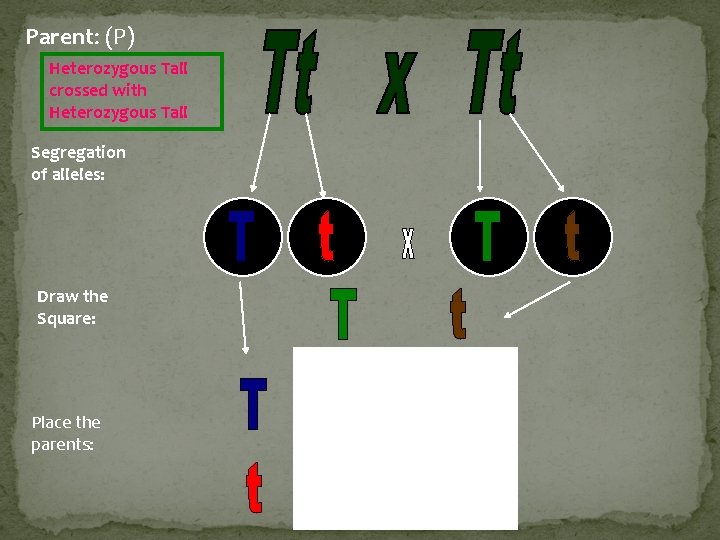
Parent: (P) Heterozygous Tall crossed with Heterozygous Tall Segregation of alleles: Draw the Square: Place the parents:
What’s next? Ratio of allele combinations Ratio of traits
Examples for you to work out! 1. Tt x tt -be sure to show both types of ratios 2. Cross a homozygous tall plant with a short plant -be sure to show both types of ratios
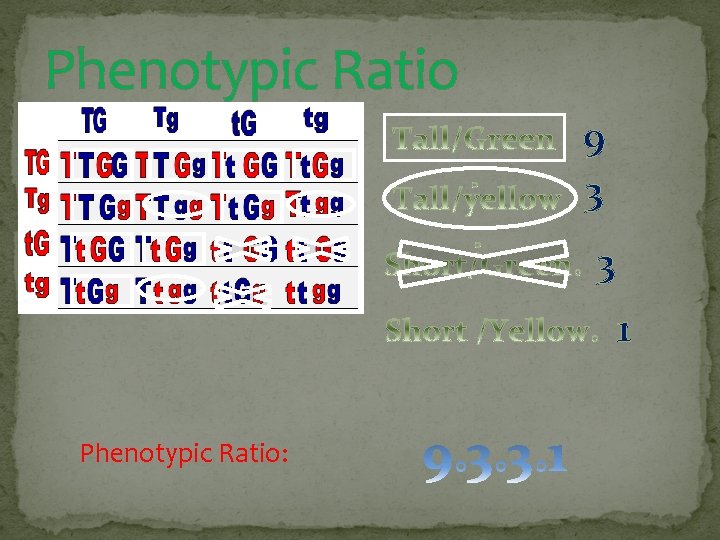
Dihybrid Crosses � A dyhybrid cross involves two traits. � Mendel’s dihybrid crosses with heterozygous plants yielded a 9: 3: 3: 1 phenotypic ratio. • Mendel’s dihybrid crosses led to his second law, the law of independent assortment. • The law of independent assortment states that allele pairs separate independently of each other during meiosis.
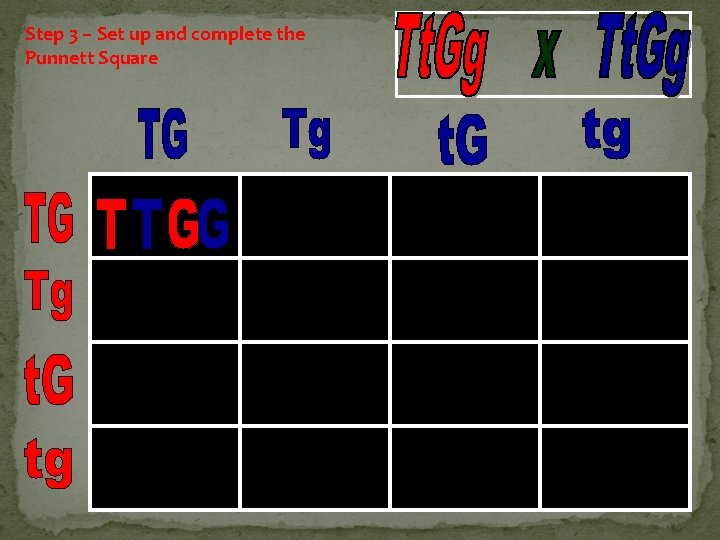
Initial Steps (for a dihybrid cross) 1. Identify the Parents being used in the cross and figure out the combo of both traits. � Homozygous or heterozygous � TTGG, TTGg, TTgg, Tt. GG, Tt. Gg, Ttgg, tt. GG, tt. Gg, ttgg? � Most important step! 2. Segregate the alleles in each set of genes for each parent � Show meiosis creating the haploid cells
Heterozygous Tall, Heterozygous Green plant crossed with Heterozygous Tall, Heterozygous Green plant x
Step 3 – Set up and complete the Punnett Square
Phenotypic Ratio 9 3 3 1 Phenotypic Ratio:
Examples for you to work out! 1. Cross a heterozygous tall, yellow plant with a homozygous tall, heterozygous green plant. 2. Cross a heterozygous tall, yellow plant with a short, heterozygous green plant.
Summary of Mendel’s Work �Traits are determined by genes which are passed from parent to offspring. �Some forms of a genes may be dominant and some recessive for a given trait. �Most sexually reproducing organisms have 2 alleles for a gene that separate when eggs and sperm are formed. �Alleles for different genes can segregate independently of one another.
10. 3 Gene Linkage and Polyploidy Chapter 10
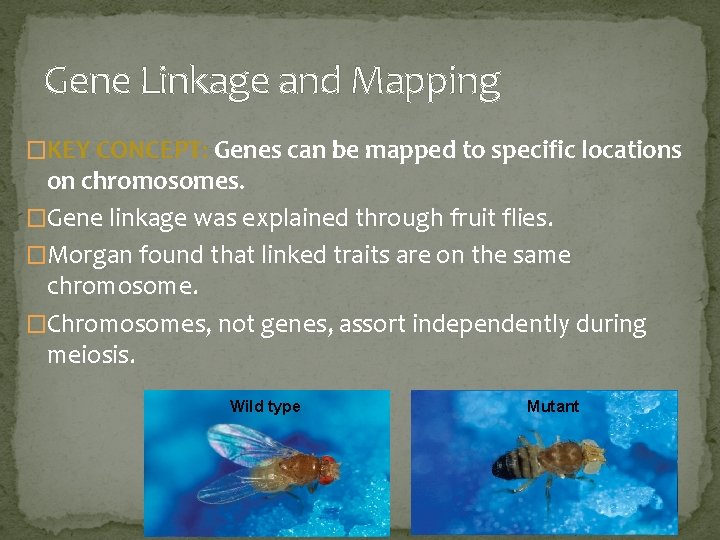
Gene Linkage and Mapping �KEY CONCEPT: Genes can be mapped to specific locations on chromosomes. �Gene linkage was explained through fruit flies. �Morgan found that linked traits are on the same chromosome. �Chromosomes, not genes, assort independently during meiosis. Wild type Mutant
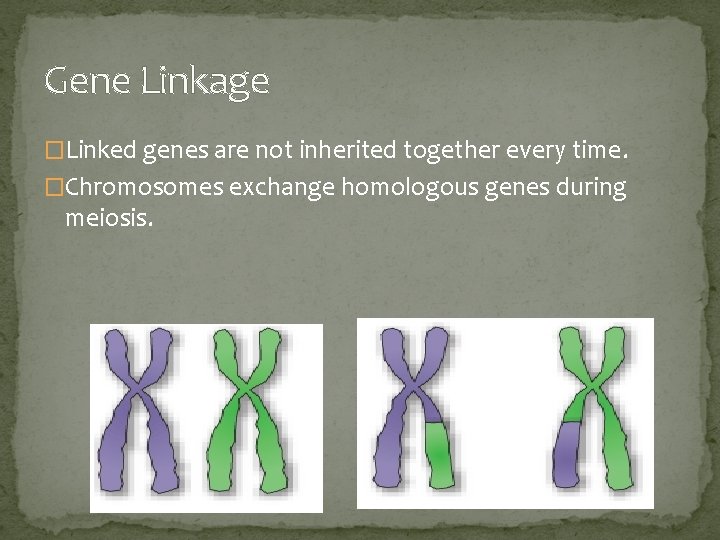
Gene Linkage �Linked genes are not inherited together every time. �Chromosomes exchange homologous genes during meiosis.
�Genes located close together on a chromosome are likely to be inherited together. http: //www. csun. edu/~cmalone/pdf 360/Ch 061 chi%202 pt. pdf
Linkage Maps �Linkage maps estimate distances between genes. �The closer together two genes are, the more likely they will be inherited together. �Cross-over frequencies are related to distances between genes. �Linkage maps show the relative locations of genes.
Crossing Over frequencies �Cross-over frequencies can be converted into map units. – gene A and gene B cross over 6. 0 percent of the time – gene B and gene C cross over 12. 5 percent of the time – gene A and gene C cross over 18. 5 percent of the time