
Chapter 10 Service Environment Physical Evidence and the

- Slides: 17
Chapter 10 Service Environment, Physical Evidence and the Servicescape
What is the Service Environment? �The service environment includes all aspects of the organization’s physical facility (servicescape) as well as other tangible aspects of tangible communication. � The service environment is used as a criteria in evaluating services by consumers. �Effective design of physical, tangible evidence is a requirement for successful services. �Servicescape is often used as a positioning tool for service organizations.
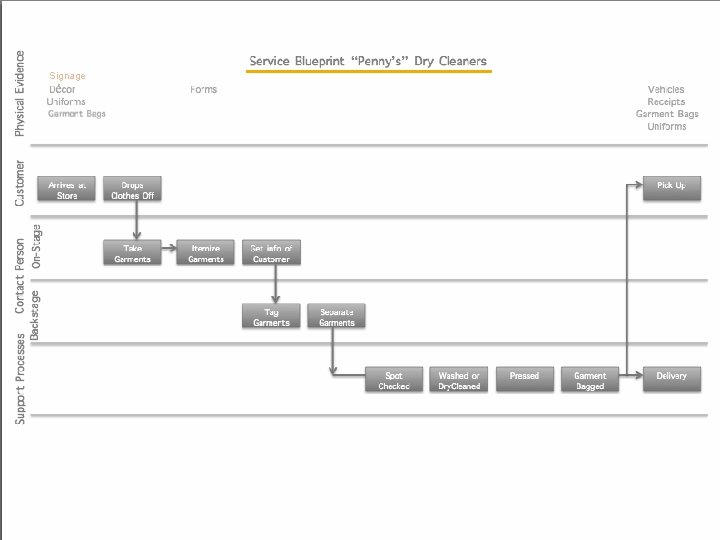
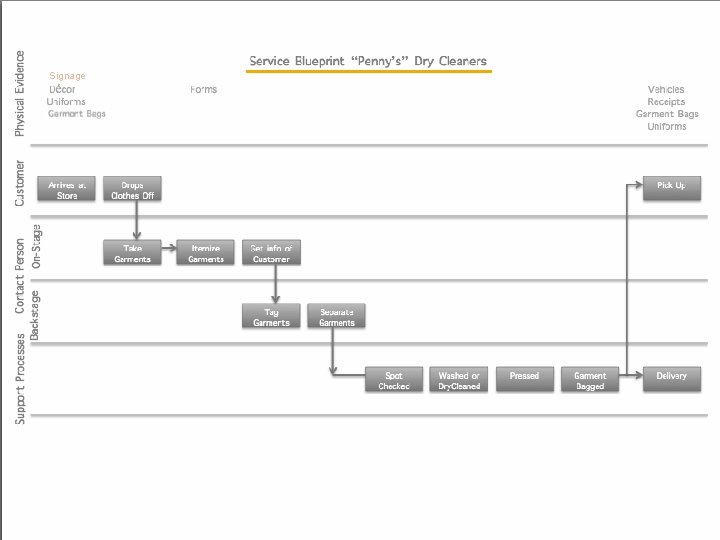
Signage
Purpose of Service Environments o Shape customers’ experience and their behaviour ▪ Message-creating medium: symbolic cues to communicate the distinctive nature and quality of the service experience ▪ Attention-creating medium: make servicescape stand out from competition and attract customers from target segments ▪ Effect-creating medium: use colors, textures, sounds, scents and spatial design to enhance desired service experience o For image, positioning and differentiation o Part of the value proposition o Facilitate service encounter and enhance productivity
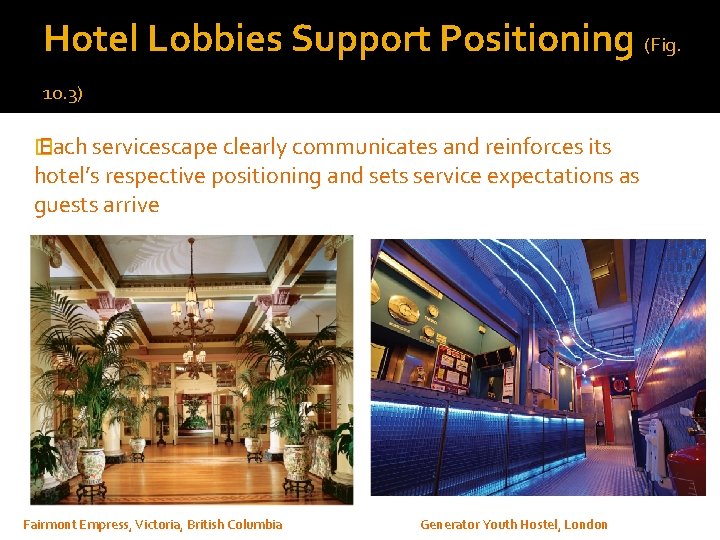
Hotel Lobbies Support Positioning (Fig. 10. 3) � Each servicescape clearly communicates and reinforces its hotel’s respective positioning and sets service expectations as guests arrive © Pearson Education South Asia Fairmont Victoria, British Pte Ltd Empress, 2013. All rights reserved 5 Columbia Generator Youth Hostel, London
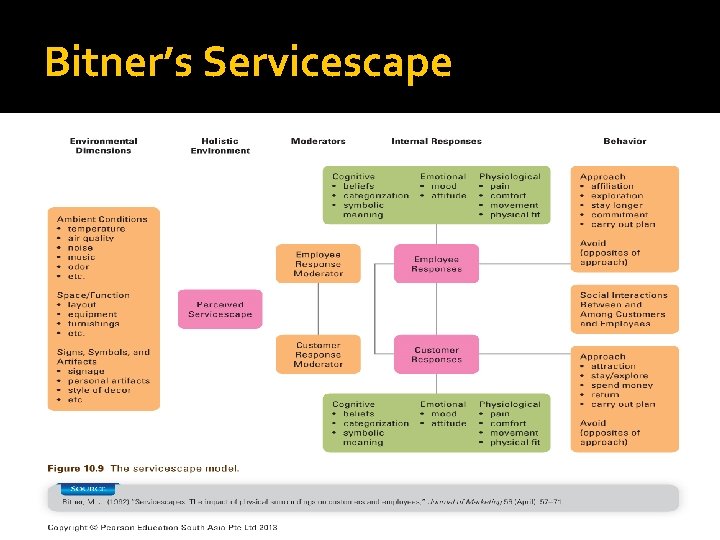
Bitner’s Servicescape
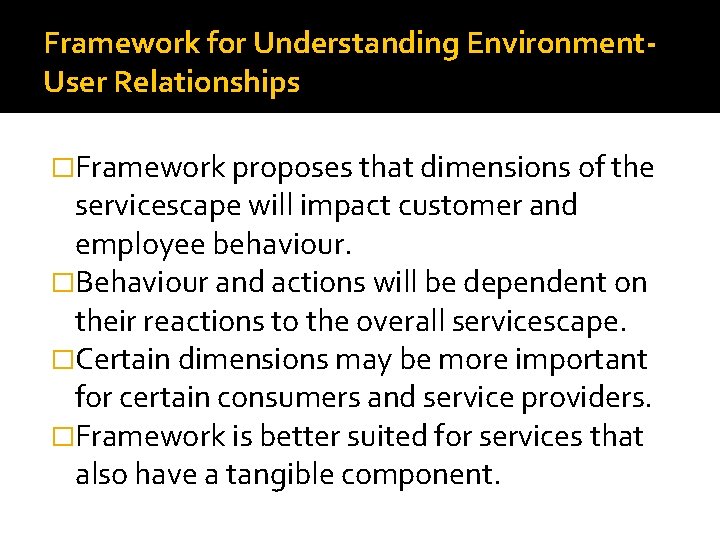
Framework for Understanding Environment. User Relationships �Framework proposes that dimensions of the servicescape will impact customer and employee behaviour. �Behaviour and actions will be dependent on their reactions to the overall servicescape. �Certain dimensions may be more important for certain consumers and service providers. �Framework is better suited for services that also have a tangible component.
Signage
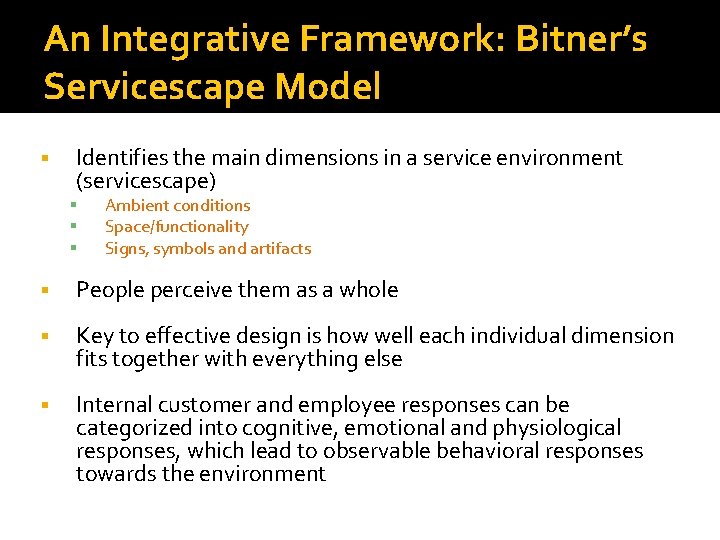
An Integrative Framework: Bitner’s Servicescape Model Identifies the main dimensions in a service environment (servicescape) Ambient conditions Space/functionality Signs, symbols and artifacts People perceive them as a whole Key to effective design is how well each individual dimension fits together with everything else Internal customer and employee responses can be categorized into cognitive, emotional and physiological responses, which lead to observable behavioral responses towards the environment
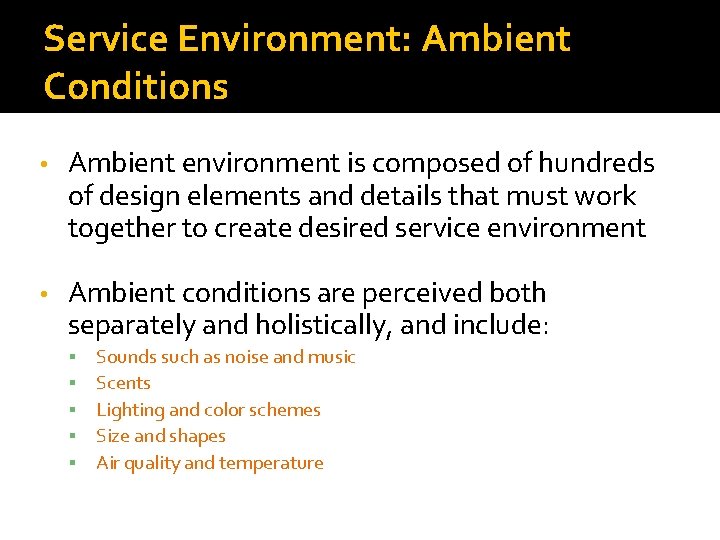
Service Environment: Ambient Conditions • Ambient environment is composed of hundreds of design elements and details that must work together to create desired service environment • Ambient conditions are perceived both separately and holistically, and include: ▪ ▪ ▪ Sounds such as noise and music Scents Lighting and color schemes Size and shapes Air quality and temperature
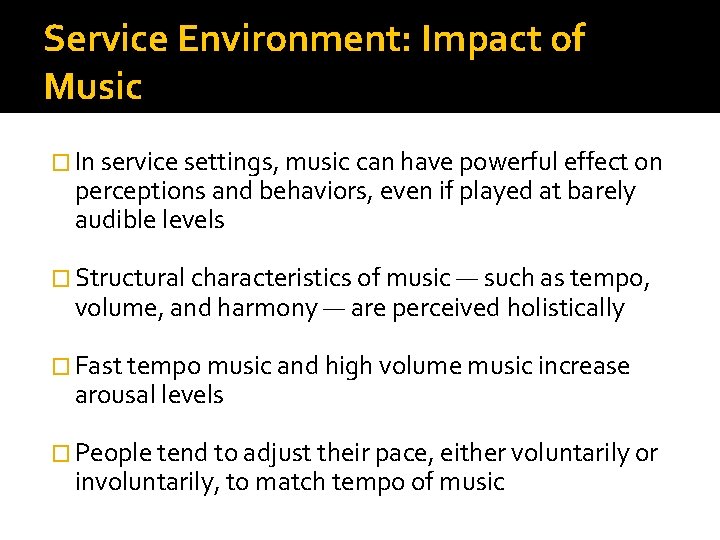
Service Environment: Impact of Music � In service settings, music can have powerful effect on perceptions and behaviors, even if played at barely audible levels � Structural characteristics of music ― such as tempo, volume, and harmony ― are perceived holistically � Fast tempo music and high volume music increase arousal levels � People tend to adjust their pace, either voluntarily or involuntarily, to match tempo of music
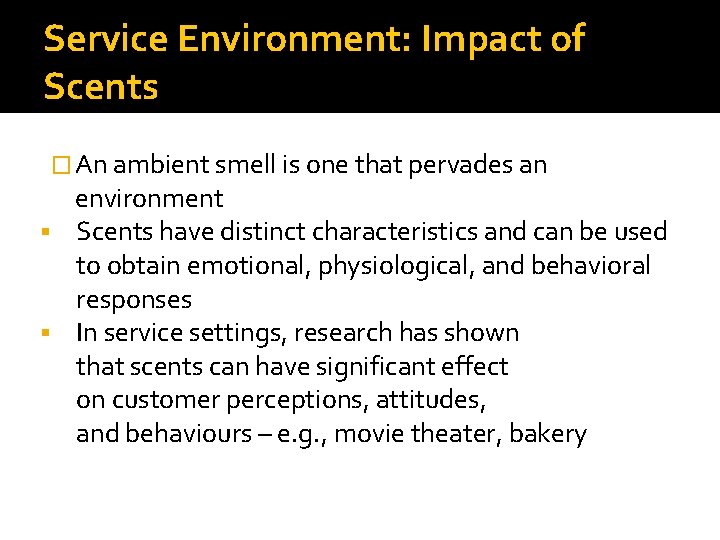
Service Environment: Impact of Scents � An ambient smell is one that pervades an environment Scents have distinct characteristics and can be used to obtain emotional, physiological, and behavioral responses In service settings, research has shown that scents can have significant effect on customer perceptions, attitudes, and behaviours – e. g. , movie theater, bakery
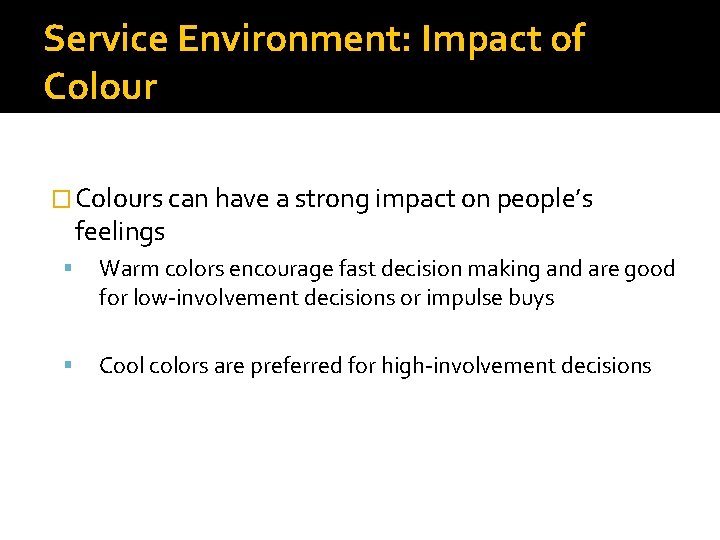
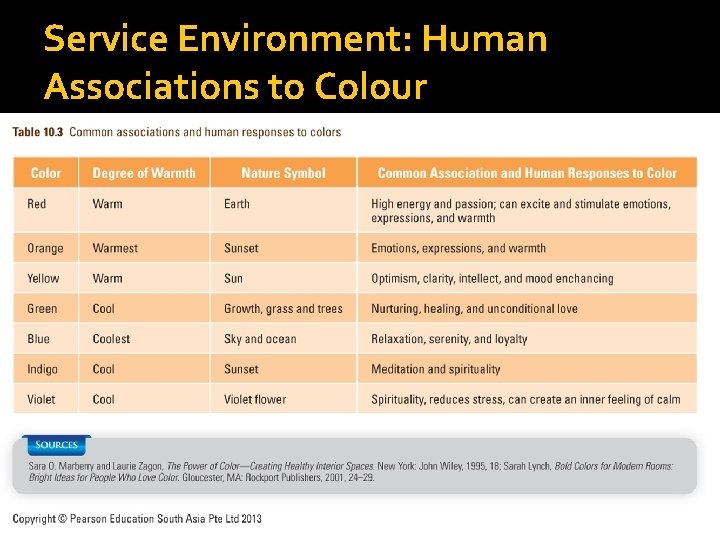
Service Environment: Impact of Colour � Colours can have a strong impact on people’s feelings Warm colors encourage fast decision making and are good for low-involvement decisions or impulse buys Cool colors are preferred for high-involvement decisions
Service Environment: Human Associations to Colour
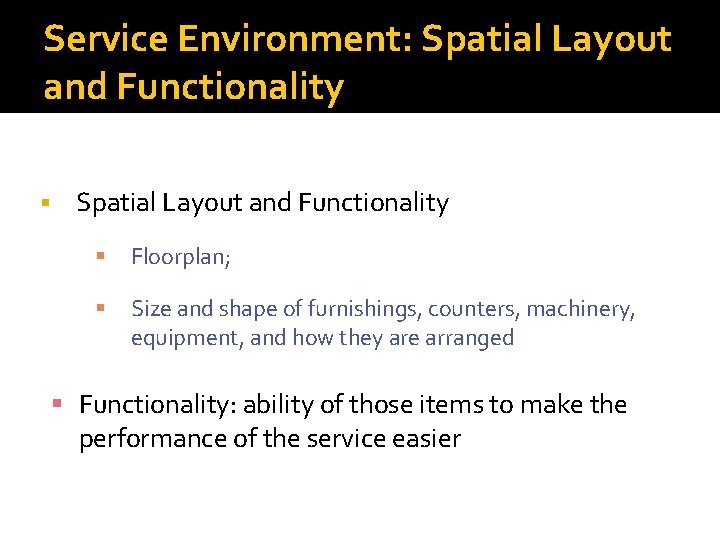
Service Environment: Spatial Layout and Functionality Floorplan; Size and shape of furnishings, counters, machinery, equipment, and how they are arranged Functionality: ability of those items to make the performance of the service easier
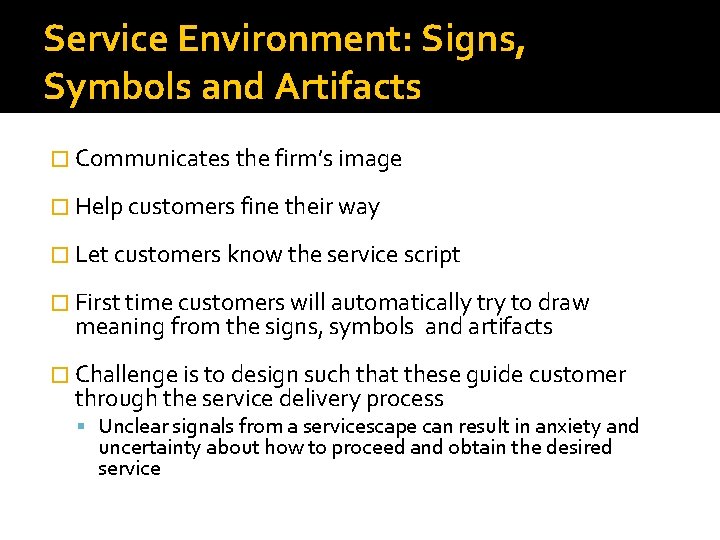
Service Environment: Signs, Symbols and Artifacts � Communicates the firm’s image � Help customers fine their way � Let customers know the service script � First time customers will automatically try to draw meaning from the signs, symbols and artifacts � Challenge is to design such that these guide customer through the service delivery process Unclear signals from a servicescape can result in anxiety and uncertainty about how to proceed and obtain the desired service
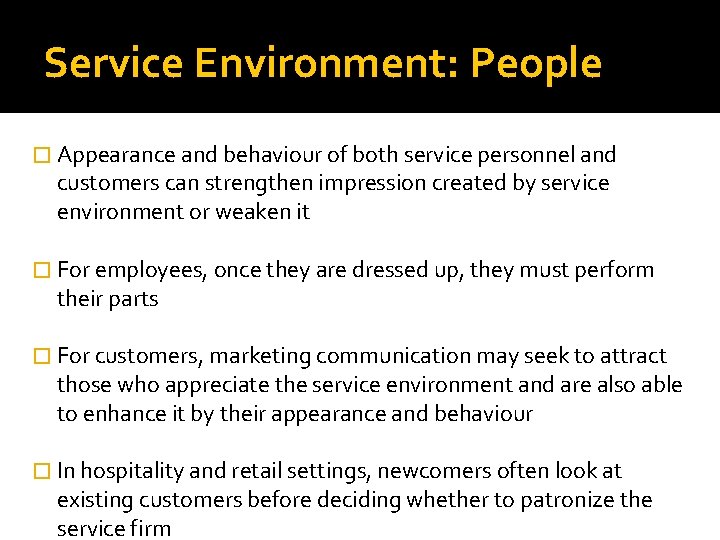
Service Environment: People � Appearance and behaviour of both service personnel and customers can strengthen impression created by service environment or weaken it � For employees, once they are dressed up, they must perform their parts � For customers, marketing communication may seek to attract those who appreciate the service environment and are also able to enhance it by their appearance and behaviour � In hospitality and retail settings, newcomers often look at existing customers before deciding whether to patronize the service firm