
Chapter 10 Section 1 Meiosis INTRODUCTION The variety


- Slides: 12
Chapter 10 Section 1 Meiosis
INTRODUCTION • The variety of characteristics shown by organisms is a result of two SEX CELLS (GAMETES) combining during sexual reproduction.
INTRODUCTION • These cells, which pass on genetic traits (such as hair color, height, or eye color) from the parents to the child, are produced by the process of MEIOSIS
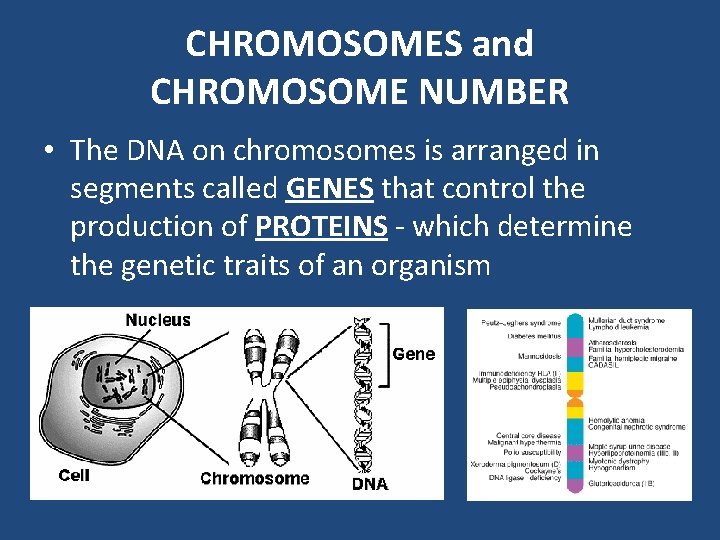
CHROMOSOMES and CHROMOSOME NUMBER • The DNA on chromosomes is arranged in segments called GENES that control the production of PROTEINS - which determine the genetic traits of an organism
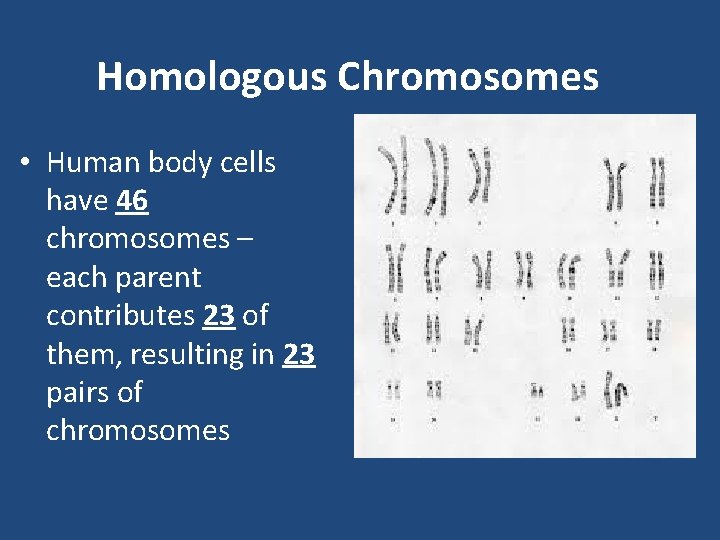
Homologous Chromosomes • Human body cells have 46 chromosomes – each parent contributes 23 of them, resulting in 23 pairs of chromosomes
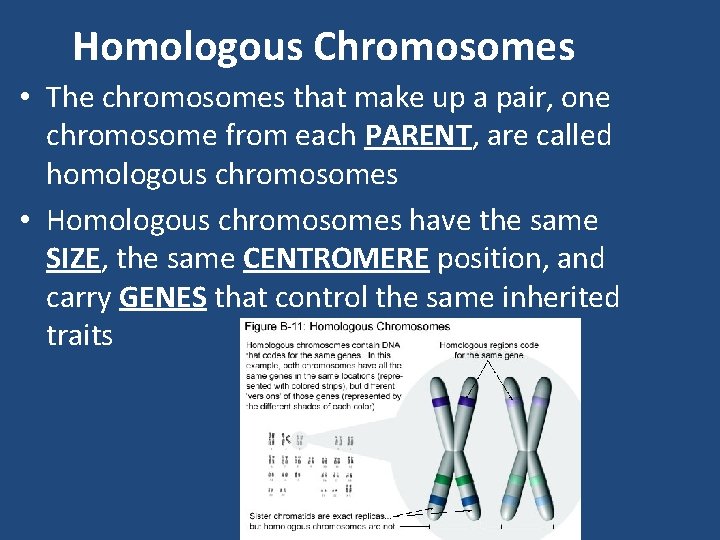
Homologous Chromosomes • The chromosomes that make up a pair, one chromosome from each PARENT, are called homologous chromosomes • Homologous chromosomes have the same SIZE, the same CENTROMERE position, and carry GENES that control the same inherited traits
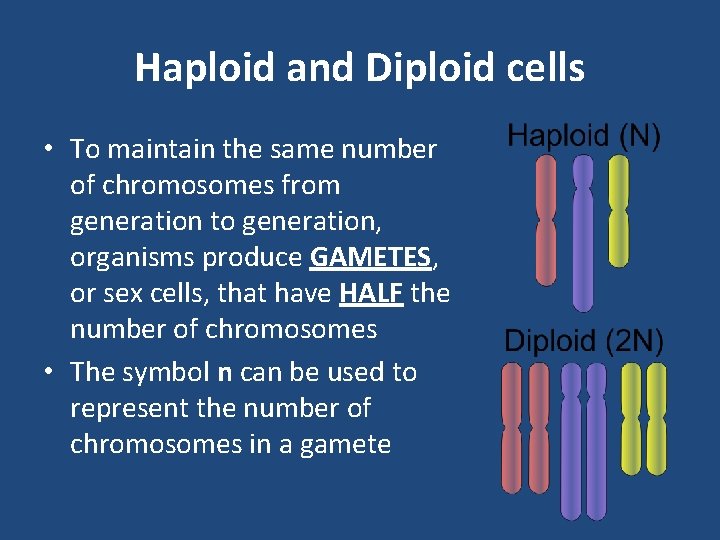
Haploid and Diploid cells • To maintain the same number of chromosomes from generation to generation, organisms produce GAMETES, or sex cells, that have HALF the number of chromosomes • The symbol n can be used to represent the number of chromosomes in a gamete
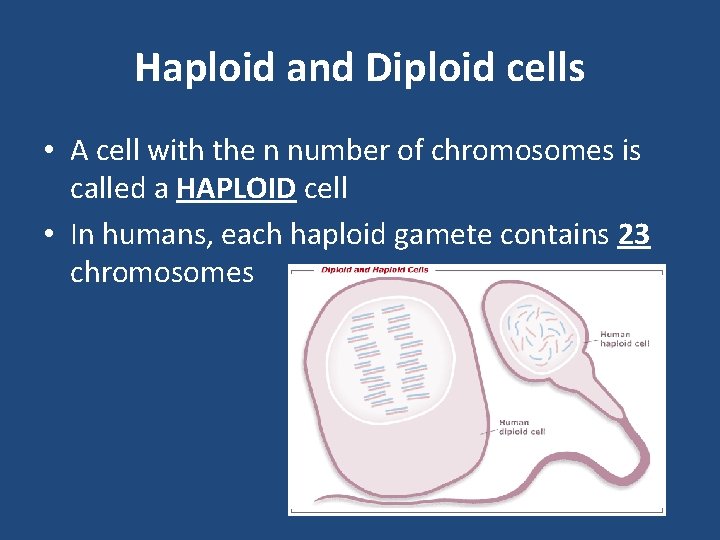
Haploid and Diploid cells • A cell with the n number of chromosomes is called a HAPLOID cell • In humans, each haploid gamete contains 23 chromosomes
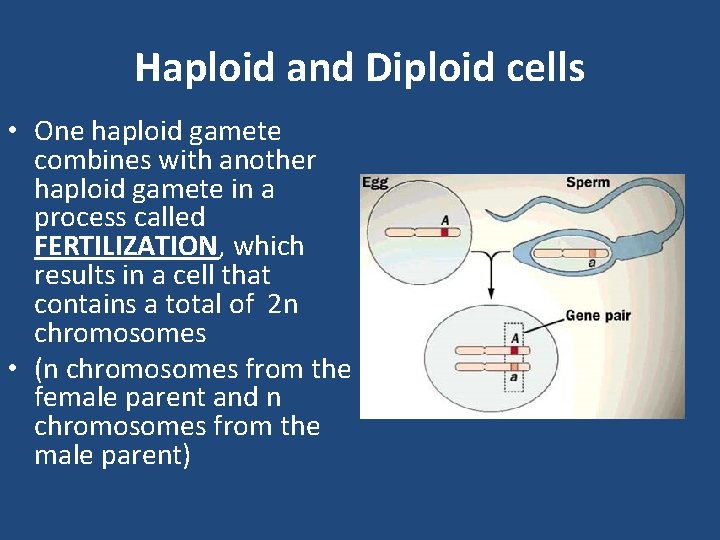
Haploid and Diploid cells • One haploid gamete combines with another haploid gamete in a process called FERTILIZATION, which results in a cell that contains a total of 2 n chromosomes • (n chromosomes from the female parent and n chromosomes from the male parent)
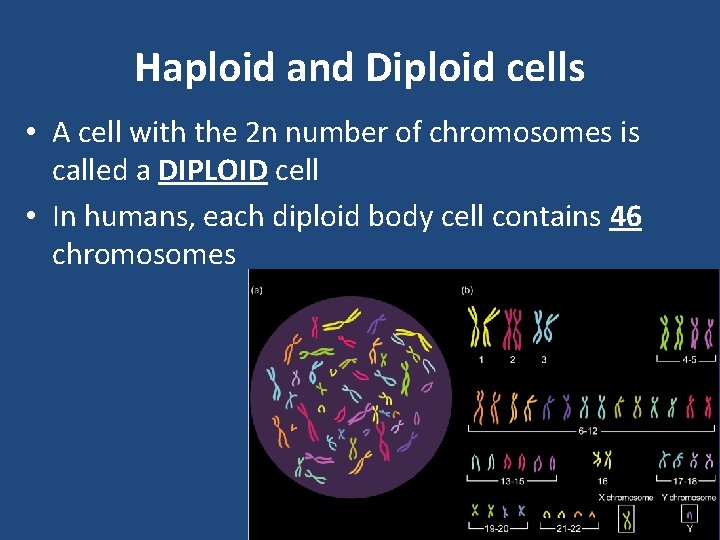
Haploid and Diploid cells • A cell with the 2 n number of chromosomes is called a DIPLOID cell • In humans, each diploid body cell contains 46 chromosomes
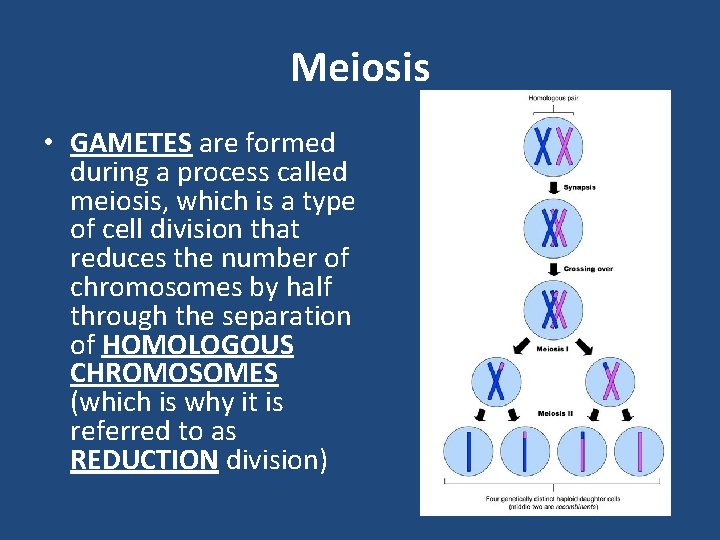
Meiosis • GAMETES are formed during a process called meiosis, which is a type of cell division that reduces the number of chromosomes by half through the separation of HOMOLOGOUS CHROMOSOMES (which is why it is referred to as REDUCTION division)
Meiosis • A cell with the 2 n number of chromosomes will result in gametes with n number of chromosomes after two consecutive divisions called MEIOSIS I and MEIOSIS II