
Chapter 10 Rotation Key contents Rigid body rotation
Chapter 10 Rotation Key contents Rigid body rotation (about a fixed axis) Rotation with a constant angular acceleration Linear and angular variables Kinetic energy of rotation Rotational inertia (Moment of inertia) Torque
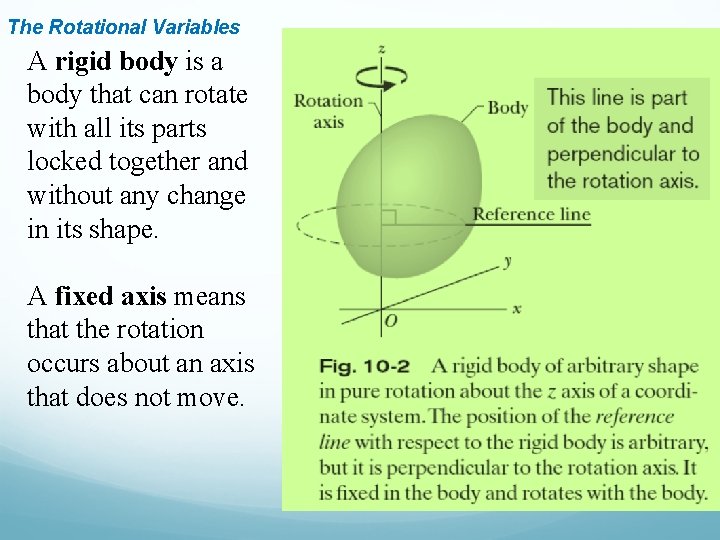
The Rotational Variables A rigid body is a body that can rotate with all its parts locked together and without any change in its shape. A fixed axis means that the rotation occurs about an axis that does not move.
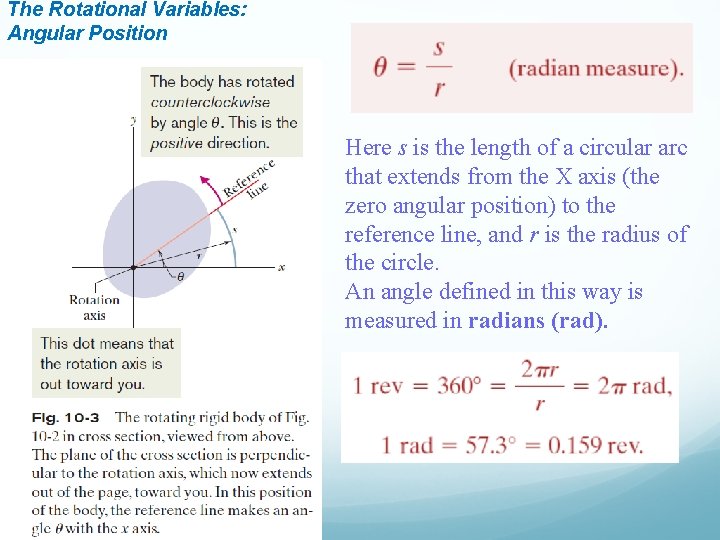
The Rotational Variables: Angular Position Here s is the length of a circular arc that extends from the X axis (the zero angular position) to the reference line, and r is the radius of the circle. An angle defined in this way is measured in radians (rad).
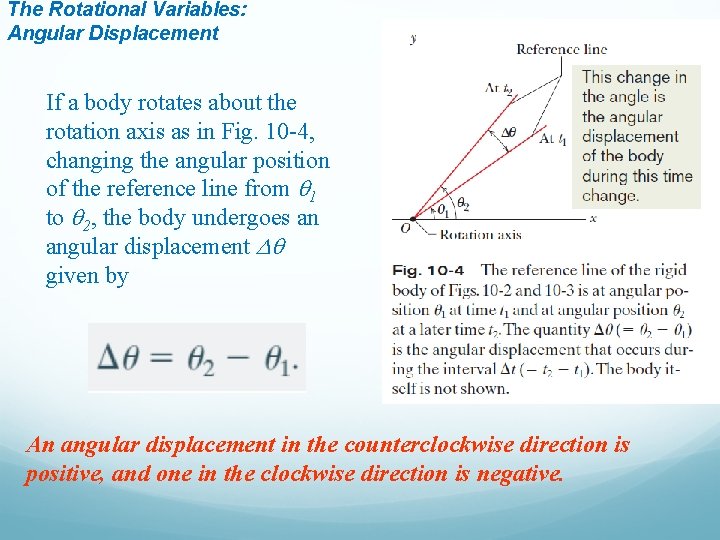
The Rotational Variables: Angular Displacement If a body rotates about the rotation axis as in Fig. 10 -4, changing the angular position of the reference line from q 1 to q 2, the body undergoes an angular displacement Dq given by An angular displacement in the counterclockwise direction is positive, and one in the clockwise direction is negative.
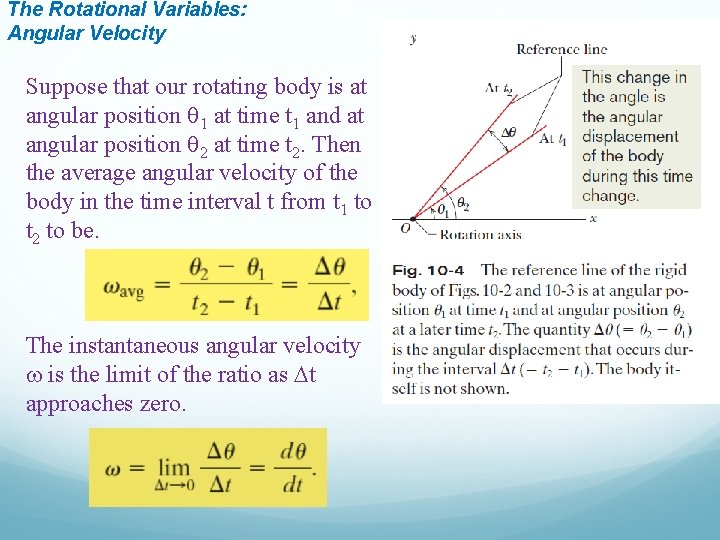
The Rotational Variables: Angular Velocity Suppose that our rotating body is at angular position q 1 at time t 1 and at angular position q 2 at time t 2. Then the average angular velocity of the body in the time interval t from t 1 to t 2 to be. The instantaneous angular velocity w is the limit of the ratio as Dt approaches zero.
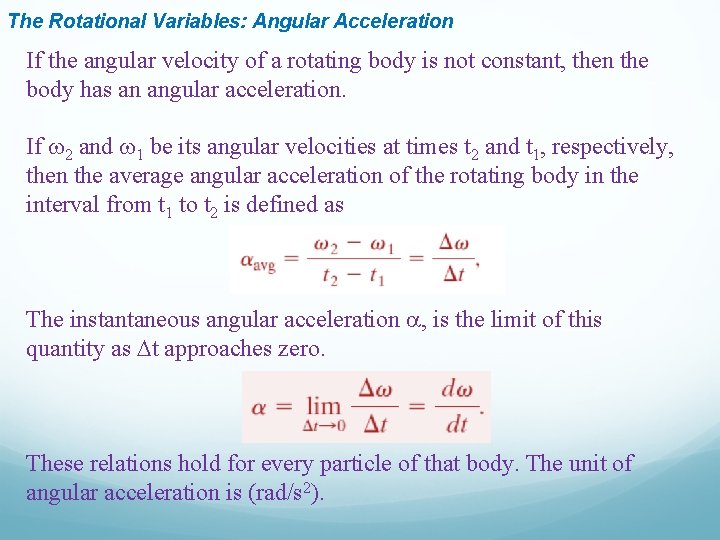
The Rotational Variables: Angular Acceleration If the angular velocity of a rotating body is not constant, then the body has an angular acceleration. If w 2 and w 1 be its angular velocities at times t 2 and t 1, respectively, then the average angular acceleration of the rotating body in the interval from t 1 to t 2 is defined as The instantaneous angular acceleration a, is the limit of this quantity as Dt approaches zero. These relations hold for every particle of that body. The unit of angular acceleration is (rad/s 2).
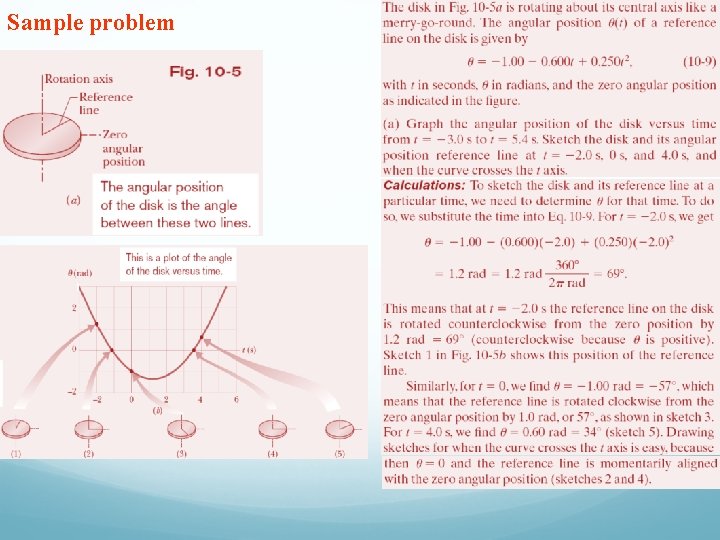
Sample problem
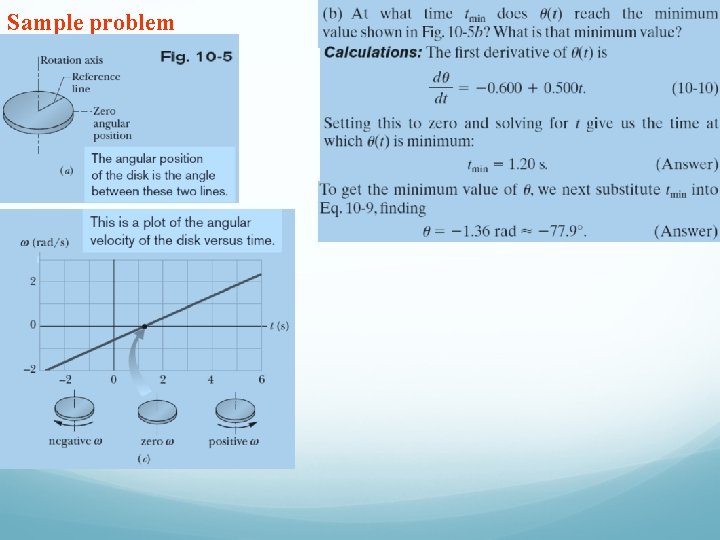
Sample problem
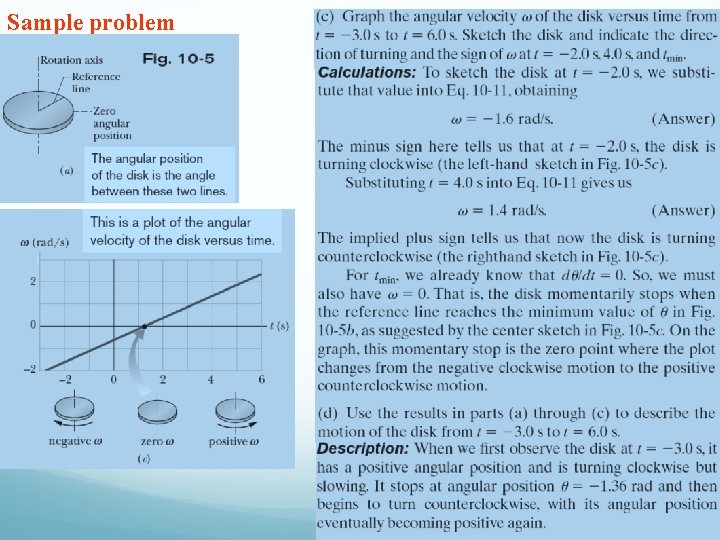
Sample problem
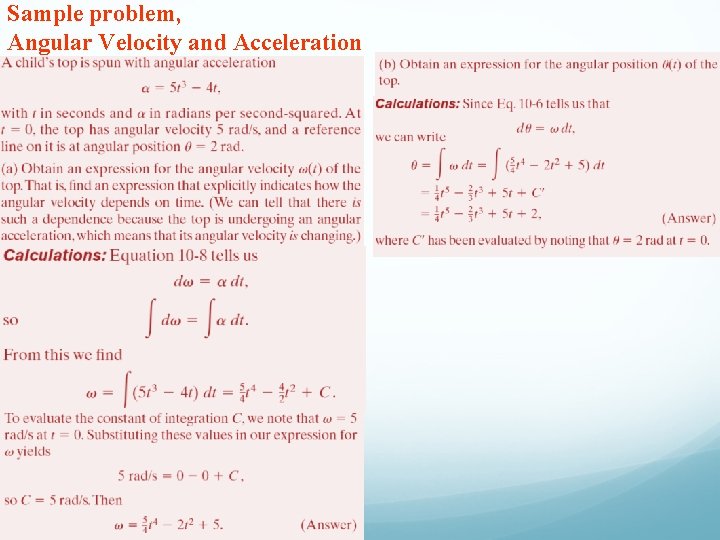
Sample problem, Angular Velocity and Acceleration
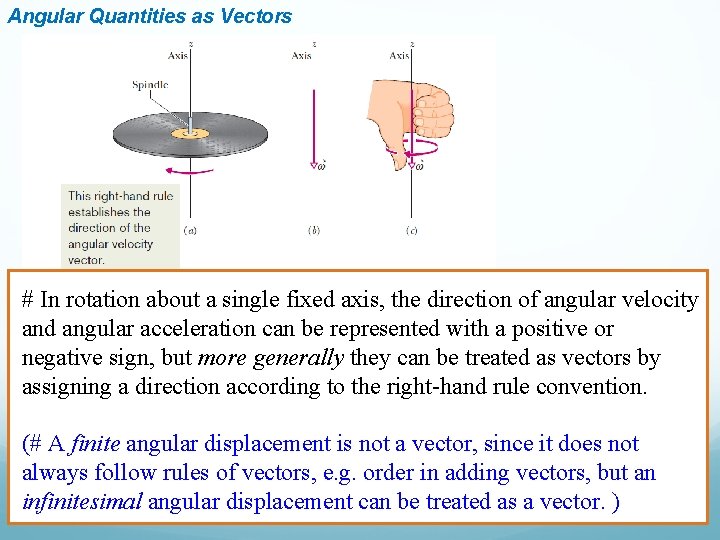
Angular Quantities as Vectors # In rotation about a single fixed axis, the direction of angular velocity and angular acceleration can be represented with a positive or negative sign, but more generally they can be treated as vectors by assigning a direction according to the right-hand rule convention. (# A finite angular displacement is not a vector, since it does not always follow rules of vectors, e. g. order in adding vectors, but an infinitesimal angular displacement can be treated as a vector. )
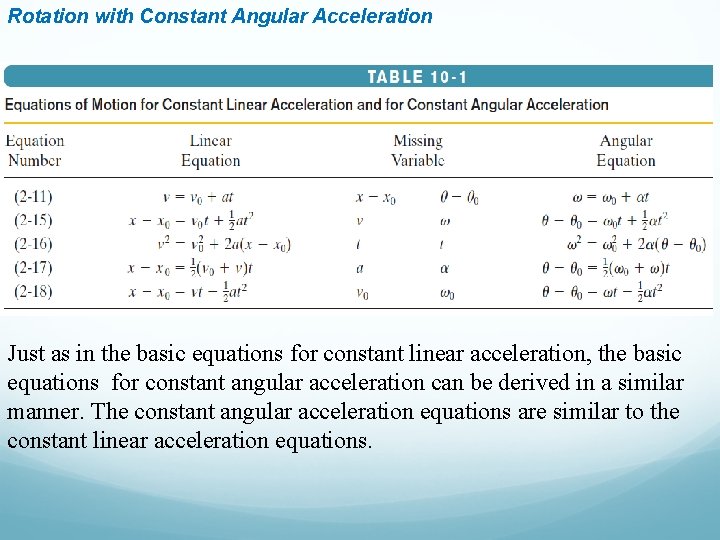
Rotation with Constant Angular Acceleration Just as in the basic equations for constant linear acceleration, the basic equations for constant angular acceleration can be derived in a similar manner. The constant angular acceleration equations are similar to the constant linear acceleration equations.
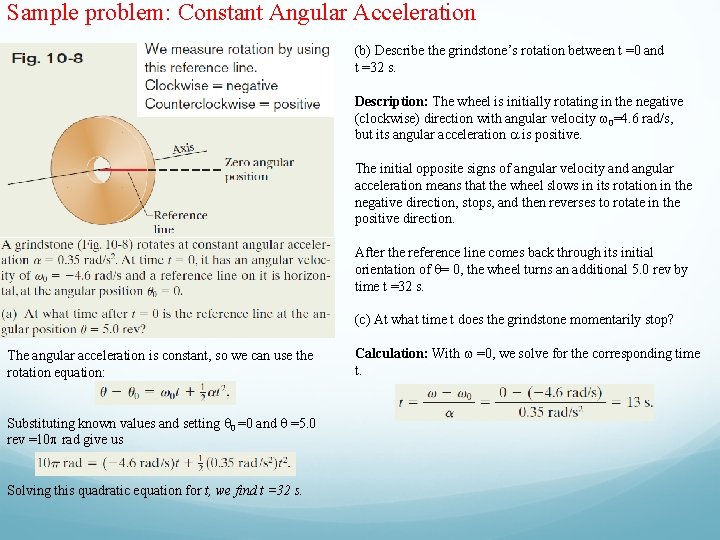
Sample problem: Constant Angular Acceleration (b) Describe the grindstone’s rotation between t =0 and t =32 s. Description: The wheel is initially rotating in the negative (clockwise) direction with angular velocity w 0=4. 6 rad/s, but its angular acceleration a is positive. The initial opposite signs of angular velocity and angular acceleration means that the wheel slows in its rotation in the negative direction, stops, and then reverses to rotate in the positive direction. After the reference line comes back through its initial orientation of q= 0, the wheel turns an additional 5. 0 rev by time t =32 s. (c) At what time t does the grindstone momentarily stop? The angular acceleration is constant, so we can use the rotation equation: Substituting known values and setting q 0 =0 and q =5. 0 rev =10 p rad give us Solving this quadratic equation for t, we find t =32 s. Calculation: With w =0, we solve for the corresponding time t.
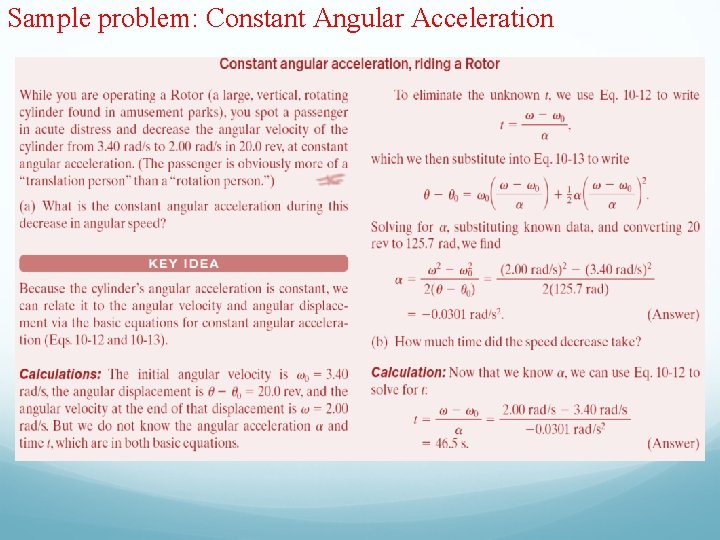
Sample problem: Constant Angular Acceleration
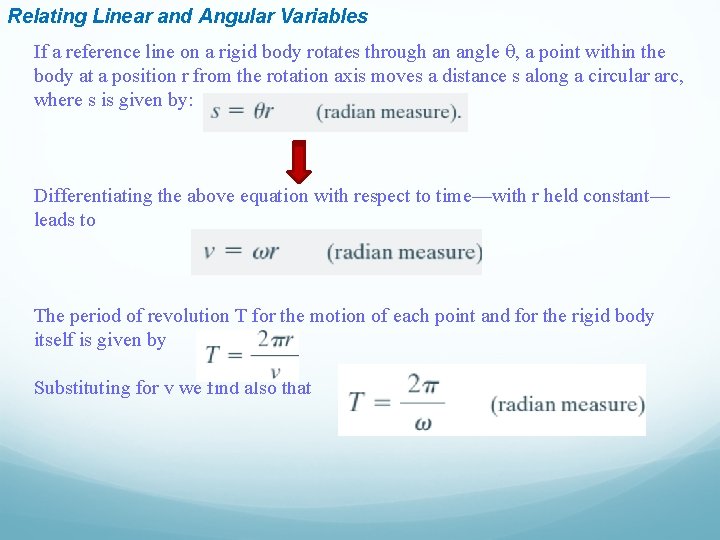
Relating Linear and Angular Variables If a reference line on a rigid body rotates through an angle q, a point within the body at a position r from the rotation axis moves a distance s along a circular arc, where s is given by: Differentiating the above equation with respect to time—with r held constant— leads to The period of revolution T for the motion of each point and for the rigid body itself is given by Substituting for v we find also that
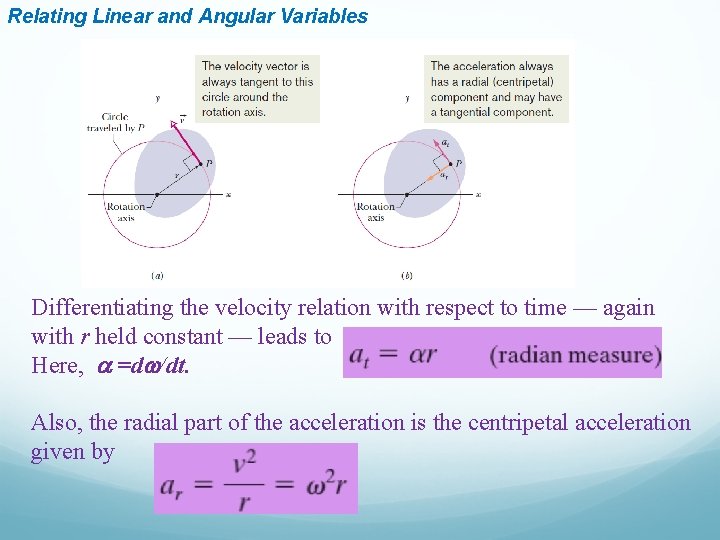
Relating Linear and Angular Variables Differentiating the velocity relation with respect to time — again with r held constant — leads to Here, a =dw/dt. Also, the radial part of the acceleration is the centripetal acceleration given by
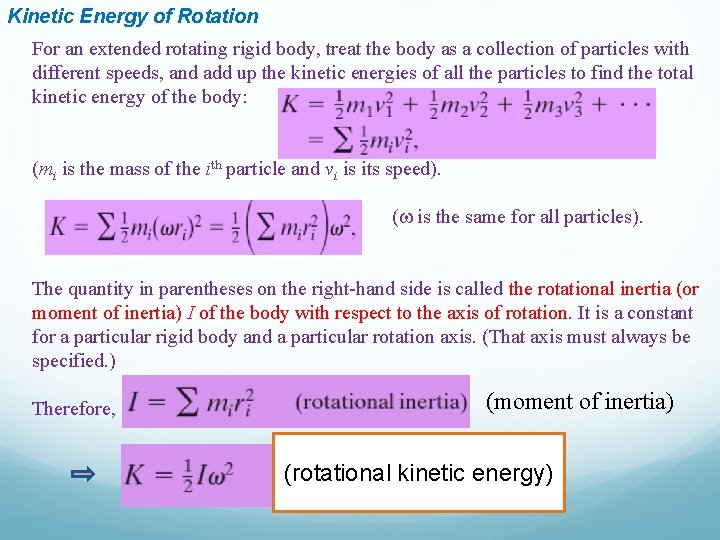
Kinetic Energy of Rotation For an extended rotating rigid body, treat the body as a collection of particles with different speeds, and add up the kinetic energies of all the particles to find the total kinetic energy of the body: (mi is the mass of the ith particle and vi is its speed). (w is the same for all particles). The quantity in parentheses on the right-hand side is called the rotational inertia (or moment of inertia) I of the body with respect to the axis of rotation. It is a constant for a particular rigid body and a particular rotation axis. (That axis must always be specified. ) Therefore, (moment of inertia) (rotational kinetic energy)
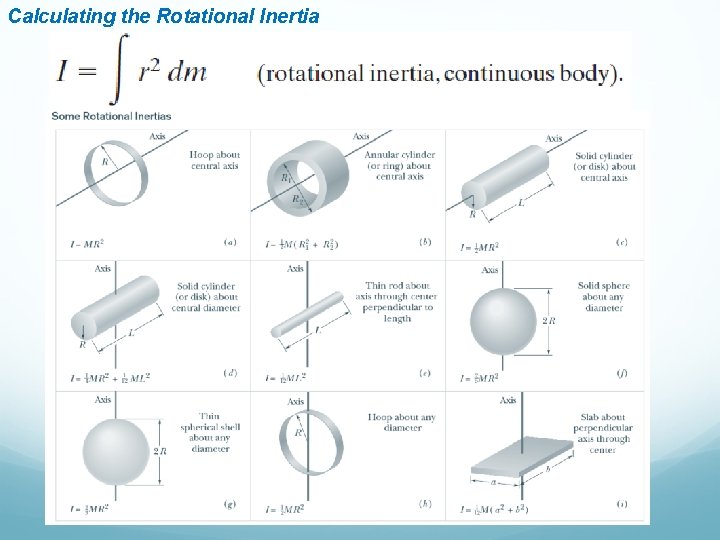
Calculating the Rotational Inertia
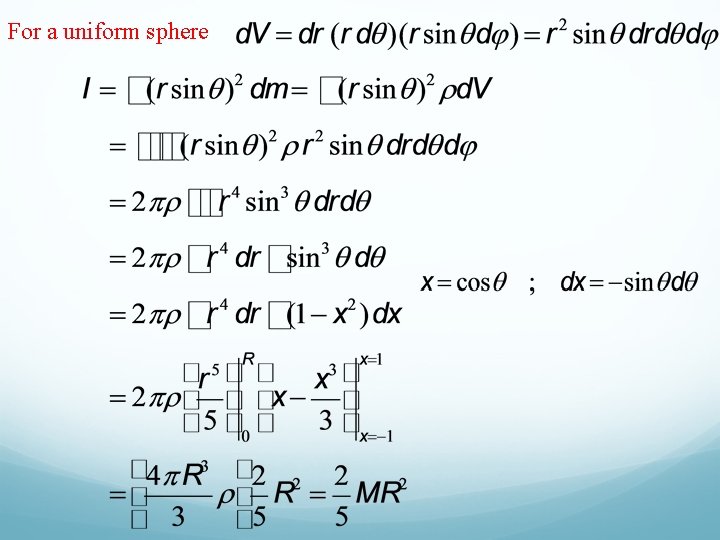
For a uniform sphere
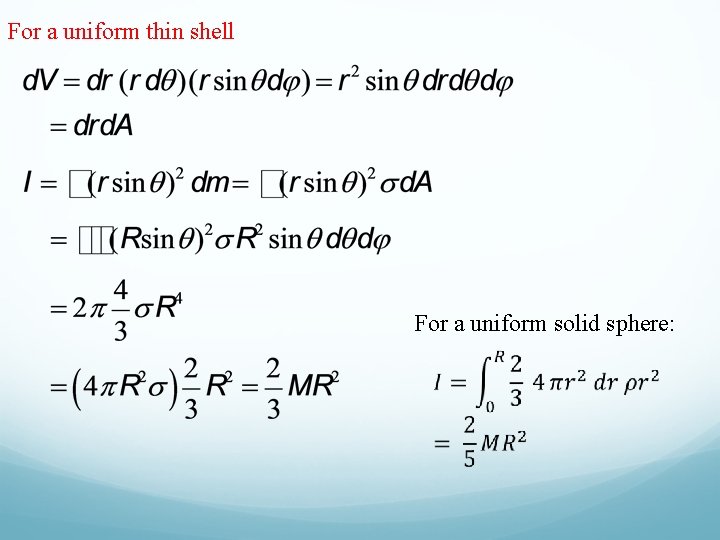
For a uniform thin shell For a uniform solid sphere:
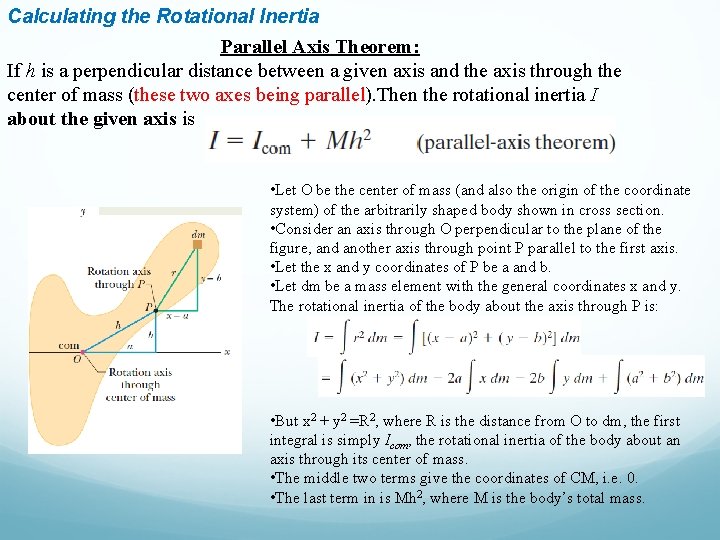
Calculating the Rotational Inertia Parallel Axis Theorem: If h is a perpendicular distance between a given axis and the axis through the center of mass (these two axes being parallel). Then the rotational inertia I about the given axis is • Let O be the center of mass (and also the origin of the coordinate system) of the arbitrarily shaped body shown in cross section. • Consider an axis through O perpendicular to the plane of the figure, and another axis through point P parallel to the first axis. • Let the x and y coordinates of P be a and b. • Let dm be a mass element with the general coordinates x and y. The rotational inertia of the body about the axis through P is: • But x 2 + y 2 =R 2, where R is the distance from O to dm, the first integral is simply Icom, the rotational inertia of the body about an axis through its center of mass. • The middle two terms give the coordinates of CM, i. e. 0. • The last term in is Mh 2, where M is the body’s total mass.
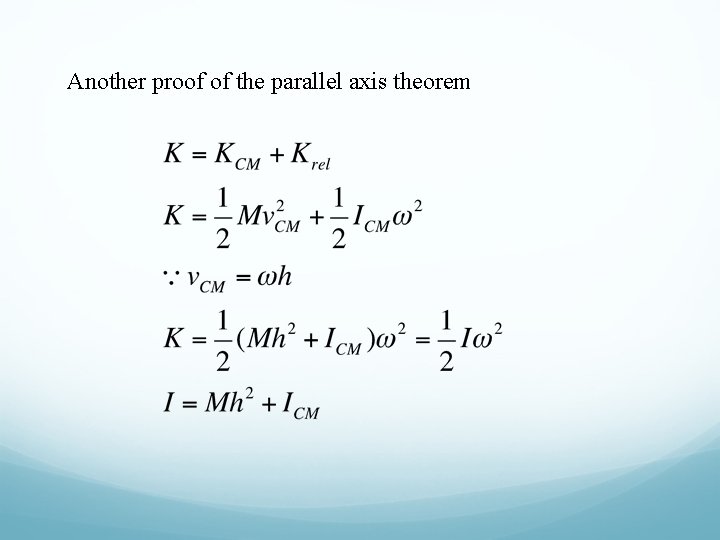
Another proof of the parallel axis theorem
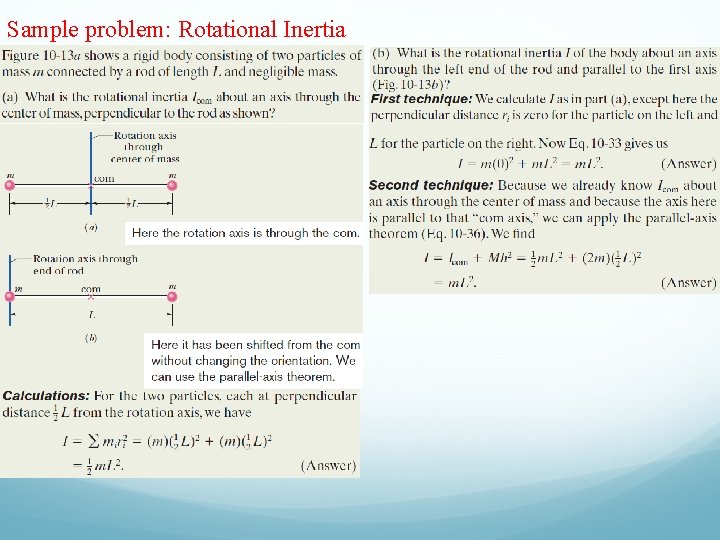
Sample problem: Rotational Inertia
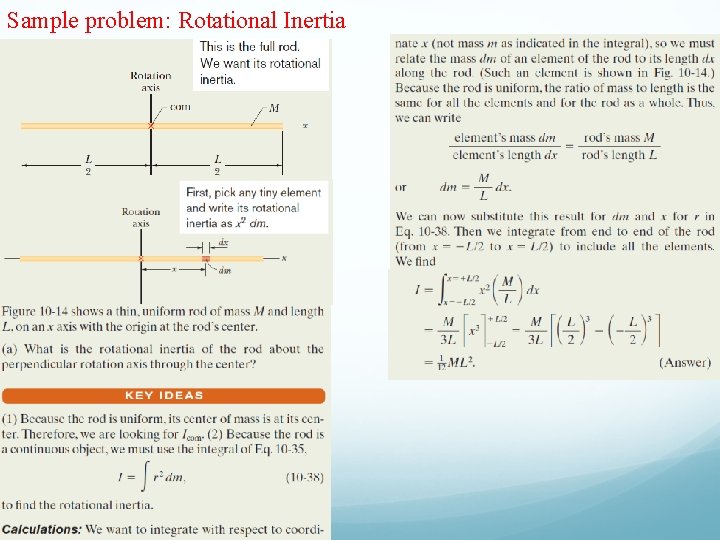
Sample problem: Rotational Inertia
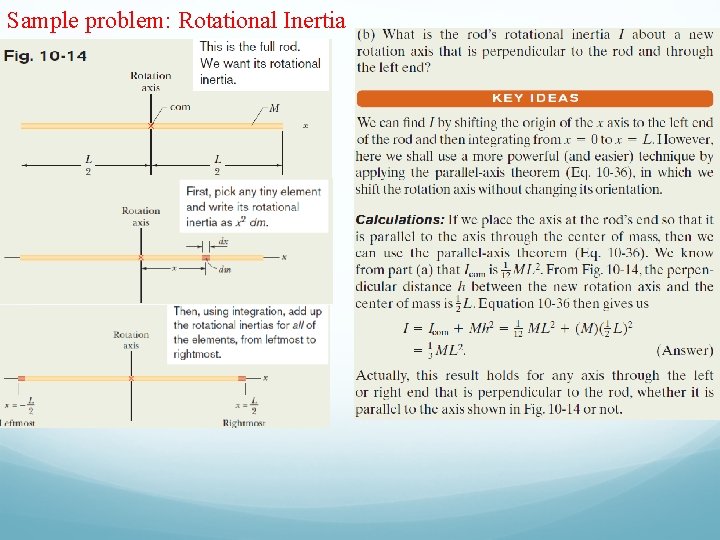
Sample problem: Rotational Inertia
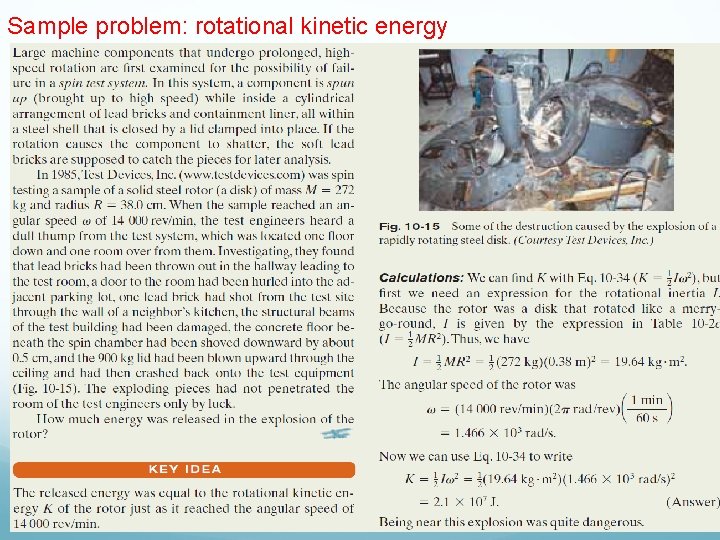
Sample problem: rotational kinetic energy
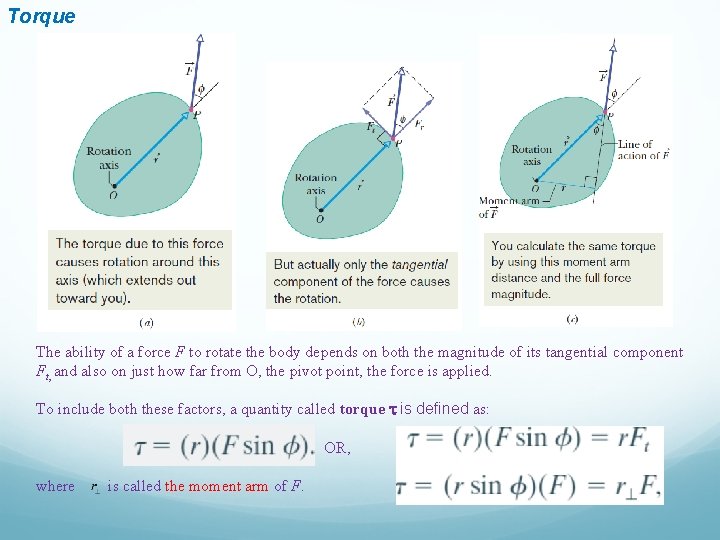
Torque The ability of a force F to rotate the body depends on both the magnitude of its tangential component Ft, and also on just how far from O, the pivot point, the force is applied. To include both these factors, a quantity called torque t is defined as: OR, where is called the moment arm of F.
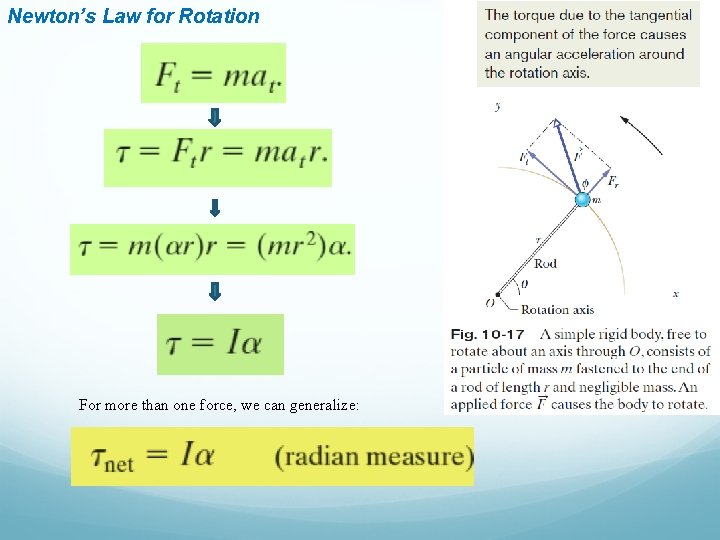
Newton’s Law for Rotation For more than one force, we can generalize:
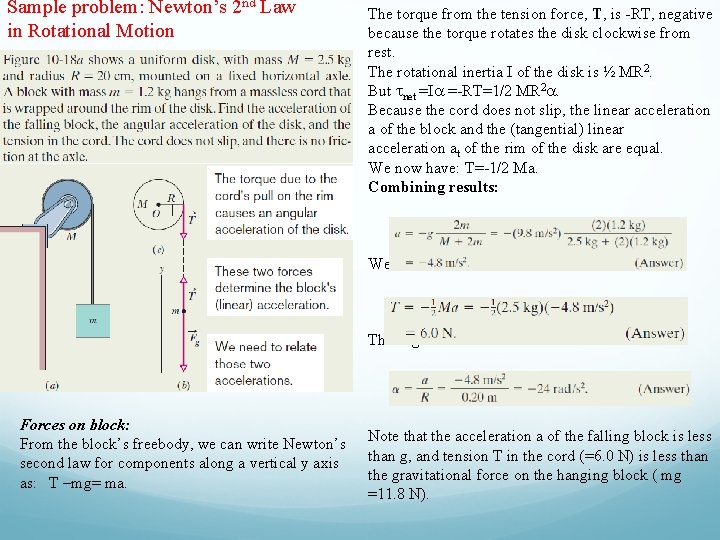
Sample problem: Newton’s 2 nd Law in Rotational Motion The torque from the tension force, T, is -RT, negative because the torque rotates the disk clockwise from rest. The rotational inertia I of the disk is ½ MR 2. But tnet =Ia =-RT=1/2 MR 2 a. Because the cord does not slip, the linear acceleration a of the block and the (tangential) linear acceleration at of the rim of the disk are equal. We now have: T=-1/2 Ma. Combining results: We then find T: The angular acceleration of the disk is: Forces on block: From the block’s freebody, we can write Newton’s second law for components along a vertical y axis as: T –mg= ma. Note that the acceleration a of the falling block is less than g, and tension T in the cord (=6. 0 N) is less than the gravitational force on the hanging block ( mg =11. 8 N).
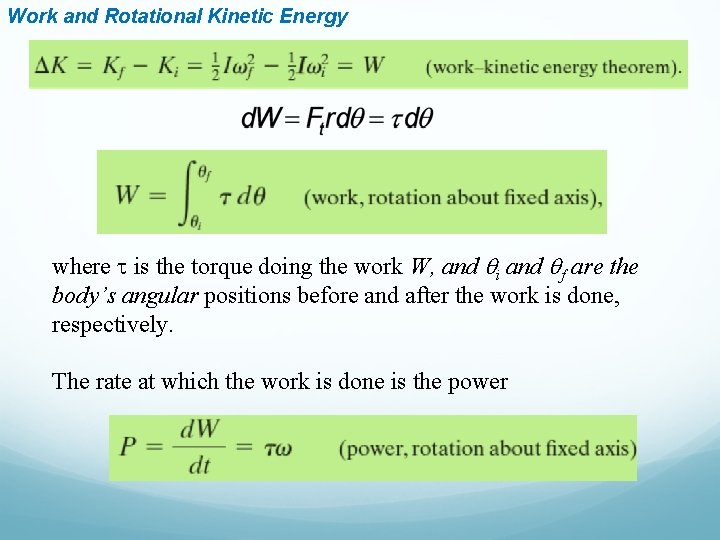
Work and Rotational Kinetic Energy where t is the torque doing the work W, and qi and qf are the body’s angular positions before and after the work is done, respectively. The rate at which the work is done is the power
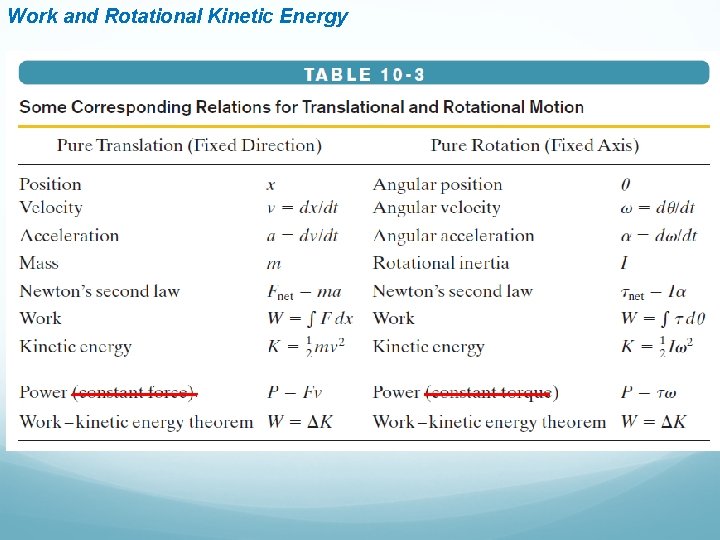
Work and Rotational Kinetic Energy
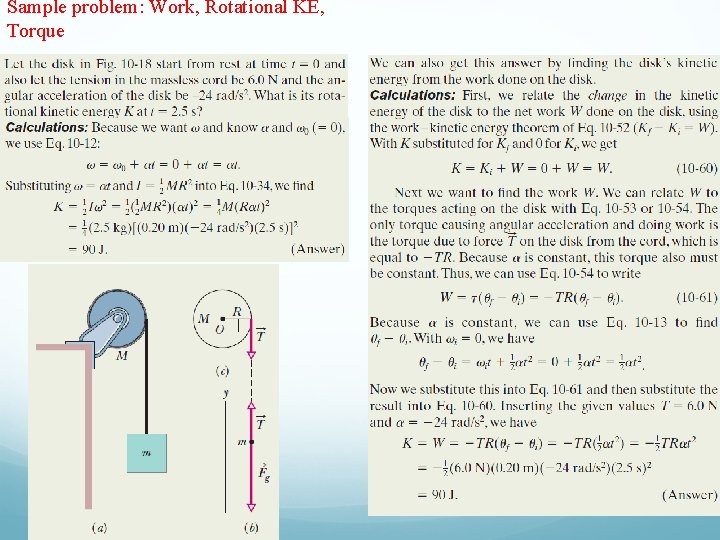
Sample problem: Work, Rotational KE, Torque
Key contents Rigid body rotation (about a fixed axis) Rotation with a constant angular acceleration Linear and angular variables Kinetic energy of rotation Rotational inertia (Moment of inertia) Torque
- Slides: 33