
Chapter 10 Risk and Return Lessons from Market
- Slides: 24
Chapter 10 Risk and Return: Lessons from Market History Mc. Graw-Hill/Irwin Copyright © 2010 by the Mc. Graw-Hill Companies, Inc. All rights reserved.
Key Concepts and Skills Know how to calculate the return on an investment o Know how to calculate the standard deviation of an investment’s returns o Understand the historical returns and risks on various types of investments o Understand the importance of the normal distribution o Understand the difference between arithmetic and geometric average returns o 10 -1
Chapter Outline 10. 1 10. 2 10. 3 10. 4 Returns Holding-Period Returns Return Statistics Average Stock Returns and Risk-Free Returns 10. 5 Risk Statistics 10. 6 More on Average Returns 10. 7 The U. S. Equity Risk Premium: Historical and International Perspectives 10 -2
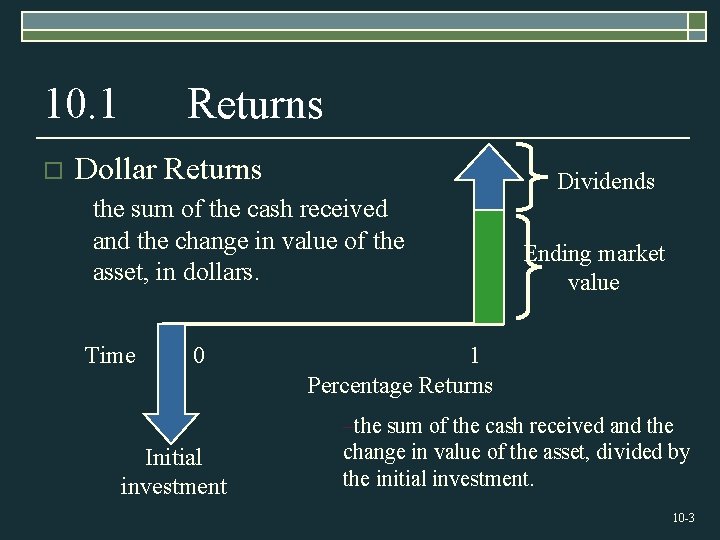
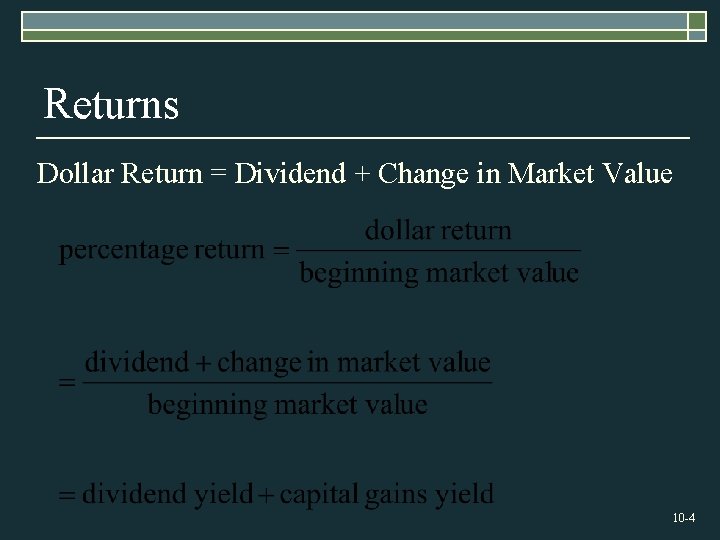
10. 1 o Returns Dollar Returns Dividends the sum of the cash received and the change in value of the asset, in dollars. Time 0 Initial investment Ending market value 1 Percentage Returns –the sum of the cash received and the change in value of the asset, divided by the initial investment. 10 -3
Returns Dollar Return = Dividend + Change in Market Value 10 -4
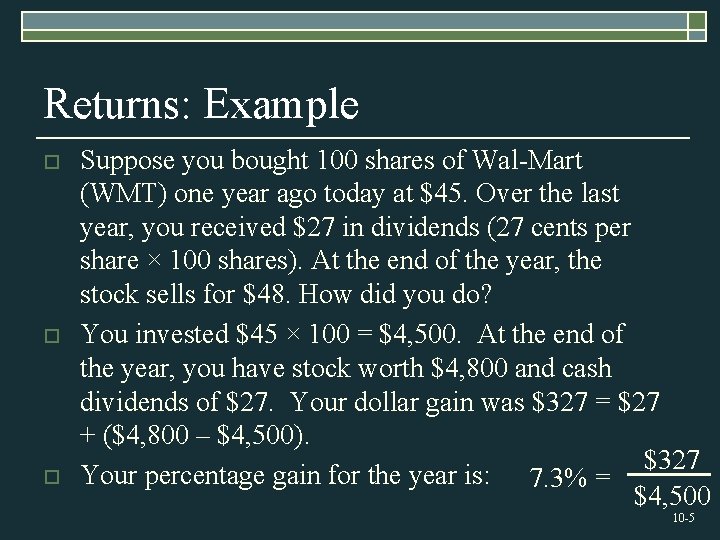
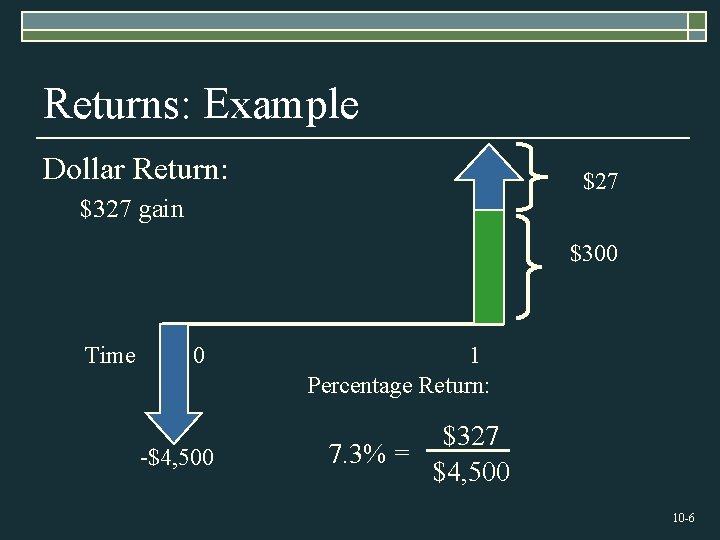
Returns: Example o o o Suppose you bought 100 shares of Wal-Mart (WMT) one year ago today at $45. Over the last year, you received $27 in dividends (27 cents per share × 100 shares). At the end of the year, the stock sells for $48. How did you do? You invested $45 × 100 = $4, 500. At the end of the year, you have stock worth $4, 800 and cash dividends of $27. Your dollar gain was $327 = $27 + ($4, 800 – $4, 500). $327 Your percentage gain for the year is: 7. 3% = $4, 500 10 -5
Returns: Example Dollar Return: $27 $327 gain $300 Time 0 -$4, 500 1 Percentage Return: $327 7. 3% = $4, 500 10 -6
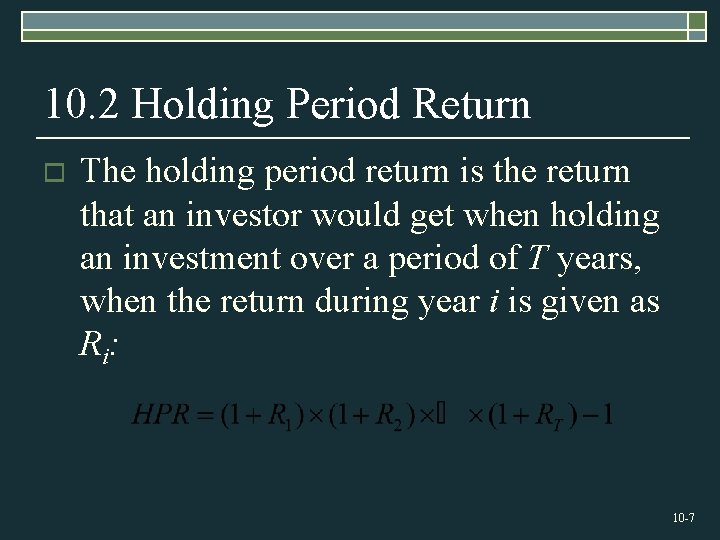
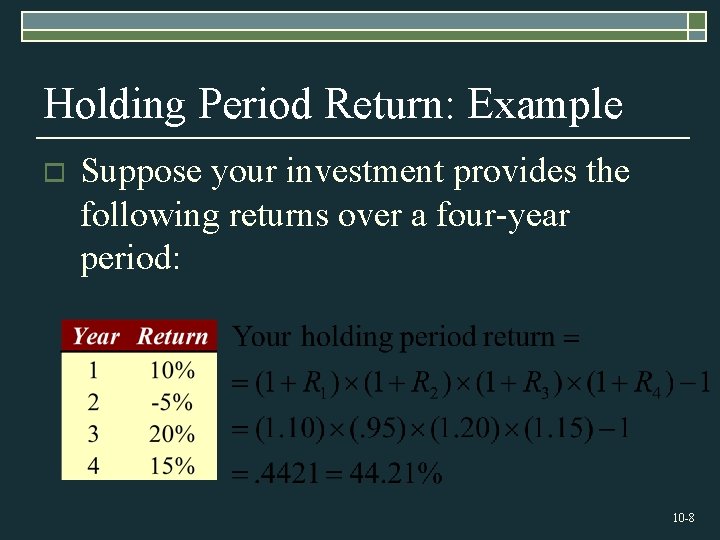
10. 2 Holding Period Return o The holding period return is the return that an investor would get when holding an investment over a period of T years, when the return during year i is given as R i: 10 -7
Holding Period Return: Example o Suppose your investment provides the following returns over a four-year period: 10 -8
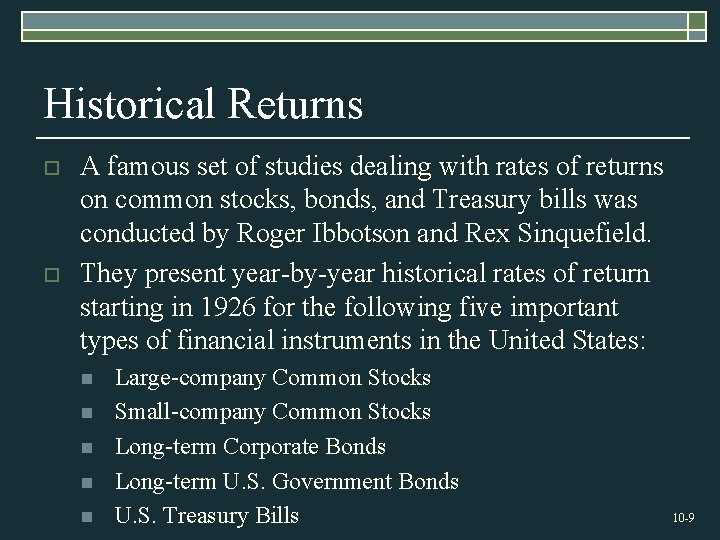
Historical Returns o o A famous set of studies dealing with rates of returns on common stocks, bonds, and Treasury bills was conducted by Roger Ibbotson and Rex Sinquefield. They present year-by-year historical rates of return starting in 1926 for the following five important types of financial instruments in the United States: n n n Large-company Common Stocks Small-company Common Stocks Long-term Corporate Bonds Long-term U. S. Government Bonds U. S. Treasury Bills 10 -9
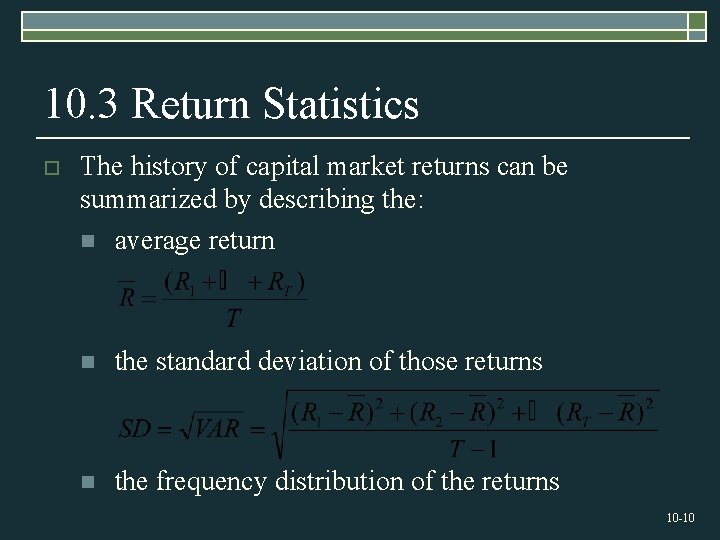
10. 3 Return Statistics o The history of capital market returns can be summarized by describing the: n average return n the standard deviation of those returns n the frequency distribution of the returns 10 -10
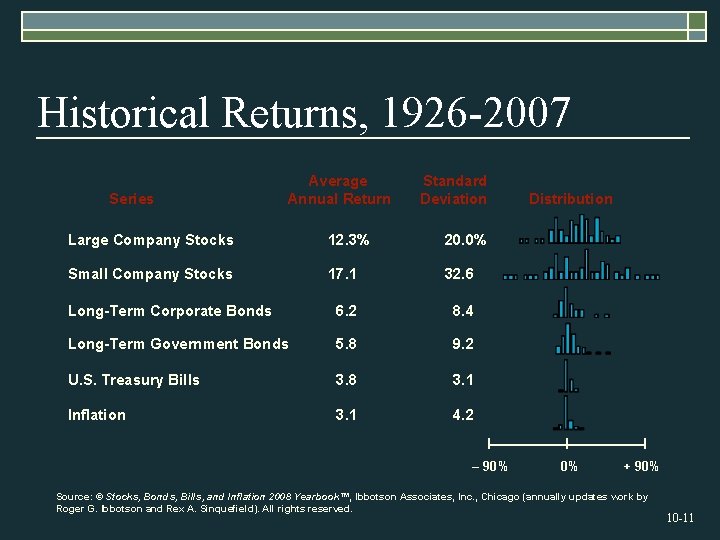
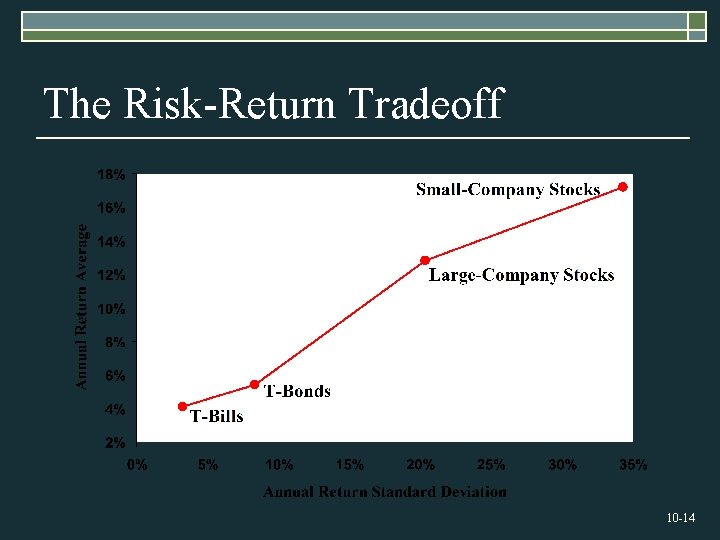
Historical Returns, 1926 -2007 Series Average Annual Return Standard Deviation Large Company Stocks 12. 3% 20. 0% Small Company Stocks 17. 1 32. 6 Long-Term Corporate Bonds 6. 2 8. 4 Long-Term Government Bonds 5. 8 9. 2 U. S. Treasury Bills 3. 8 3. 1 Inflation 3. 1 4. 2 – 90% Distribution 0% + 90% Source: © Stocks, Bonds, Bills, and Inflation 2008 Yearbook™, Ibbotson Associates, Inc. , Chicago (annually updates work by Roger G. Ibbotson and Rex A. Sinquefield). All rights reserved. 10 -11
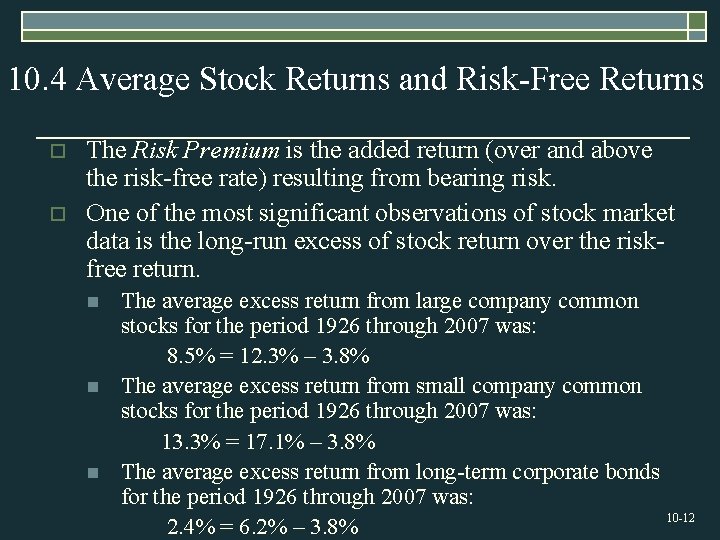
10. 4 Average Stock Returns and Risk-Free Returns o o The Risk Premium is the added return (over and above the risk-free rate) resulting from bearing risk. One of the most significant observations of stock market data is the long-run excess of stock return over the riskfree return. n n n The average excess return from large company common stocks for the period 1926 through 2007 was: 8. 5% = 12. 3% – 3. 8% The average excess return from small company common stocks for the period 1926 through 2007 was: 13. 3% = 17. 1% – 3. 8% The average excess return from long-term corporate bonds for the period 1926 through 2007 was: 10 -12 2. 4% = 6. 2% – 3. 8%
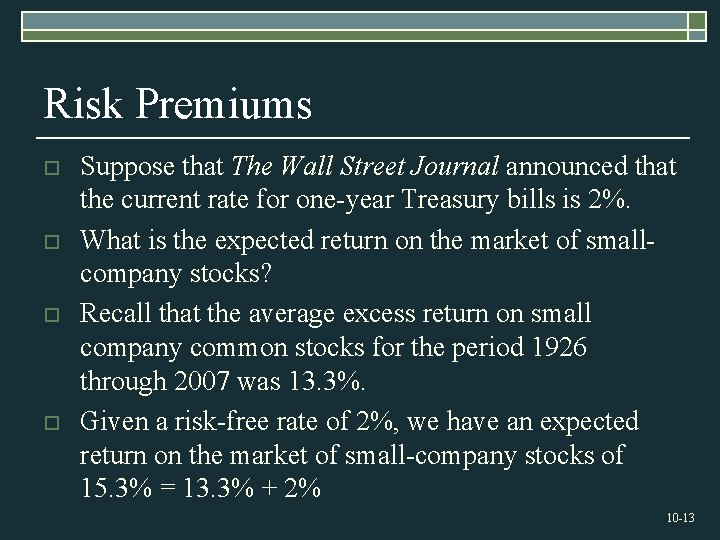
Risk Premiums o o Suppose that The Wall Street Journal announced that the current rate for one-year Treasury bills is 2%. What is the expected return on the market of smallcompany stocks? Recall that the average excess return on small company common stocks for the period 1926 through 2007 was 13. 3%. Given a risk-free rate of 2%, we have an expected return on the market of small-company stocks of 15. 3% = 13. 3% + 2% 10 -13
The Risk-Return Tradeoff 10 -14
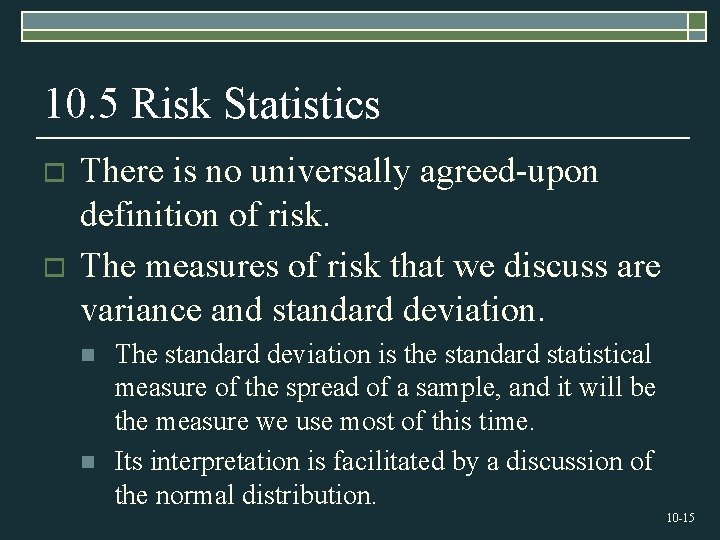
10. 5 Risk Statistics o o There is no universally agreed-upon definition of risk. The measures of risk that we discuss are variance and standard deviation. n n The standard deviation is the standard statistical measure of the spread of a sample, and it will be the measure we use most of this time. Its interpretation is facilitated by a discussion of the normal distribution. 10 -15
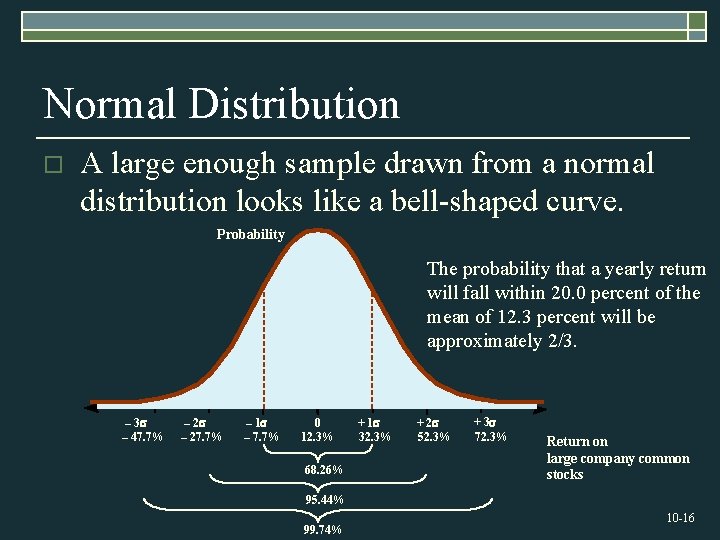
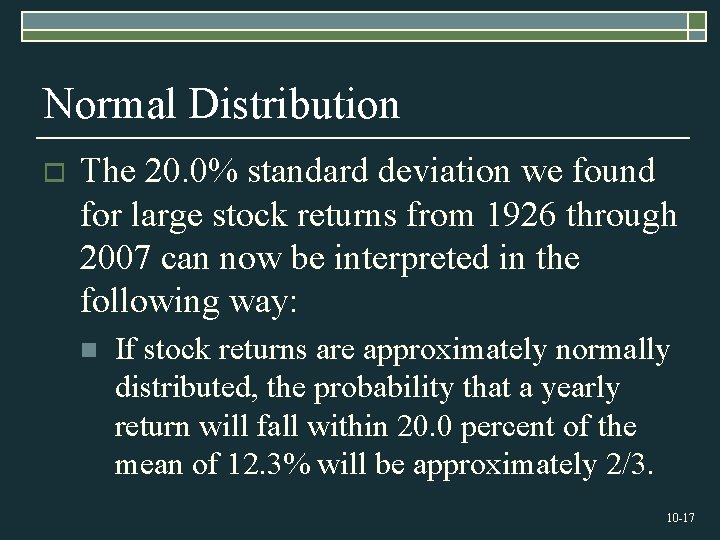
Normal Distribution o A large enough sample drawn from a normal distribution looks like a bell-shaped curve. Probability The probability that a yearly return will fall within 20. 0 percent of the mean of 12. 3 percent will be approximately 2/3. – 3 s – 47. 7% – 2 s – 27. 7% – 1 s – 7. 7% 0 12. 3% 68. 26% + 1 s 32. 3% + 2 s 52. 3% + 3 s 72. 3% Return on large company common stocks 95. 44% 99. 74% 10 -16
Normal Distribution o The 20. 0% standard deviation we found for large stock returns from 1926 through 2007 can now be interpreted in the following way: n If stock returns are approximately normally distributed, the probability that a yearly return will fall within 20. 0 percent of the mean of 12. 3% will be approximately 2/3. 10 -17
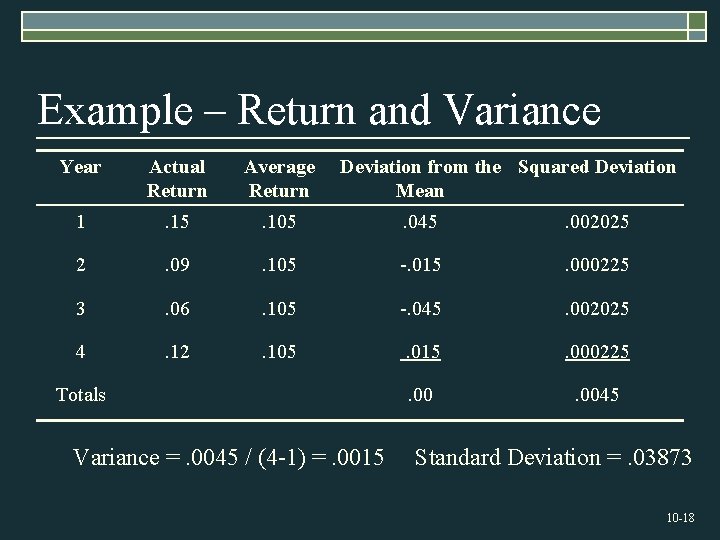
Example – Return and Variance Year Actual Return Average Return Deviation from the Squared Deviation Mean 1 . 15 . 105 . 045 . 002025 2 . 09 . 105 -. 015 . 000225 3 . 06 . 105 -. 045 . 002025 4 . 12 . 105 . 015 . 000225 . 0045 Totals Variance =. 0045 / (4 -1) =. 0015 Standard Deviation =. 03873 10 -18
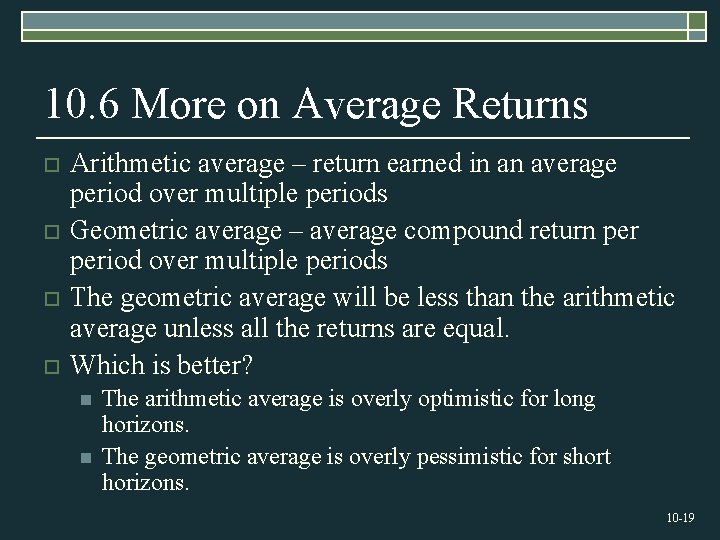
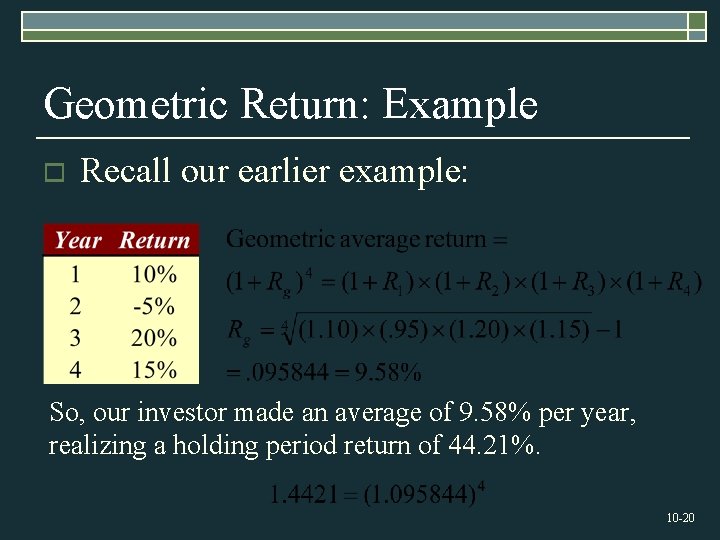
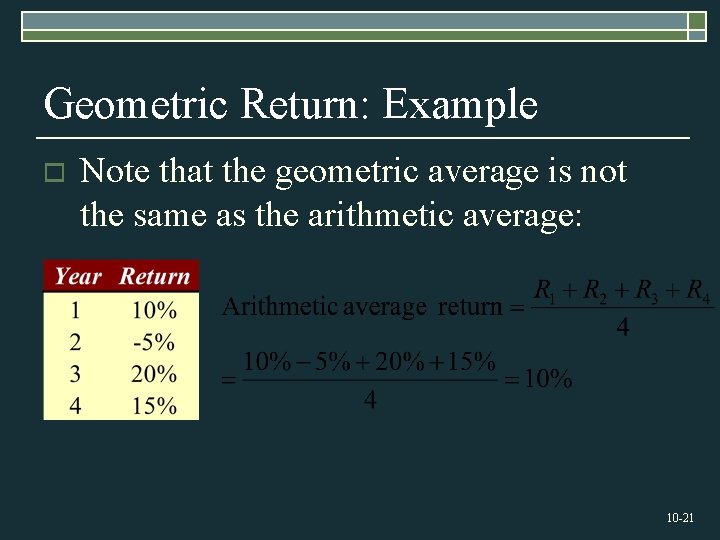
10. 6 More on Average Returns o o Arithmetic average – return earned in an average period over multiple periods Geometric average – average compound return period over multiple periods The geometric average will be less than the arithmetic average unless all the returns are equal. Which is better? n n The arithmetic average is overly optimistic for long horizons. The geometric average is overly pessimistic for short horizons. 10 -19
Geometric Return: Example o Recall our earlier example: So, our investor made an average of 9. 58% per year, realizing a holding period return of 44. 21%. 10 -20
Geometric Return: Example o Note that the geometric average is not the same as the arithmetic average: 10 -21
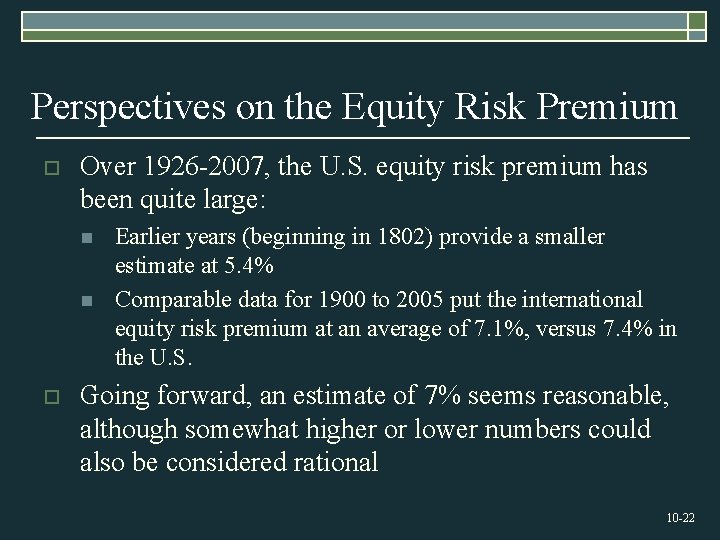
Perspectives on the Equity Risk Premium o Over 1926 -2007, the U. S. equity risk premium has been quite large: n n o Earlier years (beginning in 1802) provide a smaller estimate at 5. 4% Comparable data for 1900 to 2005 put the international equity risk premium at an average of 7. 1%, versus 7. 4% in the U. S. Going forward, an estimate of 7% seems reasonable, although somewhat higher or lower numbers could also be considered rational 10 -22
Quick Quiz o Which of the investments discussed has had the highest average return and risk premium? o Which of the investments discussed has had the highest standard deviation? o Why is the normal distribution informative? o What is the difference between arithmetic and geometric averages? 10 -23