
Chapter 10 Rhythmical Excitation of the Heart Pathway

- Slides: 16
Chapter 10: Rhythmical Excitation of the Heart
Pathway of Heartbeat • Begins in the sinoatrial (S-A) node • Internodal pathway to atrioventricular (A-V) node • Impulse delayed in A-V node (allows atria to contract before ventricles) • A-V bundle takes impulse into ventricles • Left and right bundles of Purkinje fibers take impulses to all parts of ventricles
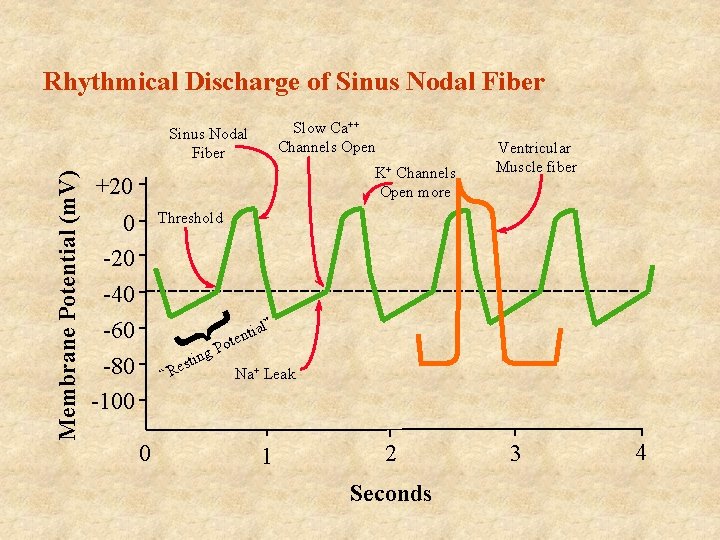
Sinus Node • Specialized cardiac muscle connected to atrial muscle. • Acts as pacemaker because membrane leaks Na+ and membrane potential is -55 to -60 m. V • When membrane potential reaches -40 m. V, slow Ca++ channels open causing action potential. • After 100 -150 msec Ca++ channels close and K+channels open more thus returning membrane potential to -55 m. V.
Rhythmical Discharge of Sinus Nodal Fiber Slow Ca++ Channels Open K+ Channels Open more +20 Ventricular Muscle fiber Threshold 0 -20 -40 -60 -80 -100 ng i t s e “R 0 l” ntia e t o } Membrane Potential (m. V) Sinus Nodal Fiber P Na+ Leak 1 2 Seconds 3 4
Internodal Pathways • Transmits cardiac impulse throughout atria • Anterior, middle, and posterior internodal pathways • Anterior interatrial band carries impulses to left atrium.
A-V Node • • Delays cardiac impulse Most delay is in A-V node Delay AV node---0. 09 sec. Delay AV bundle--0. 04 sec.
Purkinje System • Fibers lead from A-V node through A-V bundle into Ventricles • Fast conduction; many gap junctions at intercalated disks
A-V Bundles • Normally one-way conduction through the bundles • Only conducting path between atria and ventricles is A-V node - A-V bundle • Divides into left and right bundles • Transmission time between A-V bundles and last of ventricular fibers is 0. 06 second (QRS time)
Time of Arrival of Cardiac Impulse SA Node (0. 22) AV Bundle H (0. 19) (0. 0) T (0. 03) (0. 12) Left Bundle Branch ) 16 (0. AV Node (0. 19) (0. 21) (0. 18) Right Bundle Branch (0. 17) (0. 18) Main Arrival Times S-A Node 0. 00 sec A-V Node 0. 03 sec A-V Bundle 0. 12 sec Ventricular Septum 0. 16 sec
Sinus Node is Cardiac Pacemaker • Normal rate of discharge in sinus node is 7080/min. ; A-V node - 40 -60/min. ; Purkinje fibers - 15 -40/min. • Sinus node is pacemaker because of its faster discharge rate
Ectopic Pacemaker • This is a portion of the heart with a more rapid discharge than the sinus node. • Also occurs when transmission from sinus node to A-V node is blocked (A-V block).
Ectopic Pacemaker (cont’d) • During sudden onset of A-V block, sinus node discharge does not get through, and next fastest area of discharge becomes pacemaker of heart beat (Purkinje system). • Delay in pickup of the heart beat is the “Stokes-Adams” syndrome. New pacemaker is in A-V node or penetrating part of A-V bundle.
Parasympathetic Effects on Heart Rate • Parasympathetic (vagal) nerves, which release acetylcholine at their endings, innervate S-A node and A-V junctional fibers proximal to A-V node. • Causes hyperpolarization because of increased K+ permeability in response to acetylcholine. • This causes decreased transmission of impulses maybe temporarily stopping heart rate. • Ventricular escape occurs.
Sympathetic Effects on Heart Rate • • Releases norepinephrine at sympathetic ending Causes increased sinus node discharge Increases rate of conduction of impulse Increases force of contraction in atria and ventricles
Chapter 10 Objectives 1. Learn the pathway of the cardiac impulse. 2. Understand the mechanism of self-excitation of the sinus node. 3. Learn the function of the internodal pathways, A-V node, A-V bundle, and the peripheral Purkinje system. 4. Learn the time of arrival of the cardiac impulse at the A-V node and the ventricular septum.
Chapter 10 Objectives 5. Learn why the cardiac pacemaker is the sinus node. 6. Understand how ectopic foci can take over as the cardiac pacemaker. 7. Understand how autonomic stimulation changes heart rate.