
Chapter 10 reviewed and continued Gross and microscopic
- Slides: 30
Chapter 10, reviewed and continued • Gross and microscopic anatomy of skeletal muscles • Nerve to muscle: excitation-contraction coupling • Factors affecting how much force is exerted • Muscle diversity • fast-twitch vs. slow-twitch • skeletal vs. cardiac vs. smooth
Muscle metabolism, continued… A new sports drink advertises, “Includes ATP for rapid fueling of exercising muscles!” Are you tempted to buy it? Why or why not? © 2015 Pearson Education, Inc.
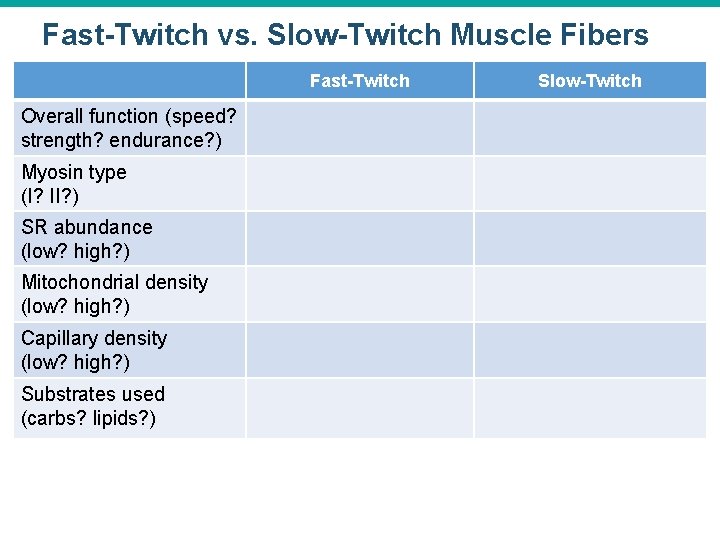
Fast-Twitch vs. Slow-Twitch Muscle Fibers Fast-Twitch Overall function (speed? strength? endurance? ) Myosin type (I? II? ) SR abundance (low? high? ) Mitochondrial density (low? high? ) Capillary density (low? high? ) Substrates used (carbs? lipids? ) Slow-Twitch
Can exercise training convert fast fibers to slow fibers or vice versa? (Or are we prisoners of our genes? )
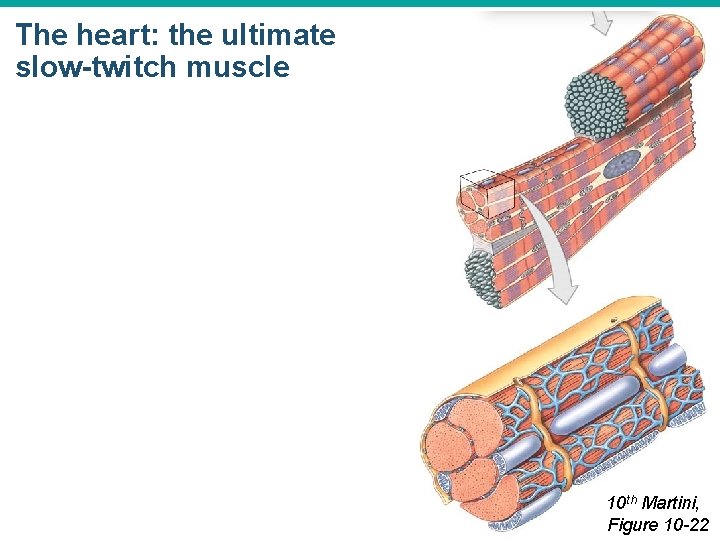
The heart: the ultimate slow-twitch muscle 10 th Martini, Figure 10 -22
Intercalated discs • Intertwined cell membranes of adjacent cells • Gap junctions • Desmosomes
High levels of troponin have been found in a patient’s blood. What could this mean?
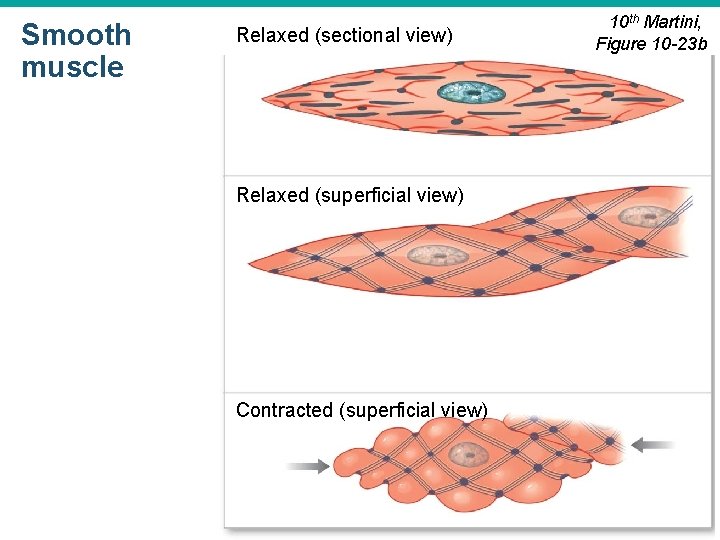
Smooth muscle Relaxed (sectional view) Relaxed (superficial view) Contracted (superficial view) 10 th Martini, Figure 10 -23 b
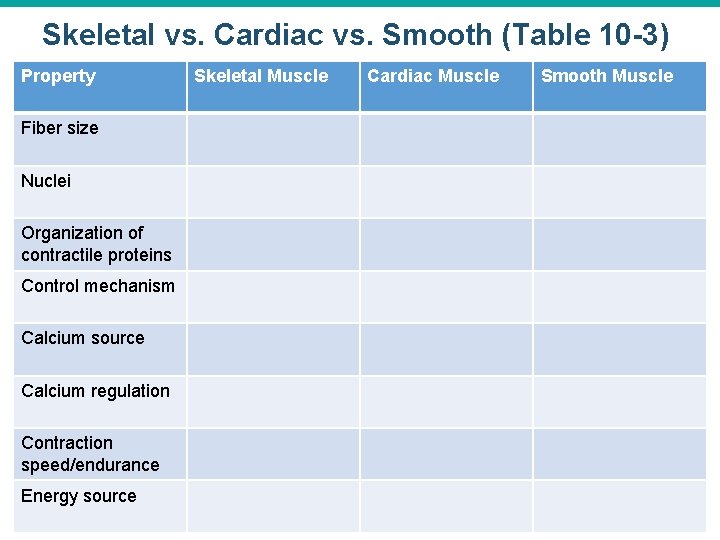
Skeletal vs. Cardiac vs. Smooth (Table 10 -3) Property Fiber size Nuclei Organization of contractile proteins Control mechanism Calcium source Calcium regulation Contraction speed/endurance Energy source Skeletal Muscle Cardiac Muscle Smooth Muscle
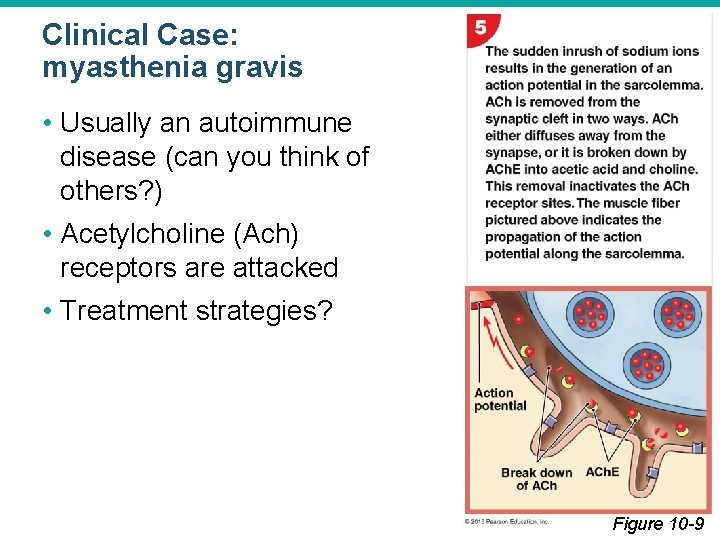
Clinical Case: myasthenia gravis • Usually an autoimmune disease (can you think of others? ) • Acetylcholine (Ach) receptors are attacked • Treatment strategies? Figure 10 -9
Worksheet: end-of-chapter review questions
10 th Martini, Chapter 11: An Introduction to the Muscular System • General concepts • Fascicle arrangements • Levers • Naming conventions • Lots and lots of muscles!
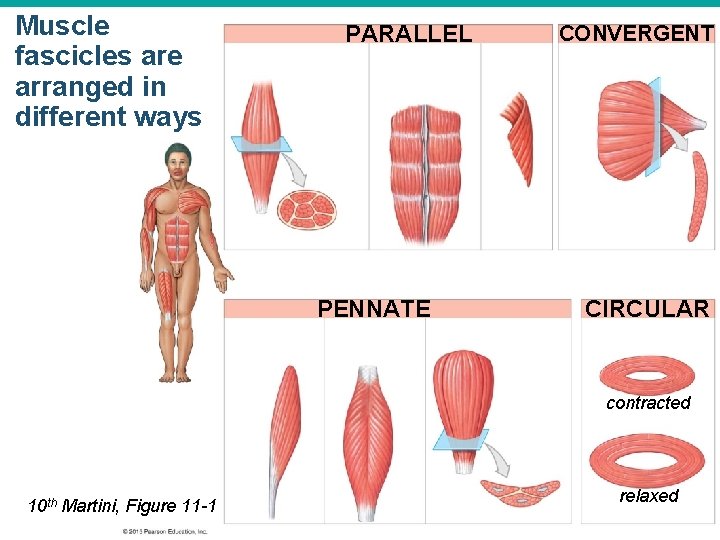
Muscle fascicles are arranged in different ways PARALLEL PENNATE CONVERGENT CIRCULAR contracted 10 th Martini, Figure 11 -1 relaxed
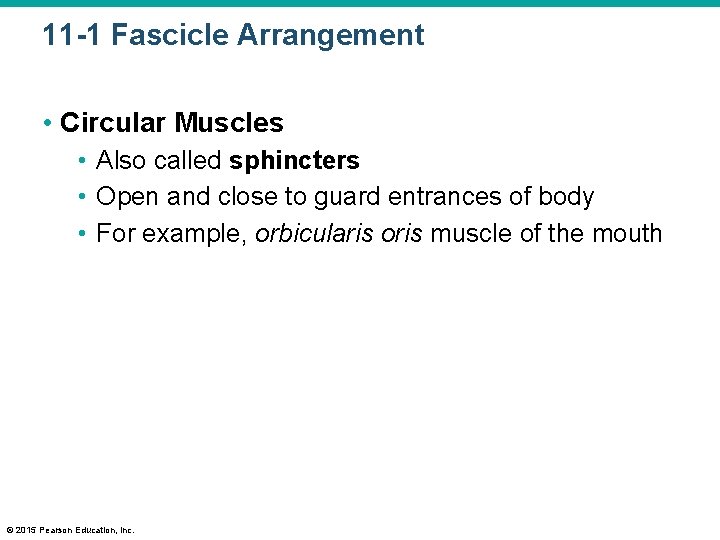
11 -1 Fascicle Arrangement • Circular Muscles • Also called sphincters • Open and close to guard entrances of body • For example, orbicularis oris muscle of the mouth © 2015 Pearson Education, Inc.
Parallel vs. Pennate: How does this affect muscle function? On page 334, your textbook says: “A pennate muscle contains more muscle fibers – and thus more myofibrils – than does a parallel muscle of the same size. For this reason, the pennate muscle produces more tension. ” This is completely wrong!
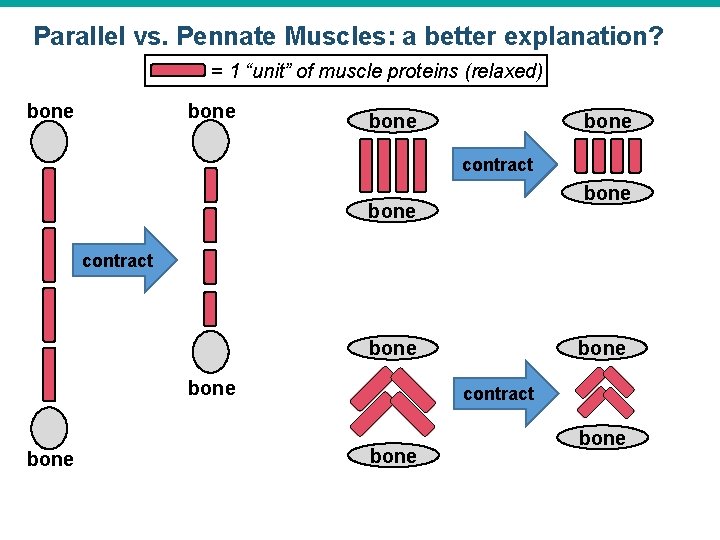
Parallel vs. Pennate Muscles: a better explanation? = 1 “unit” of muscle proteins (relaxed) bone bone contract bone
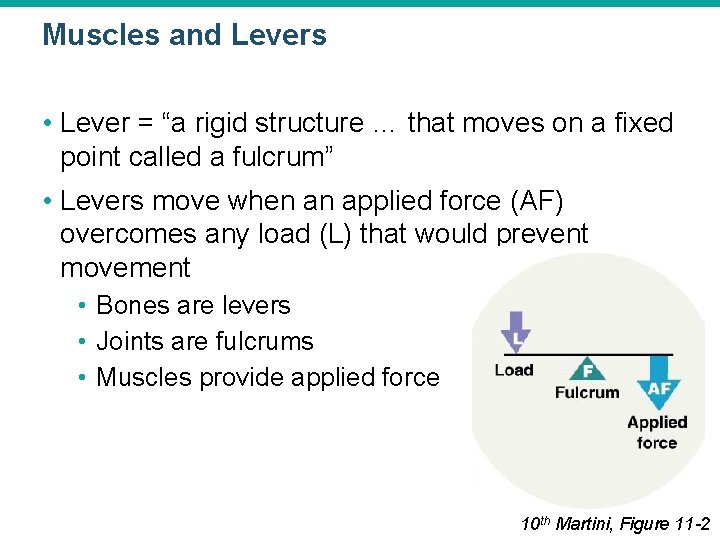
Muscles and Levers • Lever = “a rigid structure … that moves on a fixed point called a fulcrum” • Levers move when an applied force (AF) overcomes any load (L) that would prevent movement • Bones are levers • Joints are fulcrums • Muscles provide applied force 10 th Martini, Figure 11 -2
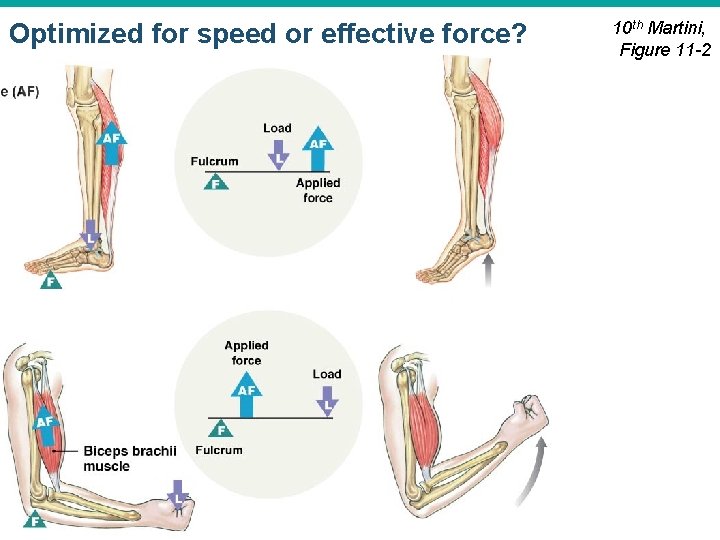
Optimized for speed or effective force? 10 th Martini, Figure 11 -2
11 -3 Muscle Attachments to Other Tissues • Origins and Insertions • • Origin: fixed point of attachment Insertion: moving point of attachment Most muscles originate or insert on the skeleton Origin is usually proximal to insertion “Knowing which end is the origin and which is the insertion is ultimately less important than knowing where the two ends attach and what the muscle accomplishes when it contracts. ” © 2015 Pearson Education, Inc.
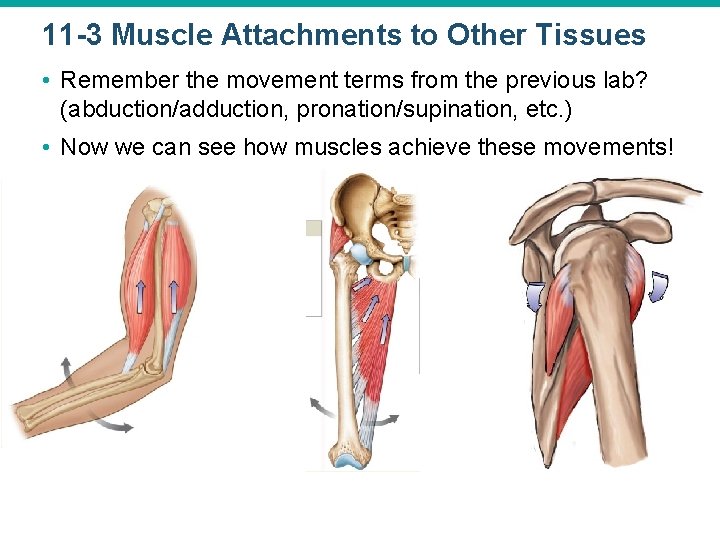
11 -3 Muscle Attachments to Other Tissues • Remember the movement terms from the previous lab? (abduction/adduction, pronation/supination, etc. ) • Now we can see how muscles achieve these movements!
11 -3 Muscle Attachments to Other Tissues • Muscle Terminology Based on Function • Agonist (or prime mover) • Antagonist • Synergist
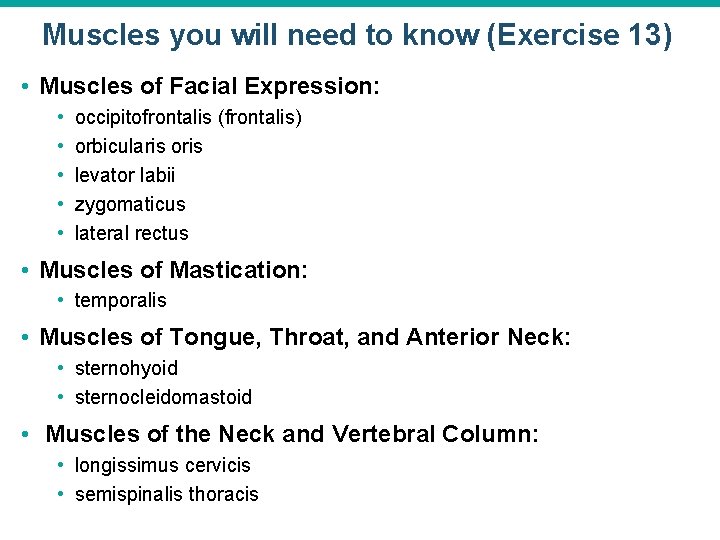
Muscles you will need to know (Exercise 13) • Muscles of Facial Expression: • • • occipitofrontalis (frontalis) orbicularis oris levator labii zygomaticus lateral rectus • Muscles of Mastication: • temporalis • Muscles of Tongue, Throat, and Anterior Neck: • sternohyoid • sternocleidomastoid • Muscles of the Neck and Vertebral Column: • longissimus cervicis • semispinalis thoracis
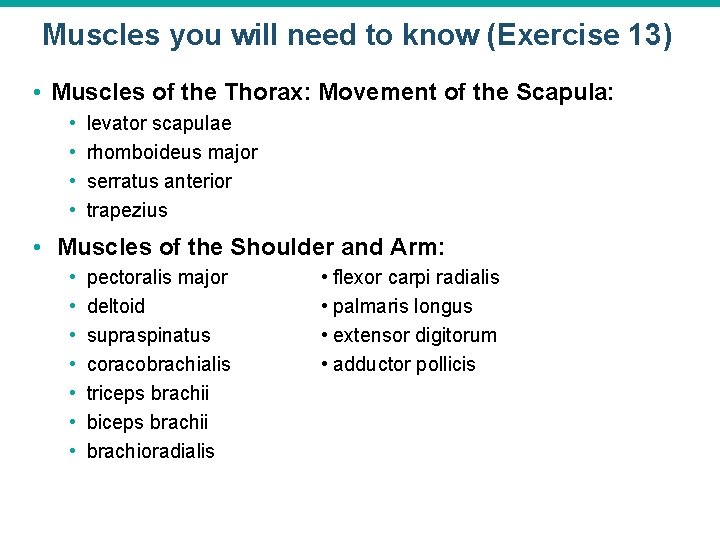
Muscles you will need to know (Exercise 13) • Muscles of the Thorax: Movement of the Scapula: • • levator scapulae rhomboideus major serratus anterior trapezius • Muscles of the Shoulder and Arm: • • pectoralis major deltoid supraspinatus coracobrachialis triceps brachii brachioradialis • flexor carpi radialis • palmaris longus • extensor digitorum • adductor pollicis
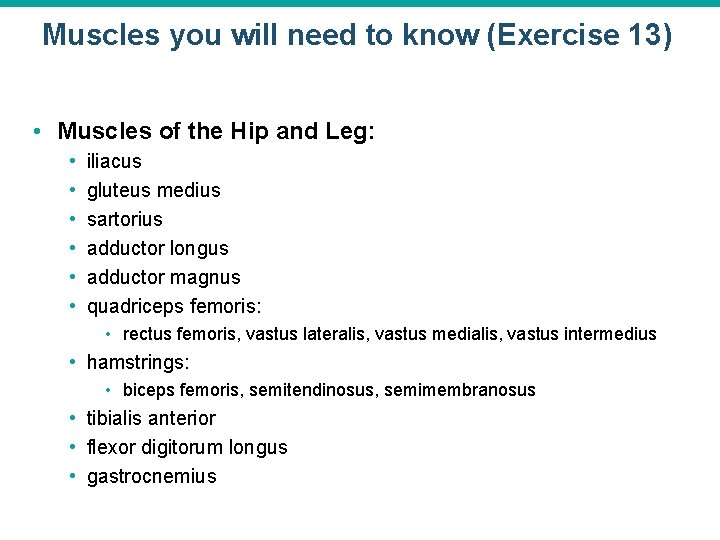
Muscles you will need to know (Exercise 13) • Muscles of the Hip and Leg: • • • iliacus gluteus medius sartorius adductor longus adductor magnus quadriceps femoris: • rectus femoris, vastus lateralis, vastus medialis, vastus intermedius • hamstrings: • biceps femoris, semitendinosus, semimembranosus • tibialis anterior • flexor digitorum longus • gastrocnemius
11 -4 Naming Skeletal Muscles • Names for skeletal muscles can indicate any of the following: • • • 1. Location in the body 2. Origin and insertion 3. Fascicle organization 4. Relative position 5. Structural characteristics 6. Action The following slides are meant to help but do not need to be memorized. © 2015 Pearson Education, Inc.
11 -4 Naming Skeletal Muscles 1. Location in the body • For example, temporalis muscle 2. Origin and insertion • First part of name indicates origin • Second part of name indicates insertion • For example, genioglossus muscle 3. Fascicle organization • For example, rectus (straight), transversus (crosswise), oblique (slanting) © 2015 Pearson Education, Inc.
11 -4 Naming Skeletal Muscles 4. Position • Externus (superficialis) = • Internus (profundus) = • Extrinsic • Muscles ______ an organ • Intrinsic • Muscles ______ an organ © 2015 Pearson Education, Inc.
11 -4 Naming Skeletal Muscles 5. Structural characteristics • Nature of origin • Biceps (__ heads) • Triceps (__ heads) • Quadriceps (__ heads) • Shape • • • Deltoid (triangle) Orbicularis (circle) Pectinate (comblike) Piriformis (pear-shaped) Platy- (flat) Pyramidal (pyramid) © 2015 Pearson Education, Inc. • Rhomboid (parallelogram) • Serratus (serrated) • Splenius (bandage) • Teres (round and long) • Trapezius (trapezoid)
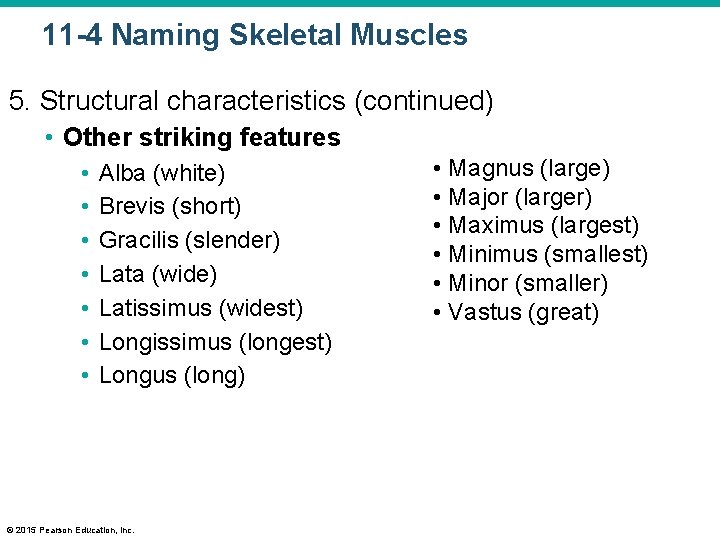
11 -4 Naming Skeletal Muscles 5. Structural characteristics (continued) • Other striking features • • Alba (white) Brevis (short) Gracilis (slender) Lata (wide) Latissimus (widest) Longissimus (longest) Longus (long) © 2015 Pearson Education, Inc. • Magnus (large) • Major (larger) • Maximus (largest) • Minimus (smallest) • Minor (smaller) • Vastus (great)
11 -4 Naming Skeletal Muscles 6. Actions • • • Abductor = Adductor = Depressor = Extensor = Flexor = Levator = Pronator = Supinator = Tensor = © 2015 Pearson Education, Inc.