
Chapter 10 REBUILDING INDIAN TERRITORY Section 1 The
Chapter 10 REBUILDING INDIAN TERRITORY
Section 1: The Five Nations Start Over Ø Essential Question: • What steps did the Five Nations take to rebuild after the Civil War?
Seminoles Ø Among the Seminole, some were loyal to the Union and some were loyal to the South. ØThe tribe elected Jumper as chief after the Civil War. Ø The Seminole national council formed in 1866, and Wewoka was capital. ØPopulation: 2, 105 Ø Ramsey Mission School was started as a school for girls in 1880 near Sasakwa.
Chickasaw Ø The Chickasaw began to quickly rebuild schools and provide care of orphans. ØBoarding schools reopened in 1876. ØClasses were taught in English. Subjects were reading, spelling, arithmetic, grammar, geography, and history. Ø “We must educate, or we must perish. ”
Choctaw Ø Tribal schools and churches soon reopened. Ø The Choctaw owned all land “in common” but could personally own homes, fences, barns, etc. ØSome whites came in as tenant farmers and worked the farm but did not own the land; they shared profits with the owners. Ø The Choctaw expected railroads and mining to change the way of life in their region.
Creek Ø The Upper and Lower Creeks were further divided by the war. Ø 1867: A new constitution and chief were chosen. ØSands Rebellion of 1871: 300 men took over the capital at Okmulgee. ØLighthorsemen and federal agents put down the group. Ø 1896: 70 neighborhood schools opened, 6 boarding schools, and an orphanage.
Cherokee Ø William Ross became chief of the Cherokee after the death of his uncle John Ross (1866). Ø The tribe was under pressure to open lands to settlement. Ø Lands were owned in common, but improvements were privately owned. Ø There were three classes of people: full bloods with small farms; mixed bloods had more money; whites with permits to work in the Nation.
Cherokee Ø An excellent school system was created with seminaries, orphanages, 100 primary schools, and a high school for blacks. Ø Tahlequah (capital) was the center of culture and education. Ø Cattlemen leased land for grazing.
Freedmen Ø Freedmen were treated as equals by Creek and Seminole but view was mixed among Cherokee, Chickasaw, and Choctaw. Ø Segregation in Indian Territory divided blacks from others in schools and sometimes entire towns. Ø Several all-black towns grew such as North Fork Town, Canadian Colored, and Arkansas Colored.
Government Schools Ø Government schools were started to help Indians assimilate. Ø Riverside Indian School was started in 1871; renamed Wichita-Caddo School in 1872. Ø Chilocco Indian School was a boarding school started for Plains Indians children. Ø Quakers, Methodists, Baptists, Catholics were among the denominations who worked to convert Indians to their faith.
Section 2: Rebuilding the Economy Ø Essential Question: • What factors helped to improve the economy of the Territory?
Cattle Drives Ø To get cattle to market, Texans drove cattle through Indian Territory to railheads in Kansas City and St. Louis. Ø Cattle in Texas might sell for $2 in Texas but up to $40 elsewhere. Ø The open grasslands of Indian Territory were used to feed cattle along the way. ØRights-of-way and leases were worked out with tribes.
Crossing the Territory Ø A cattle drive had herds of 2, 500 -3, 000 cattle, could move 10 -15 miles/day, and lasted 1 -3 months. Ø Drives needed 6 -10 cowboys, about 6 -8 horses/cowboy, a chuck wagon (food) and cook. Ø The chuck wagon had everything they would need on their.
Cattle Trails Ø Trails led to places along rivers where animals could safely cross. Ø East Shawnee was the first cattle trail but forests and marshes made it difficult to keep cattle together. Ø The West Shawnee trail headed more directly to Abilene, KS: “Cow Capital of the World”
Cattle Trails Ø The Chisholm Trail became one of the most used from 1867, because it had the most direct route from Texas to Abilene. Ø The Great Western Cattle Trail was further west and went to Dodge City, Kansas. Ø The 1886 blizzard, more settlers and railroads, and increased use of barbed wire fence contributed to decline of cattle drives.
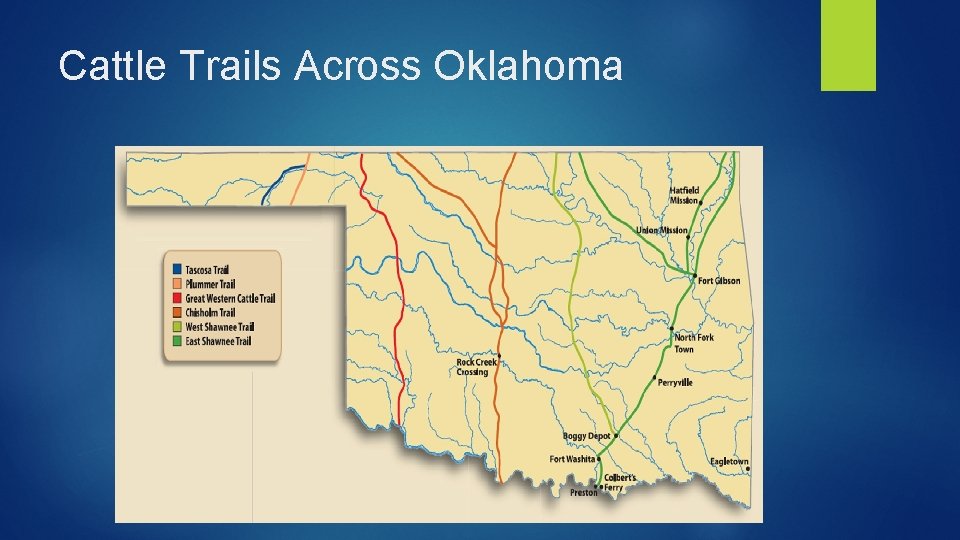
Cattle Trails Across Oklahoma
Transcontinental Railroad Ø After Civil War, stage coach routes restored, but did not last long due to railroads Ø 1869: rails from east met rails from the west to complete a transcontinental railroad.
Railroads Across Oklahoma Ø 1865: The Missouri-Kansas-Texas (MKT, Katy) came to the territory. Ø 1866 treaties allowed for two rails running northsouth and two east-west through Indian Territory. Ø 1871: The Atlantic & Pacific Railway ran east-west, and later became known as the Frisco line.
Railroads Across Oklahoma Ø The Santa Fe line ran from Kansas to the Gulf coast. Ø The Rock Island line followed Chisholm Trail. Ø In the 1860 s – 1880 s miles of rail, bridges and roundhouses were added to the Territory. Ø By 1905, the Territory had over 5, 000 miles of track.
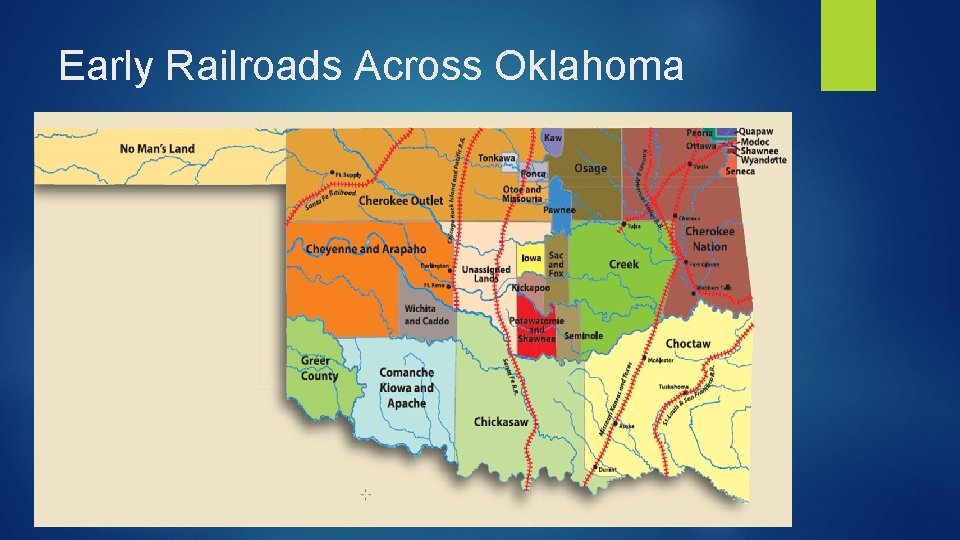
Early Railroads Across Oklahoma
Coal Mining Ø James J. Mc. Alester led the Oklahoma Mining Company with royalties split with Choctaw nation. Ø Miners provided increased business for tribes but also increased demand for land for settlement by whites. Ø 1888: The Choctaw Coal and Railway Company built railroads to haul coal from mines to Crossroads (Mc. Alester). Many communities grew from this business.
Coal Mining Ø Europeans came to the Choctaw Nation to work. Ø Osage Coal and Mining Company was the largest and owned by Katy railroad. Ø Wages were often above average, but a strike in 1884 protested wage cuts. Ø 1892: 100 men were killed and 100 injured in an explosion at Mine #11 Osage Coal and Mining.
Oil Springs Ø Oil springs were thought to cure arthritis, rheumatism, etc. ØSpas were established. Ø Early oil wells did not show much promise. Ø Chickasaw Oil Company, first oil company in 1872. ØOil was not important until automobile.
Section 3: Law and Disorder Ø Essential Question: • What steps were taken to bring law and order to the Territory?
Maintaining Order Ø Lighthorse Police from the Five Tribes enforced tribal laws. ØPunishments could be lashes to the back or death. Ø Liquor was the source of many problems and was outlawed. ØBootleggers smuggled bottles of whisky in their high-top boots. ØMany whisky traders set up shop along the border of Indian Territory.
Outlaws Ø Whites were not bound by Indian law, and U. S. law was not valid in the Territory. ØRobbers, whisky peddlers, cattle rustlers, and horse thieves hid in Indian Territory. Ø Infamous outlaws, included the Doolins, Daltons, Jennings brothers, Cook gang, and Turner gang. Ø Sam and Belle Starr (Myra Belle Shirley) owned Younger’s Bend, a haven for outlaws like Jesse James and Cole Younger.
The Hanging Judge Ø In 1871, a federal district court was established at Fort Smith, AR with jurisdiction to include Indian Territory; Isaac Parker was appointed as judge. Ø To bring law and order, he organized an “army” of deputy marshals. Ø Posses of deputies captured outlaws and brought them to court. Ø Parker was known as the “hanging judge”; he tried over 12, 000 cases with over 9, 000 convictions. 79 men were hanged.
“The Calm Before the Storm” Ø Railroads, mining, and cattle brought more whites to Indian Territory. Ø “Crowding” in neighboring states and territories make the “undeveloped” lands of Indian Territory attractive to new settlers. Ø Pressure increased to open the Indian lands to settlement.
- Slides: 28