
Chapter 10 Real Numbers Copyright 2015 2010 and
Chapter 10 Real Numbers Copyright © 2015, 2010, and 2007 Pearson Education, Inc. 1
CHAPTER 10 Real Numbers 10. 1 The Real Numbers 10. 2 Addition of Real Numbers 10. 3 Subtraction of Real Numbers 10. 4 Multiplication of Real Numbers 10. 5 Division of Real Numbers and Order of Operations Copyright © 2015, 2010, and 2007 Pearson Education, Inc. 2
10. 2 Addition of Real Numbers OBJECTIVES a Add real numbers without using the number line. b Find the opposite, or additive inverse, of a real number. Copyright © 2015, 2011, and 2008 Pearson Education, Inc. 3
Adding Integers To perform the addition a + b, we start at a, and then move according to b. a) If b is positive, we move to the right. b) If b is negative, we move to the left. c) If b is 0, we stay at a. Copyright © 2015, 2010, and 2007 Pearson Education, Inc. 4
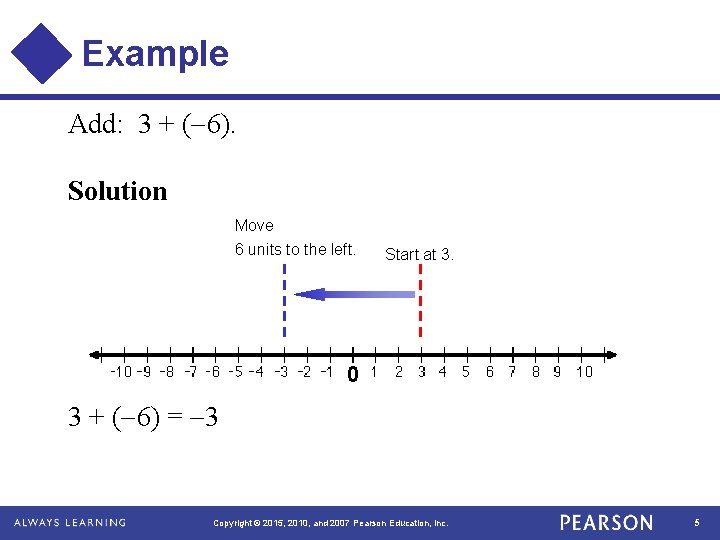
Example Add: 3 + ( 6). Solution Move 6 units to the left. Start at 3. 3 + ( 6) = 3 Copyright © 2015, 2010, and 2007 Pearson Education, Inc. 5
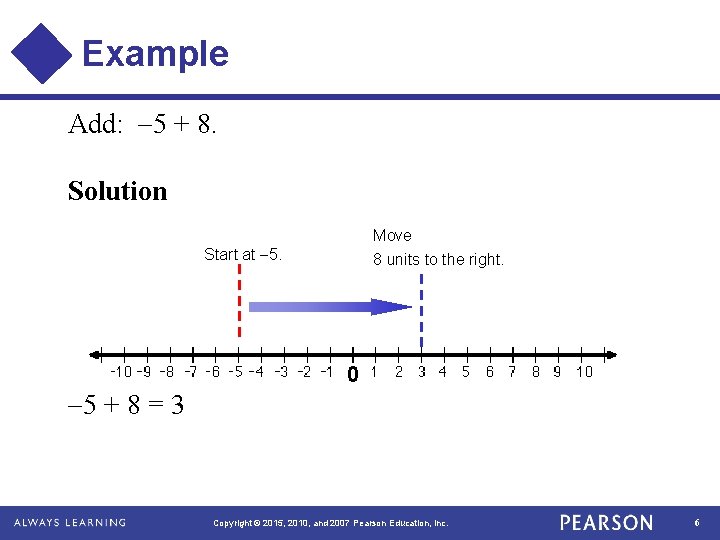
Example Add: 5 + 8. Solution Start at 5. Move 8 units to the right. 5 + 8 = 3 Copyright © 2015, 2010, and 2007 Pearson Education, Inc. 6
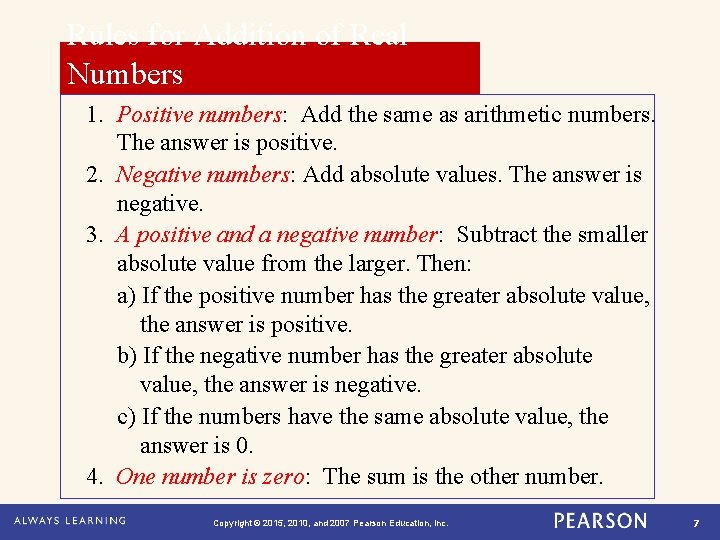
Rules for Addition of Real Numbers 1. Positive numbers: Add the same as arithmetic numbers. The answer is positive. 2. Negative numbers: Add absolute values. The answer is negative. 3. A positive and a negative number: Subtract the smaller absolute value from the larger. Then: a) If the positive number has the greater absolute value, the answer is positive. b) If the negative number has the greater absolute value, the answer is negative. c) If the numbers have the same absolute value, the answer is 0. 4. One number is zero: The sum is the other number. Copyright © 2015, 2010, and 2007 Pearson Education, Inc. 7
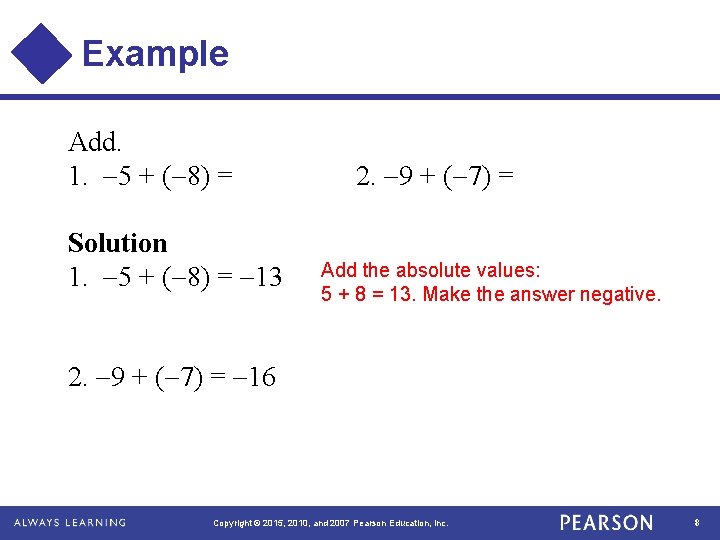
Example Add. 1. 5 + ( 8) = Solution 1. 5 + ( 8) = 13 2. 9 + ( 7) = Add the absolute values: 5 + 8 = 13. Make the answer negative. 2. 9 + ( 7) = 16 Copyright © 2015, 2010, and 2007 Pearson Education, Inc. 8
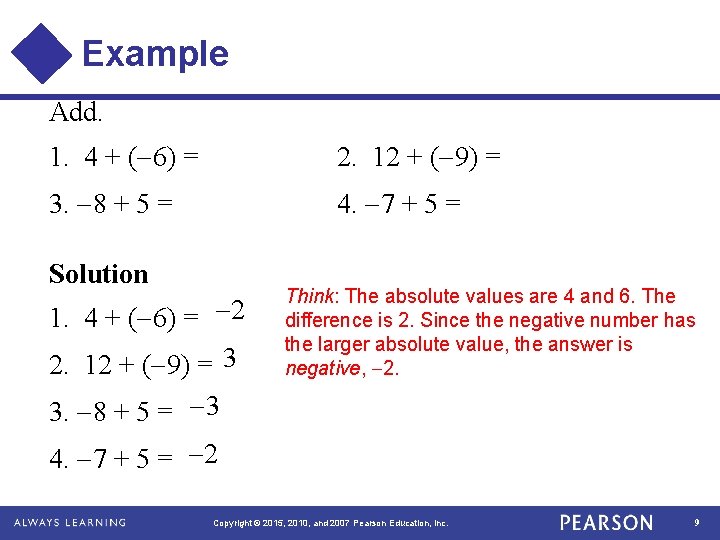
Example Add. 1. 4 + ( 6) = 2. 12 + ( 9) = 3. 8 + 5 = 4. 7 + 5 = Solution 1. 4 + ( 6) = 2 2. 12 + ( 9) = 3 Think: The absolute values are 4 and 6. The difference is 2. Since the negative number has the larger absolute value, the answer is negative, 2. 3. 8 + 5 = 3 4. 7 + 5 = 2 Copyright © 2015, 2010, and 2007 Pearson Education, Inc. 9
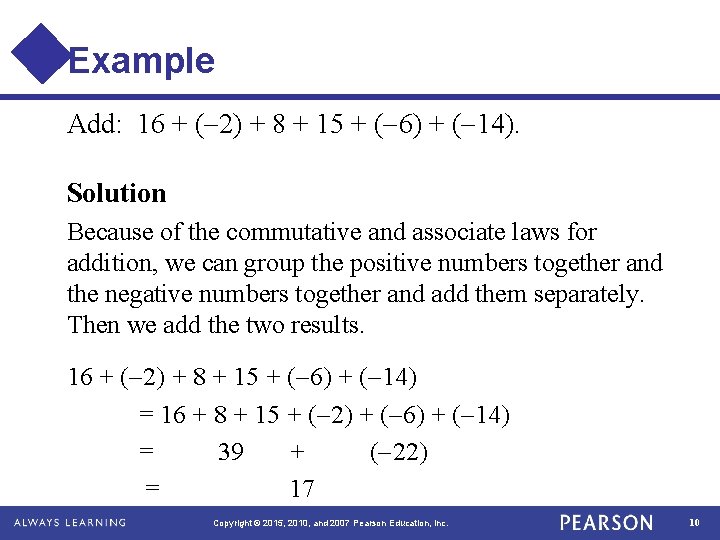
Example Add: 16 + ( 2) + 8 + 15 + ( 6) + ( 14). Solution Because of the commutative and associate laws for addition, we can group the positive numbers together and the negative numbers together and add them separately. Then we add the two results. 16 + ( 2) + 8 + 15 + ( 6) + ( 14) = 16 + 8 + 15 + ( 2) + ( 6) + ( 14) = 39 + ( 22) = 17 Copyright © 2015, 2010, and 2007 Pearson Education, Inc. 10
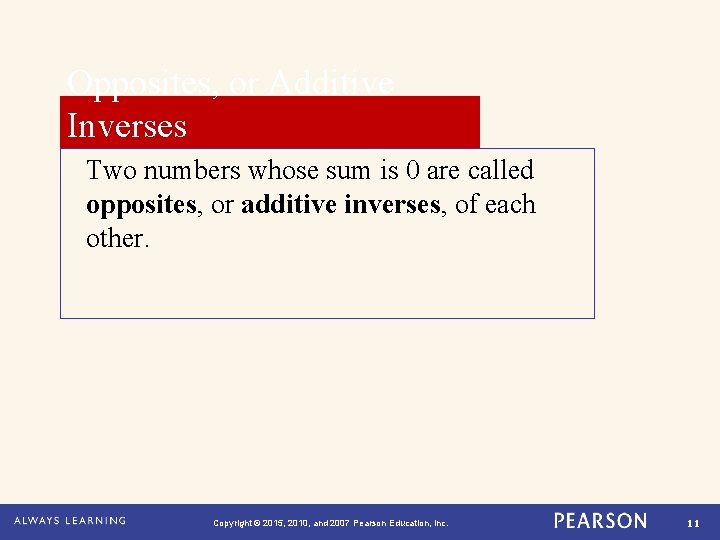
Opposites, or Additive Inverses Two numbers whose sum is 0 are called opposites, or additive inverses, of each other. Copyright © 2015, 2010, and 2007 Pearson Education, Inc. 11
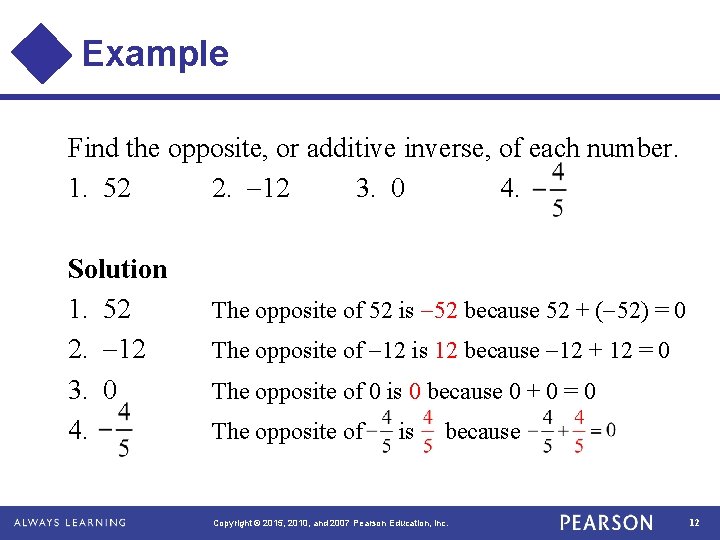
Example Find the opposite, or additive inverse, of each number. 1. 52 2. 12 3. 0 4. Solution 1. 52 2. 12 3. 0 4. The opposite of 52 is 52 because 52 + ( 52) = 0 The opposite of 12 is 12 because 12 + 12 = 0 The opposite of 0 is 0 because 0 + 0 = 0 The opposite of is because Copyright © 2015, 2010, and 2007 Pearson Education, Inc. 12
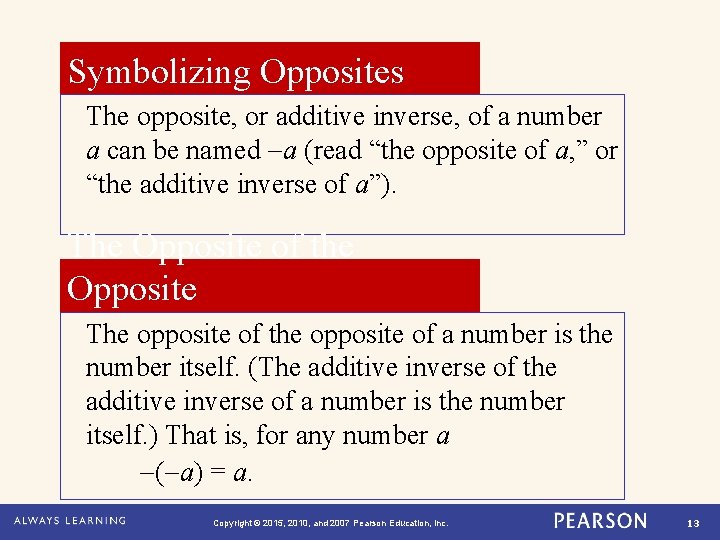
Symbolizing Opposites The opposite, or additive inverse, of a number a can be named a (read “the opposite of a, ” or “the additive inverse of a”). The Opposite of the Opposite The opposite of the opposite of a number is the number itself. (The additive inverse of the additive inverse of a number is the number itself. ) That is, for any number a ( a) = a. Copyright © 2015, 2010, and 2007 Pearson Education, Inc. 13
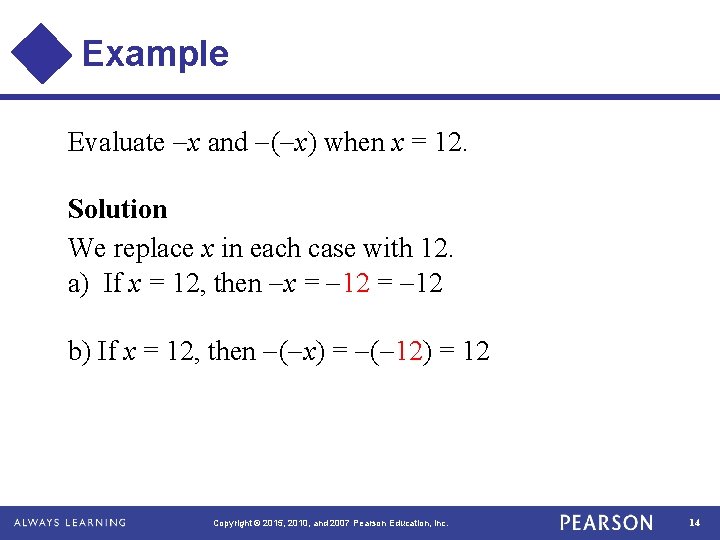
Example Evaluate x and ( x) when x = 12. Solution We replace x in each case with 12. a) If x = 12, then x = 12 b) If x = 12, then ( x) = ( 12) = 12 Copyright © 2015, 2010, and 2007 Pearson Education, Inc. 14
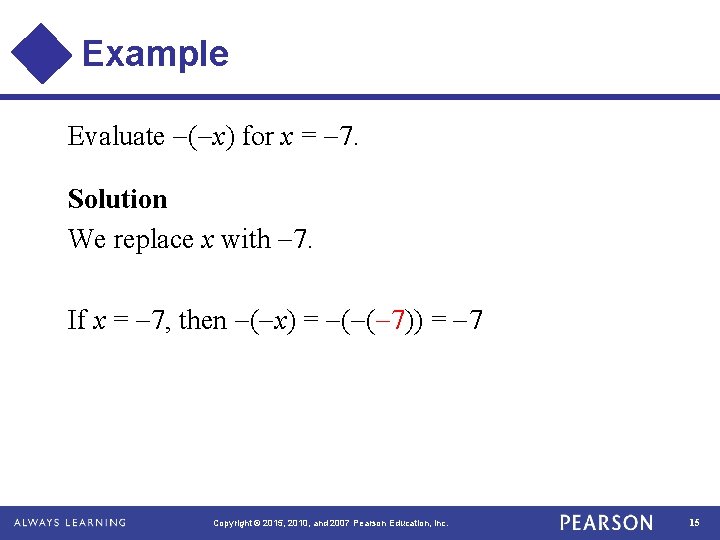
Example Evaluate ( x) for x = 7. Solution We replace x with 7. If x = 7, then ( x) = ( ( 7)) = 7 Copyright © 2015, 2010, and 2007 Pearson Education, Inc. 15
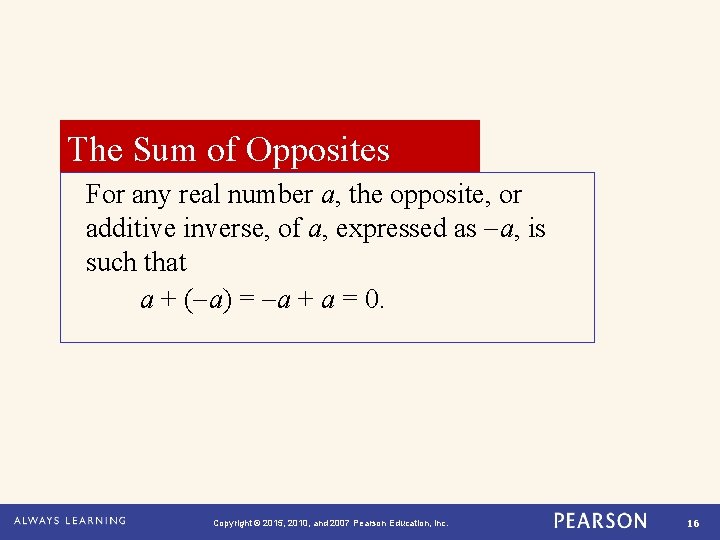
The Sum of Opposites For any real number a, the opposite, or additive inverse, of a, expressed as a, is such that a + ( a) = a + a = 0. Copyright © 2015, 2010, and 2007 Pearson Education, Inc. 16
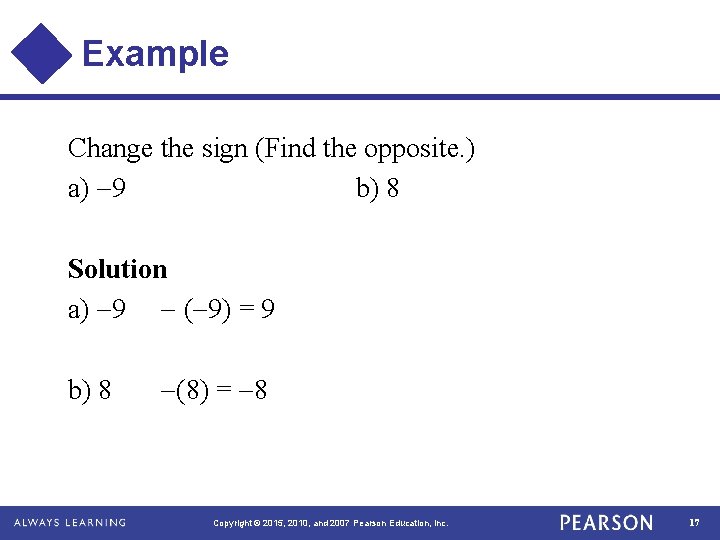
Example Change the sign (Find the opposite. ) a) 9 b) 8 Solution a) 9 ( 9) = 9 b) 8 (8) = 8 Copyright © 2015, 2010, and 2007 Pearson Education, Inc. 17
- Slides: 17