
Chapter 10 Property Crime Occasional Conventional Professional CCJ




- Slides: 20
Chapter 10: Property Crime: Occasional, Conventional, & Professional CCJ 3014 – Crime in America Dr. Matthew Matusiak
Occasional Property Crime �General Characteristics �Lack official criminal records �Limited knowledge of criminal techniques �Crime is not sole source of livelihood �Shoplifting �Inventory shrinkage �Boosters/Heels �Shadows �Snitches
Occasional Property Crime �Vandalism �Wanton �Predatory �Vindictive �Motor Vehicle Theft �Most regularly reported larceny �Joyriding �Short-term transportation �Long-term transportation �Profit-motivated
Occasional Property Crime �Check Forgery �Naïve check forgers �Systematic check forgers
Conventional Property Crime �General Characteristics �Decreasing since 1974 in the U. S. �Offenders typically begin careers as juveniles and continue �Diversified offending �Burglary �Professionals �Known Burglars �Young Burglars �Juvenile Burglars �Junkies
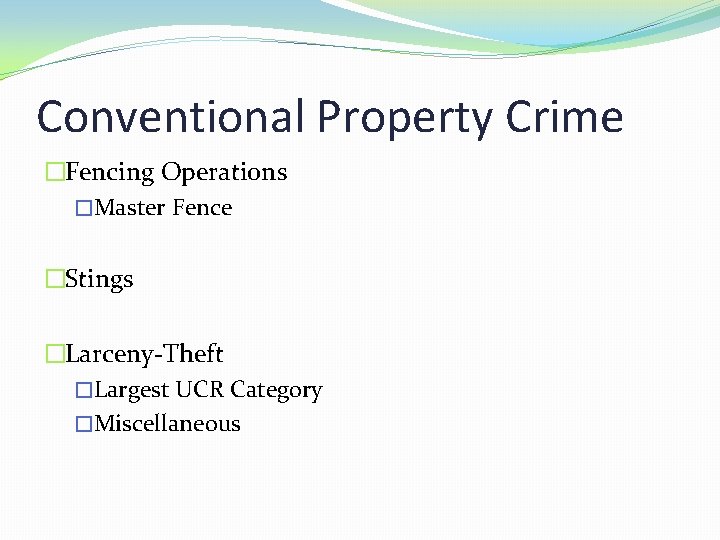
Conventional Property Crime �Fencing Operations �Master Fence �Stings �Larceny-Theft �Largest UCR Category �Miscellaneous
Arson �Added to Part I crimes in 1979 �Statistics reported by fire services, insurance investigators, and other law enforcement agencies �Types of Arson �Profit-Motivated �Revenge �Vandalism �Crime Concealment �Sabotage �Excitement
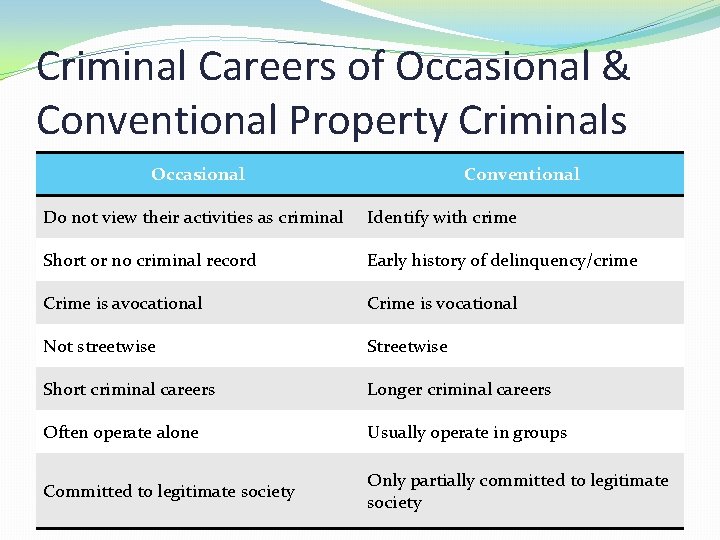
Criminal Careers of Occasional & Conventional Property Criminals Occasional Conventional Do not view their activities as criminal Identify with crime Short or no criminal record Early history of delinquency/crime Crime is avocational Crime is vocational Not streetwise Short criminal careers Longer criminal careers Often operate alone Usually operate in groups Committed to legitimate society Only partially committed to legitimate society
Professional Crime �Concept of Professional Crime �Sociological concept �Requirements of a profession � Specialized, useful knowledge � Service orientation and code of ethics � Autonomy and independence of operation � Prestige and payment �Characteristics of Professional Crime �Crime is the sole livelihood �Criminal career is highly developed �Considerable skill is involved �High status is available in the criminal world �Argot
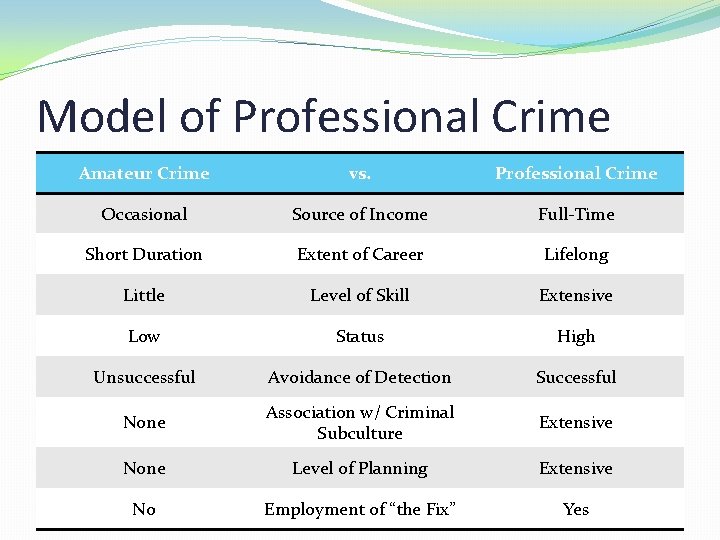
Model of Professional Crime Amateur Crime vs. Professional Crime Occasional Source of Income Full-Time Short Duration Extent of Career Lifelong Little Level of Skill Extensive Low Status High Unsuccessful Avoidance of Detection Successful None Association w/ Criminal Subculture Extensive None Level of Planning Extensive No Employment of “the Fix” Yes
Scams �Hustles �Confidence (con) games �Pigeon drop �Badger game �Bank examiner’s scam �Short cons �Boojo
Maurer’s The Big Con �Putting up the mark �Playing the con �Roping the mark �Telling the tale �Giving the convincer �Having the victim invest further �Sending the victim after more money �Playing the victim against the big store and fleecing them �Getting the victim out of the way �Cooling out the mark �Putting in the fix
Big Cons �Identity Theft �Methods of obtaining personal information �Ponzi Schemes �Pyramid Schemes �Religious Cons �Affinity group fraud �PTL Scandal
Professional Criminals �Boosters �Lowest level professional criminal �Typically work in groups � Stall � Clout � Cover �E-fencing �Cannons �Professional pickpockets �Typically work in groups
Professional Criminals �Professional Burglars �Generally work in groups � Tipster � Fixers � Fences �The Box Man �Professional Fence �Neighborhood fence �Outlet fence �Professional fence �Master fence
Professional Criminals �Paper Hangers �Passing bad checks and other documents �Counterfeiting � Money � Credit Cards �Professional Robbers �Will use force if necessary �Requires little training �Tend to work in temporary groups �Targets of choice
Professional Criminals �Professional Arsonists �Professional Auto Theft Rings �Vary greatly in operations, sophistication, and organization � 14% of auto theft is solved through arrest in the U. S. �Victimless crime? �Professional Killers
Criminal Careers of Professionals �Characteristics of professional criminals �Seek anonymity �Often on speaking terms with police �Not necessary members of organized crime �Usually not drug addicts �Arrest and imprisonment are costs of doing business �Rehearse crimes when possible �Understand the law and clearance rates �Avoid conspicuous consumption �Typically stable family members
Criminal Careers of Professionals �Societal Reaction �Theory and Crime �Routine activities �Development/Life course �Anomie �Differential association
Chapter 10: Property Crime: Occasional, Conventional, & Professional CCJ 3014 – Crime in America Dr. Matthew Matusiak