
Chapter 10 Properties of Circles Circle A set
- Slides: 78
Chapter 10 Properties of Circles
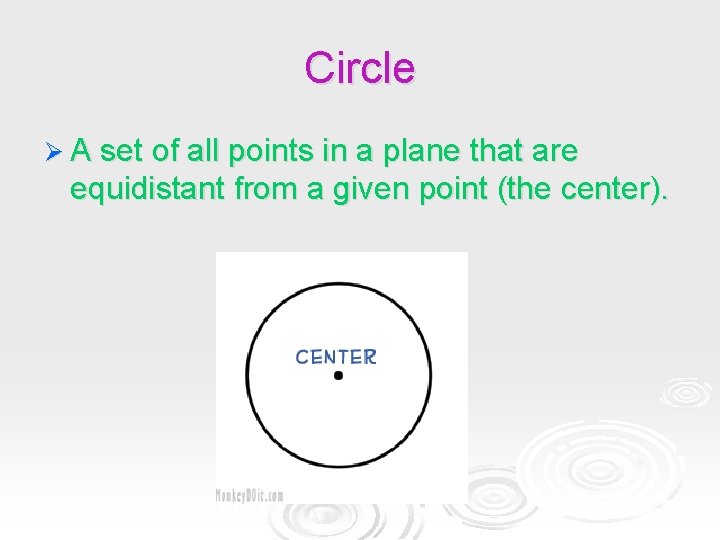
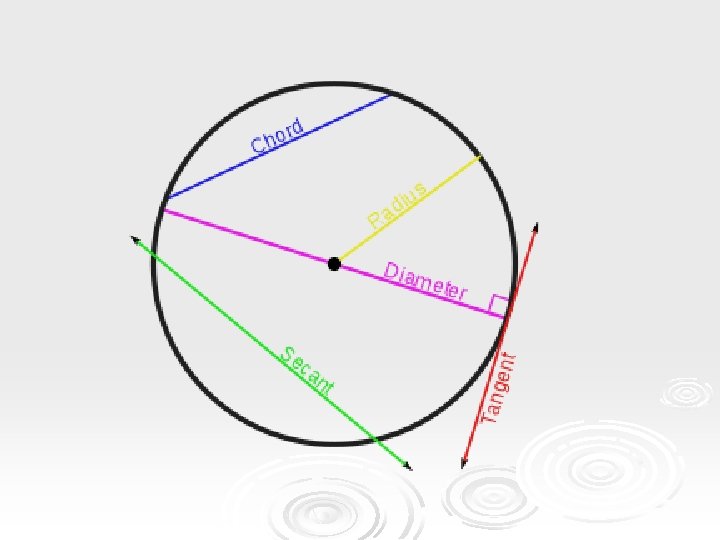
Circle Ø A set of all points in a plane that are equidistant from a given point (the center).
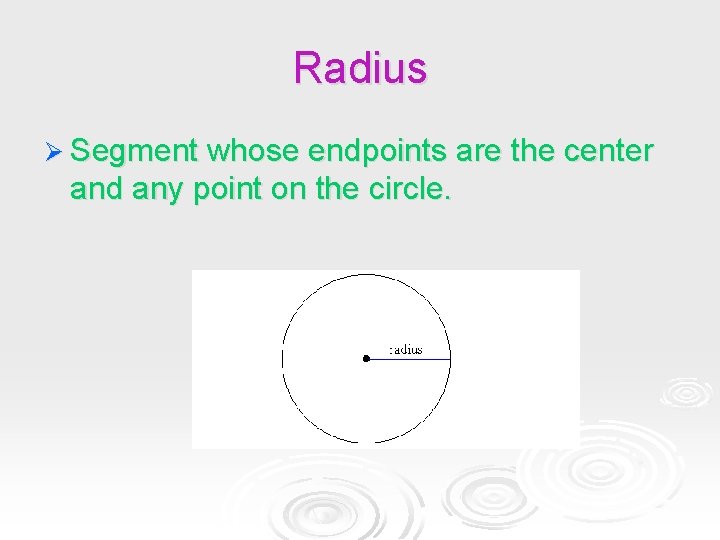
Radius Ø Segment whose endpoints are the center and any point on the circle.
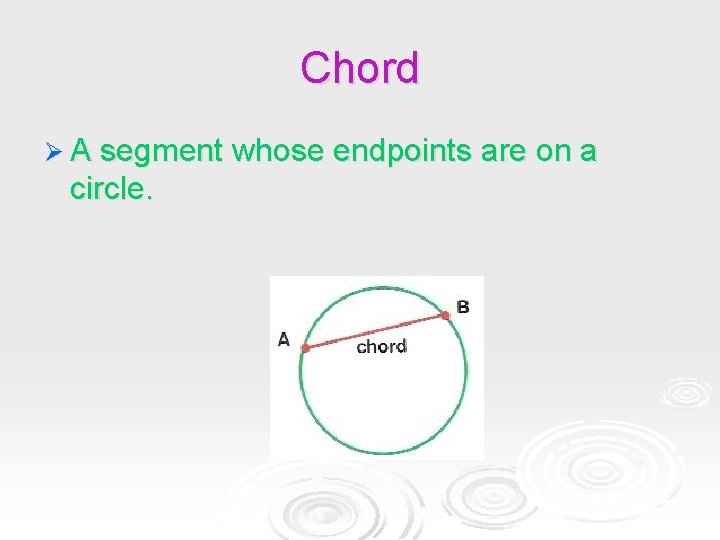
Chord Ø A segment whose endpoints are on a circle.
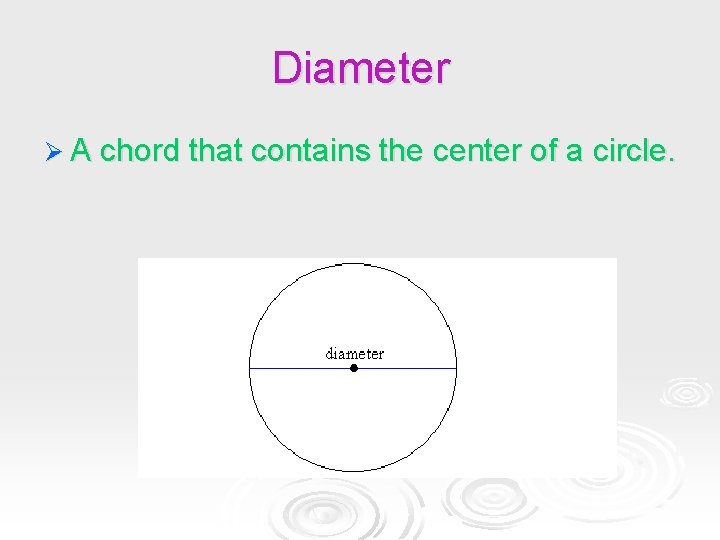
Diameter Ø A chord that contains the center of a circle.
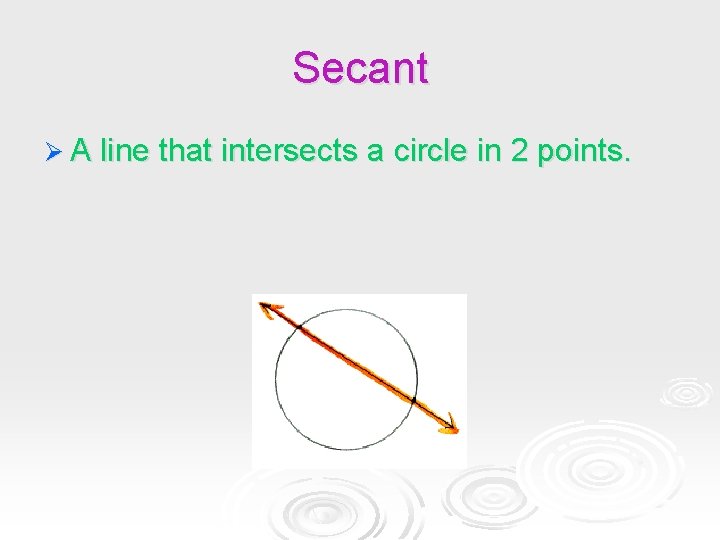
Secant Ø A line that intersects a circle in 2 points.
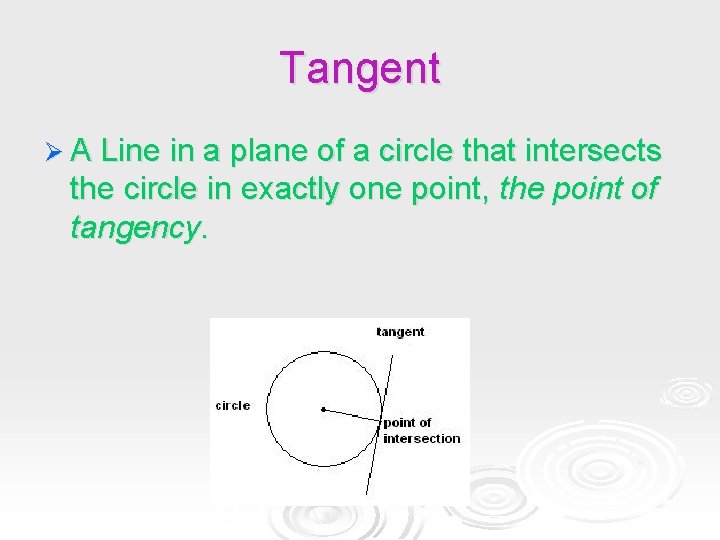
Tangent Ø A Line in a plane of a circle that intersects the circle in exactly one point, the point of tangency.
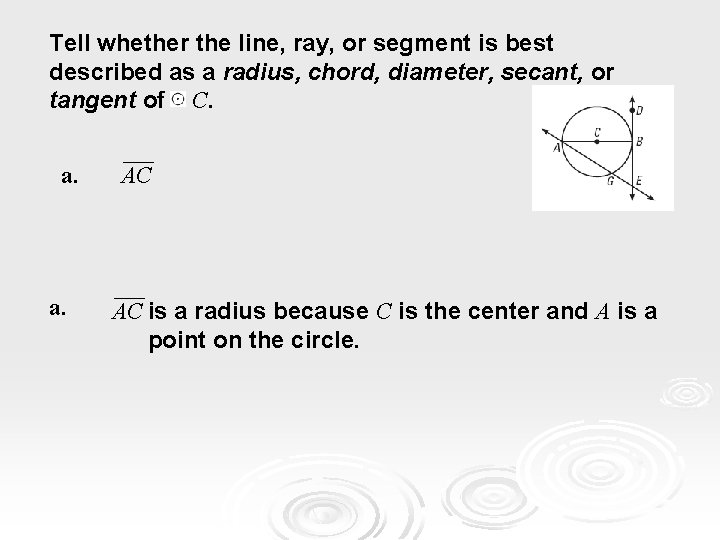
EXAMPLE 1 the line, ray, or segment is best Tell whether described as a radius, chord, diameter, secant, or tangent of C. a. AC AC is a radius because C is the center and A is a point on the circle.
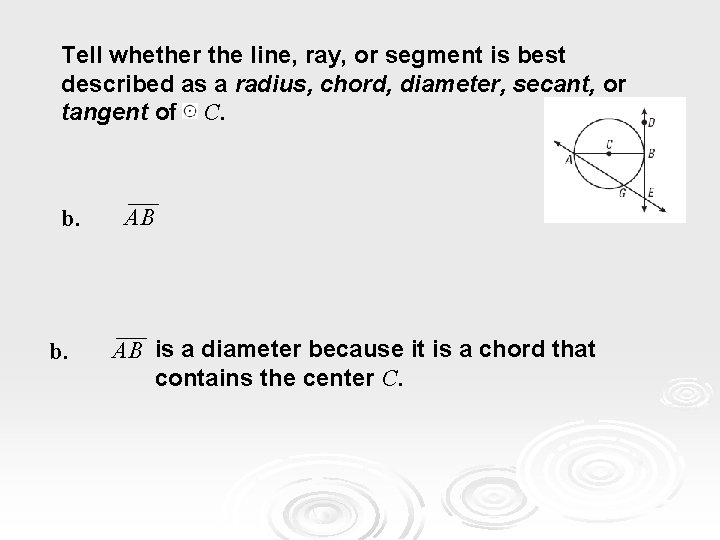
Tell whether the line, ray, or segment is best described as a radius, chord, diameter, secant, or tangent of C. b. AB AB is a diameter because it is a chord that contains the center C.
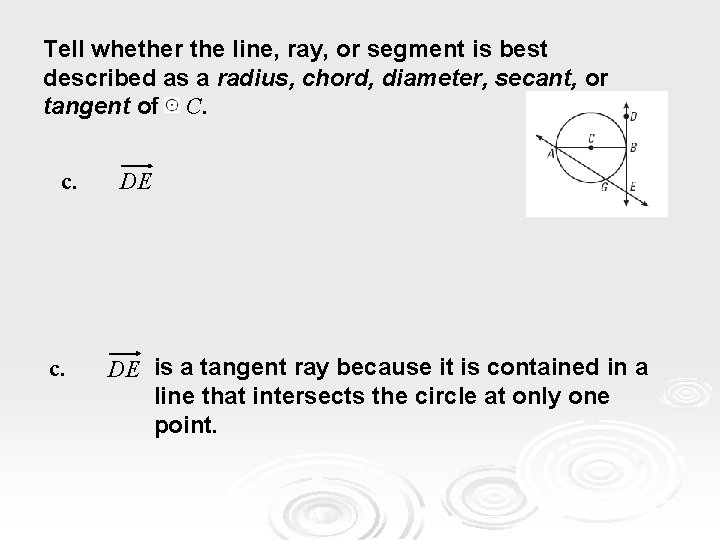
Tell whether the line, ray, or segment is best described as a radius, chord, diameter, secant, or tangent of C. c. DE DE is a tangent ray because it is contained in a line that intersects the circle at only one point.
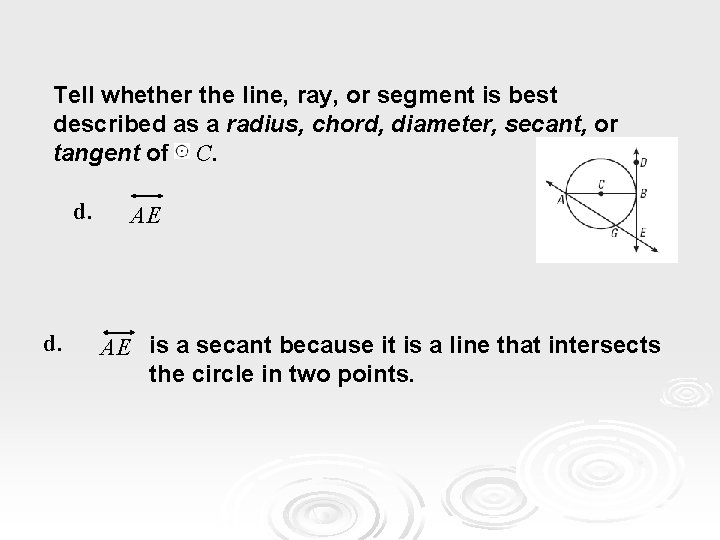
Tell whether the line, ray, or segment is best described as a radius, chord, diameter, secant, or tangent of C. d. AE AE is a secant because it is a line that intersects the circle in two points.
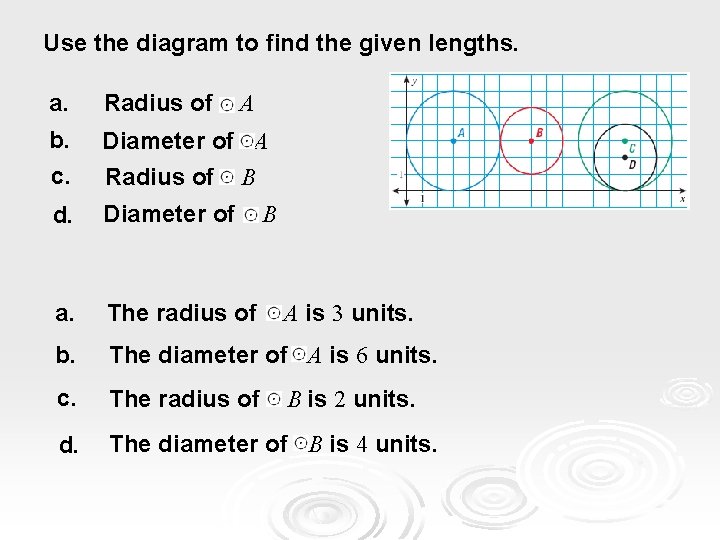
Use the diagram to find the given lengths. a. Radius of b. Diameter of A c. Radius of d. Diameter of a. The radius of b. The diameter of A is 6 units. c. The radius of d. The diameter of B is 4 units. A B B A is 3 units. B is 2 units.
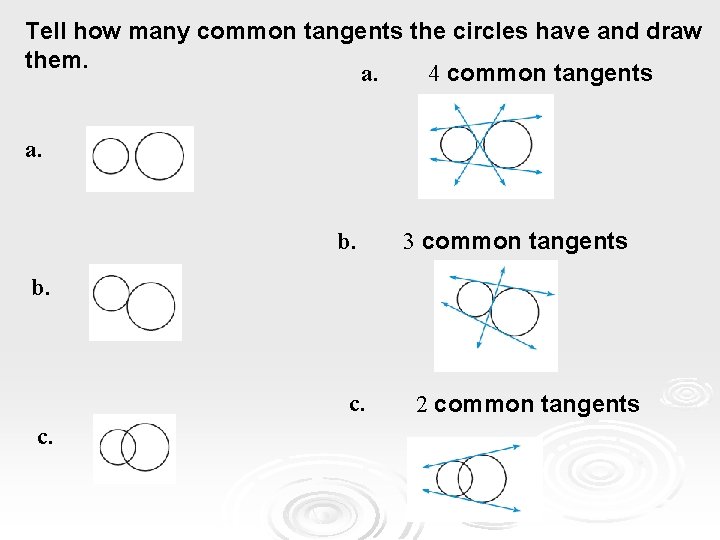
Tell how many EXAMPLE 3 common tangents the circles have and draw them. a. 4 common tangents a. b. 3 common tangents b. c. c. 2 common tangents
Chapter 10 Properties of Circles Aim: 10. 1 Use Properties of Tangents
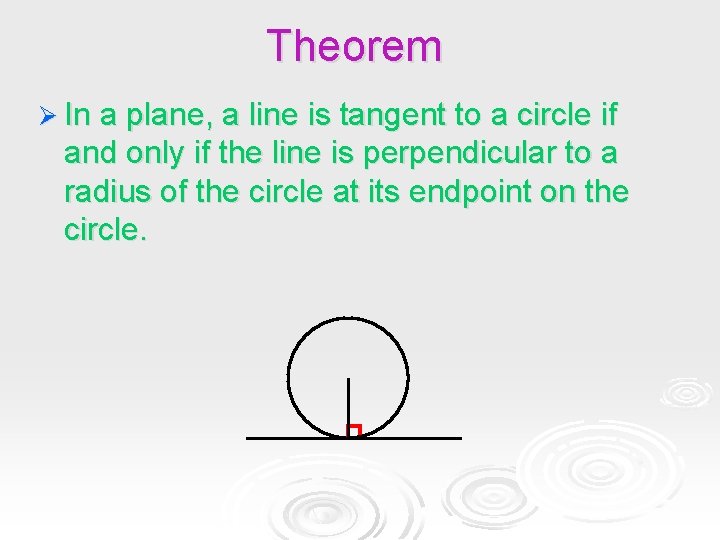
Theorem Ø In a plane, a line is tangent to a circle if and only if the line is perpendicular to a radius of the circle at its endpoint on the circle.
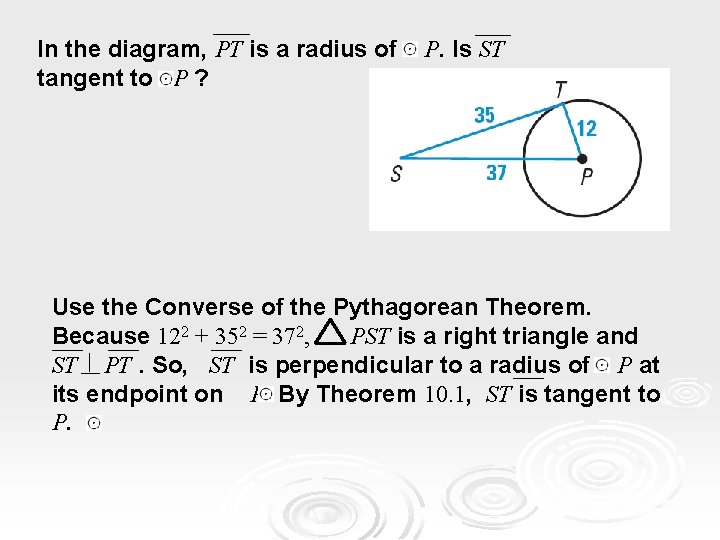
In the diagram, PT is a radius of tangent to P ? P. Is ST Use the Converse of the Pythagorean Theorem. Because 122 + 352 = 372, PST is a right triangle and ST PT. So, ST is perpendicular to a radius of P at its endpoint on P. By Theorem 10. 1, ST is tangent to P.
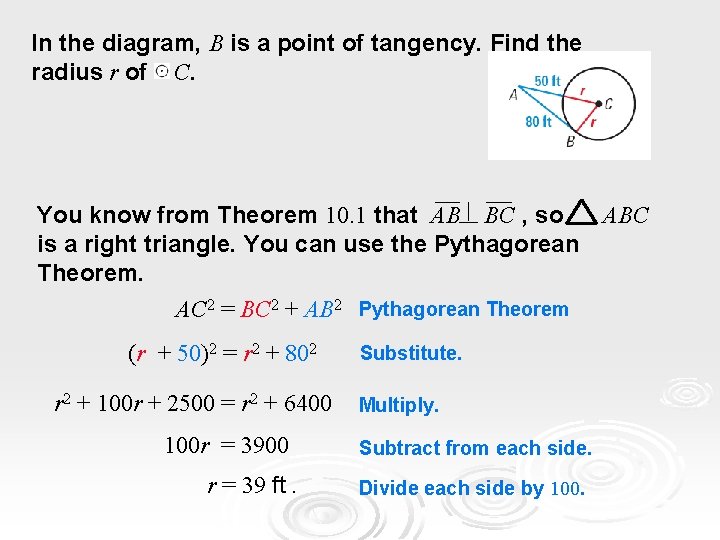
In the diagram, B is a point of tangency. Find the radius r of C. You know from Theorem 10. 1 that AB BC , so ABC is a right triangle. You can use the Pythagorean Theorem. AC 2 = BC 2 + AB 2 Pythagorean Theorem (r + 50)2 = r 2 + 802 r 2 + 100 r + 2500 = r 2 + 6400 100 r = 3900 r = 39 ft. Substitute. Multiply. Subtract from each side. Divide each side by 100.
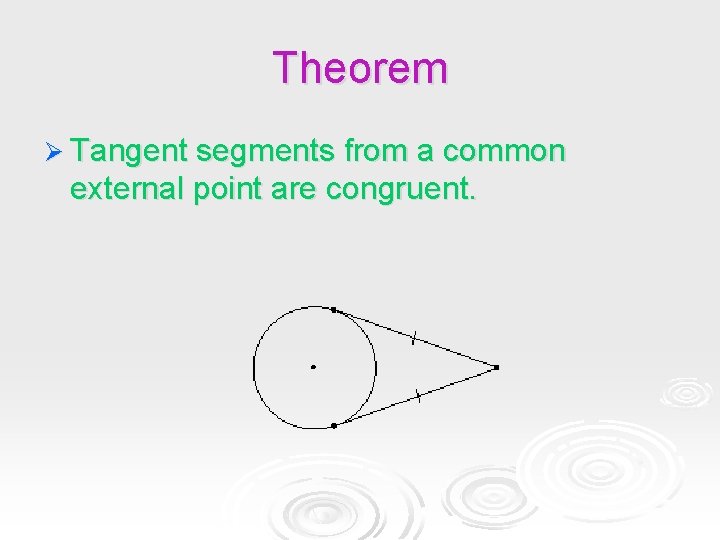
Theorem Ø Tangent segments from a common external point are congruent.
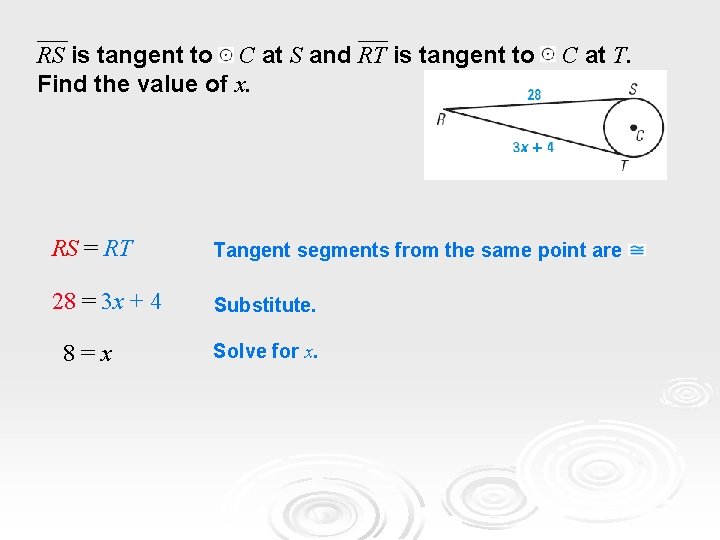
RS is tangent to C at S and RT is tangent to Find the value of x. C at T. RS = RT Tangent segments from the same point are 28 = 3 x + 4 Substitute. 8=x Solve for x.
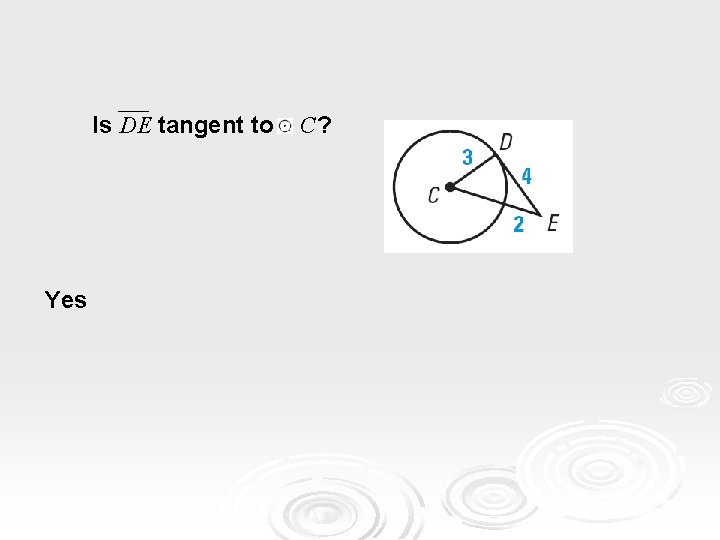
Is DE tangent to Yes C?
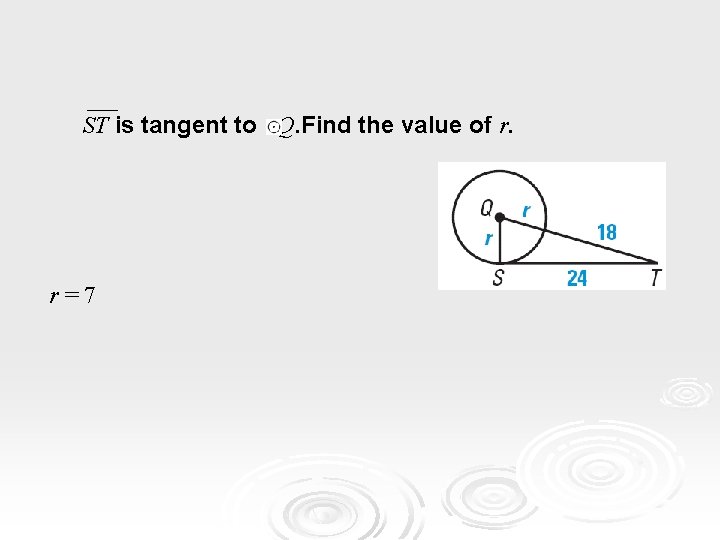
ST is tangent to Q. Find the value of r. r=7
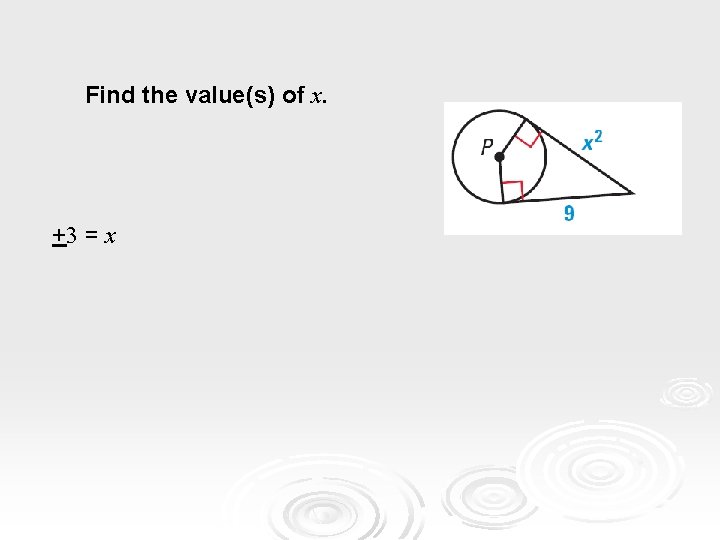
Find the value(s) of x. +3 = x
Chapter 10 Properties of Circles Aim: 10. 2 Find Arc Measures
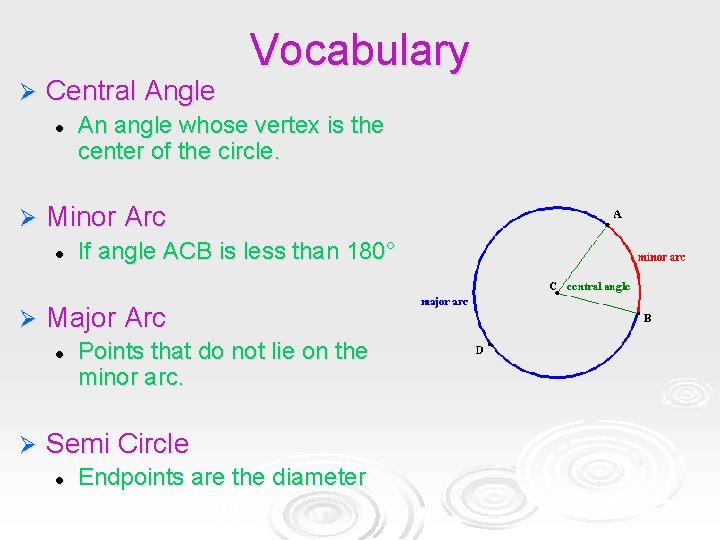
Ø Central Angle l Ø If angle ACB is less than 180° Major Arc l Ø An angle whose vertex is the center of the circle. Minor Arc l Ø Vocabulary Points that do not lie on the minor arc. Semi Circle l Endpoints are the diameter
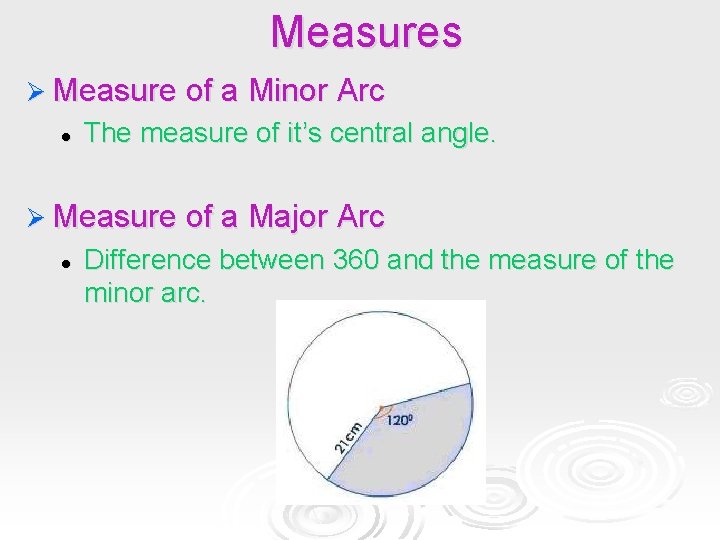
Measures Ø Measure of a Minor Arc l The measure of it’s central angle. Ø Measure of a Major Arc l Difference between 360 and the measure of the minor arc.
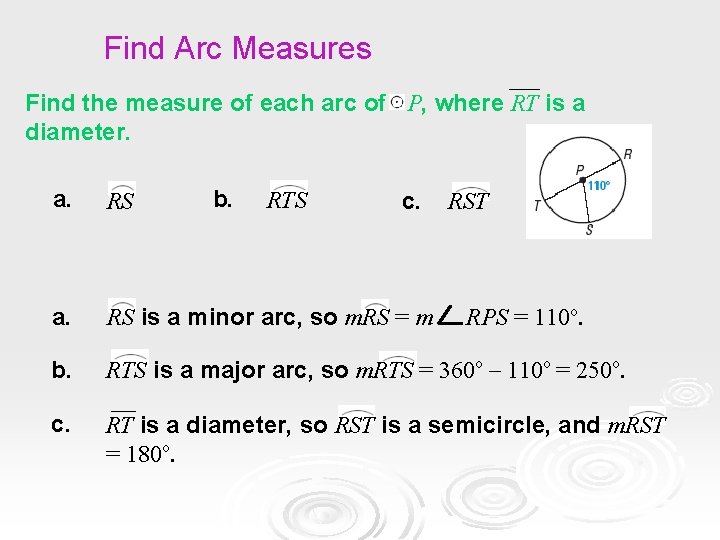
Find Arc Measures Find the measure of each arc of P, where RT is a diameter. a. RS b. a. RS is a minor arc, so m. RS = m b. RTS is a major arc, so m. RTS = 360 o – 110 o = 250 o. c. RT is a diameter, so RST is a semicircle, and m. RST = 180 o. RTS c. RST RPS = 110 o.
Arc Addition Postulate Ø The measure of an arc formed by two adjacent arcs is the sum of the measures of the two arcs.
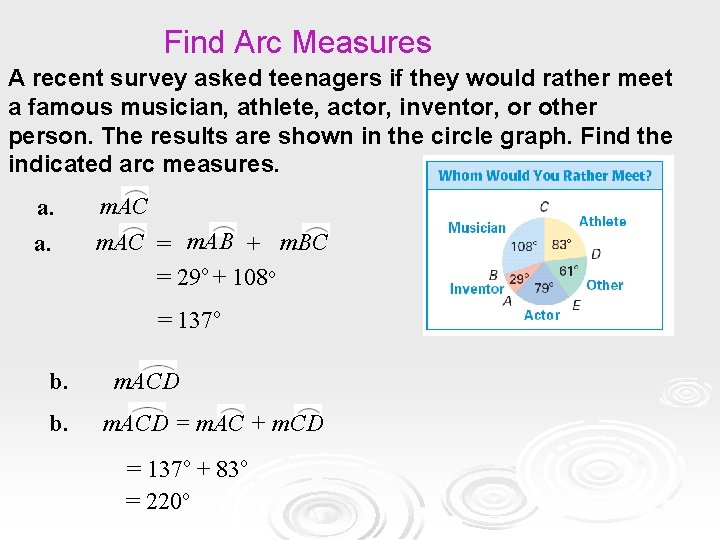
EXAMPLE 2 Find Arc Measures A recent survey asked teenagers if they would rather meet a famous musician, athlete, actor, inventor, or other person. The results are shown in the circle graph. Find the indicated arc measures. a. m. AC = m. AB + m. BC = 29 o + 108 o = 137 o b. b. m. ACD = m. AC + m. CD = 137 o + 83 o = 220 o
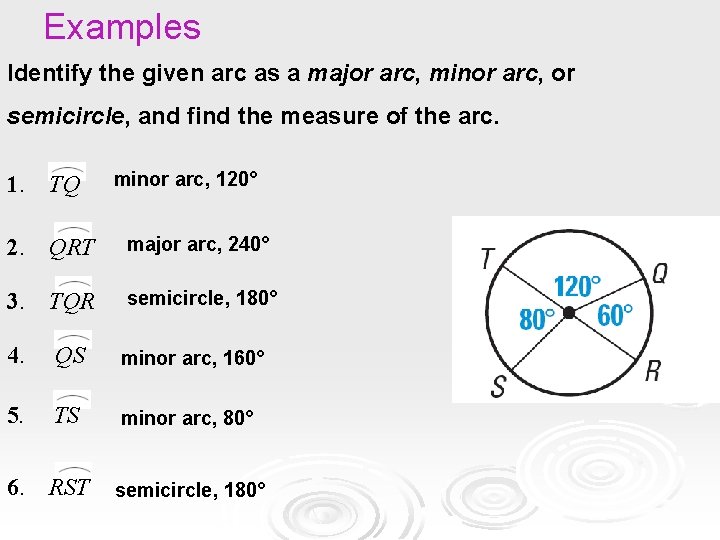
Examples Identify the given arc as a major arc, minor arc, or semicircle, and find the measure of the arc. 1. TQ minor arc, 120° 2. QRT major arc, 240° 3. TQR semicircle, 180° 4. QS minor arc, 160° 5. TS minor arc, 80° 6. RST semicircle, 180°
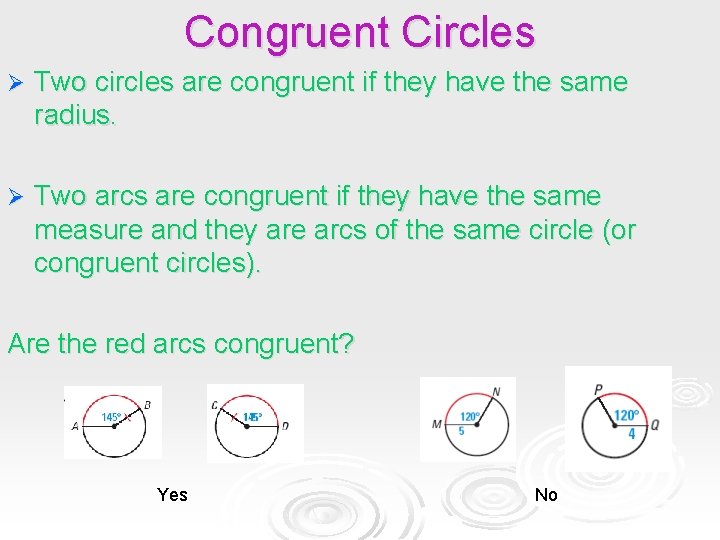
Congruent Circles Ø Two circles are congruent if they have the same radius. Ø Two arcs are congruent if they have the same measure and they are arcs of the same circle (or congruent circles). Are the red arcs congruent? Yes No
Chapter 10 Properties of Circles Aim: 10. 3 Apply Properties of Chords
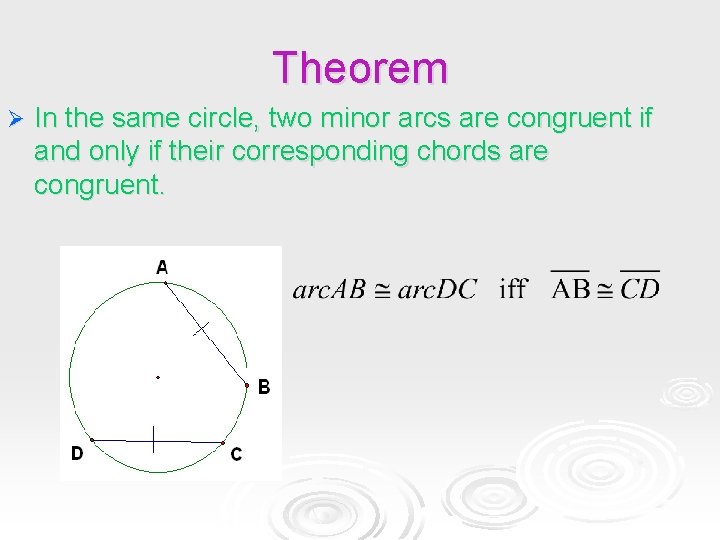
Theorem Ø In the same circle, two minor arcs are congruent if and only if their corresponding chords are congruent.
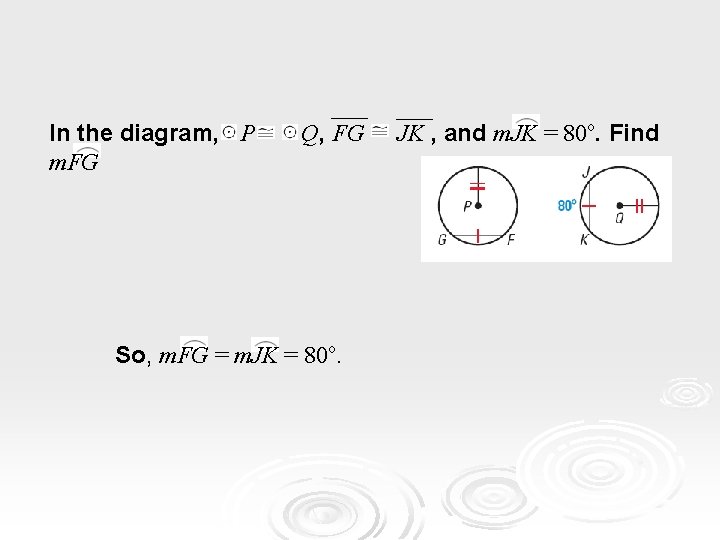
EXAMPLE 1 In the diagram, P m. FG Q, FG So, m. FG = m. JK = 80 o. JK , and m. JK = 80 o. Find
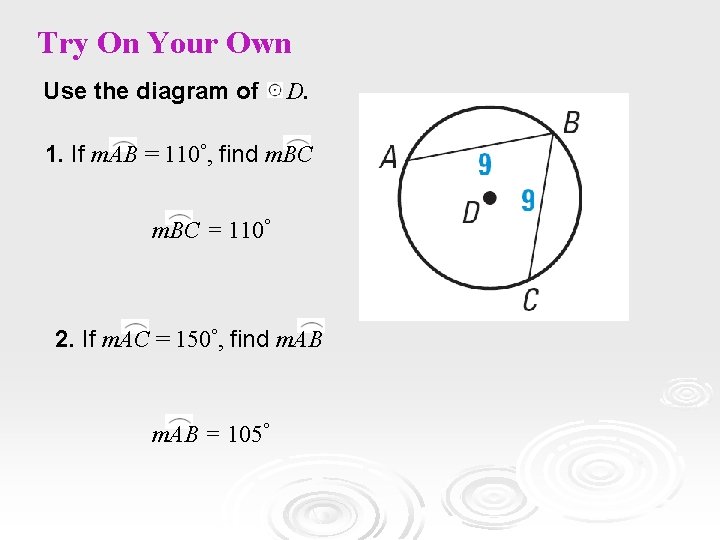
GUIDED Try On. PRACTICE Your Own Use the diagram of D. 1. If m. AB = 110°, find m. BC = 110° 2. If m. AC = 150°, find m. AB = 105°
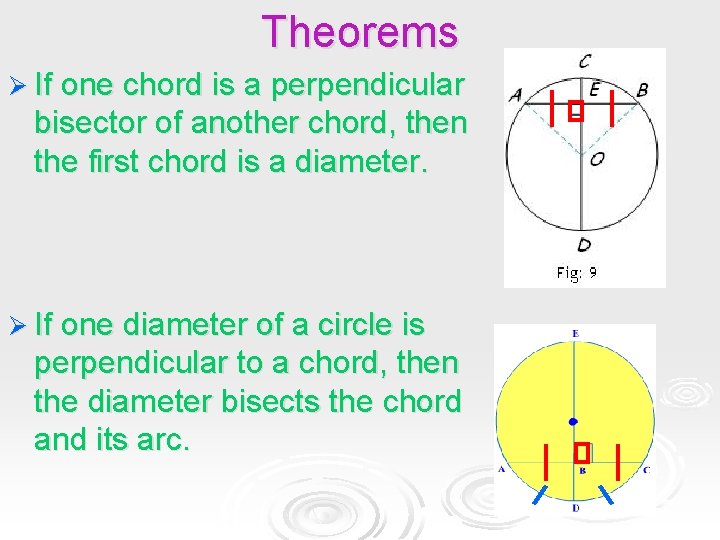
Theorems Ø If one chord is a perpendicular bisector of another chord, then the first chord is a diameter. Ø If one diameter of a circle is perpendicular to a chord, then the diameter bisects the chord and its arc.
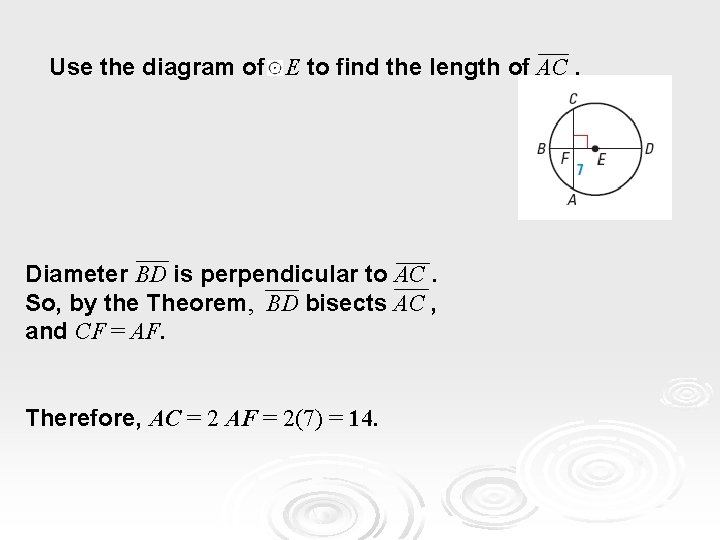
EXAMPLE 3 Use the diagram of E to find the length of AC. Diameter BD is perpendicular to AC. So, by the Theorem, BD bisects AC , and CF = AF. Therefore, AC = 2 AF = 2(7) = 14.
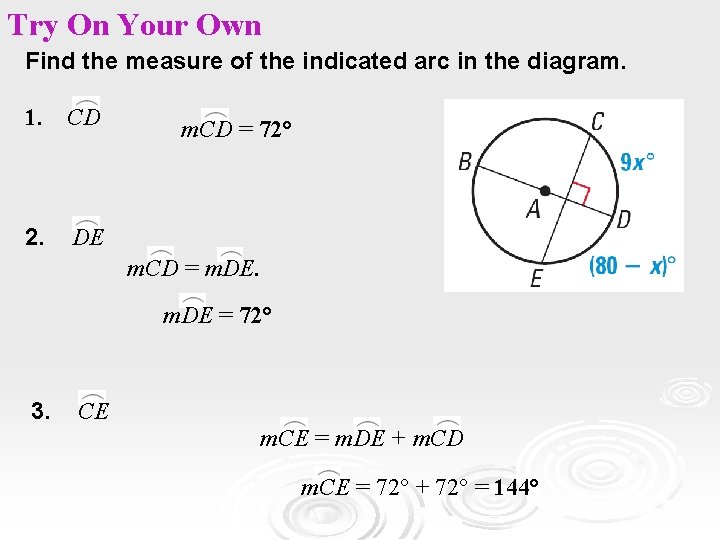
Try On Your Own Find the measure of the indicated arc in the diagram. 1. CD 2. m. CD = 72° DE m. CD = m. DE = 72° 3. CE m. CE = m. DE + m. CD m. CE = 72° + 72° = 144°
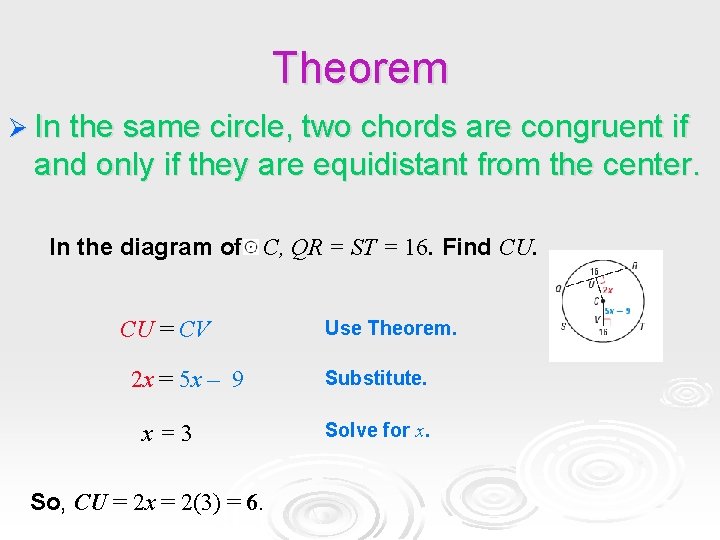
Theorem Ø In the same circle, two chords are congruent if and only if they are equidistant from the center. In the diagram of C, QR = ST = 16. Find CU. CU = CV 2 x = 5 x – 9 x=3 So, CU = 2 x = 2(3) = 6. Use Theorem. Substitute. Solve for x.
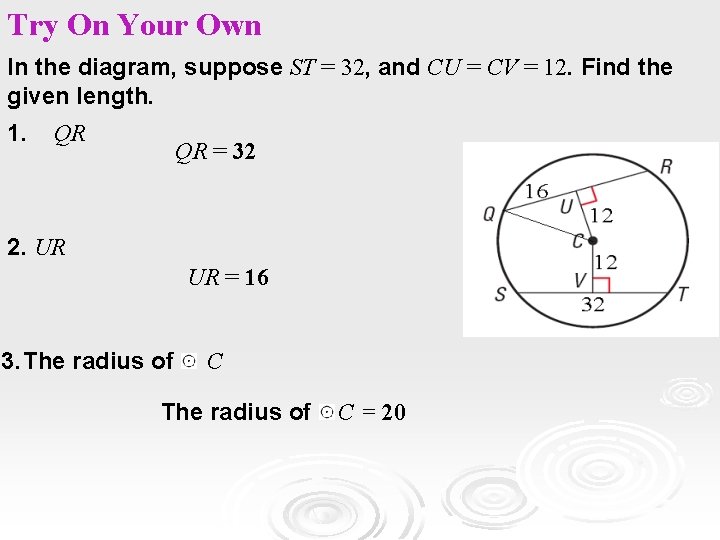
Try On Your Own In the diagram, suppose ST = 32, and CU = CV = 12. Find the given length. 1. QR QR = 32 2. UR UR = 16 3. The radius of C = 20
Chapter 10 Properties of Circles Aim: 10. 4 Use Inscribed Angles and Polygons
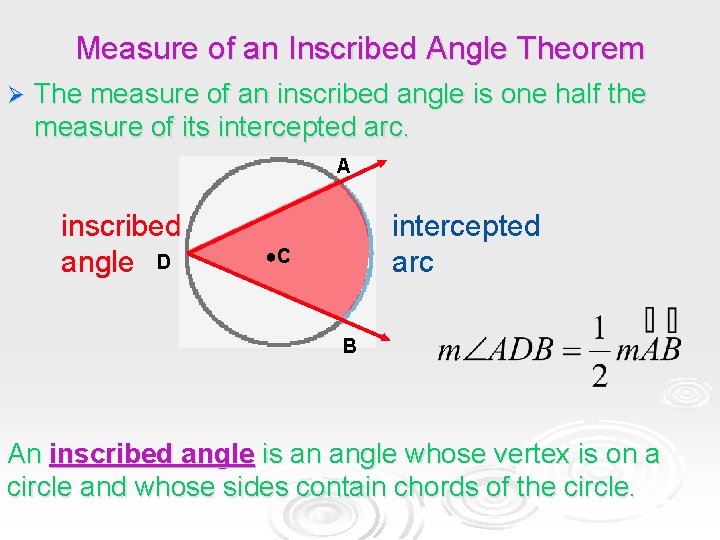
Measure of an Inscribed Angle Theorem Ø The measure of an inscribed angle is one half the measure of its intercepted arc. A inscribed angle D intercepted arc ●C B An inscribed angle is an angle whose vertex is on a circle and whose sides contain chords of the circle.
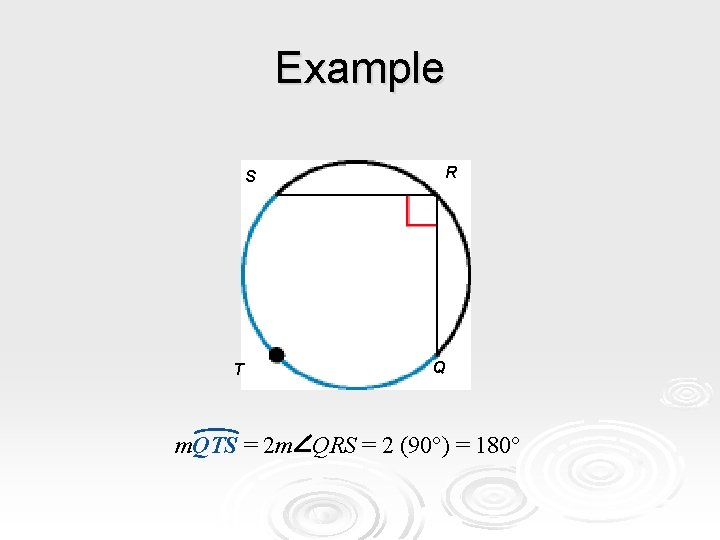
Example S T R Q m. QTS = 2 m QRS = 2 (90°) = 180°
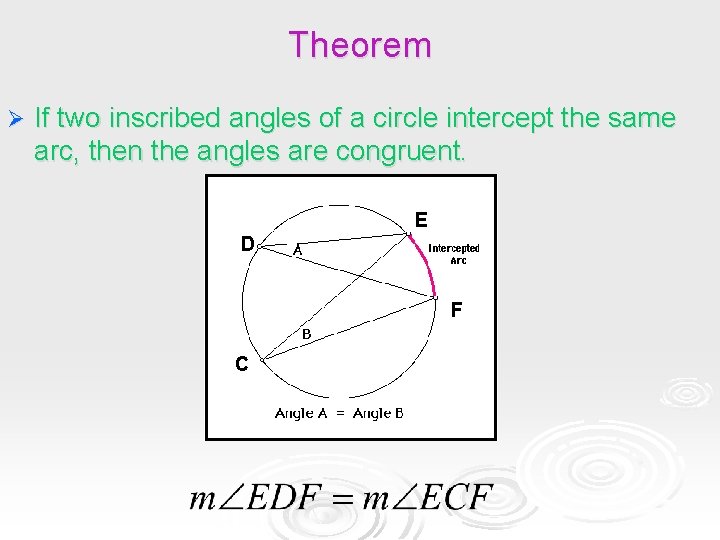
Theorem Ø If two inscribed angles of a circle intercept the same arc, then the angles are congruent. E D F C
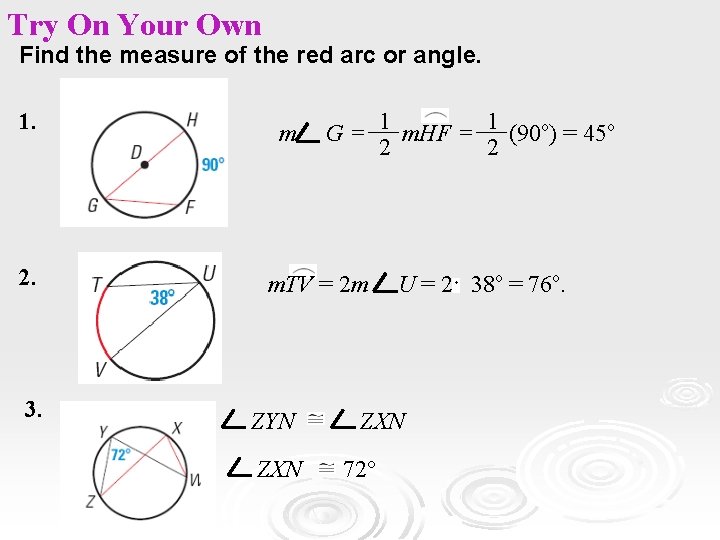
Try On Your Own Find the measure of the red arc or angle. 1. 2. 3. m G = 1 m. HF = 1 (90 o) = 45 o 2 2 m. TV = 2 m ZYN ZXN U = 2 38 o = 76 o. ZXN 72°
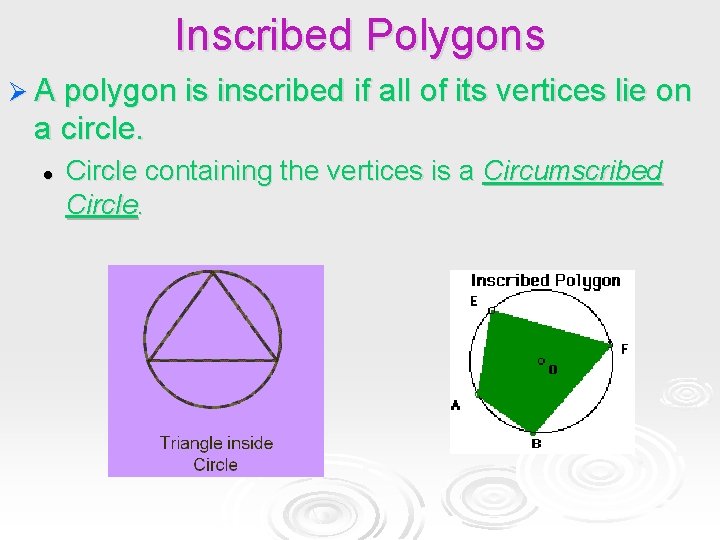
Inscribed Polygons Ø A polygon is inscribed if all of its vertices lie on a circle. l Circle containing the vertices is a Circumscribed Circle.
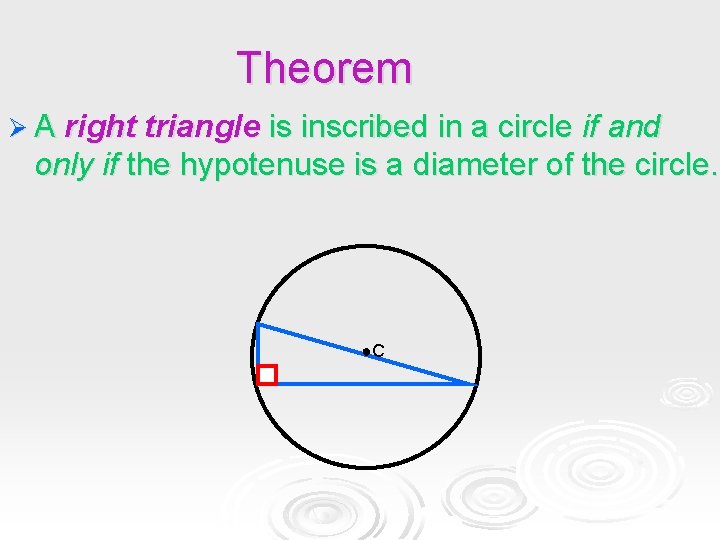
Theorem Ø A right triangle is inscribed in a circle if and only if the hypotenuse is a diameter of the circle. ●C
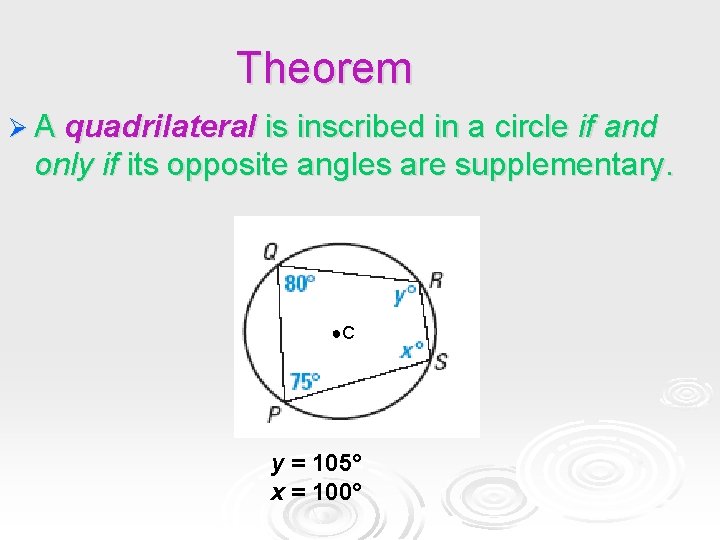
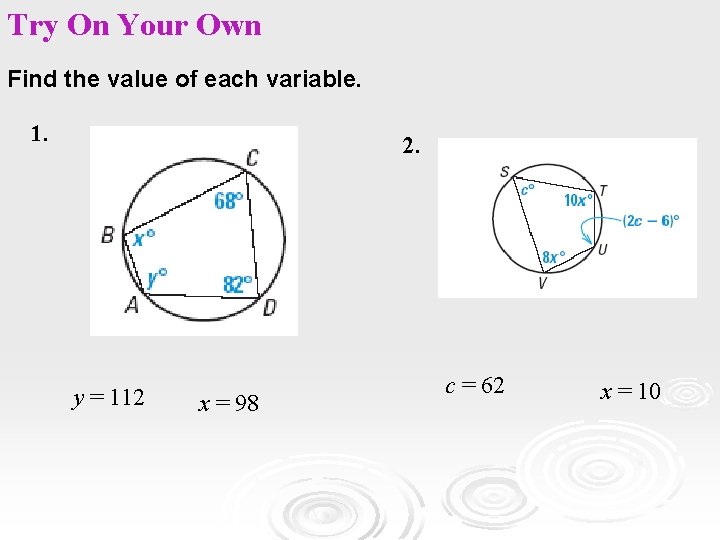
Theorem Ø A quadrilateral is inscribed in a circle if and only if its opposite angles are supplementary. ●C y = 105° x = 100°
Try On Your Own Find the value of each variable. 1. 2. y = 112 x = 98 c = 62 x = 10
Chapter 10 Properties of Circles Aim: 10. 5: Apply Other Angle Relationships in Circles
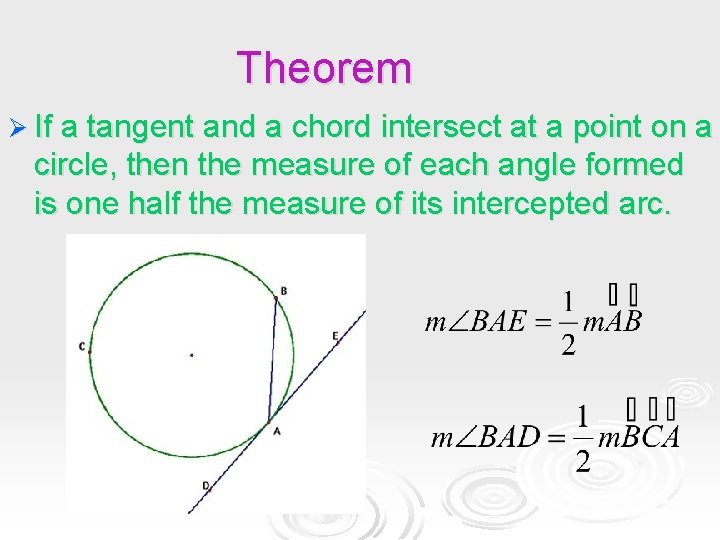
Theorem Ø If a tangent and a chord intersect at a point on a circle, then the measure of each angle formed is one half the measure of its intercepted arc.
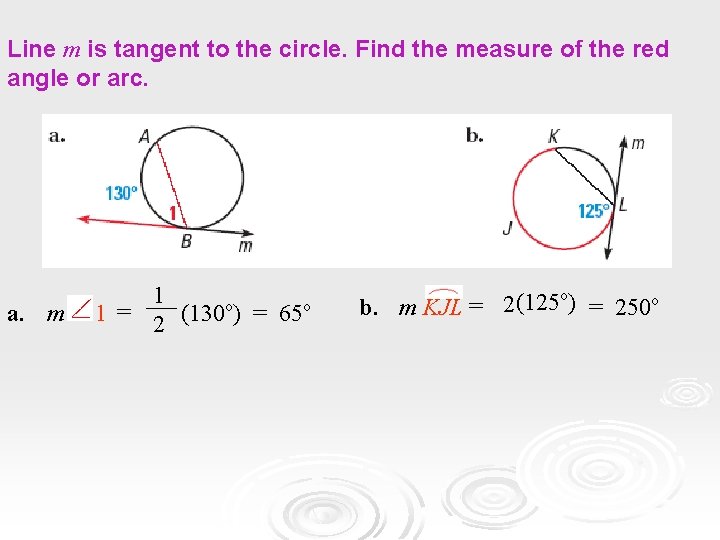
Line m is tangent to the circle. Find the measure of the red angle or arc. a. m 1 1 = 2 (130 o) = 65 o o b. m KJL = 2 (125 ) = 250 o
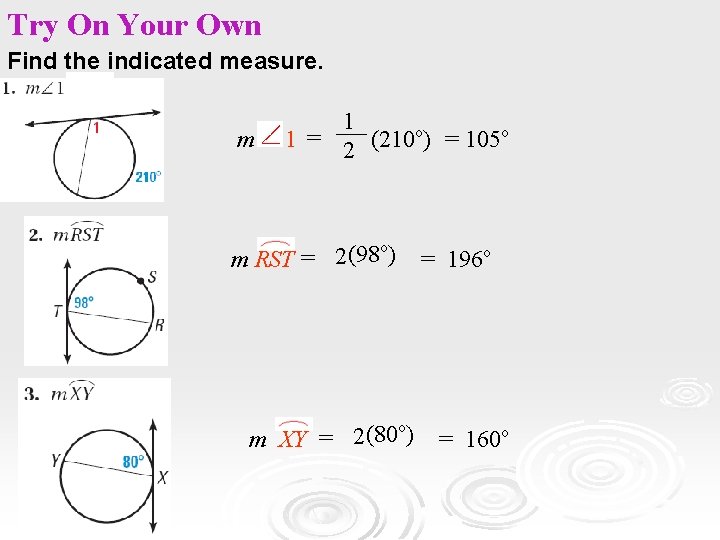
Try On Your Own Find the indicated measure. m 1 1 = 2 (210 o) = 105 o o m RST = 2 (98 ) o m XY = 2 (80 ) = 196 o = 160 o
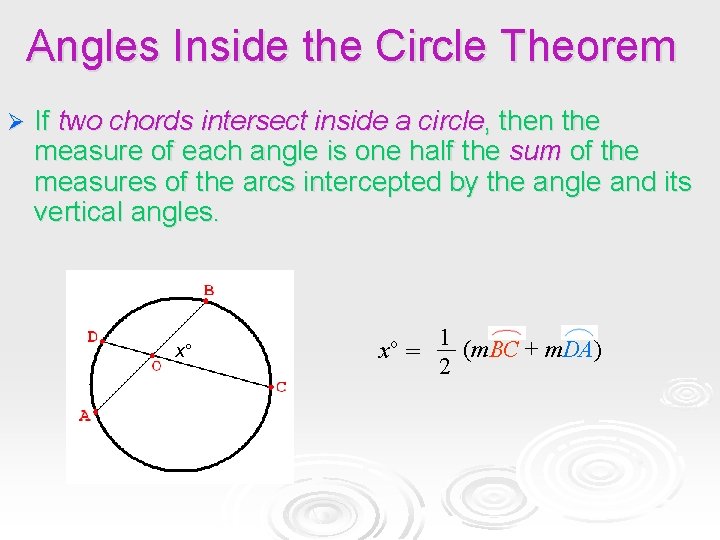
Angles Inside the Circle Theorem Ø If two chords intersect inside a circle, then the measure of each angle is one half the sum of the measures of the arcs intercepted by the angle and its vertical angles. x° xo = 1 (m. BC + m. DA) 2
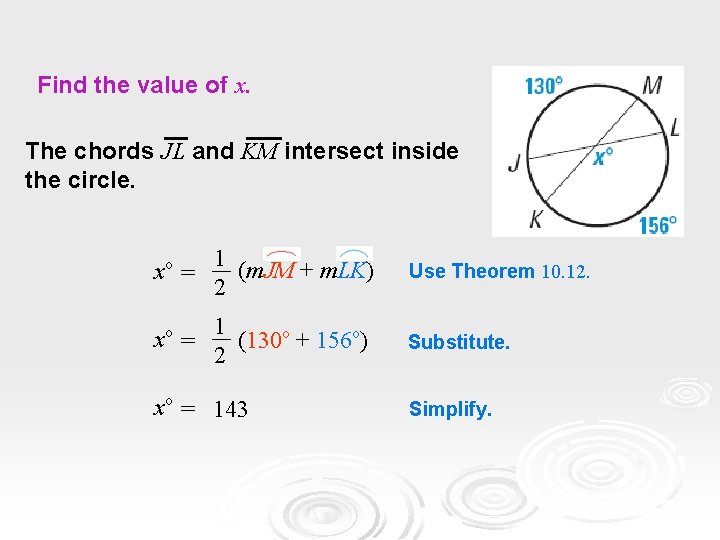
Find the value of x. The chords JL and KM intersect inside the circle. xo = 1 (m. JM + m. LK) 2 Use Theorem 10. 12. xo = 1 (130 o + 156 o) 2 Substitute. xo = 143 Simplify.
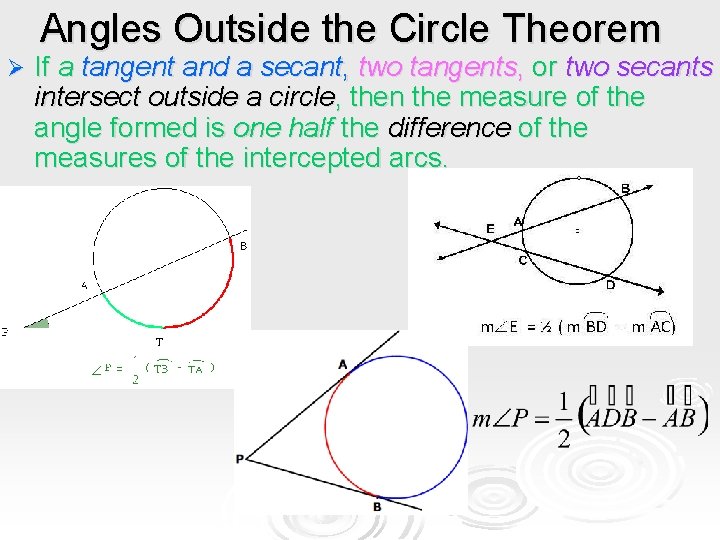
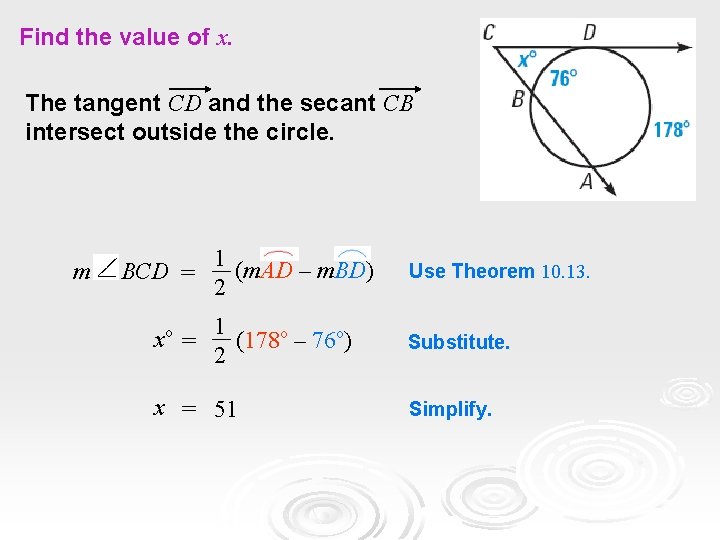
Angles Outside the Circle Theorem Ø If a tangent and a secant, two tangents, or two secants intersect outside a circle, then the measure of the angle formed is one half the difference of the measures of the intercepted arcs.
Find the value of x. The tangent CD and the secant CB intersect outside the circle. m BCD = xo = 1 (m. AD – m. BD) 2 Use Theorem 10. 13. 1 (178 o – 76 o) 2 Substitute. x = 51 Simplify.
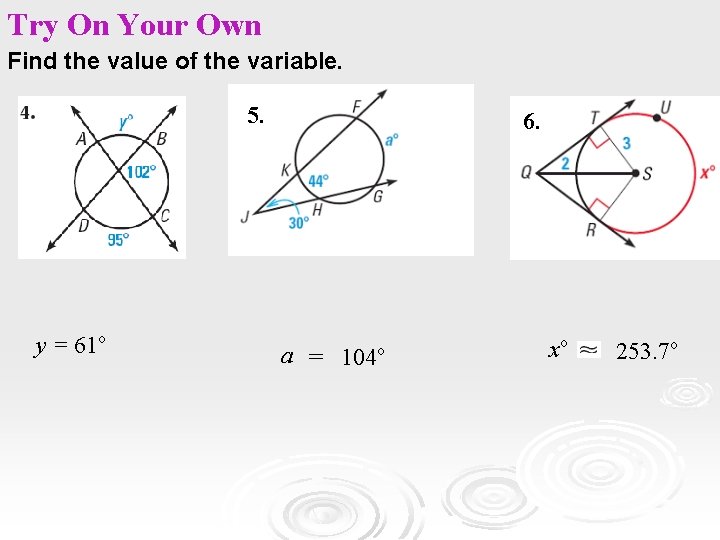
Try On Your Own Find the value of the variable. 5. y = 61 o 6. a = 104 o xo 253. 7 o
Chapter 10 Properties of Circles Aim: 10. 6: Find Segment Lengths in Circles
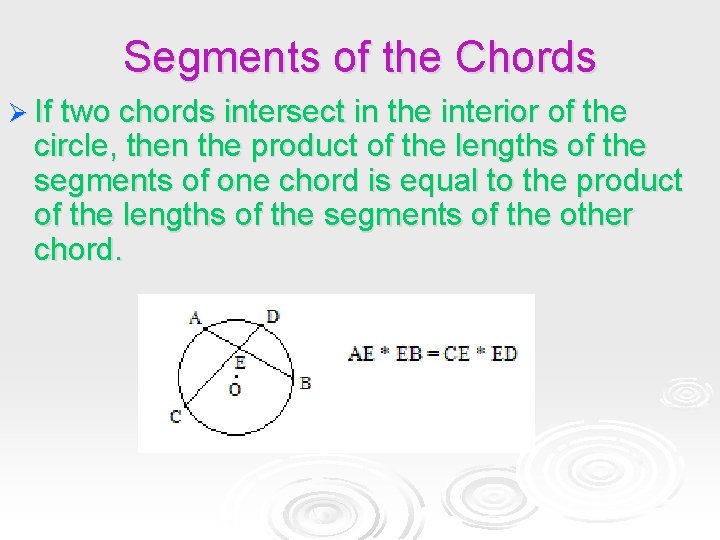
Segments of the Chords Ø If two chords intersect in the interior of the circle, then the product of the lengths of the segments of one chord is equal to the product of the lengths of the segments of the other chord.
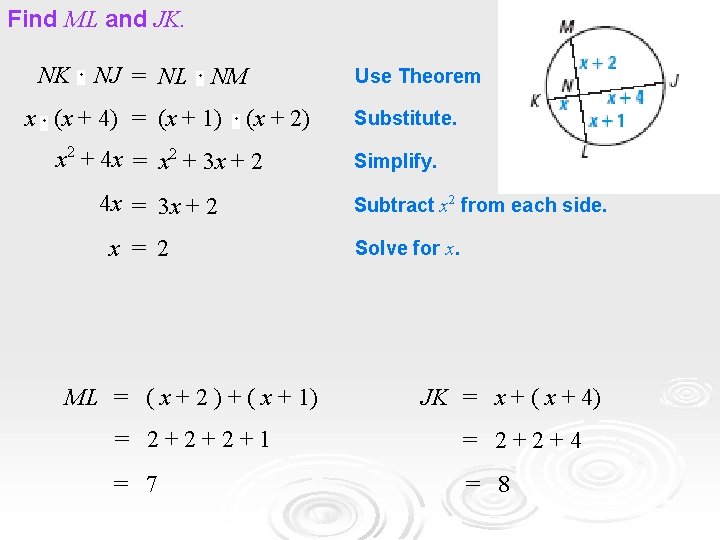
Find ML and JK. EXAMPLE 1 NK NJ = NL NM x (x + 4) = (x + 1) (x + 2) x 2 + 4 x = x 2 + 3 x + 2 4 x = 3 x + 2 x = 2 ML = ( x + 2 ) + ( x + 1) Use Theorem Substitute. Simplify. Subtract x 2 from each side. Solve for x. JK = x + ( x + 4) = 2+2+2+1 = 2+2+4 = 7 = 8
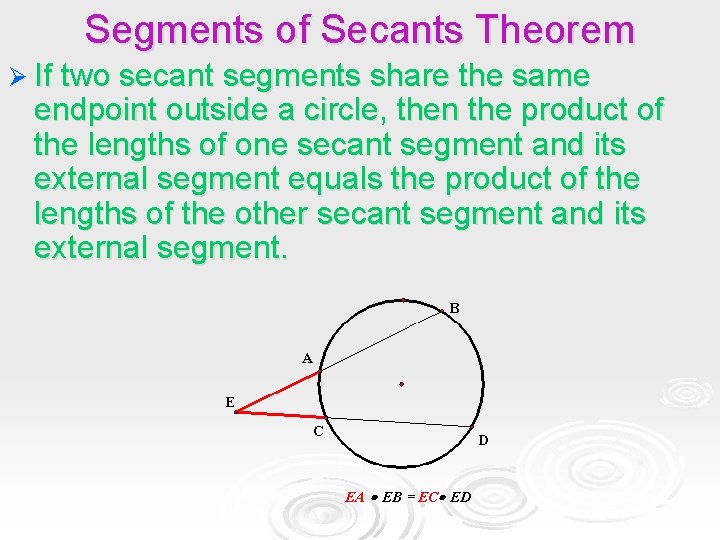
Segments of Secants Theorem Ø If two secant segments share the same endpoint outside a circle, then the product of the lengths of one secant segment and its external segment equals the product of the lengths of the other secant segment and its external segment.
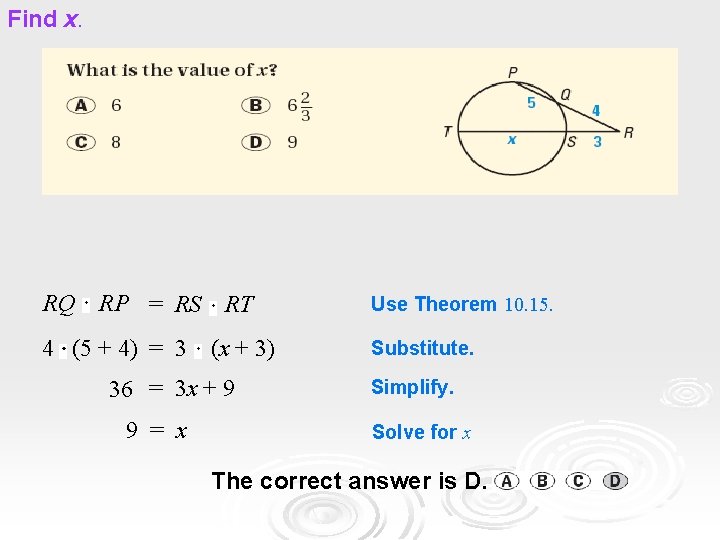
Find x. RQ RP = RS 4 (5 + 4) = 3 RT (x + 3) 36 = 3 x + 9 9 = x Use Theorem 10. 15. Substitute. Simplify. Solve for x The correct answer is D.
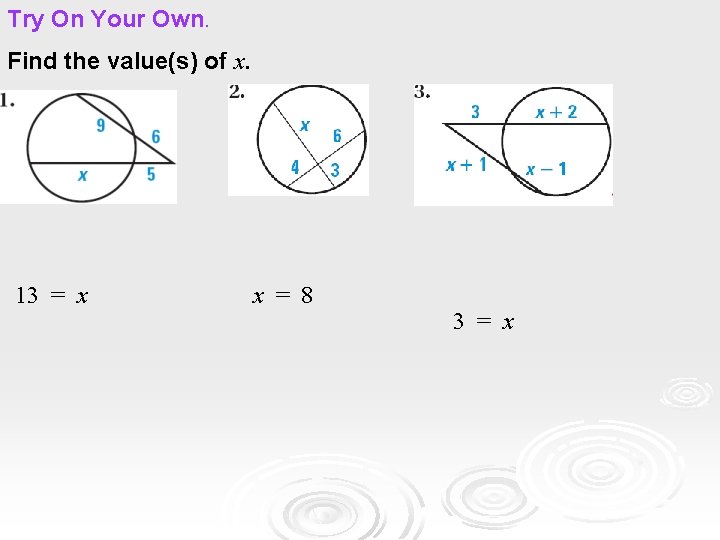
Try On Your Own. Find the value(s) of x. 13 = x x = 8 3 = x
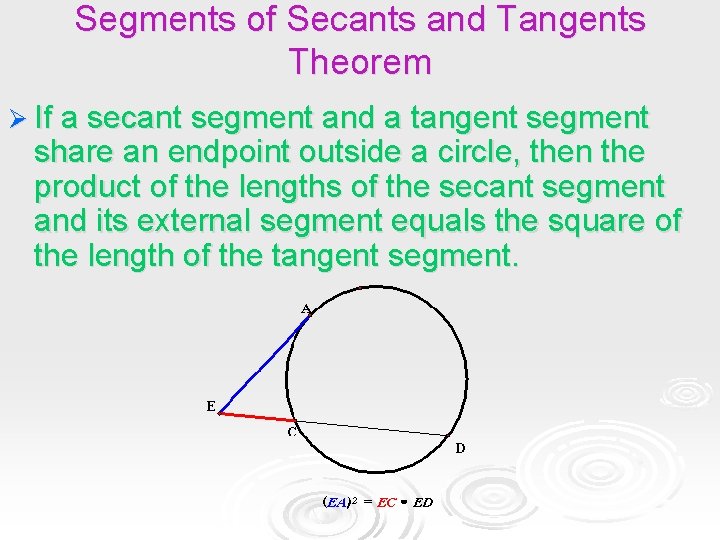
Segments of Secants and Tangents Theorem Ø If a secant segment and a tangent segment share an endpoint outside a circle, then the product of the lengths of the secant segment and its external segment equals the square of the length of the tangent segment.
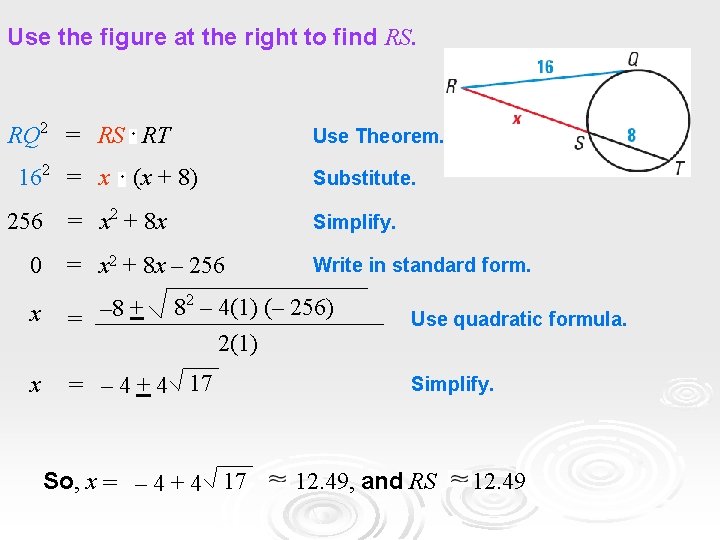
Use the figure at the right to find RS. RQ 2 = RS RT 162 = x Use Theorem. (x + 8) Substitute. = x 2 + 8 x Simplify. 0 = x 2 + 8 x – 256 Write in standard form. x = – 8 + 256 x 82 – 4(1) (– 256) 2(1) = – 4 + 4 17 So, x = – 4 + 4 17 Use quadratic formula. Simplify. 12. 49, and RS 12. 49
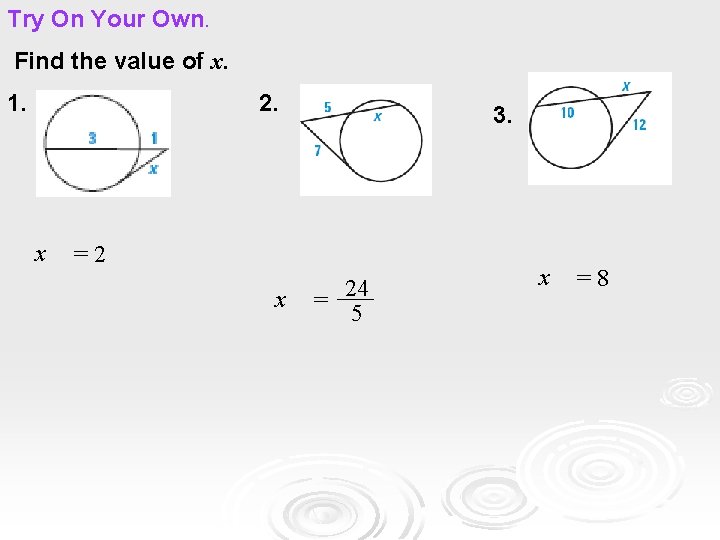
Try On Your Own. Find the value of x. 1. 2. x 3. =2 x 24 = 5 x =8
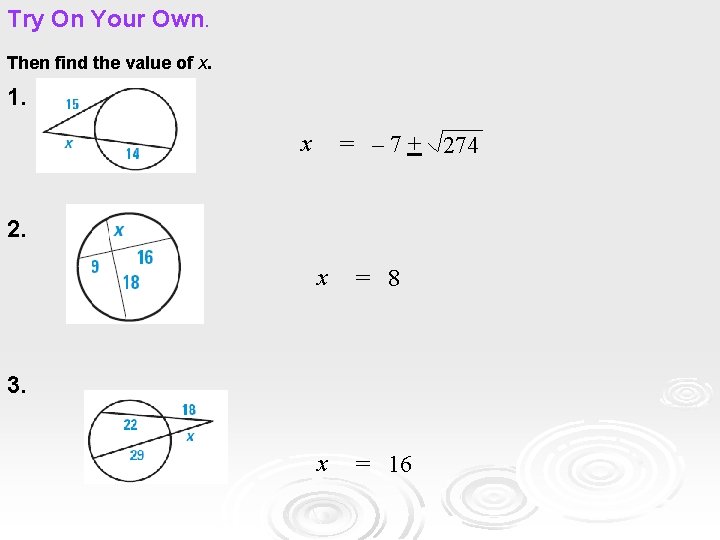
Try On Your Own. Then find the value of x. 1. x = – 7 + 274 2. x = 8 x = 16 3.
Chapter 10 Properties of Circles Aim: 10. 7: Write and Graph Equations of Circles
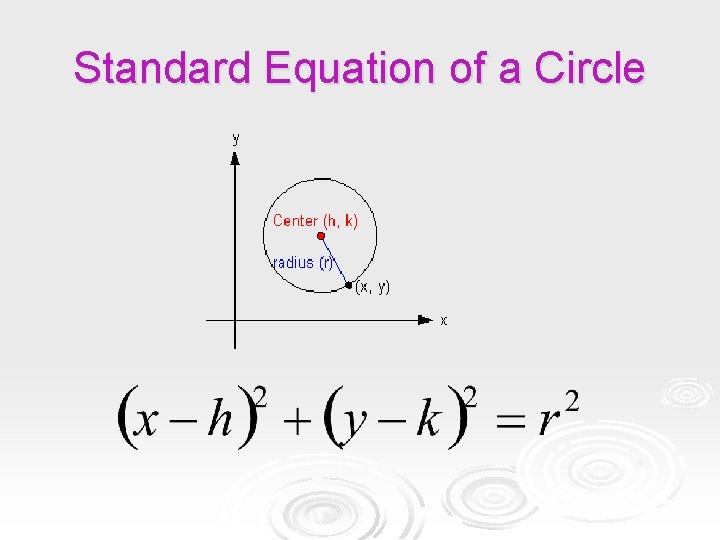
Standard Equation of a Circle
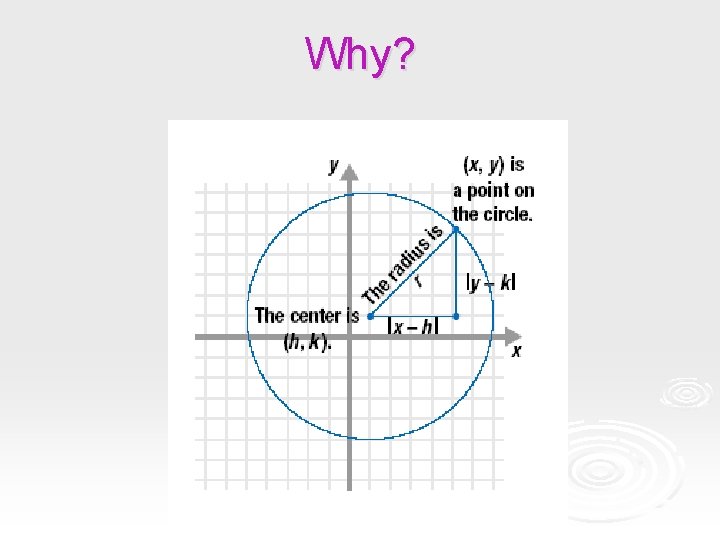
Why?
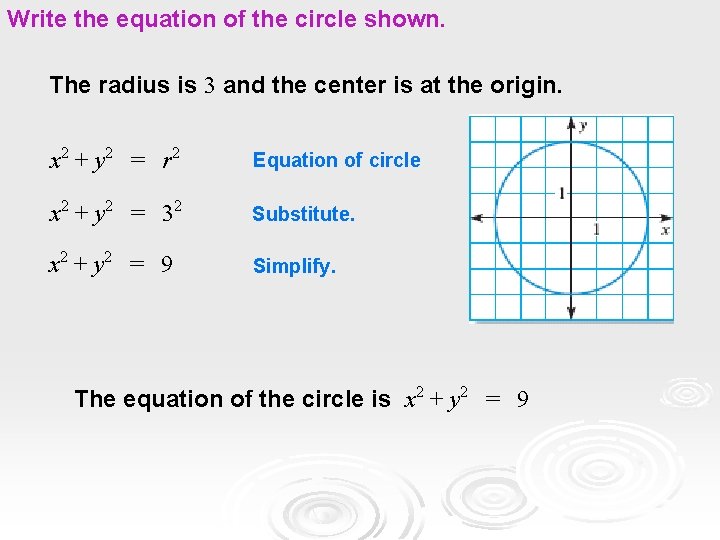
Write the equation of the circle shown. The radius is 3 and the center is at the origin. x 2 + y 2 = r 2 Equation of circle x 2 + y 2 = 32 Substitute. x 2 + y 2 = 9 Simplify. The equation of the circle is x 2 + y 2 = 9
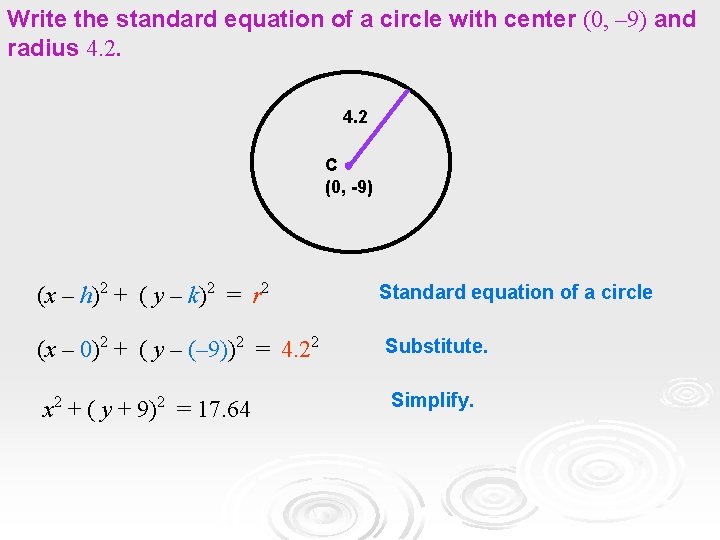
Write the standard equation of a circle with center (0, – 9) and radius 4. 2 C● (0, -9) (x – h)2 + ( y – k)2 = r 2 Standard equation of a circle (x – 0)2 + ( y – (– 9))2 = 4. 22 Substitute. x 2 + ( y + 9)2 = 17. 64 Simplify.
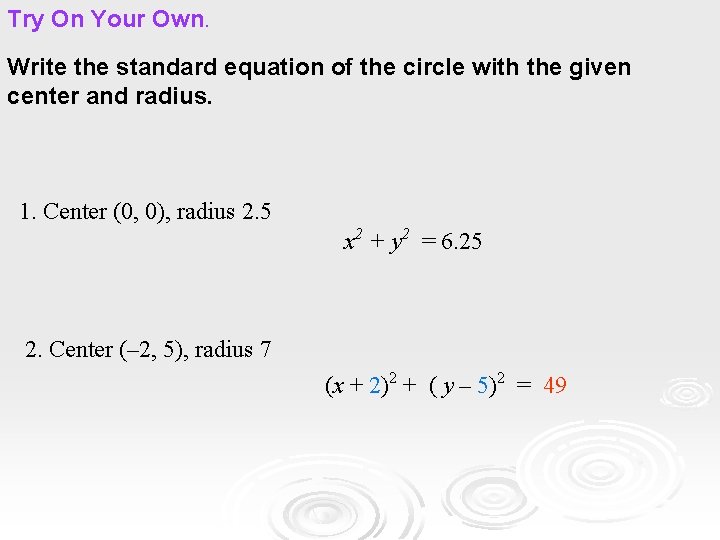
Try On Your Own. Write the standard equation of the circle with the given center and radius. 1. Center (0, 0), radius 2. 5 x 2 + y 2 = 6. 25 2. Center (– 2, 5), radius 7 (x + 2)2 + ( y – 5)2 = 49
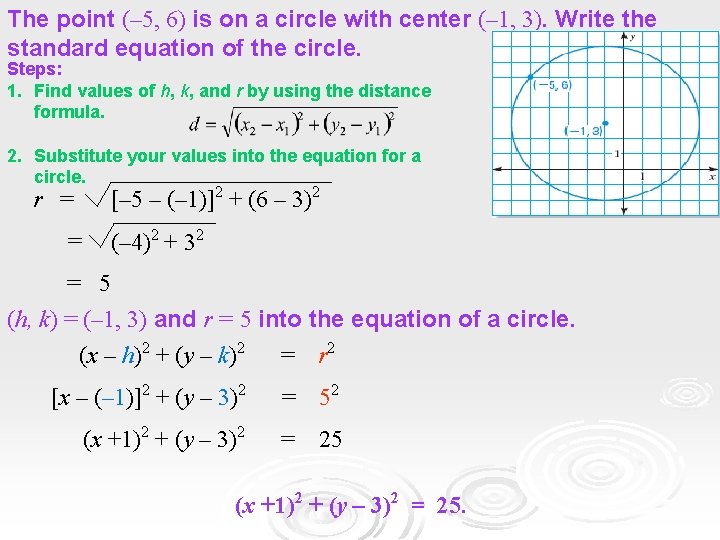
The point (– 5, 6) is on a circle with center (– 1, 3). Write the EXAMPLE 3 standard equation of the circle. Steps: 1. Find values of h, k, and r by using the distance formula. 2. Substitute your values into the equation for a circle. r = = [– 5 – (– 1)]2 + (6 – 3)2 (– 4)2 + 32 = 5 (h, k) = (– 1, 3) and r = 5 into the equation of a circle. (x – h)2 + (y – k)2 = r 2 [x – (– 1)]2 + (y – 3)2 = 52 (x +1)2 + (y – 3)2 = 25.
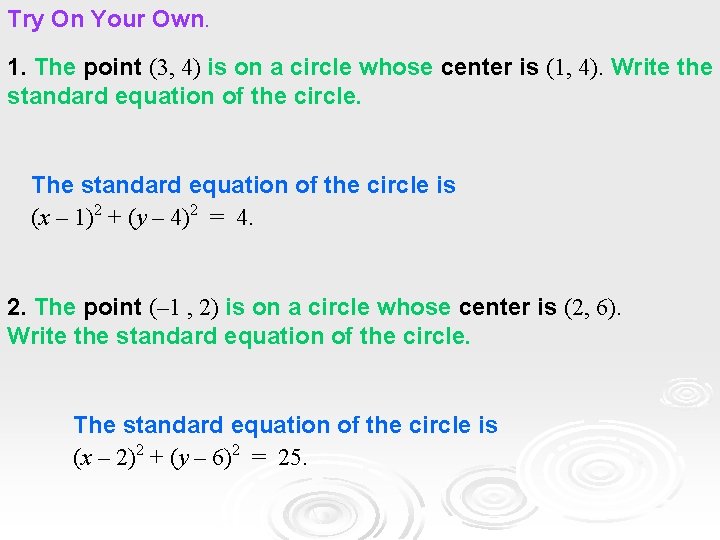
Try On Your Own. 1. The point (3, 4) is on a circle whose center is (1, 4). Write the standard equation of the circle. The standard equation of the circle is (x – 1)2 + (y – 4)2 = 4. 2. The point (– 1 , 2) is on a circle whose center is (2, 6). Write the standard equation of the circle. The standard equation of the circle is (x – 2)2 + (y – 6)2 = 25.
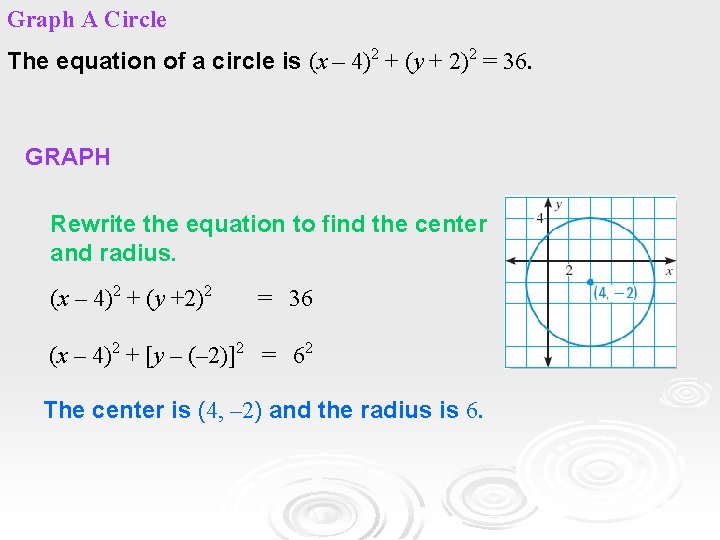
Graph A Circle The equation of a circle is (x – 4)2 + (y + 2)2 = 36. GRAPH Rewrite the equation to find the center and radius. (x – 4)2 + (y +2)2 = 36 (x – 4)2 + [y – (– 2)]2 = 62 The center is (4, – 2) and the radius is 6.
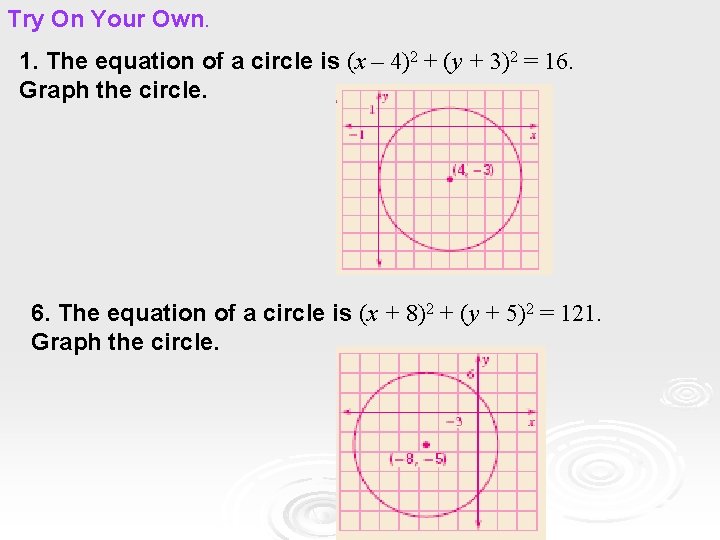
Try On Your Own. 1. The equation of a circle is (x – 4)2 + (y + 3)2 = 16. Graph the circle. 6. The equation of a circle is (x + 8)2 + (y + 5)2 = 121. Graph the circle.