
CHAPTER 10 Projects Learning Objectives 1 2 3
CHAPTER 10 Projects
Learning Objectives 1. 2. 3. 4. 5. 6. Explain what project management is and why it is important. Identify the different ways projects can be structured. Describe how projects are organized into major subprojects. Understand what a project milestone is. Determine the “critical path” for a project. Demonstrate how to “crash, ” or reduce the length, of a project.
Project Management Defined l l Project is a series of related jobs usually directed toward some major output and requiring a significant period of time to perform Project Management are the management activities of planning, directing, and controlling resources (people, equipment, material) to meet the technical, cost, and time constraints of a project
Work Breakdown Structure l l Statement of work (SOW): a written description of the objectives to be achieved Task: a further subdivision of a project l l l Usually shorter than several months Performed by one group or organization Work package: a group of activities combined to be assignable to a single organizational unit LO 3

Work Breakdown Structure l l l Continued Project milestones: specific events on the project Work breakdown structure (WBS): defines the hierarchy of project tasks, subtasks, and work packages Activities: pieces of work that consume time l LO 4 Defined within the context of the WBS
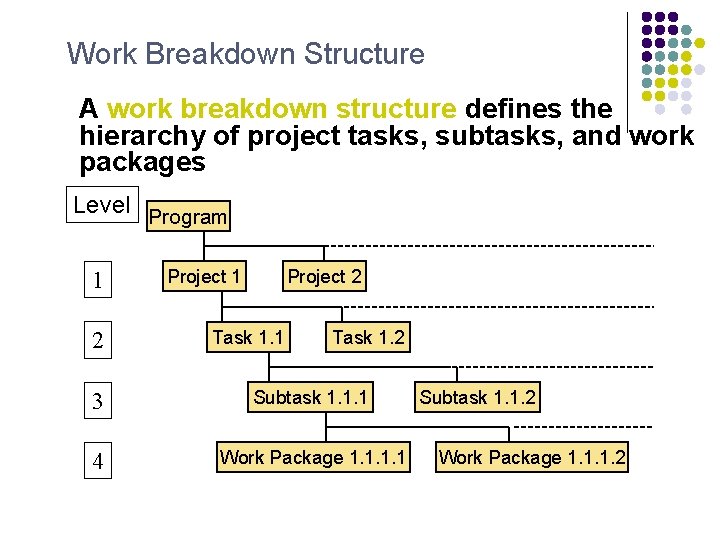
Work Breakdown Structure A work breakdown structure defines the hierarchy of project tasks, subtasks, and work packages Level Program 1 2 Project 1 Project 2 Task 1. 1 Task 1. 2 3 Subtask 1. 1. 1 4 Work Package 1. 1 Subtask 1. 1. 2 Work Package 1. 1. 1. 2
Project Control Charts l l l Charts are useful because their visual presentation is easily understood Software is available to create the charts Gantt chart: a bar chart showing both the amount of time involved and the sequence in which activities can be performed LO 3
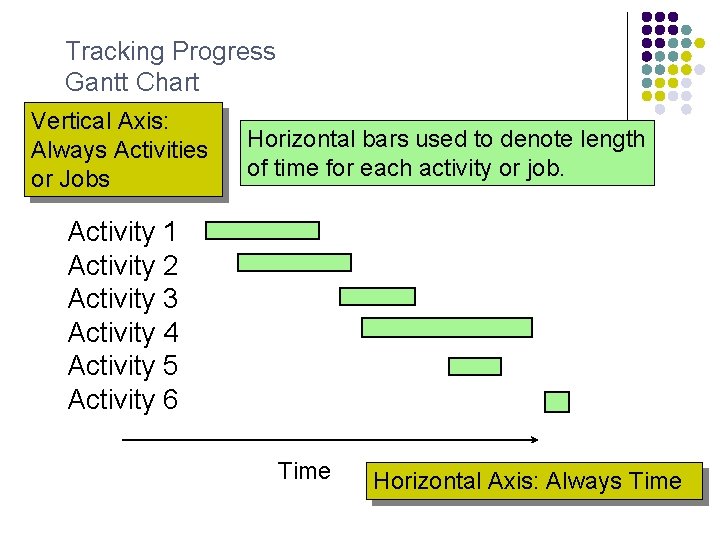
Tracking Progress Gantt Chart Vertical Axis: Always Activities or Jobs Horizontal bars used to denote length of time for each activity or job. Activity 1 Activity 2 Activity 3 Activity 4 Activity 5 Activity 6 Time Horizontal Axis: Always Time
Earned Value Management (EVM) l l l A technique for measuring project progress in an objective manner Has the ability to combine measurements of scope, schedule, and cost in a project Provides a method for evaluating the relative success of a project at a point in time LO 3
Managing Resources l l In addition to scheduling each task, must assign resources Software can spot over-allocation l l Allocations exceed resources Must either add resources or reschedule l LO 1 Moving a task within slack can free up resources
Tracking Progress l Actual progress on a project will be different from the planned progress l l l Planned progress is called the baseline A tracking Gantt chart superimposes the current schedule onto a baseline so deviations are visible Project manager can then manage the deviations LO 1
Network-Planning Models l l A project is made up of a sequence of activities that form a network representing a project The path taking longest time through this network of activities is called the “critical path” The critical path provides a wide range of scheduling information useful in managing a project Critical Path Method (CPM) helps to identify the critical path(s) in the project networks
Prerequisites for Critical Path Methodology A project must have: well-defined jobs or tasks whose completion marks the end of the project; independent jobs or tasks; and tasks that follow a given sequence.
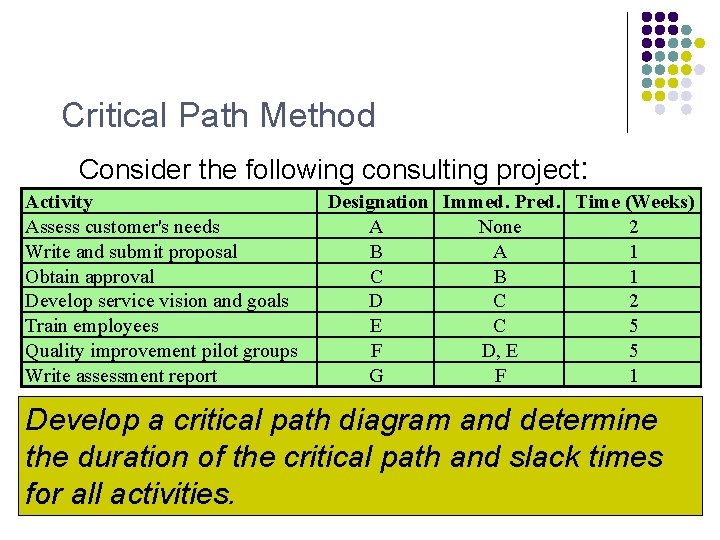
Critical Path Method Consider the following consulting project: Activity Assess customer's needs Write and submit proposal Obtain approval Develop service vision and goals Train employees Quality improvement pilot groups Write assessment report Designation Immed. Pred. Time (Weeks) A None 2 B A 1 C B 1 D C 2 E C 5 F D, E 5 G F 1 Develop a critical path diagram and determine the duration of the critical path and slack times for all activities.
CPM with Three Activity Time Estimates l If a single time estimate is not reliable, then use three time estimates l l Minimum Maximum Most like Allows us to obtain a probability estimate for completion time for the project LO 5
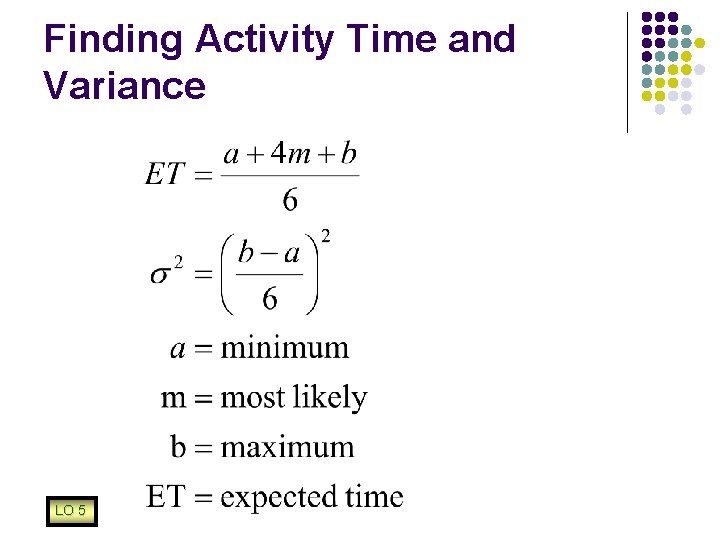
Finding Activity Time and Variance LO 5
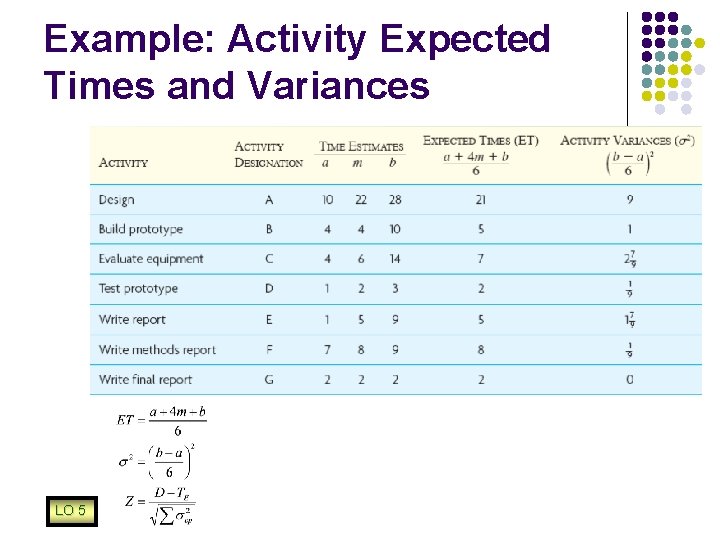
Example: Activity Expected Times and Variances LO 5
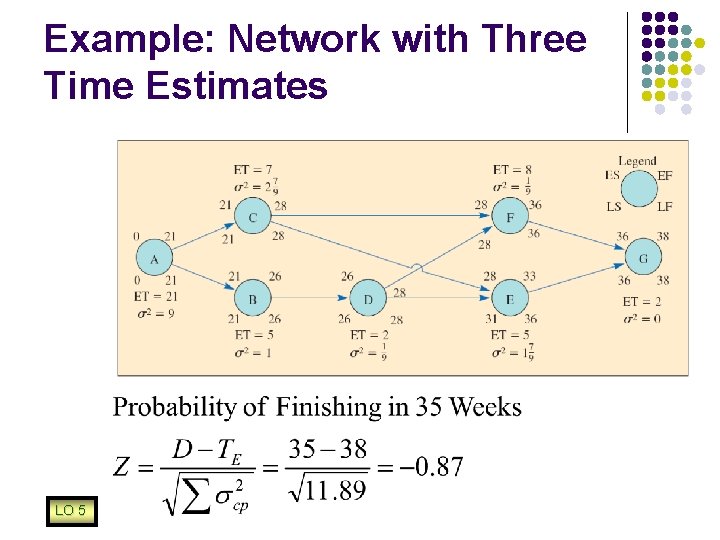
Example: Network with Three Time Estimates LO 5
Time-Cost Models l Basic Assumption: Relationship between activity completion time and project cost l Time Cost Models: Determine the optimum point in time-cost tradeoffs l l l Activity direct costs Project indirect costs Activity completion times
Procedure for Project Crashing 1. 2. 3. 4. 5. LO 6 Prepare a CPM-type network diagram Determine the cost per unit of time to expedite each activity Compute the critical path Shorten the critical path at the least cost Plot project direct, indirect, and total-cost curves and find the minimum-cost schedule

Any Questions?
- Slides: 21