
Chapter 10 Project Risk Management Copyright Course Technology
- Slides: 37
Chapter 10: Project Risk Management Copyright Course Technology 2002 1
Questions n n n What is risk utility? What are common sources of risk on projects? How can you mitigate risk? What is EMV? How does Monte Carlo simulation help you quantify risk? What type of contract has the most risk? Copyright Course Technology 2002 2
Project Risk Management n n Project risk management is the art and science of identifying, assigning, and responding to risk throughout the life of a project and in the best interests of meeting project objectives Risk management is often overlooked on projects, but it can help improve project success by helping select good projects, determining project scope, and developing realistic estimates Copyright Course Technology 2002 3
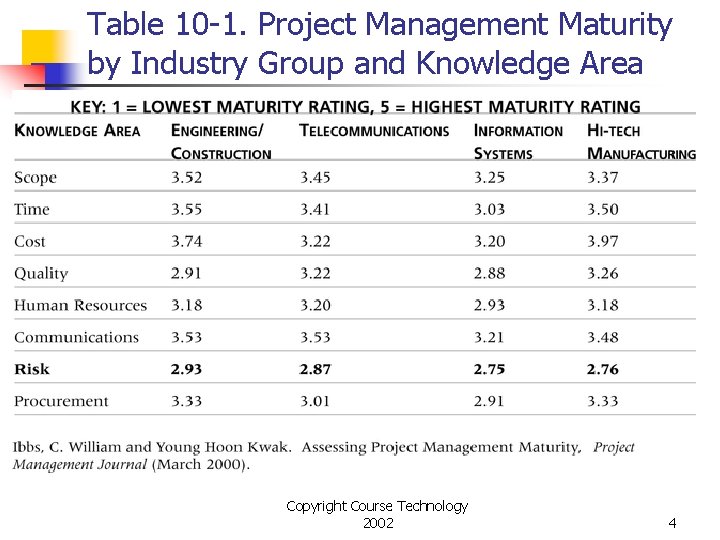
Table 10 -1. Project Management Maturity by Industry Group and Knowledge Area Copyright Course Technology 2002 4
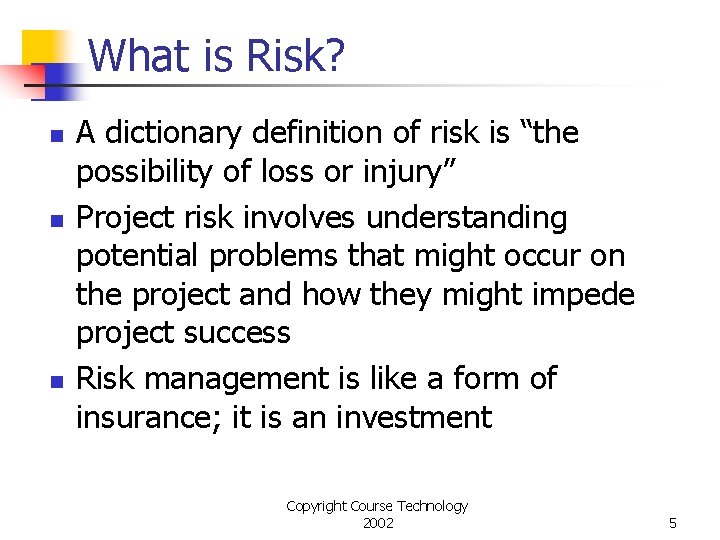
What is Risk? n n n A dictionary definition of risk is “the possibility of loss or injury” Project risk involves understanding potential problems that might occur on the project and how they might impede project success Risk management is like a form of insurance; it is an investment Copyright Course Technology 2002 5
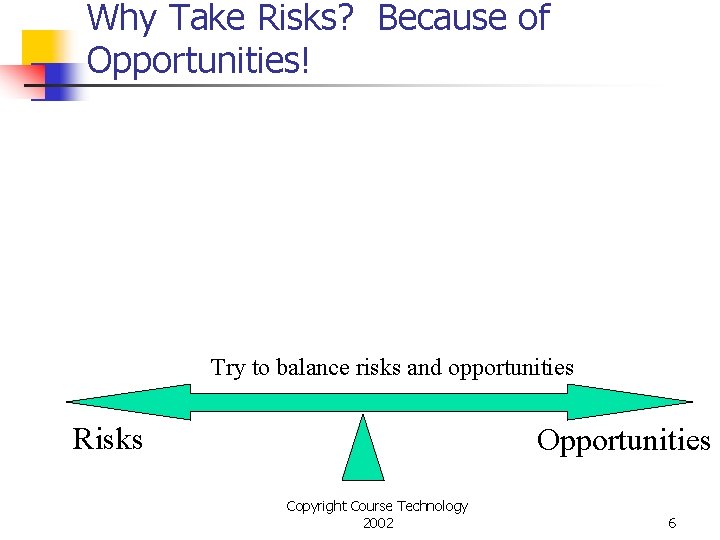
Why Take Risks? Because of Opportunities! Try to balance risks and opportunities Risks Opportunities Copyright Course Technology 2002 6
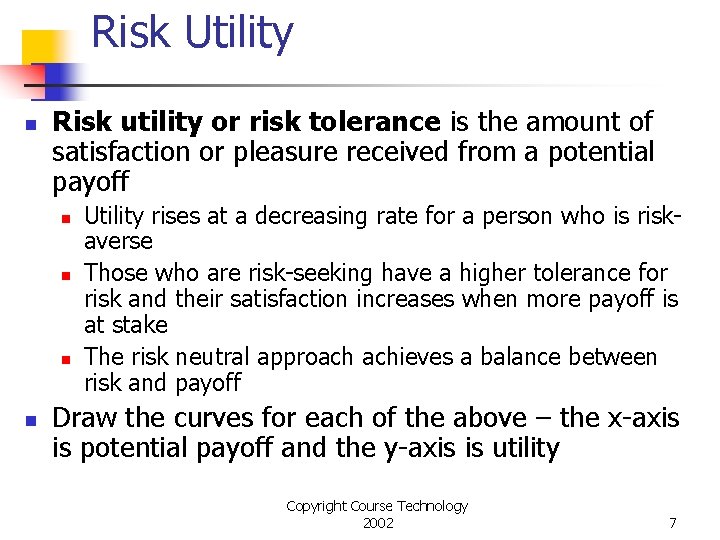
Risk Utility n Risk utility or risk tolerance is the amount of satisfaction or pleasure received from a potential payoff n n Utility rises at a decreasing rate for a person who is riskaverse Those who are risk-seeking have a higher tolerance for risk and their satisfaction increases when more payoff is at stake The risk neutral approach achieves a balance between risk and payoff Draw the curves for each of the above – the x-axis is potential payoff and the y-axis is utility Copyright Course Technology 2002 7
Figure 10 -1. Risk Utility Function and Risk Preference Copyright Course Technology 2002 8
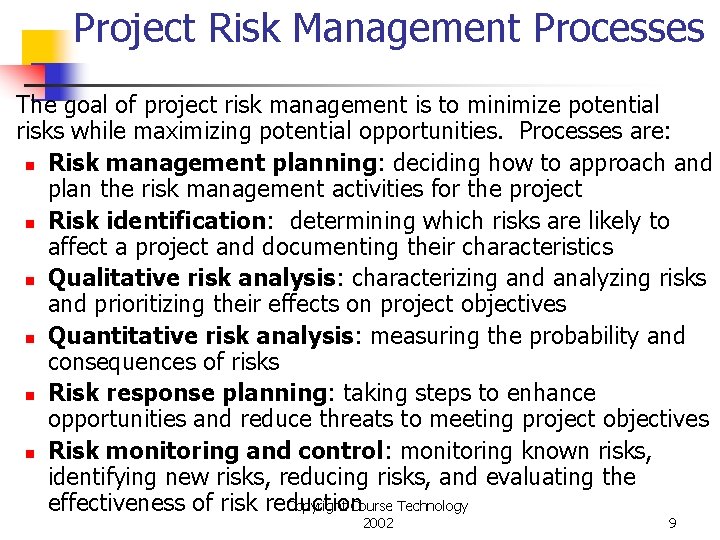
Project Risk Management Processes The goal of project risk management is to minimize potential risks while maximizing potential opportunities. Processes are: n Risk management planning: deciding how to approach and plan the risk management activities for the project n Risk identification: determining which risks are likely to affect a project and documenting their characteristics n Qualitative risk analysis: characterizing and analyzing risks and prioritizing their effects on project objectives n Quantitative risk analysis: measuring the probability and consequences of risks n Risk response planning: taking steps to enhance opportunities and reduce threats to meeting project objectives n Risk monitoring and control: monitoring known risks, identifying new risks, reducing risks, and evaluating the Copyright Course Technology effectiveness of risk reduction 2002 9
Risk Management Planning n n n The main output of risk management planning is a risk management plan The project team should review project documents and understand the organization’s and the sponsor’s approach to risk The level of detail will vary with the needs of the project Copyright Course Technology 2002 10
Contingency and Fallback Plans, Contingency Reserves n n n Contingency plans are predefined actions that the project team will take if an identified risk event occurs Fallback plans are developed for risks that have a high impact on meeting project objectives Contingency reserve or allowances are provisions held by the project sponsor that can be used to mitigate cost or schedule risk if changes in scope or quality occur Copyright Course Technology 2002 11
Risk Identification n n Risk identification is the process of understanding what potential unsatisfactory outcomes are associated with a particular project Several risk identification tools and techniques include n n Brainstorming The Delphi technique Interviewing SWOT analysis Copyright Course Technology 2002 12
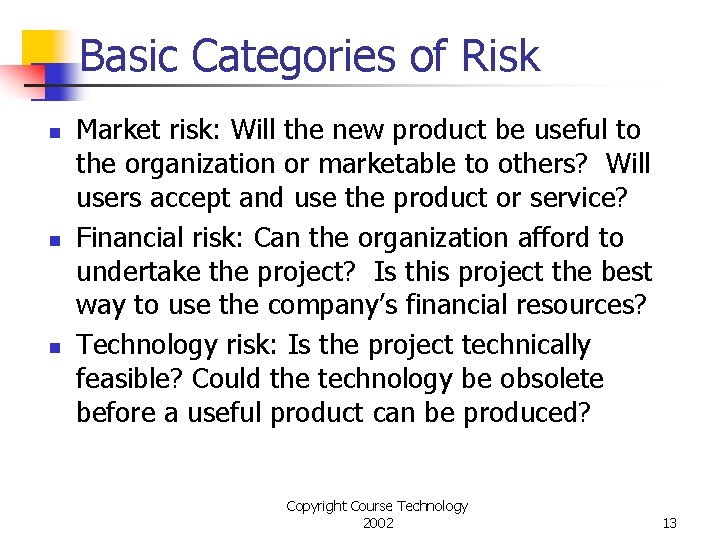
Basic Categories of Risk n n n Market risk: Will the new product be useful to the organization or marketable to others? Will users accept and use the product or service? Financial risk: Can the organization afford to undertake the project? Is this project the best way to use the company’s financial resources? Technology risk: Is the project technically feasible? Could the technology be obsolete before a useful product can be produced? Copyright Course Technology 2002 13
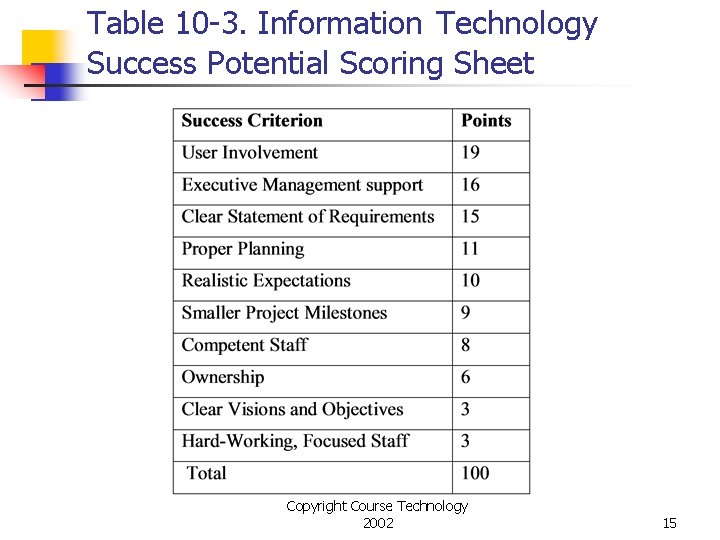
Common Sources of Risk on Information Technology Projects n n Several studies show that IT projects share some common sources of risk The Standish Group developed an IT success potential scoring sheet based on potential risks Mc. Farlan developed a risk questionnaire to help assess risk Other broad categories of risk help identify potential risks Copyright Course Technology 2002 14
Table 10 -3. Information Technology Success Potential Scoring Sheet Copyright Course Technology 2002 15
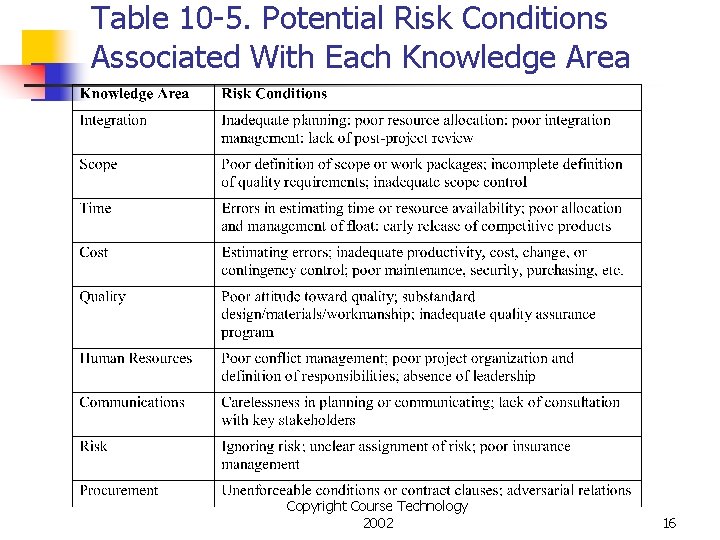
Table 10 -5. Potential Risk Conditions Associated With Each Knowledge Area Copyright Course Technology 2002 16
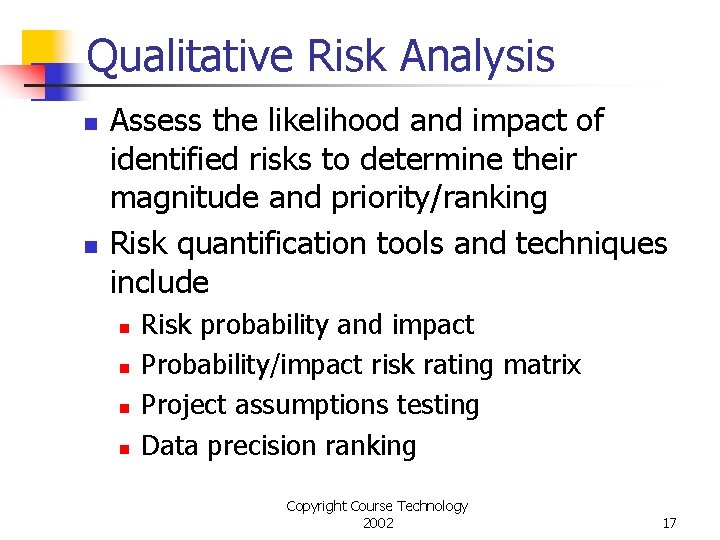
Qualitative Risk Analysis n n Assess the likelihood and impact of identified risks to determine their magnitude and priority/ranking Risk quantification tools and techniques include n n Risk probability and impact Probability/impact risk rating matrix Project assumptions testing Data precision ranking Copyright Course Technology 2002 17
Table 10 -6. Sample Probability/Impact Matrix for Qualitative Risk Assessment Copyright Course Technology 2002 18
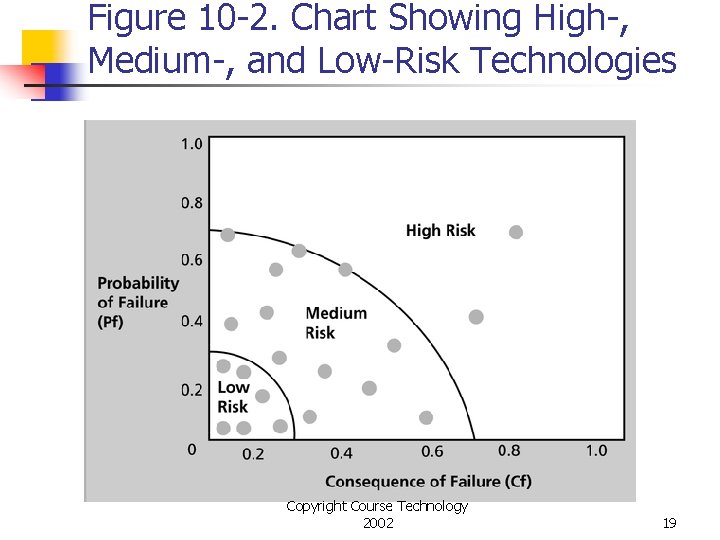
Figure 10 -2. Chart Showing High-, Medium-, and Low-Risk Technologies Copyright Course Technology 2002 19
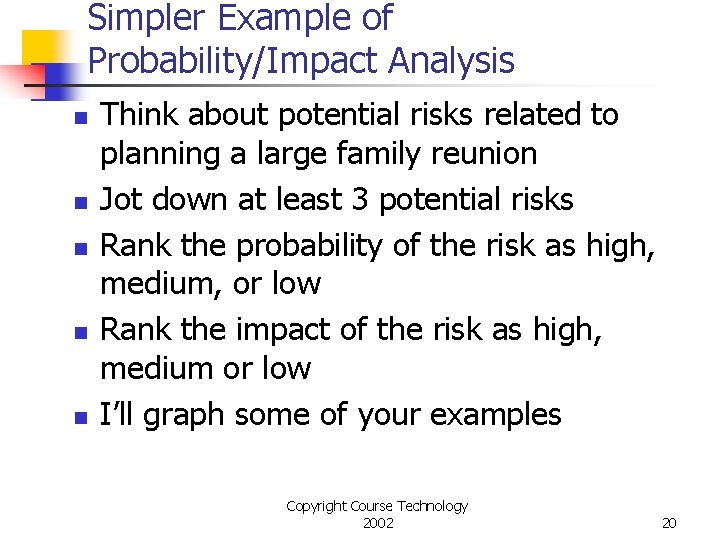
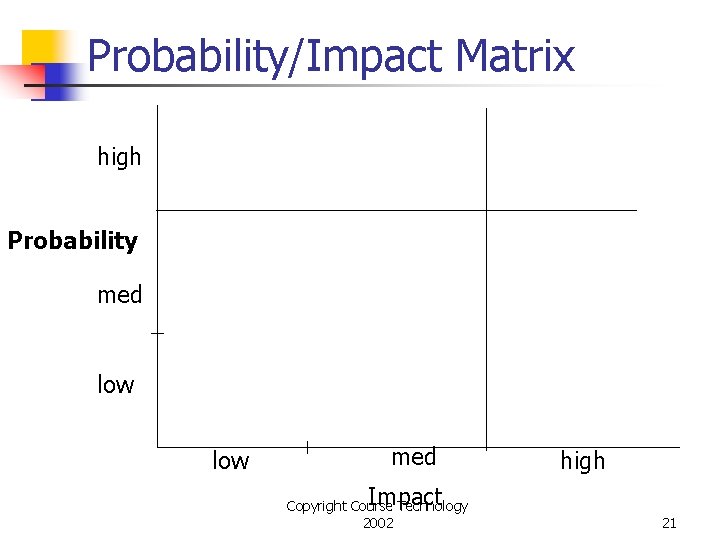
Simpler Example of Probability/Impact Analysis n n n Think about potential risks related to planning a large family reunion Jot down at least 3 potential risks Rank the probability of the risk as high, medium, or low Rank the impact of the risk as high, medium or low I’ll graph some of your examples Copyright Course Technology 2002 20
Probability/Impact Matrix high Probability med low med high Impact Copyright Course Technology 2002 21
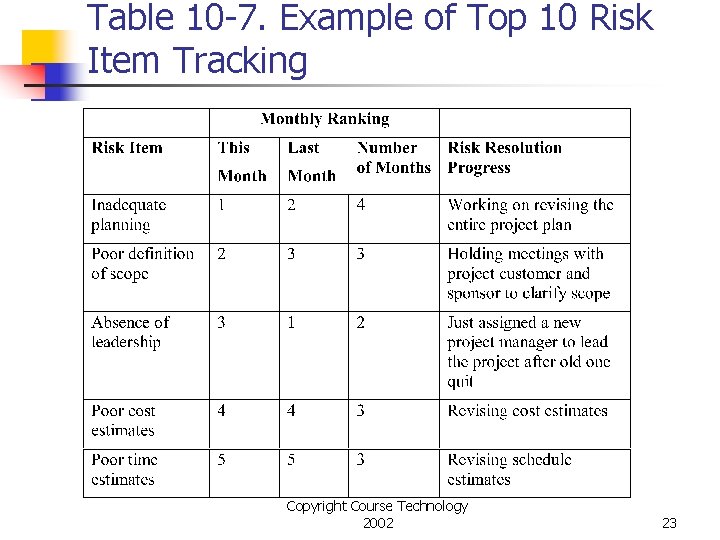
Top 10 Risk Item Tracking n n n Top 10 Risk Item Tracking is a tool for maintaining an awareness of risk throughout the life of a project Establish a periodic review of the top 10 project risk items List the current ranking, previous ranking, number of times the risk appears on the list over a period of time, and a summary of progress made in resolving the risk item Copyright Course Technology 2002 22
Table 10 -7. Example of Top 10 Risk Item Tracking Copyright Course Technology 2002 23
Expert Judgment n n Many organizations rely on the intuitive feelings and past experience of experts to help identify potential project risks Experts can categorize risks as high, medium, or low with or without more sophisticated techniques Copyright Course Technology 2002 24
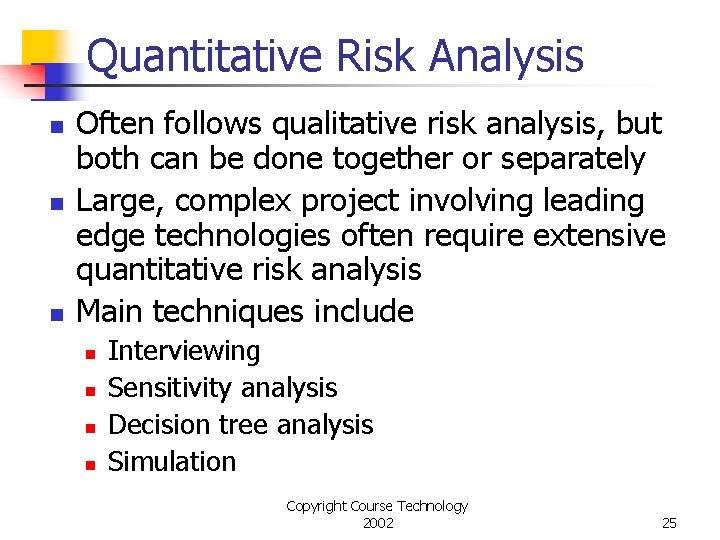
Quantitative Risk Analysis n n n Often follows qualitative risk analysis, but both can be done together or separately Large, complex project involving leading edge technologies often require extensive quantitative risk analysis Main techniques include n n Interviewing Sensitivity analysis Decision tree analysis Simulation Copyright Course Technology 2002 25
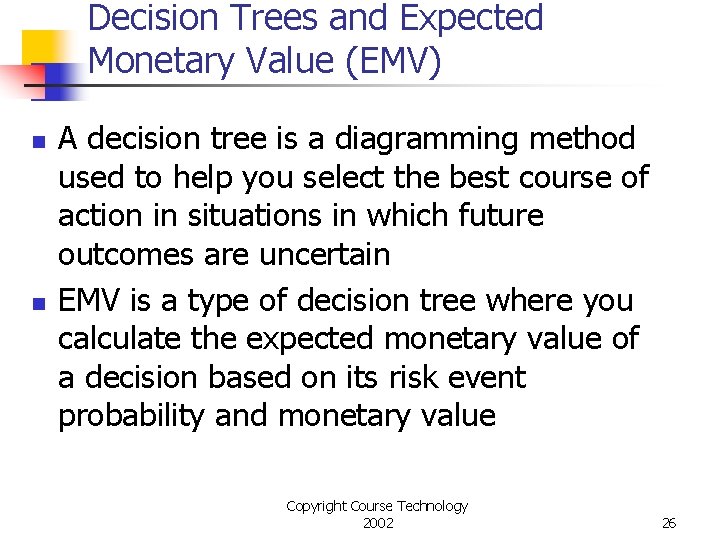
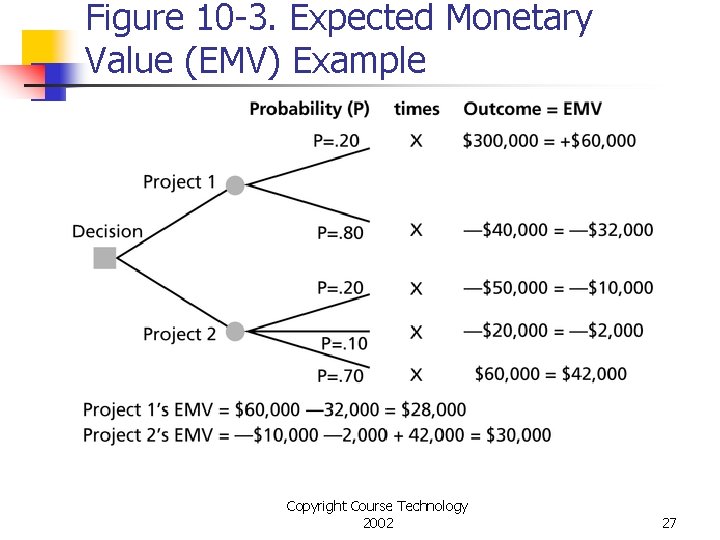
Decision Trees and Expected Monetary Value (EMV) n n A decision tree is a diagramming method used to help you select the best course of action in situations in which future outcomes are uncertain EMV is a type of decision tree where you calculate the expected monetary value of a decision based on its risk event probability and monetary value Copyright Course Technology 2002 26
Figure 10 -3. Expected Monetary Value (EMV) Example Copyright Course Technology 2002 27
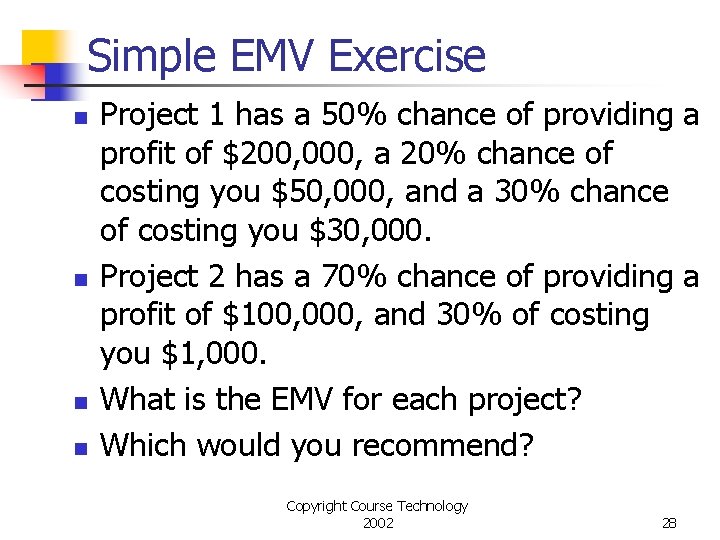
Simple EMV Exercise n n Project 1 has a 50% chance of providing a profit of $200, 000, a 20% chance of costing you $50, 000, and a 30% chance of costing you $30, 000. Project 2 has a 70% chance of providing a profit of $100, 000, and 30% of costing you $1, 000. What is the EMV for each project? Which would you recommend? Copyright Course Technology 2002 28
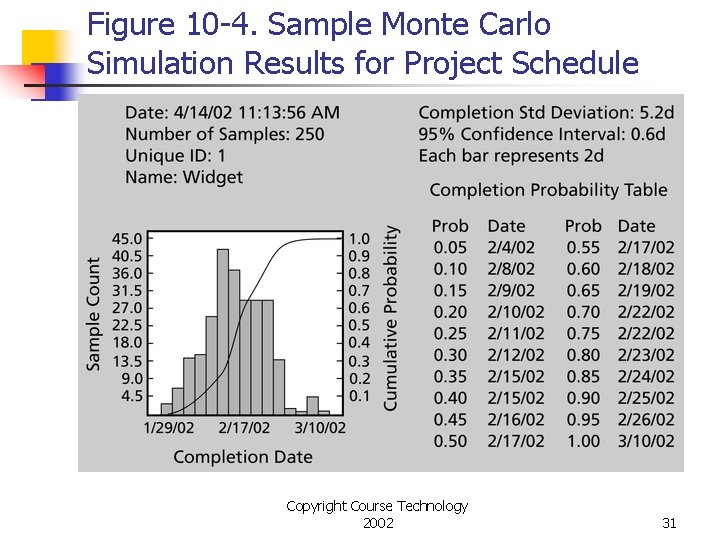
Simulation n Simulation uses a representation or model of a system to analyze the expected behavior or performance of the system Monte Carlo analysis simulates a model’s outcome many time to provide a statistical distribution of the calculated results To use a Monte Carlo simulation, you must have three estimates (most likely, pessimistic, and optimistic) plus an estimate of the likelihood of the estimate being between the optimistic and most likely values Copyright Course Technology 2002 29
What Went Right? Mc. Donnell Aircraft Company used Monte Carlo simulation to help quantify risks on several advanced-design engineering projects. The National Aerospace Plan (NASP) project involved many risks. The purpose of this multi-billion dollar project was to design and develop a vehicle that could fly into space using a single-stage-to-orbit approach. A single-stage-to-orbit approach meant the vehicle would have to achieve a speed of Mach 25 (25 times the speed of sound) without a rocket booster. A team of engineers and business professionals worked together in the mid-1980 s to develop a software model for estimating the time and cost of developing the NASP. This model was then linked with Monte Carlo simulation software to determine the sources of cost and schedule risk for the project. The results of the simulation were then used to determine how the company would invest its internal research and development funds. Although the NASP project was terminated, the resulting research has helped develop more advanced materials and propulsion systems used on many modern aircraft. Copyright Course Technology 2002 30
Figure 10 -4. Sample Monte Carlo Simulation Results for Project Schedule Copyright Course Technology 2002 31
Risk Response Planning n n After identifying and quantifying risk, you must decide how to respond to them Four main strategies: n n n Risk avoidance: eliminating a specific threat or risk, usually by eliminating its causes Risk acceptance: accepting the consequences should a risk occur Risk transference: shifting the consequence of a risk and responsibility for its management to a third party Risk mitigation: reducing the impact of a risk event by reducing the probability of its occurrence Samples of each strategy? Copyright Course Technology 2002 32
Table 10 -8. General Risk Mitigation Strategies for Technical, Cost, and Schedule Risks Copyright Course Technology 2002 33
Risk Monitoring and Control n n Monitoring risks involves knowing their status Controlling risks involves carrying out the risk management plans as risks occur Workarounds are unplanned responses to risk events that must be done when there are no contingency plans The main outputs of risk monitoring and control are corrective action, project change requests, and updates to other plans Copyright Course Technology 2002 34
Risk Response Control n n n Risk response control involves executing the risk management processes and the risk management plan to respond to risk events Risks must be monitored based on defined milestones and decisions made regarding risks and mitigation strategies Sometimes workarounds or unplanned responses to risk events are needed when there are no contingency plans Copyright Course Technology 2002 35
Using Software to Assist in Project Risk Management n n n Databases can keep track of risks. Many IT departments have issue tracking databases Spreadsheets can aid in tracking and quantifying risks More sophisticated risk management software, such as Monte Carlo simulation tools, help in analyzing project risks Copyright Course Technology 2002 36
Results of Good Project Risk Management n n n Unlike crisis management, good project risk management often goes unnoticed Well-run projects appear to be almost effortless, but a lot of work goes into running a project well (story about potential co-author) Project managers should strive to make their jobs look easy to reflect the results of well-run projects Copyright Course Technology 2002 37