
Chapter 10 Product Branding and Packaging Concepts 2019
Chapter 10 Product, Branding, and Packaging Concepts © 2019 Cengage. All rights reserved.
Learning Objectives 10– 1 Define the concept of a product. 10– 2 Discuss how products are classified. 10– 3 Explain the concepts of product line and product mix and how they are related. 10– 4 Explore the product life cycle and its impact on marketing strategies. 10– 5 Discuss the product adoption process. 10– 6 Explain the major components of branding, including brand types, branding strategies, and brand protection. 10– 7 Describe the major packaging functions and design considerations, and how packaging is used in marketing strategies. 10– 8 Identify the functions of labeling and legal issues related to labeling. © 2019 Cengage. All rights reserved.
What Is a Product? Product – a good, a service, or an idea received in an exchange Good – a tangible physical entity Service – an intangible result of the application of human and mechanical efforts to people or objects Idea – a concept, philosophy, image, or issue Interdependent elements of a product: Core product itself Supplemental features Symbolic or experiential benefits © 2019 Cengage. All rights reserved.

Classifying Products Consumer products – products purchased to satisfy personal and family needs Business products – products bought: To use in an organization’s operations To resell To make other products © 2019 Cengage. All rights reserved.

Consumer Products Convenience products – relatively inexpensive, frequently purchased items for which buyers exert minimal purchasing effort Examples: Shopping products – items for which buyers are willing to expend considerable effort in planning and making purchases Examples: Specialty products – items, with unique characteristics, that buyers are willing to expend considerable effort to obtain Examples: Unsought products – products purchased to solve a sudden problem, products of which customers are unaware, and products that people do not necessarily think about buying Examples: © 2019 Cengage. All rights reserved.

Business Products (1 of 2) Installations – facilities and nonportable major equipment Examples: Accessory equipment – equipment that does not become part of the final physical product but is used in production or office activities Examples: Raw materials – basic natural materials that become part of a physical product Examples: Component parts – items that become part of the physical product and are either finished items ready for assembly or products that little processing before assembly Examples: © 2019 Cengage. All rights reserved.

Business Products (2 of 2) Process materials – materials that are used directly in the production of other products but are not readily identifiable Examples: MRO supplies – maintenance, repair, and operating items that facilitate production and operations but do not become part of the finished product Examples: Business services – the intangible products that many organizations use in their operations Examples: © 2019 Cengage. All rights reserved.

Product Line and Product Mix (1 of 2) Product item – a specific version of a product that can be designated as a distinct offering among a firm’s products Example: Product line – a group of closely related product items viewed as a unit because of marketing, technical, or end-use considerations Example: © 2019 Cengage. All rights reserved.

Product Line and Product Mix (2 of 2) Product mix – the total group of products that an organization makes available to customers Width of product mix – the number of product lines a company offers Example: Depth of product mix – the average number of different product items offered in each product line Example: © 2019 Cengage. All rights reserved.
Product Life Cycle and Marketing Strategies Product life cycle – the progression of a product through four stages: introduction, growth, maturity, and decline Introduction stage – the initial stage of a product’s life cycle—its first appearance in the marketplace—when sales start at zero and profits are negative Growth stage – the stage of a product’s life cycle when sales rise rapidly and profits reach a peak and then start to decline Maturity stage – the stage of a product’s life cycle when the sales curve peaks and starts to decline as profits continue to fall Decline stage – the stage of a product’s life cycle when sales fall rapidly © 2019 Cengage. All rights reserved.
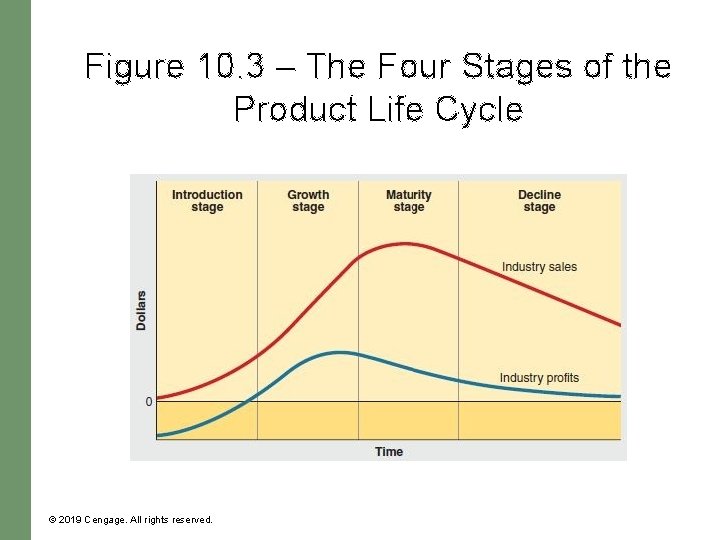
Figure 10. 3 – The Four Stages of the Product Life Cycle © 2019 Cengage. All rights reserved.
Product Adoption Process (1 of 2) Product adoption process – the stages buyers go through in accepting a product Awareness – buyer becomes aware of the product Interest – buyer seeks information and is receptive to learning about the product Evaluation – buyer considers the product’s benefits and decides whether to try it, considering its value versus the competition Trial – buyer examines, tests, or tries the product to determine if it meets his or her needs Adoption – buyer purchases the product and can be expected to use it again whenever the need for this product arises © 2019 Cengage. All rights reserved.

Product Adoption Process (2 of 2) Consumers fall into one of five adopter categories: Innovators – first adopters of new products Early adopters – careful choosers of new products Early majority – those adopting new products just before the average person Late majority – skeptics who adopt new products when they feel it is necessary Laggards – the last adopters, who distrust new products © 2019 Cengage. All rights reserved.
Branding Brand – a name, term, design, symbol, or any other feature that identifies one marketer’s product as distinct from those of other marketers Brand name – the part of a brand that can be spoken Brand mark – the part of a brand not made up of words Trademark – a legal designation of exclusive use of a brand Trade name – full legal name of an organization © 2019 Cengage. All rights reserved.
Value of Branding (1 of 4) Buyers’ benefits: Reduces time needed to identify and purchase products Permits self-expression Symbolizes a certain quality level and image Reduces perceived risk of purchase Provides a psychological reward © 2019 Cengage. All rights reserved.
Value of Branding (2 of 4) Sellers’ benefits: Makes repeat purchases easier for customers Helps introduce a new product that carries the name of one or more of existing products Facilitates promotional efforts Fosters brand loyalty Stabilizes market share, which makes resource usage more efficient © 2019 Cengage. All rights reserved.
Value of Branding (3 of 4) Cultural dimension: Consumers confer their own social meanings onto brands. Brand’s appeal is emotional based on its symbolic image and key associations. Brands help consumers develop their identity and self-concept. Brands serve as a form of self-expression. © 2019 Cengage. All rights reserved.
Value of Branding (4 of 4) Cultural branding explains how a brand conveys a powerful myth that consumers find useful in cementing their identities. A company doesn’t totally control a brand because every aspect of a brand is subject to consumers’: Emotional involvement Interpretation Memory © 2019 Cengage. All rights reserved.
Brand Equity (1 of 3) Brand equity – the marketing and financial value associated with a brand’s strength in a market Four major elements: © 2019 Cengage. All rights reserved.
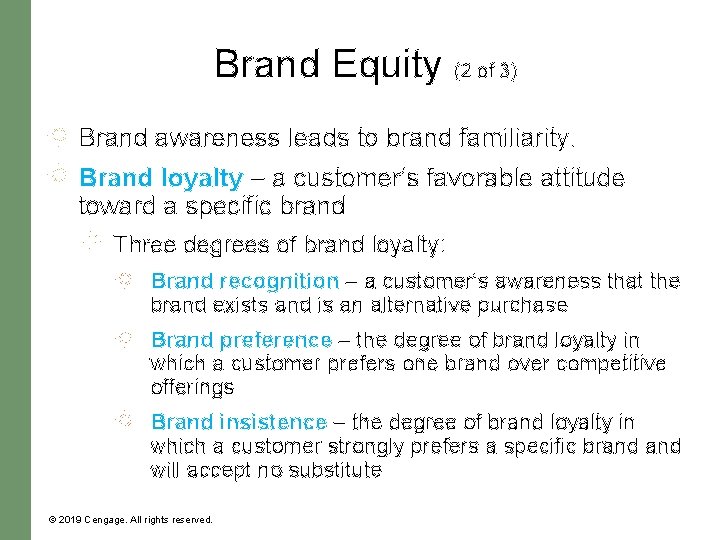
Brand Equity (2 of 3) Brand awareness leads to brand familiarity. Brand loyalty – a customer’s favorable attitude toward a specific brand Three degrees of brand loyalty: Brand recognition – a customer’s awareness that the brand exists and is an alternative purchase Brand preference – the degree of brand loyalty in which a customer prefers one brand over competitive offerings Brand insistence – the degree of brand loyalty in which a customer strongly prefers a specific brand will accept no substitute © 2019 Cengage. All rights reserved.
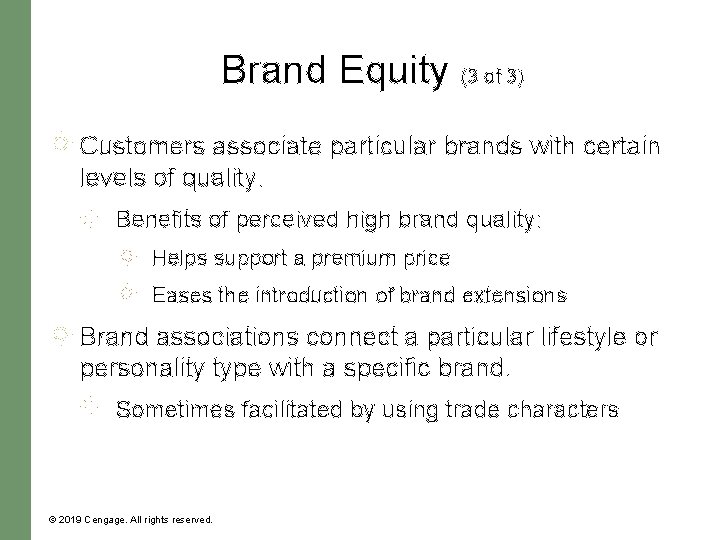
Brand Equity (3 of 3) Customers associate particular brands with certain levels of quality. Benefits of perceived high brand quality: Helps support a premium price Eases the introduction of brand extensions Brand associations connect a particular lifestyle or personality type with a specific brand. Sometimes facilitated by using trade characters © 2019 Cengage. All rights reserved.
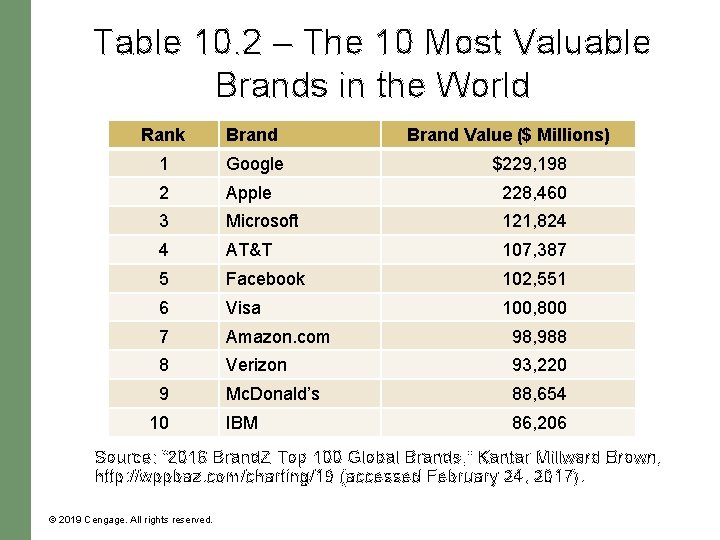
Table 10. 2 – The 10 Most Valuable Brands in the World Rank Brand 1 Google 2 Apple 228, 460 3 Microsoft 121, 824 4 AT&T 107, 387 5 Facebook 102, 551 6 Visa 100, 800 7 Amazon. com 98, 988 8 Verizon 93, 220 9 Mc. Donald’s 88, 654 IBM 86, 206 10 Brand Value ($ Millions) $229, 198 Source: “ 2016 Brand. Z Top 100 Global Brands, ” Kantar Millward Brown, http: //wppbaz. com/charting/19 (accessed February 24, 2017). © 2019 Cengage. All rights reserved.
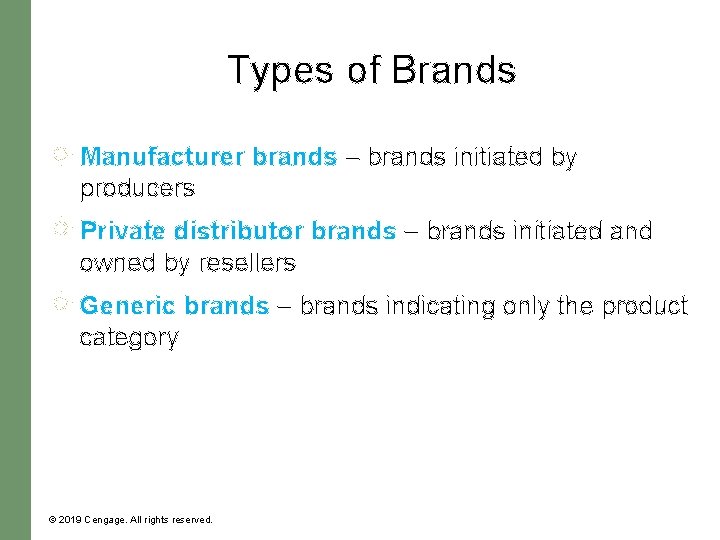
Types of Brands Manufacturer brands – brands initiated by producers Private distributor brands – brands initiated and owned by resellers Generic brands – brands indicating only the product category © 2019 Cengage. All rights reserved.
Selecting a Brand Name A brand name should: © 2019 Cengage. All rights reserved.
Protecting a Brand A marketer should design a brand so that it can be protected through registration. A brand must not infringe on any brand already registered with the U. S. Patent and Trademark Office. A brand cannot be a generic term. The symbol ® indicates that a brand is a registered trademark. Protecting a brand name in a foreign country can be difficult. Brand counterfeiting should be prevented. © 2019 Cengage. All rights reserved.

Branding Policies Individual branding – a policy of naming each product differently Family branding – branding all of a firm’s products with the same name More than one branding policy can be used. © 2019 Cengage. All rights reserved.
Brand Extensions Brand extension – using an existing brand to brand a new product in a different product category A brand can be weakened by dilution if it is: Extended too many times Extended too far outside its original product category © 2019 Cengage. All rights reserved.
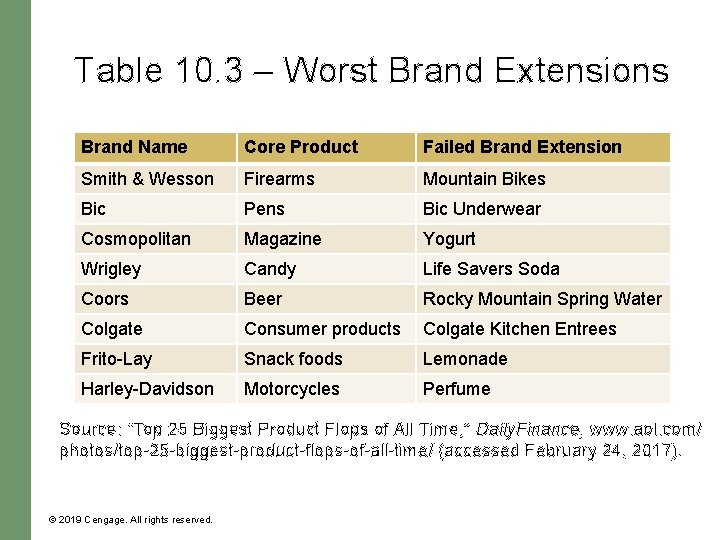
Table 10. 3 – Worst Brand Extensions Brand Name Core Product Failed Brand Extension Smith & Wesson Firearms Mountain Bikes Bic Pens Bic Underwear Cosmopolitan Magazine Yogurt Wrigley Candy Life Savers Soda Coors Beer Rocky Mountain Spring Water Colgate Consumer products Colgate Kitchen Entrees Frito-Lay Snack foods Lemonade Harley-Davidson Motorcycles Perfume Source: “Top 25 Biggest Product Flops of All Time, ” Daily. Finance, www. aol. com/ photos/top-25 -biggest-product-flops-of-all-time/ (accessed February 24, 2017). © 2019 Cengage. All rights reserved.
Co-Branding Co-branding – using two or more brands on one product Capitalizes on the brand equity of multiple brands Brands can be owned by the same company. Brands should not lose their identities. The main brand should be clear to consumers. Brands must be a complementary fit. Failure implicates both brands. © 2019 Cengage. All rights reserved.
Brand Licensing Brand licensing – an agreement whereby a company permits another organization to use its brand on other products for a licensing fee Advantages: Disadvantages: © 2019 Cengage. All rights reserved.
Packaging Functions Protect the product and maintain its functional form Prevent product tampering Deter shoplifting Offer convenience to customers Prevent waste Make storage easier Promote greater consumption Promote a product © 2019 Cengage. All rights reserved.
Major Packaging Considerations Cost Consistency between designs of different products produced by the company Family packaging – using similar packaging for all of a firm’s products or packaging that has one common design element Promotional role Reseller needs © 2019 Cengage. All rights reserved.
Packaging and Marketing Strategy Packaging may give a product a competitive advantage. The right type of package for a new product can help it gain market recognition very quickly. Marketers should view packaging as a major strategic tool. Marketers must analyze the cost of packaging and package changes. © 2019 Cengage. All rights reserved.
Altering the Package Reasons to alter a package: Update an out-of-style design Highlight new product features Use new packaging materials that become available Make the product safer or more convenient to use Make handling easier in the distribution channel Create unique appearance to stand out Accommodate multiple packaging © 2019 Cengage. All rights reserved.
Labeling – providing identifying, promotional, or other information on package labels Purposes: Size and content can vary. Can be part of the package itself or a separate feature attached to the package Federal laws and regulations specify information that must be included on the labels of certain products. © 2019 Cengage. All rights reserved.
- Slides: 35