
Chapter 10 PostHeckscher Ohlin Theories of Trade and


- Slides: 37
Chapter 10 Post–Heckscher. Ohlin Theories of Trade and Intra. Industry Trade Mc. Graw-Hill/Irwin Copyright © 2010 by The Mc. Graw-Hill Companies, Inc. All rights reserved.
Learning Objectives § Explain the basis of trade in manufactures beyond Heckscher. Ohlin. § Discuss the roles of technology dissemination, demand patterns, and time in affecting trade. § Demonstrate how the presence of imperfect competition can affect trade. § Describe the phenomenon known as intra-industry trade. 10 -2
Posner’s Imitation Lag Hypothesis § In Posner’s model, there may be a delay in the diffusion of technology between countries. § If a new product is invented in country I, there are two sorts of lags that delay the production the good in country II: • imitation lag, and • demand lag. § During these lags the inventing country will export. 10 -3
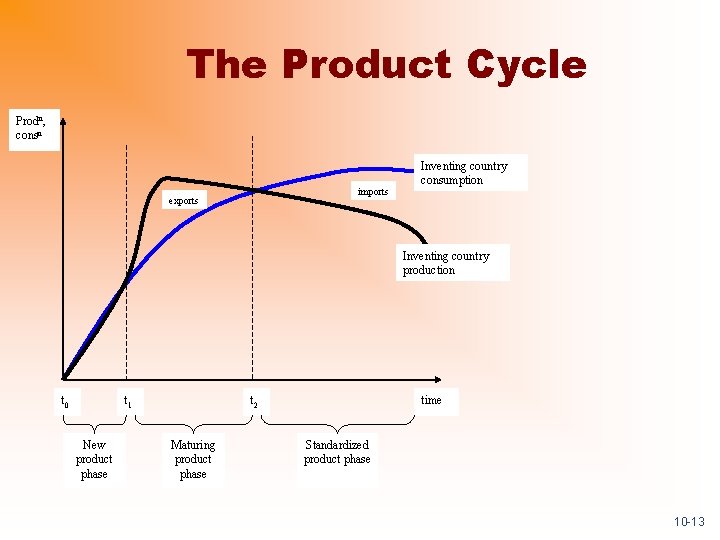
The Product Cycle Model § How might comparative advantage change over time? H-O is a static model, and therefore offers little info on this. § The Product Cycle model (Vernon, 1966) follows a product from its invention through its “old age. ” § How does it work? 10 -4
The Product Cycle Model: The New Product Phase § A new product is invented in the developed world. § Typically, the new product will be • capital-intensive and labor-saving. • aimed at high-income consumers. § All demand is located in the inventing country. 10 -5
The Product Cycle Model: The New Product Phase § Production is located in the inventing country. § Technological uncertainties make mass production unfeasible. § No trade occurs during this phase. 10 -6
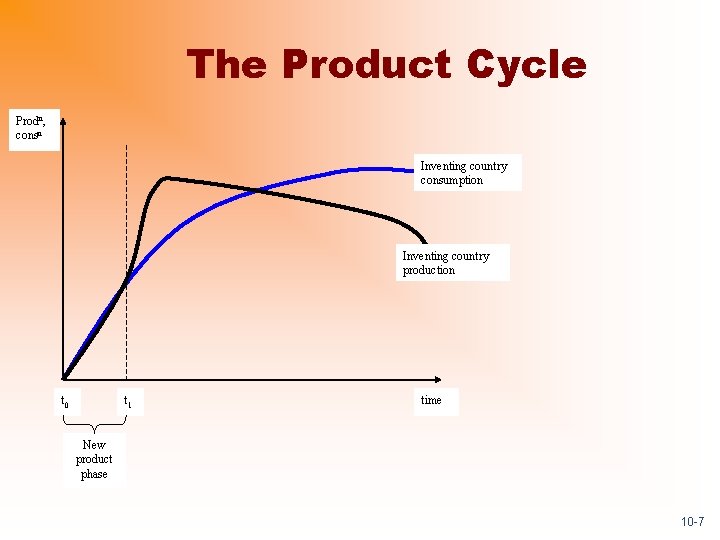
The Product Cycle Prodn, consn Inventing country consumption t 0 t 1 Inventing country production time New product phase 10 -7
The Product Cycle Model: The Maturing Product Phase § The product is increasingly standardized. § Consumers are increasingly aware of the product. § Mass production becomes possible, and economies of scale are realized. § Price steadily drops. § Demand in other developed countries picks up, so inventing country producers export more and more. 10 -8
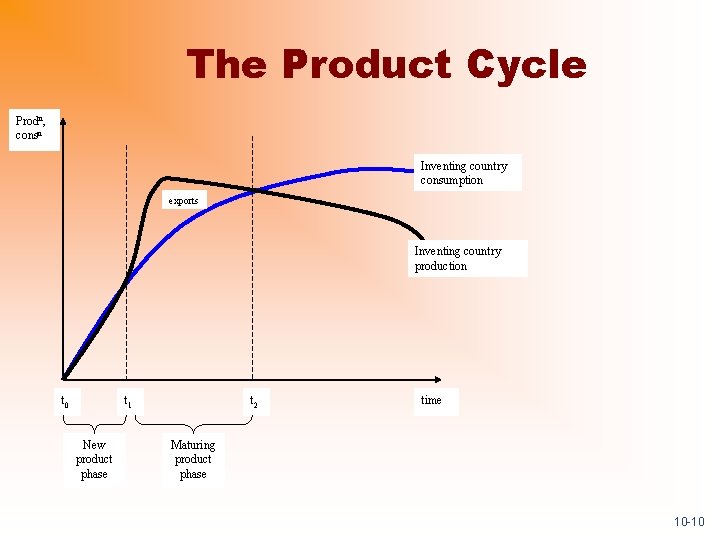
The Product Cycle Model: The Maturing Product Phase § Later in the maturing product phase, other developed countries begin to produce the product. § Lower transportation costs may give these new entrants an edge in the emerging markets. § Increasingly, output in the inventing country is displaced. 10 -9
The Product Cycle Prodn, consn Inventing country consumption exports t 0 t 1 New product phase t 2 Inventing country production time Maturing product phase 10 -10
The Product Cycle Model: The Standardized Product Phase § Global demand has grown. § Production techniques are wellknown and standard. § Competition becomes ever fiercer. § As a result, production shifts mainly to developing countries. 10 -11
The Product Cycle Model: The Standardized Product Phase § Product differentiation may occur, with the inventing country left producing only fancier versions. § The inventing country becomes a net importer. 10 -12
The Product Cycle Prodn, consn imports exports t 0 t 1 New product phase t 2 Maturing product phase Inventing country consumption Inventing country production time Standardized product phase 10 -13
The Product Cycle Theory § Vernon’s Product Cycle theory tells us that comparative advantage is fleeting: we need to perpetually invent new products. 10 -14
Vertical Specialization § Different stages of production process may occur in different countries. § If different parts of the production process vary in terms of capital or labor intensity, the production process may be spread over multiple countries. 10 -15
Firm-Focused Theories § Stage theory: owners and managers learn over time; this implies exporting firms tend to be larger and run by more experienced managers. § Resource-exchange theory: firms internationalize because they cannot generate all resources domestically. § Network theory: networking can compensate for any lack of experience or expertise. 10 -16
The Linder Theory § In the H-O model, the pattern of trade is determined by relative resource endowments. § A model by Linder (1961) focuses mainly on the demand side. § Basic idea is that a country produces stuff to satisfy domestic demand; these goods will be likely exports (and imports, too). 10 -17
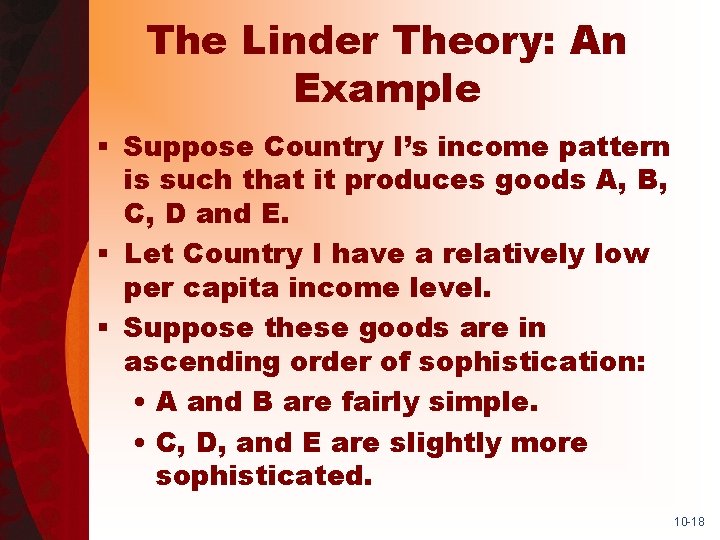
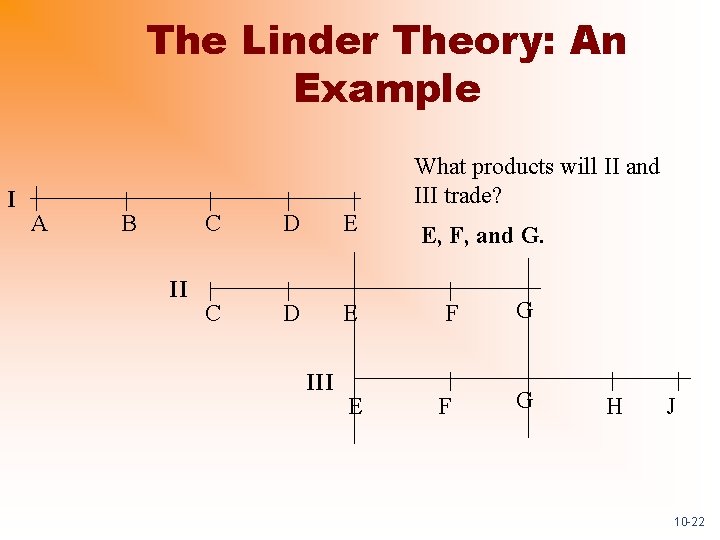
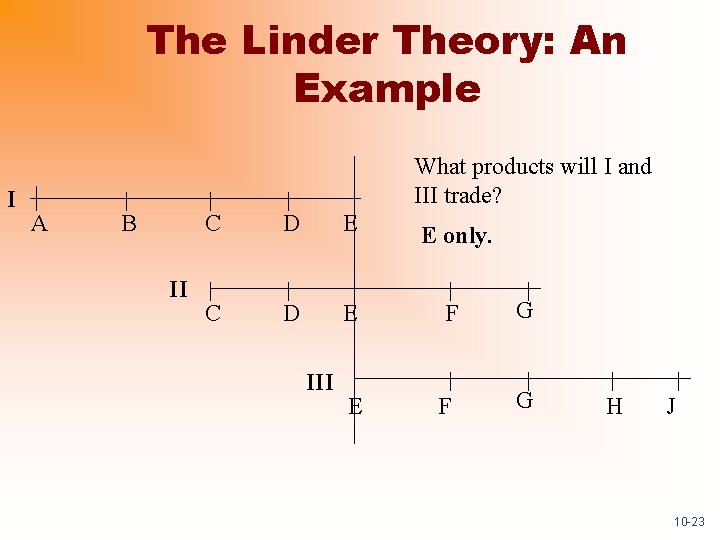
The Linder Theory: An Example § Suppose Country I’s income pattern is such that it produces goods A, B, C, D and E. § Let Country I have a relatively low per capita income level. § Suppose these goods are in ascending order of sophistication: • A and B are fairly simple. • C, D, and E are slightly more sophisticated. 10 -18
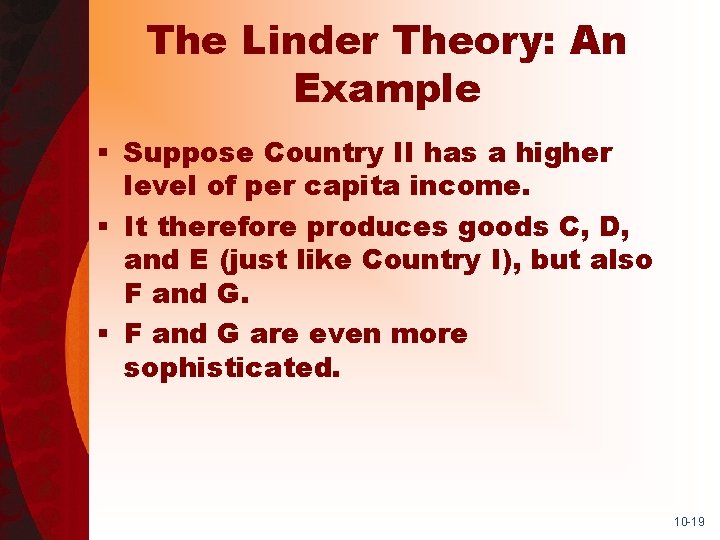
The Linder Theory: An Example § Suppose Country II has a higher level of per capita income. § It therefore produces goods C, D, and E (just like Country I), but also F and G. § F and G are even more sophisticated. 10 -19
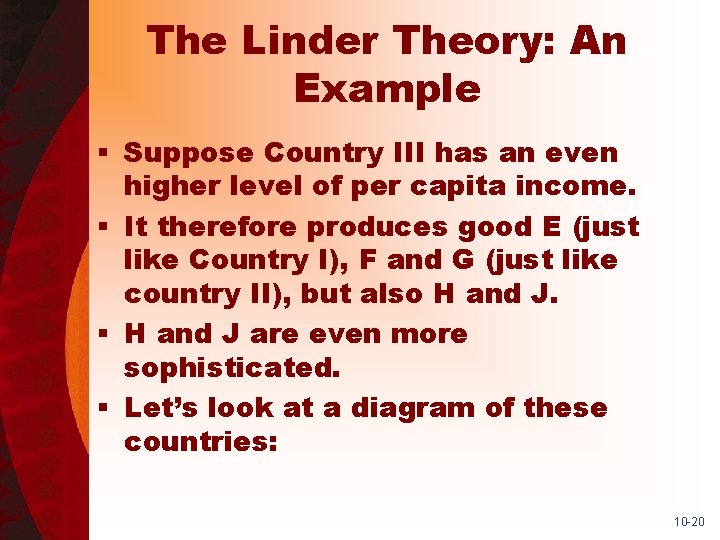
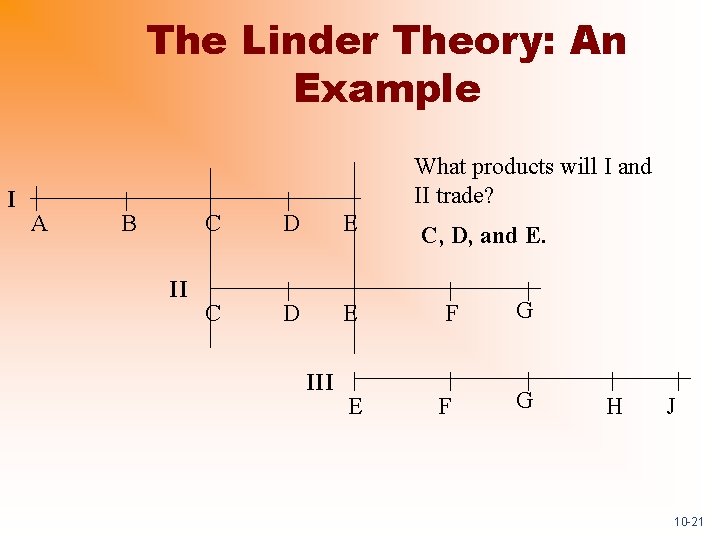
The Linder Theory: An Example § Suppose Country III has an even higher level of per capita income. § It therefore produces good E (just like Country I), F and G (just like country II), but also H and J. § H and J are even more sophisticated. § Let’s look at a diagram of these countries: 10 -20
The Linder Theory: An Example I What products will I and II trade? A B II C D E III E C, D, and E. F F G G H J 10 -21
The Linder Theory: An Example I What products will II and III trade? A B II C D E III E E, F, and G. F F G G H J 10 -22
The Linder Theory: An Example I What products will I and III trade? A B II C D E E only. C D E F III E F G G H J 10 -23
The Linder Theory § So trade will involve goods for which there is overlapping demand. § Implication: trade should be most intense between countries with similar levels of per capita income. 10 -24
The Linder Theory § This theory would explain two things that H-O cannot: • why most trade is between the industrialized countries, which all have (presumably) very similar resource endowments. • why a country might import and export the same product (intraindustry trade). 10 -25
The Linder Theory § The theory has been subjected to a barrage of tests. • Sailors, et al. (1973), Thursby and Thursby (1987), and Mc. Pherson, Redfearn and Tieslau (2000) and others found evidence to support the Linder theory. • Hoftyzer (1984), Kennedy and Mc. Hugh (1983) and others found evidence against theory. 10 -26
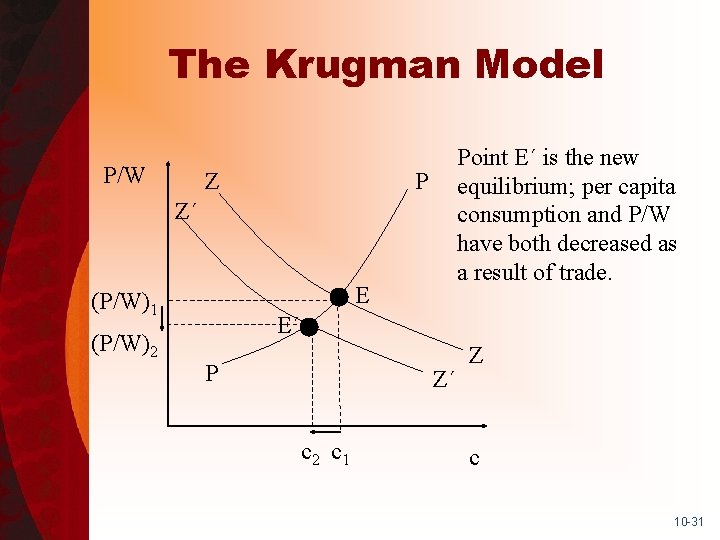
The Krugman Model § Incorporates economies of scale and monopolistic competition. § Consider a graph: • The price of the good relative to the wage (P/W) is on the vertical axis. • Per capita consumption (c) is on the horizontal axis. 10 -27
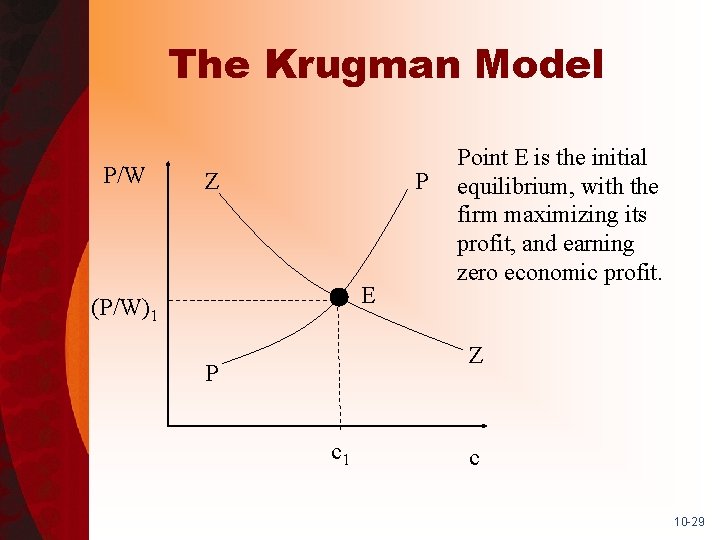
The Krugman Model § Two functions are on the graph: • The PP curve slopes upward, since P/W increases as c increases. • The ZZ curve has a negative slope: as c increases, average cost decreases (due to economies of scale). To maintain the zeroprofit condition in monopolistically competitive firms, price must be reduced. 10 -28
The Krugman Model P/W Z P E (P/W)1 Point E is the initial equilibrium, with the firm maximizing its profit, and earning zero economic profit. Z P c 10 -29
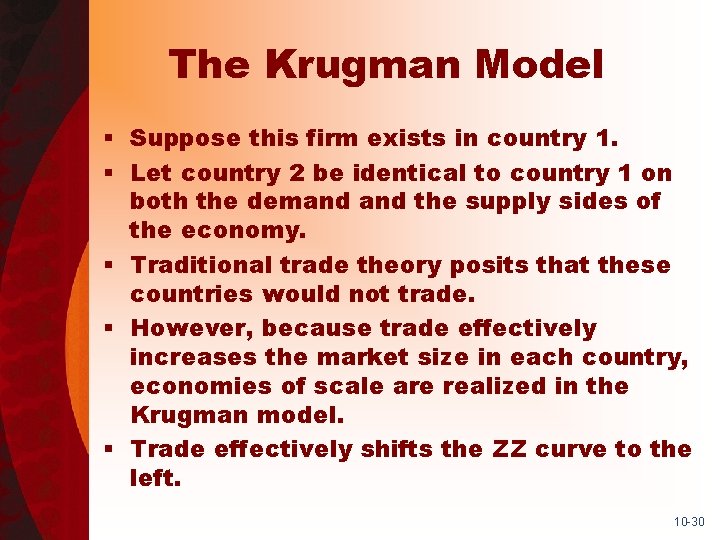
The Krugman Model § Suppose this firm exists in country 1. § Let country 2 be identical to country 1 on both the demand the supply sides of the economy. § Traditional trade theory posits that these countries would not trade. § However, because trade effectively increases the market size in each country, economies of scale are realized in the Krugman model. § Trade effectively shifts the ZZ curve to the left. 10 -30
The Krugman Model P/W Z Point E΄ is the new equilibrium; per capita consumption and P/W have both decreased as a result of trade. P Z΄ E (P/W)1 (P/W)2 E΄ P Z΄ c 2 c 1 Z c 10 -31
The Krugman Model: The Bottom Line § Although trade causes per capita consumption (c) to fall, total consumption of the firm’s output has risen. § P/W has decreased because of trade; this also means that its reciprocal (W/P) rises. § This suggests that trade causes the real wage of workers to rise. § Even owners of the relatively scarce factor see a rise in real wages, suggesting that the negative income distribution effects of trade may not occur. 10 -32
Other Trade Models § Reciprocal dumping model (Brander and Krugman, 1983) • Because of imperfect competition, intra-industry trade occurs in this model. • Welfare may increase due to increased competition, but may decrease due to waste involved with transporting identical products internationally; the overall welfare effect is unclear. § The gravity model • The focus is on explaining trade volume. • These models illuminate the underlying causes of trade. 10 -33
Intra-Industry Trade § Examples: • Japan imports and exports computers. • The Netherlands imports and exports beer. • The U. S. imports and exports broccoli. § H-O-S is useless in explaining this there’s no way a country could export and import the same good. 10 -34
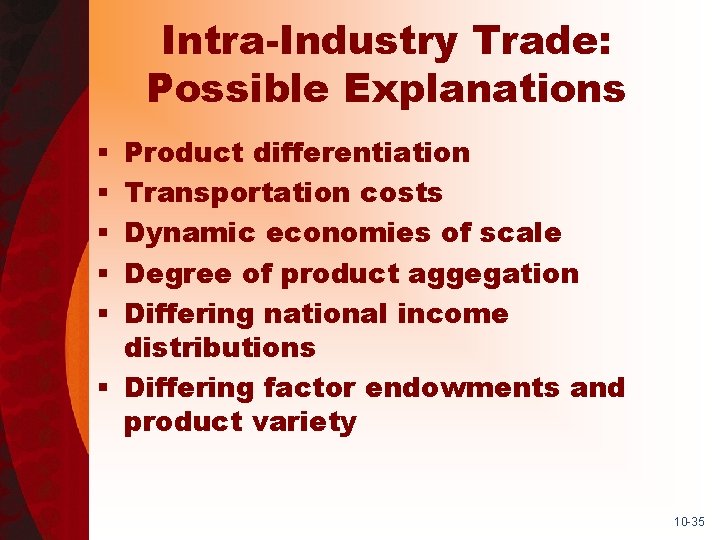
Intra-Industry Trade: Possible Explanations Product differentiation Transportation costs Dynamic economies of scale Degree of product aggegation Differing national income distributions § Differing factor endowments and product variety § § § 10 -35
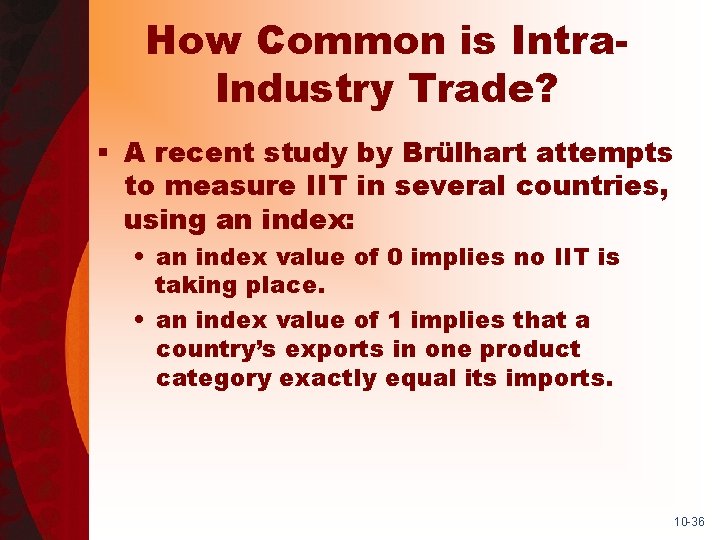
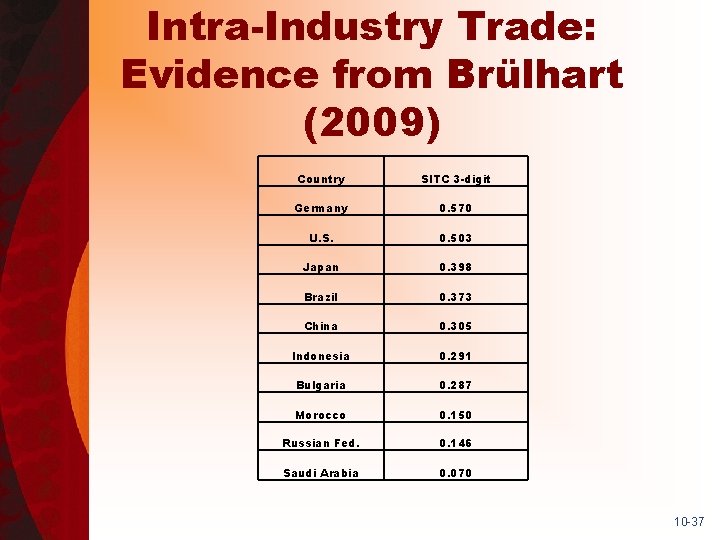
How Common is Intra. Industry Trade? § A recent study by Brülhart attempts to measure IIT in several countries, using an index: • an index value of 0 implies no IIT is taking place. • an index value of 1 implies that a country’s exports in one product category exactly equal its imports. 10 -36
Intra-Industry Trade: Evidence from Brülhart (2009) Country SITC 3 -digit Germany 0. 570 U. S. 0. 503 Japan 0. 398 Brazil 0. 373 China 0. 305 Indonesia 0. 291 Bulgaria 0. 287 Morocco 0. 150 Russian Fed. 0. 146 Saudi Arabia 0. 070 10 -37