
Chapter 10 Pointers and Dynamic Arrays Copyright 2016
![Array Variables Pointers • Recall previous example: int a[10]; typedef int* Int. Ptr; Int.](https://slidetodoc.com/presentation_image/26b8526859ca0030cb3a22ab330b373b/image-35.jpg "Array Variables Pointers • Recall previous example: int a[10]; typedef int* Int. Ptr; Int.")
![Array Variables Pointers • Array variable int a[10]; • MORE than a pointer variable](https://slidetodoc.com/presentation_image/26b8526859ca0030cb3a22ab330b373b/image-36.jpg "Array Variables Pointers • Array variable int a[10]; • MORE than a pointer variable")
- Slides: 54
Chapter 10 Pointers and Dynamic Arrays Copyright © 2016 Pearson, Inc. All rights reserved.
Learning Objectives • Pointers – Pointer variables – Memory management • Dynamic Arrays – Creating and using – Pointer arithmetic • Classes, Pointers, Dynamic Arrays – The this pointer – Destructors, copy constructors Copyright © 2016 Pearson Inc. All rights reserved. 10 -2
Pointer Introduction • Pointer definition: – Memory address of a variable • Recall: memory divided – Numbered memory locations – Addresses used as name for variable • You’ve used pointers already! – Call-by-reference parameters • Address of actual argument was passed Copyright © 2016 Pearson Inc. All rights reserved. 10 -3
Pointer Variables • Pointers are "typed" – Can store pointer in variable – Not int, double, etc. • Instead: A POINTER to int, double, etc. ! • Example: double *p; – p is declared a "pointer to double" variable – Can hold pointers to variables of type double • Not other types! (unless typecast, but could be dangerous) Copyright © 2016 Pearson Inc. All rights reserved. 10 -4
Declaring Pointer Variables • Pointers declared like other types – Add "*" before variable name – Produces "pointer to" that type • "*" must be before each variable • int *p 1, *p 2, v 1, v 2; – p 1, p 2 hold pointers to int variables – v 1, v 2 are ordinary int variables Copyright © 2016 Pearson Inc. All rights reserved. 10 -5
Addresses and Numbers • Pointer is an address • Address is an integer • Pointer is NOT an integer! – Not crazy abstraction! • C++ forces pointers be used as addresses – Cannot be used as numbers – Even though it "is a" number Copyright © 2016 Pearson Inc. All rights reserved. 10 -6
Pointing • Terminology, view – Talk of "pointing", not "addresses" – Pointer variable "points to" ordinary variable – Leave "address" talk out • Makes visualization clearer – "See" memory references • Arrows Copyright © 2016 Pearson Inc. All rights reserved. 10 -7
Pointing to … • int *p 1, *p 2, v 1, v 2; p 1 = &v 1; – Sets pointer variable p 1 to "point to" int variable v 1 • Operator, & – Determines "address of" variable • Read like: – "p 1 equals address of v 1" – Or "p 1 points to v 1" Copyright © 2016 Pearson Inc. All rights reserved. 10 -8
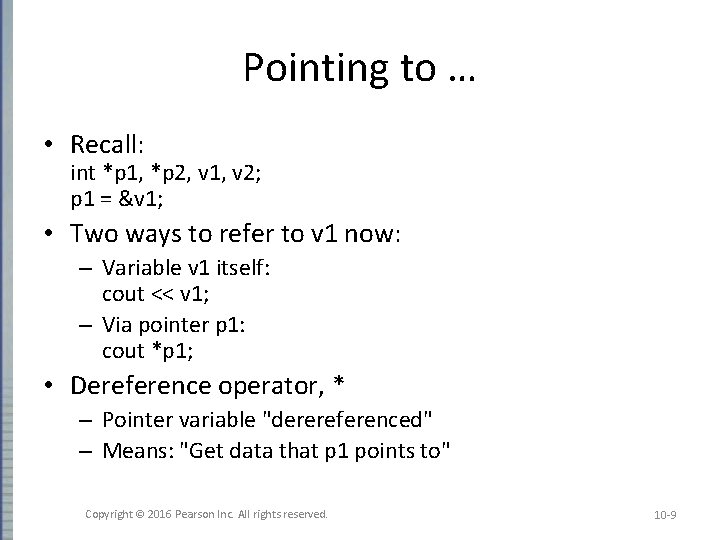
Pointing to … • Recall: int *p 1, *p 2, v 1, v 2; p 1 = &v 1; • Two ways to refer to v 1 now: – Variable v 1 itself: cout << v 1; – Via pointer p 1: cout *p 1; • Dereference operator, * – Pointer variable "derereferenced" – Means: "Get data that p 1 points to" Copyright © 2016 Pearson Inc. All rights reserved. 10 -9
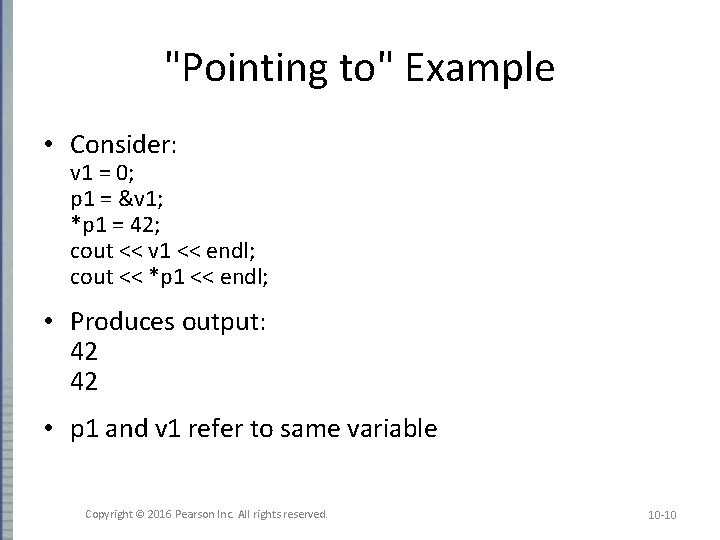
"Pointing to" Example • Consider: v 1 = 0; p 1 = &v 1; *p 1 = 42; cout << v 1 << endl; cout << *p 1 << endl; • Produces output: 42 42 • p 1 and v 1 refer to same variable Copyright © 2016 Pearson Inc. All rights reserved. 10 -10
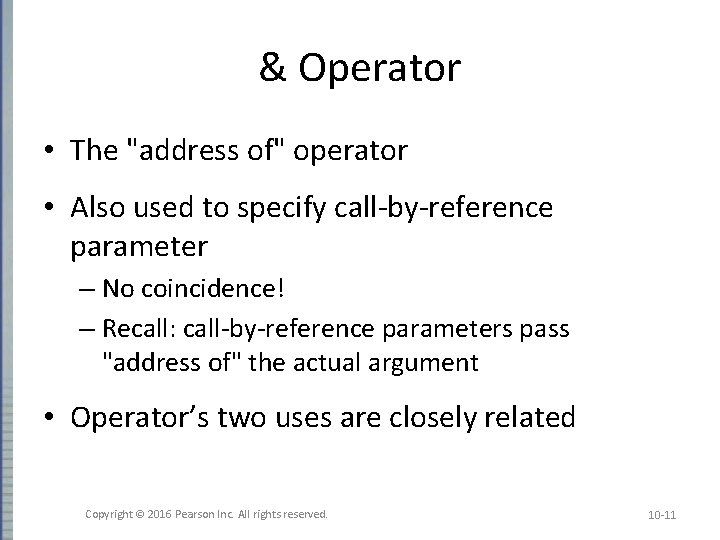
& Operator • The "address of" operator • Also used to specify call-by-reference parameter – No coincidence! – Recall: call-by-reference parameters pass "address of" the actual argument • Operator’s two uses are closely related Copyright © 2016 Pearson Inc. All rights reserved. 10 -11
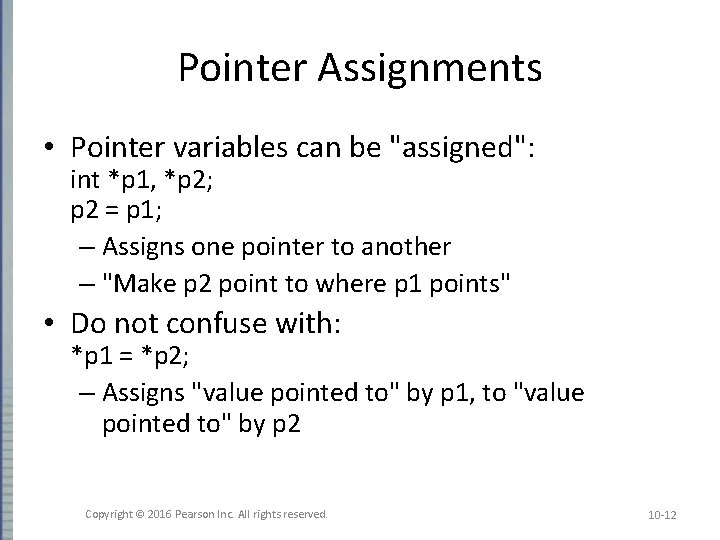
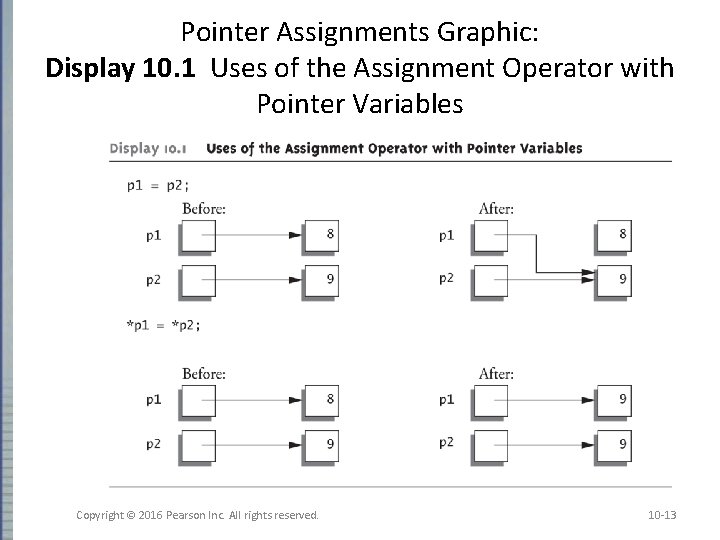
Pointer Assignments • Pointer variables can be "assigned": int *p 1, *p 2; p 2 = p 1; – Assigns one pointer to another – "Make p 2 point to where p 1 points" • Do not confuse with: *p 1 = *p 2; – Assigns "value pointed to" by p 1, to "value pointed to" by p 2 Copyright © 2016 Pearson Inc. All rights reserved. 10 -12
Pointer Assignments Graphic: Display 10. 1 Uses of the Assignment Operator with Pointer Variables Copyright © 2016 Pearson Inc. All rights reserved. 10 -13
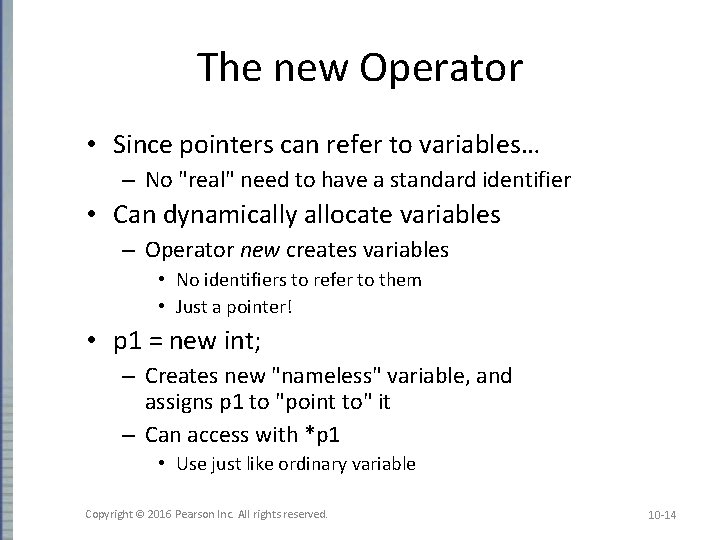
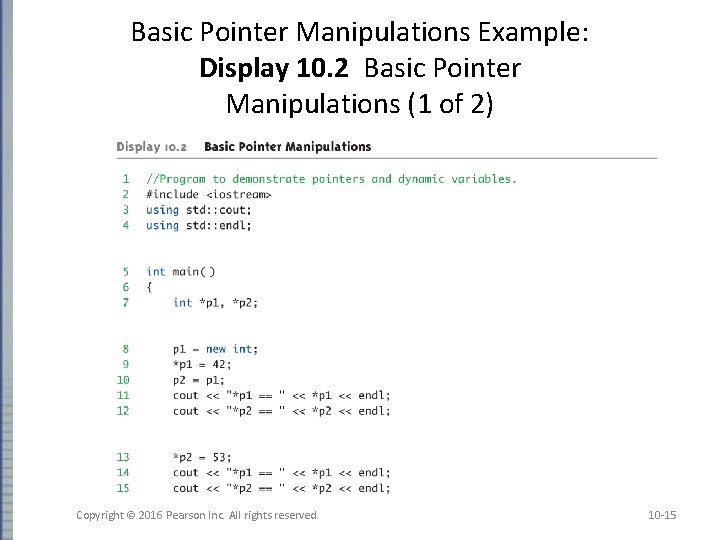
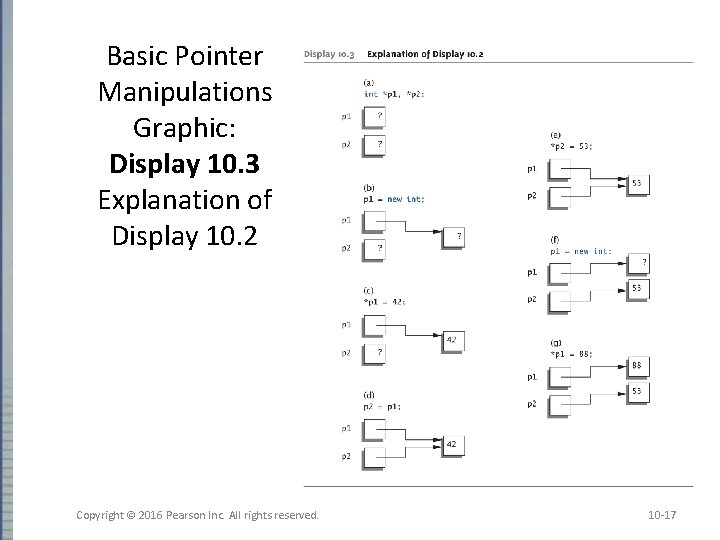
The new Operator • Since pointers can refer to variables… – No "real" need to have a standard identifier • Can dynamically allocate variables – Operator new creates variables • No identifiers to refer to them • Just a pointer! • p 1 = new int; – Creates new "nameless" variable, and assigns p 1 to "point to" it – Can access with *p 1 • Use just like ordinary variable Copyright © 2016 Pearson Inc. All rights reserved. 10 -14
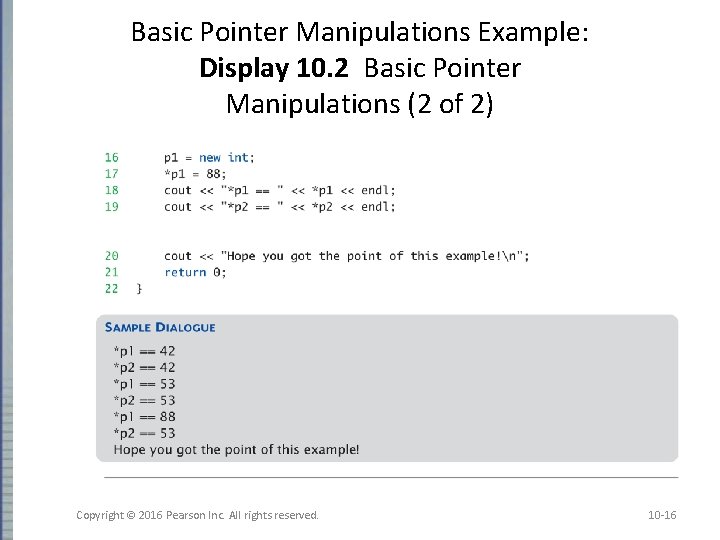
Basic Pointer Manipulations Example: Display 10. 2 Basic Pointer Manipulations (1 of 2) Copyright © 2016 Pearson Inc. All rights reserved. 10 -15
Basic Pointer Manipulations Example: Display 10. 2 Basic Pointer Manipulations (2 of 2) Copyright © 2016 Pearson Inc. All rights reserved. 10 -16
Basic Pointer Manipulations Graphic: Display 10. 3 Explanation of Display 10. 2 Copyright © 2016 Pearson Inc. All rights reserved. 10 -17
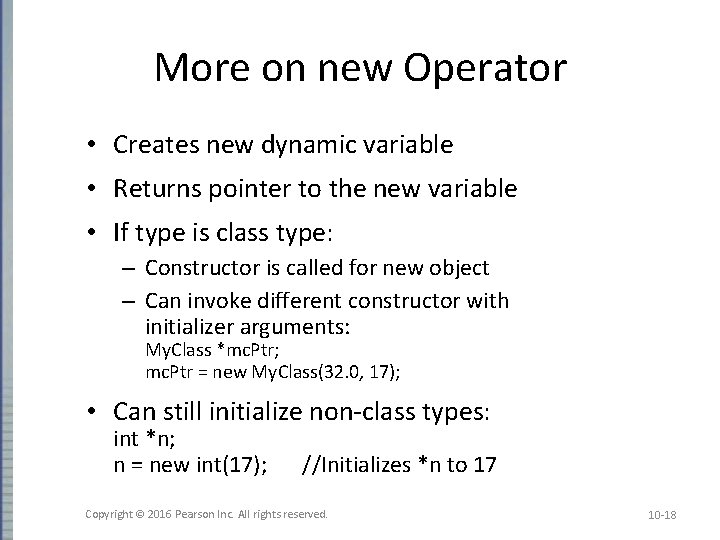
More on new Operator • Creates new dynamic variable • Returns pointer to the new variable • If type is class type: – Constructor is called for new object – Can invoke different constructor with initializer arguments: My. Class *mc. Ptr; mc. Ptr = new My. Class(32. 0, 17); • Can still initialize non-class types: int *n; n = new int(17); //Initializes *n to 17 Copyright © 2016 Pearson Inc. All rights reserved. 10 -18
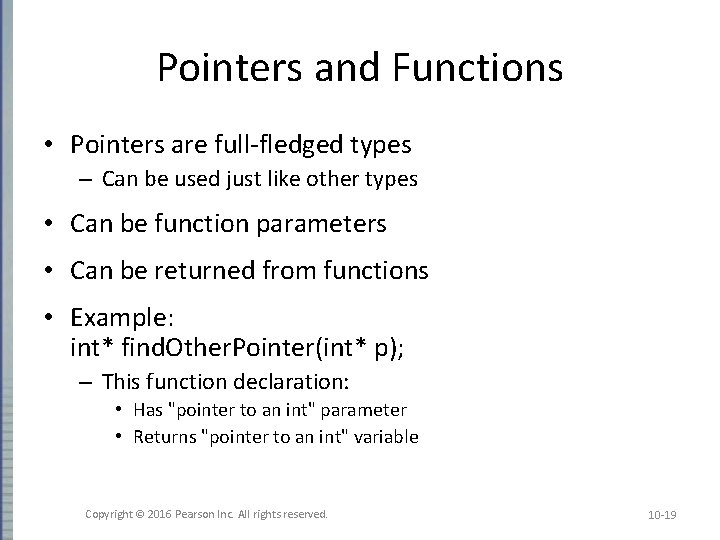
Pointers and Functions • Pointers are full-fledged types – Can be used just like other types • Can be function parameters • Can be returned from functions • Example: int* find. Other. Pointer(int* p); – This function declaration: • Has "pointer to an int" parameter • Returns "pointer to an int" variable Copyright © 2016 Pearson Inc. All rights reserved. 10 -19
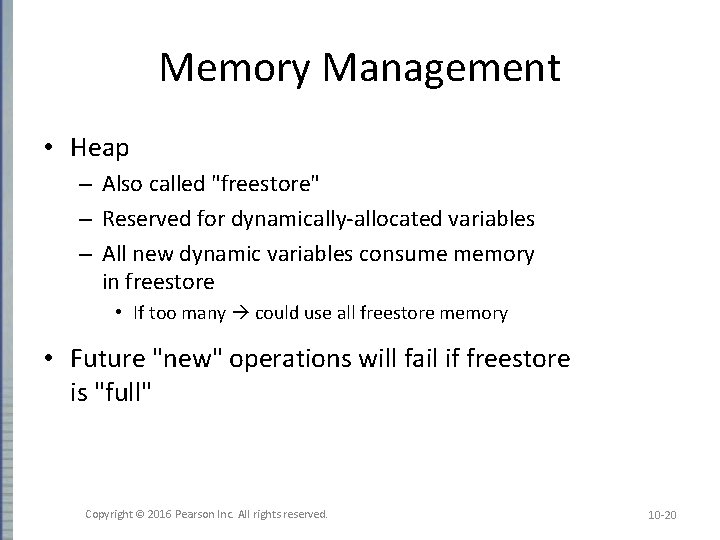
Memory Management • Heap – Also called "freestore" – Reserved for dynamically-allocated variables – All new dynamic variables consume memory in freestore • If too many could use all freestore memory • Future "new" operations will fail if freestore is "full" Copyright © 2016 Pearson Inc. All rights reserved. 10 -20
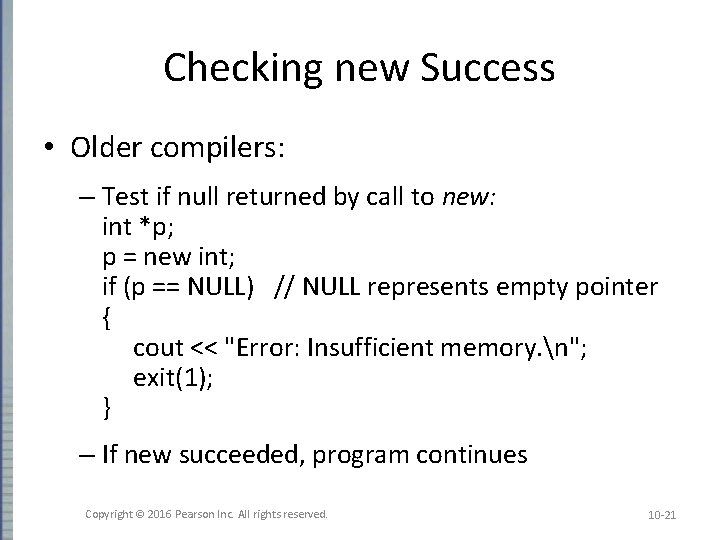
Checking new Success • Older compilers: – Test if null returned by call to new: int *p; p = new int; if (p == NULL) // NULL represents empty pointer { cout << "Error: Insufficient memory. n"; exit(1); } – If new succeeded, program continues Copyright © 2016 Pearson Inc. All rights reserved. 10 -21
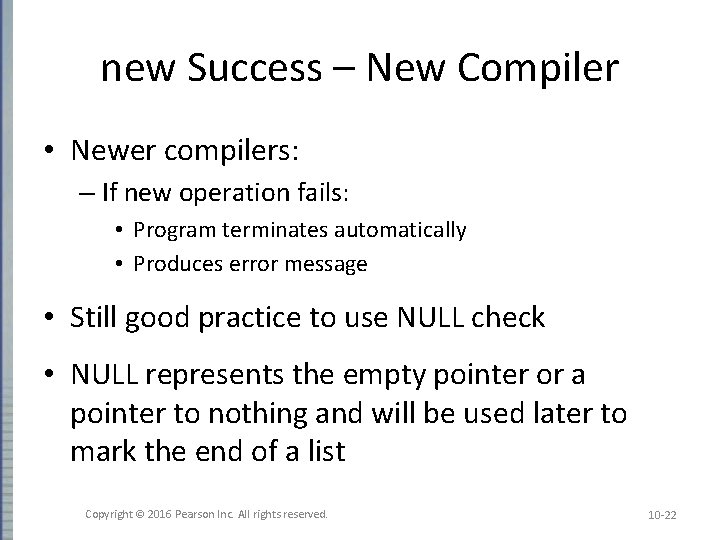
new Success – New Compiler • Newer compilers: – If new operation fails: • Program terminates automatically • Produces error message • Still good practice to use NULL check • NULL represents the empty pointer or a pointer to nothing and will be used later to mark the end of a list Copyright © 2016 Pearson Inc. All rights reserved. 10 -22
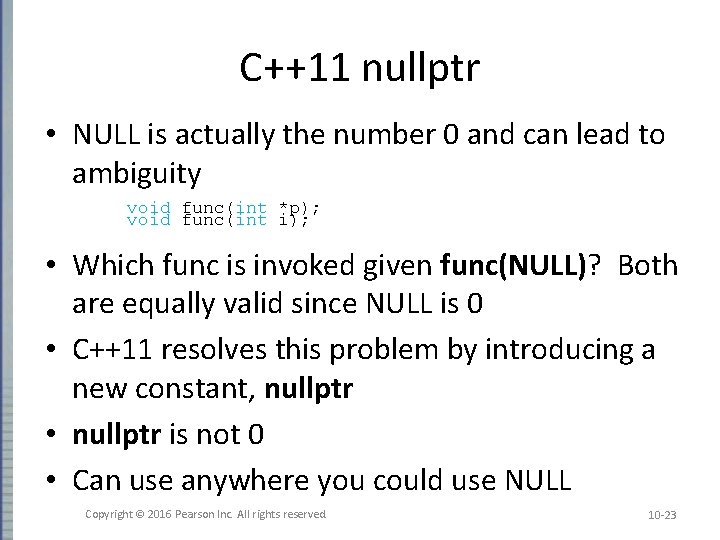
C++11 nullptr • NULL is actually the number 0 and can lead to ambiguity void func(int *p); void func(int i); • Which func is invoked given func(NULL)? Both are equally valid since NULL is 0 • C++11 resolves this problem by introducing a new constant, nullptr • nullptr is not 0 • Can use anywhere you could use NULL Copyright © 2016 Pearson Inc. All rights reserved. 10 -23
Freestore Size • Varies with implementations • Typically large – Most programs won’t use all memory • Memory management – Still good practice – Solid software engineering principle – Memory IS finite • Regardless of how much there is! Copyright © 2016 Pearson Inc. All rights reserved. 10 -24
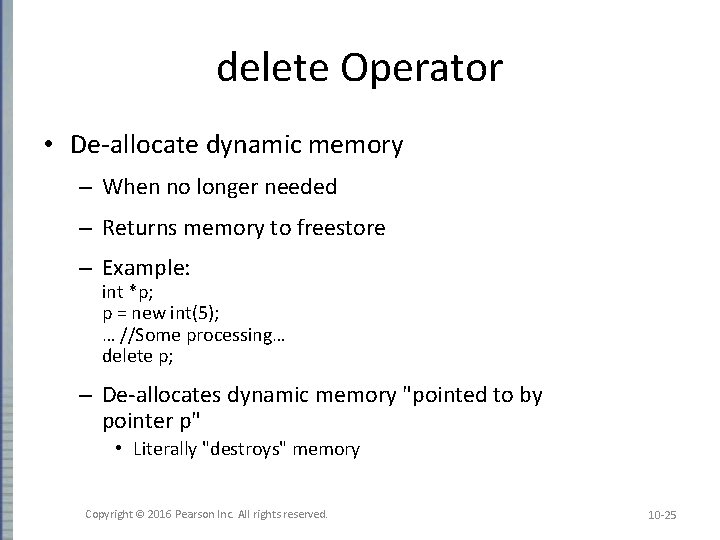
delete Operator • De-allocate dynamic memory – When no longer needed – Returns memory to freestore – Example: int *p; p = new int(5); … //Some processing… delete p; – De-allocates dynamic memory "pointed to by pointer p" • Literally "destroys" memory Copyright © 2016 Pearson Inc. All rights reserved. 10 -25
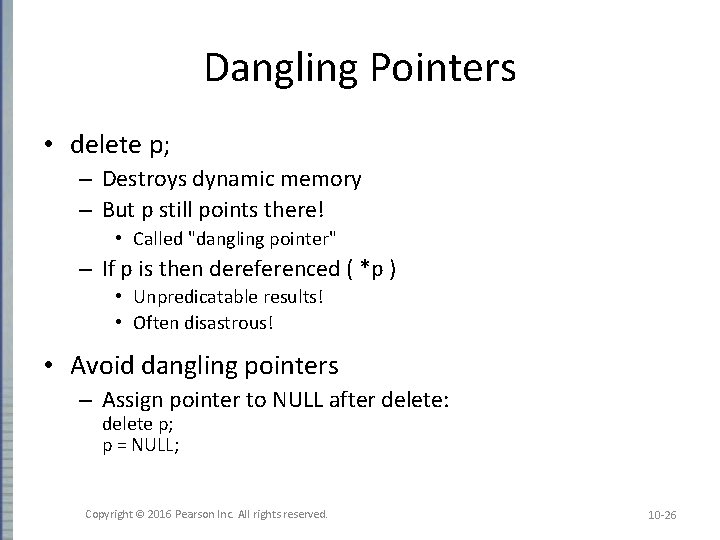
Dangling Pointers • delete p; – Destroys dynamic memory – But p still points there! • Called "dangling pointer" – If p is then dereferenced ( *p ) • Unpredicatable results! • Often disastrous! • Avoid dangling pointers – Assign pointer to NULL after delete: delete p; p = NULL; Copyright © 2016 Pearson Inc. All rights reserved. 10 -26
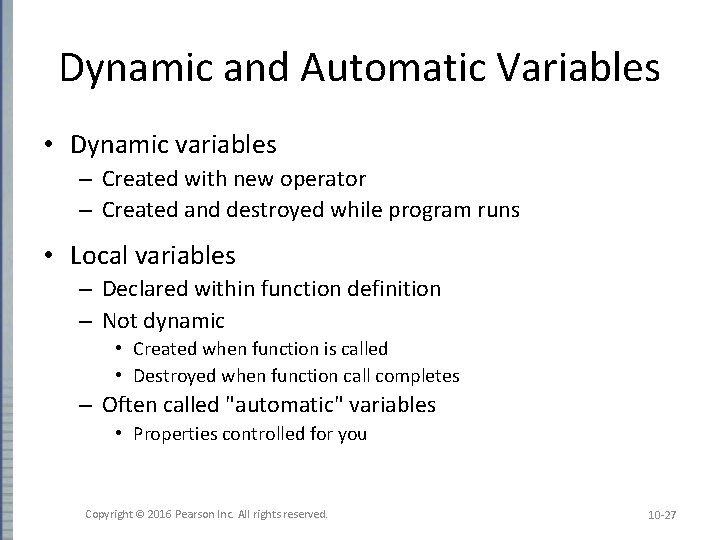
Dynamic and Automatic Variables • Dynamic variables – Created with new operator – Created and destroyed while program runs • Local variables – Declared within function definition – Not dynamic • Created when function is called • Destroyed when function call completes – Often called "automatic" variables • Properties controlled for you Copyright © 2016 Pearson Inc. All rights reserved. 10 -27
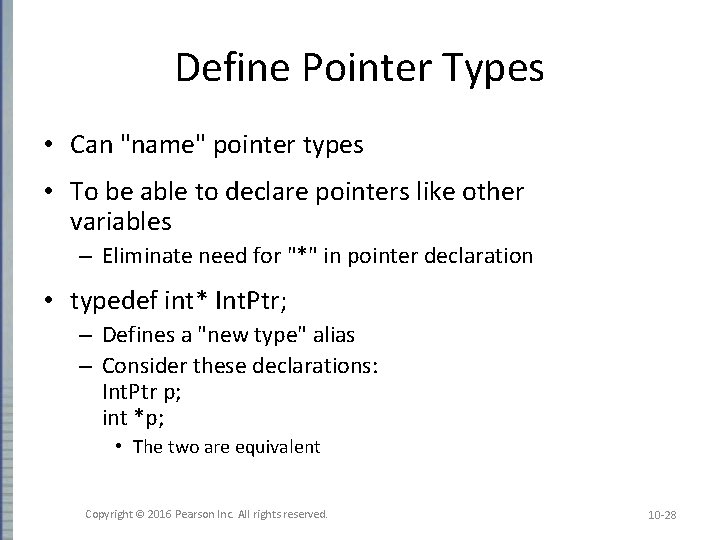
Define Pointer Types • Can "name" pointer types • To be able to declare pointers like other variables – Eliminate need for "*" in pointer declaration • typedef int* Int. Ptr; – Defines a "new type" alias – Consider these declarations: Int. Ptr p; int *p; • The two are equivalent Copyright © 2016 Pearson Inc. All rights reserved. 10 -28
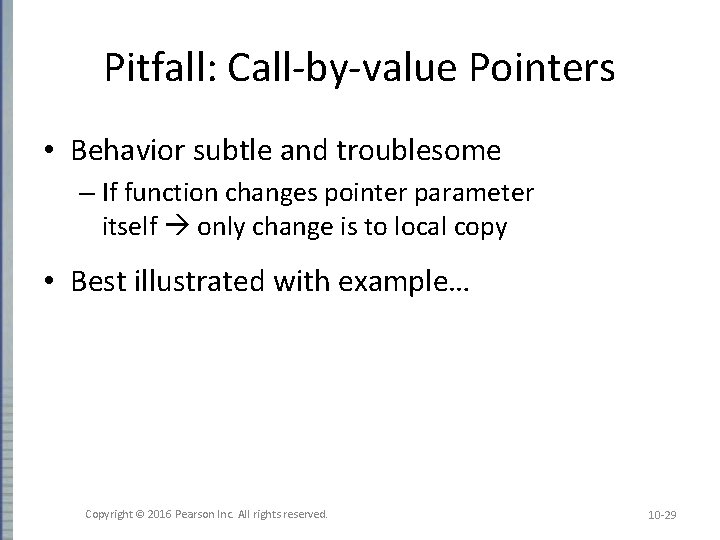
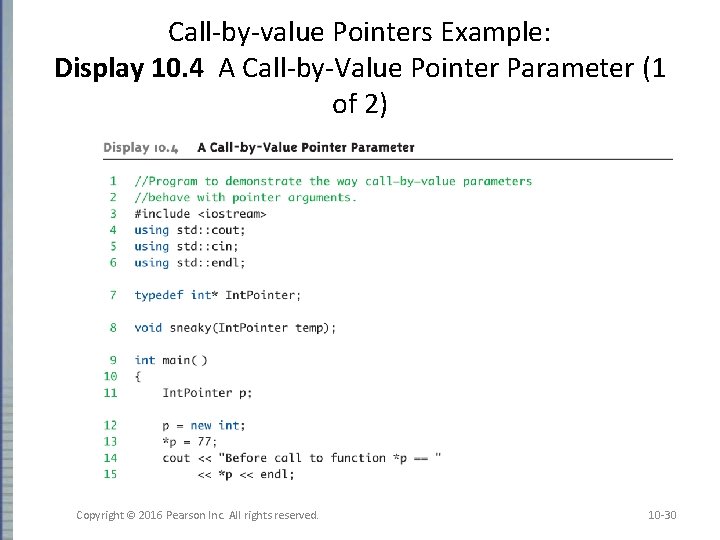
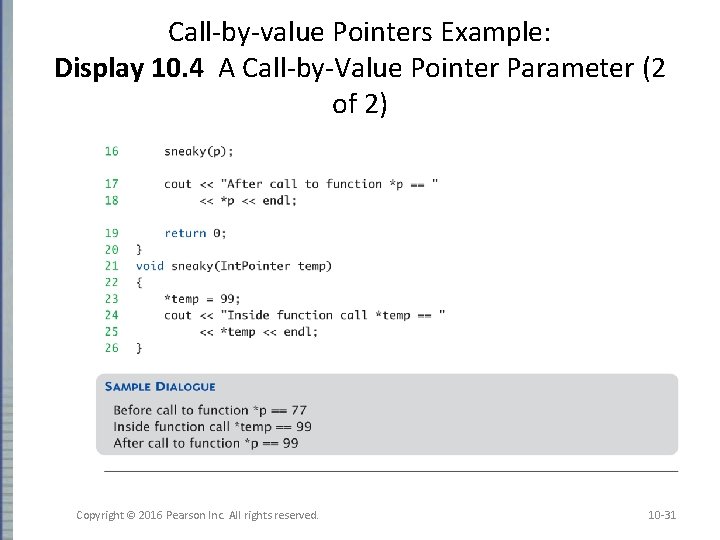
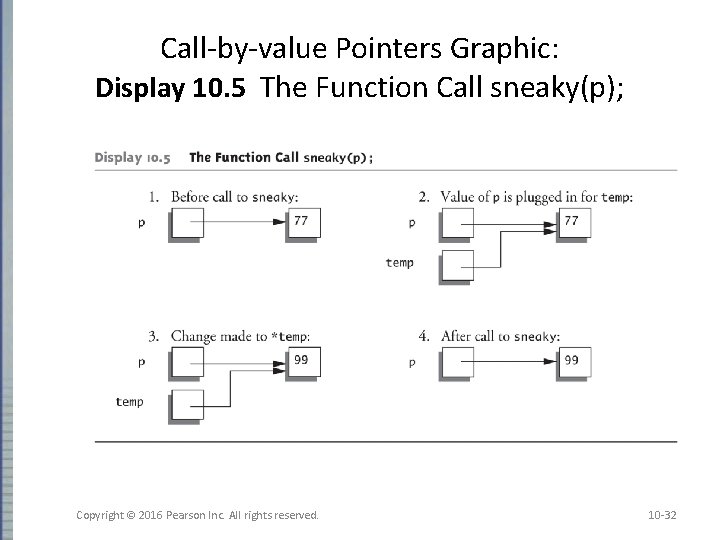
Pitfall: Call-by-value Pointers • Behavior subtle and troublesome – If function changes pointer parameter itself only change is to local copy • Best illustrated with example… Copyright © 2016 Pearson Inc. All rights reserved. 10 -29
Call-by-value Pointers Example: Display 10. 4 A Call-by-Value Pointer Parameter (1 of 2) Copyright © 2016 Pearson Inc. All rights reserved. 10 -30
Call-by-value Pointers Example: Display 10. 4 A Call-by-Value Pointer Parameter (2 of 2) Copyright © 2016 Pearson Inc. All rights reserved. 10 -31
Call-by-value Pointers Graphic: Display 10. 5 The Function Call sneaky(p); Copyright © 2016 Pearson Inc. All rights reserved. 10 -32
Dynamic Arrays • Array variables – Really pointer variables! • Standard array – Fixed size • Dynamic array – Size not specified at programming time – Determined while program running Copyright © 2016 Pearson Inc. All rights reserved. 10 -33
Array Variables • Recall: arrays stored in memory addresses, sequentially – Array variable "refers to" first indexed variable – So array variable is a kind of pointer variable! • Example: int a[10]; int * p; – a and p are both pointer variables! Copyright © 2016 Pearson Inc. All rights reserved. 10 -34
Array Variables Pointers • Recall previous example: int a[10]; typedef int* Int. Ptr; Int. Ptr p; • a and p are pointer variables – Can perform assignments: p = a; // Legal. • p now points where a points – To first indexed variable of array a – a = p; // ILLEGAL! • Array pointer is CONSTANT pointer! Copyright © 2016 Pearson Inc. All rights reserved. 10 -35
Array Variables Pointers • Array variable int a[10]; • MORE than a pointer variable – "const int *" type – Array was allocated in memory already – Variable a MUST point there…always! • Cannot be changed! • In contrast to ordinary pointers – Which can (& typically do) change Copyright © 2016 Pearson Inc. All rights reserved. 10 -36
Dynamic Arrays • Array limitations – Must specify size first – May not know until program runs! • Must "estimate" maximum size needed – Sometimes OK, sometimes not – "Wastes" memory • Dynamic arrays – Can grow and shrink as needed Copyright © 2016 Pearson Inc. All rights reserved. 10 -37
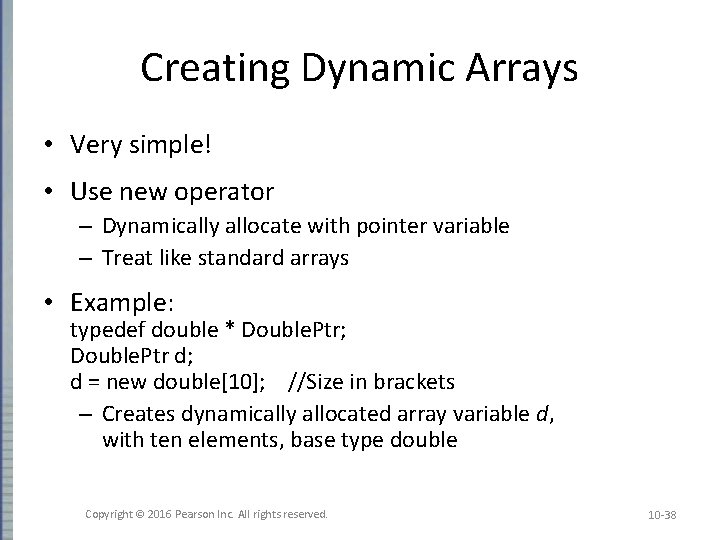
Creating Dynamic Arrays • Very simple! • Use new operator – Dynamically allocate with pointer variable – Treat like standard arrays • Example: typedef double * Double. Ptr; Double. Ptr d; d = new double[10]; //Size in brackets – Creates dynamically allocated array variable d, with ten elements, base type double Copyright © 2016 Pearson Inc. All rights reserved. 10 -38
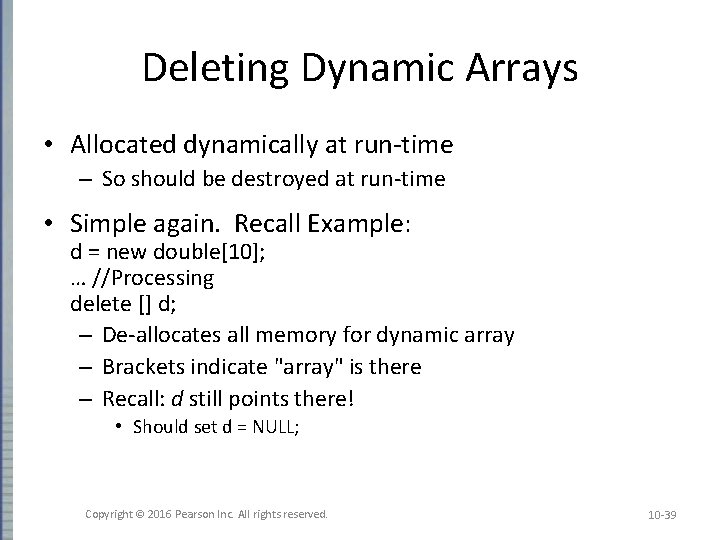
Deleting Dynamic Arrays • Allocated dynamically at run-time – So should be destroyed at run-time • Simple again. Recall Example: d = new double[10]; … //Processing delete [] d; – De-allocates all memory for dynamic array – Brackets indicate "array" is there – Recall: d still points there! • Should set d = NULL; Copyright © 2016 Pearson Inc. All rights reserved. 10 -39
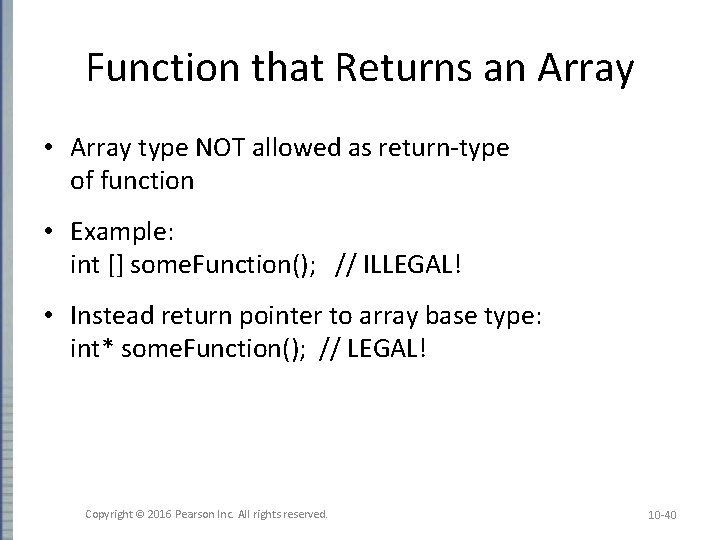
Function that Returns an Array • Array type NOT allowed as return-type of function • Example: int [] some. Function(); // ILLEGAL! • Instead return pointer to array base type: int* some. Function(); // LEGAL! Copyright © 2016 Pearson Inc. All rights reserved. 10 -40
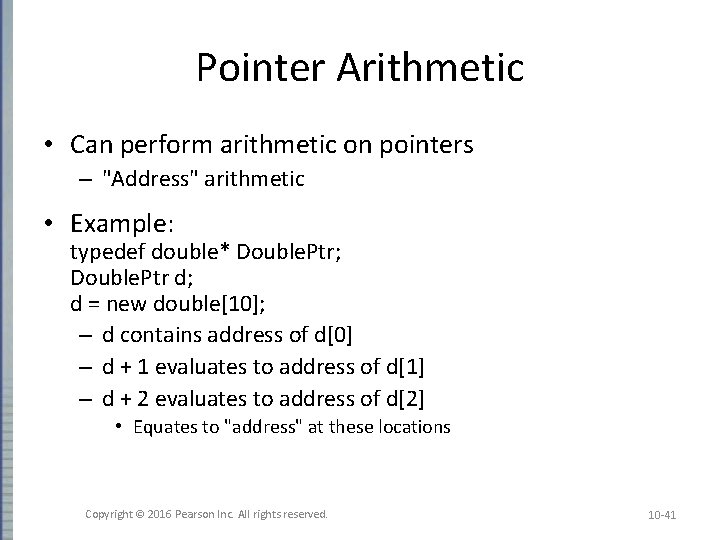
Pointer Arithmetic • Can perform arithmetic on pointers – "Address" arithmetic • Example: typedef double* Double. Ptr; Double. Ptr d; d = new double[10]; – d contains address of d[0] – d + 1 evaluates to address of d[1] – d + 2 evaluates to address of d[2] • Equates to "address" at these locations Copyright © 2016 Pearson Inc. All rights reserved. 10 -41
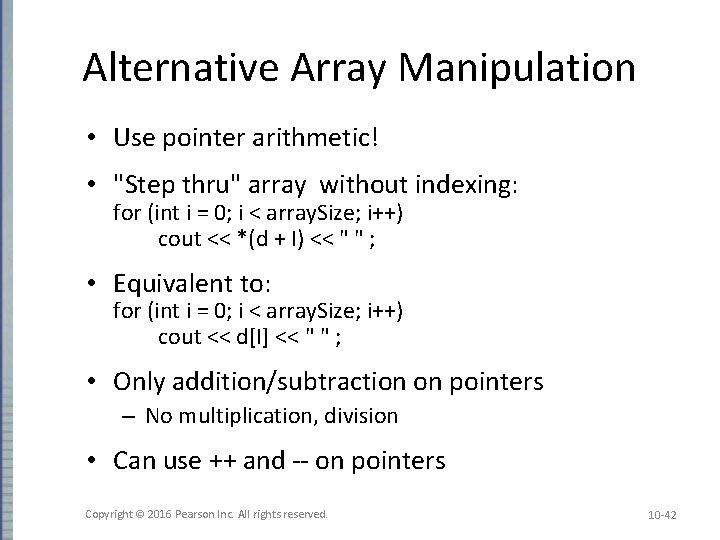
Alternative Array Manipulation • Use pointer arithmetic! • "Step thru" array without indexing: for (int i = 0; i < array. Size; i++) cout << *(d + I) << " " ; • Equivalent to: for (int i = 0; i < array. Size; i++) cout << d[I] << " " ; • Only addition/subtraction on pointers – No multiplication, division • Can use ++ and -- on pointers Copyright © 2016 Pearson Inc. All rights reserved. 10 -42
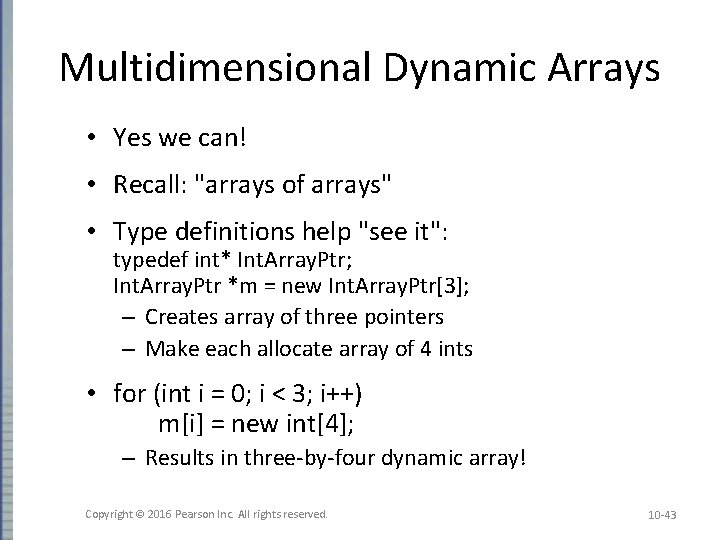
Multidimensional Dynamic Arrays • Yes we can! • Recall: "arrays of arrays" • Type definitions help "see it": typedef int* Int. Array. Ptr; Int. Array. Ptr *m = new Int. Array. Ptr[3]; – Creates array of three pointers – Make each allocate array of 4 ints • for (int i = 0; i < 3; i++) m[i] = new int[4]; – Results in three-by-four dynamic array! Copyright © 2016 Pearson Inc. All rights reserved. 10 -43
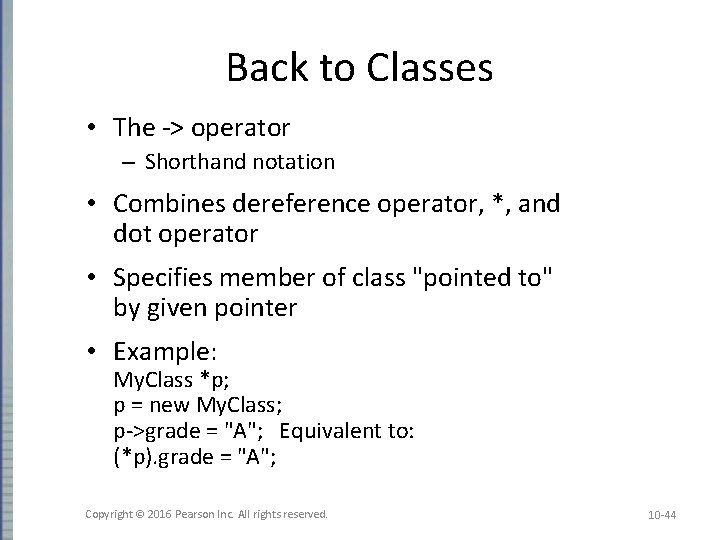
Back to Classes • The -> operator – Shorthand notation • Combines dereference operator, *, and dot operator • Specifies member of class "pointed to" by given pointer • Example: My. Class *p; p = new My. Class; p->grade = "A"; Equivalent to: (*p). grade = "A"; Copyright © 2016 Pearson Inc. All rights reserved. 10 -44
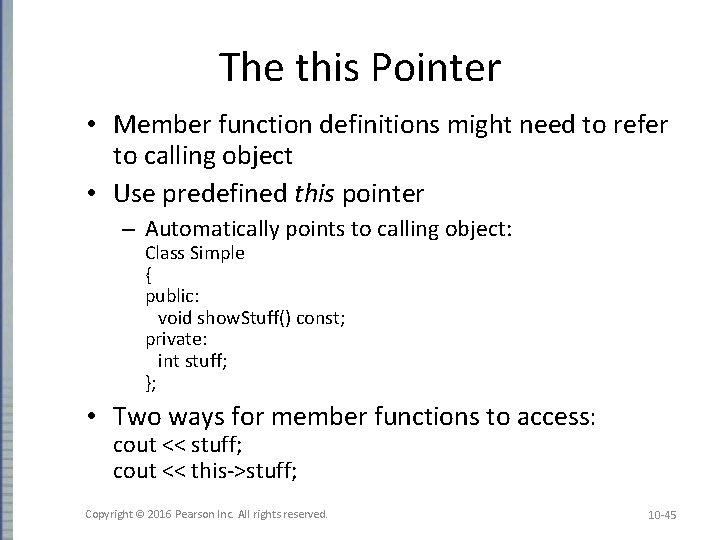
The this Pointer • Member function definitions might need to refer to calling object • Use predefined this pointer – Automatically points to calling object: Class Simple { public: void show. Stuff() const; private: int stuff; }; • Two ways for member functions to access: cout << stuff; cout << this->stuff; Copyright © 2016 Pearson Inc. All rights reserved. 10 -45
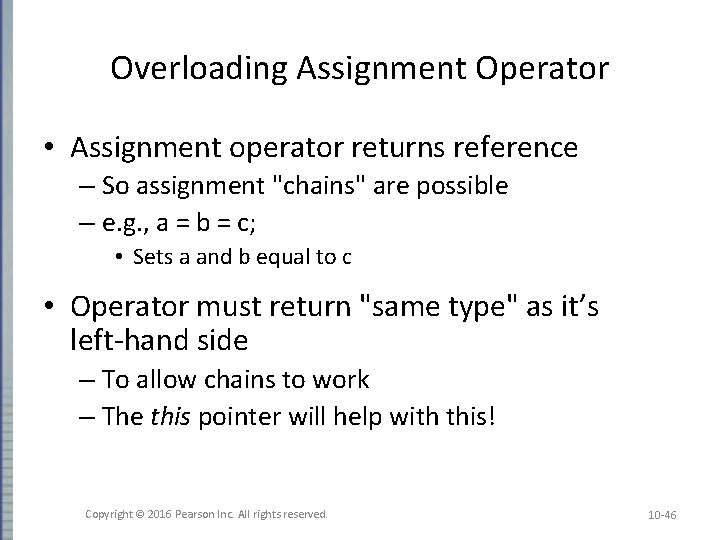
Overloading Assignment Operator • Assignment operator returns reference – So assignment "chains" are possible – e. g. , a = b = c; • Sets a and b equal to c • Operator must return "same type" as it’s left-hand side – To allow chains to work – The this pointer will help with this! Copyright © 2016 Pearson Inc. All rights reserved. 10 -46
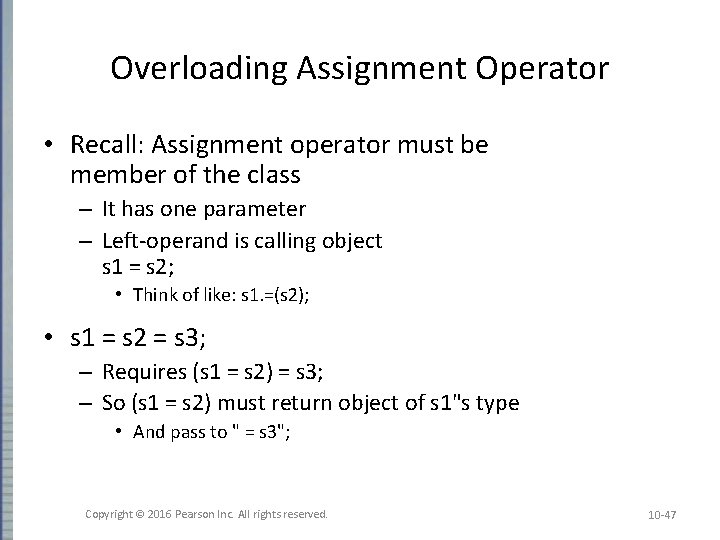
Overloading Assignment Operator • Recall: Assignment operator must be member of the class – It has one parameter – Left-operand is calling object s 1 = s 2; • Think of like: s 1. =(s 2); • s 1 = s 2 = s 3; – Requires (s 1 = s 2) = s 3; – So (s 1 = s 2) must return object of s 1"s type • And pass to " = s 3"; Copyright © 2016 Pearson Inc. All rights reserved. 10 -47
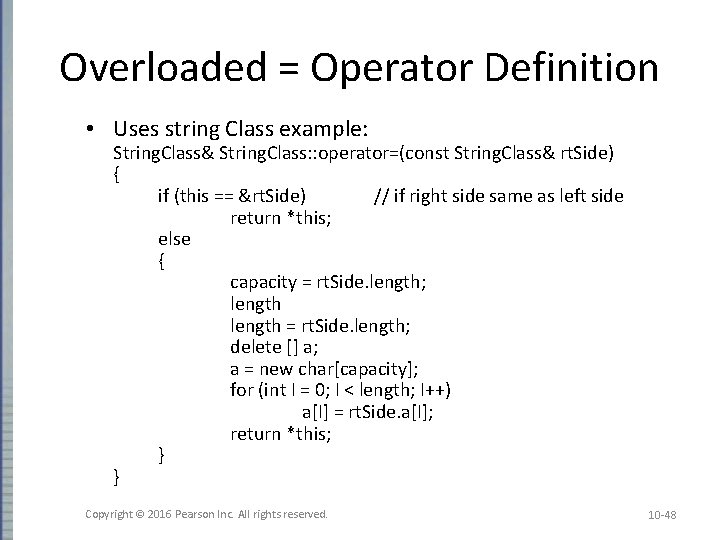
Overloaded = Operator Definition • Uses string Class example: String. Class& String. Class: : operator=(const String. Class& rt. Side) { if (this == &rt. Side) // if right side same as left side return *this; else { capacity = rt. Side. length; length = rt. Side. length; delete [] a; a = new char[capacity]; for (int I = 0; I < length; I++) a[I] = rt. Side. a[I]; return *this; } } Copyright © 2016 Pearson Inc. All rights reserved. 10 -48
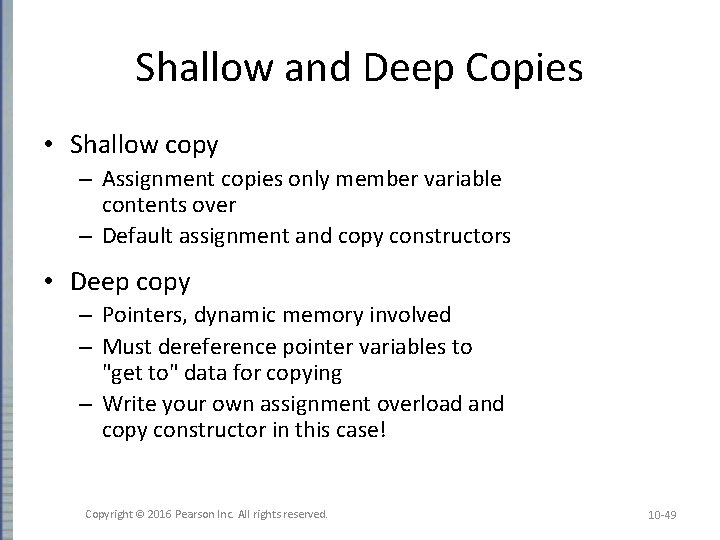
Shallow and Deep Copies • Shallow copy – Assignment copies only member variable contents over – Default assignment and copy constructors • Deep copy – Pointers, dynamic memory involved – Must dereference pointer variables to "get to" data for copying – Write your own assignment overload and copy constructor in this case! Copyright © 2016 Pearson Inc. All rights reserved. 10 -49
Destructor Need • Dynamically-allocated variables – Do not go away until "deleted" • If pointers are only private member data – They dynamically allocate "real" data • In constructor – Must have means to "deallocate" when object is destroyed • Answer: destructor! Copyright © 2016 Pearson Inc. All rights reserved. 10 -50
Destructors • Opposite of constructor – Automatically called when object is out-of-scope – Default version only removes ordinary variables, not dynamic variables • Defined like constructor, just add ~ – My. Class: : ~My. Class() { //Perform delete clean-up duties } Copyright © 2016 Pearson Inc. All rights reserved. 10 -51
Copy Constructors • Automatically called when: 1. Class object declared and initialized to other object 2. When function returns class type object 3. When argument of class type is "plugged in" as actual argument to call-by-value parameter • Requires "temporary copy" of object – • Default copy constructor – • Copy constructor creates it Like default "=", performs member-wise copy Pointers write own copy constructor! Copyright © 2016 Pearson Inc. All rights reserved. 10 -52
Summary 1 • Pointer is memory address – Provides indirect reference to variable • Dynamic variables – Created and destroyed while program runs • Freestore – Memory storage for dynamic variables • Dynamically allocated arrays – Size determined as program runs Copyright © 2016 Pearson Inc. All rights reserved. 10 -53
Summary 2 • Class destructor – Special member function – Automatically destroys objects • Copy constructor – Single argument member function – Called automatically when temp copy needed • Assignment operator – Must be overloaded as member function – Returns reference for chaining Copyright © 2016 Pearson Inc. All rights reserved. 10 -54