
CHAPTER 10 PHYSICAL SOCIAL AND MENTAL BENEFITS OF

CHAPTER 10 PHYSICAL, SOCIAL AND MENTAL BENEFITS OF REGULAR PHYSICAL ACTIVITY AND HEALTH RISKS OF INACTIVITY
KEY KNOWLEDGE v Physical, social, mental and emotional benefits of regular participation in physical activity v The increased health risks associated with being physically inactive, including Type 2 diabetes and obesity v Physical activity and sedentary behaviour guidelines for different age groups and population groups © Victorian Curriculum & Assessment Authority
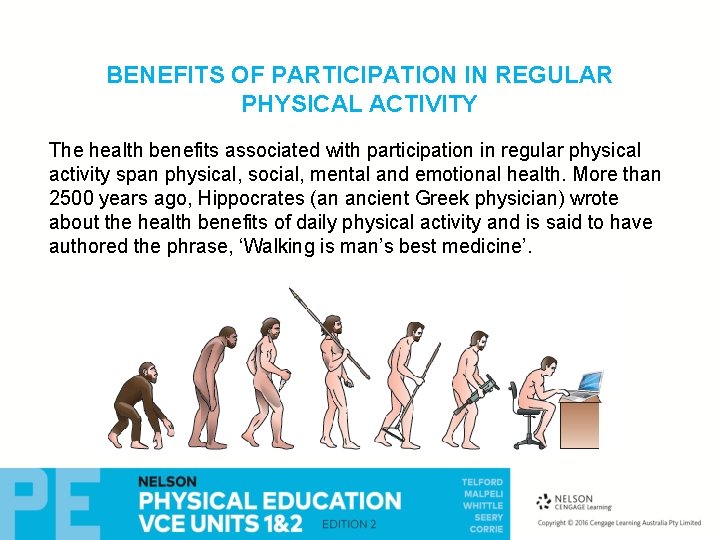
BENEFITS OF PARTICIPATION IN REGULAR PHYSICAL ACTIVITY The health benefits associated with participation in regular physical activity span physical, social, mental and emotional health. More than 2500 years ago, Hippocrates (an ancient Greek physician) wrote about the health benefits of daily physical activity and is said to have authored the phrase, ‘Walking is man’s best medicine’.
PHYSICAL HEALTH BENEFITS (1) v v v v Decreased diabetes risk Improved quality of life for diabetics Improved metabolic fitness Extended lifespan Reduced chronic illness Decrease in dysfunctional years Aids people suffering from arthritis, PMS, asthma, chronic pain, fibromyalgia and impotence v Improved immune system
PHYSICAL HEALTH BENEFITS (2) v Improved cardiovascular function v Improved strength and muscular endurance v Resistance to fatigue v Improved appearance v Greater lean body mass, less body fat v Improved flexibility and coordination v Bone development v Reduced cancer risk v Reduced effects of acquired ageing and other health benefits (see textbook page 184)
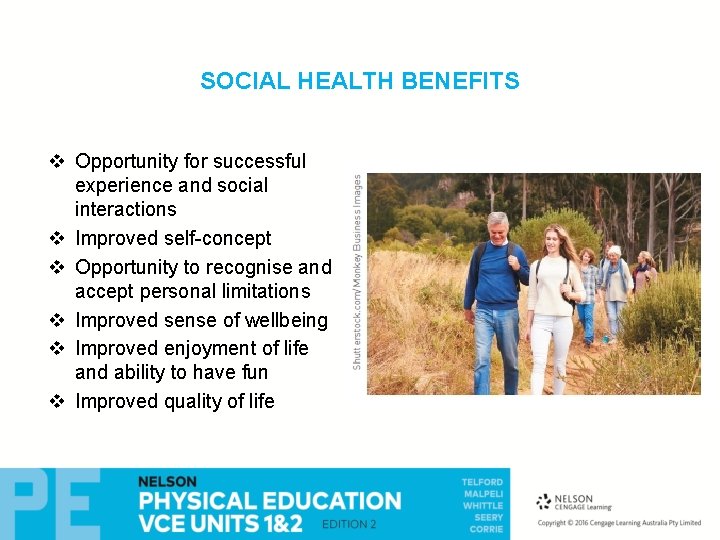
SOCIAL HEALTH BENEFITS v Opportunity for successful experience and social interactions v Improved self-concept v Opportunity to recognise and accept personal limitations v Improved sense of wellbeing v Improved enjoyment of life and ability to have fun v Improved quality of life
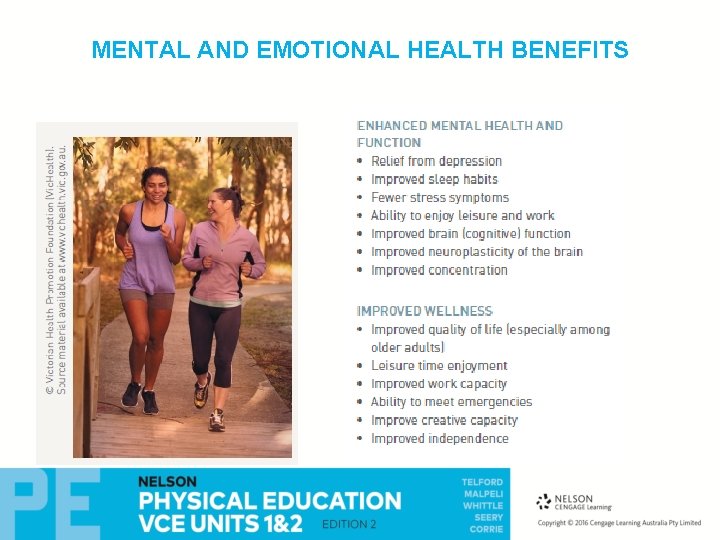
MENTAL AND EMOTIONAL HEALTH BENEFITS
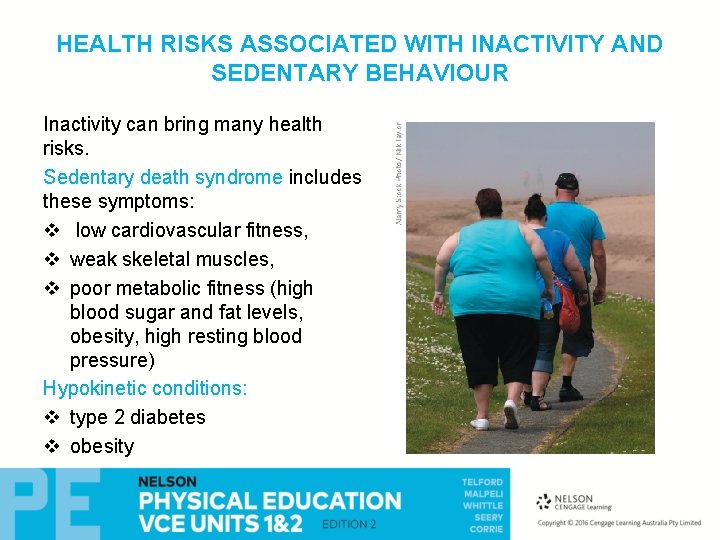
HEALTH RISKS ASSOCIATED WITH INACTIVITY AND SEDENTARY BEHAVIOUR Inactivity can bring many health risks. Sedentary death syndrome includes these symptoms: v low cardiovascular fitness, v weak skeletal muscles, v poor metabolic fitness (high blood sugar and fat levels, obesity, high resting blood pressure) Hypokinetic conditions: v type 2 diabetes v obesity
TYPE 2 DIABETES Diabetes is a disease that results from too much sugar in the blood, when the body either doesn’t produce or properly use insulin. Insulin is produced within the pancreas and is used by the body to convert sugar and other foodstuffs into energy. Low physical activity levels and poor cardiorespiratory fitness are both predictors of mortality (death) related to type 2 diabetes. Physical activity is extremely important in preventing type 2 diabetes, and is commonly prescribed in its treatment.
OBESITY In Australia, about 60% of adults and 30% of young people are either overweight or obese. There is an association between weight status and physical activity. However, obesity is very complex and it would be simplistic to suggest that people become obese solely because they don’t do enough physical activity. Medical complications resulting from obesity include: pulmonary diseases cirrhosis coronary heart disease diabetes gout sleep apnoea gall bladder disease stroke hypertension liver disease polycystic ovary syndrome cataracts cancer
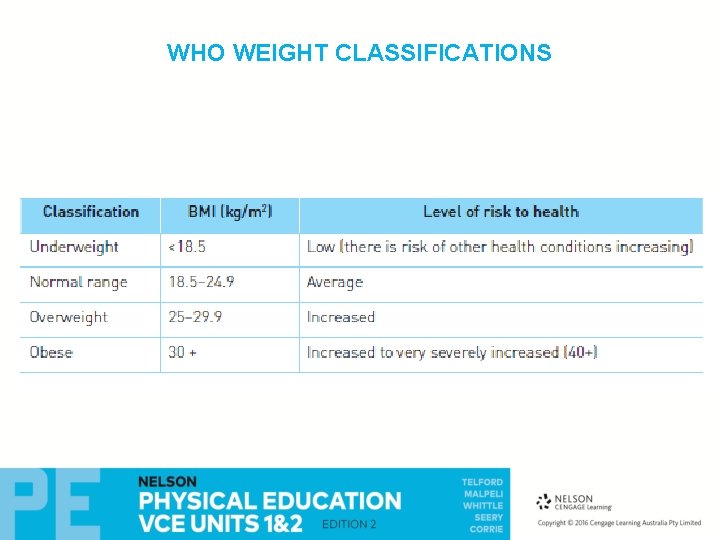
WHO WEIGHT CLASSIFICATIONS
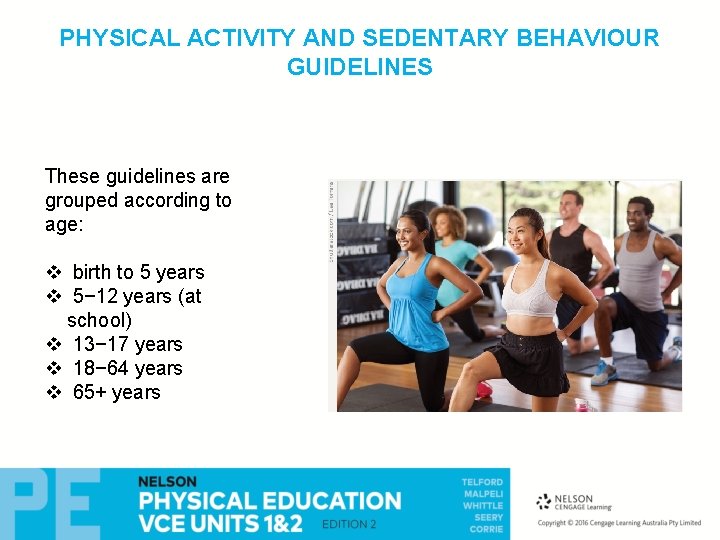
PHYSICAL ACTIVITY AND SEDENTARY BEHAVIOUR GUIDELINES These guidelines are grouped according to age: v birth to 5 years v 5− 12 years (at school) v 13− 17 years v 18− 64 years v 65+ years
BIRTH TO 5 YEARS Physical activity recommendations v For health development in infants (birth to 1 year) physical activity – particularly supervised floor-based play in safe environments – should be encouraged from birth. v Toddlers (1 to 3 years) and pre-schoolers (3 to 5 years) should be physically active every day for at least 3 hours, throughout the day. Sedentary behaviour recommendations v Children younger than 2 years should not spend any time watching television or using other electronic media v Children 2 to 5 years, sitting and watching television and the use of other electronic media (DVDs, computer and other electronic games) should be limited to less than one hour per day. v Infants, toddlers and pre-schoolers (birth to 5 years) should not be sedentary, restrained, or kept inactive, for more than one hour at a time, with the exception of sleeping.
ALL CHILDREN 5 TO 12 YEARS (AT SCHOOL) Physical activity recommendations v At least one hour of PA per day include a variety of aerobic activities, with some vigorous intensity activity v On 3 or more days per week, children should engage in activities to strengthen muscle and bone Sedentary behaviour recommendations v Limit use of electronic media for entertainment to 2 hours a day or less v Break up long periods of sitting as often as possible
ALL YOUNG PEOPLE 13 TO 17 YEARS Physical activity recommendations v At least 1 hour of moderate to vigorous intensity physical activity every day. v Include a variety of aerobic activities, including some vigorous intensity activity. v On at least 3 days a week, engage in activities to strengthen muscle and bone. Sedentary behaviour recommendations v Limit use of electronic media for entertainment to no more than 2 hours a day v Break up long periods of sitting as often as possible.
ADULTS 18 TO 64 YEARS Physical activity recommendations v Doing any physical activity is better than doing none. Start by doing some, and gradually build up to the recommended amount. v Be active on most, preferably all, days every week. v Accumulate 2. 5 -5 hours of moderate intensity physical activity or 75 to 150 minutes of vigorous intensity physical activity, or a combination of both, each week. v Do muscle strengthening activities at least 2 days each week. Sedentary behaviour recommendations v Minimise the amount of time spent in prolonged sitting. v Break up long periods of sitting as often as possible.
ADULTS 65+ YEARS Physical activity recommendations v Older people, irrespective of cultural background, gender or ability. should do some form of physical activity, whatever their age, weight, health problems or abilities. v They should be active every day, with a range of physical activities that incorporate fitness, strength, balance and flexibility. v They should try for at least 30 minutes of moderate intensity physical activity on most days. v Older people who have stopped physical activity, or who are starting a new physical activity, should start at an easily manageable level and v gradually build up the recommended amount, type and frequency of activity v Older people used to vigorous physical activity should carry on doing so in a way suited to their capability, following recommended safety procedures and guidelines.
- Slides: 18