
CHAPTER 10 PHOTOSYNTHESIS The human brain so frail
CHAPTER 10 PHOTOSYNTHESIS The human brain, so frail, so perishable, so full of inexhaustible dreams and hungers, burns by the power of the leaf. " Loren Eiseley, The Unexpected Universe
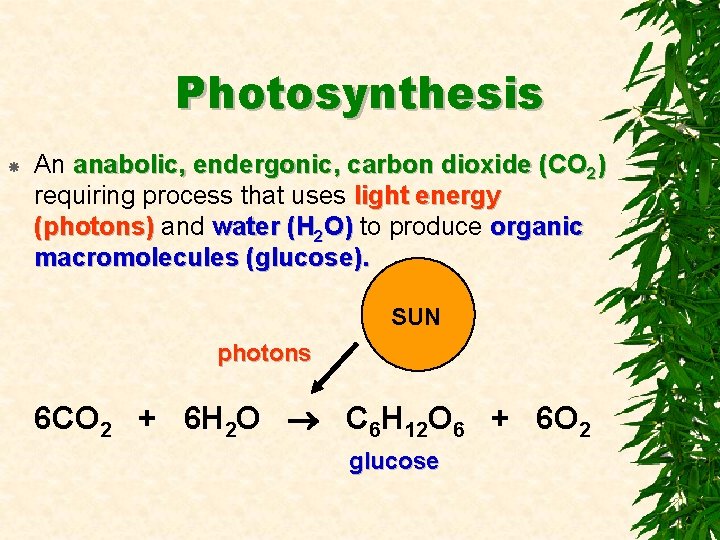
Photosynthesis An anabolic, endergonic, carbon dioxide (CO 2) requiring process that uses light energy (photons) and water (H 2 O) to produce organic macromolecules (glucose). SUN photons 6 CO 2 + 6 H 2 O C 6 H 12 O 6 + 6 O 2 glucose
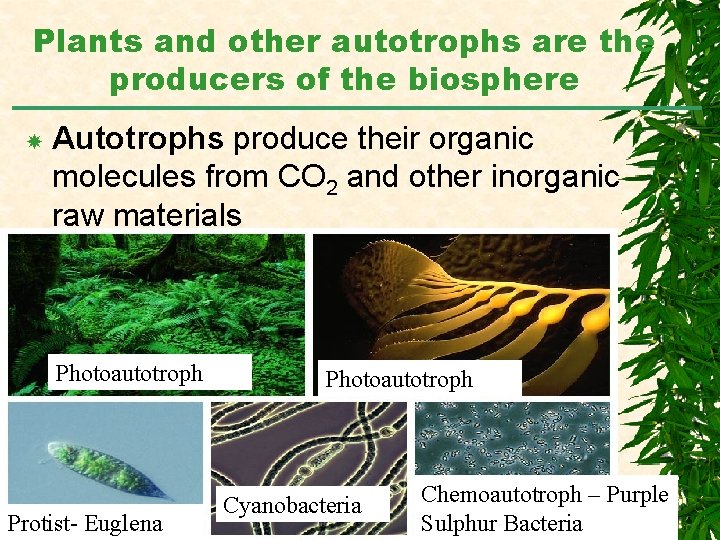
Plants and other autotrophs are the producers of the biosphere Autotrophs produce their organic molecules from CO 2 and other inorganic raw materials Photoautotroph Protist- Euglena Photoautotroph Cyanobacteria Chemoautotroph – Purple Sulphur Bacteria
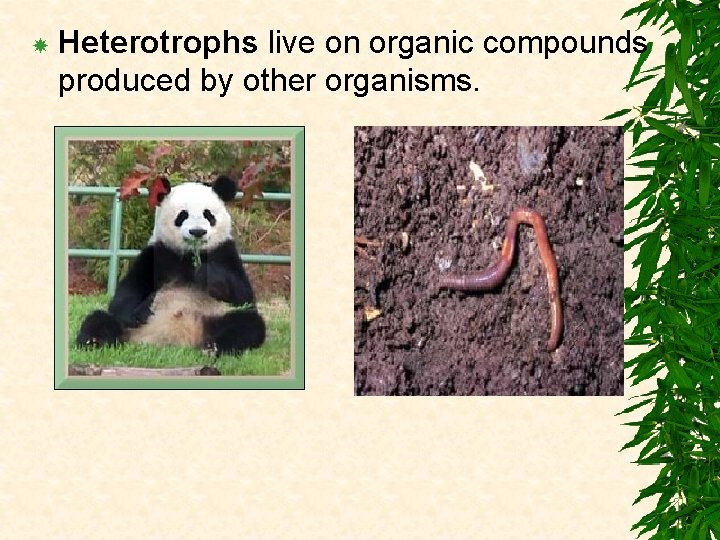
Heterotrophs live on organic compounds produced by other organisms.
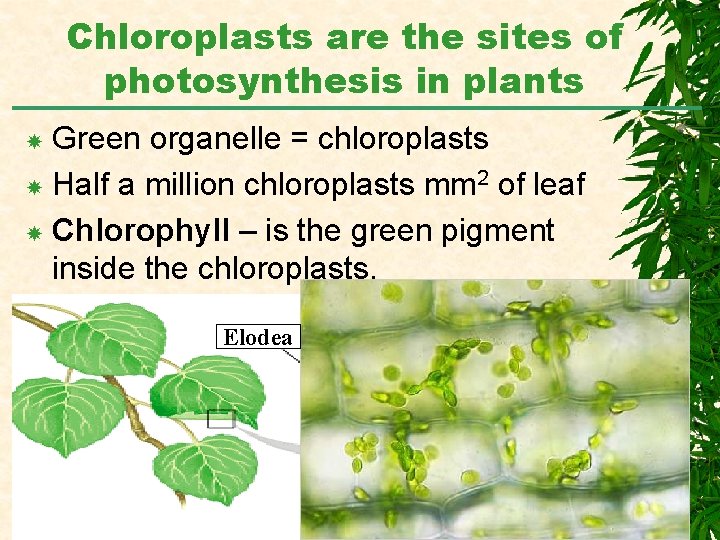
Chloroplasts are the sites of photosynthesis in plants Green organelle = chloroplasts Half a million chloroplasts mm 2 of leaf Chlorophyll – is the green pigment inside the chloroplasts. Elodea
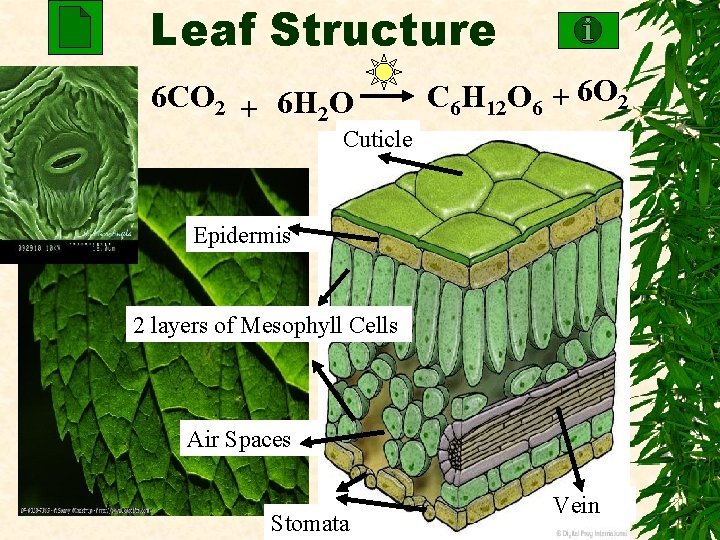
Leaf Structure 6 CO 2 + 6 H 2 O C 6 H 12 O 6 + 6 O 2 Cuticle Epidermis 2 layers of Mesophyll Cells Air Spaces Stomata Vein
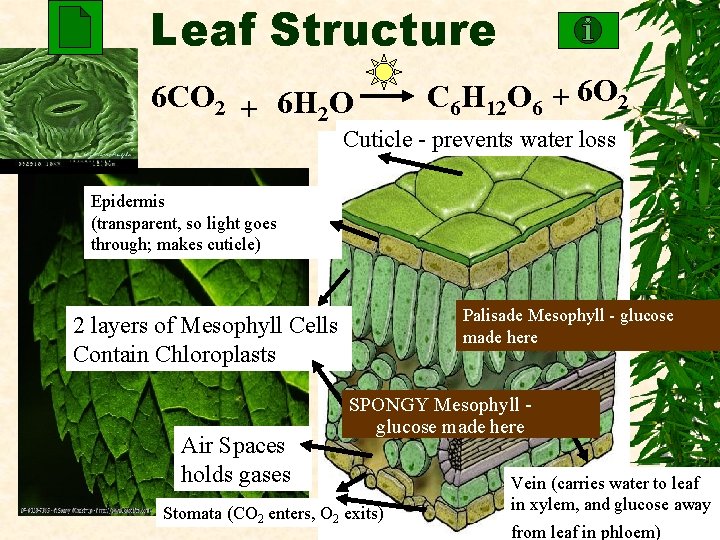
Leaf Structure 6 CO 2 + 6 H 2 O C 6 H 12 O 6 + 6 O 2 Cuticle - prevents water loss Epidermis (transparent, so light goes through; makes cuticle) Palisade Mesophyll - glucose made here 2 layers of Mesophyll Cells Contain Chloroplasts Air Spaces holds gases SPONGY Mesophyll glucose made here Stomata (CO 2 enters, O 2 exits) Vein (carries water to leaf in xylem, and glucose away from leaf in phloem)
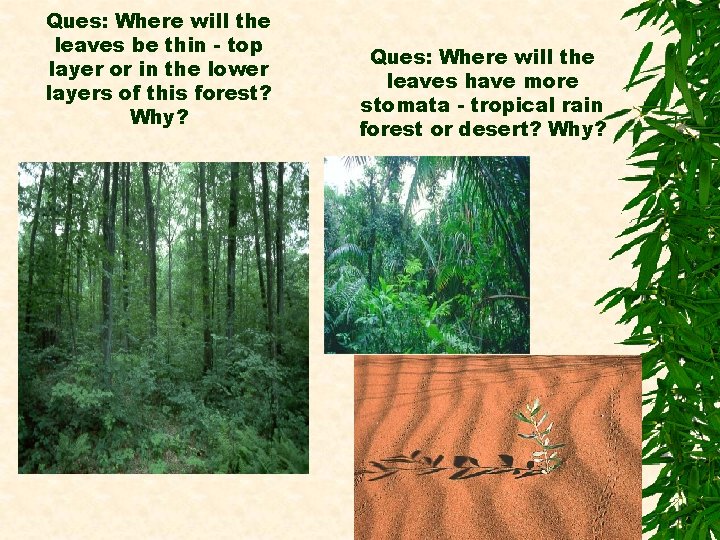
Ques: Where will the leaves be thin - top layer or in the lower layers of this forest? Why? Ques: Where will the leaves have more stomata - tropical rain forest or desert? Why?
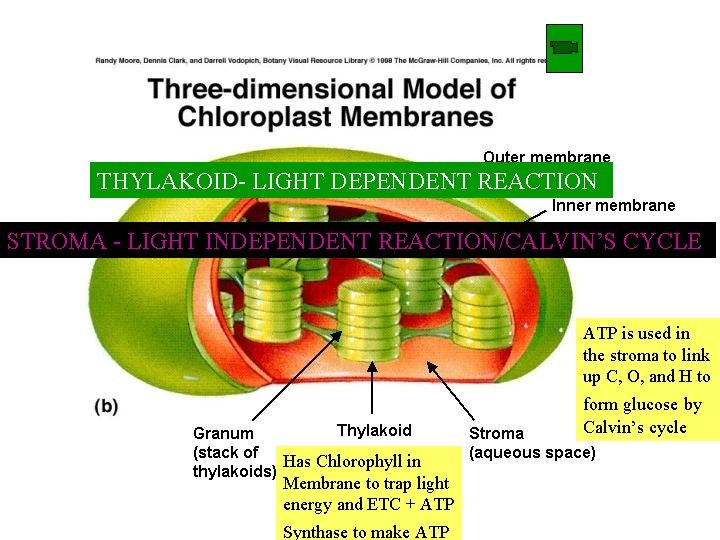
THYLAKOID- LIGHT DEPENDENT REACTION STROMA - LIGHT INDEPENDENT REACTION/CALVIN’S CYCLE ATP is used in the stroma to link up C, O, and H to form glucose by Calvin’s cycle Has Chlorophyll in Membrane to trap light energy and ETC + ATP Synthase to make ATP Fig. 10. 2
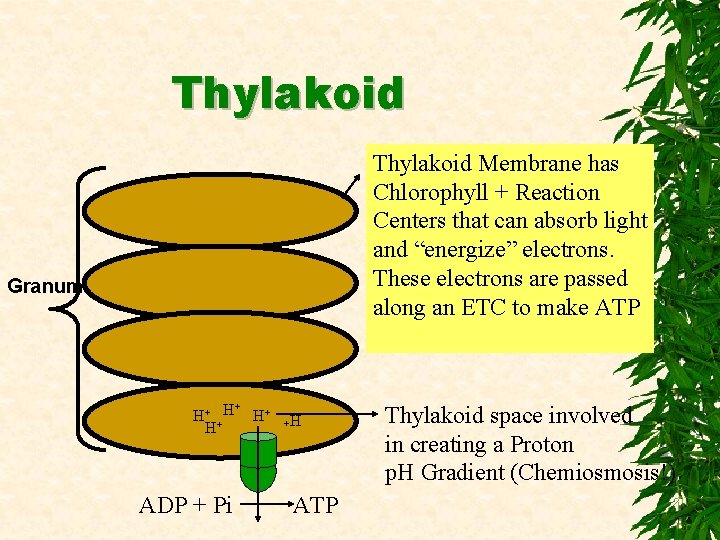
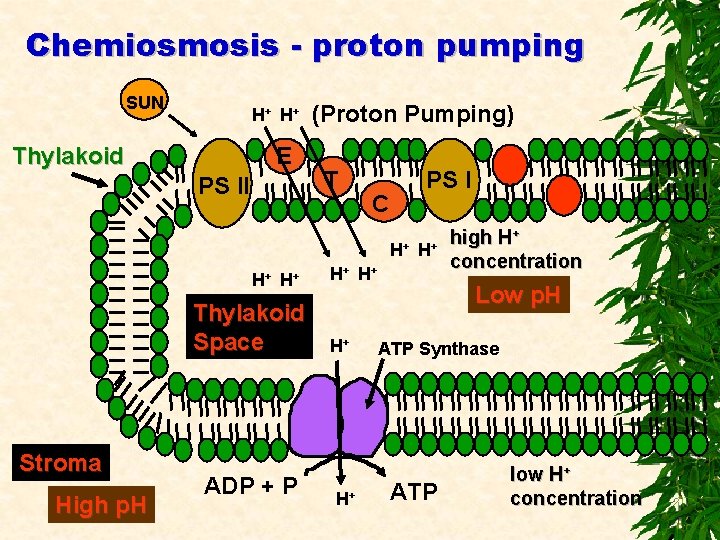
Thylakoid Membrane has Chlorophyll + Reaction Centers that can absorb light and “energize” electrons. These electrons are passed along an ETC to make ATP Granum ADP + Pi + H+ H+ H+ + H H ATP Thylakoid space involved in creating a Proton p. H Gradient (Chemiosmosis!)
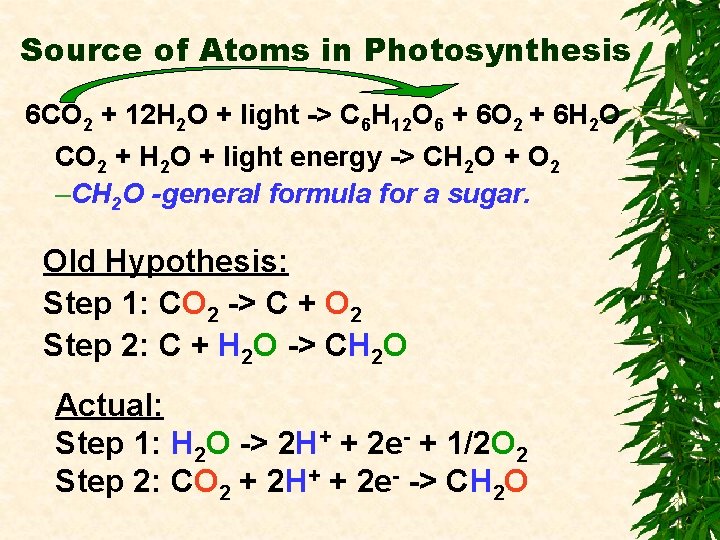
Source of Atoms in Photosynthesis 6 CO 2 + 12 H 2 O + light -> C 6 H 12 O 6 + 6 O 2 + 6 H 2 O CO 2 + H 2 O + light energy -> CH 2 O + O 2 –CH 2 O -general formula for a sugar. Old Hypothesis: Step 1: CO 2 -> C + O 2 Step 2: C + H 2 O -> CH 2 O Actual: Step 1: H 2 O -> 2 H+ + 2 e- + 1/2 O 2 Step 2: CO 2 + 2 H+ + 2 e- -> CH 2 O
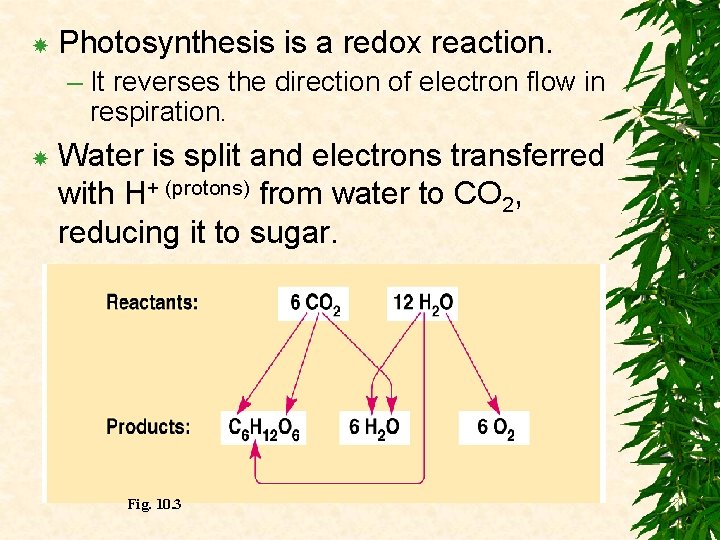
Photosynthesis is a redox reaction. – It reverses the direction of electron flow in respiration. Water is split and electrons transferred with H+ (protons) from water to CO 2, reducing it to sugar. Fig. 10. 3
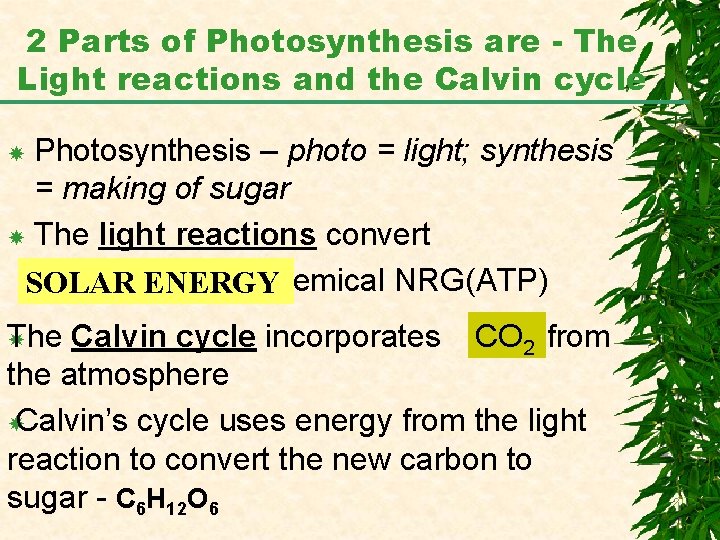
2 Parts of Photosynthesis are - The Light reactions and the Calvin cycle Photosynthesis – photo = light; synthesis = making of sugar The light reactions convert to chemical NRG(ATP) SOLAR ENERGY The Calvin cycle incorporates CO 2 from the atmosphere Calvin’s cycle uses energy from the light reaction to convert the new carbon to sugar - C 6 H 12 O 6
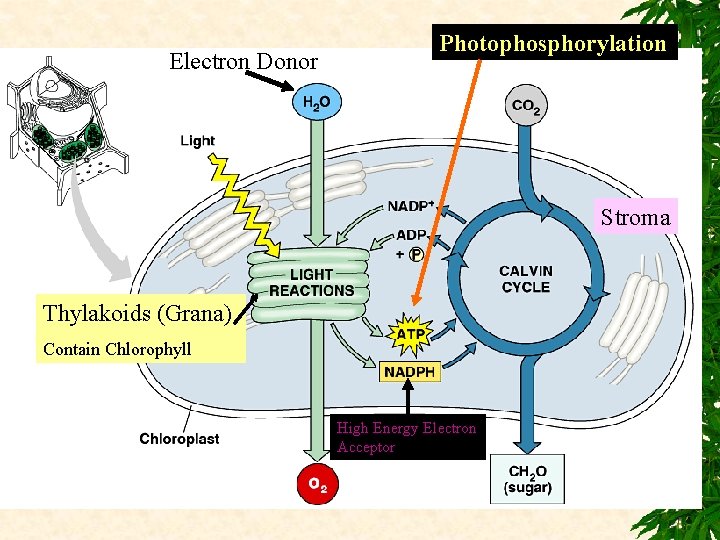
Electron Donor Photophosphorylation Stroma Thylakoids (Grana) Contain Chlorophyll High Energy Electron Acceptor
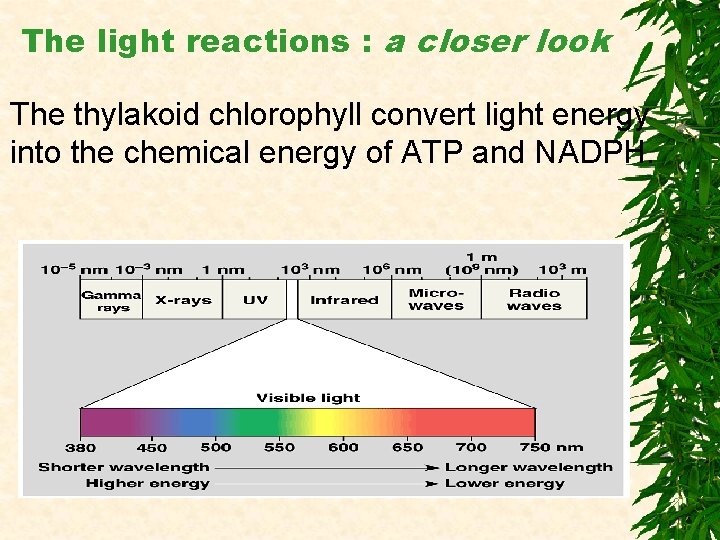
The light reactions : a closer look The thylakoid chlorophyll convert light energy into the chemical energy of ATP and NADPH.
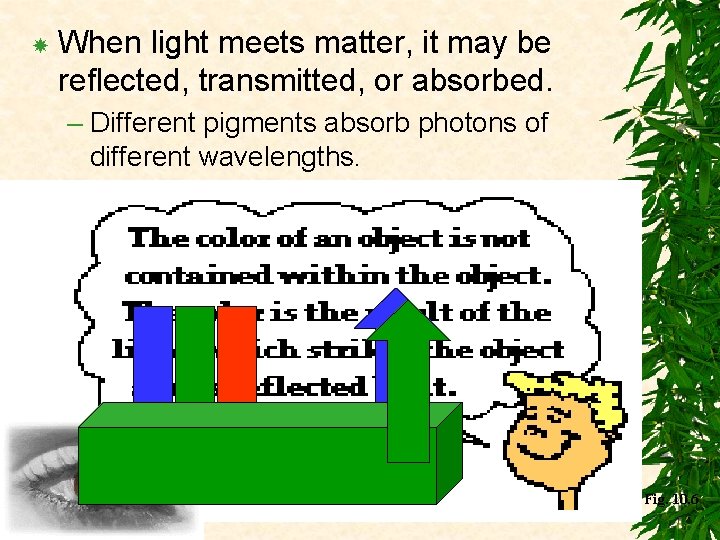
When light meets matter, it may be reflected, transmitted, or absorbed. – Different pigments absorb photons of different wavelengths. Fig. 10. 6
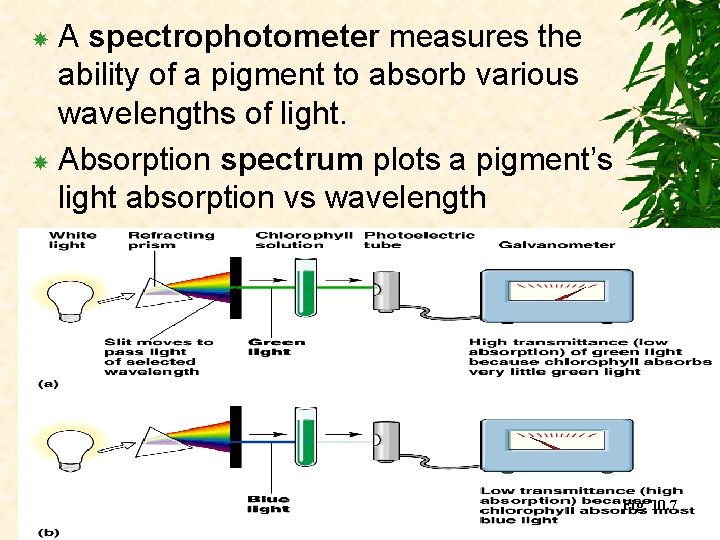
A spectrophotometer measures the ability of a pigment to absorb various wavelengths of light. Absorption spectrum plots a pigment’s light absorption vs wavelength Fig. 10. 7
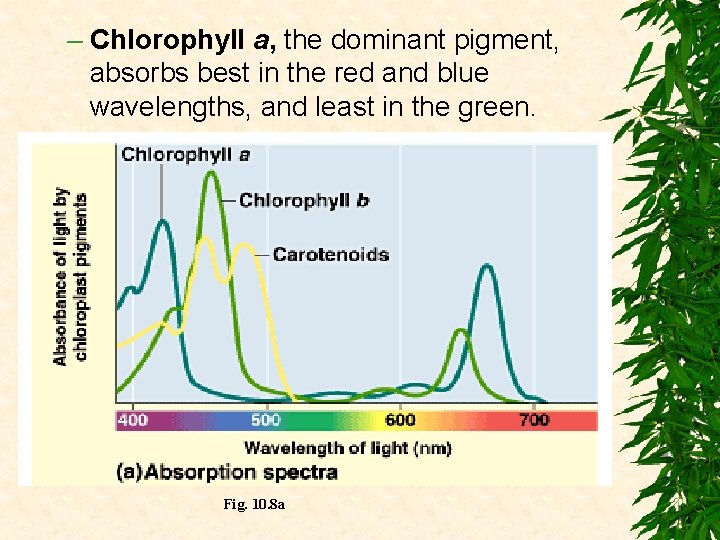
– Chlorophyll a, the dominant pigment, absorbs best in the red and blue wavelengths, and least in the green. Fig. 10. 8 a
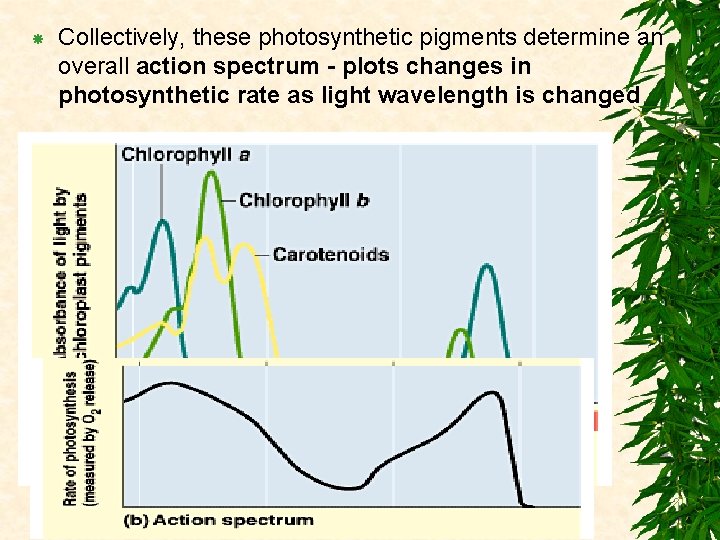
Collectively, these photosynthetic pigments determine an overall action spectrum - plots changes in photosynthetic rate as light wavelength is changed
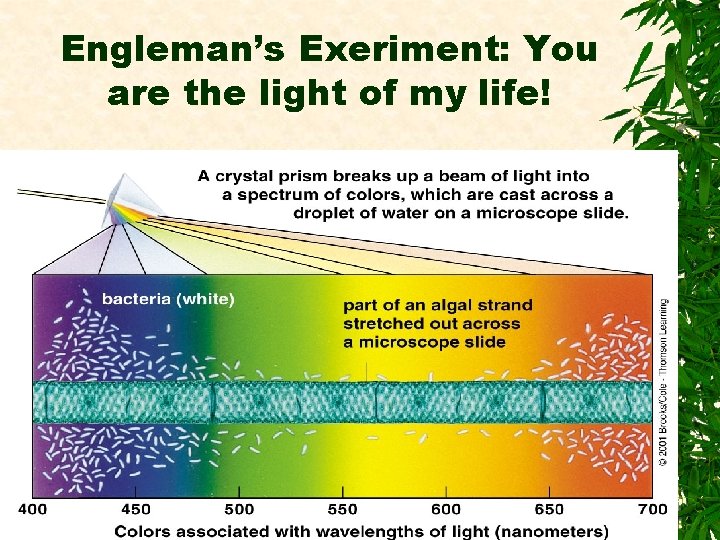
Engleman’s Exeriment: You are the light of my life!
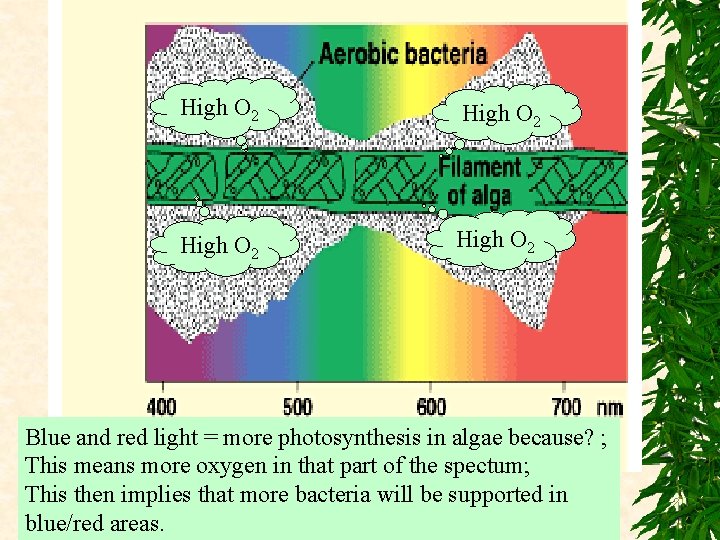
High O 2 Blue and red light = more photosynthesis in algae because? ; This means more oxygen in that part of the spectum; This then implies that more bacteria will be supported in Fig. 10. 8 c blue/red areas.
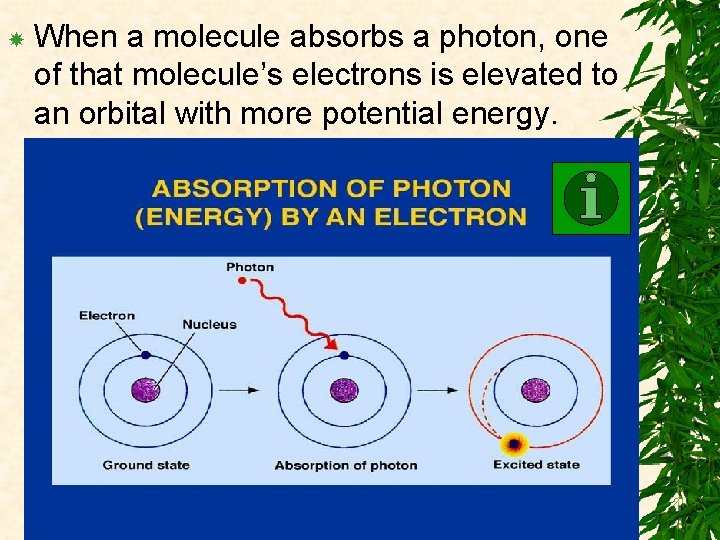
When a molecule absorbs a photon, one of that molecule’s electrons is elevated to an orbital with more potential energy.
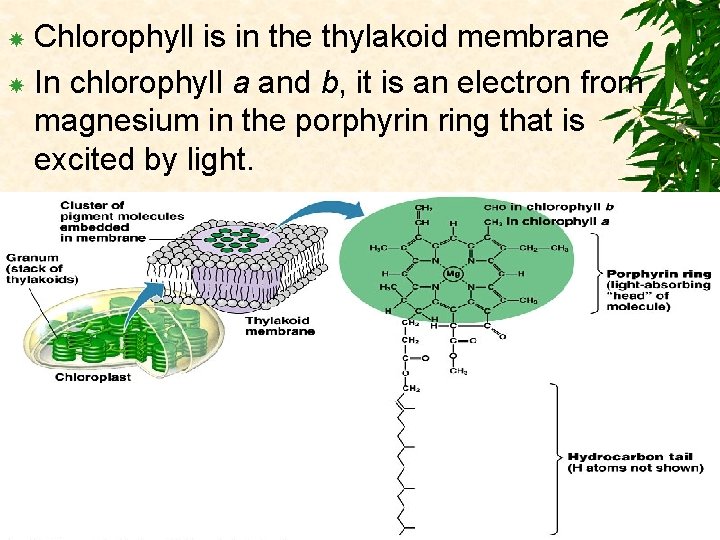
Chlorophyll is in the thylakoid membrane In chlorophyll a and b, it is an electron from magnesium in the porphyrin ring that is excited by light.
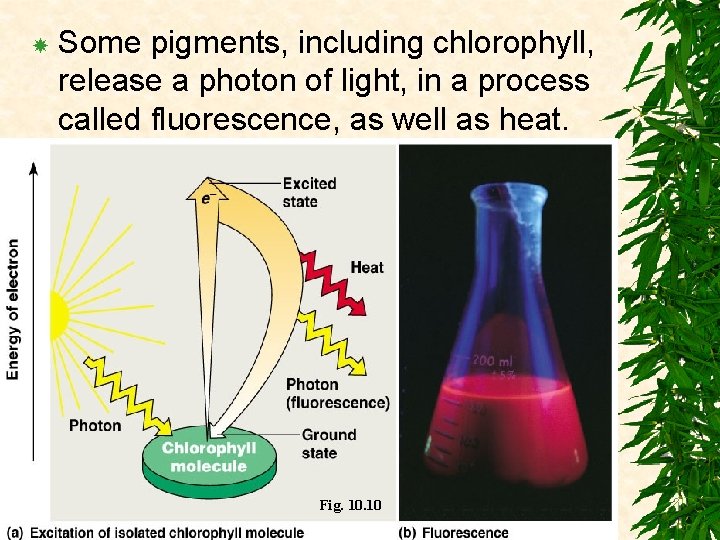
Some pigments, including chlorophyll, release a photon of light, in a process called fluorescence, as well as heat. Fig. 10
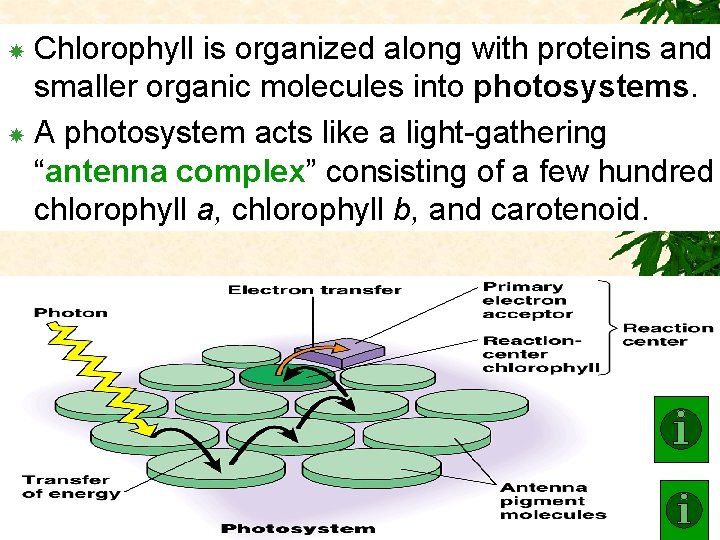
Chlorophyll is organized along with proteins and smaller organic molecules into photosystems. A photosystem acts like a light-gathering “antenna complex” consisting of a few hundred chlorophyll a, chlorophyll b, and carotenoid.
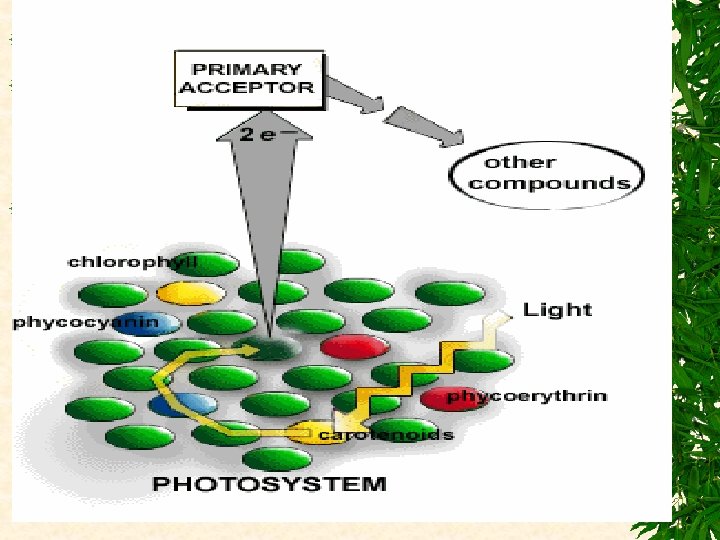
There are two types of photosystems. Photosystem I has a reaction center chlorophyll, the P 700 center, that has an absorption peak at 700 nm. Photosystem II has a reaction center with a peak at 680 nm.
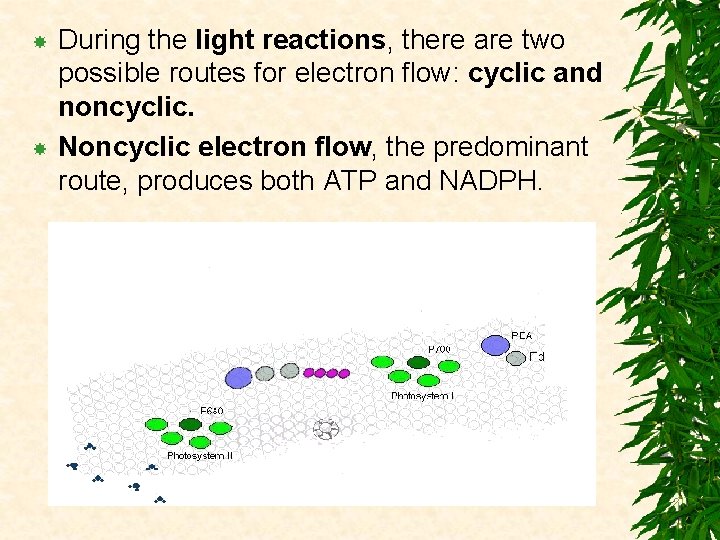
During the light reactions, there are two possible routes for electron flow: cyclic and noncyclic. Noncyclic electron flow, the predominant route, produces both ATP and NADPH.
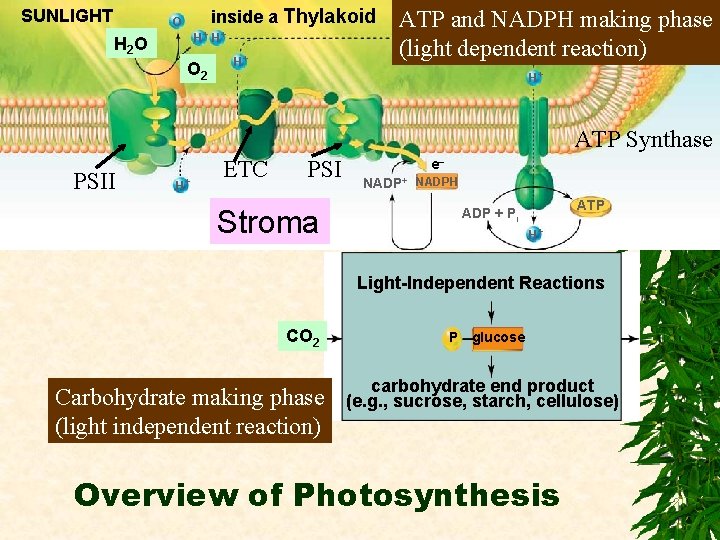
SUNLIGHT inside a Thylakoid O H+ H 2 O O 2 H+ H+ ATP and NADPH making phase (light dependent reaction) H+ ATP Synthase PSII H+ ETC PSI Stroma e– NADP+ NADPH ATP ADP + Pi H+ Light-Independent Reactions CO 2 Carbohydrate making phase (light independent reaction) P glucose carbohydrate end product (e. g. , sucrose, starch, cellulose) Overview of Photosynthesis
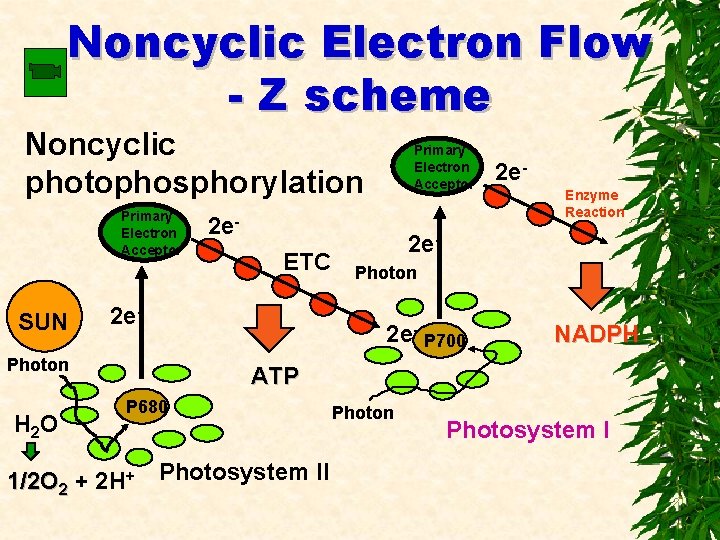
Noncyclic Electron Flow - Z scheme Noncyclic photophosphorylation Primary Electron Acceptor SUN H 2 O 2 e. ETC 2 e- Photon Primary Electron Acceptor 2 e. Enzyme Reaction 2 e. Photon 2 e- P 700 NADPH ATP P 680 1/2 O 2 + 2 H+ Photosystem II Photon Photosystem I
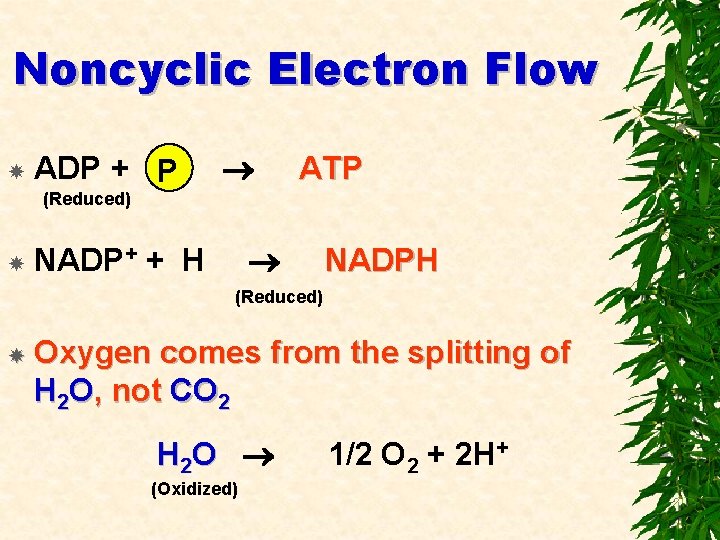
Noncyclic Electron Flow ADP + P ATP (Reduced) NADP+ + H NADPH (Reduced) Oxygen comes from the splitting of H 2 O, not CO 2 H 2 O (Oxidized) 1/2 O 2 + 2 H+
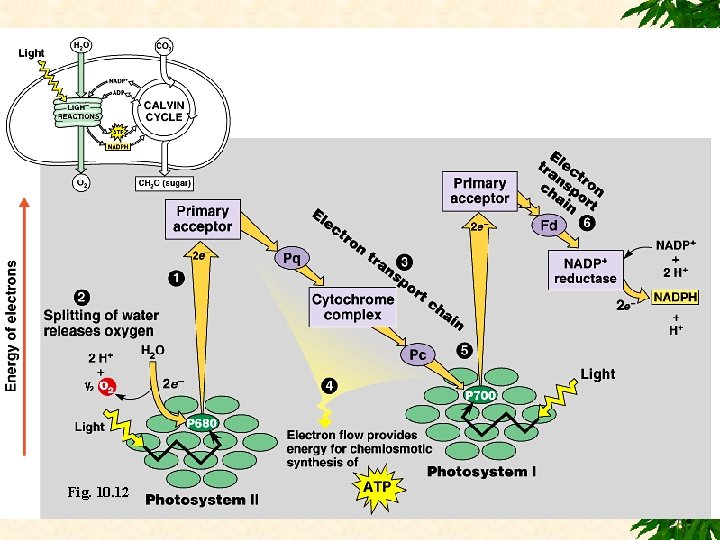
Fig. 10. 12
Chemiosmosis Proton Pump Powers ATP synthesis Located in the thylakoid membranes Uses Electron Transport Chain and ATP synthase (enzyme) to make ATP. Protons are pumped into thylakoid space from stroma to form a gradient during Light Reactions. When they flow back through ATP synthase, ATP is made Photophosphorylation: addition of phosphate to ADP to make ATP using the energy provided by light
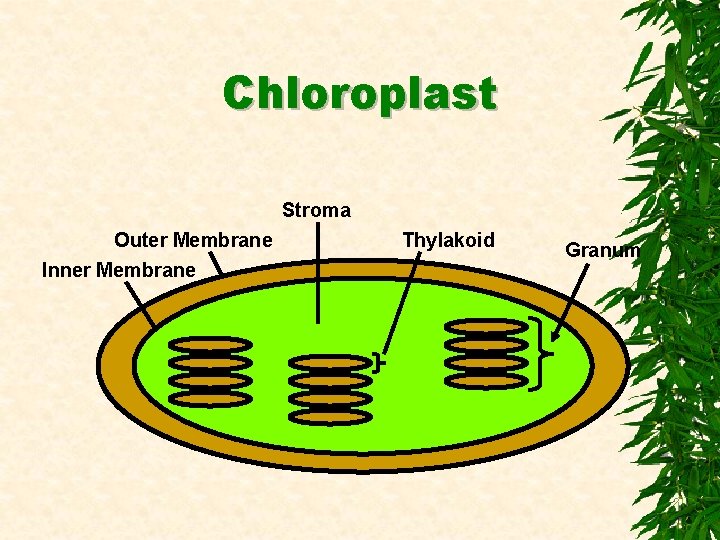
Chloroplast Stroma Outer Membrane Inner Membrane Thylakoid Granum
Chemiosmosis - proton pumping SUN H+ H + Thylakoid E PS II (Proton Pumping) T PS I C H+ H+ H + Thylakoid Space Stroma High p. H ADP + P H+ H+ H+ high H+ concentration Low p. H ATP Synthase ATP low H+ concentration
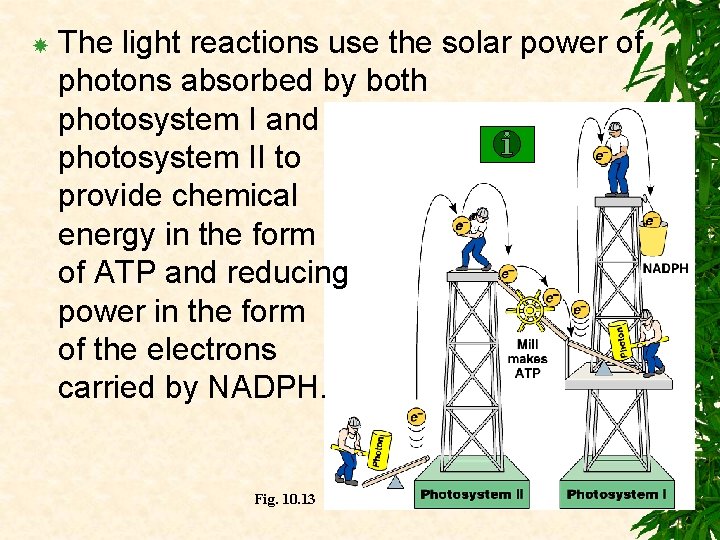
The light reactions use the solar power of photons absorbed by both photosystem I and photosystem II to provide chemical energy in the form of ATP and reducing power in the form of the electrons carried by NADPH. Fig. 10. 13
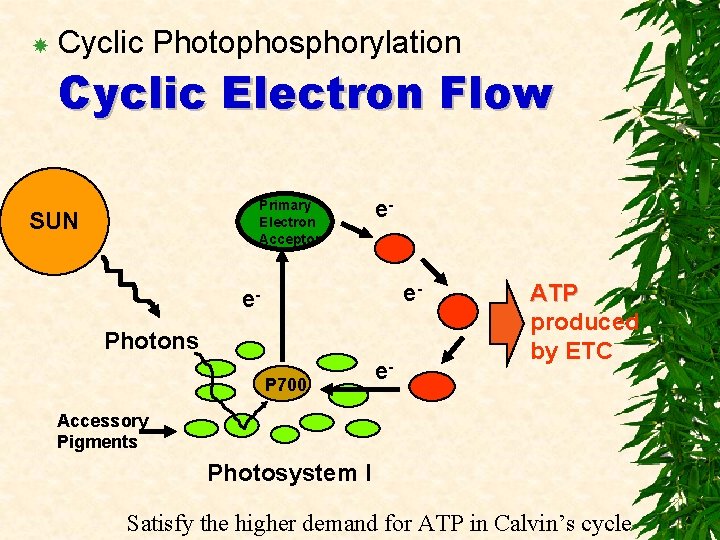
Cyclic Photophosphorylation Cyclic Electron Flow Primary Electron Acceptor SUN ee- e. Photons P 700 e- ATP produced by ETC Accessory Pigments Photosystem I Satisfy the higher demand for ATP in Calvin’s cycle
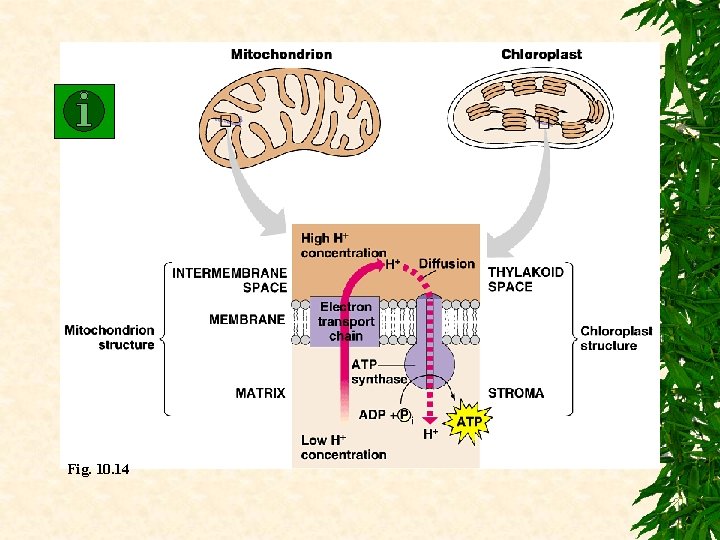
Fig. 10. 14
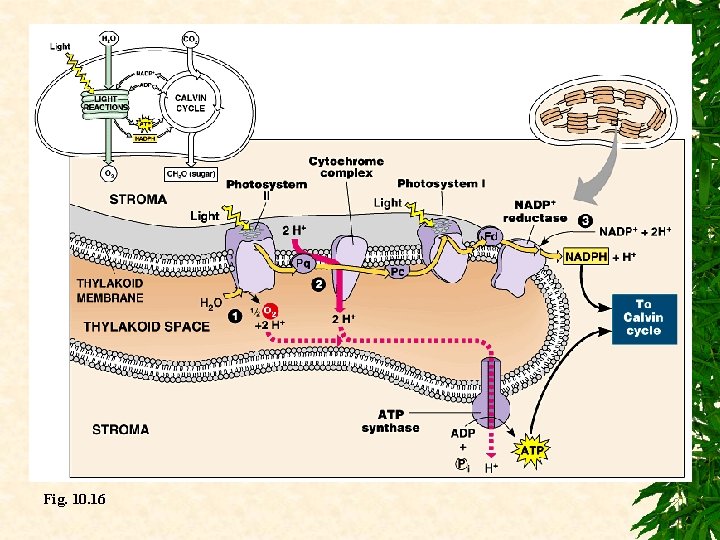
Fig. 10. 16
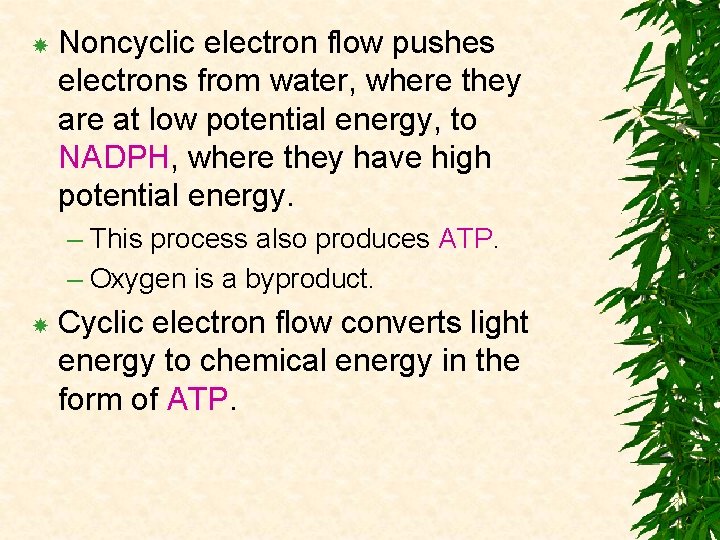
Noncyclic electron flow pushes electrons from water, where they are at low potential energy, to NADPH, where they have high potential energy. – This process also produces ATP. – Oxygen is a byproduct. Cyclic electron flow converts light energy to chemical energy in the form of ATP.
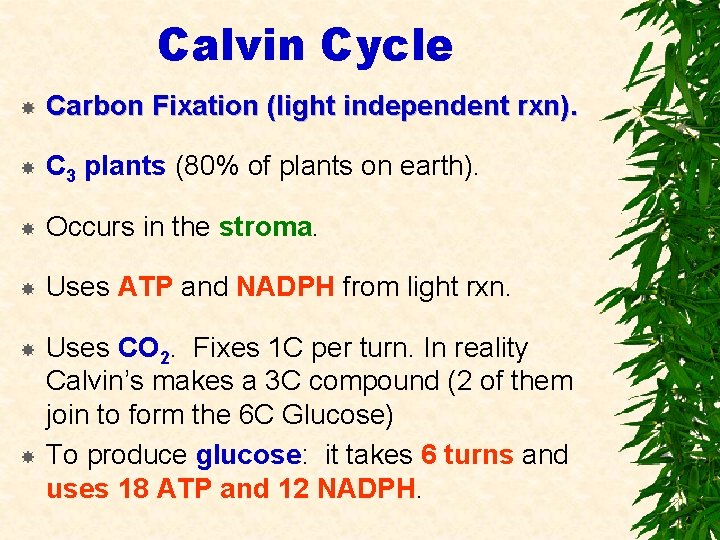
Calvin Cycle Carbon Fixation (light independent rxn). C 3 plants (80% of plants on earth). Occurs in the stroma. Uses ATP and NADPH from light rxn. Uses CO 2. Fixes 1 C per turn. In reality Calvin’s makes a 3 C compound (2 of them join to form the 6 C Glucose) To produce glucose: it takes 6 turns and uses 18 ATP and 12 NADPH.
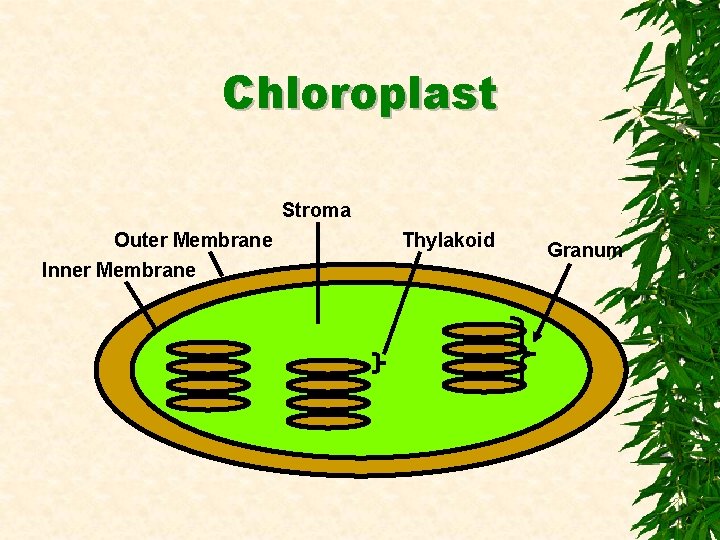
Chloroplast Stroma Outer Membrane Inner Membrane Thylakoid Granum
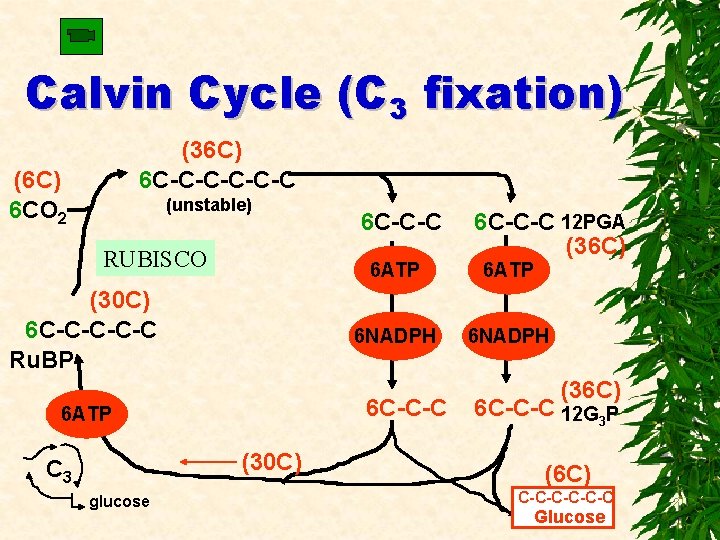
Calvin Cycle (C 3 fixation) (36 C) 6 C-C-C-C (6 C) 6 CO 2 (unstable) RUBISCO (30 C) 6 C-C-C Ru. BP (30 C) glucose 6 C-C-C 12 PGA (36 C) 6 ATP 6 NADPH 6 C-C-C 6 ATP C 3 6 C-C-C (36 C) 6 C-C-C 12 G 3 P (6 C) C-C-C-C Glucose
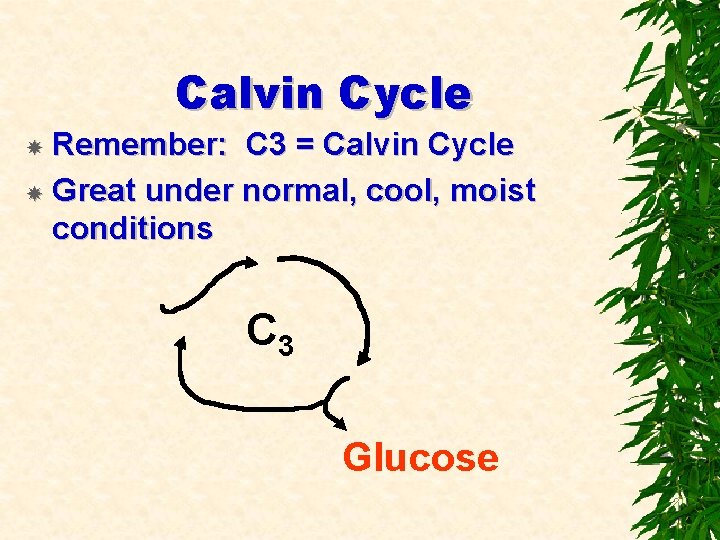
Calvin Cycle Remember: C 3 = Calvin Cycle Great under normal, cool, moist conditions C 3 Glucose
Photorespiration Occurs on hot, dry, bright days Stomates close = more O 2 and less CO 2 Fixation of O 2 instead of CO 2 because RUBISCO (first enzyme in Calvin’s cycle) acts as an OXYGENASE = acts different when oxygen concentration rises in a leaf cell. Light reaction and Calvin’s cycle take place, BUT Produces 2 -C molecules (not glucose) instead of 3 -C sugar molecules Produces no glucose molecules and uses up ATP - what a waste!
Photorespiration Because of photorespiration: photorespiration Plants have special adaptations to limit the effect of photorespiration 1. C 4 plants 2. CAM plants
C 4 Plants Hot, moist environments - stomata open. 15% of plants (grasses, corn, sugarcane). Divides photosynthesis spatially to prevent photorespiration. Light rxn - mesophyll cells (makes ATP and NADPH and oxygen!). Calvin cycle - bundle sheath cells - cells surrounding xylem and phloem.
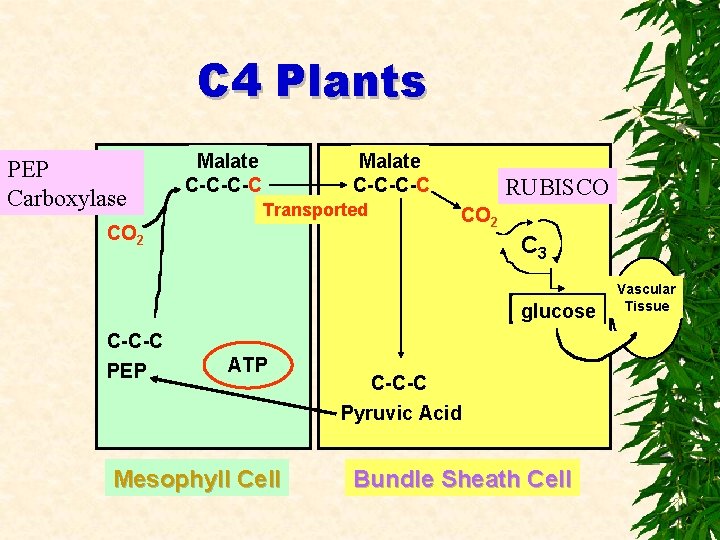
C 4 Plants PEP Carboxylase Malate C-C-C-C Transported CO 2 RUBISCO CO 2 C 3 glucose C-C-C PEP ATP Mesophyll Cell C-C-C Pyruvic Acid Bundle Sheath Cell Vascular Tissue
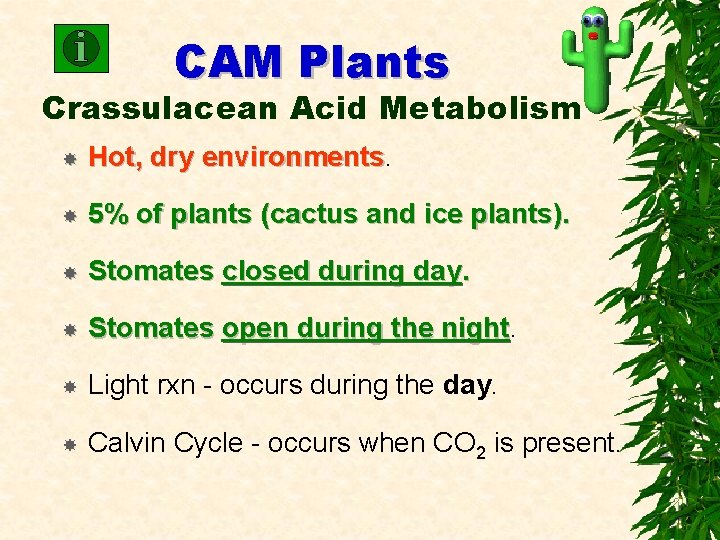
CAM Plants Crassulacean Acid Metabolism Hot, dry environments 5% of plants (cactus and ice plants). Stomates closed during day. Stomates open during the night Light rxn - occurs during the day. Calvin Cycle - occurs when CO 2 is present.
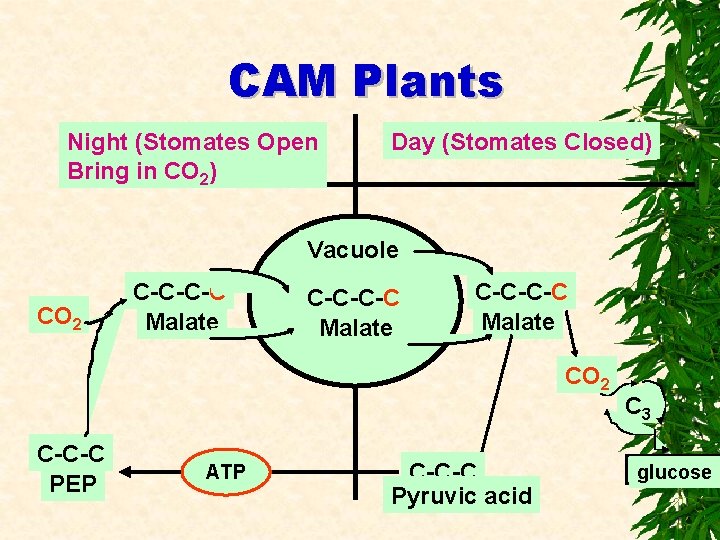
CAM Plants Night (Stomates Open Bring in CO 2) Day (Stomates Closed) Vacuole CO 2 C-C-C-C Malate CO 2 C-C-C PEP ATP C-C-C Pyruvic acid C 3 glucose
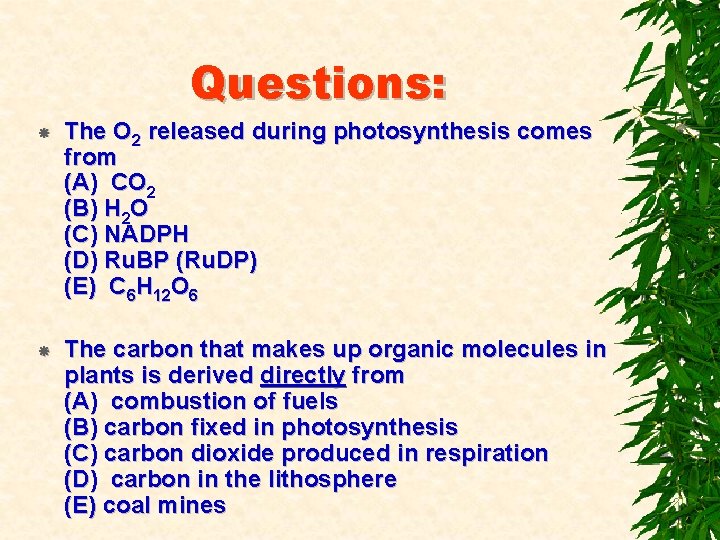
Questions: The O 2 released during photosynthesis comes from (A) CO 2 (B) H 2 O (C) NADPH (D) Ru. BP (Ru. DP) (E) C 6 H 12 O 6 The carbon that makes up organic molecules in plants is derived directly from (A) combustion of fuels (B) carbon fixed in photosynthesis (C) carbon dioxide produced in respiration (D) carbon in the lithosphere (E) coal mines
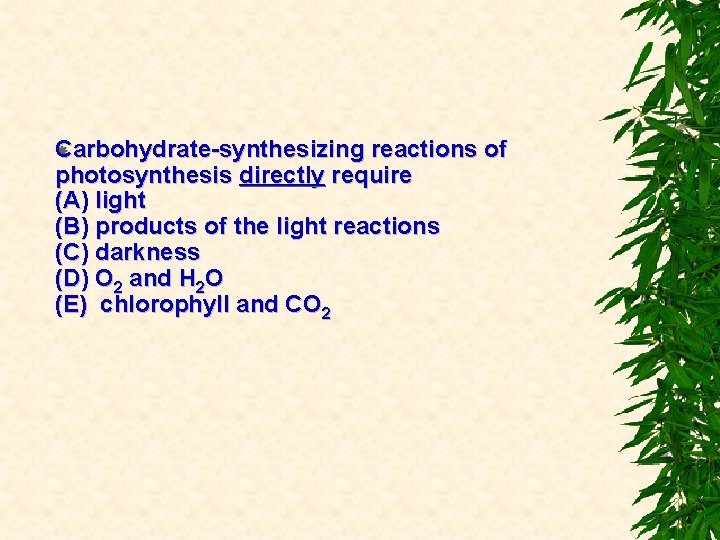
Carbohydrate-synthesizing reactions of photosynthesis directly require (A) light (B) products of the light reactions (C) darkness (D) O 2 and H 2 O (E) chlorophyll and CO 2
If If plants are grown for several days in an atmosphere containing 14 CO 2 in place of 12 CO 2, one would expect to find (A) very little radioactivity in the growing leaves (B) large amounts of radioactive water released from the stomates (C) a large increase in 14 C in the starch stored in the roots (D) a large decrease in the rate of carbon fixation in the guard cells (E) an increase in the activity of Ru. BP carboxylase (rubisco) in the photosynthetic cells.
Which of the following is an important difference between light-dependent and light-independent reactions of photosynthesis? (A) The light-dependent reactions occur only during the day; the light-independent reactions occur only during the night. (B) The light-dependent reactions occur in the cytoplasm; the light-independent reactions occur in the chloroplasts. (C) The light-dependent reactions utilize CO 2 and H 2 O; the light -independent reactions produce CO 2 and H 2 O. (D) The light-dependent reactions depend on the presents of both photosystems I and II; the lightindependent reactons require only photosystem I. (E) The light-dependent reactions produce ATP and NADPH; the light-independent reactions use energy stored in ATP and NADPH.
- Slides: 58