
Chapter 10 Photosynthesis Photosynthesis is the process that

- Slides: 43
Chapter 10 Photosynthesis
Photosynthesis is the process that converts solar energy into chemical energy Directly or indirectly, photosynthesis nourishes almost the entire living world Autotrophs sustain themselves without eating anything derived from other organisms Heterotrophs obtain their organic material from other organisms Almost all heterotrophs, including humans, depend on photoautotrophs for food and O 2 Copyright © 2008 Pearson Education, Inc. , publishing as Pearson Benjamin Cummings
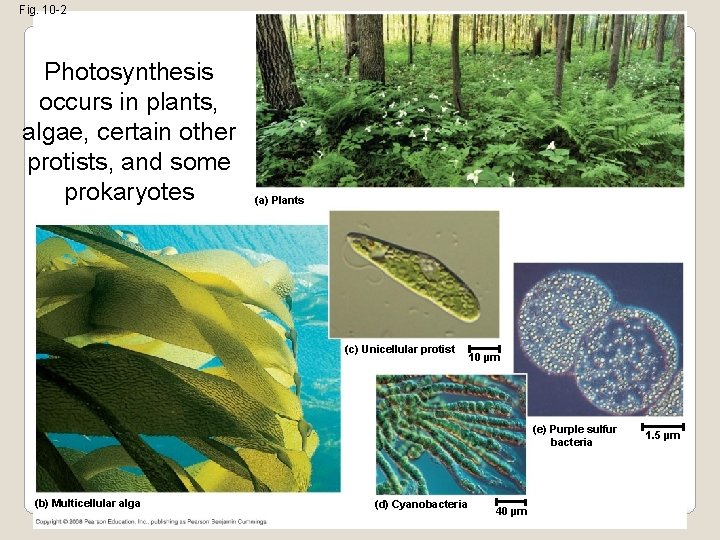
Fig. 10 -2 Photosynthesis occurs in plants, algae, certain other protists, and some prokaryotes (a) Plants (c) Unicellular protist 10 µm (e) Purple sulfur bacteria (b) Multicellular alga (d) Cyanobacteria 40 µm 1. 5 µm
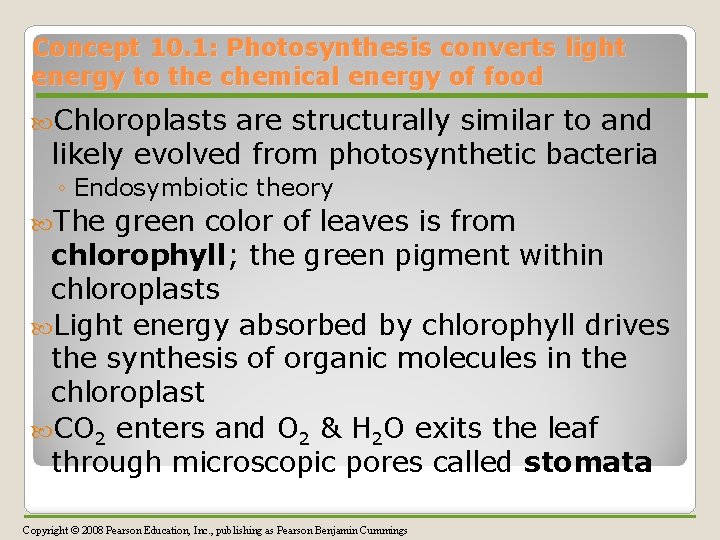
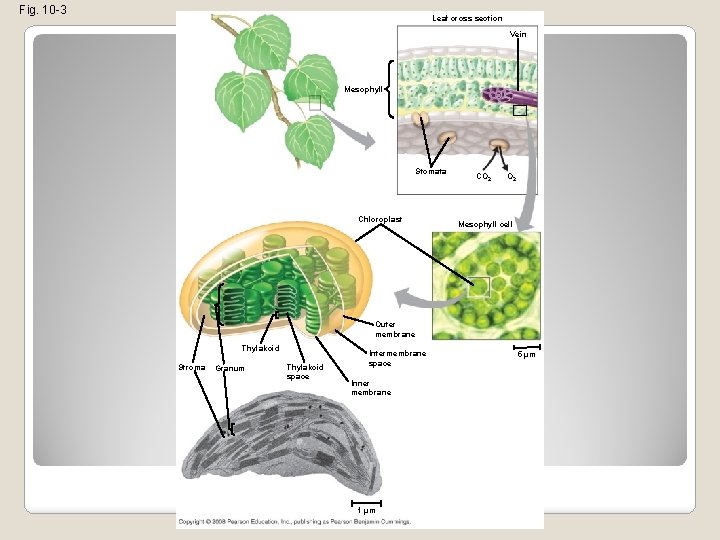
Concept 10. 1: Photosynthesis converts light energy to the chemical energy of food Chloroplasts are structurally similar to and likely evolved from photosynthetic bacteria ◦ Endosymbiotic theory The green color of leaves is from chlorophyll; the green pigment within chloroplasts Light energy absorbed by chlorophyll drives the synthesis of organic molecules in the chloroplast CO 2 enters and O 2 & H 2 O exits the leaf through microscopic pores called stomata Copyright © 2008 Pearson Education, Inc. , publishing as Pearson Benjamin Cummings
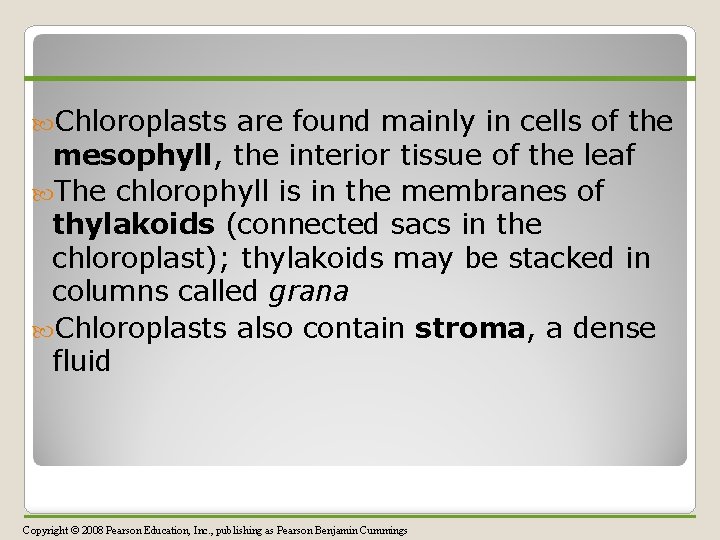
Chloroplasts are found mainly in cells of the mesophyll, the interior tissue of the leaf The chlorophyll is in the membranes of thylakoids (connected sacs in the chloroplast); thylakoids may be stacked in columns called grana Chloroplasts also contain stroma, a dense fluid Copyright © 2008 Pearson Education, Inc. , publishing as Pearson Benjamin Cummings
Fig. 10 -3 Leaf cross section Vein Mesophyll Stomata Chloroplast CO 2 Mesophyll cell Outer membrane Thylakoid Stroma Granum Thylakoid space Intermembrane space Inner membrane 1 µm 5 µm
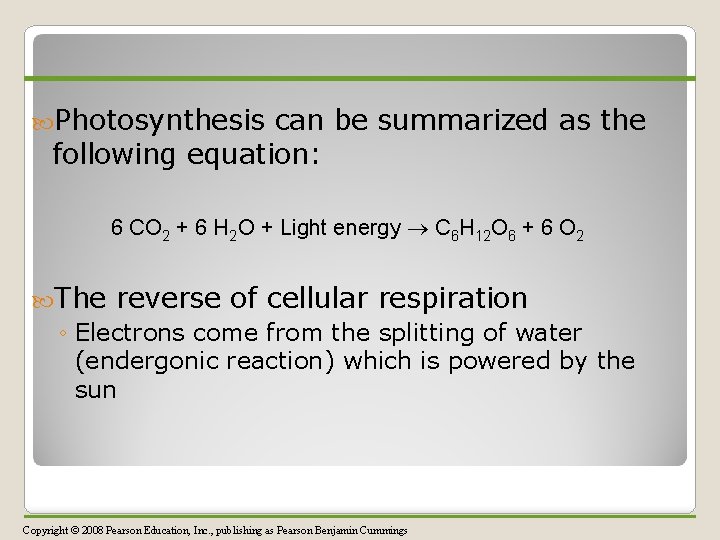
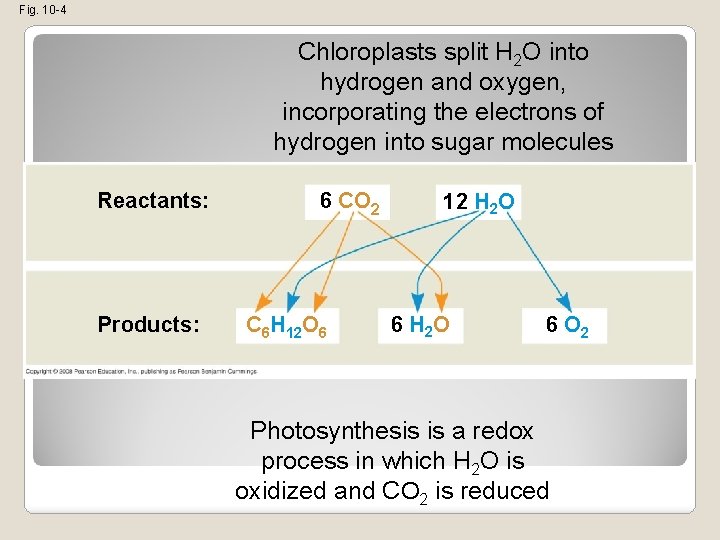
Photosynthesis can be summarized as the following equation: 6 CO 2 + 6 H 2 O + Light energy C 6 H 12 O 6 + 6 O 2 The reverse of cellular respiration ◦ Electrons come from the splitting of water (endergonic reaction) which is powered by the sun Copyright © 2008 Pearson Education, Inc. , publishing as Pearson Benjamin Cummings
Fig. 10 -4 Chloroplasts split H 2 O into hydrogen and oxygen, incorporating the electrons of hydrogen into sugar molecules Reactants: Products: 6 CO 2 C 6 H 12 O 6 12 H 2 O 6 O 2 Photosynthesis is a redox process in which H 2 O is oxidized and CO 2 is reduced
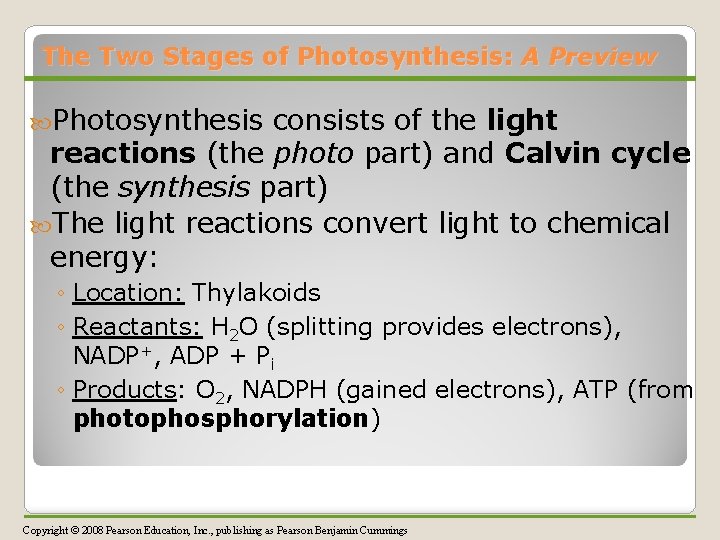
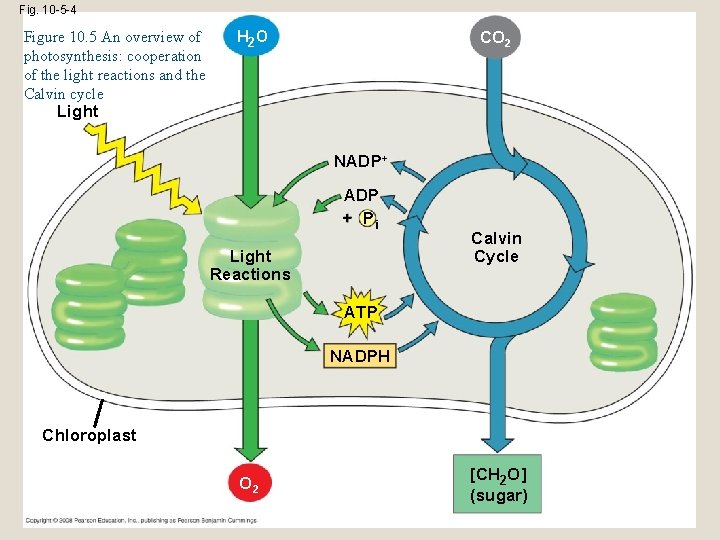
The Two Stages of Photosynthesis: A Preview Photosynthesis consists of the light reactions (the photo part) and Calvin cycle (the synthesis part) The light reactions convert light to chemical energy: ◦ Location: Thylakoids ◦ Reactants: H 2 O (splitting provides electrons), NADP+, ADP + Pi ◦ Products: O 2, NADPH (gained electrons), ATP (from photophosphorylation) Copyright © 2008 Pearson Education, Inc. , publishing as Pearson Benjamin Cummings
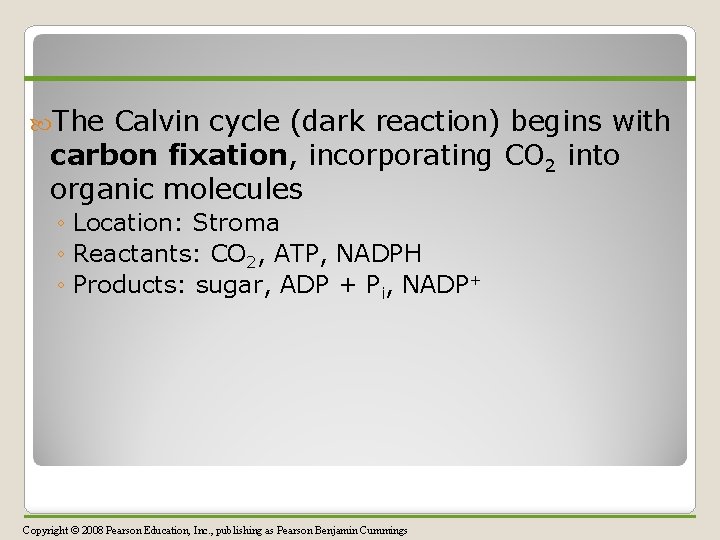
The Calvin cycle (dark reaction) begins with carbon fixation, incorporating CO 2 into organic molecules ◦ Location: Stroma ◦ Reactants: CO 2, ATP, NADPH ◦ Products: sugar, ADP + Pi, NADP+ Copyright © 2008 Pearson Education, Inc. , publishing as Pearson Benjamin Cummings
Fig. 10 -5 -4 Figure 10. 5 An overview of photosynthesis: cooperation of the light reactions and the Calvin cycle CO 2 H 2 O Light NADP+ ADP + Pi Light Reactions Calvin Cycle ATP NADPH Chloroplast O 2 [CH 2 O] (sugar)
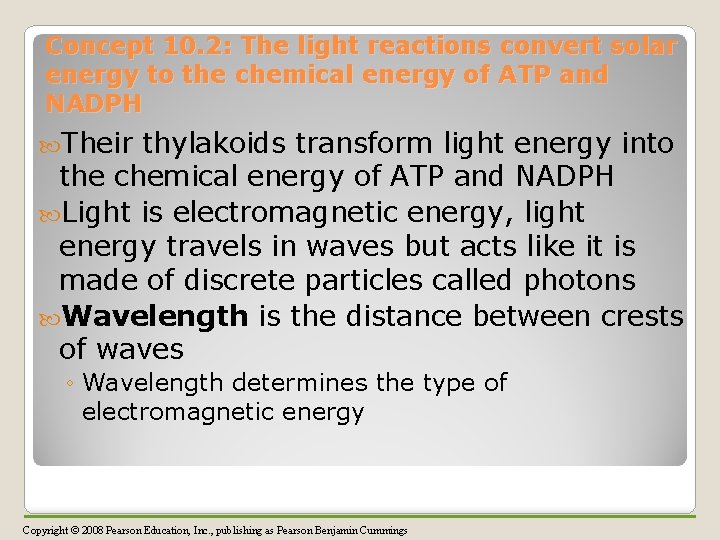
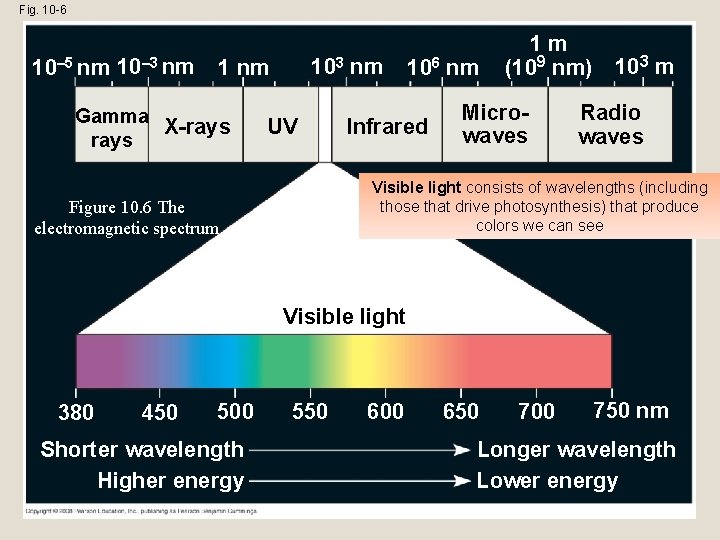
Concept 10. 2: The light reactions convert solar energy to the chemical energy of ATP and NADPH Their thylakoids transform light energy into the chemical energy of ATP and NADPH Light is electromagnetic energy, light energy travels in waves but acts like it is made of discrete particles called photons Wavelength is the distance between crests of waves ◦ Wavelength determines the type of electromagnetic energy Copyright © 2008 Pearson Education, Inc. , publishing as Pearson Benjamin Cummings
Fig. 10 -6 10– 5 nm 10– 3 nm 103 nm 1 nm Gamma X-rays UV 106 nm Infrared 1 m (109 nm) Microwaves 103 m Radio waves Visible light consists of wavelengths (including those that drive photosynthesis) that produce colors we can see Figure 10. 6 The electromagnetic spectrum Visible light 380 450 500 Shorter wavelength Higher energy 550 600 650 700 750 nm Longer wavelength Lower energy
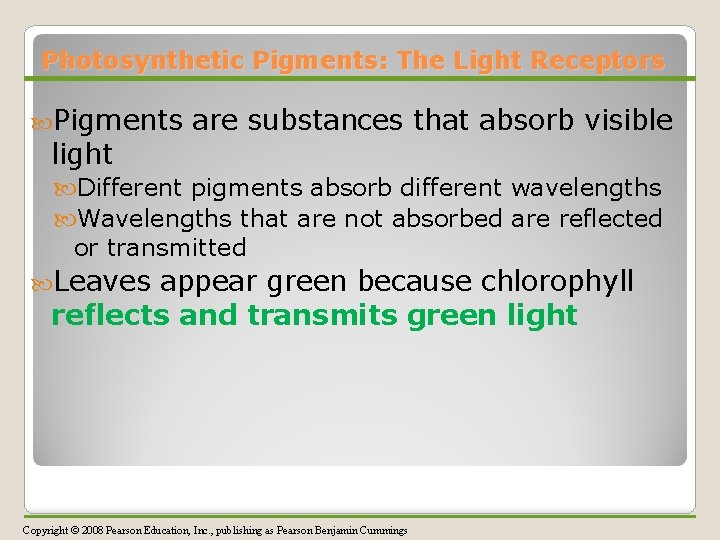
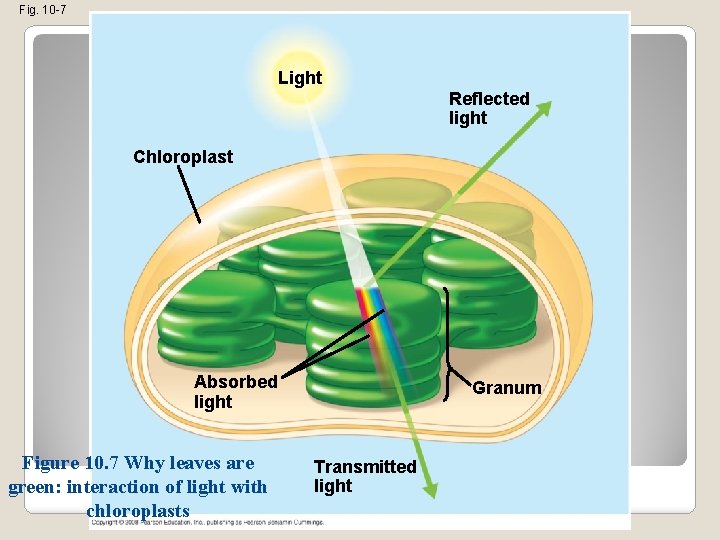
Photosynthetic Pigments: The Light Receptors Pigments light are substances that absorb visible Different pigments absorb different wavelengths Wavelengths that are not absorbed are reflected or transmitted Leaves appear green because chlorophyll reflects and transmits green light Copyright © 2008 Pearson Education, Inc. , publishing as Pearson Benjamin Cummings
Fig. 10 -7 Light Reflected light Chloroplast Absorbed light Figure 10. 7 Why leaves are green: interaction of light with chloroplasts Granum Transmitted light
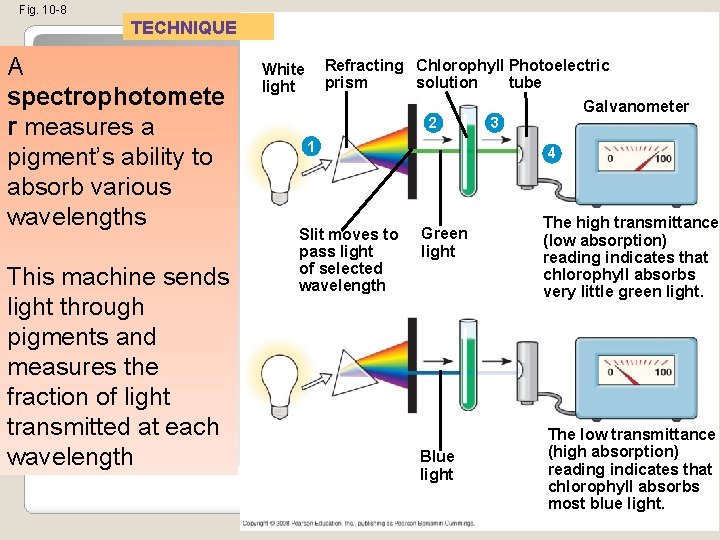
Fig. 10 -8 TECHNIQUE A spectrophotomete r measures a pigment’s ability to absorb various wavelengths This machine sends light through pigments and measures the fraction of light transmitted at each wavelength Refracting Chlorophyll Photoelectric prism solution tube Galvanometer White light 2 1 Slit moves to pass light of selected wavelength 3 4 Green light Blue light The high transmittance (low absorption) reading indicates that chlorophyll absorbs very little green light. The low transmittance (high absorption) reading indicates that chlorophyll absorbs most blue light.
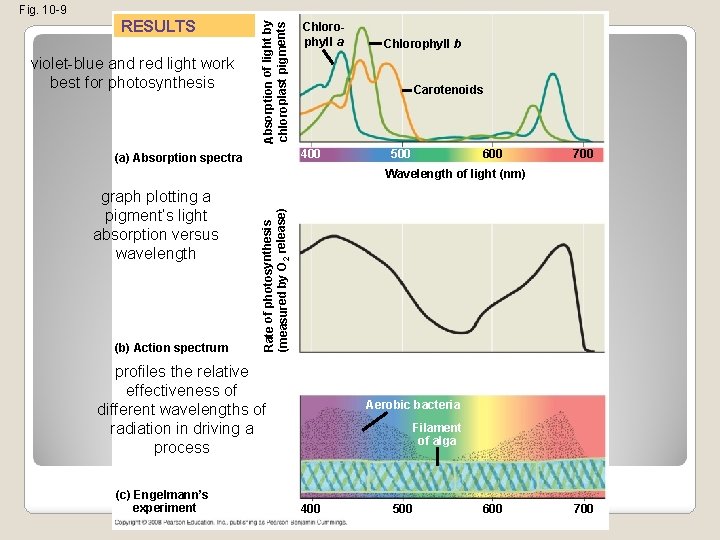
RESULTS violet-blue and red light work best for photosynthesis Absorption of light by chloroplast pigments Fig. 10 -9 Chlorophyll a Carotenoids 400 (a) Absorption spectra Chlorophyll b 500 600 700 graph plotting a pigment’s light absorption versus wavelength (b) Action spectrum Rate of photosynthesis (measured by O 2 release) Wavelength of light (nm) profiles the relative effectiveness of different wavelengths of radiation in driving a process (c) Engelmann’s experiment Aerobic bacteria Filament of alga 400 500 600 700
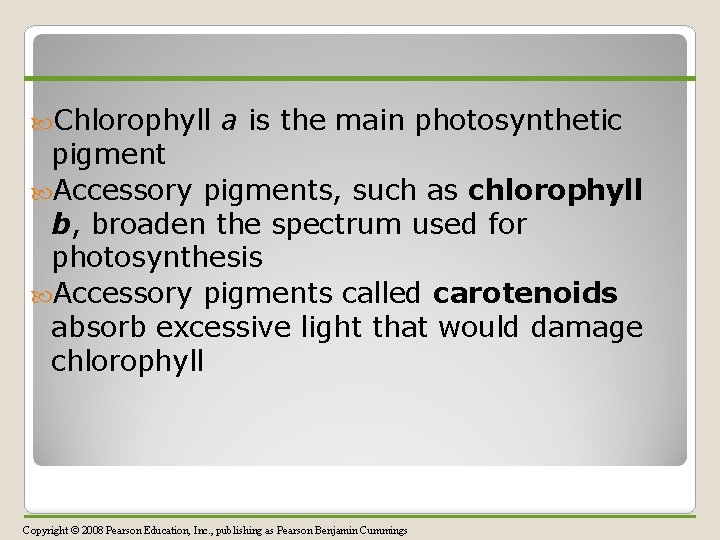
Chlorophyll a is the main photosynthetic pigment Accessory pigments, such as chlorophyll b, broaden the spectrum used for photosynthesis Accessory pigments called carotenoids absorb excessive light that would damage chlorophyll Copyright © 2008 Pearson Education, Inc. , publishing as Pearson Benjamin Cummings
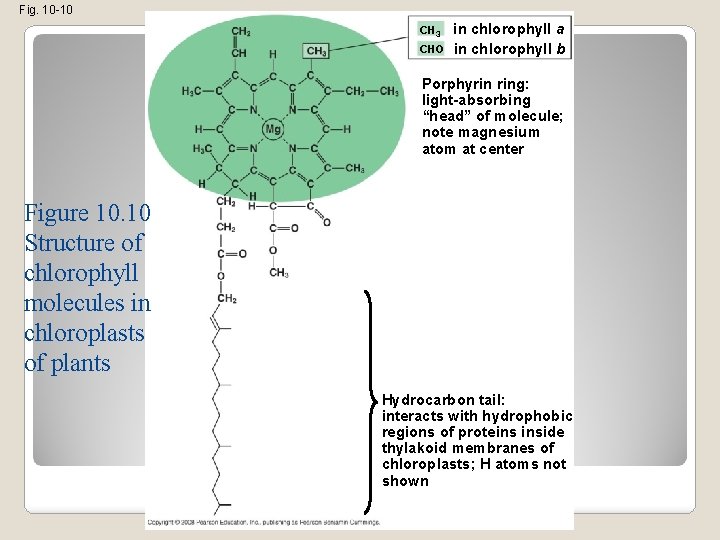
Fig. 10 -10 CH 3 CHO in chlorophyll a in chlorophyll b Porphyrin ring: light-absorbing “head” of molecule; note magnesium atom at center Figure 10. 10 Structure of chlorophyll molecules in chloroplasts of plants Hydrocarbon tail: interacts with hydrophobic regions of proteins inside thylakoid membranes of chloroplasts; H atoms not shown
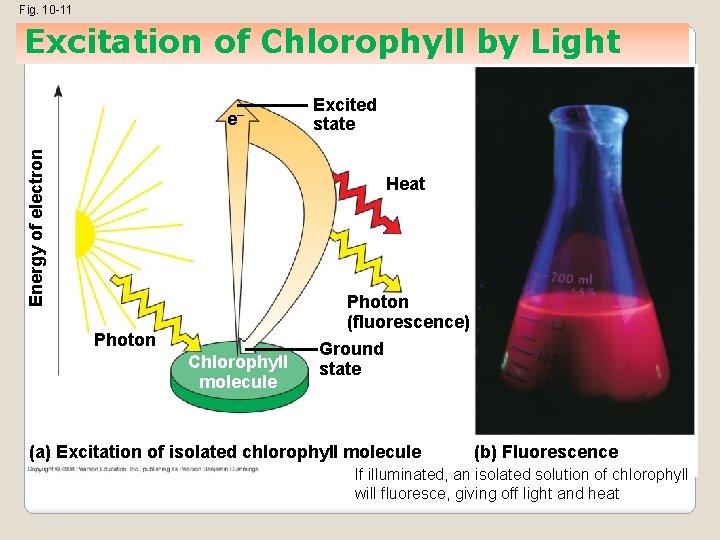
Fig. 10 -11 Excitation of Chlorophyll by Light Energy of electron e– Excited state Heat Photon (fluorescence) Photon Chlorophyll molecule Ground state (a) Excitation of isolated chlorophyll molecule (b) Fluorescence If illuminated, an isolated solution of chlorophyll will fluoresce, giving off light and heat
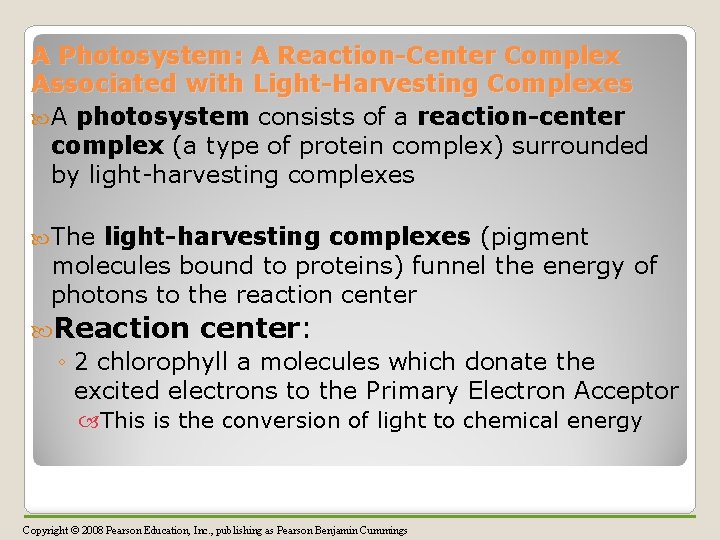
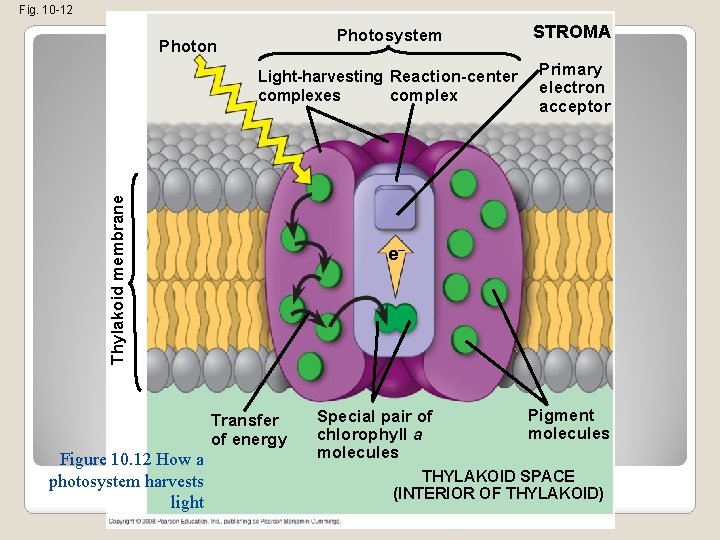
A Photosystem: A Reaction-Center Complex Associated with Light-Harvesting Complexes A photosystem consists of a reaction-center complex (a type of protein complex) surrounded by light-harvesting complexes The light-harvesting complexes (pigment molecules bound to proteins) funnel the energy of photons to the reaction center Reaction center: ◦ 2 chlorophyll a molecules which donate the excited electrons to the Primary Electron Acceptor This is the conversion of light to chemical energy Copyright © 2008 Pearson Education, Inc. , publishing as Pearson Benjamin Cummings
Fig. 10 -12 Photosystem STROMA Light-harvesting Reaction-center complexes Primary electron acceptor Thylakoid membrane Photon e– Transfer of energy Figure 10. 12 How a photosystem harvests light Special pair of chlorophyll a molecules Pigment molecules THYLAKOID SPACE (INTERIOR OF THYLAKOID)
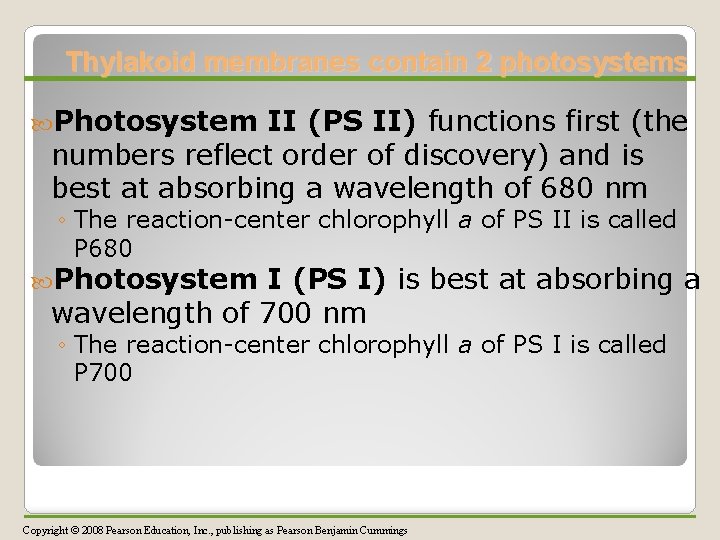
Thylakoid membranes contain 2 photosystems Photosystem II (PS II) functions first (the numbers reflect order of discovery) and is best at absorbing a wavelength of 680 nm ◦ The reaction-center chlorophyll a of PS II is called P 680 Photosystem I (PS I) is best at absorbing a wavelength of 700 nm ◦ The reaction-center chlorophyll a of PS I is called P 700 Copyright © 2008 Pearson Education, Inc. , publishing as Pearson Benjamin Cummings
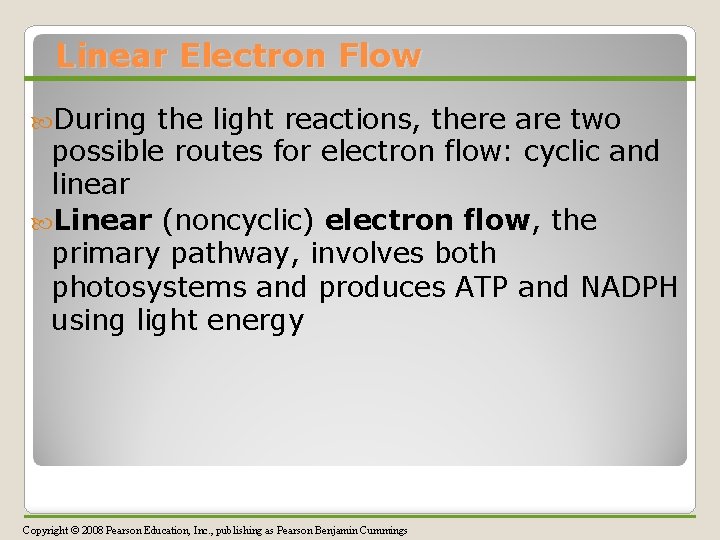
Linear Electron Flow During the light reactions, there are two possible routes for electron flow: cyclic and linear Linear (noncyclic) electron flow, the primary pathway, involves both photosystems and produces ATP and NADPH using light energy Copyright © 2008 Pearson Education, Inc. , publishing as Pearson Benjamin Cummings
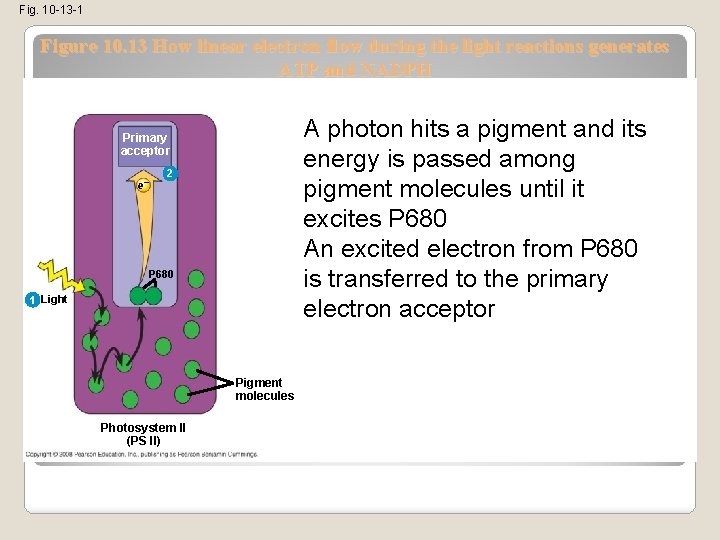
Fig. 10 -13 -1 Figure 10. 13 How linear electron flow during the light reactions generates ATP and NADPH A photon hits a pigment and its energy is passed among pigment molecules until it excites P 680 An excited electron from P 680 is transferred to the primary electron acceptor Primary acceptor e– 2 P 680 1 Light Pigment molecules Photosystem II (PS II)
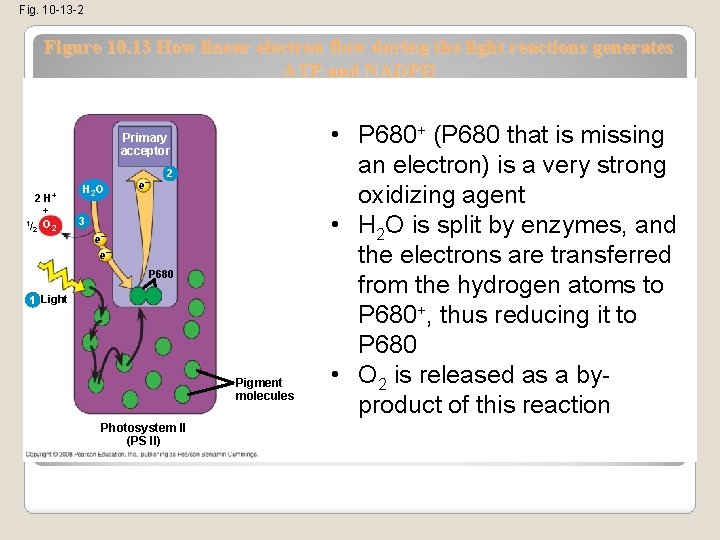
Fig. 10 -13 -2 Figure 10. 13 How linear electron flow during the light reactions generates ATP and NADPH Primary acceptor 2 H+ + 1/ O 2 2 H 2 O e– 2 3 e– e– P 680 1 Light Pigment molecules Photosystem II (PS II) • P 680+ (P 680 that is missing an electron) is a very strong oxidizing agent • H 2 O is split by enzymes, and the electrons are transferred from the hydrogen atoms to P 680+, thus reducing it to P 680 • O 2 is released as a byproduct of this reaction
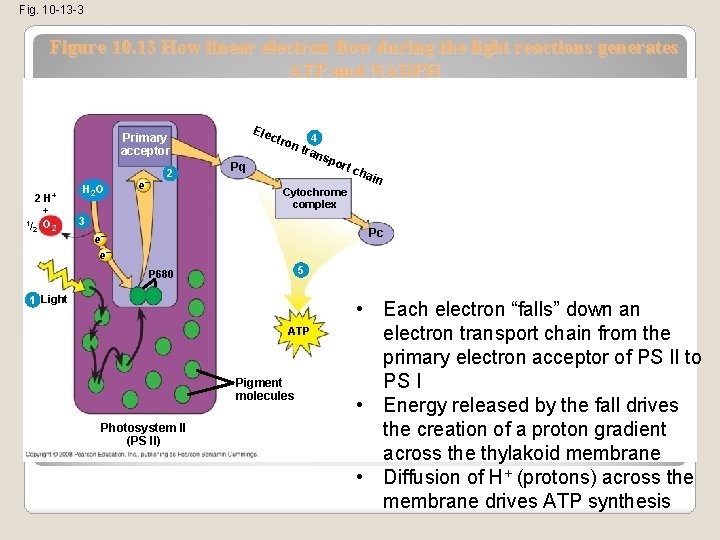
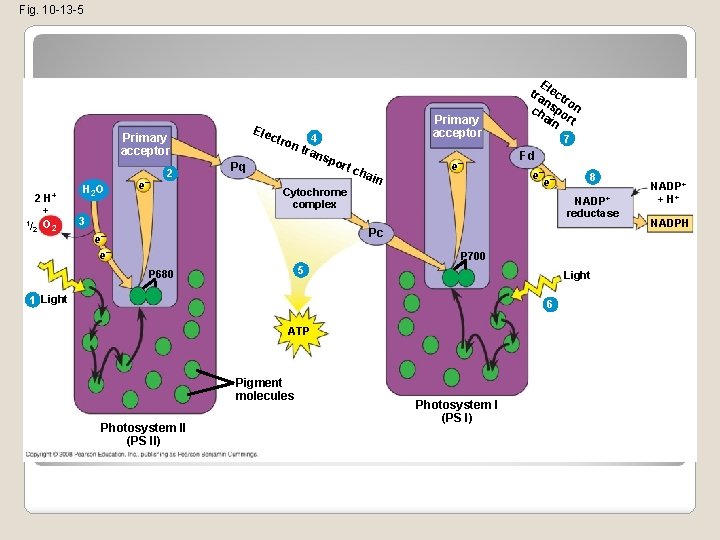
Fig. 10 -13 -3 Figure 10. 13 How linear electron flow during the light reactions generates ATP and NADPH Ele c Primary acceptor 2 H+ + 1/ O 2 2 H 2 O e– 2 tron Pq 4 tran spo rt c hai n Cytochrome complex 3 Pc e– e– 5 P 680 1 Light ATP Pigment molecules Photosystem II (PS II) • Each electron “falls” down an electron transport chain from the primary electron acceptor of PS II to PS I • Energy released by the fall drives the creation of a proton gradient across the thylakoid membrane • Diffusion of H+ (protons) across the membrane drives ATP synthesis
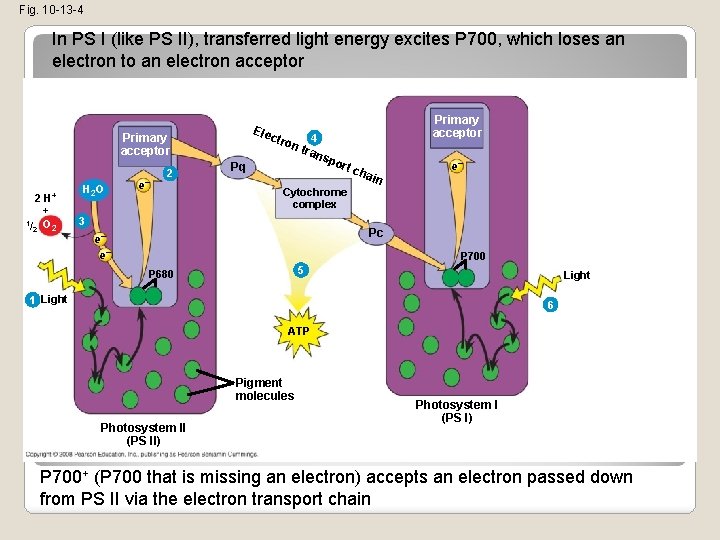
Fig. 10 -13 -4 In PS I (like PS II), transferred light energy excites P 700, which loses an electron to an electron acceptor Ele c Primary acceptor 2 H+ + 1/ O 2 2 H 2 O e– 2 tron Pq Primary acceptor 4 tran spo rt c hai e– n Cytochrome complex 3 Pc e– e– P 700 5 P 680 Light 1 Light 6 ATP Pigment molecules Photosystem II (PS II) Photosystem I (PS I) P 700+ (P 700 that is missing an electron) accepts an electron passed down from PS II via the electron transport chain
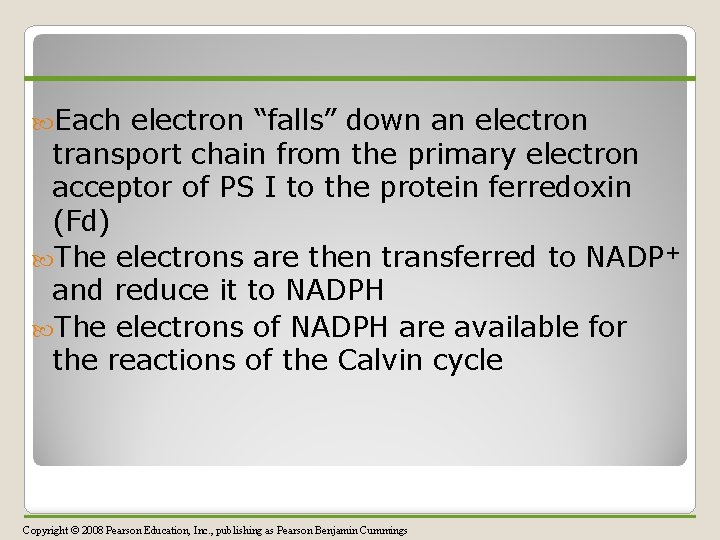
Each electron “falls” down an electron transport chain from the primary electron acceptor of PS I to the protein ferredoxin (Fd) The electrons are then transferred to NADP + and reduce it to NADPH The electrons of NADPH are available for the reactions of the Calvin cycle Copyright © 2008 Pearson Education, Inc. , publishing as Pearson Benjamin Cummings
Fig. 10 -13 -5 Ele c Primary acceptor 2 H+ + 1/ O 2 2 H 2 O e– 2 tron Pq Primary acceptor 4 tran spo rt c hai e– n Cytochrome complex 3 E tra lect n ro ch spo n ain rt 7 Fd e– e– 8 NADP+ reductase Pc e– e– P 700 5 P 680 Light 1 Light 6 ATP Pigment molecules Photosystem II (PS II) Photosystem I (PS I) NADP+ + H+ NADPH
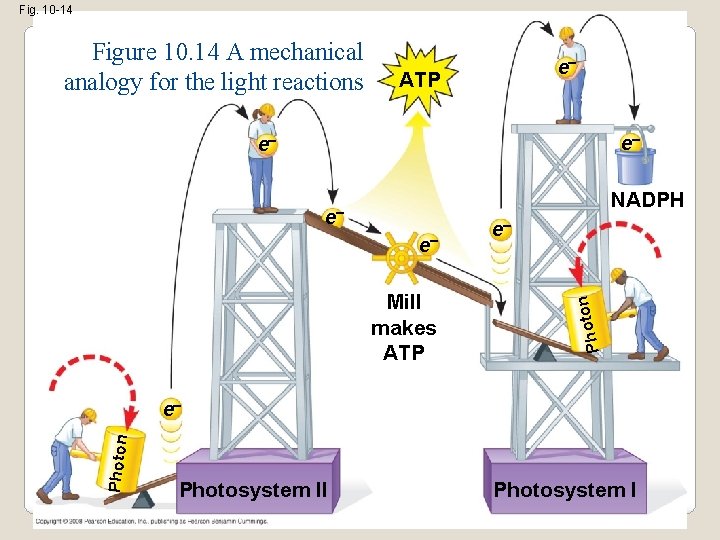
Fig. 10 -14 Figure 10. 14 A mechanical analogy for the light reactions e– ATP e– e– NADPH Mill makes ATP n e– e– Photon e– Photosystem II Photosystem I
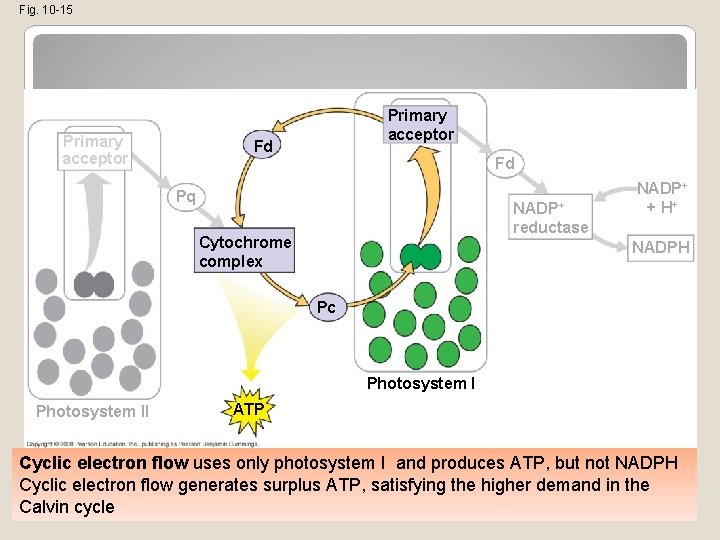
Fig. 10 -15 Primary acceptor Fd Fd Pq NADP+ reductase Cytochrome complex NADP+ + H+ NADPH Pc Photosystem II ATP Cyclic electron flow uses only photosystem I and produces ATP, but not NADPH Cyclic electron flow generates surplus ATP, satisfying the higher demand in the Calvin cycle
Some organisms such as purple sulfur bacteria have PS I but not PS II Cyclic electron flow is thought to have evolved before linear electron flow ◦ Cyclic electron flow may protect cells from lightinduced damage Produces ATP (by chemiosmosis) but no NADPH is produced and no Oxygen is released Copyright © 2008 Pearson Education, Inc. , publishing as Pearson Benjamin Cummings
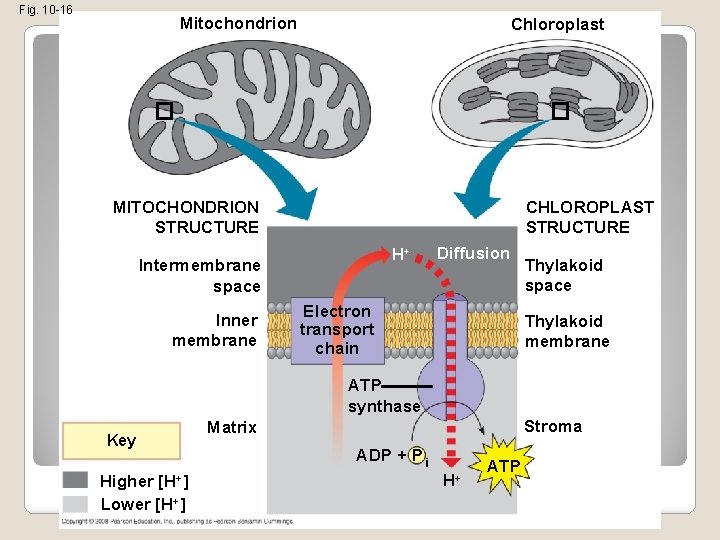
A Comparison of Chemiosmosis in Chloroplasts and Mitochondria Chloroplasts and mitochondria generate ATP by chemiosmosis, but use different sources of energy Mitochondria transfer chemical energy from food to ATP; chloroplasts transform light energy into the chemical energy of ATP Copyright © 2008 Pearson Education, Inc. , publishing as Pearson Benjamin Cummings
In mitochondria, protons are pumped to the intermembrane space and drive ATP synthesis as they diffuse back into the mitochondrial matrix In chloroplasts, protons are pumped into the thylakoid space and drive ATP synthesis as they diffuse back into the stroma ◦ ATP and NADPH are produced on the side facing the stroma, where the Calvin cycle takes place Copyright © 2008 Pearson Education, Inc. , publishing as Pearson Benjamin Cummings
Fig. 10 -16 Mitochondrion Chloroplast MITOCHONDRION STRUCTURE CHLOROPLAST STRUCTURE H+ Intermembrane space Inner membrane Diffusion Electron transport chain Thylakoid space Thylakoid membrane ATP synthase Stroma Matrix Key ADP + P i [H+] Higher Lower [H+] H+ ATP
In summary, light reactions generate ATP and increase the potential energy of electrons by moving them from H 2 O to NADPH Copyright © 2008 Pearson Education, Inc. , publishing as Pearson Benjamin Cummings
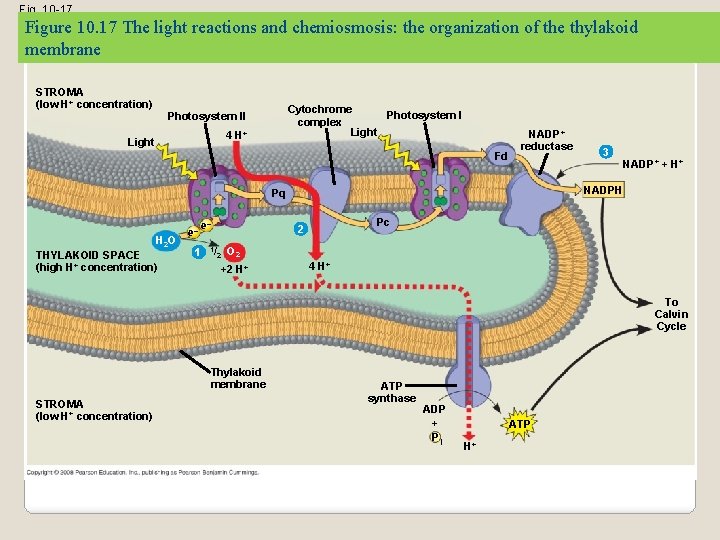
Fig. 10 -17 Figure 10. 17 The light reactions and chemiosmosis: the organization of the thylakoid membrane STROMA (low H+ concentration) Cytochrome Photosystem I complex Light Photosystem II 4 H+ Light Fd NADP+ reductase H 2 O THYLAKOID SPACE (high H+ concentration) 1 e– Pc 2 1/ 2 NADP+ + H+ NADPH Pq e– 3 O 2 +2 H+ 4 H+ To Calvin Cycle Thylakoid membrane STROMA (low H+ concentration) ATP synthase ADP + Pi ATP H+
Concept 10. 3: The Calvin cycle uses ATP and NADPH to convert CO 2 to sugar The Calvin cycle, like the citric acid cycle, regenerates its starting material after molecules enter and leave the cycle The cycle builds sugar from smaller molecules by using ATP and the reducing power of electrons carried by NADPH Copyright © 2008 Pearson Education, Inc. , publishing as Pearson Benjamin Cummings
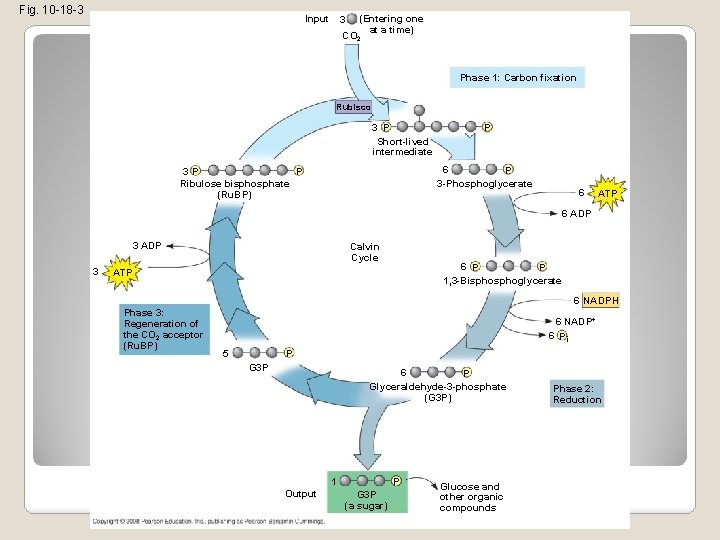
Carbon enters the cycle as CO 2 and leaves as a sugar named glyceraldehyde-3 phospate (G 3 P glucose/other ocompounds) For net synthesis of 1 G 3 P, the cycle must take place three times, fixing 3 molecules of CO 2 The Calvin cycle has three phases: 1. Carbon fixation (catalyzed by rubisco) 2. Reduction 3. Regeneration of the CO 2 acceptor (Ru. BP) Copyright © 2008 Pearson Education, Inc. , publishing as Pearson Benjamin Cummings
Fig. 10 -18 -3 Input 3 (Entering one at a time) CO 2 Phase 1: Carbon fixation Rubisco 3 P Short-lived intermediate P 6 P 3 -Phosphoglycerate 3 P P Ribulose bisphosphate (Ru. BP) 6 ATP 6 ADP 3 Calvin Cycle 6 P P 1, 3 -Bisphoglycerate ATP 6 NADPH Phase 3: Regeneration of the CO 2 acceptor (Ru. BP) 6 NADP+ 6 Pi P 5 G 3 P 6 P Glyceraldehyde-3 -phosphate (G 3 P) 1 Output P G 3 P (a sugar) Glucose and other organic compounds Phase 2: Reduction
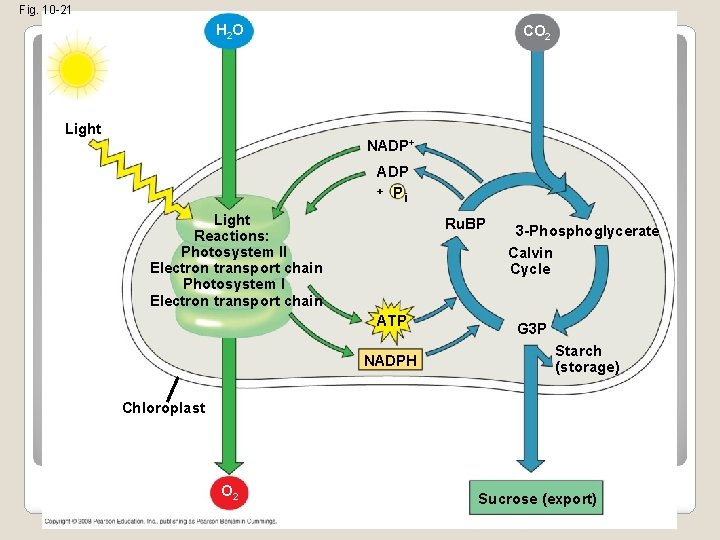
Fig. 10 -21 H 2 O CO 2 Light NADP+ ADP + P i Light Reactions: Photosystem II Electron transport chain Photosystem I Electron transport chain Ru. BP ATP NADPH 3 -Phosphoglycerate Calvin Cycle G 3 P Starch (storage) Chloroplast O 2 Sucrose (export)
http: //www. youtube. com/watch? v=yr. Qz. Ew 9 x. Y 5 k https: //www. youtube. com/watch? v=t. SHm w. IZ 9 FNw http: //www. youtube. com/watch? v=hj_WKg n. L 6 MI