
Chapter 10 Photosynthesis Life from Light AP Biology
Chapter 10 Photosynthesis: Life from Light AP Biology
Energy needs of life § All life needs a constant input of energy u Heterotrophs § get their energy from “eating others” § consumers of other organisms § consume organic molecules u Autotrophs § get their energy from “self” § get their energy from sunlight § use light energy to synthesize organic molecules AP Biology
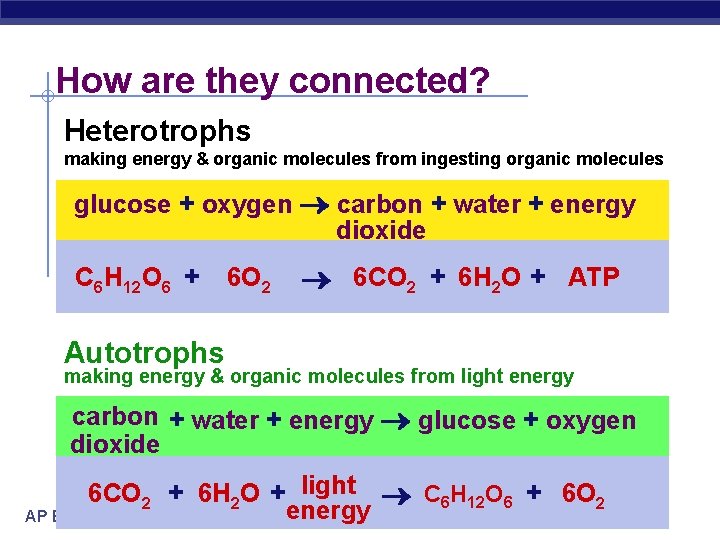
How are they connected? Heterotrophs making energy & organic molecules from ingesting organic molecules glucose + oxygen carbon + water + energy dioxide C 6 H 12 O 6 + 6 O 2 6 CO 2 + 6 H 2 O + ATP Autotrophs making energy & organic molecules from light energy carbon + water + energy glucose + oxygen dioxide 6 CO 2 + 6 H 2 O + light C 6 H 12 O 6 + 6 O 2 energy AP Biology

Energy cycle sun Photosynthesis CO 2 H 2 O glucose Cellular Respiration ATP AP Biology O 2
What does it mean to be a plant § Need to… u collect light energy § transform it into chemical energy u store light energy § in a stable form to be moved around the plant & also saved for a rainy day u need to get building block atoms from the environment § C, H, O, N, P, S u produce all organic molecules needed for growth § carbohydrates, proteins, lipids, nucleic acids AP Biology
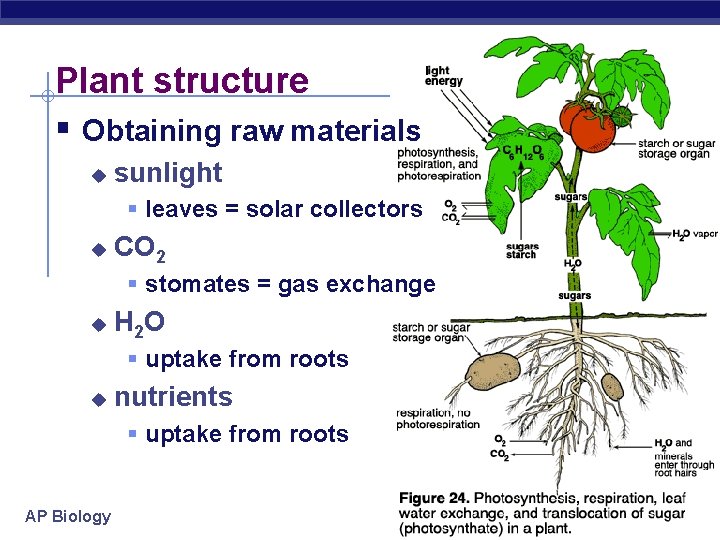
Plant structure § Obtaining raw materials u sunlight § leaves = solar collectors u CO 2 § stomates = gas exchange u H 2 O § uptake from roots u nutrients § uptake from roots AP Biology
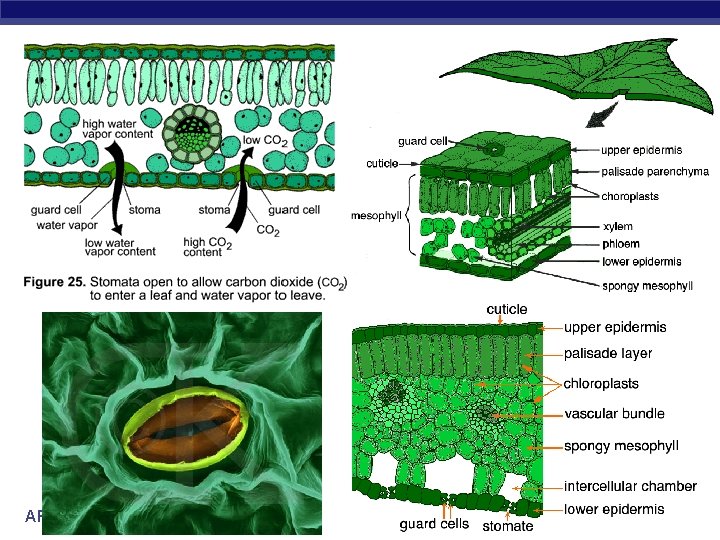
AP Biology

Plant structure § Chloroplasts double membrane u stroma u thylakoid sacs u grana stacks u § Chlorophyll & ETC in thylakoid membrane u H+ gradient built up within thylakoid sac H+ AP Biology + + H+ H H+ + H H + H+ H+ H+ + H H
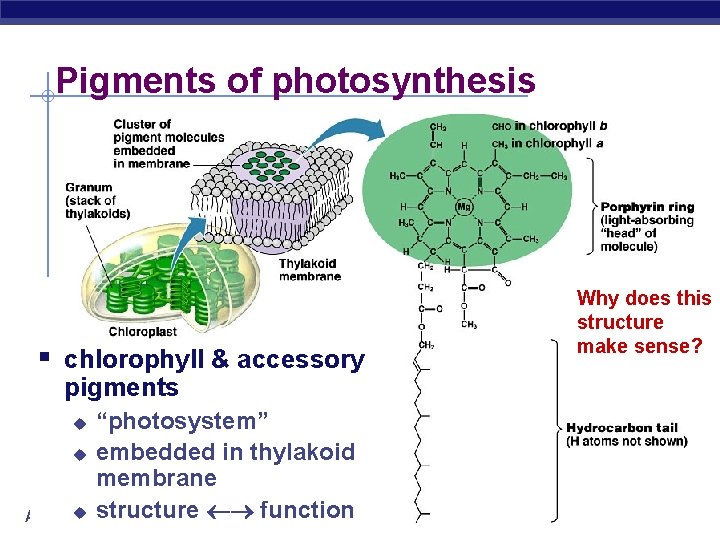
Pigments of photosynthesis § chlorophyll & accessory pigments “photosystem” u embedded in thylakoid membrane u structure function AP Biology u Why does this structure make sense?
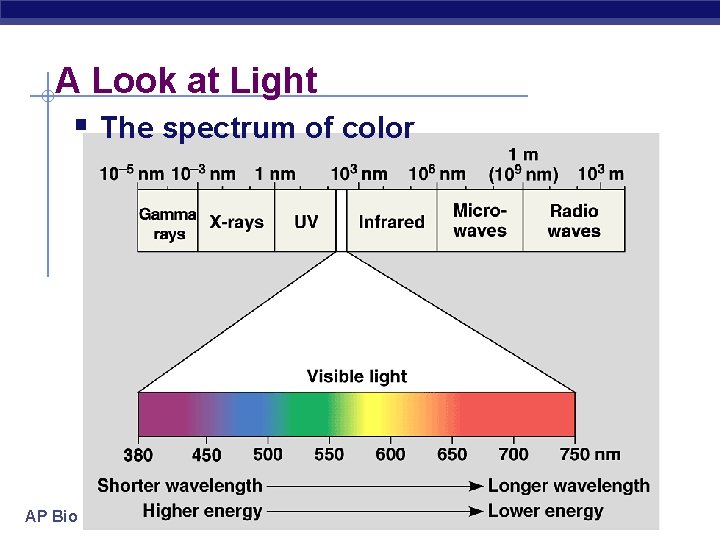
A Look at Light § The spectrum of color AP Biology
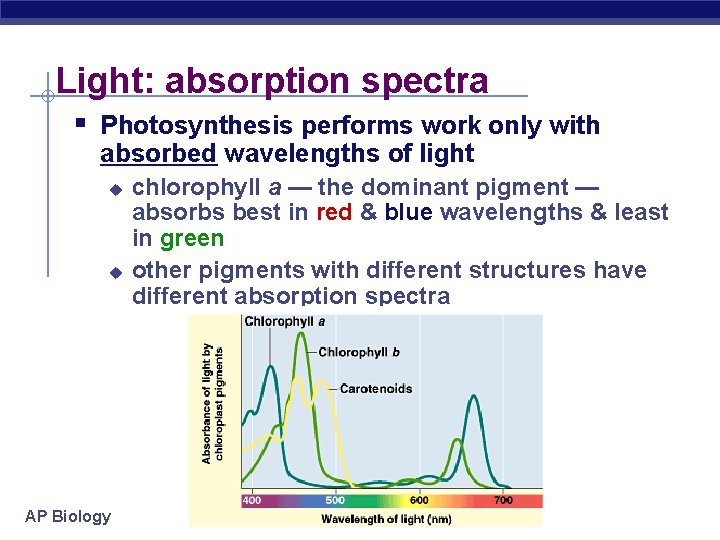
Light: absorption spectra § Photosynthesis performs work only with absorbed wavelengths of light u u AP Biology chlorophyll a — the dominant pigment — absorbs best in red & blue wavelengths & least in green other pigments with different structures have different absorption spectra

Chloroplasts § Chloroplasts are green because they absorb light wavelengths in red & blue and reflect green back out structure function AP Biology
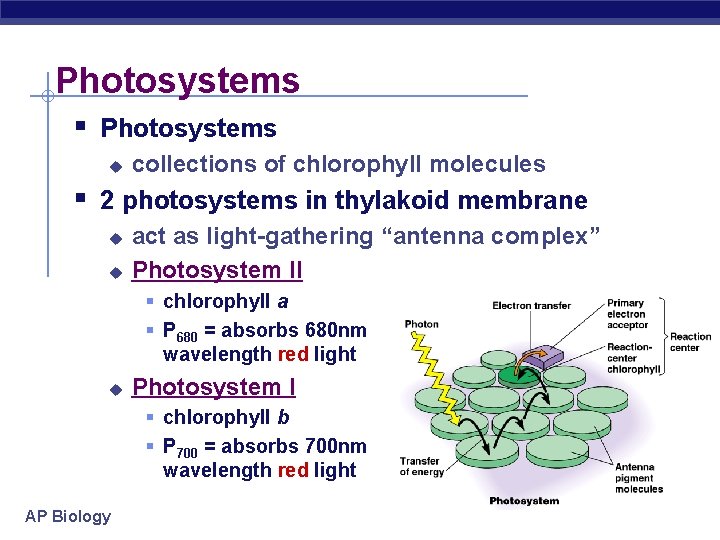
Photosystems § Photosystems u collections of chlorophyll molecules § 2 photosystems in thylakoid membrane u u act as light-gathering “antenna complex” Photosystem II § chlorophyll a § P 680 = absorbs 680 nm wavelength red light u Photosystem I § chlorophyll b § P 700 = absorbs 700 nm wavelength red light AP Biology
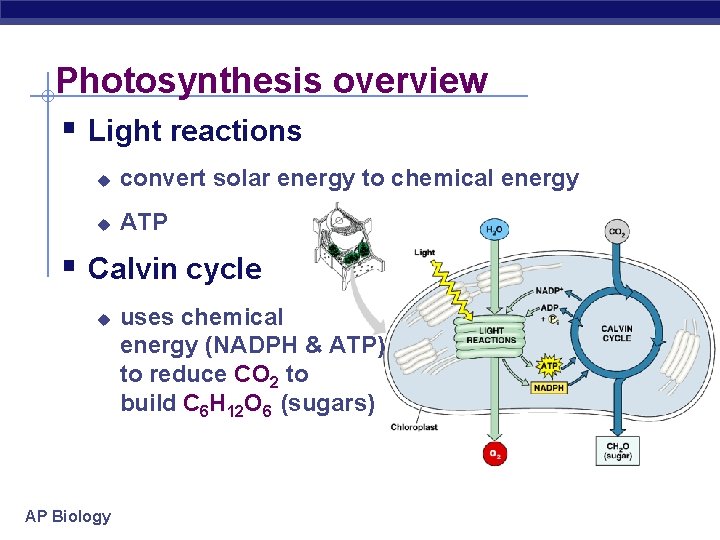
Photosynthesis overview § Light reactions u convert solar energy to chemical energy u ATP § Calvin cycle u AP Biology uses chemical energy (NADPH & ATP) to reduce CO 2 to build C 6 H 12 O 6 (sugars)
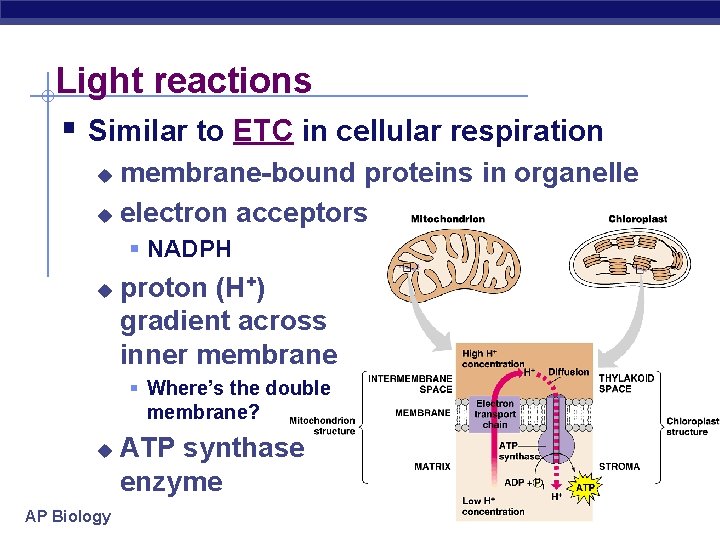
Light reactions § Similar to ETC in cellular respiration membrane-bound proteins in organelle u electron acceptors u § NADPH u proton (H+) gradient across inner membrane § Where’s the double membrane? u AP Biology ATP synthase enzyme
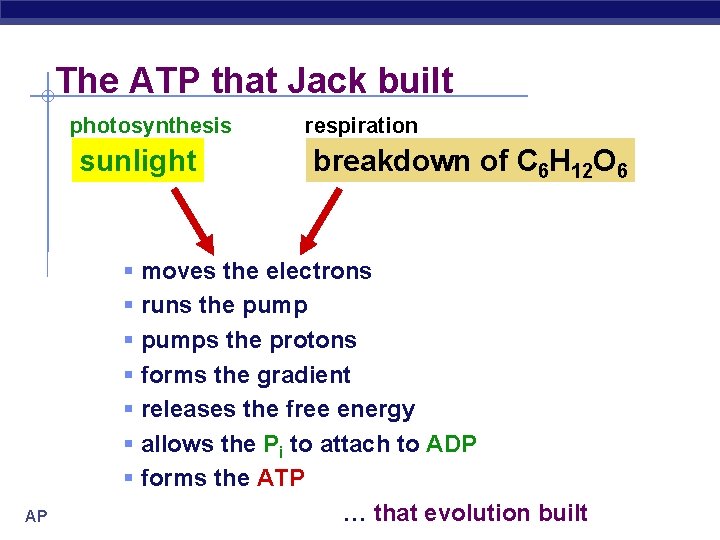
The ATP that Jack built photosynthesis sunlight § § § § AP Biology respiration breakdown of C 6 H 12 O 6 moves the electrons runs the pumps the protons forms the gradient releases the free energy allows the Pi to attach to ADP forms the ATP … that evolution built
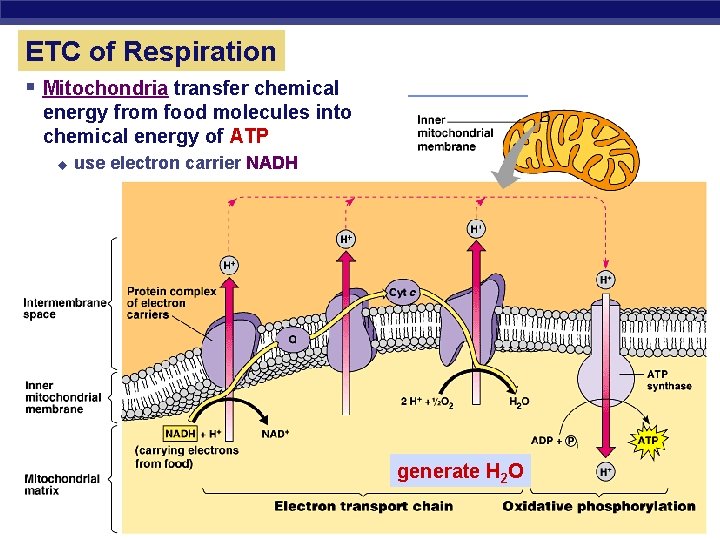
ETC of Respiration § Mitochondria transfer chemical energy from food molecules into chemical energy of ATP u use electron carrier NADH generate H 2 O AP Biology
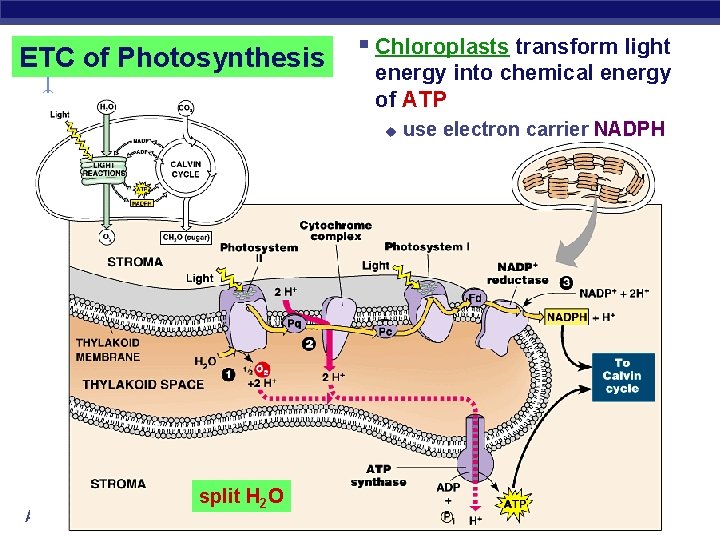
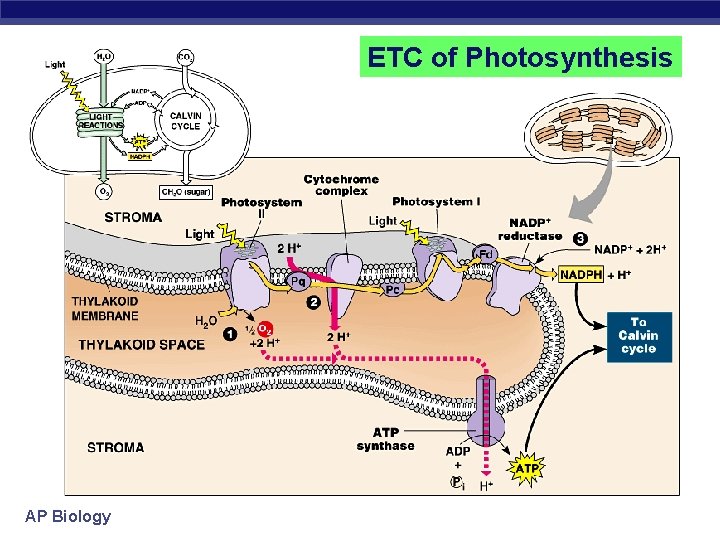
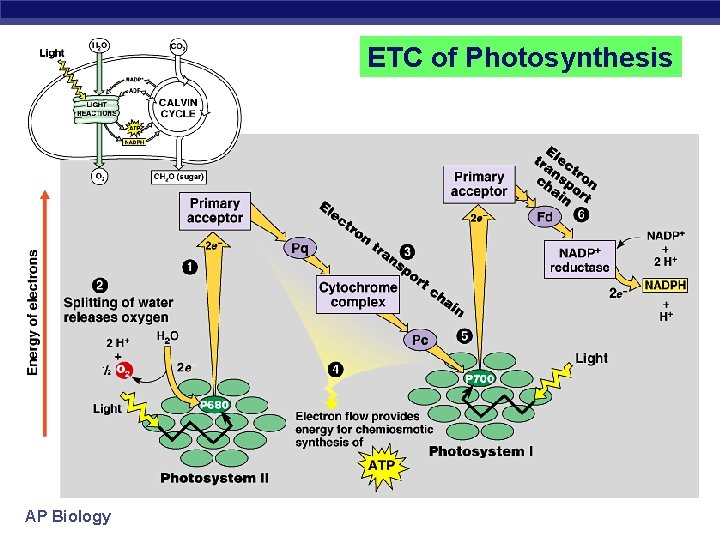
ETC of Photosynthesis § Chloroplasts transform light energy into chemical energy of ATP u AP Biology split H 2 O use electron carrier NADPH
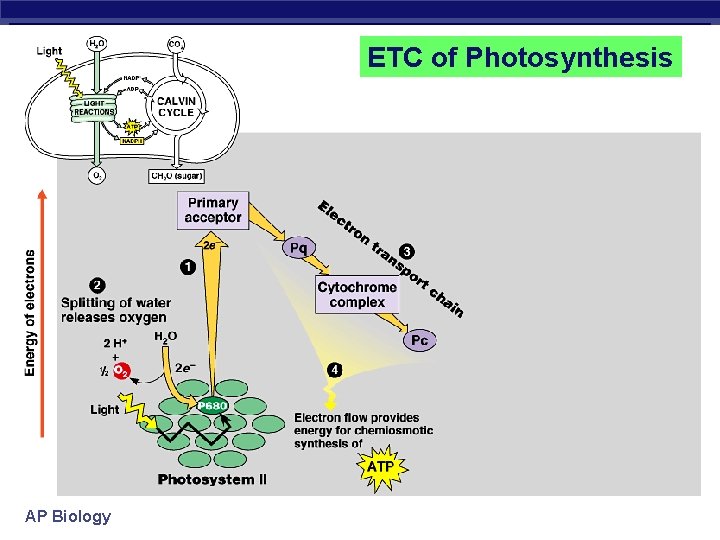
ETC of Photosynthesis AP Biology
ETC of Photosynthesis AP Biology
ETC of Photosynthesis AP Biology
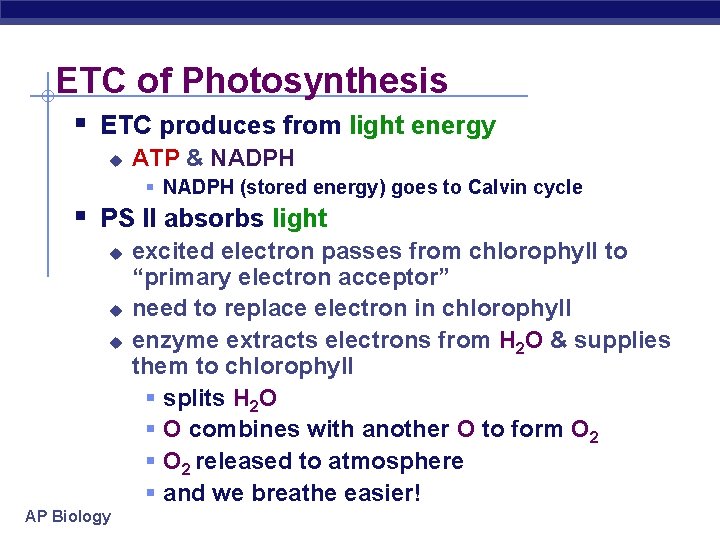
ETC of Photosynthesis § ETC produces from light energy u ATP & NADPH § NADPH (stored energy) goes to Calvin cycle § PS II absorbs light u u u AP Biology excited electron passes from chlorophyll to “primary electron acceptor” need to replace electron in chlorophyll enzyme extracts electrons from H 2 O & supplies them to chlorophyll § splits H 2 O § O combines with another O to form O 2 § O 2 released to atmosphere § and we breathe easier!
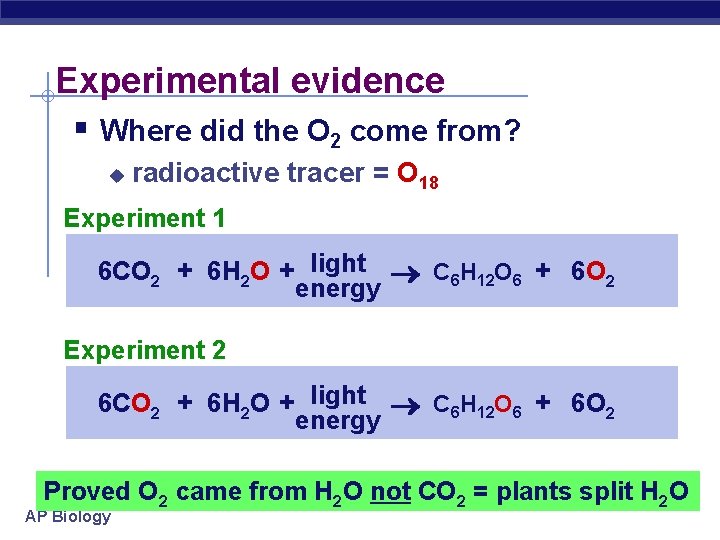
Experimental evidence § Where did the O 2 come from? u radioactive tracer = O 18 Experiment 1 6 CO 2 + 6 H 2 O + light C 6 H 12 O 6 + 6 O 2 energy Experiment 2 6 CO 2 + 6 H 2 O + light C 6 H 12 O 6 + 6 O 2 energy Proved O 2 came from H 2 O not CO 2 = plants split H 2 O AP Biology
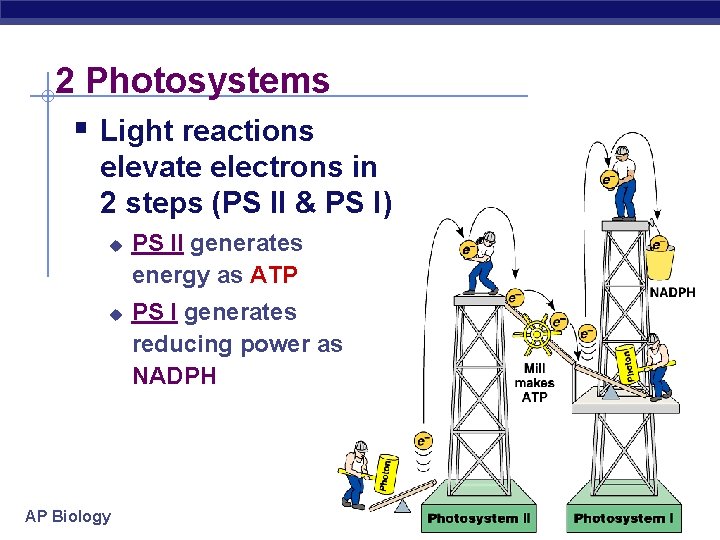
2 Photosystems § Light reactions elevate electrons in 2 steps (PS II & PS I) u u AP Biology PS II generates energy as ATP PS I generates reducing power as NADPH
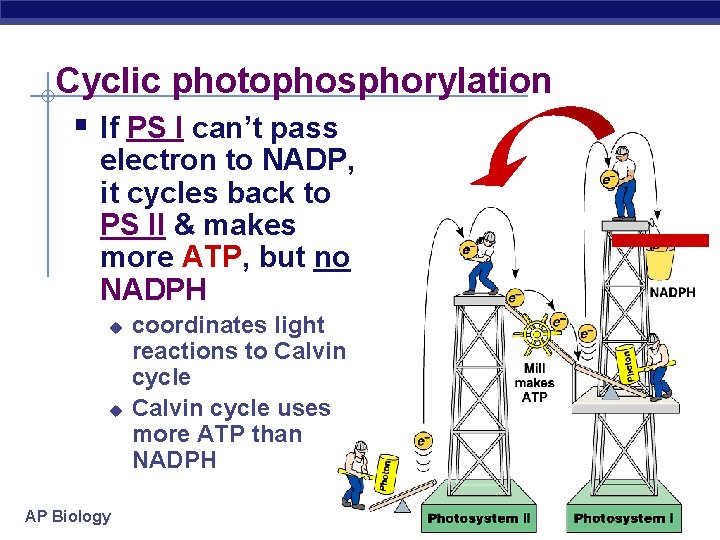
Cyclic photophosphorylation § If PS I can’t pass electron to NADP, it cycles back to PS II & makes more ATP, but no NADPH u u AP Biology coordinates light reactions to Calvin cycle uses more ATP than NADPH
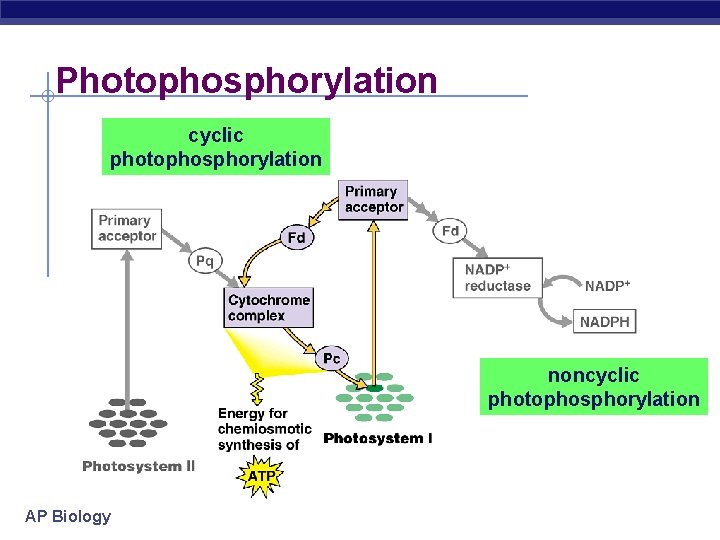
Photophosphorylation cyclic photophosphorylation noncyclic photophosphorylation AP Biology
Photosynthesis summary Where did the energy come from? Where did the H 2 O come from? Where did the electrons come from? Where did the O 2 come from? Where did the H+ come from? Where did the ATP come from? Where did the O 2 go? What will the ATP be used for? What will the NADPH be used for? …stay tuned for the Calvin cycle AP Biology
Chapter 10. Photosynthesis: The Calvin Cycle Life from Air AP Biology
Remember what it means to be a plant… § Need to produce all organic molecules necessary for growth carbohydrates, lipids u proteins, nucleic acids u § Need to store chemical energy in stable form u can be moved around plant u saved for a rainy day u AP Biology
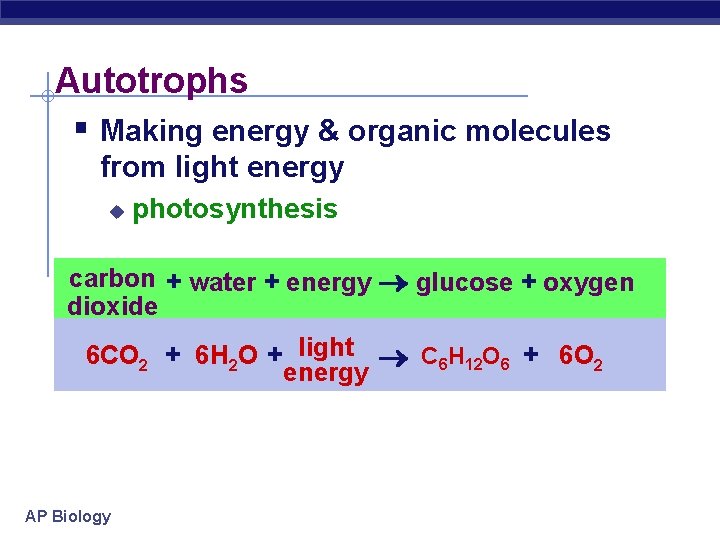
Autotrophs § Making energy & organic molecules from light energy u photosynthesis carbon + water + energy glucose + oxygen dioxide 6 CO 2 + 6 H 2 O + light C 6 H 12 O 6 + 6 O 2 energy AP Biology
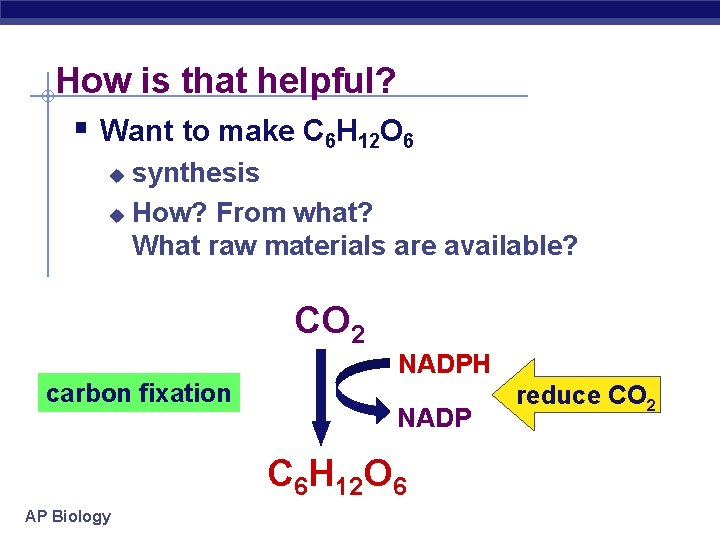
How is that helpful? § Want to make C 6 H 12 O 6 synthesis u How? From what? What raw materials are available? u CO 2 carbon fixation NADPH NADP C 6 H 12 O 6 AP Biology reduce CO 2
From CO 2 C 6 H 12 O 6 § CO 2 has very little chemical energy u fully oxidized § C 6 H 12 O 6 contains a lot of chemical energy reduced u endergonic u § Reduction of CO 2 C 6 H 12 O 6 proceeds in many small uphill steps each catalyzed by specific enzyme u using energy stored in ATP & NADPH u AP Biology
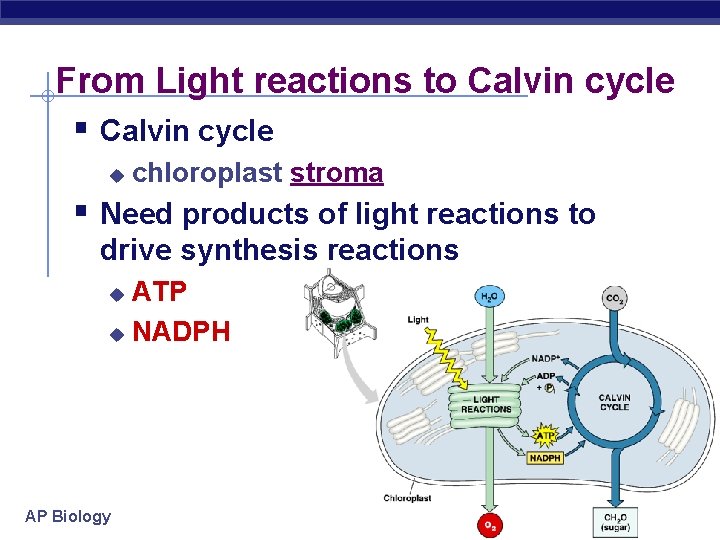
From Light reactions to Calvin cycle § Calvin cycle u chloroplast stroma § Need products of light reactions to drive synthesis reactions ATP u NADPH u AP Biology
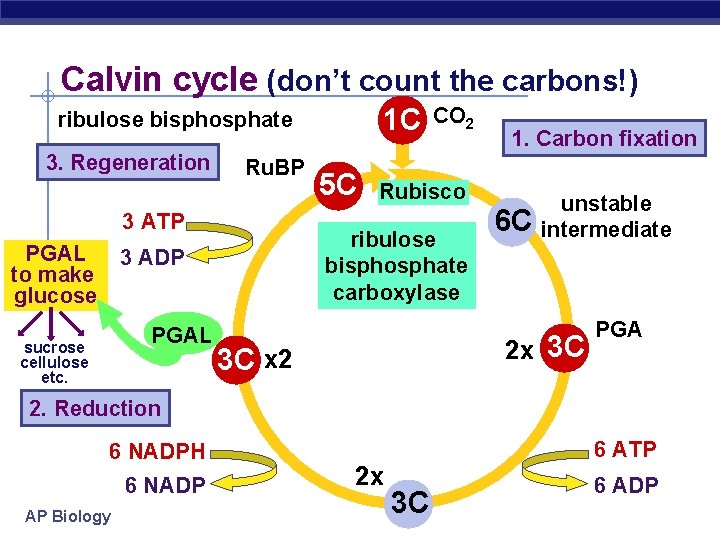
Calvin cycle (don’t count the carbons!) 1 C ribulose bisphosphate 3. Regeneration Ru. BP 3 ATP PGAL to make glucose sucrose cellulose etc. Rubisco ribulose bisphosphate carboxylase 3 ADP PGAL 5 C CO 2 1. Carbon fixation 6 C unstable intermediate 2 x 3 C 3 C x 2 PGA 2. Reduction 6 NADPH 6 NADP AP Biology 2 x 6 ATP 3 C 6 ADP
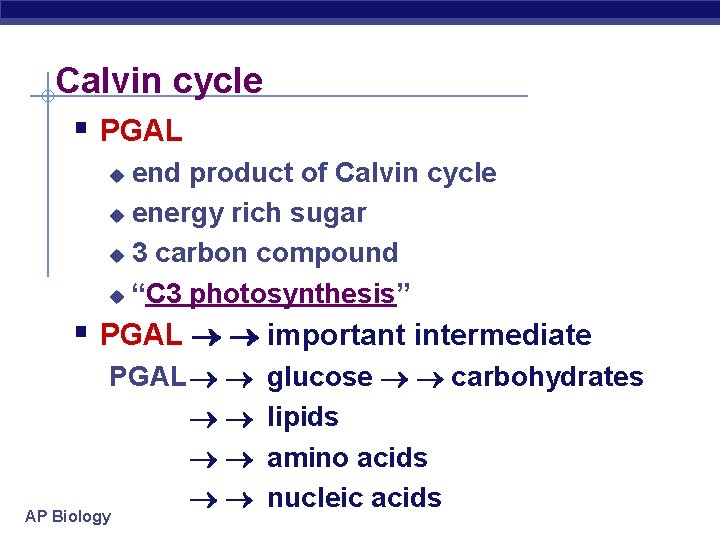
Calvin cycle § PGAL end product of Calvin cycle u energy rich sugar u 3 carbon compound u “C 3 photosynthesis” u § PGAL important intermediate PGAL AP Biology glucose carbohydrates lipids amino acids nucleic acids
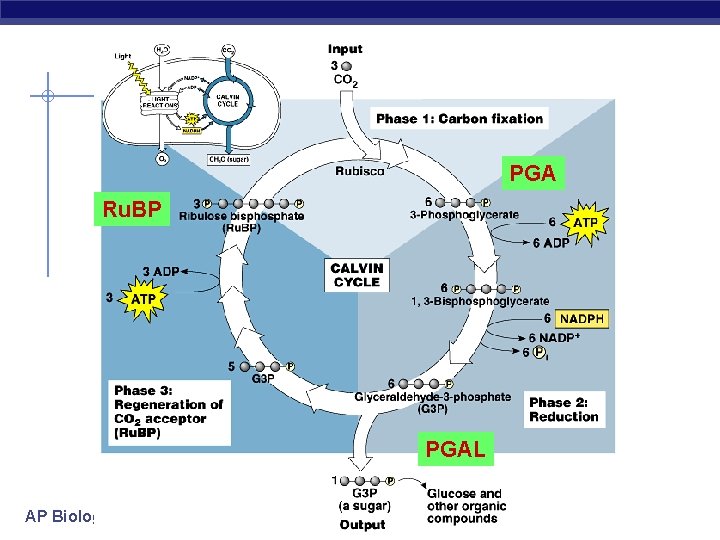
PGA PGA Ru. BP PGAL AP Biology
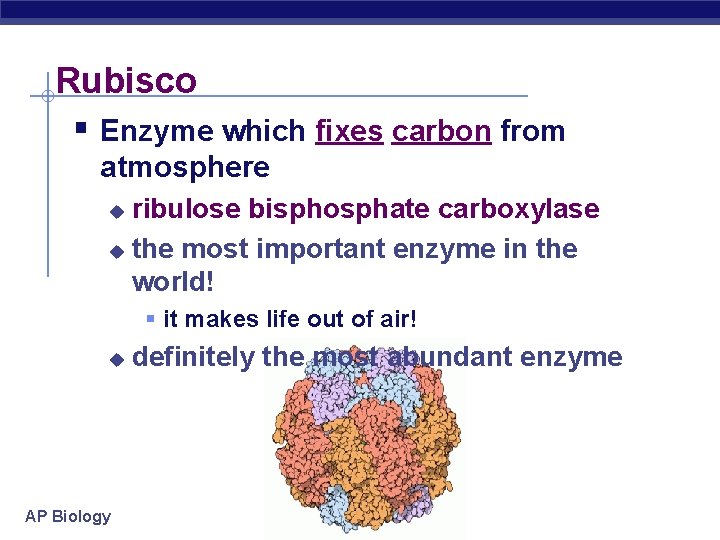
Rubisco § Enzyme which fixes carbon from atmosphere ribulose bisphosphate carboxylase u the most important enzyme in the world! u § it makes life out of air! u AP Biology definitely the most abundant enzyme
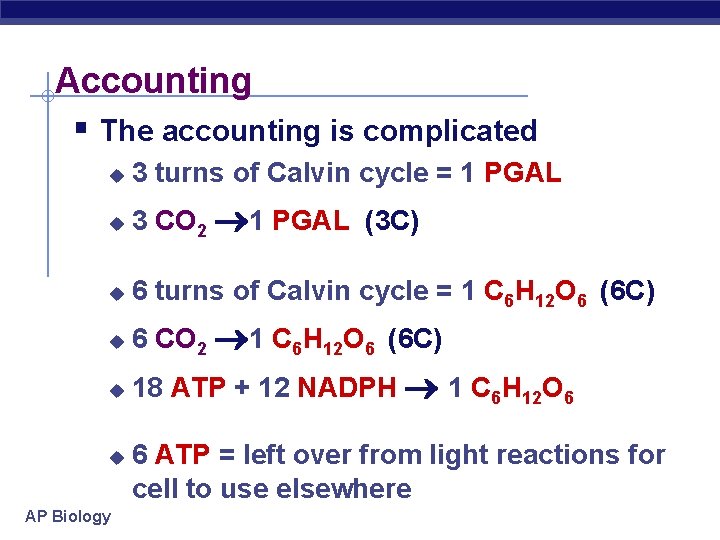
Accounting § The accounting is complicated u 3 turns of Calvin cycle = 1 PGAL u 3 CO 2 1 PGAL (3 C) u 6 turns of Calvin cycle = 1 C 6 H 12 O 6 (6 C) u 6 CO 2 1 C 6 H 12 O 6 (6 C) u 18 ATP + 12 NADPH 1 C 6 H 12 O 6 u AP Biology 6 ATP = left over from light reactions for cell to use elsewhere
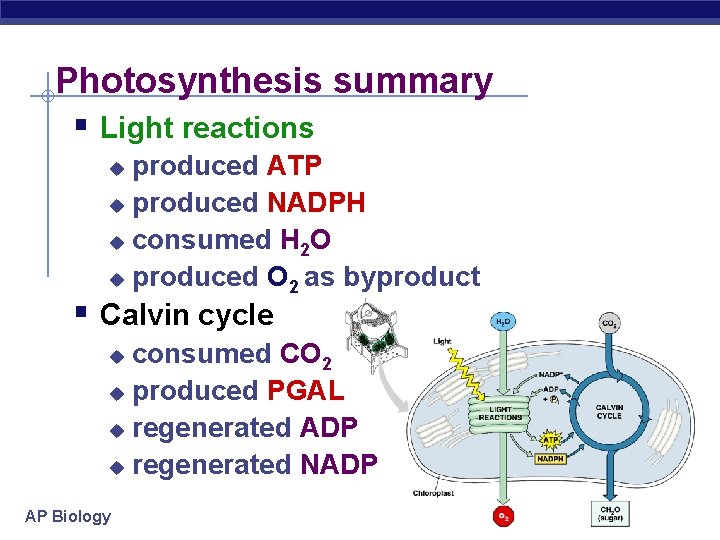
Photosynthesis summary § Light reactions produced ATP u produced NADPH u consumed H 2 O u produced O 2 as byproduct u § Calvin cycle consumed CO 2 u produced PGAL u regenerated ADP u regenerated NADP u AP Biology
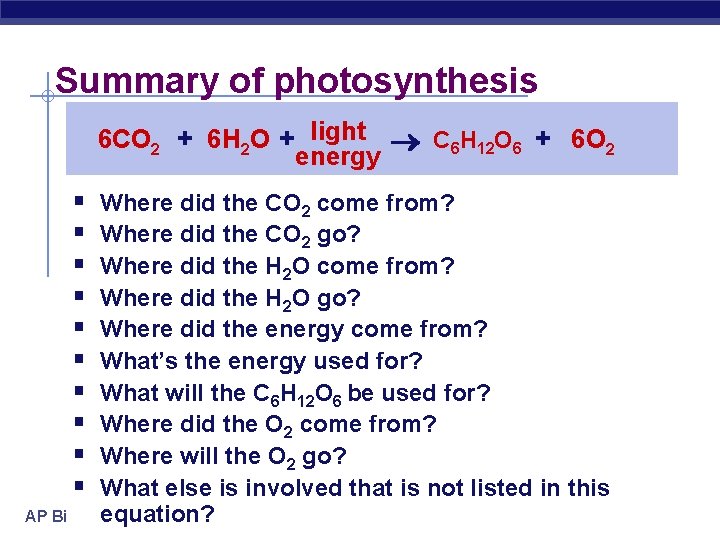
Summary of photosynthesis 6 CO 2 + 6 H 2 O + light C 6 H 12 O 6 + 6 O 2 energy § § § § § Where did the CO 2 come from? Where did the CO 2 go? Where did the H 2 O come from? Where did the H 2 O go? Where did the energy come from? What’s the energy used for? What will the C 6 H 12 O 6 be used for? Where did the O 2 come from? Where will the O 2 go? What else is involved that is not listed in this equation? AP Biology
Chapter 10. Photosynthesis: Variations on the Theme AP Biology
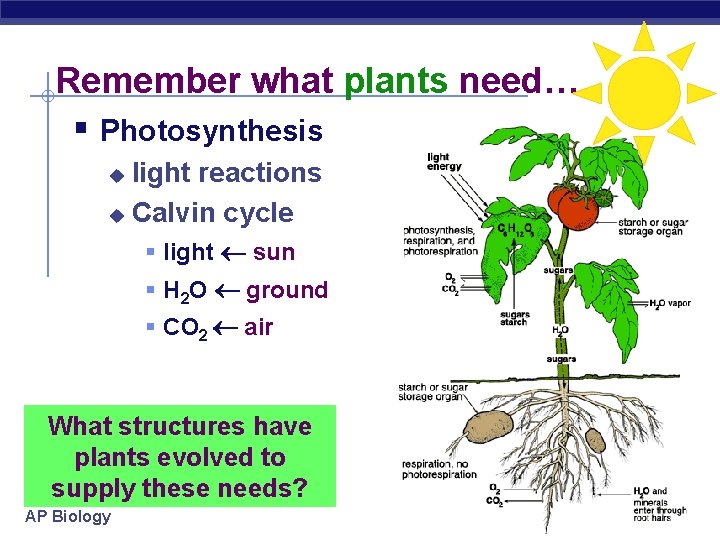
Remember what plants need… § Photosynthesis light reactions u Calvin cycle u § light sun § H 2 O ground § CO 2 air What structures have plants evolved to supply these needs? AP Biology
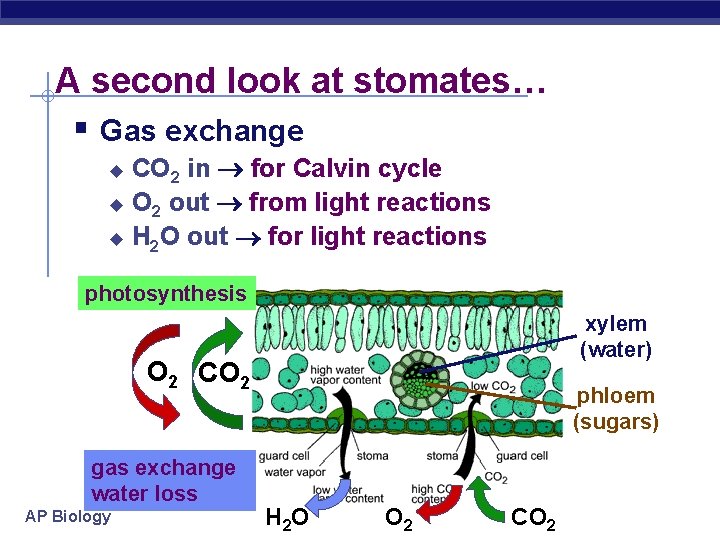
A second look at stomates… § Gas exchange CO 2 in for Calvin cycle u O 2 out from light reactions u H 2 O out for light reactions u photosynthesis xylem (water) O 2 CO 2 gas exchange water loss AP Biology phloem (sugars) H 2 O O 2 CO 2
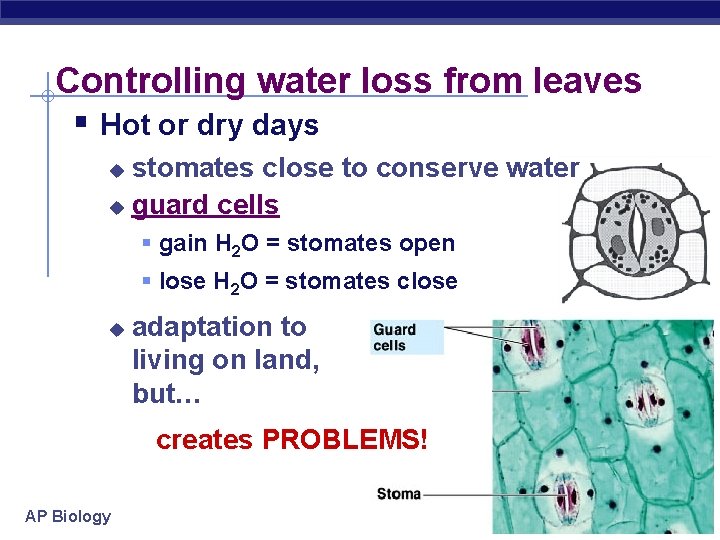
Controlling water loss from leaves § Hot or dry days stomates close to conserve water u guard cells u § gain H 2 O = stomates open § lose H 2 O = stomates close u adaptation to living on land, but… creates PROBLEMS! AP Biology
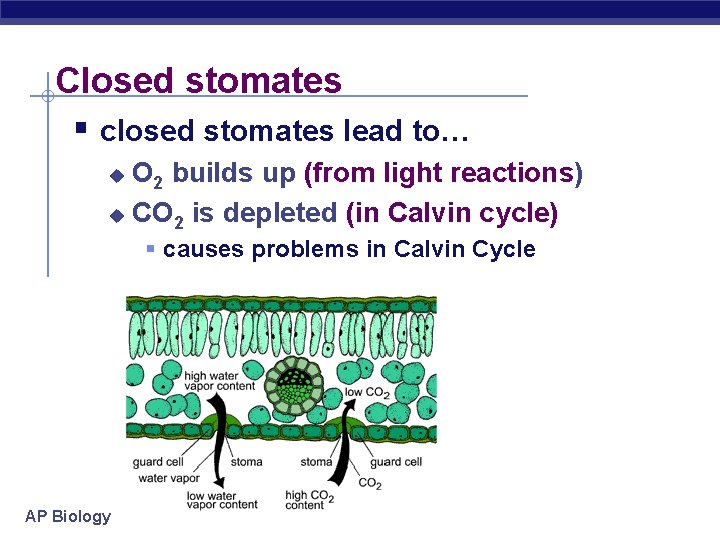
Closed stomates § closed stomates lead to… O 2 builds up (from light reactions) u CO 2 is depleted (in Calvin cycle) u § causes problems in Calvin Cycle AP Biology
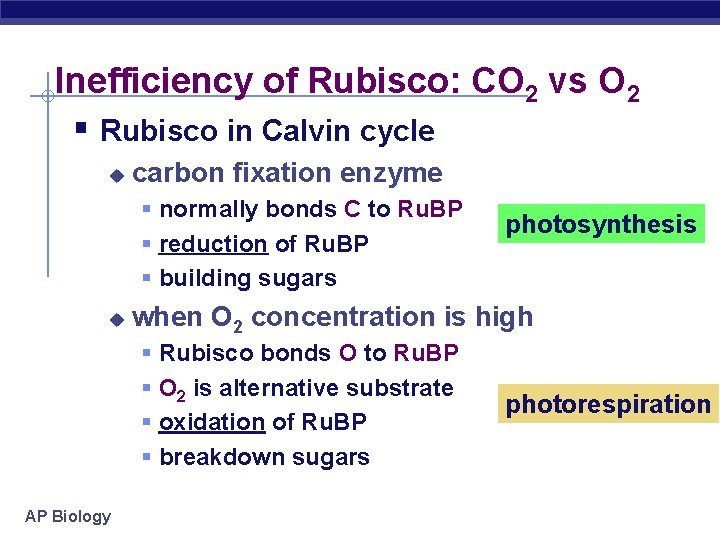
Inefficiency of Rubisco: CO 2 vs O 2 § Rubisco in Calvin cycle u carbon fixation enzyme § normally bonds C to Ru. BP § reduction of Ru. BP § building sugars u when O 2 concentration is high § § AP Biology photosynthesis Rubisco bonds O to Ru. BP O 2 is alternative substrate oxidation of Ru. BP breakdown sugars photorespiration
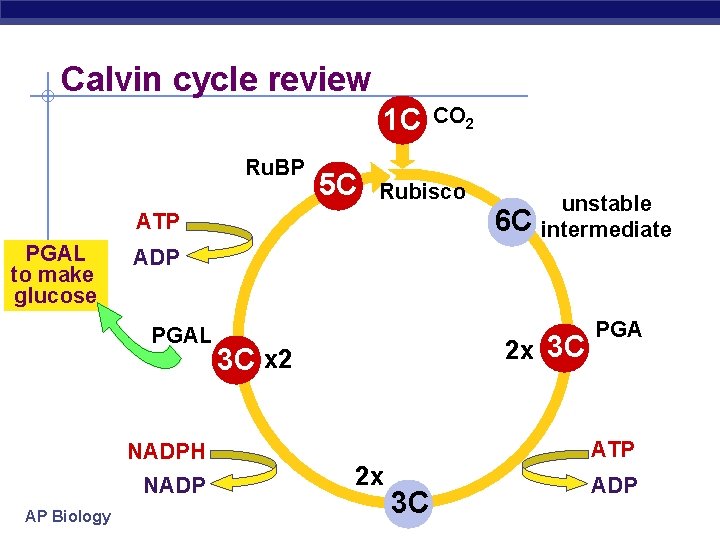
Calvin cycle review 1 C Ru. BP 5 C Rubisco ATP PGAL to make glucose 6 C unstable intermediate ADP PGAL NADPH NADP AP Biology CO 2 2 x 3 C 3 C x 2 2 x PGA ATP 3 C ADP
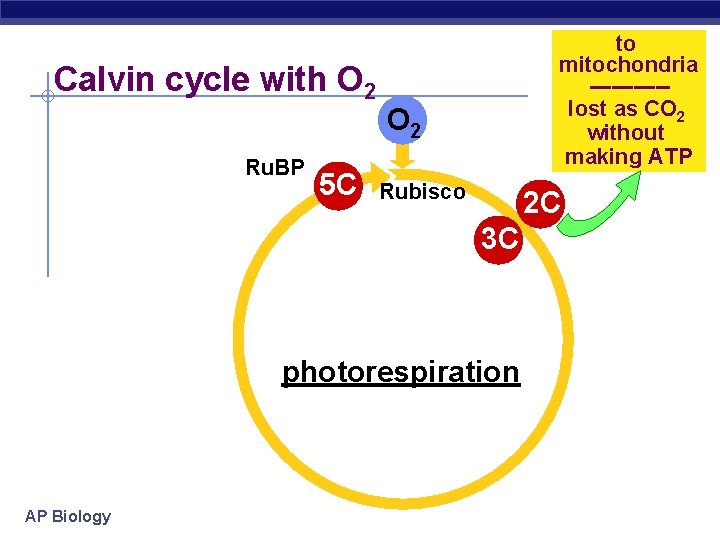
Calvin cycle with O 2 Ru. BP 5 C to mitochondria -----lost as CO 2 without making ATP O 2 Rubisco 2 C 3 C photorespiration AP Biology
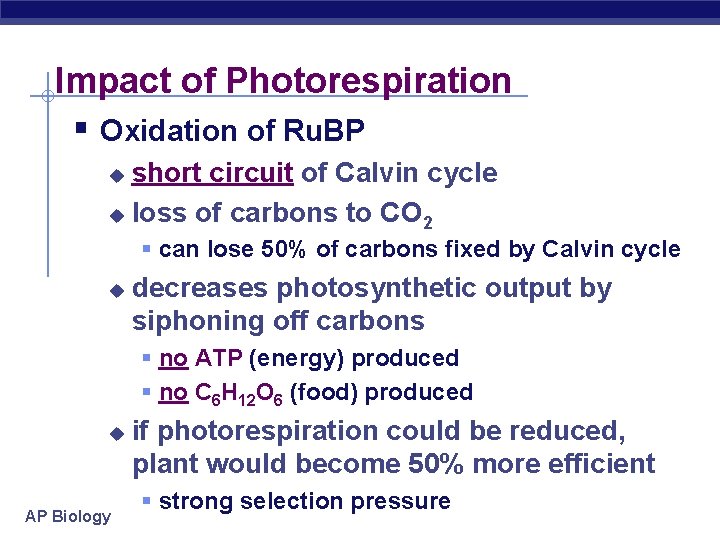
Impact of Photorespiration § Oxidation of Ru. BP short circuit of Calvin cycle u loss of carbons to CO 2 u § can lose 50% of carbons fixed by Calvin cycle u decreases photosynthetic output by siphoning off carbons § no ATP (energy) produced § no C 6 H 12 O 6 (food) produced u AP Biology if photorespiration could be reduced, plant would become 50% more efficient § strong selection pressure
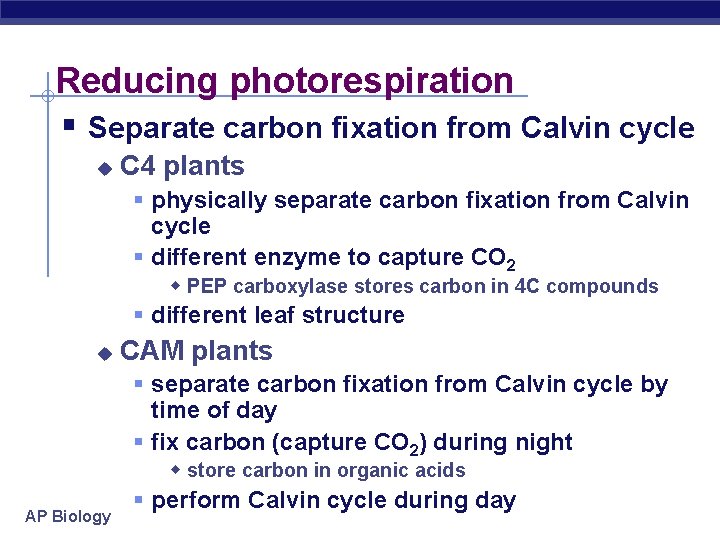
Reducing photorespiration § Separate carbon fixation from Calvin cycle u C 4 plants § physically separate carbon fixation from Calvin cycle § different enzyme to capture CO 2 w PEP carboxylase stores carbon in 4 C compounds § different leaf structure u AP Biology CAM plants § separate carbon fixation from Calvin cycle by time of day § fix carbon (capture CO 2) during night w store carbon in organic acids § perform Calvin cycle during day
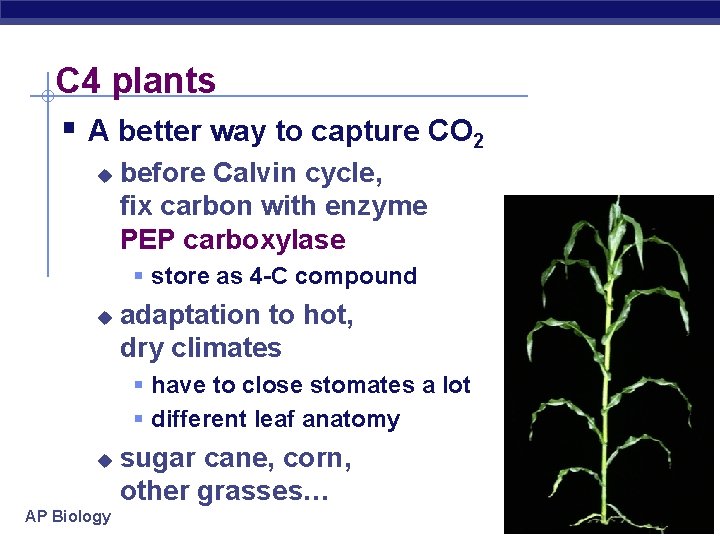
C 4 plants § A better way to capture CO 2 u before Calvin cycle, fix carbon with enzyme PEP carboxylase § store as 4 -C compound u adaptation to hot, dry climates § have to close stomates a lot § different leaf anatomy u AP Biology sugar cane, corn, other grasses…
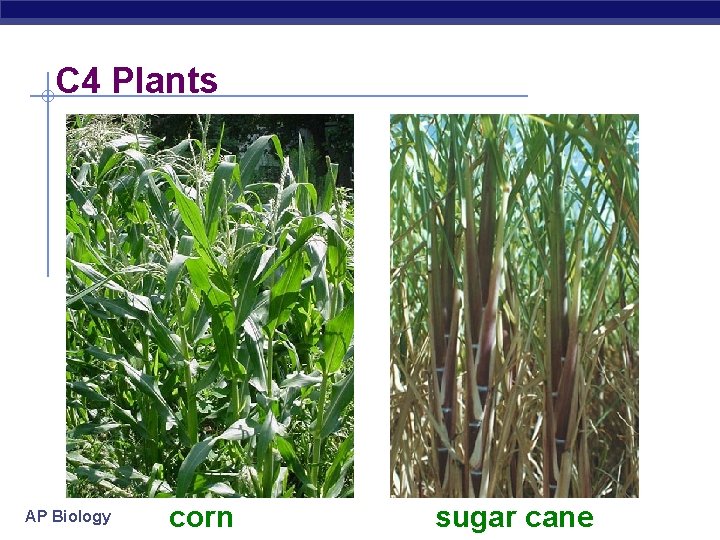
C 4 Plants AP Biology corn sugar cane
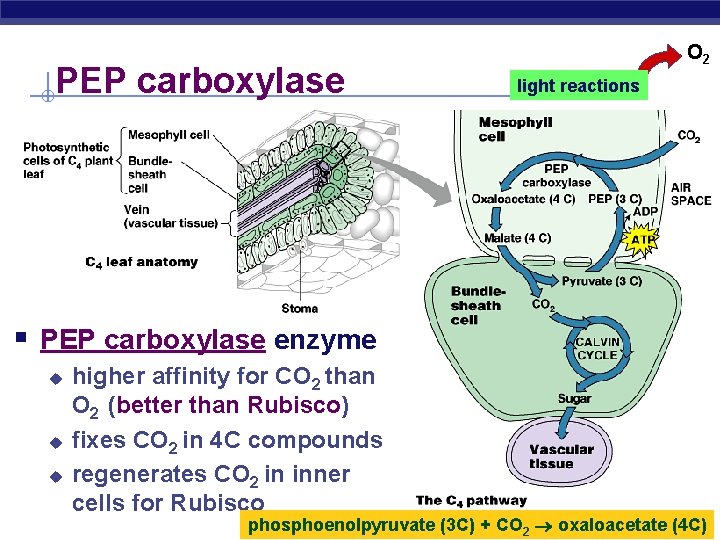
PEP carboxylase O 2 light reactions § PEP carboxylase enzyme higher affinity for CO 2 than O 2 (better than Rubisco) u fixes CO 2 in 4 C compounds u regenerates CO 2 in inner cells for Rubisco AP Biology u phosphoenolpyruvate (3 C) + CO 2 oxaloacetate (4 C)
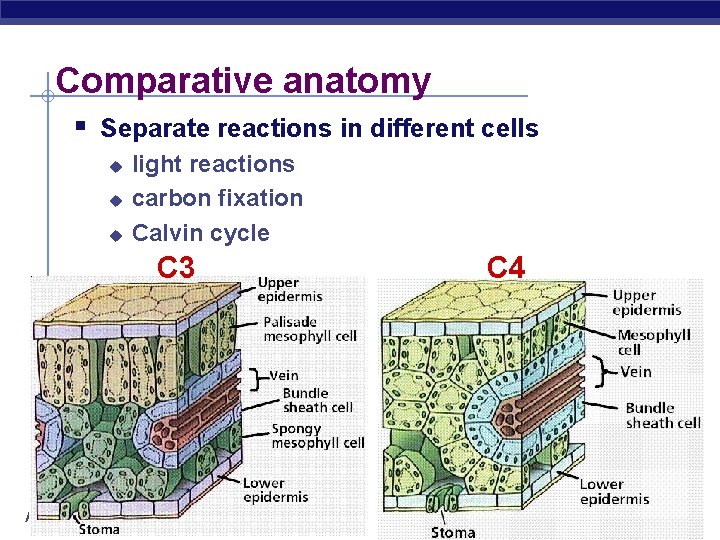
Comparative anatomy § Separate reactions in different cells u u u light reactions carbon fixation Calvin cycle C 3 AP Biology C 4
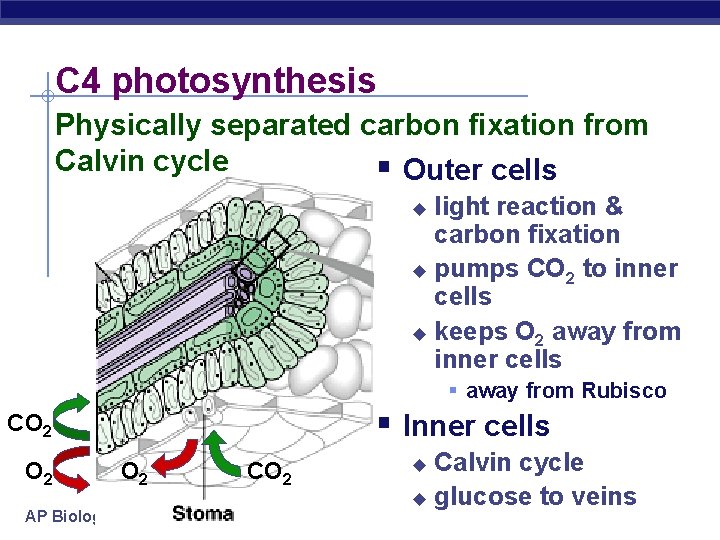
C 4 photosynthesis Physically separated carbon fixation from Calvin cycle § Outer cells light reaction & carbon fixation u pumps CO 2 to inner cells u keeps O 2 away from inner cells u § away from Rubisco § Inner cells CO 2 AP Biology O 2 Calvin cycle u glucose to veins u
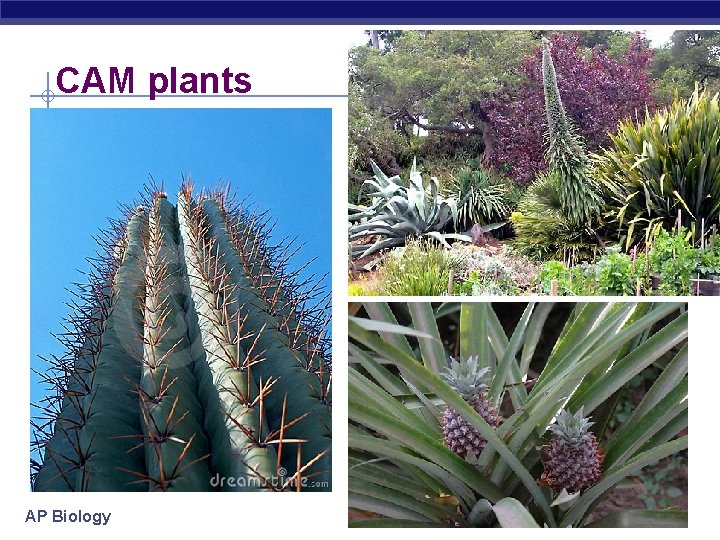
CAM (Crassulacean Acid Metabolism) plants § Different adaptation to hot, dry climates u succulents, some cacti, pineapple u separate carbon fixation from Calvin cycle by time § close stomates during day § open stomates during night u at night, open stomates & fix carbon in “storage” compounds § organic acids: malic acid, isocitric acid u AP Biology in day, close stomates & release CO 2 from “storage” compounds to Calvin cycle § increases concentration of CO 2 in cells
CAM plants AP Biology
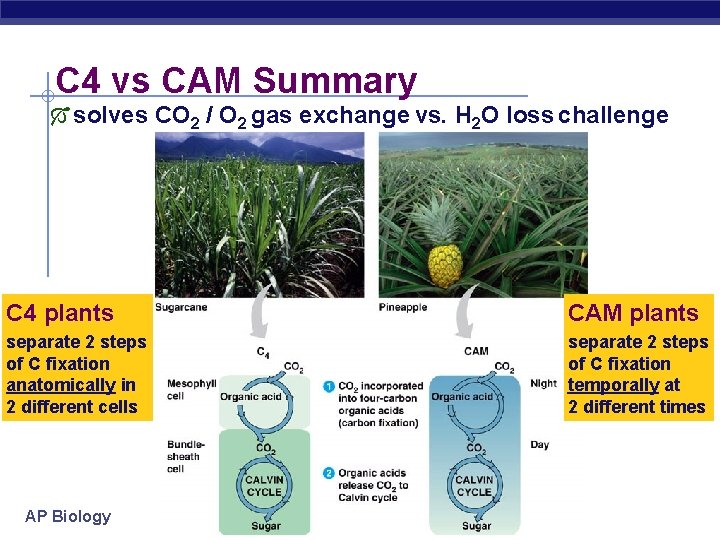
C 4 vs CAM Summary solves CO 2 / O 2 gas exchange vs. H 2 O loss challenge C 4 plants CAM plants separate 2 steps of C fixation anatomically in 2 different cells separate 2 steps of C fixation temporally at 2 different times AP Biology
Why the C 3 problem? § Possibly evolutionary baggage u Rubisco evolved in high CO 2 atmosphere § there wasn’t strong selection against active site of Rubisco accepting both CO 2 & O 2 § Today it makes a difference u u u AP Biology 21% O 2 vs. 0. 03% CO 2 photorespiration can drain away 50% of carbon fixed by Calvin cycle on a hot, dry day strong selection pressure to evolve better way to fix carbon & minimize photorespiration
Sunshine is good! Any Questions? ? AP Biology
- Slides: 60