
Chapter 10 Photosynthesis Energy needs of life All












- Slides: 30
Chapter 10 Photosynthesis
Energy needs of life All life needs a constant input of energy • Heterotrophs (Animals) get their energy from “eating others” organic molecules make energy through cellular respiration • Autotrophs (Plants) get their energy sunlight Build their own organic molecules (food) from CO 2 synthesize sugars through photosynthesis Then get energy from the sugars they made by performing cellular respiration.
How are they connected? Heterotrophs making energy & organic molecules from ingesting organic molecules glucose + oxygen carbon + water + energy dioxide C 6 H 12 O 6 + 6 O 2 6 CO 2 + 6 H 2 O + ATP exergonic Autotrophs making energy & organic molecules from light energy carbon + water + energy glucose + oxygen dioxide 6 CO 2 + 6 H 2 O +light energy endergonic C 6 H 12 O 6 + 6 O 2
Sites of Photosynthesis Mesophyll cells: chloroplasts mainly found in these cells of leaf stomata: pores in leaf (CO 2 enter/O 2 exits) chlorophyll: green pigment in thylakoid membranes of chloroplasts
Plant structure Chloroplasts • double membrane • stroma fluid-filled interior • thylakoid sacs • grana stacks Thylakoid membrane contains • chlorophyll molecules • electron transport chain • ATP synthase H+ gradient built up within thylakoid sac
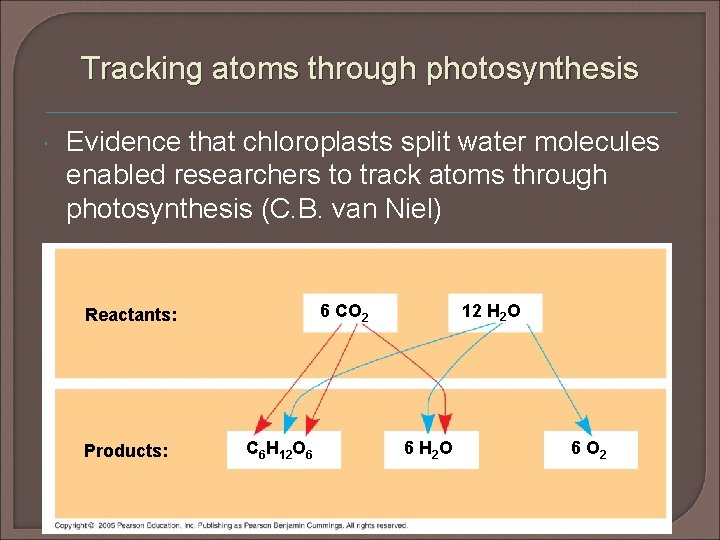
Tracking atoms through photosynthesis Evidence that chloroplasts split water molecules enabled researchers to track atoms through photosynthesis (C. B. van Niel) Products: 12 H 2 O 6 CO 2 Reactants: C 6 H 12 O 6 6 H 2 O 6 O 2
Photosynthesis = Light Reactions + Calvin Cycle “photo” “synthesis”
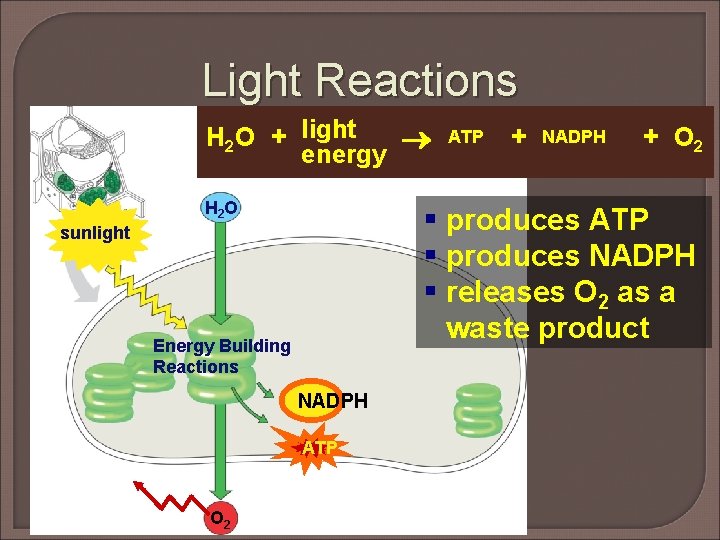
Light Reactions H 2 O + light energy H 2 O + NADPH + O 2 § produces ATP § produces NADPH § releases O 2 as a waste product sunlight Energy Building Reactions NADPH ATP O 2 ATP
Calvin Cycle CO 2 + ATP + NADPH C 6 H 12 O 6 CO 2 ADP NADP Sugar Building Reactions NADPH ATP sugars C 6 H 12 O 6 + ADP + NADP § builds sugars § uses ATP & NADPH § recycles ADP & NADP back to make more ATP & NADPH
Putting it all together light CO 2 + H 2 O + energy H 2 O CO 2 sunlight ADP NADP Sugar Energy Building Reactions NADPH ATP O 2 sugars C 6 H 12 O 6 + O 2 Plants make both: § Energy (ATP & NADPH) § sugars
Why do Calvin Cycle? Because light reaction only produces 1 ATP The glucose made from Calvin cycle goes to cells of plant for cellular respiration (yes, the plants do BOTH photosynthesis and cellular respiration) to produce lots of ATP!
Light Reactions
The light reactions convert solar energy to chemical energy of ATP and NADPH Nature of sunlight Light = energy = electromagnetic radiation Shorter wavelength (λ): higher E Visible light - detected by human eye Light: reflected, transmitted or absorbed
Photosynthetic pigments Pigments absorb different λ of light chlorophyll – absorb violet-blue/red light, **reflect green chlorophyll a (blue-green): light reaction, converts solar to chemical E Ø chlorophyll b (yellow-green): conveys E to chlorophyll a Ø carotenoids (yellow, orange): photoprotection, broaden color spectrum for photosynthesis Ø
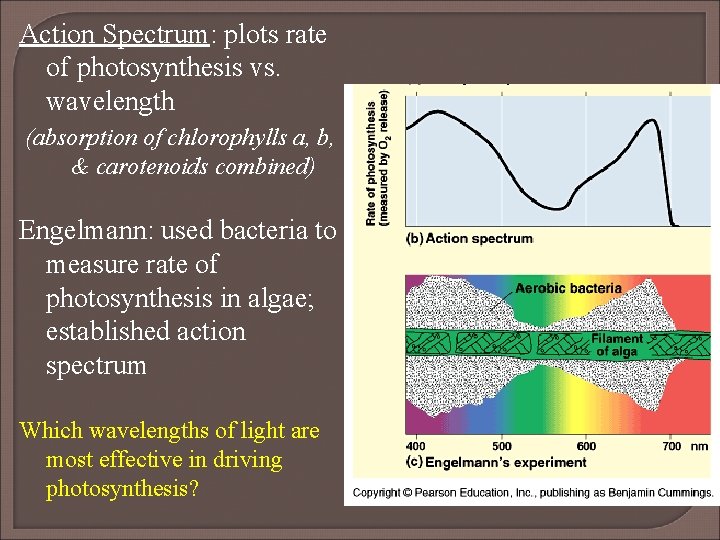
Action Spectrum: plots rate of photosynthesis vs. wavelength (absorption of chlorophylls a, b, & carotenoids combined) Engelmann: used bacteria to measure rate of photosynthesis in algae; established action spectrum Which wavelengths of light are most effective in driving photosynthesis?
Interaction of light with chloroplasts
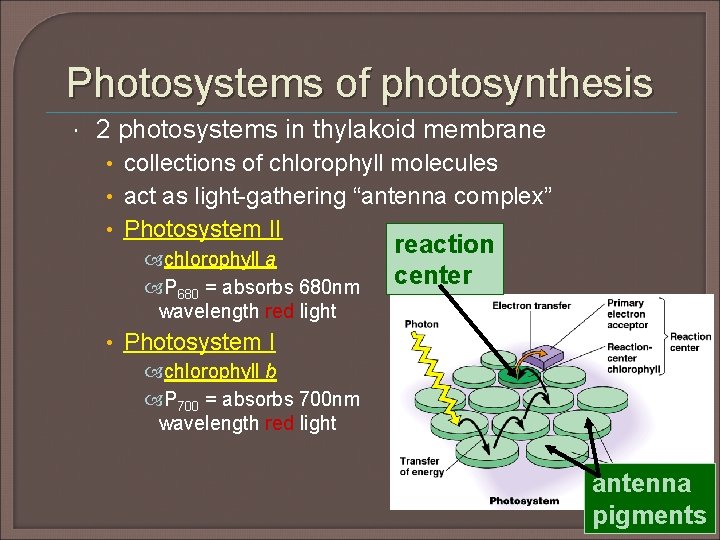
Photosystems of photosynthesis 2 photosystems in thylakoid membrane • collections of chlorophyll molecules • act as light-gathering “antenna complex” • Photosystem II chlorophyll a P 680 = absorbs 680 nm wavelength red light reaction center • Photosystem I chlorophyll b P 700 = absorbs 700 nm wavelength red light antenna pigments
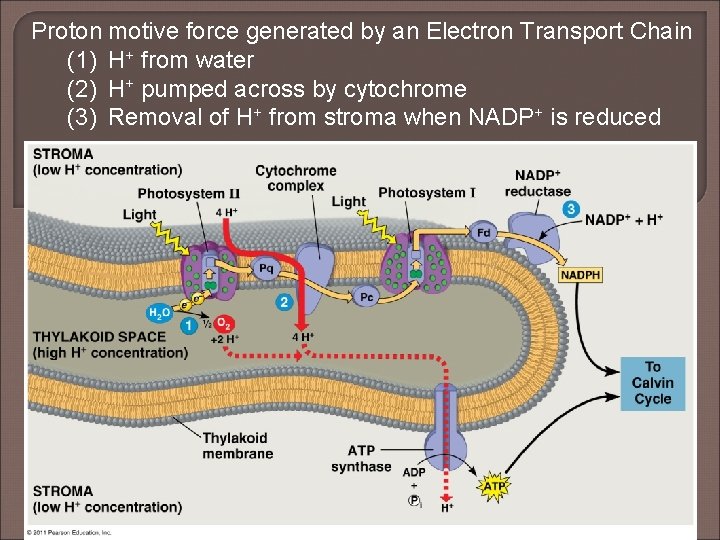
Proton motive force generated by an Electron Transport Chain (1) H+ from water (2) H+ pumped across by cytochrome (3) Removal of H+ from stroma when NADP+ is reduced
Calvin Cycle
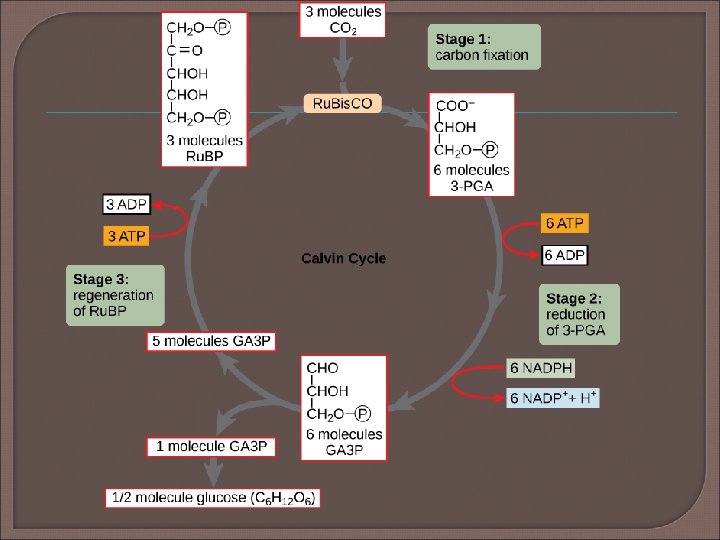
The Calvin cycle uses ATP and NADPH to convert CO 2 to sugar Uses ATP, NADPH, CO 2 Produces 3 -C sugar G 3 P (glyceraldehyde 3 -phosphate) Three phases: 1. Carbon fixation 2. Reduction 3. Regeneration of Ru. BP (CO 2 acceptor)
To G-3 -P and Beyond! Glyceraldehyde-3 -P • end product of Calvin cycle • energy rich 3 carbon sugar • “C 3 photosynthesis”…. . C 3 Plants G-3 -P = important intermediate G-3 -P glucose carbohydrates lipids amino acids nucleic acids
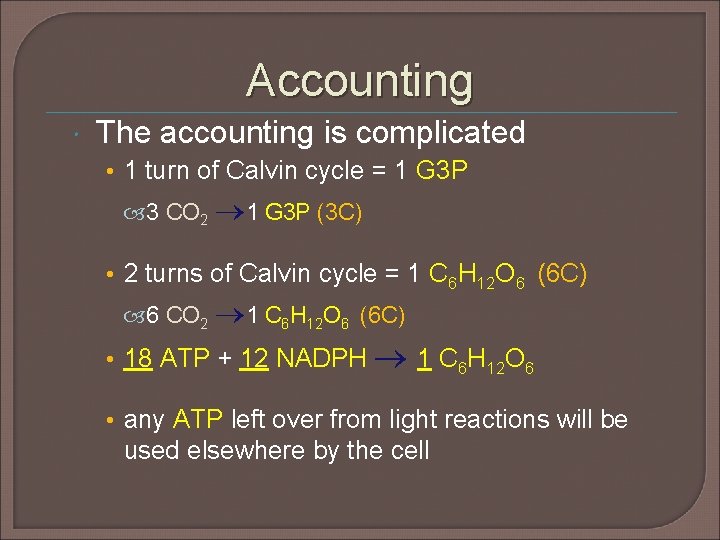
Accounting The accounting is complicated • 1 turn of Calvin cycle = 1 G 3 P 3 CO 2 1 G 3 P (3 C) • 2 turns of Calvin cycle = 1 C 6 H 12 O 6 (6 C) 6 CO 2 1 C 6 H 12 O 6 (6 C) • 18 ATP + 12 NADPH 1 C 6 H 12 O 6 • any ATP left over from light reactions will be used elsewhere by the cell
Evolutionary Adaptations On hot dry days when a plant is forced to close its stomata to prevent excess water loss, CO 2 levels inside the leaf become low. If the plant continues to attempt to fix CO 2 when its stomata are closed, the CO 2 will get used up and the O 2 ratio in the leaf will increase relative to CO 2 concentrations. Less sugar is made…. bad news for the plant. This is called Photorespiration. To prevent this process, two specialized biochemical additions have been evolved in the plant world: C 4 and CAM metabolism
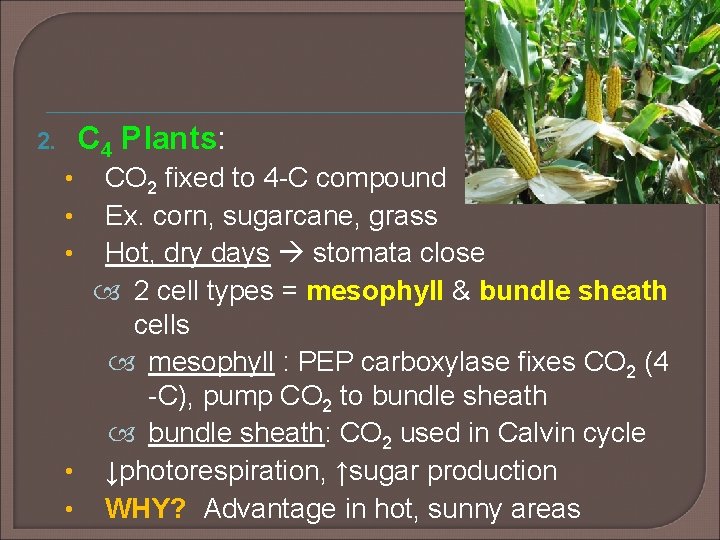
C 4 Plants: 2. CO 2 fixed to 4 -C compound Ex. corn, sugarcane, grass Hot, dry days stomata close 2 cell types = mesophyll & bundle sheath cells mesophyll : PEP carboxylase fixes CO 2 (4 -C), pump CO 2 to bundle sheath: CO 2 used in Calvin cycle • ↓photorespiration, ↑sugar production • WHY? Advantage in hot, sunny areas • • •
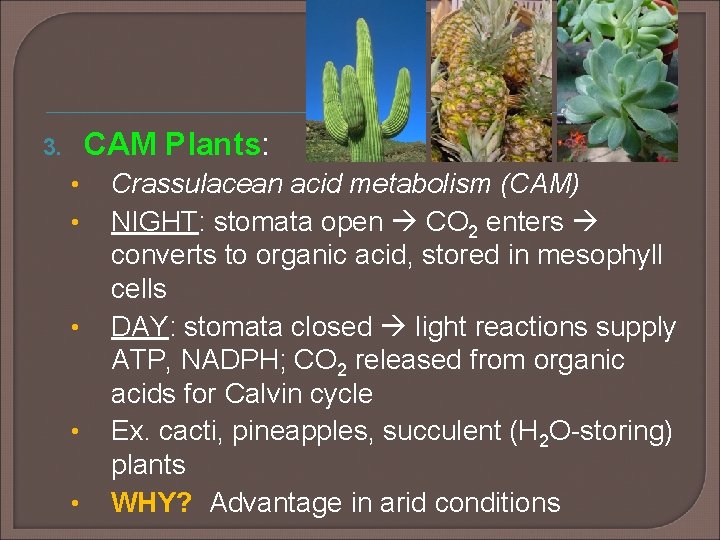
CAM Plants: 3. • • • Crassulacean acid metabolism (CAM) NIGHT: stomata open CO 2 enters converts to organic acid, stored in mesophyll cells DAY: stomata closed light reactions supply ATP, NADPH; CO 2 released from organic acids for Calvin cycle Ex. cacti, pineapples, succulent (H 2 O-storing) plants WHY? Advantage in arid conditions
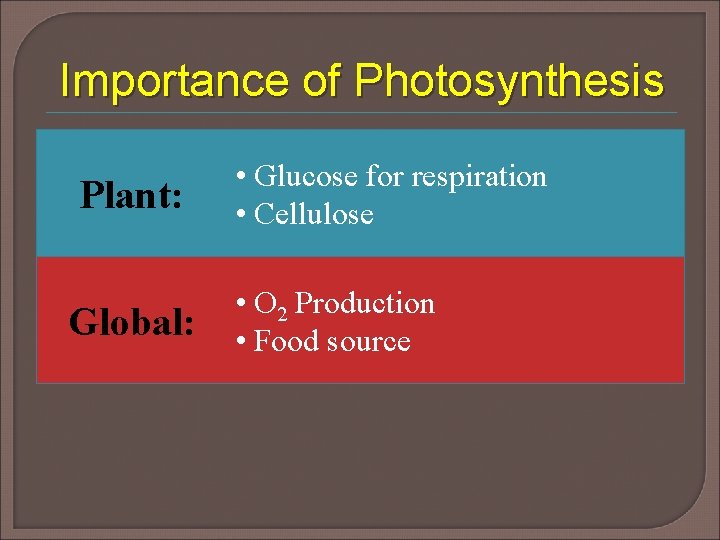
Importance of Photosynthesis Plant: Global: • Glucose for respiration • Cellulose • O 2 Production • Food source
Review of Photosynthesis and Cellular Respiration
Comparison RESPIRATION Plants + Animals Needs O 2 and food Produces CO 2, H 2 O and ATP, NADH Occurs in mitochondria membrane & matrix Oxidative phosphorylation Proton gradient across membrane PHOTOSYNTHESIS Plants Needs CO 2, H 2 O, sunlight Produces glucose, O 2 and ATP, NADPH Occurs in chloroplast thylakoid membrane & stroma Photorespiration Proton gradient across membrane