
Chapter 10 Photosynthesis 1 What is photosynthesis what
![Figure 10. 16 Comparison of chemiosmosis in mitochondria and chloroplasts Key Higher [H+] Lower](https://slidetodoc.com/presentation_image_h2/5f744305e45902ebd04117bdb0700a6c/image-27.jpg "Figure 10. 16 Comparison of chemiosmosis in mitochondria and chloroplasts Key Higher [H+] Lower")
- Slides: 39
Chapter 10: Photosynthesis 1. What is photosynthesis & what organisms do photosynthesis? - Photosynthesis – conversion of light energy to chemical energy - Photoautotrophs
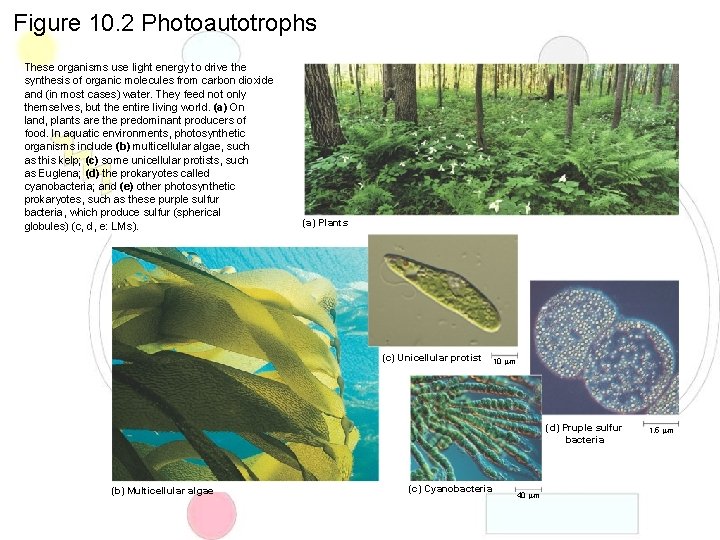
Figure 10. 2 Photoautotrophs These organisms use light energy to drive the synthesis of organic molecules from carbon dioxide and (in most cases) water. They feed not only themselves, but the entire living world. (a) On land, plants are the predominant producers of food. In aquatic environments, photosynthetic organisms include (b) multicellular algae, such as this kelp; (c) some unicellular protists, such as Euglena; (d) the prokaryotes called cyanobacteria; and (e) other photosynthetic prokaryotes, such as these purple sulfur bacteria, which produce sulfur (spherical globules) (c, d, e: LMs). (a) Plants (c) Unicellular protist 10 m (d) Pruple sulfur bacteria (b) Multicellular algae (c) Cyanobacteria 40 m 1. 5 m
Chapter 10: Photosynthesis 1. What is photosynthesis & what organisms do photosynthesis? - Photosynthesis – conversion of light energy to chemical energy - Photoautotrophs 2. Where does photosynthesis occur? - Chloroplasts
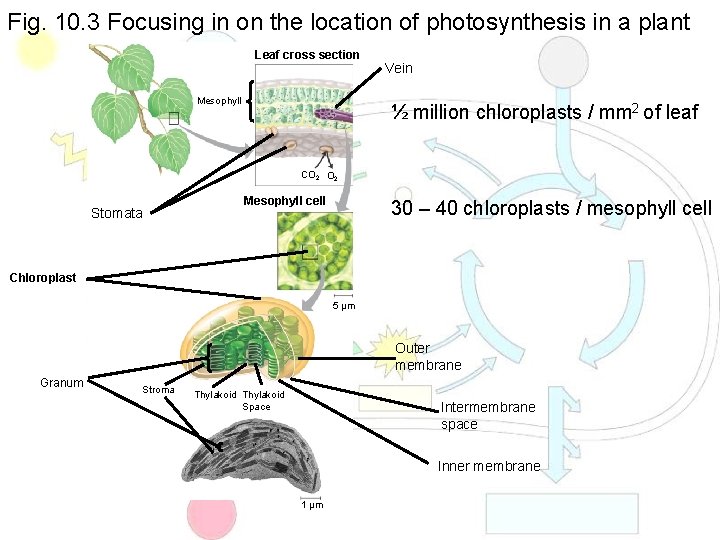
Fig. 10. 3 Focusing in on the location of photosynthesis in a plant Leaf cross section Mesophyll Vein ½ million chloroplasts / mm 2 of leaf CO 2 Stomata Mesophyll cell 30 – 40 chloroplasts / mesophyll cell Chloroplast 5 µm Outer membrane Granum Stroma Thylakoid Space Intermembrane space Inner membrane 1 µm
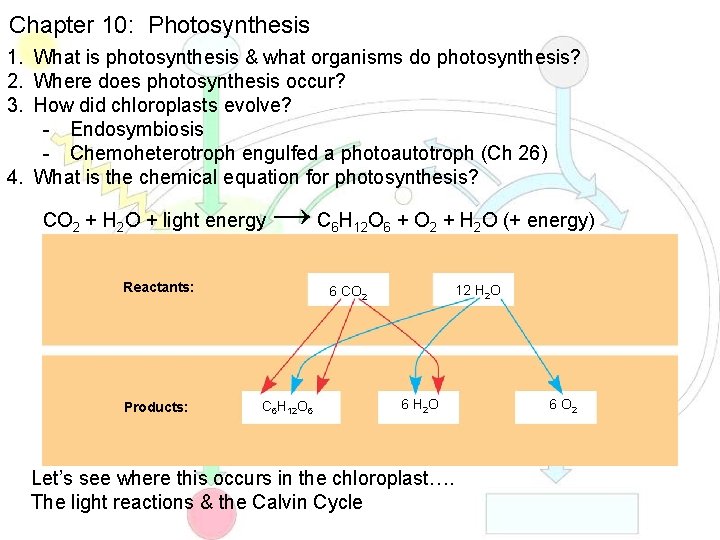
Chapter 10: Photosynthesis 1. What is photosynthesis & what organisms do photosynthesis? 2. Where does photosynthesis occur? 3. How did chloroplasts evolve? - Endosymbiosis - Chemoheterotroph engulfed a photoautotroph (Ch 26) 4. What is the chemical equation for photosynthesis? CO 2 + H 2 O + light energy →C H Reactants: Products: 6 12 O 6 + O 2 + H 2 O (+ energy) 12 H 2 O 6 CO 2 C 6 H 12 O 6 6 H 2 O Let’s see where this occurs in the chloroplast…. The light reactions & the Calvin Cycle 6 O 2
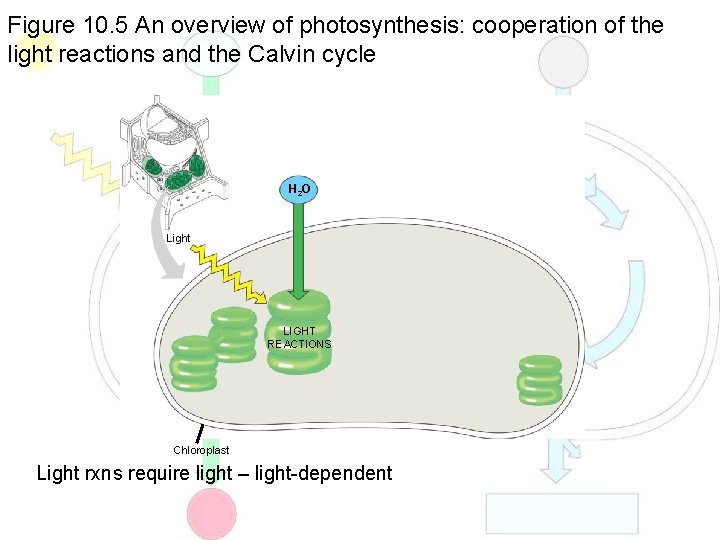
Figure 10. 5 An overview of photosynthesis: cooperation of the light reactions and the Calvin cycle H 2 O Light LIGHT REACTIONS Chloroplast Light rxns require light – light-dependent
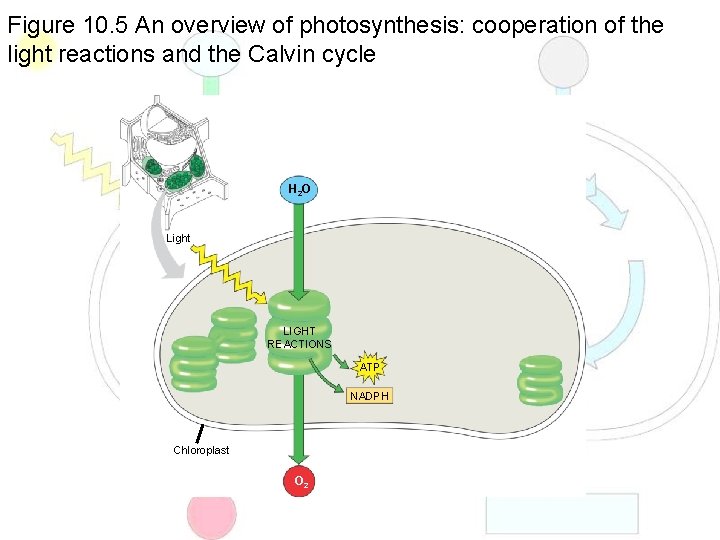
Figure 10. 5 An overview of photosynthesis: cooperation of the light reactions and the Calvin cycle H 2 O Light LIGHT REACTIONS ATP NADPH Chloroplast O 2
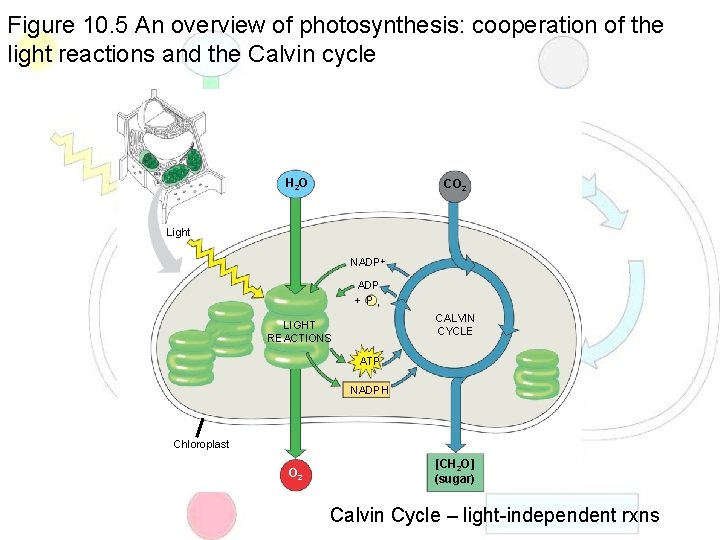
Figure 10. 5 An overview of photosynthesis: cooperation of the light reactions and the Calvin cycle H 2 O CO 2 Light NADP + Pi CALVIN CYCLE LIGHT REACTIONS ATP NADPH Chloroplast O 2 [CH 2 O] (sugar) Calvin Cycle – light-independent rxns
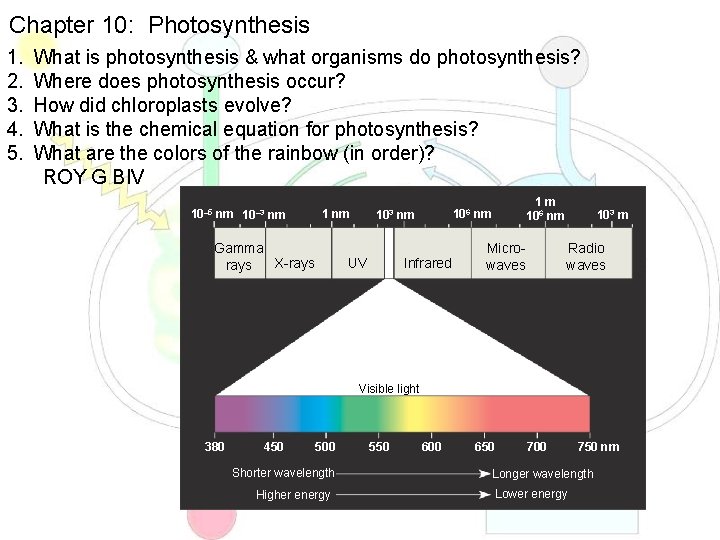
Chapter 10: Photosynthesis 1. 2. 3. 4. 5. What is photosynthesis & what organisms do photosynthesis? Where does photosynthesis occur? How did chloroplasts evolve? What is the chemical equation for photosynthesis? What are the colors of the rainbow (in order)? ROY G BIV 10– 5 nm 10– 3 nm 1 nm Gamma X-rays UV 1 m 106 nm 103 nm Infrared Microwaves 103 m Radio waves Visible light 380 450 500 Shorter wavelength Higher energy 550 600 650 700 750 nm Longer wavelength Lower energy
Chapter 10: Photosynthesis 1. 2. 3. 4. 5. 6. What is photosynthesis & what organisms do photosynthesis? Where does photosynthesis occur? How did chloroplasts evolve? What is the chemical equation for photosynthesis? What are the colors of the rainbow (in order)? What 3 things can happen to light when it “hits” an object?
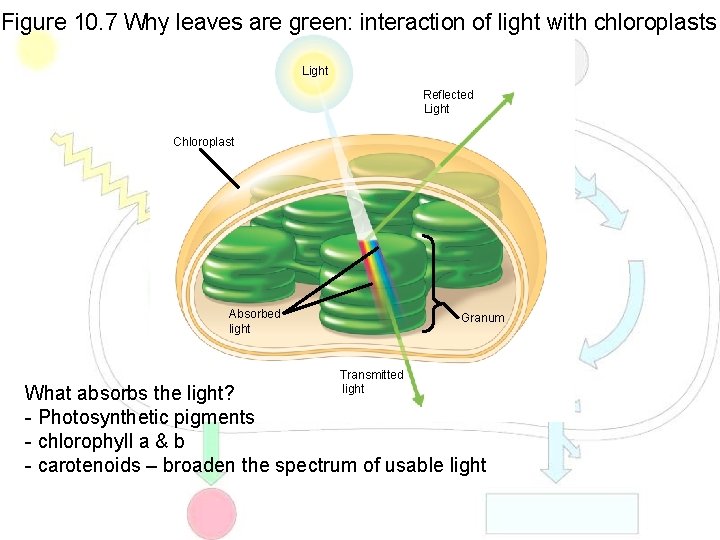
Figure 10. 7 Why leaves are green: interaction of light with chloroplasts Light Reflected Light Chloroplast Absorbed light Granum Transmitted light What absorbs the light? - Photosynthetic pigments - chlorophyll a & b - carotenoids – broaden the spectrum of usable light
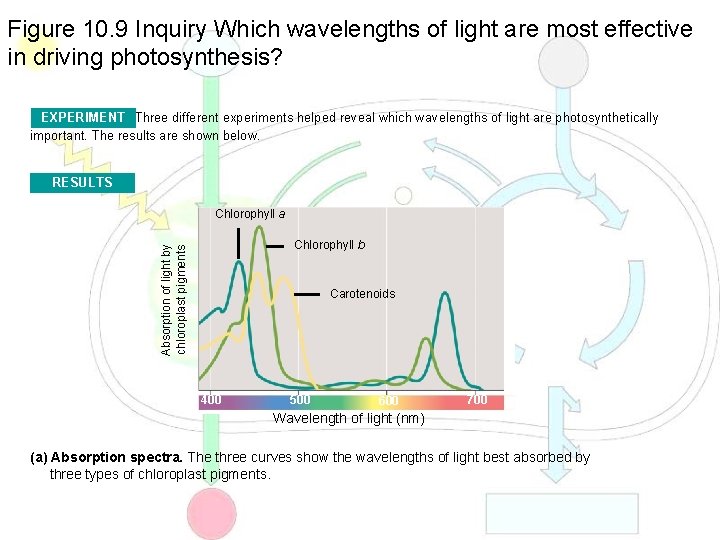
Figure 10. 9 Inquiry Which wavelengths of light are most effective in driving photosynthesis? EXPERIMENT Three different experiments helped reveal which wavelengths of light are photosynthetically important. The results are shown below. RESULTS Chlorophyll a Absorption of light by chloroplast pigments Chlorophyll b Carotenoids 400 500 600 700 Wavelength of light (nm) (a) Absorption spectra. The three curves show the wavelengths of light best absorbed by three types of chloroplast pigments.
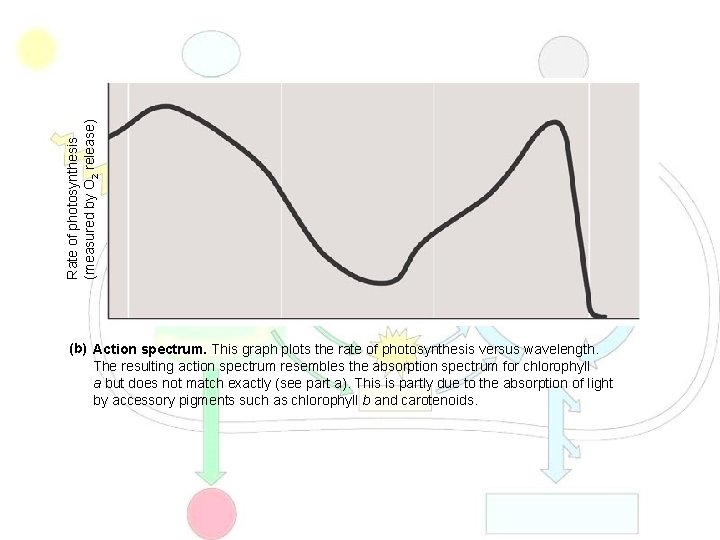
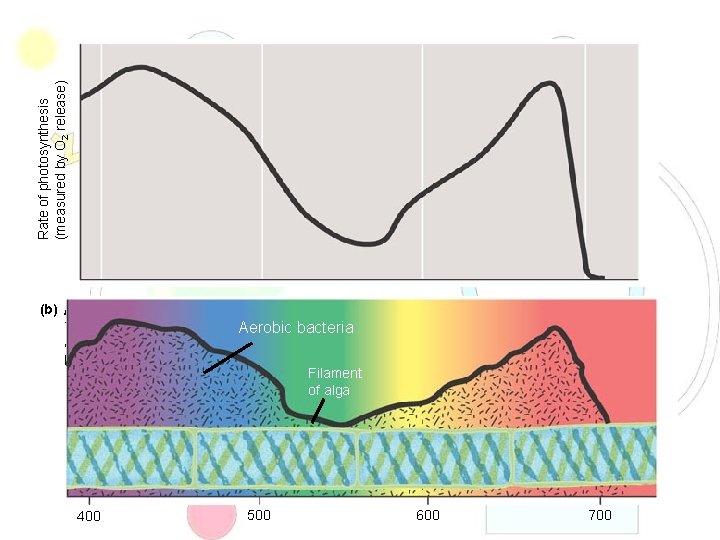
Rate of photosynthesis (measured by O 2 release) (b) Action spectrum. This graph plots the rate of photosynthesis versus wavelength. The resulting action spectrum resembles the absorption spectrum for chlorophyll a but does not match exactly (see part a). This is partly due to the absorption of light by accessory pigments such as chlorophyll b and carotenoids.
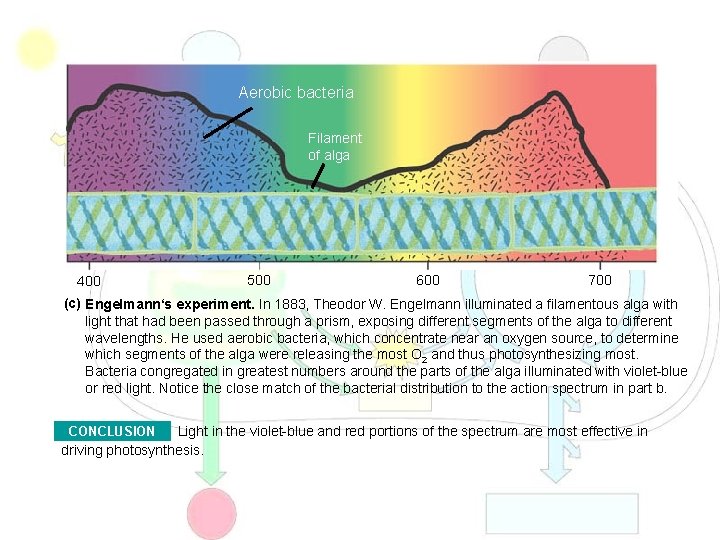
Aerobic bacteria Filament of alga 400 500 600 700 (c) Engelmann‘s experiment. In 1883, Theodor W. Engelmann illuminated a filamentous alga with light that had been passed through a prism, exposing different segments of the alga to different wavelengths. He used aerobic bacteria, which concentrate near an oxygen source, to determine which segments of the alga were releasing the most O 2 and thus photosynthesizing most. Bacteria congregated in greatest numbers around the parts of the alga illuminated with violet-blue or red light. Notice the close match of the bacterial distribution to the action spectrum in part b. Light in the violet-blue and red portions of the spectrum are most effective in driving photosynthesis. CONCLUSION
Rate of photosynthesis (measured by O 2 release) (b) Action spectrum. This graph plots the rate of photosynthesis versus wavelength. The resulting action spectrum resembles the absorption spectrum for chlorophyll Aerobic bacteria a but does not match exactly (see part a). This is partly due to the absorption of light by accessory pigments such as chlorophyll b and carotenoids. Filament of alga 400 500 600 700
Chapter 10: Photosynthesis 1. 2. 3. 4. 5. 6. 7. What is photosynthesis & what organisms do photosynthesis? Where does photosynthesis occur? How did chloroplasts evolve? What is the chemical equation for photosynthesis? What are the colors of the rainbow (in order)? What 3 things can happen to light when it “hits” an object? What is the structure of chlorophyll?
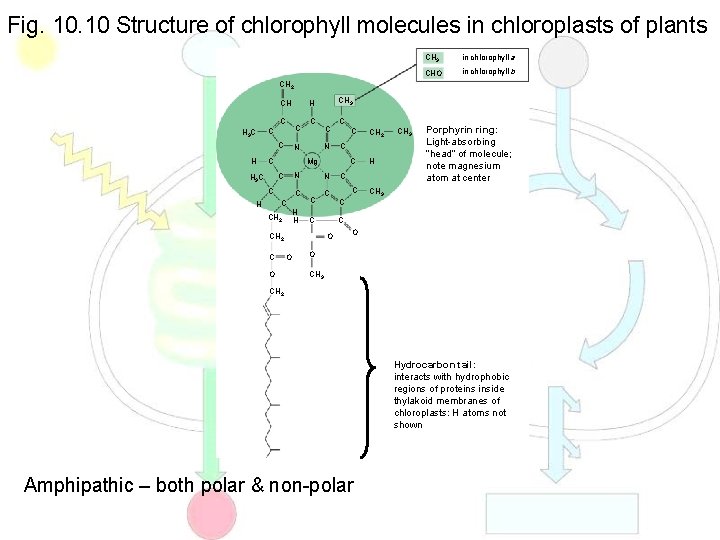
Fig. 10 Structure of chlorophyll molecules in chloroplasts of plants CH 3 in chlorophyll a CHO in chlorophyll b CH 2 CH C H 3 C C H C C N C C CH 2 H H N C C CH 2 C O C CH 2 C H C CH 3 Porphyrin ring: Light-absorbing “head” of molecule; note magnesium atom at center C C O O C C Mg C H C N C H 3 C CH 3 H O O CH 3 CH 2 Hydrocarbon tail: interacts with hydrophobic regions of proteins inside thylakoid membranes of chloroplasts: H atoms not shown Amphipathic – both polar & non-polar
Chapter 10: Photosynthesis 1. 2. 3. 4. 5. 6. 7. 8. What is photosynthesis & what organisms do photosynthesis? Where does photosynthesis occur? How did chloroplasts evolve? What is the chemical equation for photosynthesis? What are the colors of the rainbow (in order)? What 3 things can happen to light when it “hits” an object? What is the structure of chlorophyll? How do the photosystems harvest light energy?
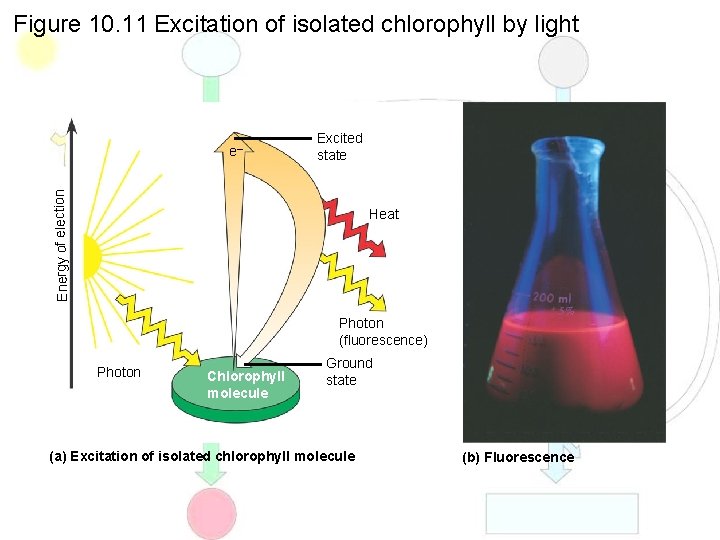
Figure 10. 11 Excitation of isolated chlorophyll by light Excited state Energy of election e– Heat Photon (fluorescence) Photon Chlorophyll molecule Ground state (a) Excitation of isolated chlorophyll molecule (b) Fluorescence
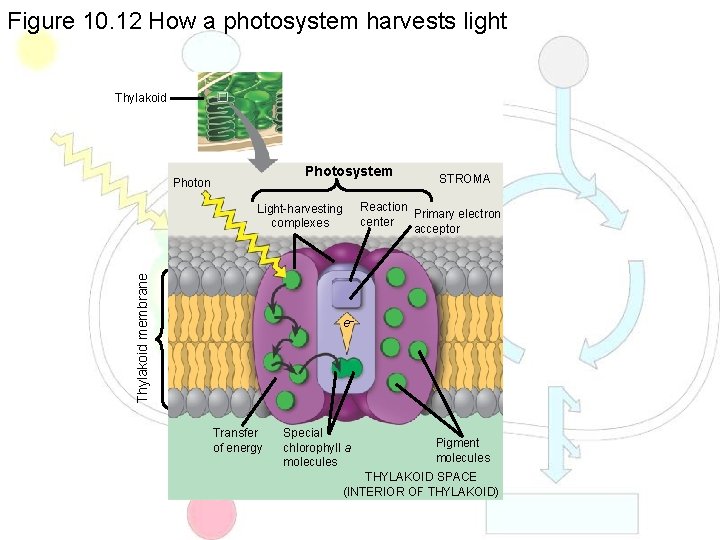
Figure 10. 12 How a photosystem harvests light Thylakoid Photosystem Photon Reaction Primary electron center acceptor Light-harvesting complexes Thylakoid membrane STROMA e– Transfer of energy Special chlorophyll a molecules Pigment molecules THYLAKOID SPACE (INTERIOR OF THYLAKOID)
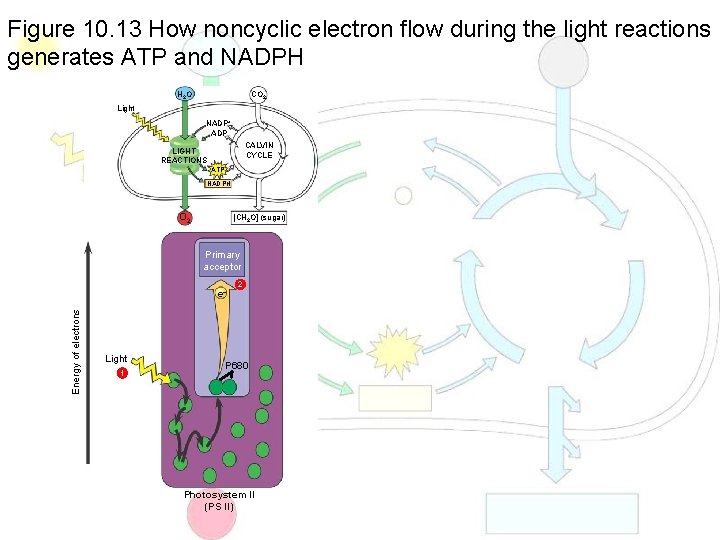
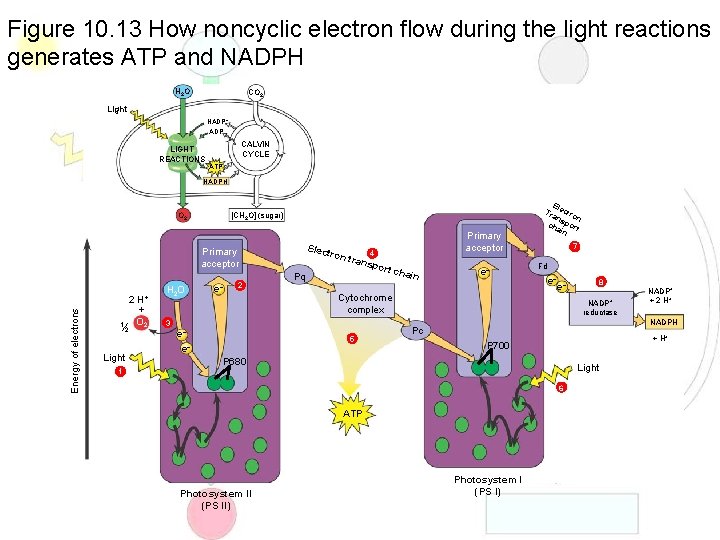
Figure 10. 13 How noncyclic electron flow during the light reactions generates ATP and NADPH H 2 O CO 2 Light NADP+ ADP CALVIN CYCLE LIGHT REACTIONS ATP NADPH O 2 [CH 2 O] (sugar) Primary acceptor Energy of electrons e Light 1 2 P 680 Photosystem II (PS II)
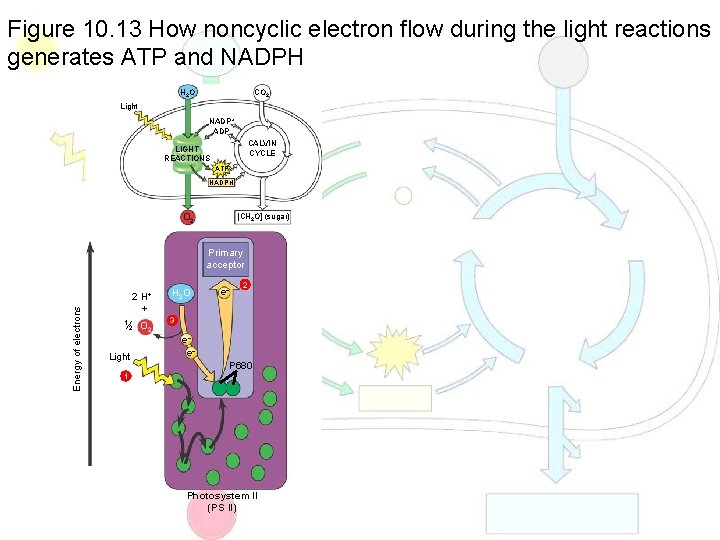
Figure 10. 13 How noncyclic electron flow during the light reactions generates ATP and NADPH H 2 O CO 2 Light NADP+ ADP CALVIN CYCLE LIGHT REACTIONS ATP NADPH O 2 [CH 2 O] (sugar) Primary acceptor Energy of electrons 2 H+ H 2 O e 2 + 1⁄ 2 Light O 2 3 e e P 680 1 Photosystem II (PS II)
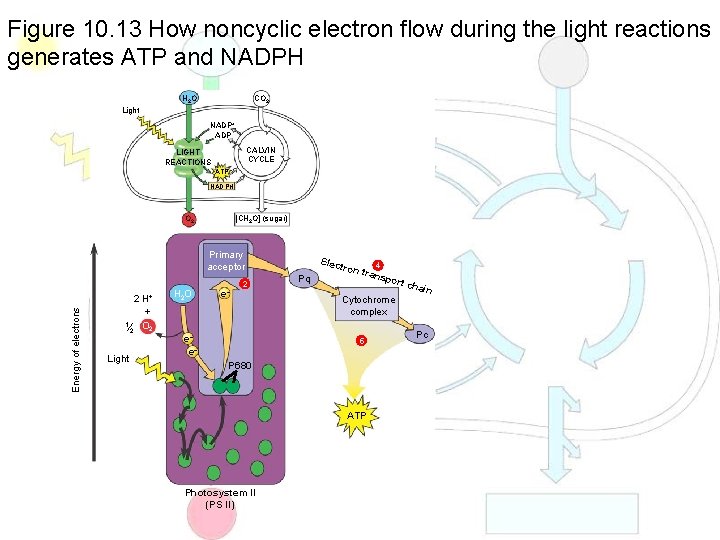
Figure 10. 13 How noncyclic electron flow during the light reactions generates ATP and NADPH H 2 O CO 2 Light NADP+ ADP CALVIN CYCLE LIGHT REACTIONS ATP NADPH O 2 [CH 2 O] (sugar) Primary acceptor Energy of electrons 2 1⁄ 2 Light 1 H+ + O 2 H 2 O e 2 Pq Elec tr on tr 4 ansp or t cha Cytochrome complex in 3 e e 5 P 680 ATP Photosystem II (PS II) Pc
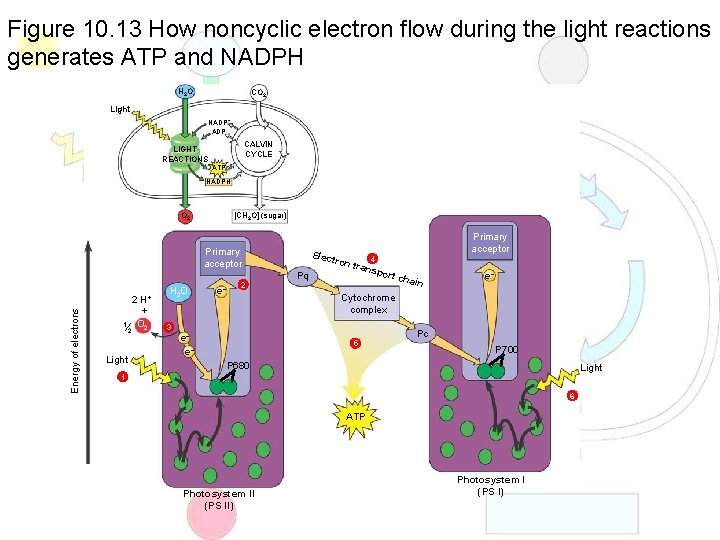
Figure 10. 13 How noncyclic electron flow during the light reactions generates ATP and NADPH H 2 O CO 2 Light NADP+ ADP LIGHT REACTIONS CALVIN CYCLE ATP NADPH [CH 2 O] (sugar) O 2 Energy of electrons Primary acceptor 2 H+ + 1⁄ O 2 2 Light H 2 O 3 e 2 Elec tr Pq Primary acceptor on tr 4 ansp or t cha in e Cytochrome complex e e 5 Pc P 700 P 680 Light 1 6 ATP Photosystem II (PS II) Photosystem I (PS I)
Figure 10. 13 How noncyclic electron flow during the light reactions generates ATP and NADPH H 2 O CO 2 Light NADP+ ADP LIGHT REACTIONS CALVIN CYCLE ATP NADPH [CH 2 O] (sugar) O 2 Elec tr Energy of electrons Primary acceptor 1⁄ 2 Light 2 H+ + O 2 H 2 O e 2 Pq on tr 4 ansp ort c hain e Cytochrome complex 3 e e Primary acceptor 5 El Tra ectro ns n ch port ain 7 Fd e 8 e NADP+ reductase NADPH Pc + H+ P 700 P 680 Light 1 1 6 ATP Photosystem II (PS II) NADP+ + 2 H+ Photosystem I (PS I) 6
Chapter 10: Photosynthesis 1. 2. 3. 4. 5. 6. 7. 8. 9. What is photosynthesis & what organisms do photosynthesis? Where does photosynthesis occur? How did chloroplasts evolve? What is the chemical equation for photosynthesis? What are the colors of the rainbow (in order)? What 3 things can happen to light when it “hits” an object? What is the structure of chlorophyll? How do the photosystems harvest light energy? What’s the difference re: chemiosmosis in mitochondria & chloroplasts?
Figure 10. 16 Comparison of chemiosmosis in mitochondria and chloroplasts Key Higher [H+] Lower [H+] Chloroplast Mitochondrion CHLOROPLAST STRUCTURE MITOCHONDRION STRUCTURE H+ Intermembrance space Membrance Diffusion Thylakoid space Electron transport chain ATP Synthase Matrix Stroma ADP+ P H+ ATP
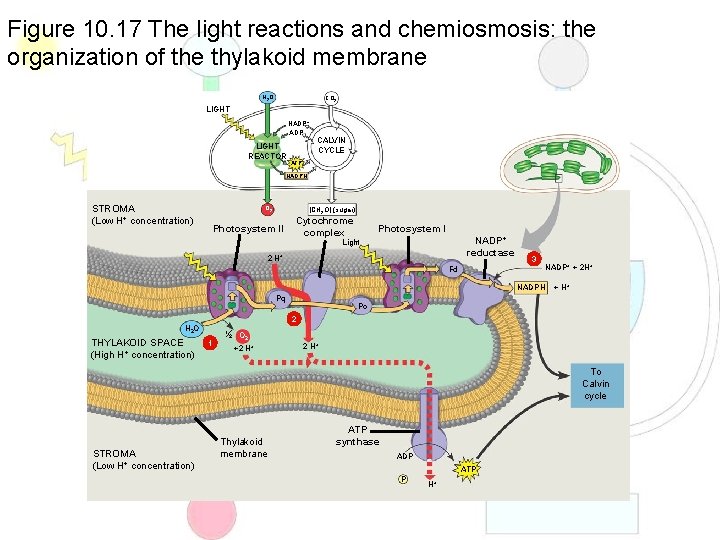
Figure 10. 17 The light reactions and chemiosmosis: the organization of the thylakoid membrane H 2 O CO 2 LIGHT NADP+ ADP LIGHT REACTOR CALVIN CYCLE ATP NADPH STROMA (Low H+ concentration) O 2 [CH 2 O] (sugar) Photosystem II Cytochrome complex Photosystem I NADP+ reductase Light 2 H+ Fd 3 NADP+ + 2 H+ NADPH Pq + H+ Pc 2 H 2 O THYLAKOID SPACE (High H+ concentration) 1⁄ 1 2 O 2 +2 H+ To Calvin cycle STROMA (Low H+ concentration) Thylakoid membrane ATP synthase ADP ATP P H+
Chapter 10: Photosynthesis 1. What is photosynthesis & what organisms do photosynthesis? 2. Where does photosynthesis occur? 3. How did chloroplasts evolve? 4. What is the chemical equation for photosynthesis? 5. What are the colors of the rainbow (in order)? 6. What 3 things can happen to light when it “hits” an object? 7. What is the structure of chlorophyll? 8. How do the photosystems harvest light energy? 9. What’s the difference chemiosmosis in mitochondria & chloroplasts? 10. How do plants make “sugar? ” - Calvin Cycle
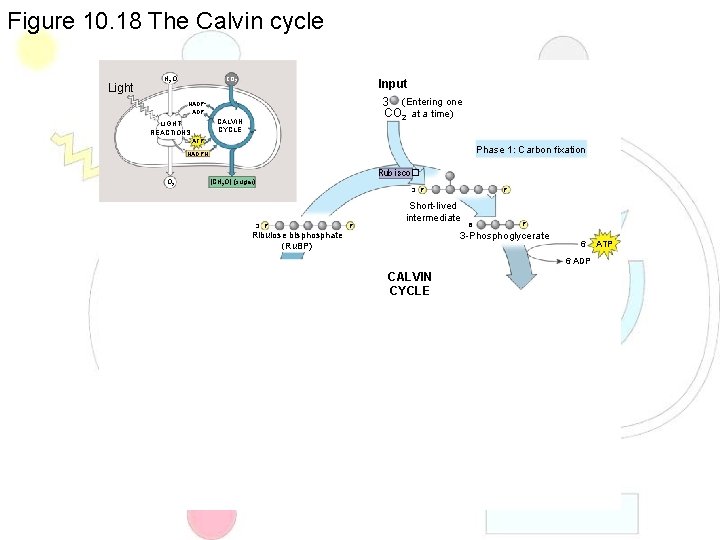
Figure 10. 18 The Calvin cycle Light H 2 O CO 2 Input 3 (Entering one CO 2 at a time) NADP+ ADP CALVIN CYCLE LIGHT REACTIONS ATP Phase 1: Carbon fixation NADPH O 2 Rubisco� [CH 2 O] (sugar) 3 P P P Short-lived intermediate Ribulose bisphosphate (Ru. BP) 6 P 3 -Phosphoglycerate 6 6 ADP CALVIN CYCLE ATP
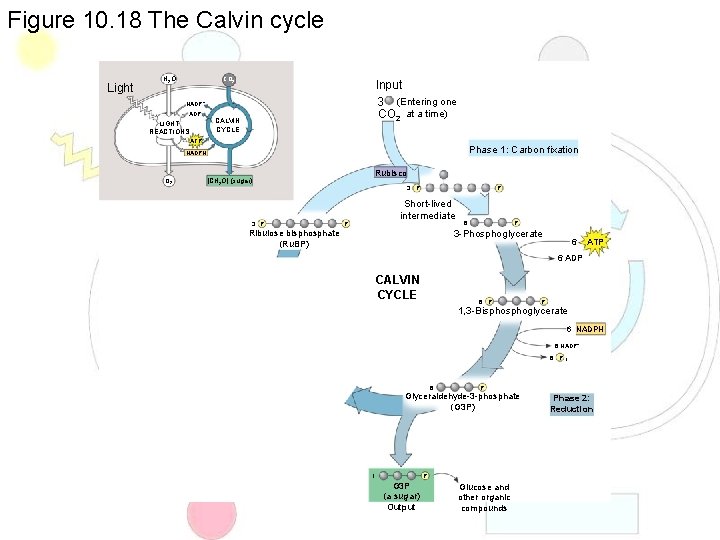
Figure 10. 18 The Calvin cycle Light H 2 O CO 2 Input 3 (Entering one CO 2 at a time) NADP+ ADP CALVIN CYCLE LIGHT REACTIONS ATP Phase 1: Carbon fixation NADPH O 2 Rubisco [CH 2 O] (sugar) 3 P P Short-lived intermediate P Ribulose bisphosphate (Ru. BP) P 6 3 -Phosphoglycerate 6 ATP 6 ADP CALVIN CYCLE 6 P P 1, 3 -Bisphoglycerate 6 NADPH 6 NADP+ 6 P Glyceraldehyde-3 -phosphate (G 3 P) P 1 G 3 P (a sugar) Output i Glucose and other organic compounds Phase 2: Reduction
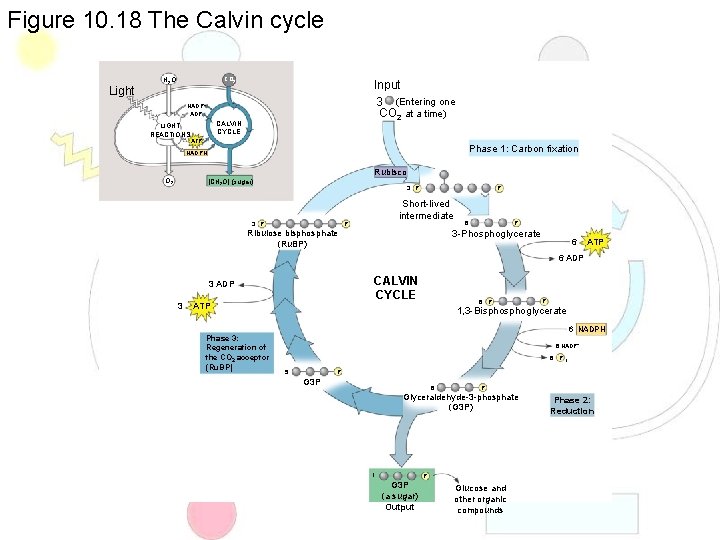
Figure 10. 18 The Calvin cycle Light H 2 O CO 2 Input 3 (Entering one CO 2 at a time) NADP+ ADP LIGHT REACTIONS CALVIN CYCLE ATP Phase 1: Carbon fixation NADPH Rubisco O 2 [CH 2 O] (sugar) 3 P P Short-lived intermediate P Ribulose bisphosphate (Ru. BP) P 6 3 -Phosphoglycerate 6 ATP 6 ADP CALVIN CYCLE 3 ADP 3 ATP Phase 3: Regeneration of the CO 2 acceptor (Ru. BP) 6 P P 1, 3 -Bisphoglycerate 6 NADPH 6 NADP+ 6 P 5 i P G 3 P 6 P Glyceraldehyde-3 -phosphate (G 3 P) 1 P G 3 P (a sugar) Output Glucose and other organic compounds Phase 2: Reduction
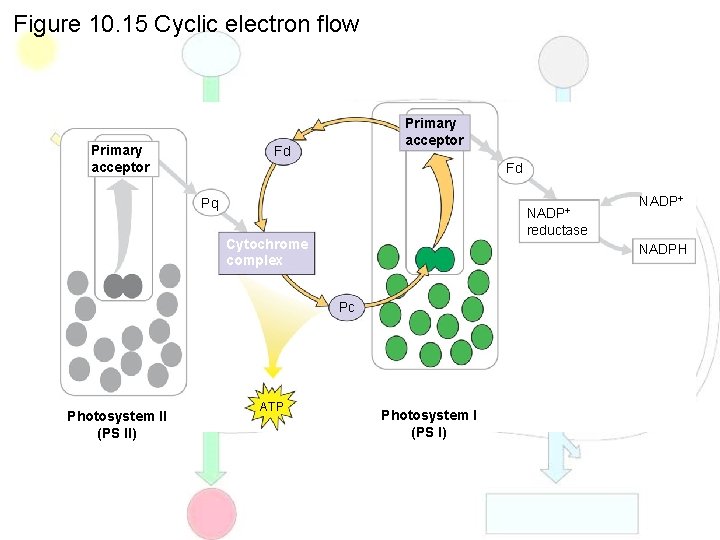
Chapter 10: Photosynthesis 1. What is photosynthesis & what organisms do photosynthesis? 2. Where does photosynthesis occur? 3. How did chloroplasts evolve? 4. What is the chemical equation for photosynthesis? 5. What are the colors of the rainbow (in order)? 6. What 3 things can happen to light when it “hits” an object? 7. What is the structure of chlorophyll? 8. How do the photosystems harvest light energy? 9. What’s the difference chemiosmosis in mitochondria & chloroplasts? 10. How do plants make “sugar? ” 11. How do plants get out of ATP debt? - Cyclic electron flow
Figure 10. 15 Cyclic electron flow Primary acceptor Fd Fd Pq NADP+ reductase Cytochrome complex NADPH Pc Photosystem II (PS II) ATP NADP+ Photosystem I (PS I)
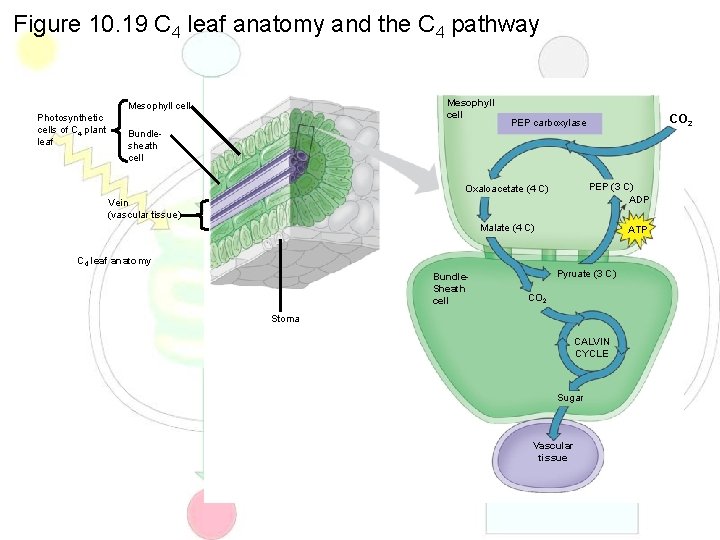
Chapter 10: Photosynthesis 1. What is photosynthesis & what organisms do photosynthesis? 2. Where does photosynthesis occur? 3. How did chloroplasts evolve? 4. What is the chemical equation for photosynthesis? 5. What are the colors of the rainbow (in order)? 6. What 3 things can happen to light when it “hits” an object? 7. What is the structure of chlorophyll? 8. How do the photosystems harvest light energy? 9. What’s the difference chemiosmosis in mitochondria & chloroplasts? 10. How do plants make “sugar? ” 11. How do plants get out of ATP debt? 12. What is the difference between C 3 & C 4 photosynthesis?
Figure 10. 19 C 4 leaf anatomy and the C 4 pathway Mesophyll cell Photosynthetic cells of C 4 plant leaf Bundlesheath cell CO CO 2 2 PEP carboxylase PEP (3 C) ADP Oxaloacetate (4 C) Vein (vascular tissue) Malate (4 C) ATP C 4 leaf anatomy Bundle. Sheath cell Pyruate (3 C) CO 2 Stoma CALVIN CYCLE Sugar Vascular tissue
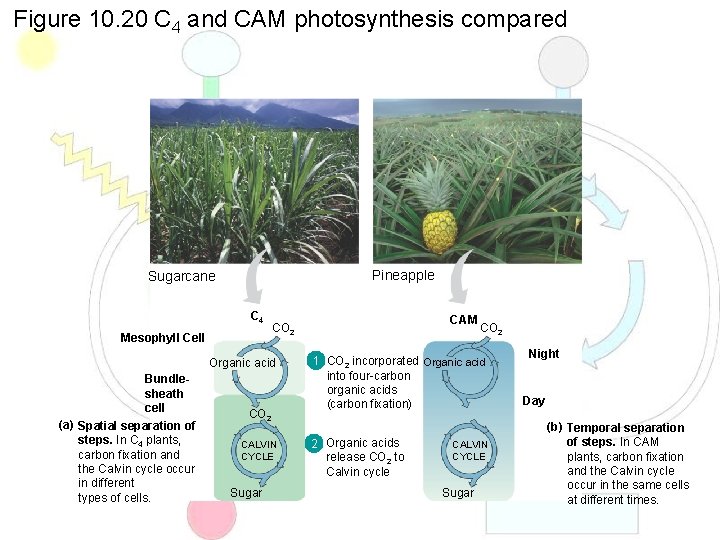
Chapter 10: Photosynthesis 1. What is photosynthesis & what organisms do photosynthesis? 2. Where does photosynthesis occur? 3. How did chloroplasts evolve? 4. What is the chemical equation for photosynthesis? 5. What are the colors of the rainbow (in order)? 6. What 3 things can happen to light when it “hits” an object? 7. What is the structure of chlorophyll? 8. How do the photosystems harvest light energy? 9. What’s the difference chemiosmosis in mitochondria & chloroplasts? 10. How do plants make “sugar? ” 11. How do plants get out of ATP debt? 12. What is the difference between C 3 & C 4 photosynthesis? 13. How do CAM plants differ from C 4 plants? -Crassulacean Acid Metabolism
Figure 10. 20 C 4 and CAM photosynthesis compared Pineapple Sugarcane C 4 Mesophyll Cell Organic acid Bundlesheath cell (a) Spatial separation of steps. In C 4 plants, carbon fixation and the Calvin cycle occur in different types of cells. CO 2 CALVIN CYCLE Sugar CAM CO 2 1 CO 2 incorporated Organic acid into four-carbon organic acids (carbon fixation) 2 Organic acids release CO 2 to Calvin cycle CALVIN CYCLE Sugar Night Day (b) Temporal separation of steps. In CAM plants, carbon fixation and the Calvin cycle occur in the same cells at different times.
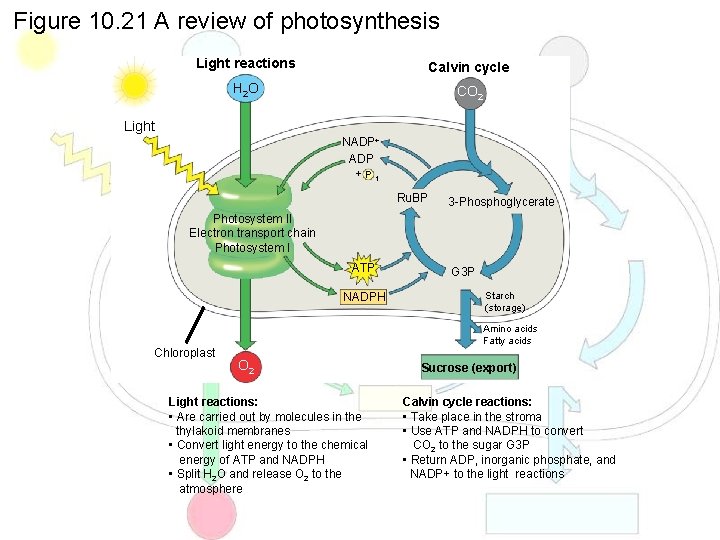
Figure 10. 21 A review of photosynthesis Light reactions Calvin cycle H 2 O CO 2 Light NADP+ ADP +P 1 Ru. BP 3 -Phosphoglycerate Photosystem II Electron transport chain Photosystem I ATP NADPH G 3 P Starch (storage) Amino acids Fatty acids Chloroplast O 2 Light reactions: • Are carried out by molecules in the thylakoid membranes • Convert light energy to the chemical energy of ATP and NADPH • Split H 2 O and release O 2 to the atmosphere Sucrose (export) Calvin cycle reactions: • Take place in the stroma • Use ATP and NADPH to convert CO 2 to the sugar G 3 P • Return ADP, inorganic phosphate, and NADP+ to the light reactions