
Chapter 10 Part A Distribution and Network Models
Chapter 10, Part A Distribution and Network Models n n Supply Chain Models • Transportation Problem • Transshipment Problem Assignment Problem
Transportation, Transshipment, and Assignment Problems n n A network model is one which can be represented by a set of nodes, a set of arcs, and functions (e. g. costs, supplies, demands, etc. ) associated with the arcs and/or nodes. Transportation, transshipment, assignment, shortest -route, and maximal flow problems of this chapter as well as the PERT/CPM problems (in Chapter 13) are all examples of network problems.
Transportation, Transshipment, and Assignment Problems n n n Each of the problems of this chapter can be formulated as linear programs and solved by general purpose linear programming codes. For each of the problems, if the right-hand side of the linear programming formulations are all integers, the optimal solution will be in terms of integer values for the decision variables. However, there are many computer packages that contain separate computer codes for these problems which take advantage of their network structure.
Supply Chain Models n n n A supply chain describes the set of all interconnected resources involved in producing and distributing a product. In general, supply chains are designed to satisfy customer demand for a product at minimum cost. Those that control the supply chain must make decisions such as where to produce a product, how much should be produced, and where it should be sent.
Transportation Problem n n The transportation problem seeks to minimize the total shipping costs of transporting goods from m origins (each with a supply si) to n destinations (each with a demand dj), when the unit shipping cost from an origin, i, to a destination, j, is cij. The network representation for a transportation problem with two sources and three destinations is given on the next slide.
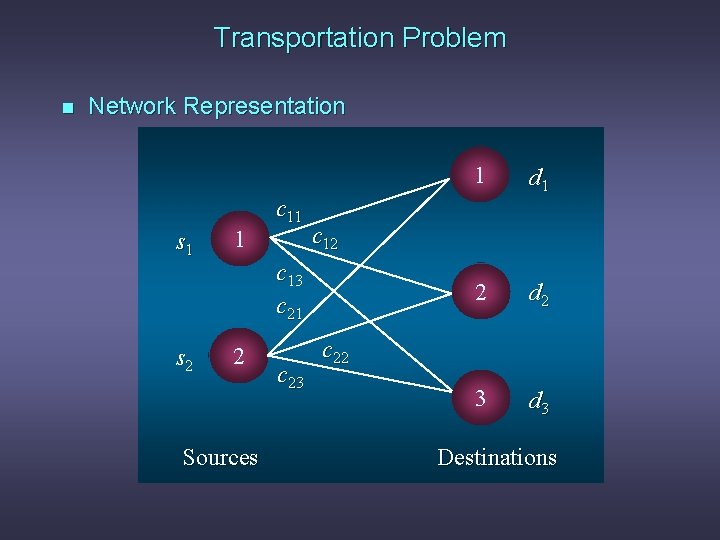
Transportation Problem n Network Representation s 1 s 2 1 c 11 Sources c 23 d 1 2 d 2 3 d 3 c 12 c 13 c 21 2 1 c 22 Destinations
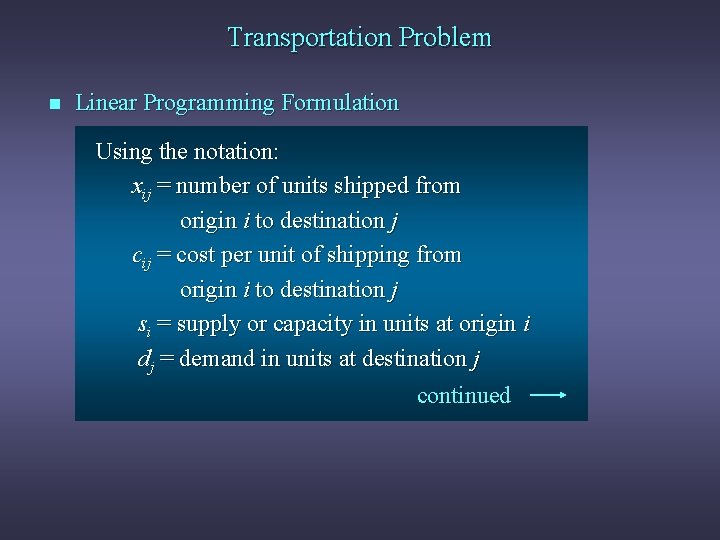
Transportation Problem n Linear Programming Formulation Using the notation: xij = number of units shipped from origin i to destination j cij = cost per unit of shipping from origin i to destination j si = supply or capacity in units at origin i dj = demand in units at destination j continued
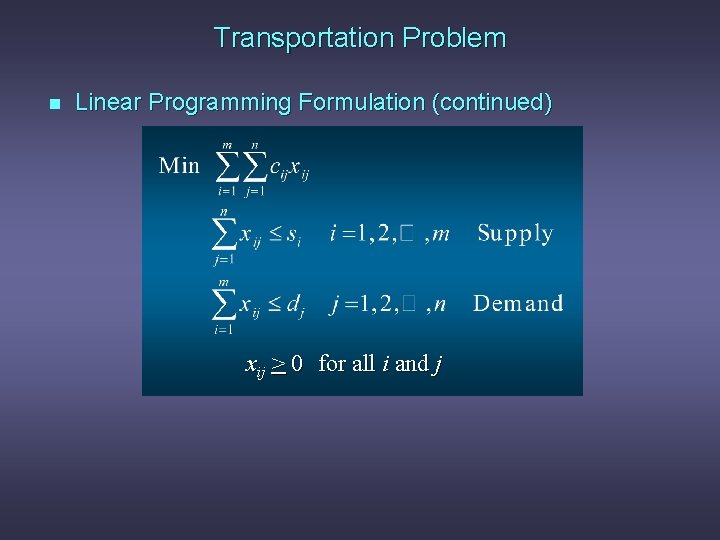
Transportation Problem n Linear Programming Formulation (continued) xij > 0 for all i and j
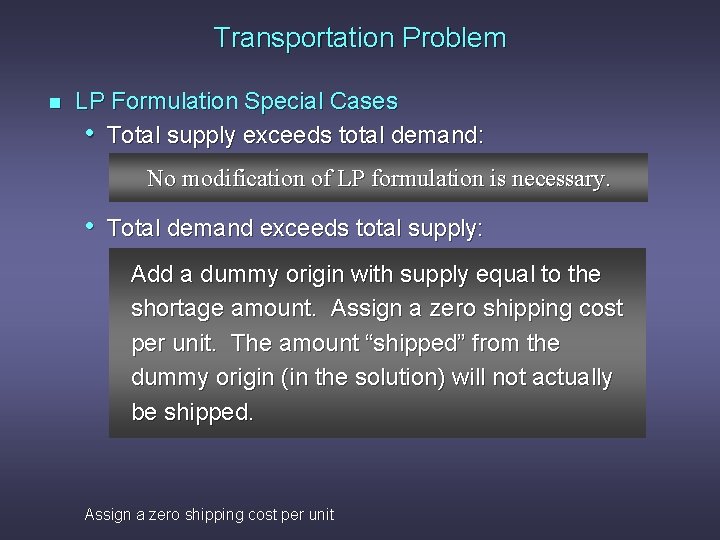
Transportation Problem n LP Formulation Special Cases • Total supply exceeds total demand: No modification of LP formulation is necessary. • Total demand exceeds total supply: Add a dummy origin with supply equal to the shortage amount. Assign a zero shipping cost per unit. The amount “shipped” from the dummy origin (in the solution) will not actually be shipped. Assign a zero shipping cost per unit
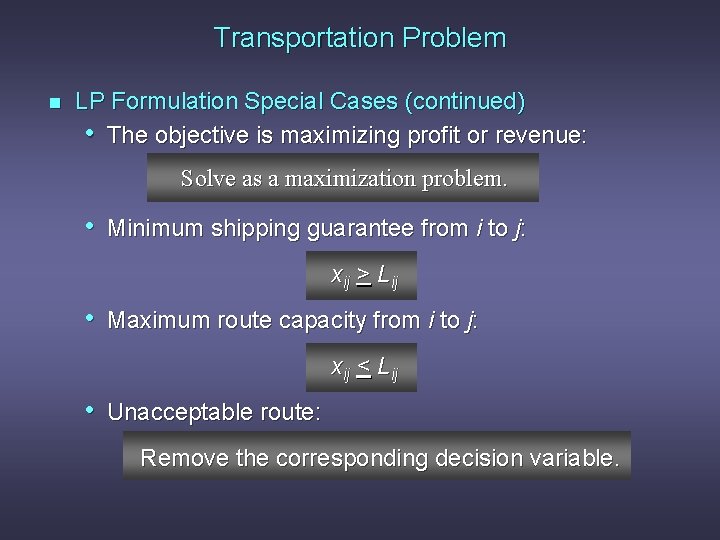
Transportation Problem n LP Formulation Special Cases (continued) • The objective is maximizing profit or revenue: Solve as a maximization problem. • Minimum shipping guarantee from i to j: xij > Lij • Maximum route capacity from i to j: xij < Lij • Unacceptable route: Remove the corresponding decision variable.
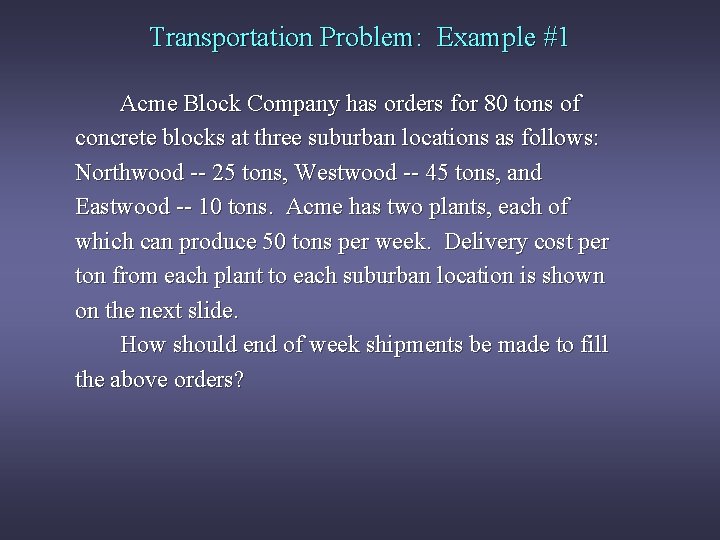
Transportation Problem: Example #1 Acme Block Company has orders for 80 tons of concrete blocks at three suburban locations as follows: Northwood -- 25 tons, Westwood -- 45 tons, and Eastwood -- 10 tons. Acme has two plants, each of which can produce 50 tons per week. Delivery cost per ton from each plant to each suburban location is shown on the next slide. How should end of week shipments be made to fill the above orders?
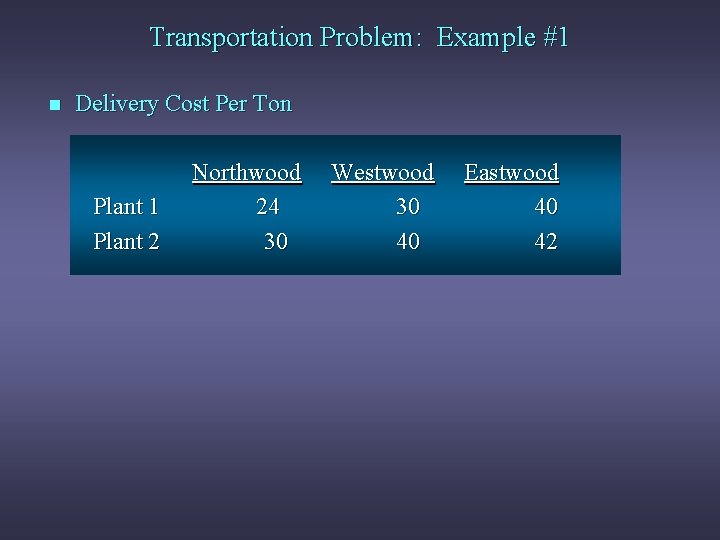
Transportation Problem: Example #1 n Delivery Cost Per Ton Plant 1 Plant 2 Northwood 24 30 Westwood 30 40 Eastwood 40 42
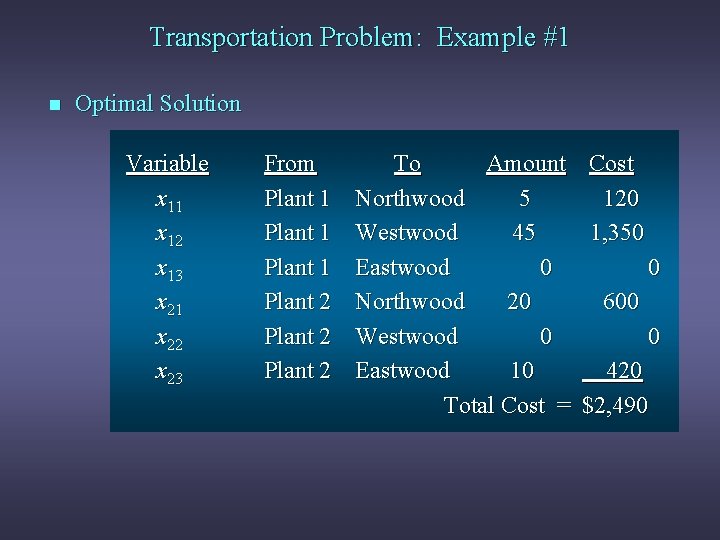
Transportation Problem: Example #1 n Optimal Solution Variable x 11 x 12 x 13 x 21 x 22 x 23 From Plant 1 Plant 2 To Amount Northwood 5 Westwood 45 Eastwood 0 Northwood 20 Westwood 0 Eastwood 10 Total Cost = Cost 120 1, 350 0 600 0 420 $2, 490
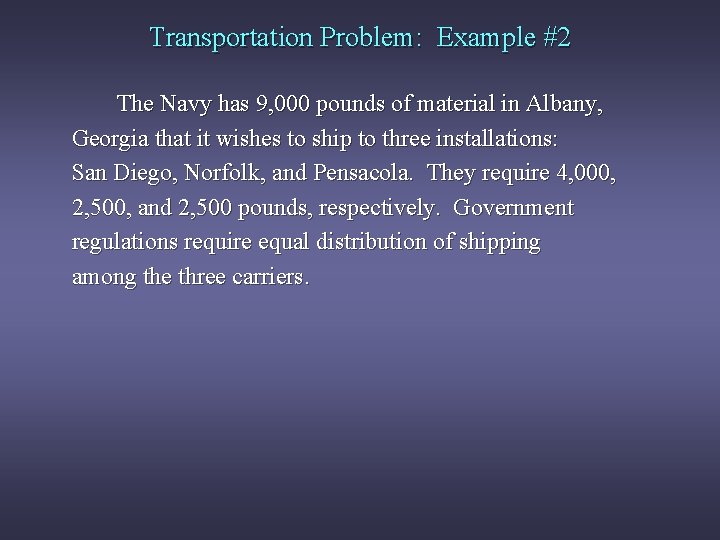
Transportation Problem: Example #2 The Navy has 9, 000 pounds of material in Albany, Georgia that it wishes to ship to three installations: San Diego, Norfolk, and Pensacola. They require 4, 000, 2, 500, and 2, 500 pounds, respectively. Government regulations require equal distribution of shipping among the three carriers.
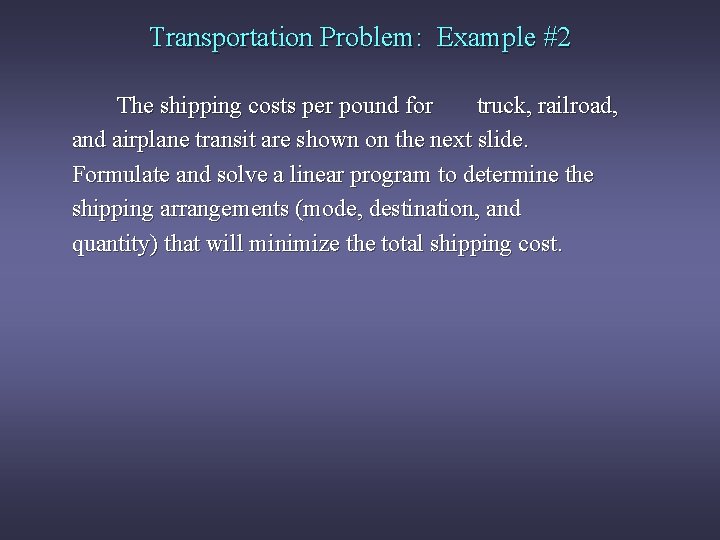
Transportation Problem: Example #2 The shipping costs per pound for truck, railroad, and airplane transit are shown on the next slide. Formulate and solve a linear program to determine the shipping arrangements (mode, destination, and quantity) that will minimize the total shipping cost.
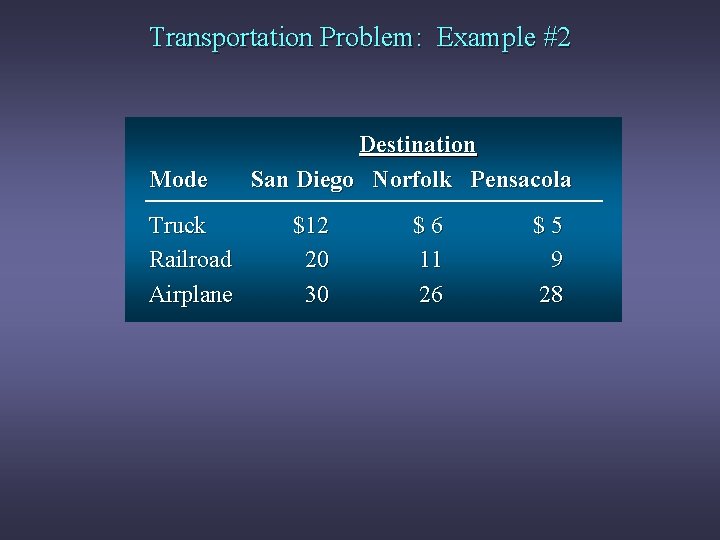
Transportation Problem: Example #2 Mode Truck Railroad Airplane Destination San Diego Norfolk Pensacola $12 20 30 $6 11 26 $5 9 28
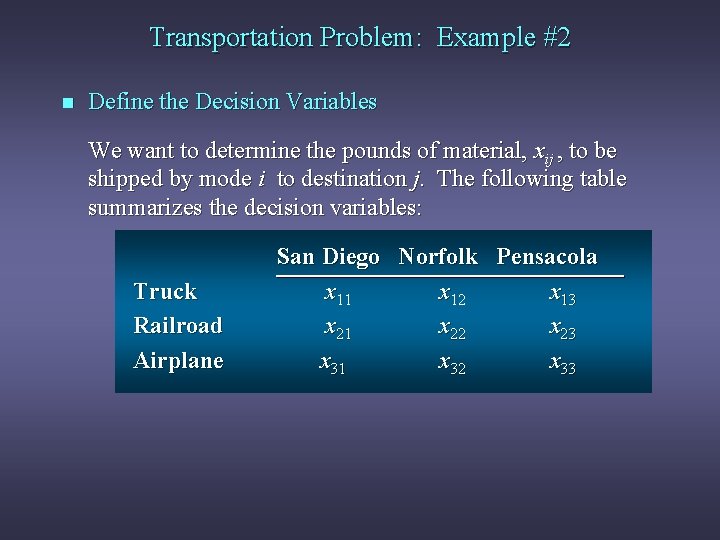
Transportation Problem: Example #2 n Define the Decision Variables We want to determine the pounds of material, xij , to be shipped by mode i to destination j. The following table summarizes the decision variables: Truck Railroad Airplane San Diego Norfolk Pensacola x 11 x 12 x 13 x 21 x 22 x 23 x 31 x 32 x 33
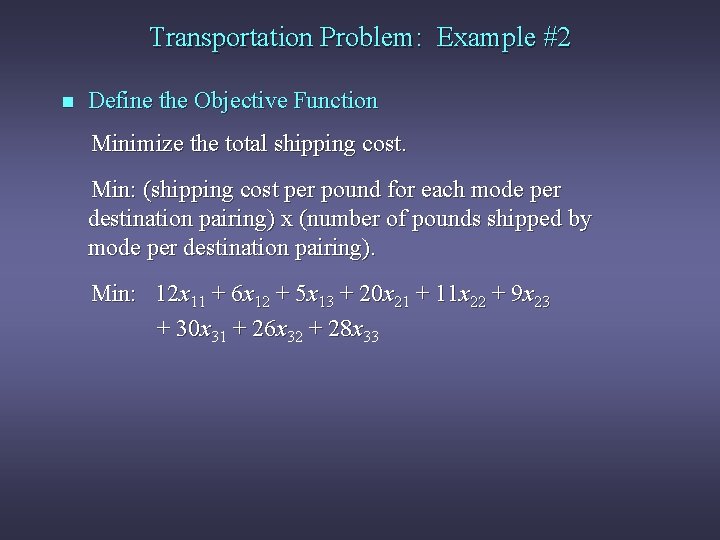
Transportation Problem: Example #2 n Define the Objective Function Minimize the total shipping cost. Min: (shipping cost per pound for each mode per destination pairing) x (number of pounds shipped by mode per destination pairing). Min: 12 x 11 + 6 x 12 + 5 x 13 + 20 x 21 + 11 x 22 + 9 x 23 + 30 x 31 + 26 x 32 + 28 x 33
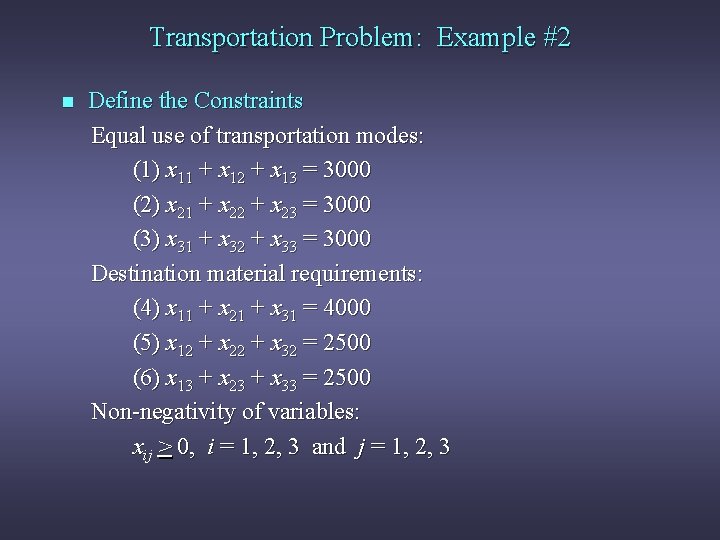
Transportation Problem: Example #2 n Define the Constraints Equal use of transportation modes: (1) x 11 + x 12 + x 13 = 3000 (2) x 21 + x 22 + x 23 = 3000 (3) x 31 + x 32 + x 33 = 3000 Destination material requirements: (4) x 11 + x 21 + x 31 = 4000 (5) x 12 + x 22 + x 32 = 2500 (6) x 13 + x 23 + x 33 = 2500 Non-negativity of variables: xij > 0, i = 1, 2, 3 and j = 1, 2, 3
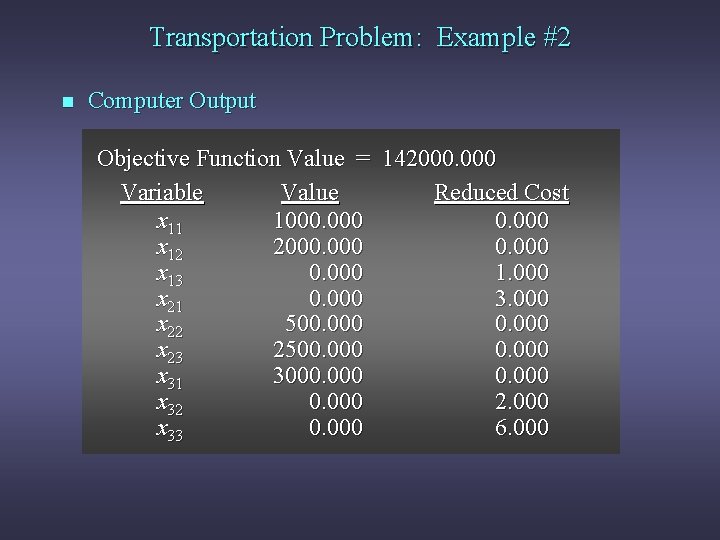
Transportation Problem: Example #2 n Computer Output Objective Function Value = 142000. 000 Variable Value Reduced Cost x 11 1000. 000 x 12 2000. 000 x 13 0. 000 1. 000 x 21 0. 000 3. 000 x 22 500. 000 x 23 2500. 000 x 31 3000. 000 x 32 0. 000 2. 000 x 33 0. 000 6. 000
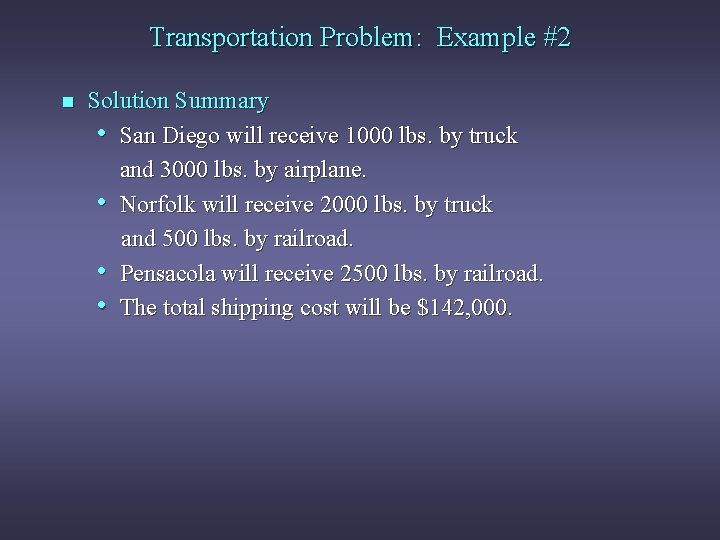
Transportation Problem: Example #2 n Solution Summary • San Diego will receive 1000 lbs. by truck and 3000 lbs. by airplane. • Norfolk will receive 2000 lbs. by truck and 500 lbs. by railroad. • Pensacola will receive 2500 lbs. by railroad. • The total shipping cost will be $142, 000.
Transshipment Problem n n Transshipment problems are transportation problems in which a shipment may move through intermediate nodes (transshipment nodes) before reaching a particular destination node. Transshipment problems can be converted to larger transportation problems and solved by a special transportation program. Transshipment problems can also be solved by general purpose linear programming codes. The network representation for a transshipment problem with two sources, three intermediate nodes, and two destinations is shown on the next slide.
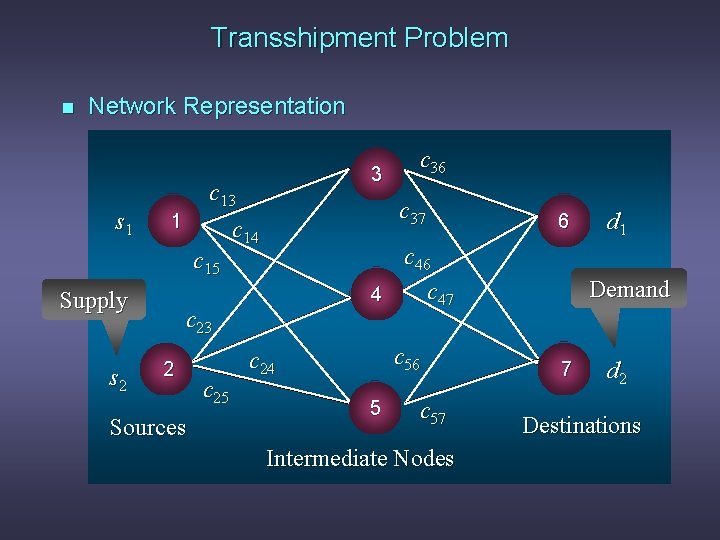
Transshipment Problem n Network Representation s 1 c 13 1 c 15 Supply s 2 3 c 37 c 14 Sources c 25 6 c 47 4 c 23 2 c 36 c 56 c 24 5 c 57 Intermediate Nodes d 1 Demand 7 d 2 Destinations
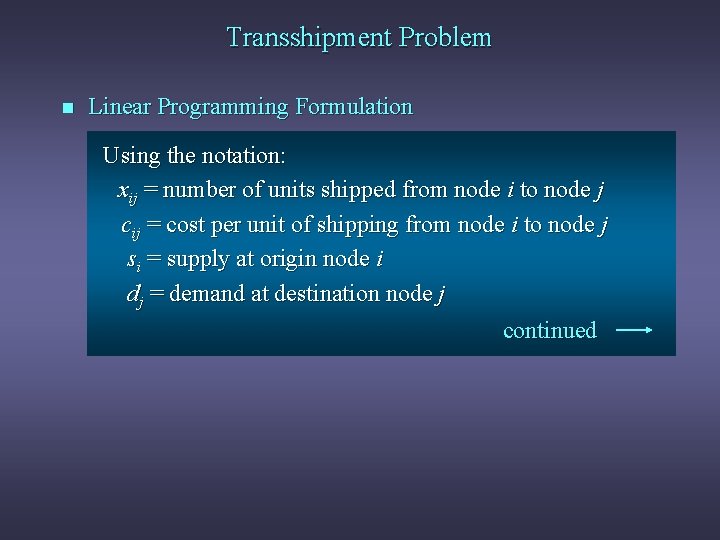
Transshipment Problem n Linear Programming Formulation Using the notation: xij = number of units shipped from node i to node j cij = cost per unit of shipping from node i to node j si = supply at origin node i dj = demand at destination node j continued
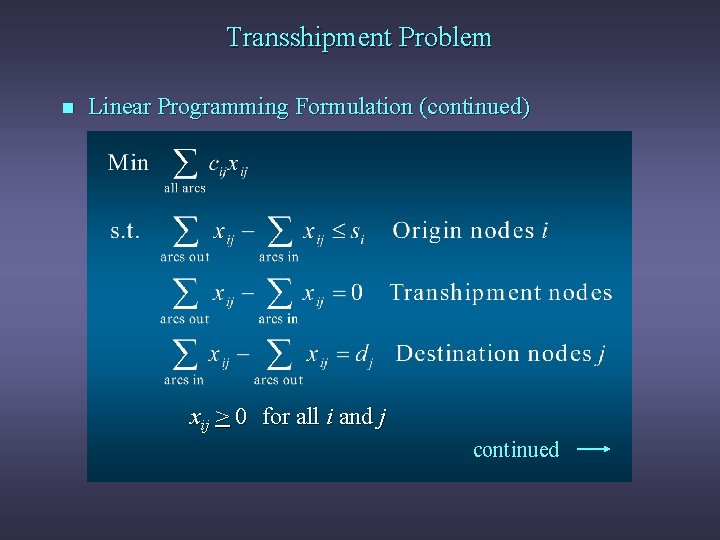
Transshipment Problem n Linear Programming Formulation (continued) xij > 0 for all i and j continued
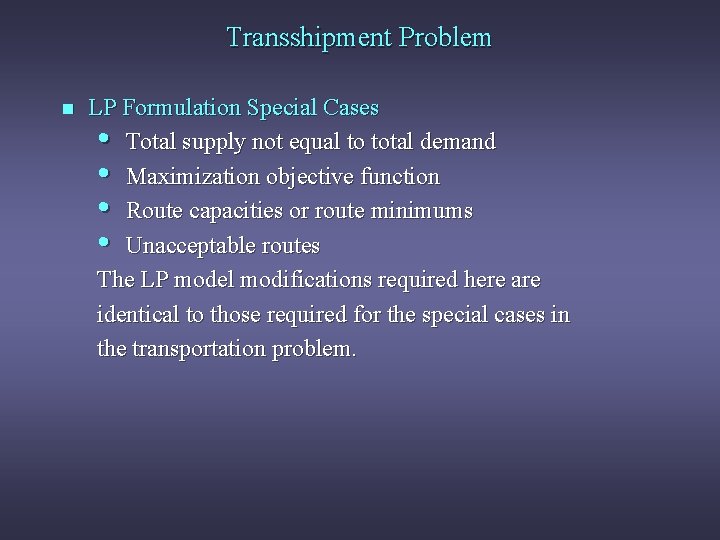
Transshipment Problem n LP Formulation Special Cases • Total supply not equal to total demand • Maximization objective function • Route capacities or route minimums • Unacceptable routes The LP model modifications required here are identical to those required for the special cases in the transportation problem.
Transshipment Problem: Example The Northside and Southside facilities of Zeron Industries supply three firms (Zrox, Hewes, Rockrite) with customized shelving for its offices. They both order shelving from the same two manufacturers, Arnold Manufacturers and Supershelf, Inc. Currently weekly demands by the users are 50 for Zrox, 60 for Hewes, and 40 for Rockrite. Both Arnold and Supershelf can supply at most 75 units to its customers. Additional data is shown on the next slide.
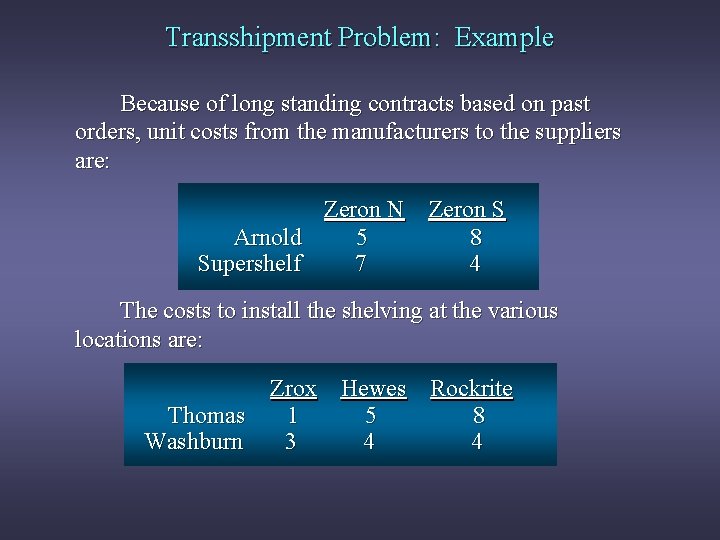
Transshipment Problem: Example Because of long standing contracts based on past orders, unit costs from the manufacturers to the suppliers are: Zeron N Zeron S Arnold 5 8 Supershelf 7 4 The costs to install the shelving at the various locations are: Zrox Hewes Rockrite Thomas 1 5 8 Washburn 3 4 4
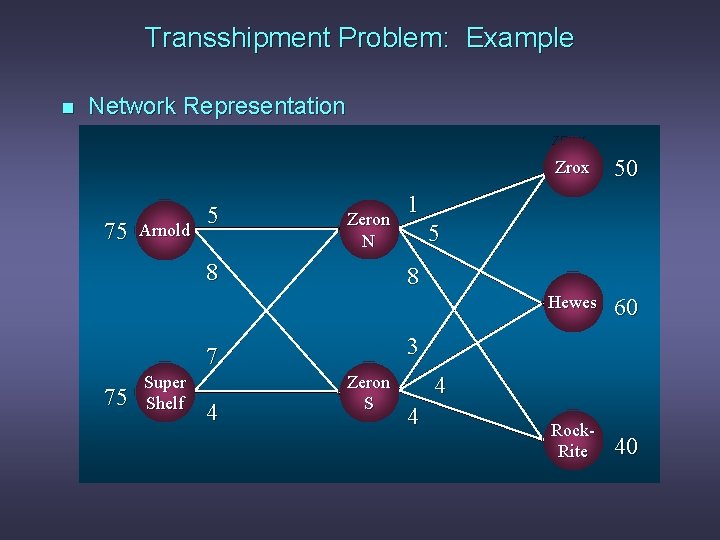
Transshipment Problem: Example n Network Representation ZROX 75 ARNOLD Arnold 5 Zeron N 8 75 Hewes HEWES 60 Rock. Rite 40 1 5 3 Zeron 4 50 8 7 Super Shelf Zrox Zeron WASH BURN S 4 4
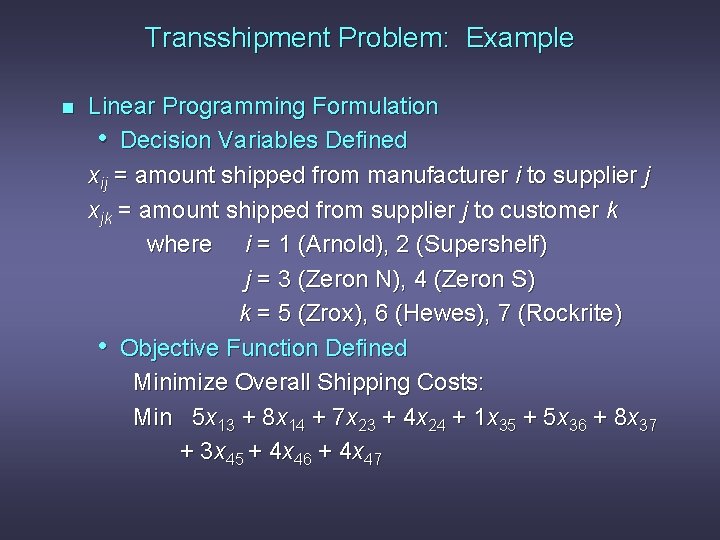
Transshipment Problem: Example n Linear Programming Formulation • Decision Variables Defined xij = amount shipped from manufacturer i to supplier j xjk = amount shipped from supplier j to customer k where i = 1 (Arnold), 2 (Supershelf) j = 3 (Zeron N), 4 (Zeron S) k = 5 (Zrox), 6 (Hewes), 7 (Rockrite) • Objective Function Defined Minimize Overall Shipping Costs: Min 5 x 13 + 8 x 14 + 7 x 23 + 4 x 24 + 1 x 35 + 5 x 36 + 8 x 37 + 3 x 45 + 4 x 46 + 4 x 47
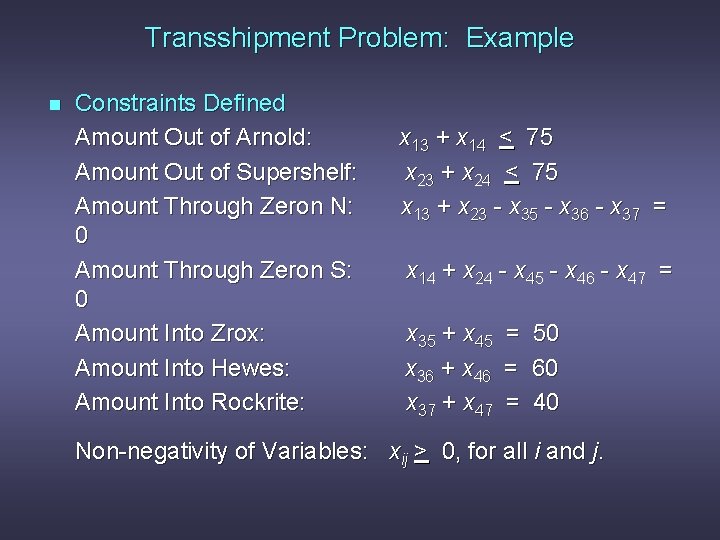
Transshipment Problem: Example n Constraints Defined Amount Out of Arnold: Amount Out of Supershelf: Amount Through Zeron N: 0 Amount Through Zeron S: 0 Amount Into Zrox: Amount Into Hewes: Amount Into Rockrite: x 13 + x 14 < 75 x 23 + x 24 < 75 x 13 + x 23 - x 35 - x 36 - x 37 = x 14 + x 24 - x 45 - x 46 - x 47 = x 35 + x 45 x 36 + x 46 x 37 + x 47 = = = 50 60 40 Non-negativity of Variables: xij > 0, for all i and j.
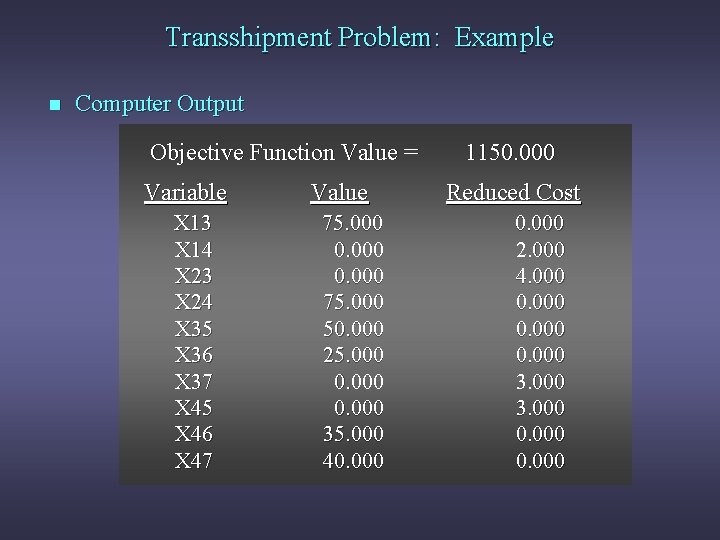
Transshipment Problem: Example n Computer Output Objective Function Value = Variable X 13 X 14 X 23 X 24 X 35 X 36 X 37 X 45 X 46 X 47 Value 75. 000 0. 000 75. 000 50. 000 25. 000 0. 000 35. 000 40. 000 1150. 000 Reduced Cost 0. 000 2. 000 4. 000 0. 000 3. 000 0. 000
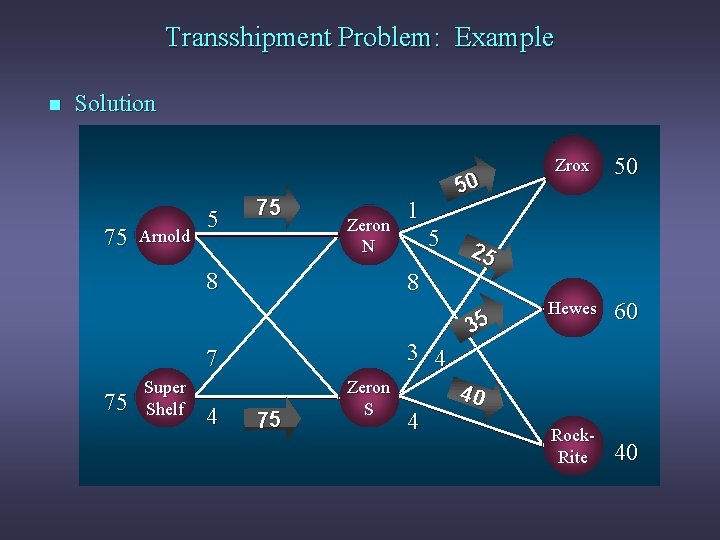
Transshipment Problem: Example n Solution ZROX 75 ARNOLD Arnold 5 75 Zeron N 8 75 1 5 3 4 Zeron 4 50 Hewes HEWES 60 Rock. Rite 40 25 8 7 Super Shelf 50 Zrox 75 Zeron WASH BURN S 4 35 40
Assignment Problem n n An assignment problem seeks to minimize the total cost assignment of m workers to m jobs, given that the cost of worker i performing job j is cij. It assumes all workers are assigned and each job is performed. An assignment problem is a special case of a transportation problem in which all supplies and all demands are equal to 1; hence assignment problems may be solved as linear programs. The network representation of an assignment problem with three workers and three jobs is shown on the next slide.
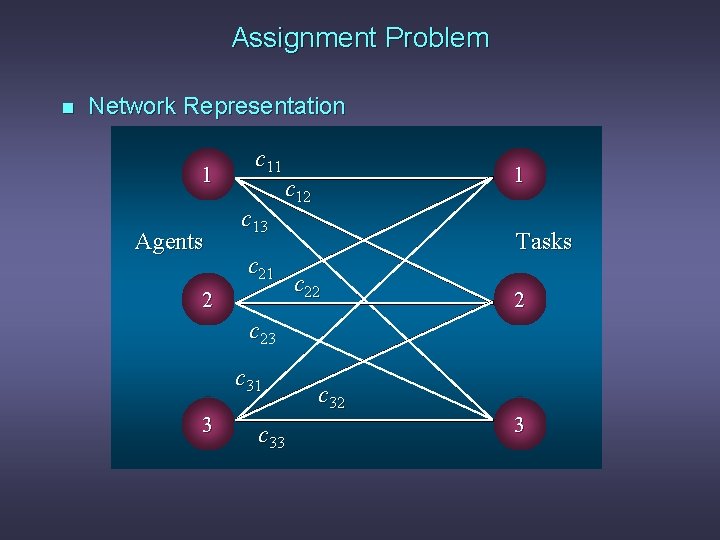
Assignment Problem n Network Representation 1 Agents c 11 c 13 1 c 12 c 21 2 Tasks c 22 2 c 23 c 31 3 c 32 3
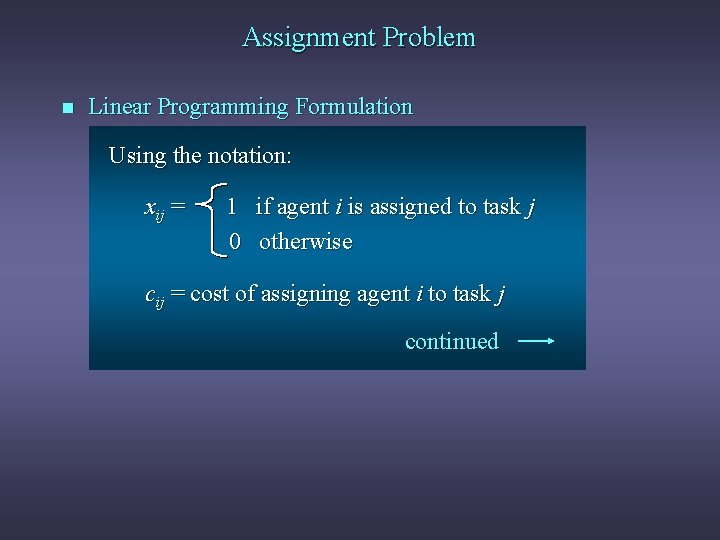
Assignment Problem n Linear Programming Formulation Using the notation: xij = 1 if agent i is assigned to task j 0 otherwise cij = cost of assigning agent i to task j continued
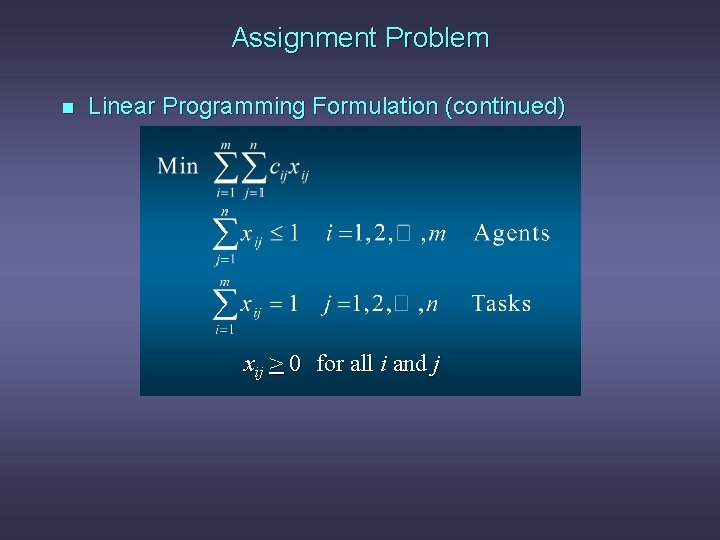
Assignment Problem n Linear Programming Formulation (continued) xij > 0 for all i and j
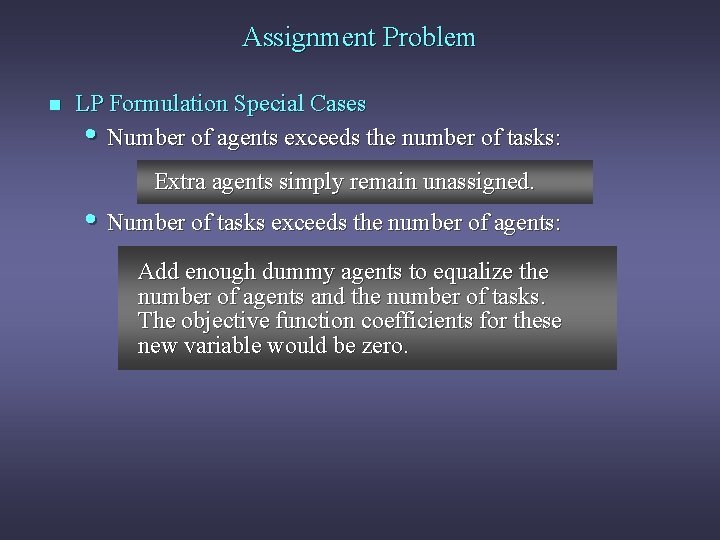
Assignment Problem n LP Formulation Special Cases • Number of agents exceeds the number of tasks: Extra agents simply remain unassigned. • Number of tasks exceeds the number of agents: Add enough dummy agents to equalize the number of agents and the number of tasks. The objective function coefficients for these new variable would be zero.
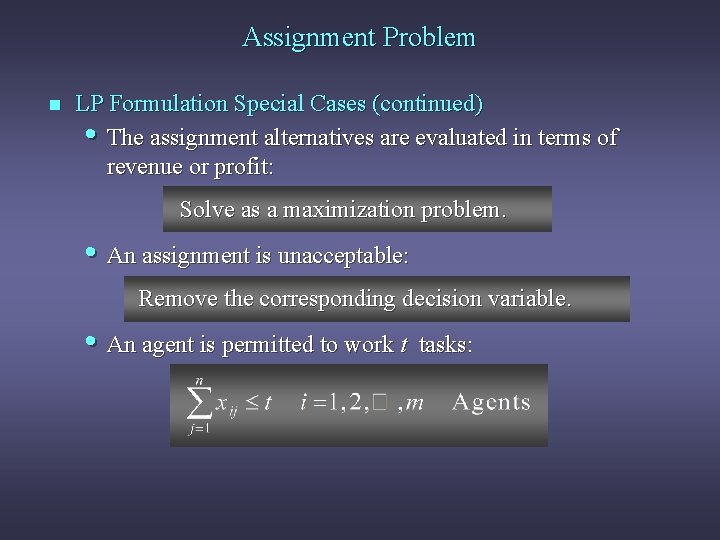
Assignment Problem n LP Formulation Special Cases (continued) • The assignment alternatives are evaluated in terms of revenue or profit: Solve as a maximization problem. • An assignment is unacceptable: Remove the corresponding decision variable. • An agent is permitted to work t tasks:
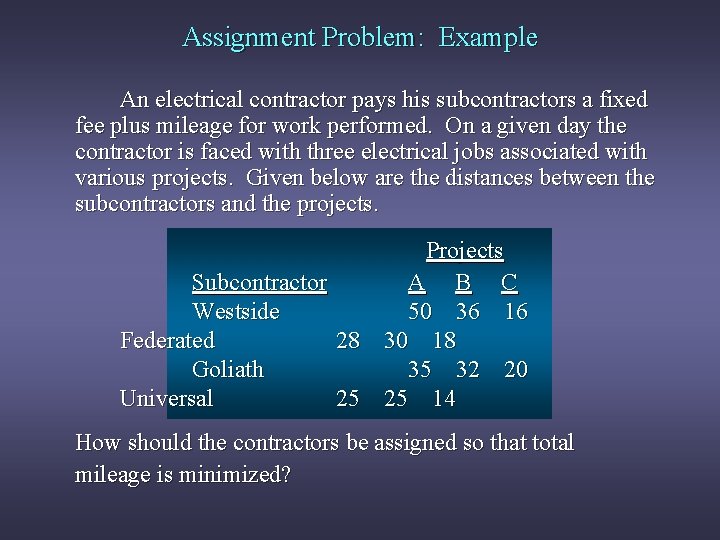
Assignment Problem: Example An electrical contractor pays his subcontractors a fixed fee plus mileage for work performed. On a given day the contractor is faced with three electrical jobs associated with various projects. Given below are the distances between the subcontractors and the projects. Projects Subcontractor A B C Westside 50 36 16 Federated 28 30 18 Goliath 35 32 20 Universal 25 25 14 How should the contractors be assigned so that total mileage is minimized?
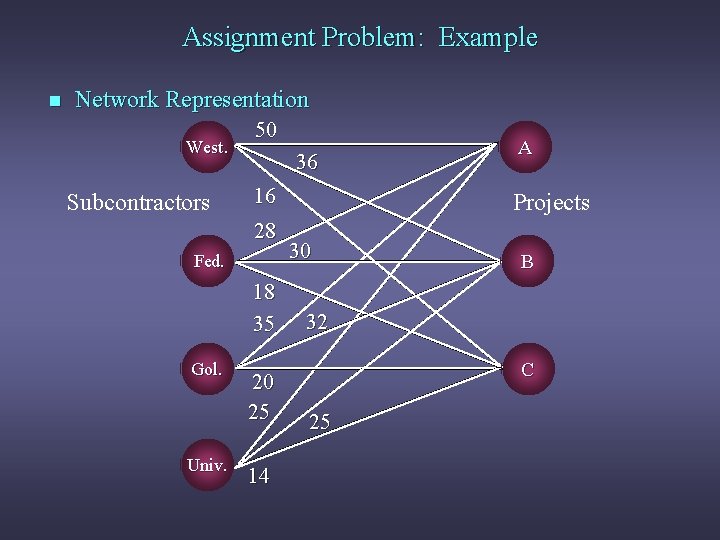
Assignment Problem: Example n Network Representation West. Subcontractors 50 36 16 28 Fed. 18 35 Gol. Univ. 20 25 14 A Projects 30 B 32 C 25
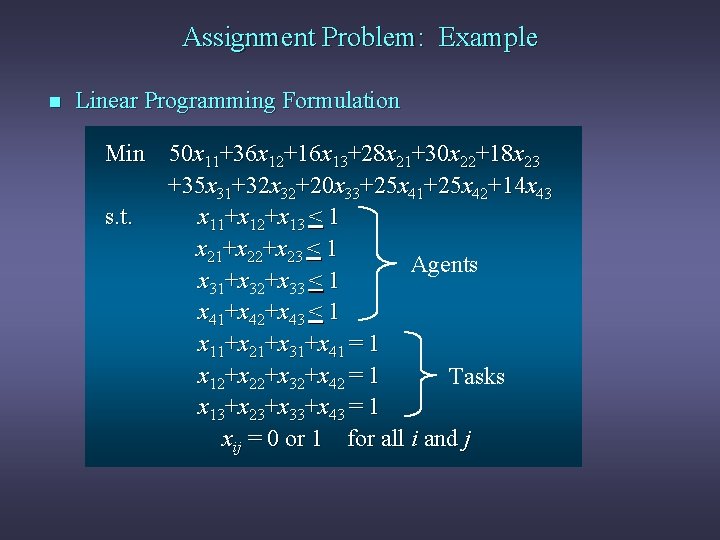
Assignment Problem: Example n Linear Programming Formulation Min 50 x 11+36 x 12+16 x 13+28 x 21+30 x 22+18 x 23 +35 x 31+32 x 32+20 x 33+25 x 41+25 x 42+14 x 43 s. t. x 11+x 12+x 13 < 1 x 21+x 22+x 23 < 1 Agents x 31+x 32+x 33 < 1 x 41+x 42+x 43 < 1 x 11+x 21+x 31+x 41 = 1 x 12+x 22+x 32+x 42 = 1 Tasks x 13+x 23+x 33+x 43 = 1 xij = 0 or 1 for all i and j
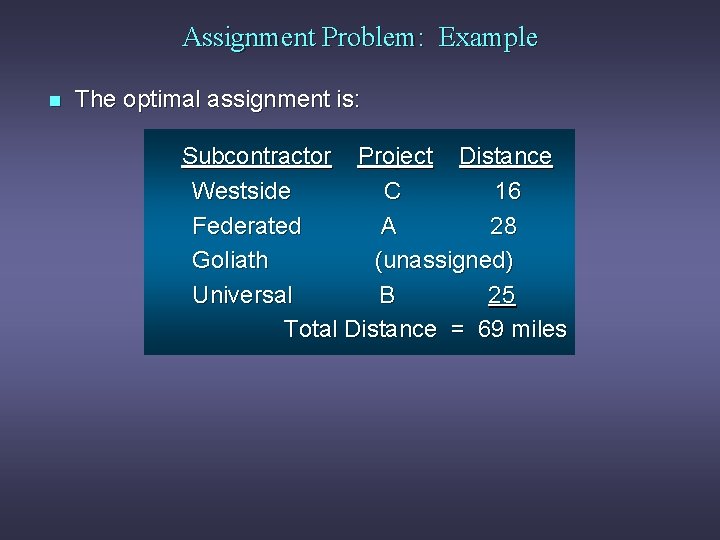
Assignment Problem: Example n The optimal assignment is: Subcontractor Project Distance Westside C 16 Federated A 28 Goliath (unassigned) Universal B 25 Total Distance = 69 miles
End of Chapter 10, Part A
- Slides: 44