
Chapter 10 Part 4 Alternative Pathways Photosynthesis Ms










- Slides: 33
Chapter 10 (Part 4) Alternative Pathways & Photosynthesis Ms. Day AP Biology
In small groups, decide on an answer: 1. What is the first STABLE product after RUBISCO fixes CO 2 into an organic molecule? 1, 3 -PGA Ru. BP 3 -PGA G 3 P 2. Why do you think the Calvin cycle is also known as the C 3 pathway?
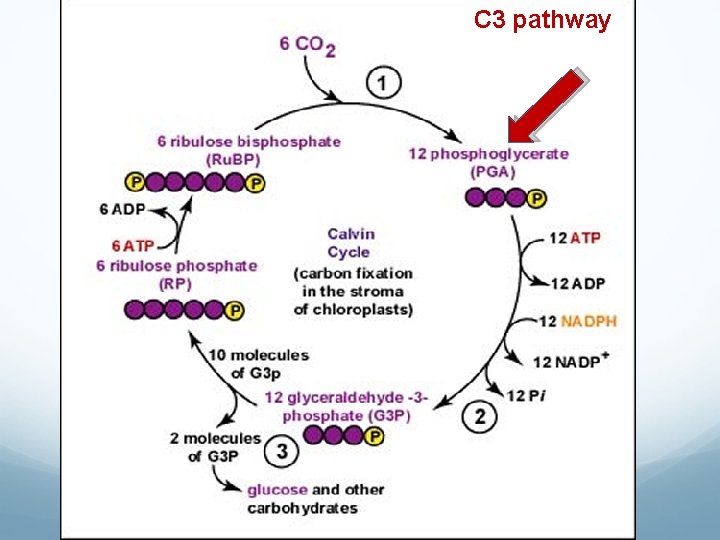
All plants carry out photosynthesis by… Fixing CO 2 to a Ru. BP using RUBISCO Ru. BP+CO 2 breaks down IMMEDIATELY 3 -PGA (STABLE!!!) 3 -PGA + ATP 1, 3 -PGA reduced to G 3 P by NADPH This is called the Calvin cycle Also known as C 3 pathway.
C 3 pathway
Alternative mechanisms of carbon fixation Plants evolved ~475 mya Discuss in your lab group… As they moved from water to land, what do you hypothesize was their BIGGEST problem? So…different carbon fixation pathways have evolved in hot, arid (dry) climates
In small groups, decide on an answer: VOCAB RECALL… What are stomata? Chemicals in plants that lose water Cells that absorb O 2 Holes in leaves A gel-like fluid in chloroplasts
STOMATA Stoma = singular Leaf “pores” or holes usually on UNDERSIDE of leaf…why would they be located here? Less evaporation from sun!
In small groups, decide on an answer: What usually diffuses into stomata during photosynthesis? Water O 2 G 3 P CO 2
In small groups, decide on an answer: What usually diffuses OF stomata during photosynthesis? Water O 2 G 3 P CO 2 OUT
Stomata Allows O 2 out (from photolysis) Allows CO 2 in for photosynthesis Why do you need CO 2? BUT… Allows H 2 O out through transpiration (“plant sweating”)
In small groups, decide on an answer: RECALL…Why is transpiration important in plants? It allows water to move into the soil It helps feed the plant It allows water to move to the leaves from the soil It helps move sugar (food) to the roots
In small groups, discuss a possible outcome of this scenario: On hot, dry days, plants close their stomata to conserve H 2 O. What sequence of events might happen to this plant when stomata are closed and why?
Conserves water but limits access to CO 2 reduces photosynthesis § Causing O 2 to build up § WHY? ? ? § http: //highered. mheducation. com/olcweb/cgi/pluginpop. cgi? it=swf: : 640: : 480: : /sites/dl/free/007251 0846/58644/0021. swf: : Stomata
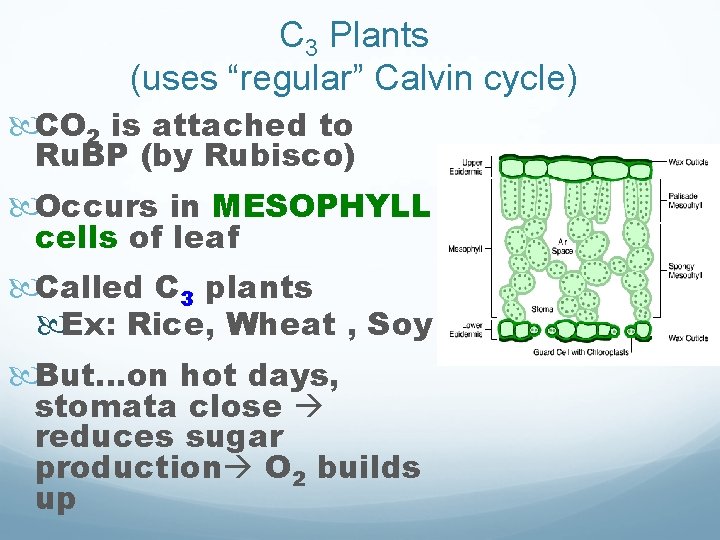
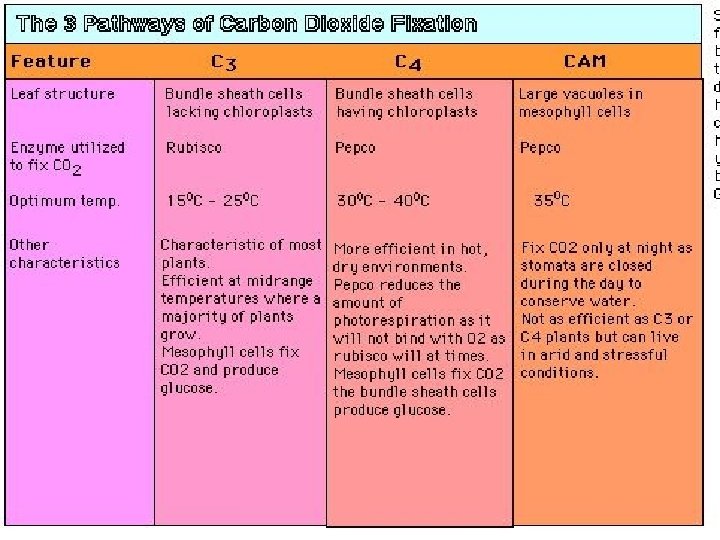
C 3 Plants (uses “regular” Calvin cycle) CO 2 is attached to Ru. BP (by Rubisco) Occurs in MESOPHYLL cells of leaf Called C 3 plants Ex: Rice, Wheat , Soy But…on hot days, stomata close reduces sugar production O 2 builds up
RUBISCO ribulose bisphosphate carboxylase oxygenase In small groups, discuss a possible meaning for the following words Carboxylase? Oxygenase?
RUBISCO Can bind CO 2 carbon fixation BUT… Also can bind O 2 IF…concentrations of O 2 are higher than CO 2 in stroma
In your small groups… Using prior knowledge of the light reactions, discuss why there would be a build up of O 2 in the stroma?
So…why is binding O 2 a problem? Light Reactions gives off O 2 Higher temps more sunlight more light reactions More light reactions more O 2 Therefore, high light intensities and high temperatures favor the second reaction (oxygenase action) of Rubisco
Photorespiration: An Evolutionary Relic? Photorespiration O 2 substitutes for CO 2 (competitive inhibitor) in active site of Rubisco adds O 2 in Calvin cycle NOT CO 2 product made and splits into 2 -C can’t make G 3 P It USES ATP to make 2 C sugar BUT…. . NO USABLE SUGAR produced Photosynthetic rate is reduced
Alternative mechanisms of carbon fixation § Photosynthetic adaptations to MINIMIZE photorespiration and OPTIMIZE Calvin Cycle § 2 Types of plants have adaptated: § C 4 Plants § CAM Plants
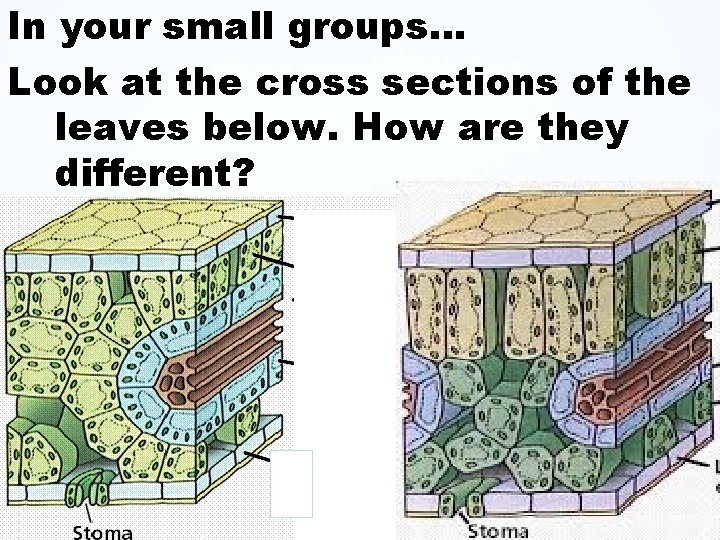
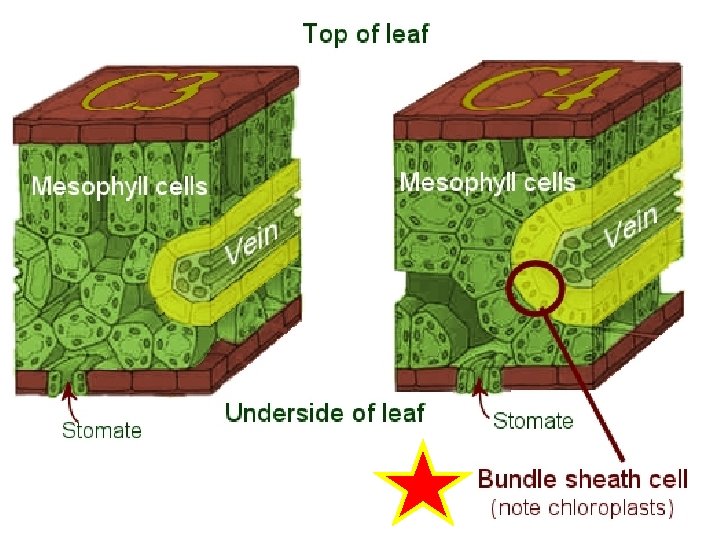
C 4 Plants Found in high daytime temps and intense sunlight Ex: Corn, Sugarcane, crab grass Has different leaf anatomy than C 3 plant C 3 = uses mesophyll cells C 4 = uses mesophyll AND bundle sheath cells
In your small groups… Look at the cross sections of the leaves below. How are they different?
C 4 Plants Minimize photorespiration Fixes CO 2 in MESOPHYLL CELL makes a 3 -C PEP molecule uses PEP carboxylase (enzyme) A new “carbon fixing” enzyme!!! 3 -C PEP turned into 4 -C intermediates (an organic acid) ACIDS are then stored in plant for later STORED in bundle sheath cell
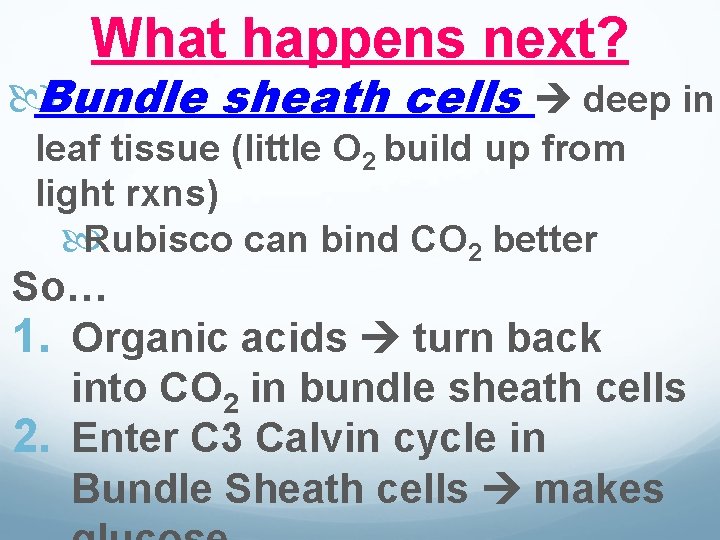
What happens next? Bundle sheath cells deep in leaf tissue (little O 2 build up from light rxns) Rubisco can bind CO 2 better So… 1. Organic acids turn back into CO 2 in bundle sheath cells 2. Enter C 3 Calvin cycle in Bundle Sheath cells makes
In your small groups… Discuss one advantage that a C 4 plant would have over a C 3 plant in Florida or Southern California.
C 4 leaf anatomy and the C 4 pathway 4 C acids Plasmodesma Differences compared to a C 3 plant: 1. 2 types of cells: bundle sheath and mesophyll 2. 2 carbon fixation enzymes: PEP carboxylase and RUBISCO 3. CO 2 reduced twice
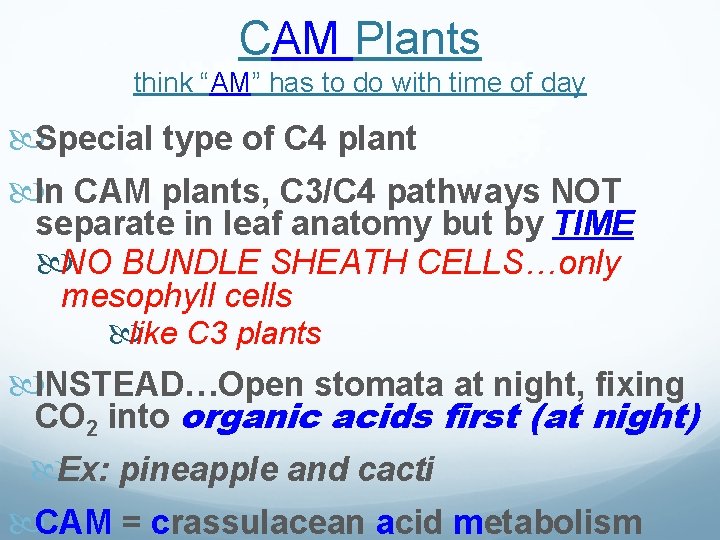
CAM Plants think “AM” has to do with time of day Special type of C 4 plant In CAM plants, C 3/C 4 pathways NOT separate in leaf anatomy but by TIME NO BUNDLE SHEATH CELLS…only mesophyll cells like C 3 plants INSTEAD…Open stomata at night, fixing CO 2 into organic acids first (at night) Ex: pineapple and cacti CAM = crassulacean acid metabolism
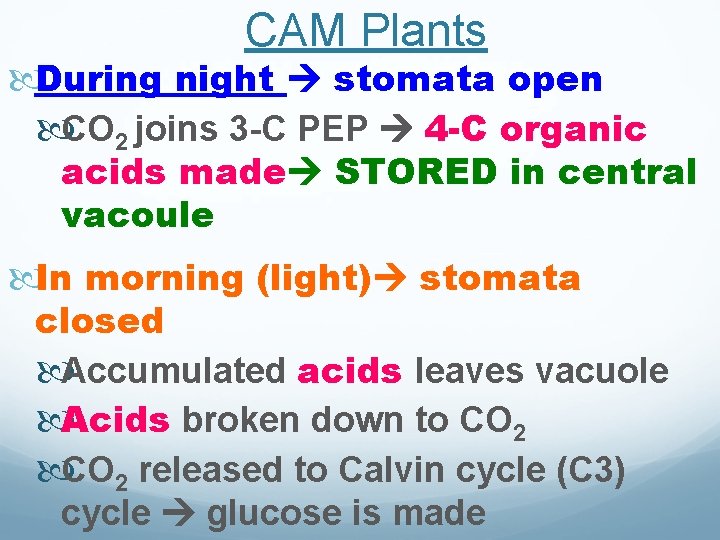
CAM Plants During night stomata open CO 2 joins 3 -C PEP 4 -C organic acids made STORED in central vacoule In morning (light) stomata closed Accumulated acids leaves vacuole Acids broken down to CO 2 released to Calvin cycle (C 3) cycle glucose is made
NOTE: PGAL = G 3 P http: //media. pearsoncmg. com/bc/bc_campbell_biology_7/media/int eractivemedia/activities/load. html? 10&F
OVERALL TUTORIAL/VIDEO https: //www. youtube. com/watch? v=Dq 38 Mp. YOb 8 w https: //www. youtube. com/watch? v=g 78 utc. LQr. J 4