
Chapter 10 Part 2 Photosystems Light Reactions AP
- Slides: 37
Chapter 10 (Part 2) Photosystems & Light Reactions AP Biology Ms. Day
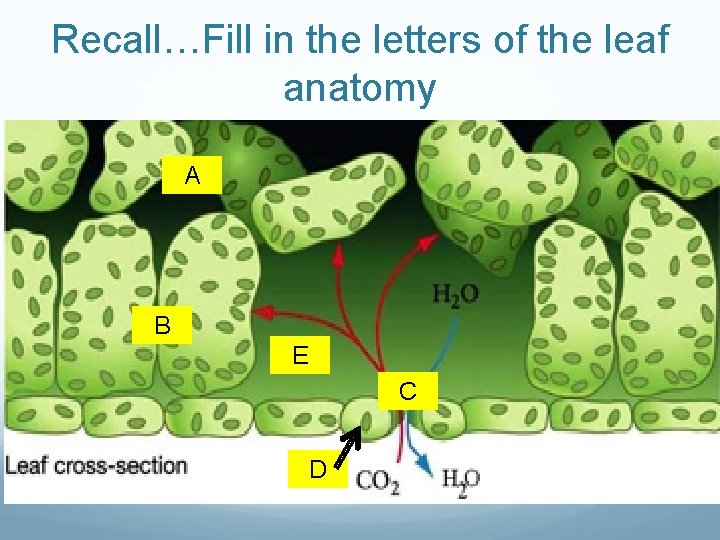
Recall…Fill in the letters of the leaf anatomy A B E C D
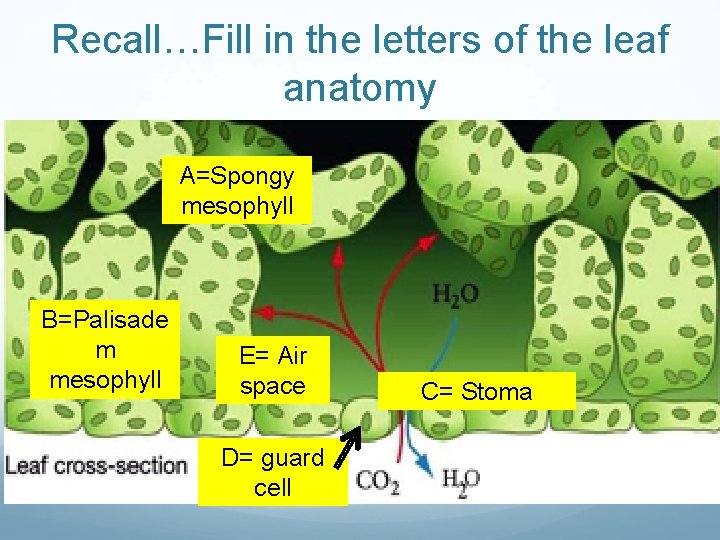
Recall…Fill in the letters of the leaf anatomy A=Spongy mesophyll B=Palisade m mesophyll E= Air space D= guard cell C= Stoma
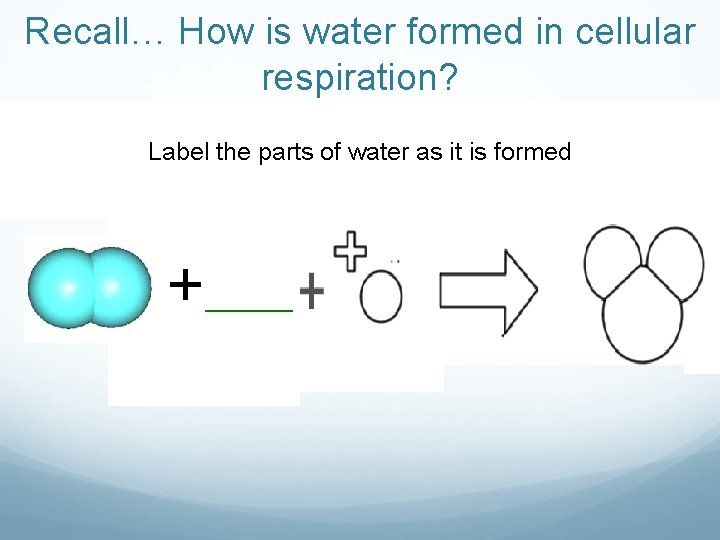
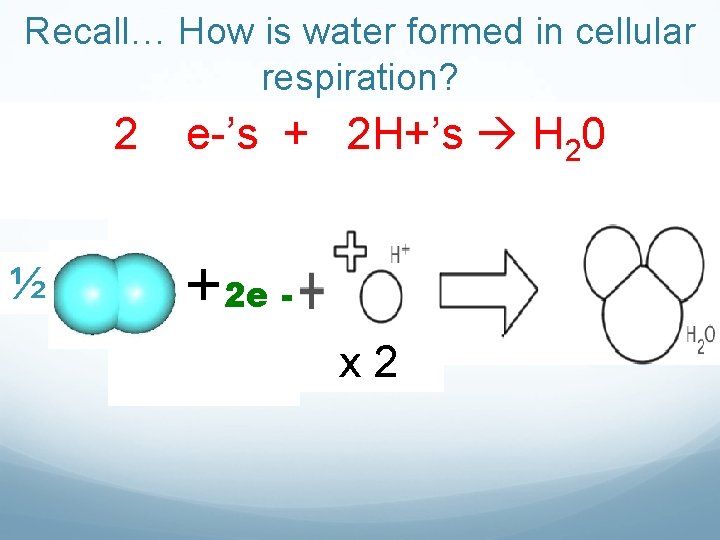
Recall… How is water formed in cellular respiration? Label the parts of water as it is formed +_____
Recall… How is water formed in cellular respiration? 2 ½ e-’s + 2 H+’s H 20 +2 e x 2
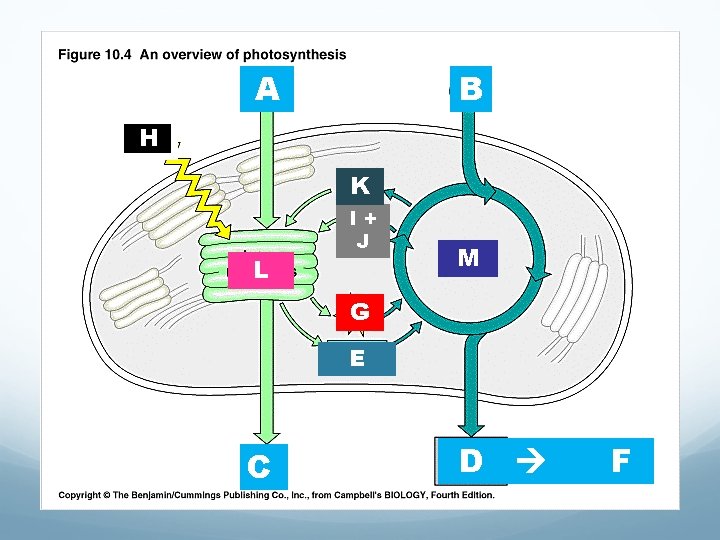
A B ? H K L I+ J M G E C D F
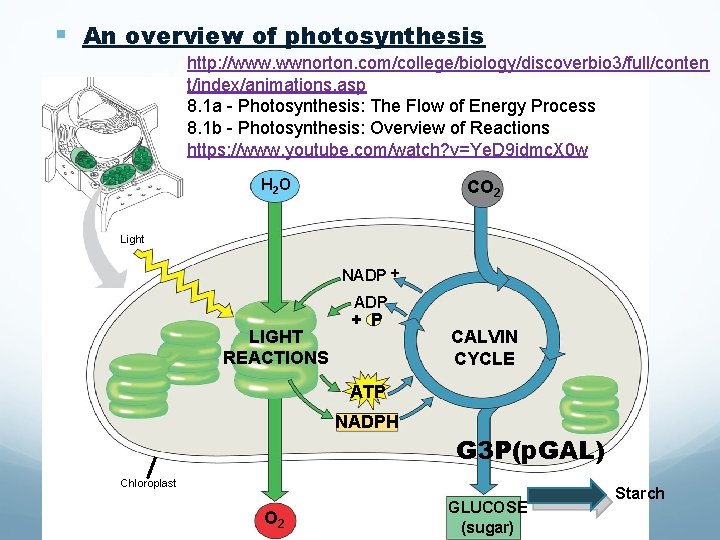
§ An overview of photosynthesis http: //www. wwnorton. com/college/biology/discoverbio 3/full/conten t/index/animations. asp 8. 1 a - Photosynthesis: The Flow of Energy Process 8. 1 b - Photosynthesis: Overview of Reactions https: //www. youtube. com/watch? v=Ye. D 9 idmc. X 0 w H 2 O CO 2 Light NADP LIGHT REACTIONS + P CALVIN CYCLE ATP NADPH G 3 P(p. GAL) Chloroplast O 2 GLUCOSE (sugar) Starch
The Light Reactions § Occur in the grana (& thylakoids) § Convert solar energy to chemical energy § Chlorophyll absorbs solar energy § Split water § release oxygen gas (a by-product) § produce ATP (using chemiosmosis) § Forms NADPH from NADP+ (an eacceptor) § Temporarily stores high energy e-’s § “Electron shuttle bus”
Light Reactions (in detail) § The light reactions convert solar energy to the chemical energy of ATP and NADPH
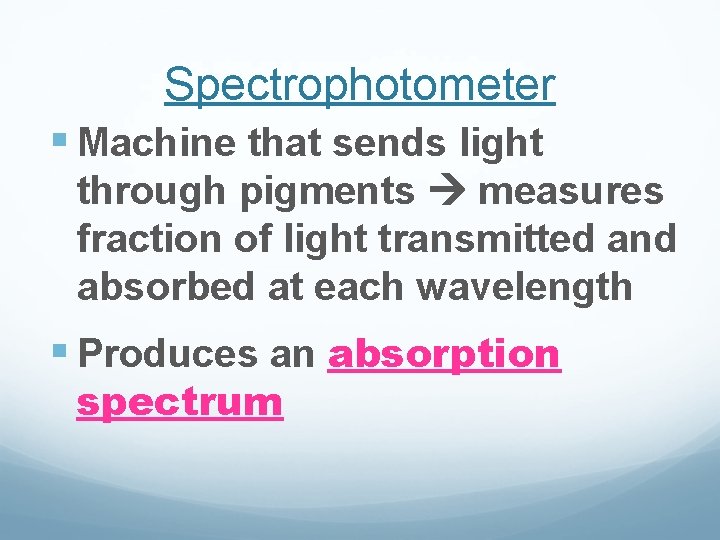
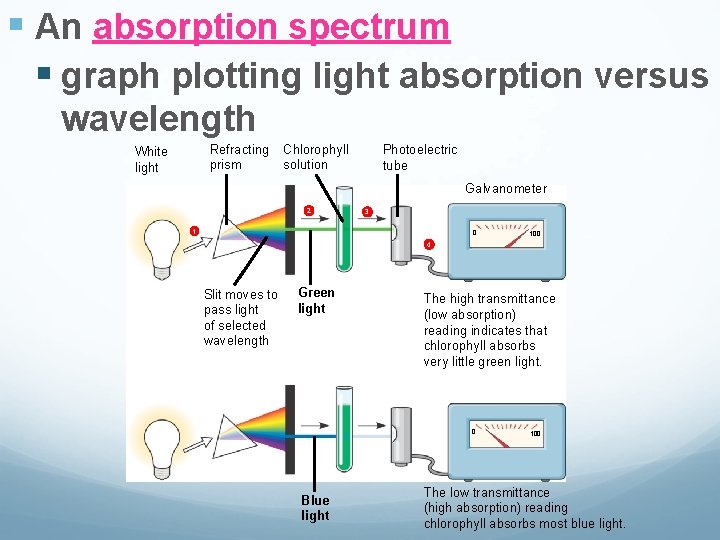
Spectrophotometer § Machine that sends light through pigments measures fraction of light transmitted and absorbed at each wavelength § Produces an absorption spectrum
§ An absorption spectrum § graph plotting light absorption versus wavelength Refracting prism White light Chlorophyll solution Photoelectric tube Galvanometer 2 3 1 0 100 4 Slit moves to pass light of selected wavelength Green light The high transmittance (low absorption) reading indicates that chlorophyll absorbs very little green light. 0 Blue light 100 The low transmittance (high absorption) reading chlorophyll absorbs most blue light.
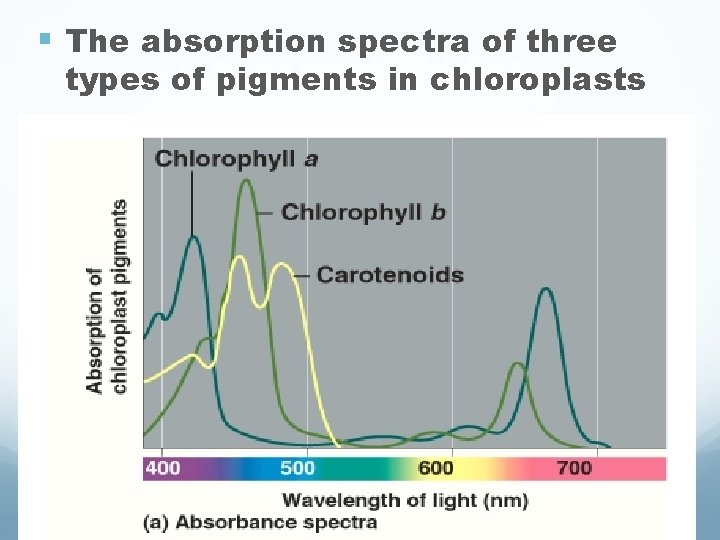
§ The absorption spectra of three types of pigments in chloroplasts
§ Chlorophyll a § The main photosynthetic pigment (primary pigment) § Accessory Pigments § Absorb different wavelengths of light § pass energy to chlorophyll a
Excitation of Chlorophyll by Light § When a pigment absorbs light § It goes from a ground state (stable) to an excited state (unstable)
Photosystems § Reaction centers used in Light Reactions § Made of light harvesting proteins (complexes) § Funnel (move) energy of photons (light pieces) to the middle of reaction center § INSIDE thylakoid membrane § 2 DIFFERENT CENTERS § Photosystem II (PSII) § Photosystem I (PSI)
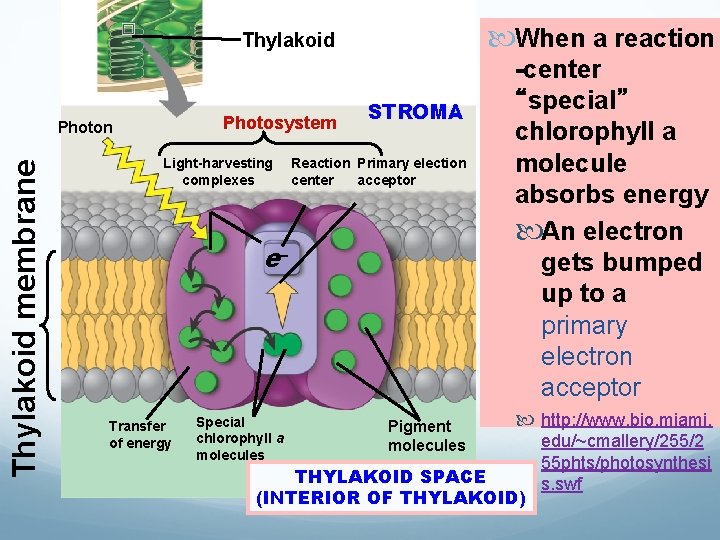
When a reaction Thylakoid Photosystem Thylakoid membrane Photon Light-harvesting complexes STROMA Reaction Primary election center acceptor e– Transfer of energy Special chlorophyll a molecules Pigment molecules -center “special” chlorophyll a molecule absorbs energy An electron gets bumped up to a primary electron acceptor http: //www. bio. miami. THYLAKOID SPACE (INTERIOR OF THYLAKOID) edu/~cmallery/255/2 55 phts/photosynthesi s. swf
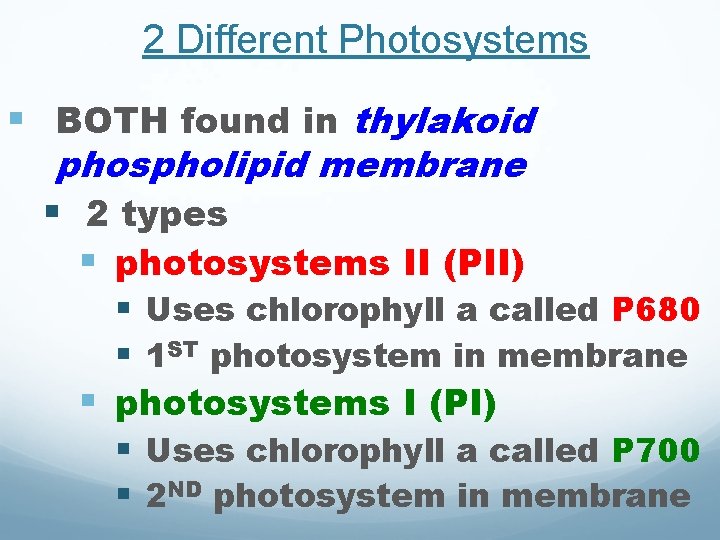
2 Different Photosystems § BOTH found in thylakoid phospholipid membrane § 2 types § photosystems II (PII) § Uses chlorophyll a called P 680 § 1 ST photosystem in membrane § photosystems I (PI) § Uses chlorophyll a called P 700 § 2 ND photosystem in membrane
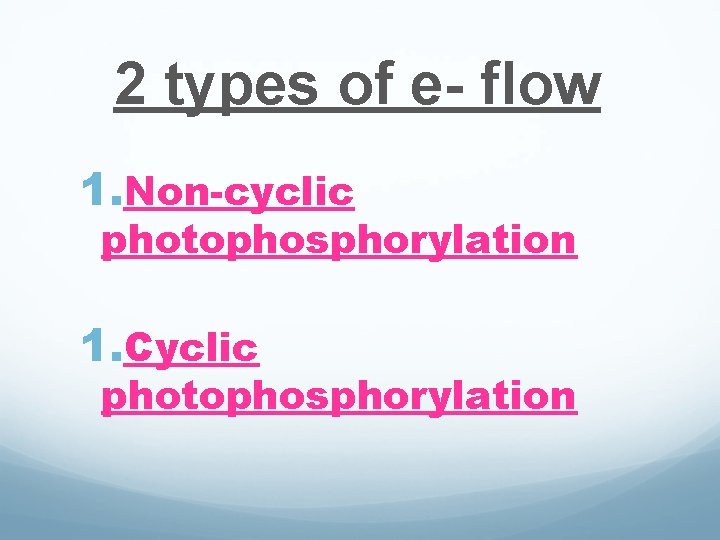
2 types of e- flow 1. Non-cyclic photophosphorylation 1. Cyclic photophosphorylation
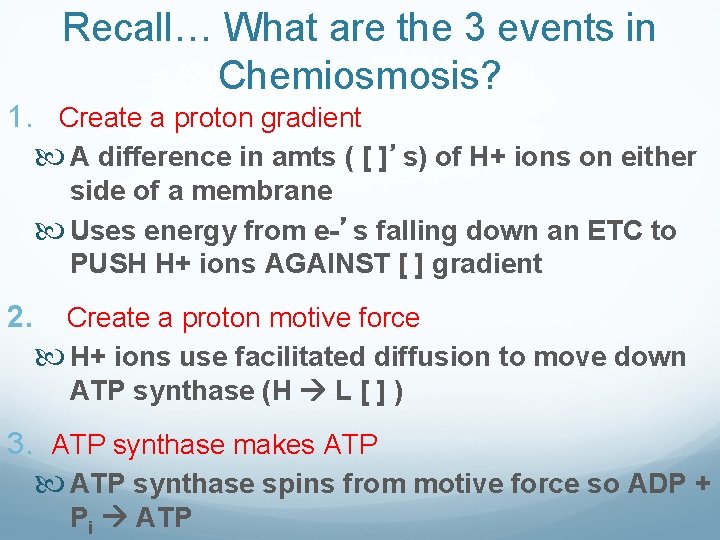
Recall… What are the 3 events in Chemiosmosis? 1. Create a proton gradient A difference in amts ( [ ]’s) of H+ ions on either side of a membrane Uses energy from e-’s falling down an ETC to PUSH H+ ions AGAINST [ ] gradient 2. Create a proton motive force H+ ions use facilitated diffusion to move down ATP synthase (H L [ ] ) 3. ATP synthase makes ATP synthase spins from motive force so ADP + Pi ATP
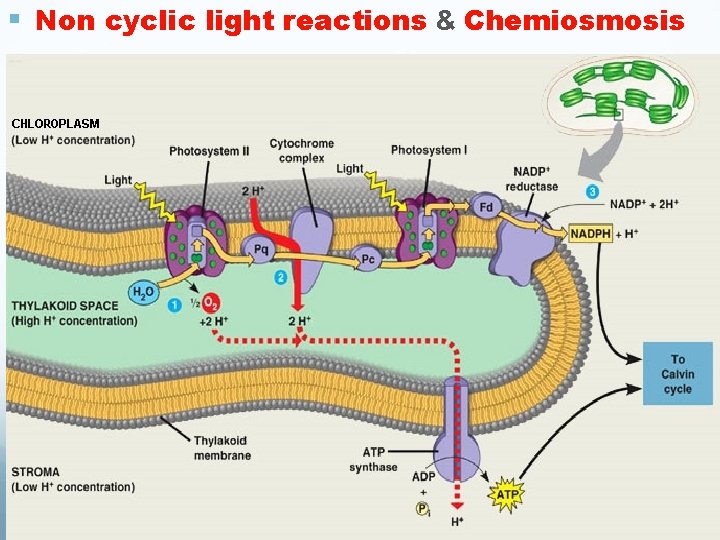
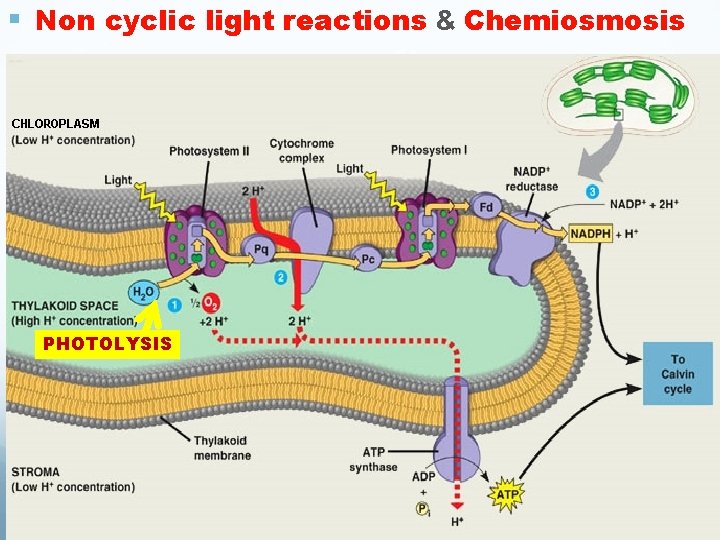
§ Non cyclic light reactions & Chemiosmosis
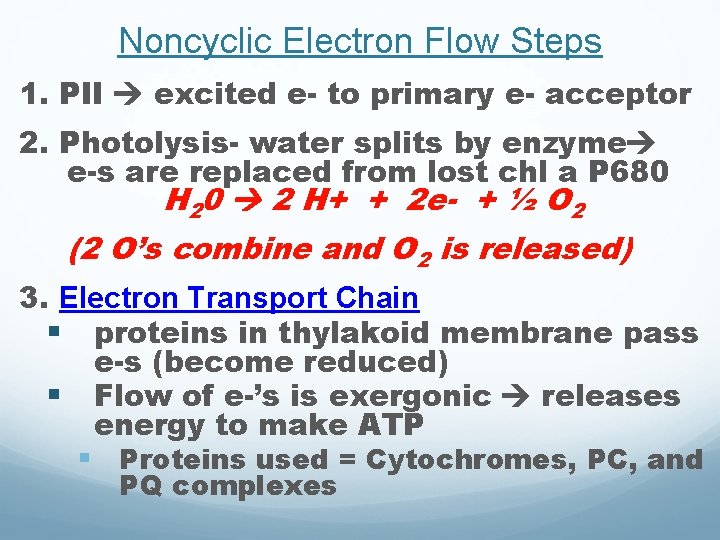
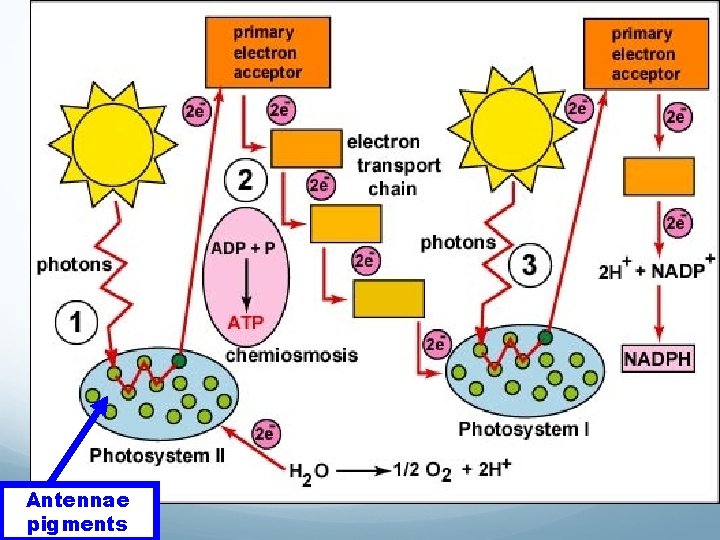
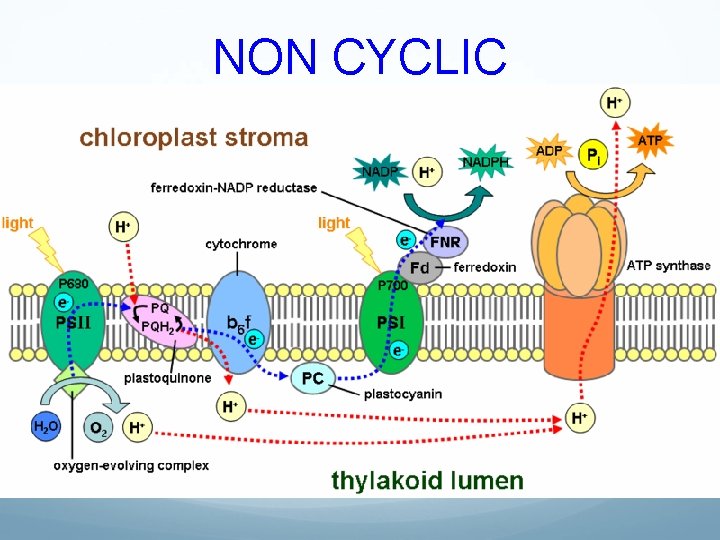
Noncyclic Electron Flow Steps 1. PII excited e- to primary e- acceptor 2. Photolysis- water splits by enzyme e-s are replaced from lost chl a P 680 H 20 2 H+ + 2 e- + ½ O 2 (2 O’s combine and O 2 is released) 3. Electron Transport Chain § proteins in thylakoid membrane pass e-s (become reduced) § Flow of e-’s is exergonic releases energy to make ATP § Proteins used = Cytochromes, PC, and PQ complexes
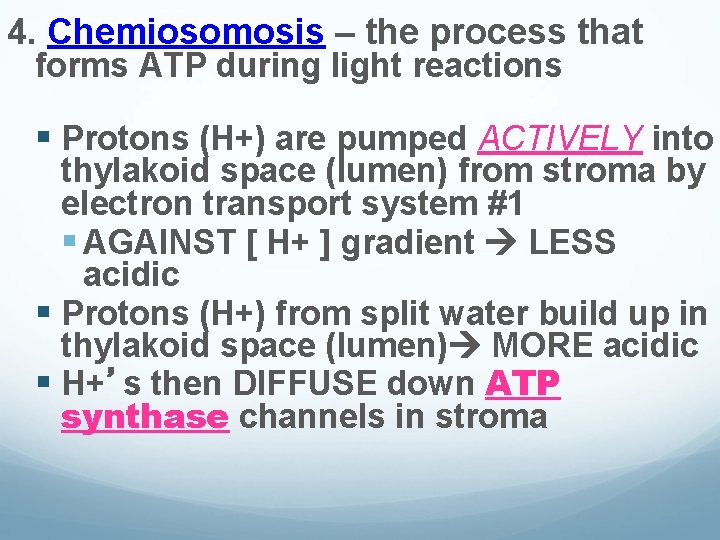
4. Chemiosomosis – the process that forms ATP during light reactions § Protons (H+) are pumped ACTIVELY into thylakoid space (lumen) from stroma by electron transport system #1 § AGAINST [ H+ ] gradient LESS acidic § Protons (H+) from split water build up in thylakoid space (lumen) MORE acidic § H+’s then DIFFUSE down ATP synthase channels in stroma
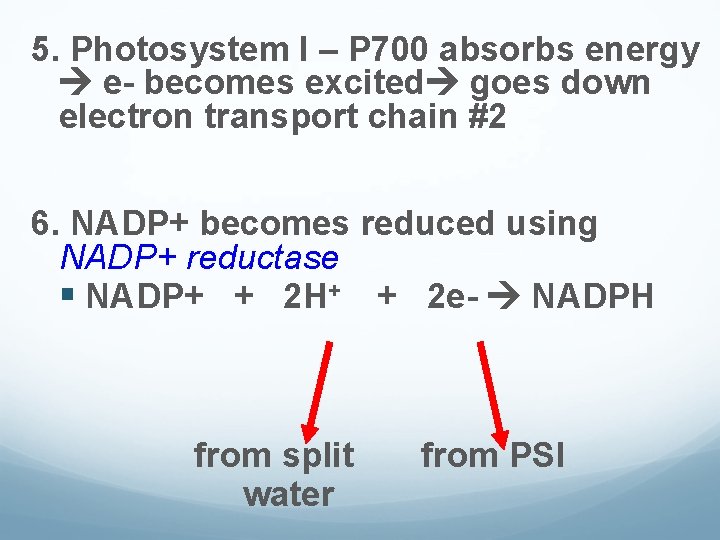
5. Photosystem I – P 700 absorbs energy e- becomes excited goes down electron transport chain #2 6. NADP+ becomes reduced using NADP+ reductase § NADP+ + 2 H+ + 2 e- NADPH from split water from PSI
§ Non cyclic light reactions & Chemiosmosis PHOTOLYSIS
Antennae pigments
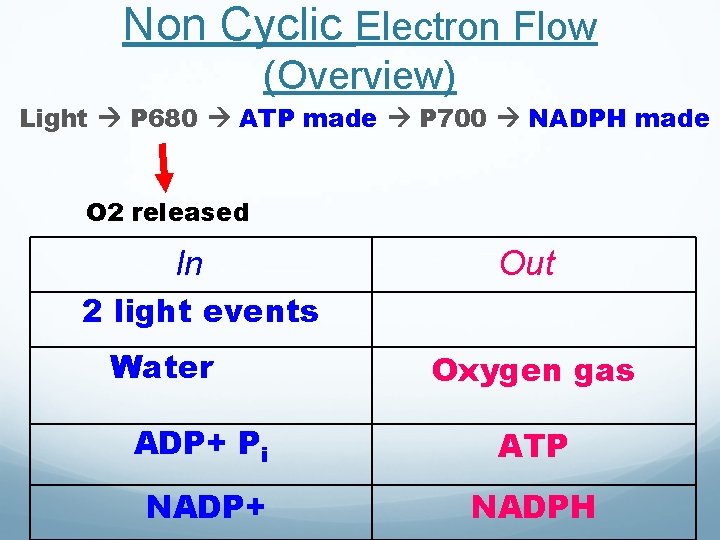
Non Cyclic Electron Flow (Overview) Light P 680 ATP made P 700 NADPH made O 2 released In Out 2 light events Water Oxygen gas ADP+ Pi ATP NADP+ NADPH
Noncyclic Electron Flow Animations 1. http: //www. stolaf. edu/people/giannini/flashanimat /metabolism/photosynthesis. swf 2. http: //highered. mcgrawhill. com/sites/0072437316/student_view 0/chapter 10/animations. html# 2 nd animation 3. http: //www. science. smith. edu/departments/Biolo gy/Bio 231/ltrxn. html 4. http: //www. sumanasinc. com/webcontent/animati ons/content/harvestinglight. html
Tutorials (Light Reactions) 1. http: //faculty. nl. edu/jste/noncyclic_photophosphorylation. ht m 2. http: //www. bio. miami. edu/~cmallery/255 phts/255 phts. htm 3. http: //www. biology. arizona. edu/biochemistry/problem_sets/ photosynthesis_1/photosynthesis_1. html
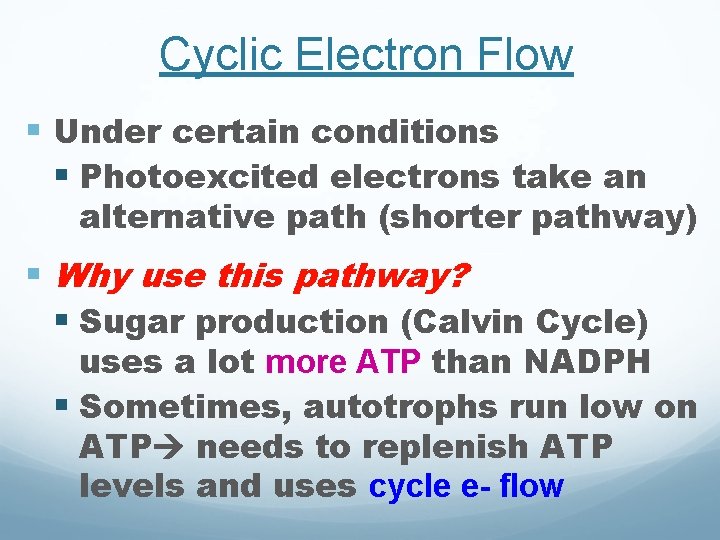
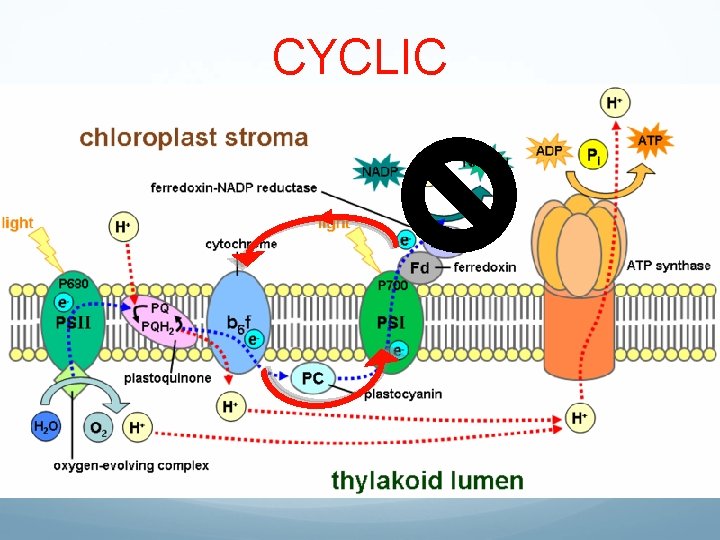
Cyclic Electron Flow § Under certain conditions § Photoexcited electrons take an alternative path (shorter pathway) § Why use this pathway? § Sugar production (Calvin Cycle) uses a lot more ATP than NADPH § Sometimes, autotrophs run low on ATP needs to replenish ATP levels and uses cycle e- flow
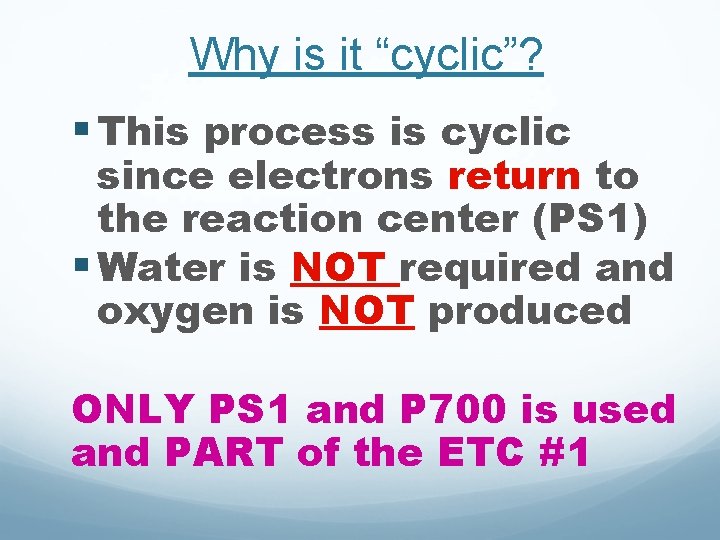
Why is it “cyclic”? § This process is cyclic since electrons return to the reaction center (PS 1) § Water is NOT required and oxygen is NOT produced ONLY PS 1 and P 700 is used and PART of the ETC #1
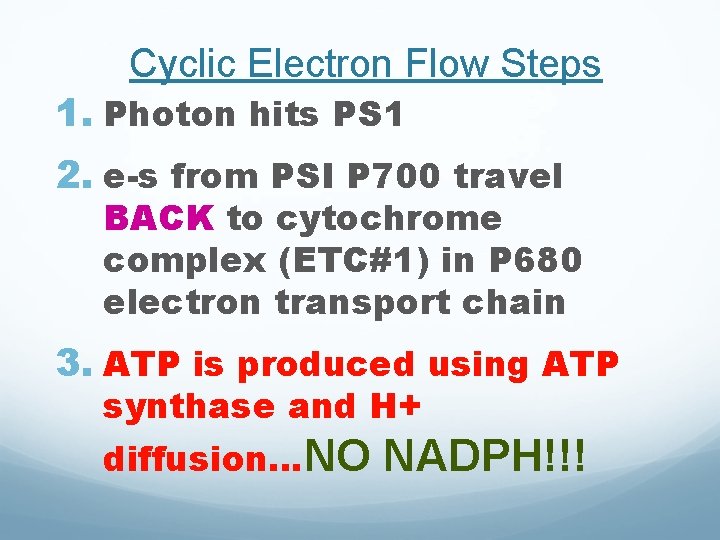
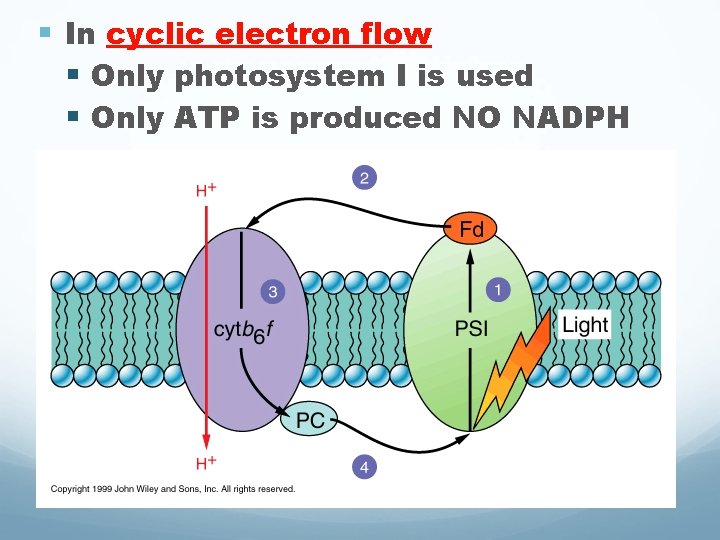
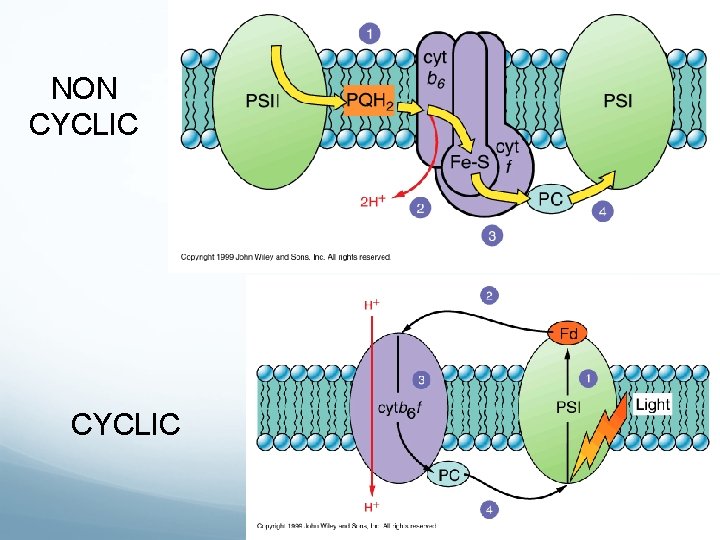
Cyclic Electron Flow Steps 1. Photon hits PS 1 2. e-s from PSI P 700 travel BACK to cytochrome complex (ETC#1) in P 680 electron transport chain 3. ATP is produced using ATP synthase and H+ diffusion…NO NADPH!!!
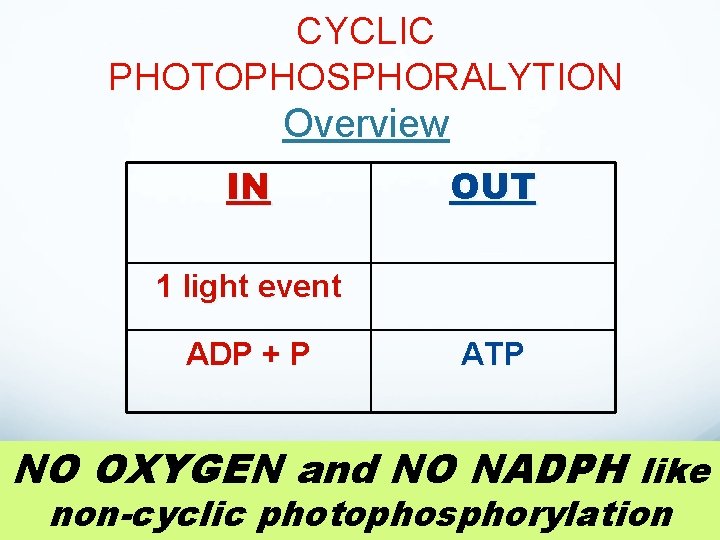
§ In cyclic electron flow § Only photosystem I is used § Only ATP is produced NO NADPH
NON CYCLIC
CYCLIC
NON CYCLIC
CYCLIC PHOTOPHOSPHORALYTION Overview IN OUT 1 light event ADP + P ATP NO OXYGEN and NO NADPH like non-cyclic photophosphorylation
Noncyclic Electron Flow Animations 1. https: //www. youtube. com/watch? v=NG- Yn. MFk. K 78 2. https: //www. youtube. com/watch? v=w. JDlxp 17 r. Y 4 3. http: //highered. mcgrawhill. com/sites/0072437316/student_view 0/chapter 10/animations. html# 1 st animation EXCELLENT REVIEW OF CELLULAR RESPIRATION and PHOTOSYNTHESIS (14 min) https: //www. youtube. com/watch? v=5 Pqo. GW 7 s. Zo. U