
Chapter 10 p 277 The Work of Gregor

- Slides: 37
Chapter 10 p. 277 The Work of Gregor Mendel 11 -1 The Work of Gregor Mendel Slide 1 of 32 Copyright Pearson Prentice Hall End Show
11 -1 The Work of Gregor Mendel’s Peas Genetics is the scientific study of heredity. Gregor Mendel was an Austrian monk. His work was important to the understanding of heredity. Mendel carried out his work with ordinary garden peas. Slide 2 of 32 Copyright Pearson Prentice Hall End Show
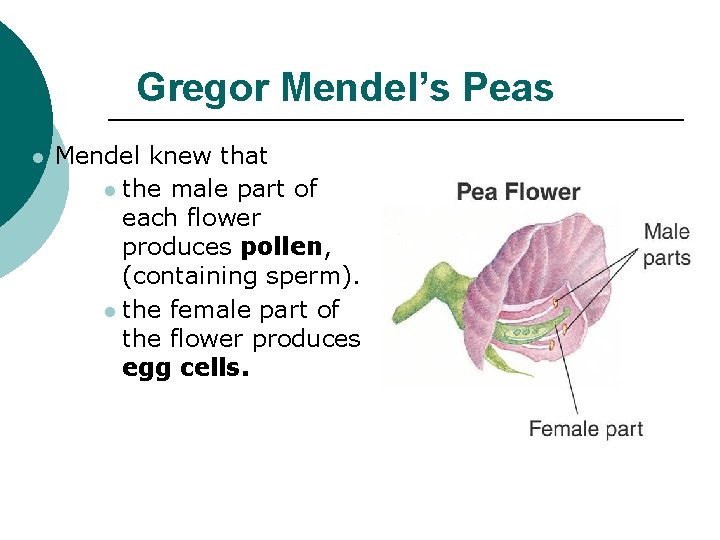
Gregor Mendel’s Peas l Mendel knew that l the male part of each flower produces pollen, (containing sperm). l the female part of the flower produces egg cells. Slide 3 of 32
Gregor Mendel’s Peas During sexual reproduction, sperm and egg cells join in a process called fertilization. ¡ Fertilization produces a new cell called a zygote. ¡ Slide 4 of 32
Gregor Mendel’s Pea flowers are self-pollinating. ¡ Sperm cells in pollen fertilize the egg cells in the same flower. ¡ The seeds that are produced by selfpollination inherit all of their characteristics from the single plant that bore them. ¡ Slide 5 of 32
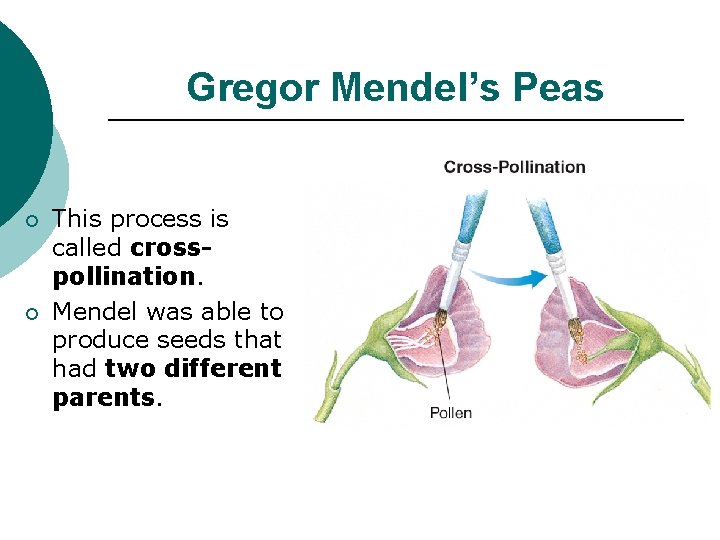
Gregor Mendel’s Peas ¡ ¡ ¡ Mendel had true-breeding pea plants that, if allowed to selfpollinate, would produce offspring identical to themselves. Mendel wanted to produce seeds by joining male and female reproductive cells from two different plants. He cut away the pollen-bearing male parts of the plant and dusted the plant’s flower with pollen from Slide 6 of 32 another plant.
Gregor Mendel’s Peas ¡ ¡ This process is called crosspollination. Mendel was able to produce seeds that had two different parents. Slide 7 of 32
Genes and Dominance l A trait is a specific characteristic that varies from one individual to another. Slide 8 of 32
Genes and Dominance ¡ Mendel studied seven pea plant traits, each with two contrasting characters. ¡ He crossed plants with each of the seven contrasting characters and studied their offspring. Slide 9 of 32
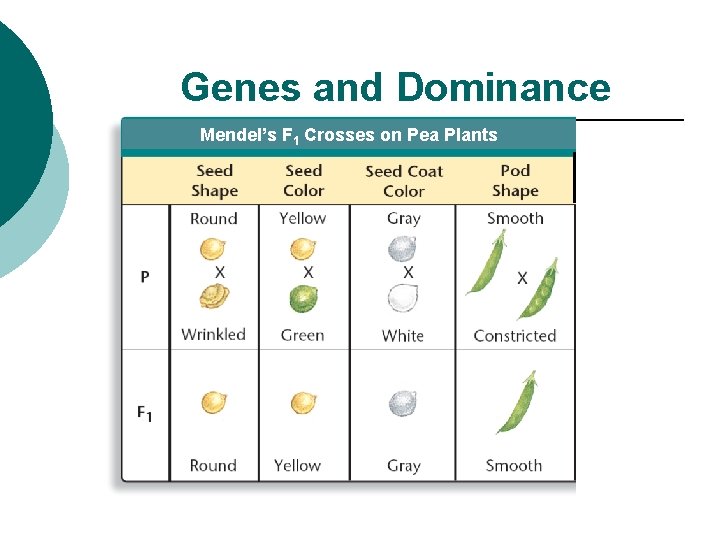
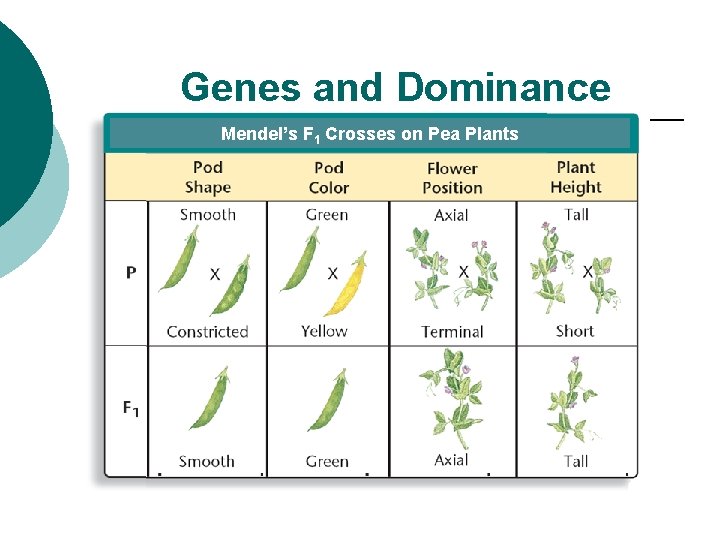
Genes and Dominance Each original pair of plants is the P (parental) generation. ¡ The offspring are called the F 1, or “first filial, ” generation. ¡ The offspring of crosses between parents with different traits are called hybrids. ¡ The F 1 hybrid plants all had the character of only one of the parents. ¡ Slide 10 of 32
Genes and Dominance Mendel’s F 1 Crosses on Pea Plants Slide 11 of 32
Genes and Dominance Mendel’s Seven F Crosses on Pea Plants 1 Mendel’s F 1 Crosses on Pea Plants Slide 12 of 32
Genes and Dominance Mendel's first conclusion was that biological inheritance is determined by factors that are passed from one generation to the next. ¡ Today, scientists call the factors that determine traits genes. ¡ Slide 13 of 32
Genes and Dominance Each of the traits Mendel studied was controlled by one gene that occurred in two contrasting forms that produced different characters for each trait. ¡ The different forms of a gene are called alleles. ¡ Mendel’s second conclusion is called the principle of dominance. ¡ Slide 14 of 32
11 -1 The Work of Gregor Mendel Genes and Dominance What is the principle of dominance? Slide 15 of 32 Copyright Pearson Prentice Hall End Show
11 -1 The Work of Gregor Mendel Genes and Dominance The principle of dominance states that some alleles are dominant and others are recessive. Slide 16 of 32 Copyright Pearson Prentice Hall End Show
Genes and Dominance An organism with a dominant allele for a trait will always exhibit that form of the trait. ¡ An organism with the recessive allele for a trait will exhibit that form only when the dominant allele for that trait is not present. ¡ Slide 17 of 32
11 -1 The Work of Gregor Mendel Segregation What happens during segregation? Slide 18 of 32 Copyright Pearson Prentice Hall End Show
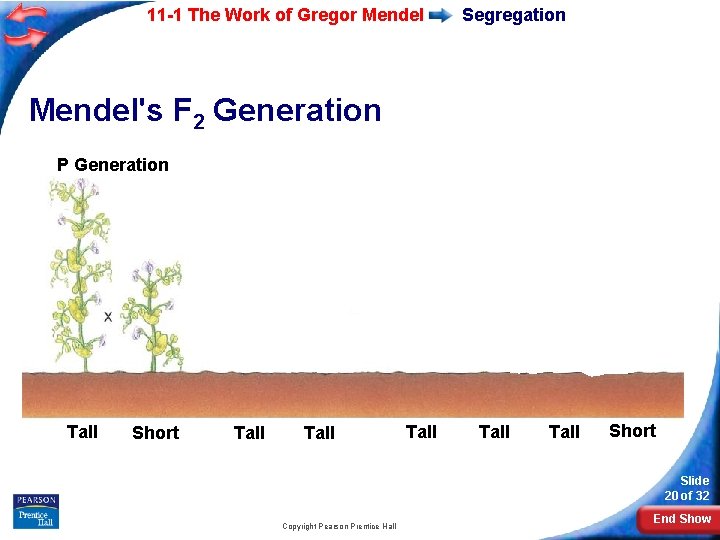
Segregation l l Mendel crossed the F 1 generation with itself to produce the F 2 (second filial) generation. The traits controlled by recessive alleles reappeared in one fourth of the F 2 plants. Slide 19 of 32
11 -1 The Work of Gregor Mendel Segregation Mendel's F 2 Generation P Generation Tall Short F 2 Generation F 1 Generation Tall Tall Short Slide 20 of 32 Copyright Pearson Prentice Hall End Show
Segregation Mendel assumed that a dominant allele had masked the corresponding recessive allele in the F 1 generation. ¡ The trait controlled by the recessive allele showed up in some of the F 2 plants. ¡ Slide 21 of 32
Segregation ¡ The reappearance of the trait controlled by the recessive allele indicated that at some point the allele for shortness had been separated, or segregated, from the allele for tallness. Slide 22 of 32
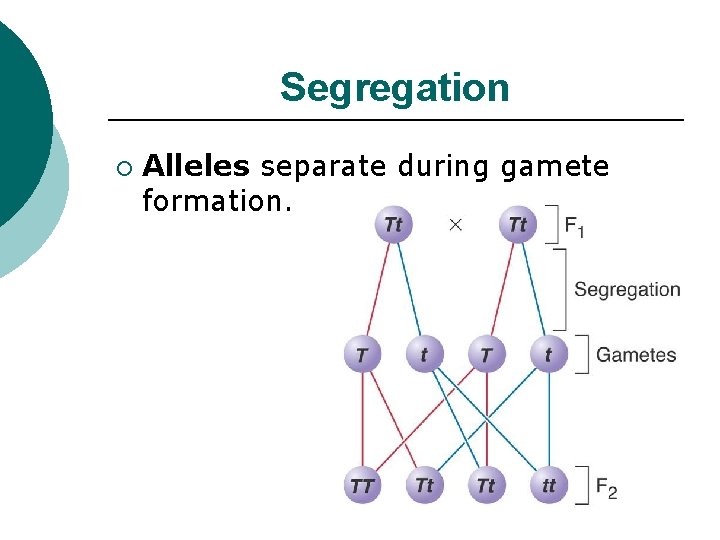
Segregation ¡ Mendel suggested that the alleles for tallness and shortness in the F 1 plants segregated from each other during the formation of the sex cells, or gametes. Slide 23 of 32
11 -1 The Work of Gregor Mendel Segregation When each F 1 plant flowers and produces gametes, the two alleles segregate from each other so that each gamete carries only a single copy of each gene. Therefore, each F 1 plant produces two types of gametes—those with the allele for tallness, and those with the allele for shortness. Slide 24 of 32 Copyright Pearson Prentice Hall End Show
Segregation ¡ Alleles separate during gamete formation. Slide 25 of 32
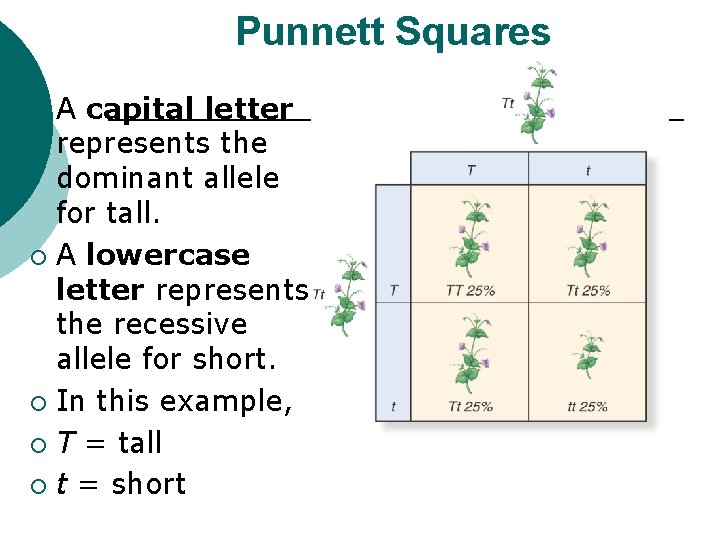
¡ Punnett Squares l The gene combinations that might result from a genetic cross can be determined by drawing a diagram known as a Punnett square. l Punnett squares can be used to predict and compare the genetic variations that will result from a cross. 9 th 10 th 11 th 12 th TOTAL Male Female 210 192 52% 198 184 52% 211 190 53% 213 227 48% 832 793 51% 48% 47% 52% 49% Slide 26 of 32
Punnett Squares A capital letter represents the dominant allele for tall. ¡ A lowercase letter represents the recessive allele for short. ¡ In this example, ¡ T = tall ¡ t = short ¡ Slide 27 of 32
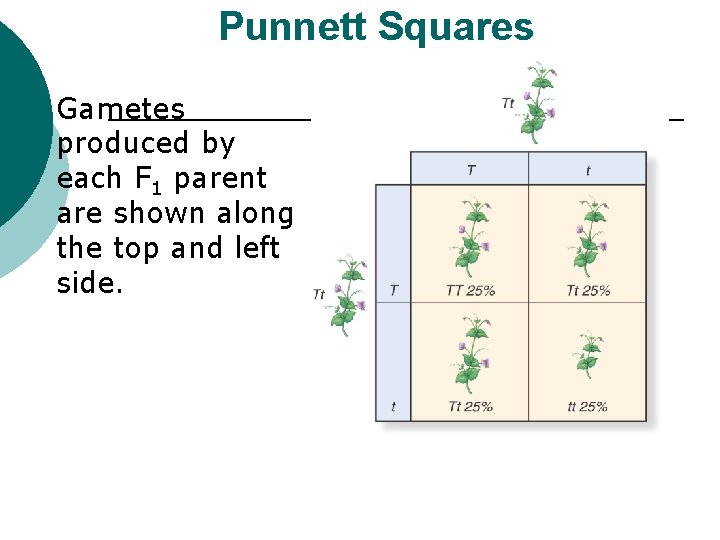
Punnett Squares ¡ Gametes produced by each F 1 parent are shown along the top and left side. Slide 28 of 32
Punnett Squares Organisms that have two identical alleles for a particular trait are said to be homozygous. ¡ Organisms that have two different alleles for the same trait are heterozygous. ¡ Homozygous organisms are truebreeding for a particular trait. ¡ Heterozygous organisms are hybrid for Slide a particular trait. 29 of 32 ¡
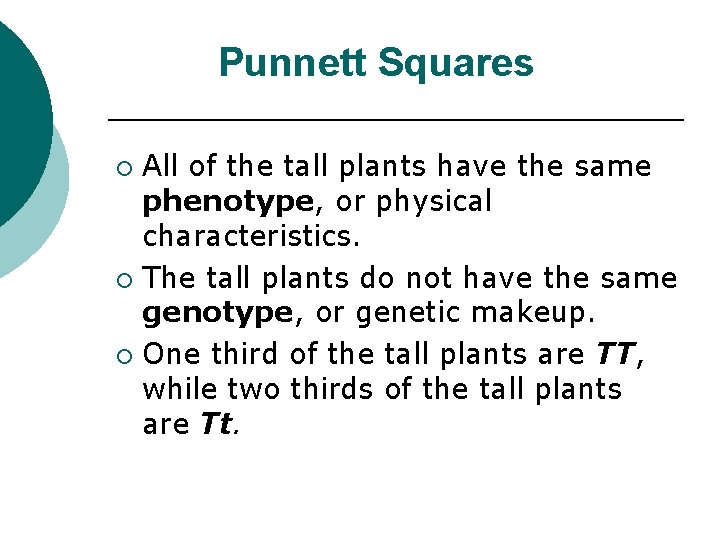
Punnett Squares All of the tall plants have the same phenotype, or physical characteristics. ¡ The tall plants do not have the same genotype, or genetic makeup. ¡ One third of the tall plants are TT, while two thirds of the tall plants are Tt. ¡ Slide 30 of 32
11 -1 Click to Launch: Continue to: - or - Slide 31 of 32 End Show Copyright Pearson Prentice Hall
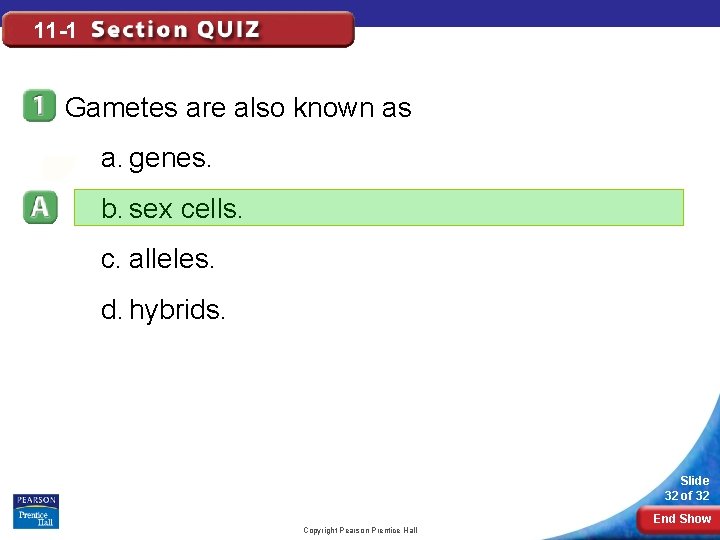
11 -1 Gametes are also known as a. genes. b. sex cells. c. alleles. d. hybrids. Slide 32 of 32 End Show Copyright Pearson Prentice Hall
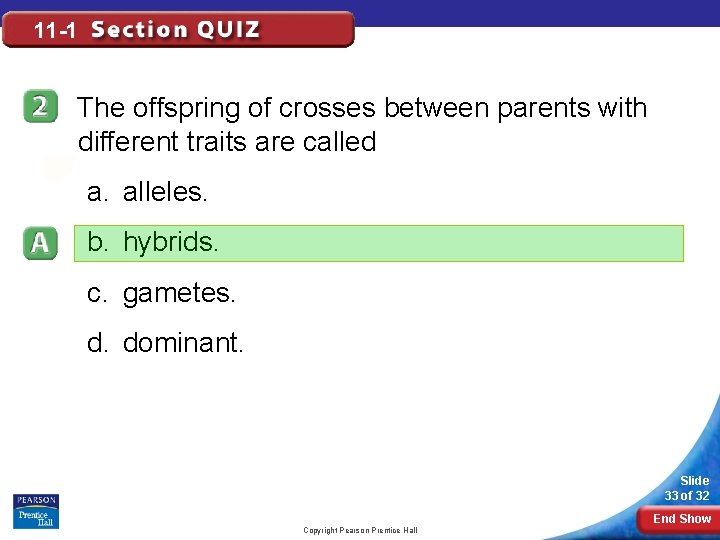
11 -1 The offspring of crosses between parents with different traits are called a. alleles. b. hybrids. c. gametes. d. dominant. Slide 33 of 32 End Show Copyright Pearson Prentice Hall
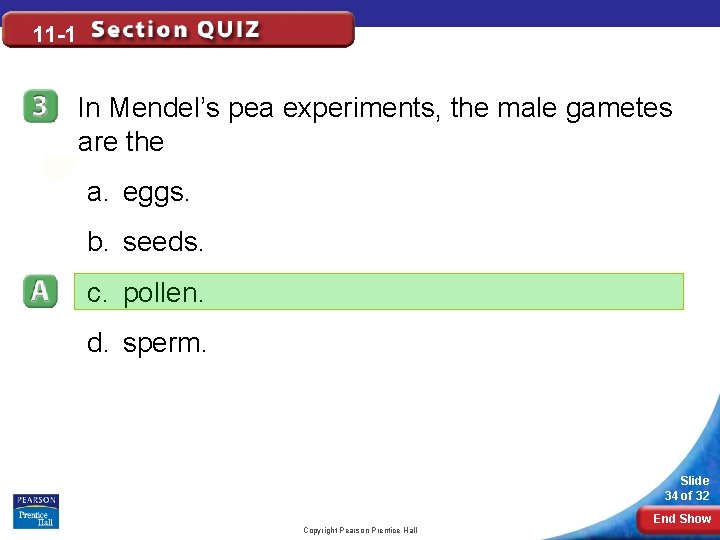
11 -1 In Mendel’s pea experiments, the male gametes are the a. eggs. b. seeds. c. pollen. d. sperm. Slide 34 of 32 End Show Copyright Pearson Prentice Hall
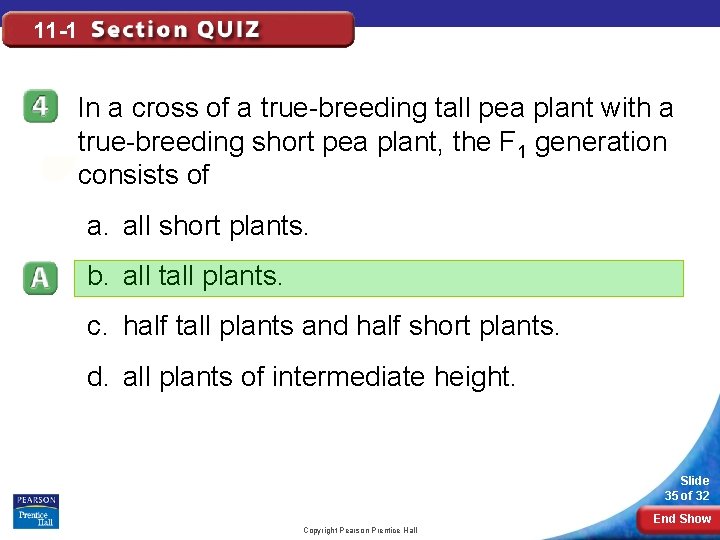
11 -1 In a cross of a true-breeding tall pea plant with a true-breeding short pea plant, the F 1 generation consists of a. all short plants. b. all tall plants. c. half tall plants and half short plants. d. all plants of intermediate height. Slide 35 of 32 End Show Copyright Pearson Prentice Hall
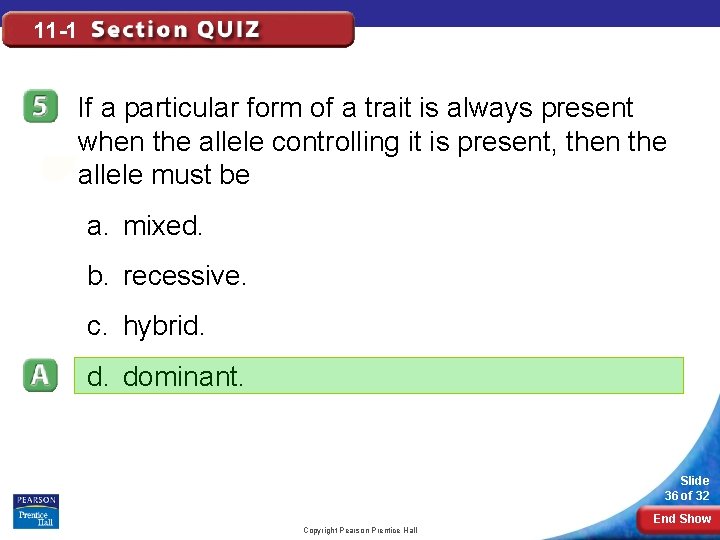
11 -1 If a particular form of a trait is always present when the allele controlling it is present, then the allele must be a. mixed. b. recessive. c. hybrid. d. dominant. Slide 36 of 32 End Show Copyright Pearson Prentice Hall
END OF SECTION