
Chapter 10 Optical burst switching TOPICS Optical packet
Chapter 10: Optical burst switching TOPICS – Optical packet switching – Optical burst switching • Connection setup schemes • Reservation/release of resources • Scheduling – The Jumpstart project Connection-Oriented Networks - Harry Perros 1
Optical burst switching (OBS) • It has not been standardized yet • It is regarded as a viable solution for transmitting bursts over an optical network • A connection is setup uniquely for the transmission of a single burst • OBS was preceded by an earlier scheme: optical packet switching (OPS) Connection-Oriented Networks - Harry Perros 2
Optical Packet Switching (OPS) • A WDM optical packet network consists of optical packet switches interconnected by WDM fiber links. • Optical packet switches operate in a slotted manner. • An optical packet are fixed-sized in time, but the actual transmission rate may vary, i. e. , the packet size may vary Connection-Oriented Networks - Harry Perros 3
WDM optical packet switches • A WDM optical packet switch consists of the following four parts: – input interfaces – the switching fabric – output interfaces, and – the control unit. Connection-Oriented Networks - Harry Perros 4
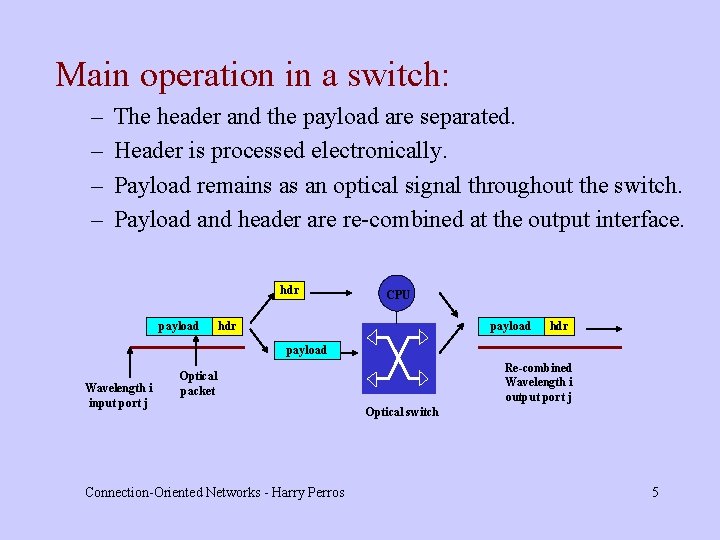
Main operation in a switch: – – The header and the payload are separated. Header is processed electronically. Payload remains as an optical signal throughout the switch. Payload and header are re-combined at the output interface. hdr payload CPU hdr payload Wavelength i input port j Re-combined Wavelength i output port j Optical packet Connection-Oriented Networks - Harry Perros Optical switch 5
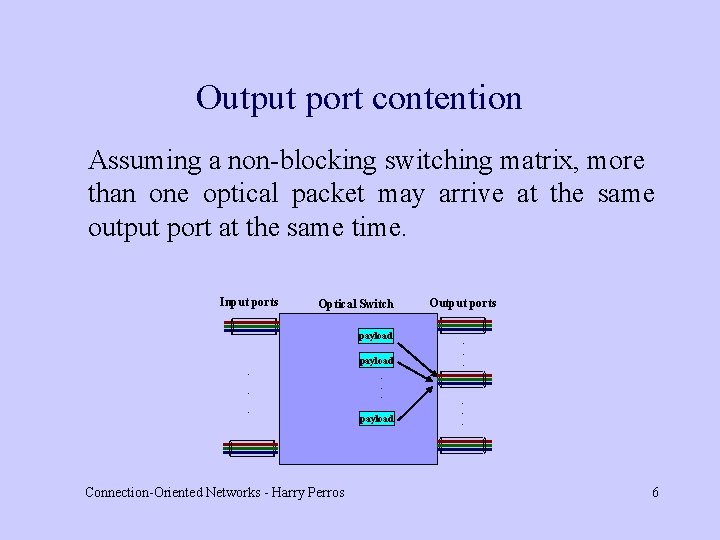
Output port contention Assuming a non-blocking switching matrix, more than one optical packet may arrive at the same output port at the same time. Input ports Optical Switch payload . . . Connection-Oriented Networks - Harry Perros payload. . . payload Output ports. . . 6
Contention resolution • Output port contention commonly arises in packet switches, and it is known as external blocking. • It is resolved by buffering all the contending packets, except one which is permitted to go out. Connection-Oriented Networks - Harry Perros 7
Techniques for resolving contention in an optical switching • optical buffering, • exploiting the wavelength domain, and • using deflection routing. Connection-Oriented Networks - Harry Perros 8
Optical buffering The Achilles' heel of OPS! • Optical buffering currently can only be implemented using fiber delay lines (FDL). • An FDL can delay an optical packet for a specified amount of time, which is related to the length of the delay line. • FDLs are not commercially viable. Connection-Oriented Networks - Harry Perros 9
FDLs • A buffer for N packets with a FIFO discipline can be implemented using N optical delay lines of different lengths. • FDL i delays an optical packet for i timeslots. • Assuming C wavelengths, FDL i may be able to store: C*i optical packets. • Limited by the length of the delay lines, this type of optical buffer is usually small, and it does not scale up. Connection-Oriented Networks - Harry Perros 10
Exploiting the wavelength domain • External blocking may be minimized by exploiting the WDM feature on a fiber link that connects two optical switches. • Two optical packets destined to go out of the same output port at the same time can be sent out on two different wavelengths. This requires converters. • This method may have some potential since the number of wavelengths that can be coupled together onto a single fiber continues to increase. Connection-Oriented Networks - Harry Perros 11
Deflection routing • When there is a conflict between two optical packets, one will be routed to the correct output port, and the other will be routed to any other available output port. • A deflected optical packet may follow a longer path to its destination. In view of this: – The end-to-end delay for an optical packet may be unacceptably high. – Optical packets may have to be re-ordered at the destination Connection-Oriented Networks - Harry Perros 12
Optical packet switch architectures • Based on the switching fabric used, they have been classified in the following three classes: – space switch fabrics, – broadcast-and-select switch fabrics, and – wavelength routing switch fabrics. Connection-Oriented Networks - Harry Perros 13
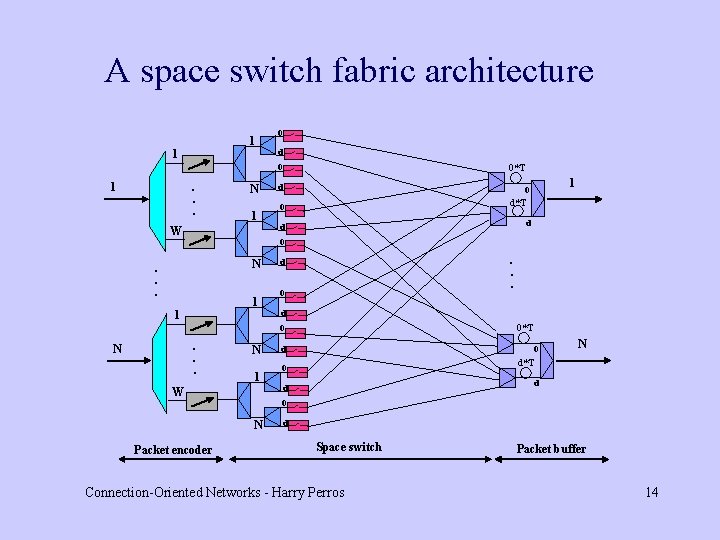
A space switch fabric architecture 1 1 0 d 0 . . . 1 N 1 W 0*T d d*T 0 d d 0 1 d . . . N 1 0 d 0*T 0 . . . N 1 0 N 1 W 0 N d*T 0 d d 0 N Packet encoder d d Space switch Connection-Oriented Networks - Harry Perros Packet buffer 14
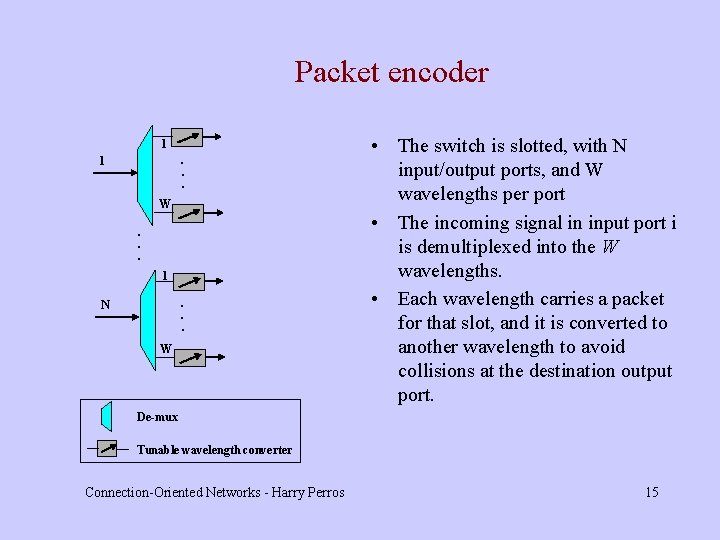
Packet encoder 1 . . . 1 W . . . 1 . . . N W • The switch is slotted, with N input/output ports, and W wavelengths per port • The incoming signal in input port i is demultiplexed into the W wavelengths. • Each wavelength carries a packet for that slot, and it is converted to another wavelength to avoid collisions at the destination output port. De-mux Tunable wavelength converter Connection-Oriented Networks - Harry Perros 15
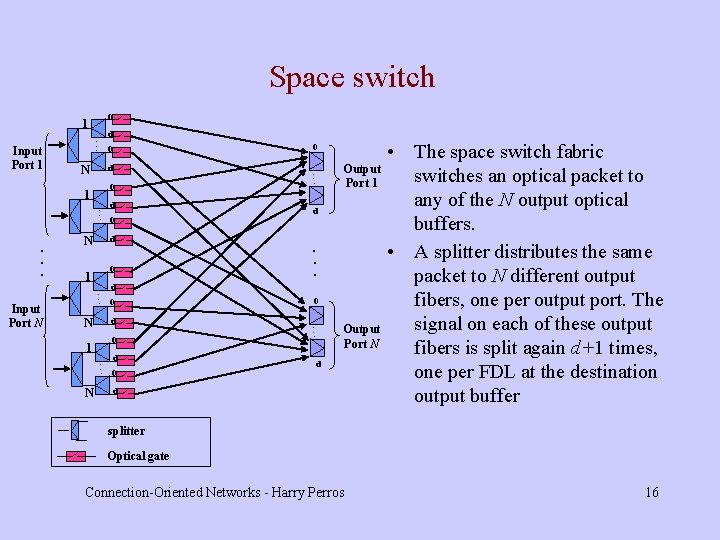
Space switch 0 1. . . Input Port 1 d 0 . . . d 0 Output Port 1 d d N . . . 0 1 d . . . 0 N 0 d . . . d 0 . . . 0 1 N . . . N 1 Input Port N 0 Output Port N d d • The space switch fabric switches an optical packet to any of the N output optical buffers. • A splitter distributes the same packet to N different output fibers, one per output port. The signal on each of these output fibers is split again d+1 times, one per FDL at the destination output buffer splitter Optical gate Connection-Oriented Networks - Harry Perros 16
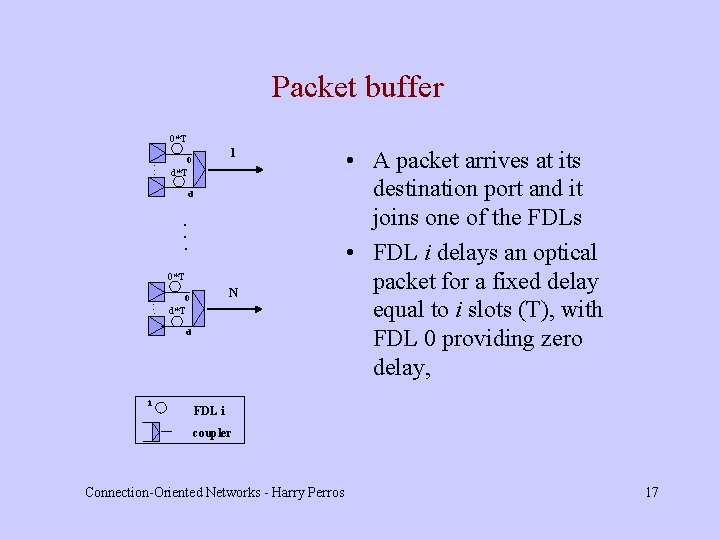
Packet buffer 0*T 1 . . . 0 d*T d . . . 0*T N 0 . . . d*T d i • A packet arrives at its destination port and it joins one of the FDLs • FDL i delays an optical packet for a fixed delay equal to i slots (T), with FDL 0 providing zero delay, FDL i coupler Connection-Oriented Networks - Harry Perros 17
Optical Burst Switching • Optical burst switching is a new technology that it is currently under study. It has not as yet been commercialized. • Unlike optical packet switching, it does not require optical buffering. • It can be seen as lying between optical packet switching and wavelength-routing networks. Connection-Oriented Networks - Harry Perros 18
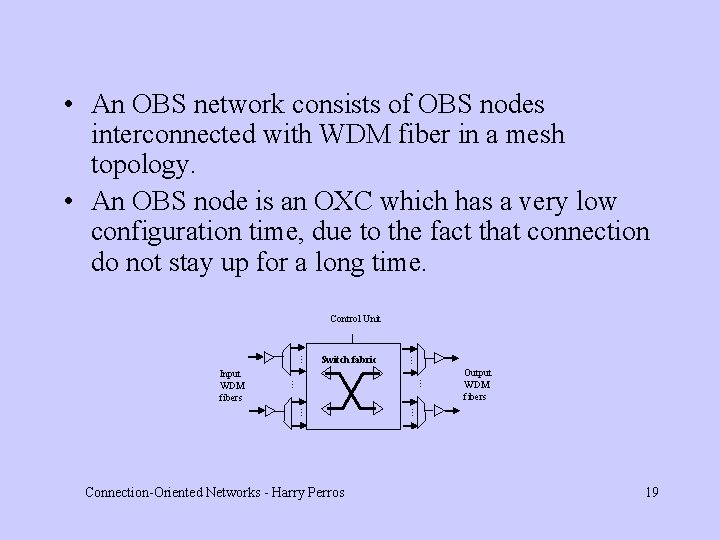
• An OBS network consists of OBS nodes interconnected with WDM fiber in a mesh topology. • An OBS node is an OXC which has a very low configuration time, due to the fact that connection do not stay up for a long time. Connection-Oriented Networks - Harry Perros … … Output WDM fibers … … Input WDM fibers Switch fabric … … Control Unit 19
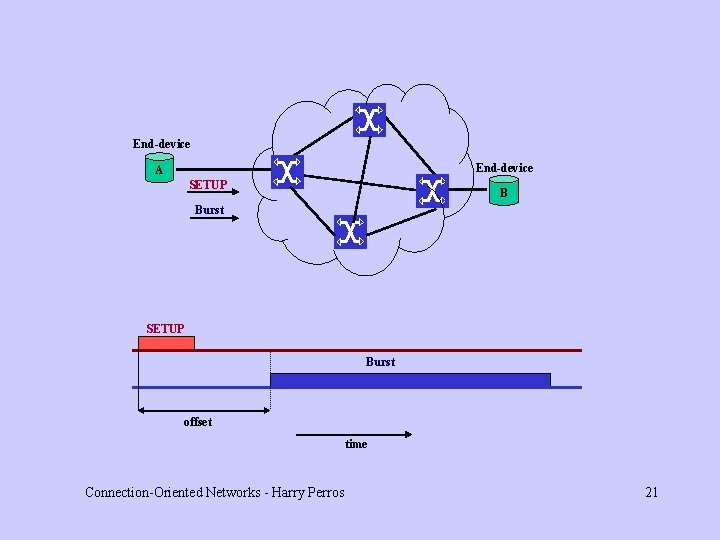
Main features of OBS networks • Each user transmits data in bursts. • For each burst, it first sends a SETUP message to the network, to announce its intention to transmit. • Transmission of the burst takes place after a delay known as offset. • The network nodes allocate resources for just this single burst. Connection-Oriented Networks - Harry Perros 20
End-device A SETUP B Burst SETUP Burst offset time Connection-Oriented Networks - Harry Perros 21
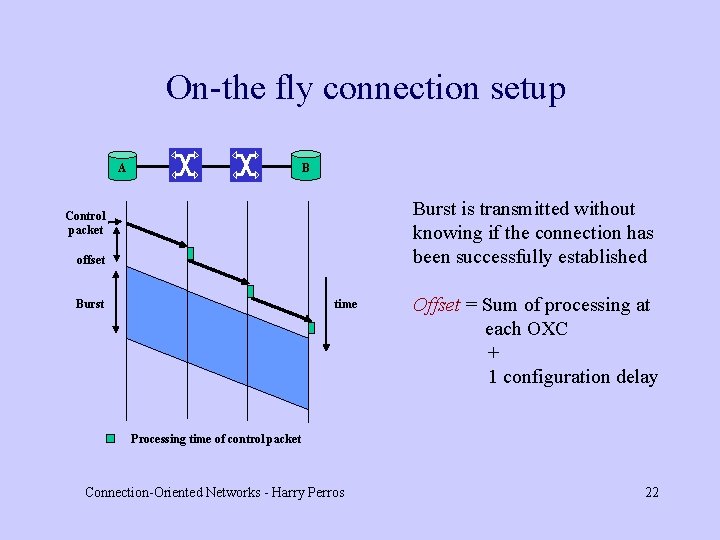
On-the fly connection setup B A Burst is transmitted without knowing if the connection has been successfully established Control packet offset Burst time Offset = Sum of processing at each OXC + 1 configuration delay Processing time of control packet Connection-Oriented Networks - Harry Perros 22
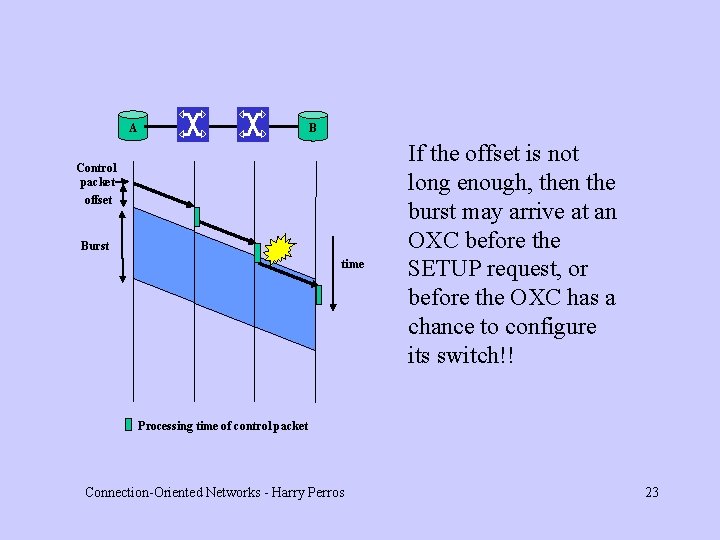
A B Control packet offset Burst time If the offset is not long enough, then the burst may arrive at an OXC before the SETUP request, or before the OXC has a chance to configure its switch!! Processing time of control packet Connection-Oriented Networks - Harry Perros 23
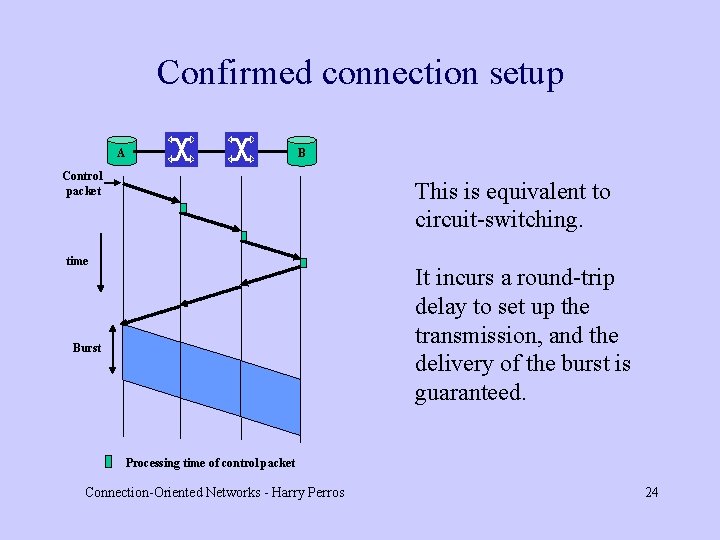
Confirmed connection setup A B Control packet This is equivalent to circuit-switching. time It incurs a round-trip delay to set up the transmission, and the delivery of the burst is guaranteed. Burst Processing time of control packet Connection-Oriented Networks - Harry Perros 24
Reservation of resources in an OXC • Immediate setup – The switch is configured immediately after the SETUP request has been processed. • Delayed setup – The SETUP request provides information that is used to estimate when to configure the switch for the incoming burst Connection-Oriented Networks - Harry Perros 25
Release of resources in an OXC • Timed burst – The control packet contains information re. the length of the burst. This permits the OXC to know when to release its resources. • Explicit release – An OXC releases the resources allocated to a burst upon receipt of an explicit release message Connection-Oriented Networks - Harry Perros 26
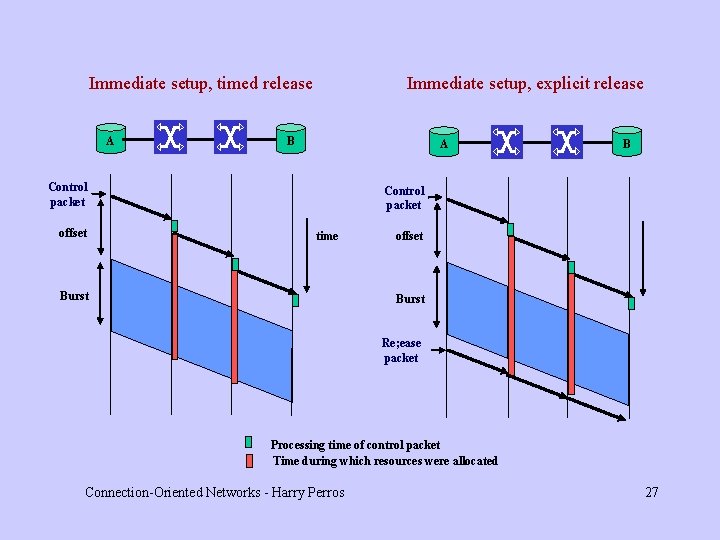
Immediate setup, timed release A Immediate setup, explicit release B A Control packet offset B Control packet time Burst offset Burst Re; ease packet Processing time of control packet Time during which resources were allocated Connection-Oriented Networks - Harry Perros 27
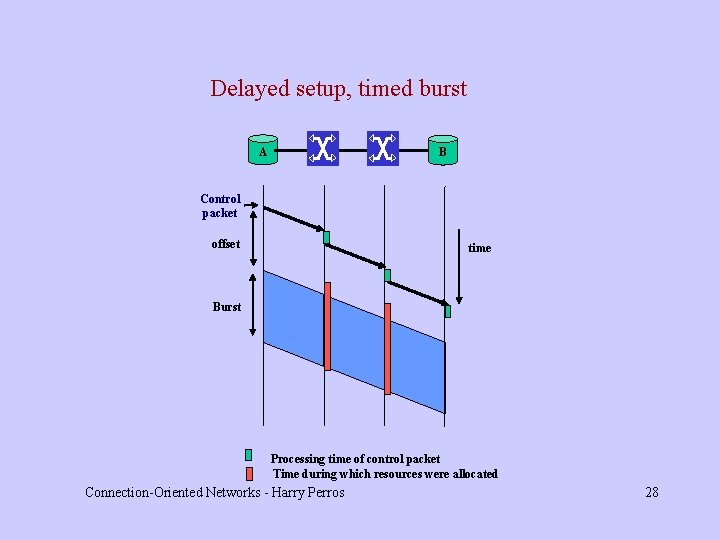
Delayed setup, timed burst A B Control packet offset time Burst Processing time of control packet Time during which resources were allocated Connection-Oriented Networks - Harry Perros 28
Classification of reservation/release schemes 1. 2. 3. 4. Immediate setup/explicit release Immediate setup/timed release Delayed setup/explicit release Delayed setup/ timed release Connection-Oriented Networks - Harry Perros 29
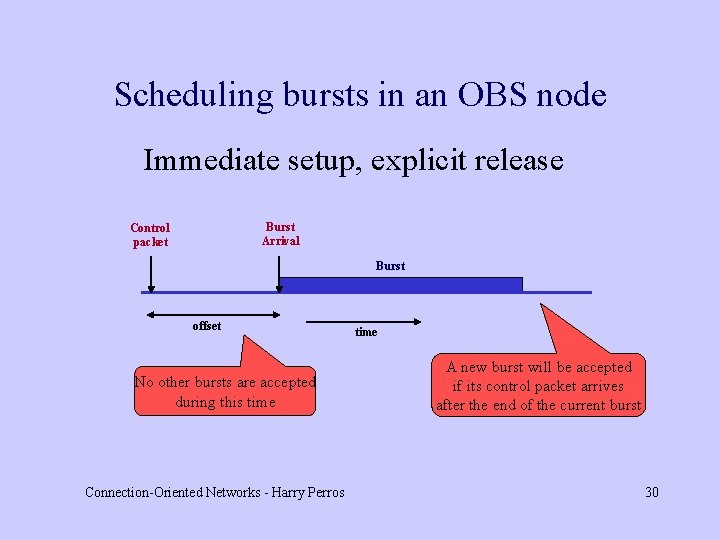
Scheduling bursts in an OBS node Immediate setup, explicit release Burst Arrival Control packet Burst offset No other bursts are accepted during this time Connection-Oriented Networks - Harry Perros time A new burst will be accepted if its control packet arrives after the end of the current burst 30
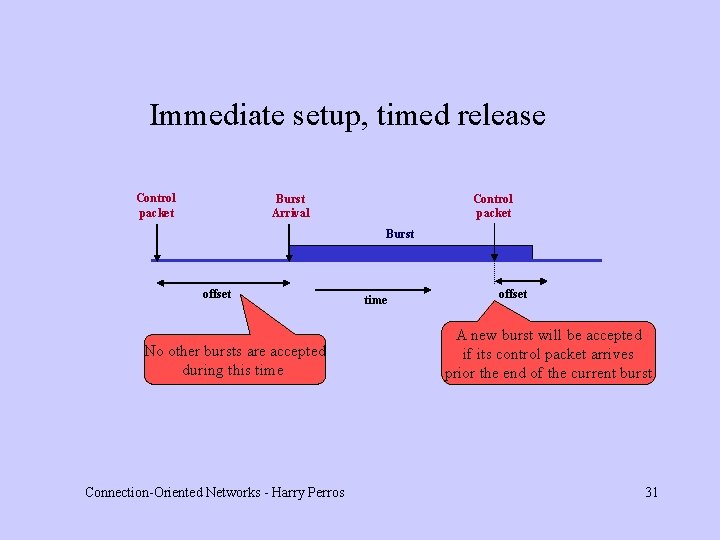
Immediate setup, timed release Control packet Burst Arrival Control packet Burst offset No other bursts are accepted during this time Connection-Oriented Networks - Harry Perros time offset A new burst will be accepted if its control packet arrives prior the end of the current burst 31
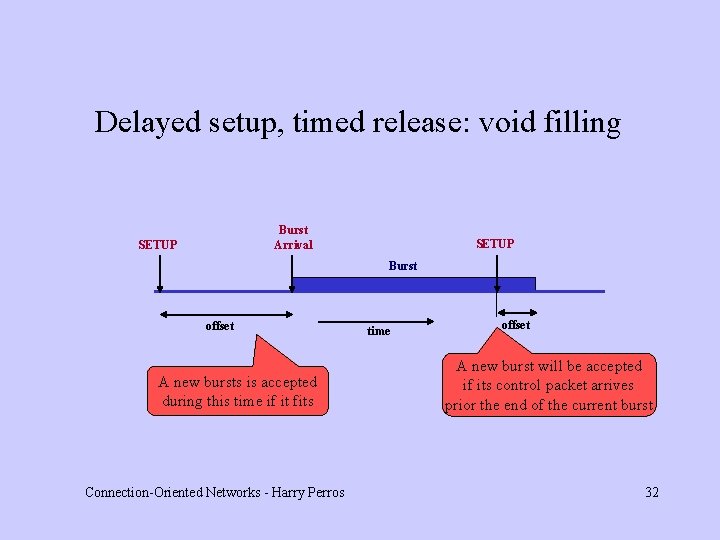
Delayed setup, timed release: void filling Burst Arrival SETUP Burst offset A new bursts is accepted during this time if it fits Connection-Oriented Networks - Harry Perros time offset A new burst will be accepted if its control packet arrives prior the end of the current burst 32
Lost bursts • A burst is blocked when upon arrival at a node, its wavelength is at the output port is not free. • Solutions: – Burst is dropped – Wavelength conversion – Deflection routing Connection-Oriented Networks - Harry Perros 33
Burst assembly • Each end-device maintains a queue for each destination end-device. • Packets arriving at the end-device are placed accordingly to the destination queues, from where they are transmitted out in bursts. • When to transmit a burst: – Timer – Max/min burst size Connection-Oriented Networks - Harry Perros 34
• When a timer expires, all packets in the queue are transmitted out in a single burst, as long as: Min. burst size < burst size Also, burst size < max. burst size • A burst can also be transmitted out if the queue size reaches the max. burst size before the timer expires. Connection-Oriented Networks - Harry Perros 35
Priorities • The end-device can also introduce priorities when transmitting bursts. • Each destination queue may be further sub-divided to a number of quality-of-service queues. The arriving packets are grouped into these queues, which are served according to a scheduler. • In addition, different timers and maximum/minimum burst sizes can be used for different queues. Connection-Oriented Networks - Harry Perros 36
The Jumpstart architecture • Jumpstart is a Do. D-funded project carried out by NC State University and MCNC, an RTPbased non-profit research organization. • The objectives of Jumpstart are: – Define an architecture for signaling in OBS networks and demonstrate proof of concept – Define a routing architecture for OBS networks and demonstrate proof of concept. Connection-Oriented Networks - Harry Perros 37
Features – Jumpstart uses the immediate setup with timed or explicit release. – Both on-the-fly and confirmed connection setup methods are used. – Uses out-of-band packet-based signaling (ATM network) – The signaling messages for establishment and tearing down of a connection are processed by the OBS nodes in hardware to assure fast connections. Connection-Oriented Networks - Harry Perros 38
Basic signaling messages • The following signaling messages have been defined for the basic operation of an OBS network: – – – SETUP ACK KEEP ALIVE RELEASE CONNECT FAILURE Connection-Oriented Networks - Harry Perros 39
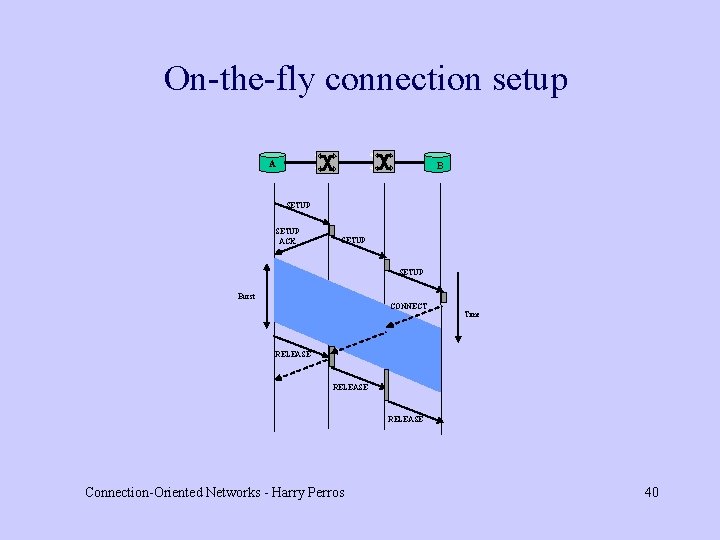
On-the-fly connection setup A B SETUP ACK SETUP Burst CONNECT Time RELEASE Connection-Oriented Networks - Harry Perros 40
KEEP ALIVE messages • In the case of explicit release, to guard against lost RELEASE messages, the control unit of each OBS node associates the transmission of a burst with a timer. • The control unit assumes that the transmission of a burst has been completed if the timer expires and it has not received a RELEASE message. • In view of this, when an end-device transmits a very long burst, it must periodically send to the network KEEP ALIVE messages which are used by each control unit to reset the timer. Connection-Oriented Networks - Harry Perros 41
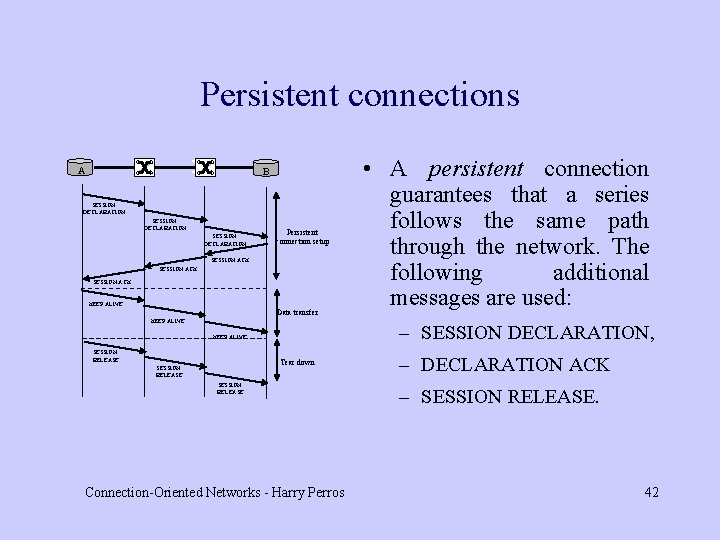
Persistent connections A B SESSION DECLARATION Persistent connection setup SESSION ACK KEEP ALIVE Data transfer KEEP ALIVE – SESSION DECLARATION, KEEP ALIVE SESSION RELEASE Tear down SESSION RELEASE • A persistent connection guarantees that a series follows the same path through the network. The following additional messages are used: SESSION RELEASE Connection-Oriented Networks - Harry Perros – DECLARATION ACK – SESSION RELEASE. 42
The signaling message structure • Signaling messages are structured so that they can be partly processed in hardware and partly in software. • The information carried in a message is organized in information elements (IEs): – Hardpath IEs (processed in hardware) – Softpath IEs (processed in software) • IE structure: TLV (type, length, value) Connection-Oriented Networks - Harry Perros 43
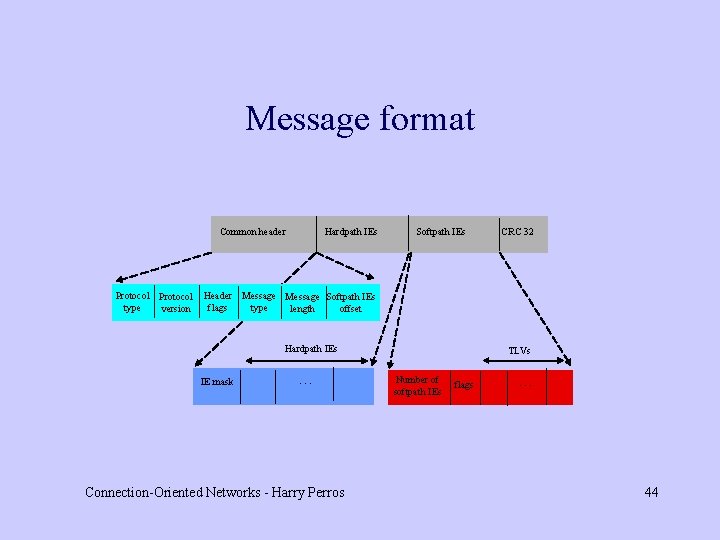
Message format Common header Protocol type version Hardpath IEs Softpath IEs CRC 32 Header Message Softpath IEs flags type length offset Hardpath IEs IE mask . . . Connection-Oriented Networks - Harry Perros TLVs Number of softpath IEs flags . . . 44
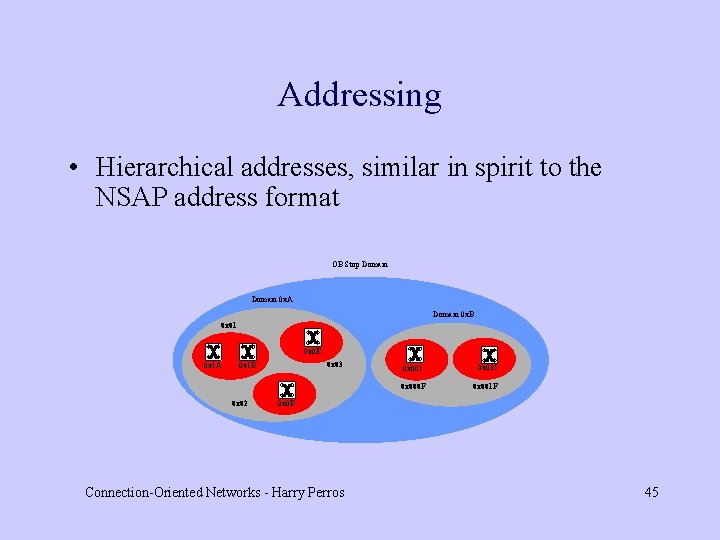
Addressing • Hierarchical addresses, similar in spirit to the NSAP address format OBS top Domain 0 x. A Domain 0 x. B 0 x 01 0 x 0 E 0 x 1 A 0 x 03 0 x 1 B 0 x 001 0 x 000 F 0 x 02 0 x 035 0 x 001 F 0 x 0 B Connection-Oriented Networks - Harry Perros 45
JITPAC: The Jumpstart signaling processing engine • The JITPAC processes SETUP/RELEASE messages and controls the optical fiber. • Hardware-based • Uses ATM/AAL 5 frames for signaling • Controls the OXC (2 D MEMS) via RPC calls done over dedicated Ethernet. Connection-Oriented Networks - Harry Perros 46
Main operation: SETUP message • JITPAC receives a SETUP message. • Using the destination address it looks up the next hop (i. e. the output port number). • Instructs the switch fabric to setup the path from input to output. • Forwards the SETUP message to the JITPAC of the next hop OXC. Connection-Oriented Networks - Harry Perros 47
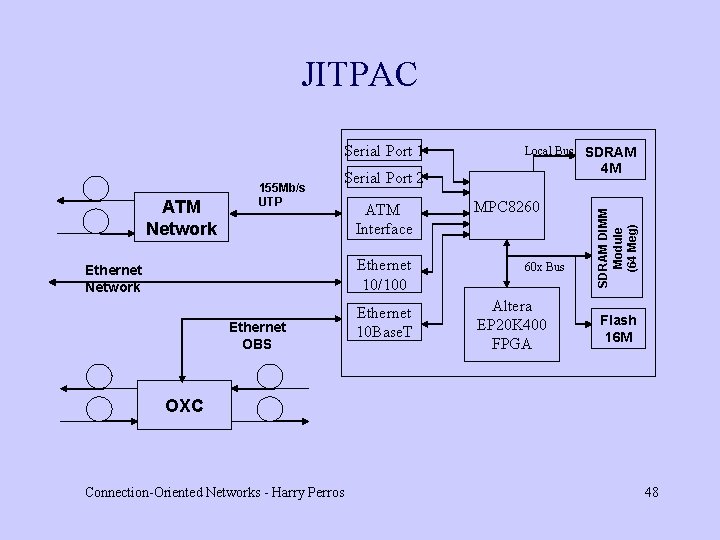
JITPAC ATM Network 155 Mb/s UTP Ethernet OBS 4 M Serial Port 2 ATM Interface Ethernet 10/100 Ethernet Network Local Bus SDRAM Ethernet 10 Base. T MPC 8260 60 x Bus Altera EP 20 K 400 FPGA SDRAM DIMM Module (64 Meg) Serial Port 1 Flash 16 M OXC Connection-Oriented Networks - Harry Perros 48
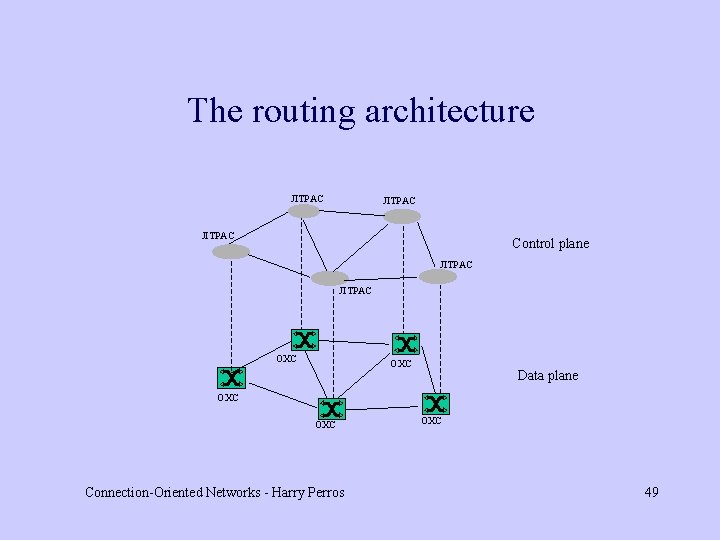
The routing architecture JITPAC Control plane JITPAC OXC Data plane OXC Connection-Oriented Networks - Harry Perros OXC 49
Features • Different routing architectures for control messages and data bursts are used. • Signaling messages were not considered, since they use the same routes as the data bursts. • Each JITPAC maintains two logical forwarding tables: the control forwarding table, and the burst forwarding table. • Two separate and independent path computation components were defined for the control forwarding table and the burst forwarding table. Connection-Oriented Networks - Harry Perros 50
The routing architecture for control messages • The control plane was implemented on an electrical packet-switched network. • The primary routing goal is the computation of shortest paths between JITPAC controllers to enable the efficient exchange of control messages. • To that effect a link-state protocol such as OSPF or IS-IS can be used to establish paths for control messages. Connection-Oriented Networks - Harry Perros 51
Routing architecture for data bursts • A centralized architecture is used for computing paths for data bursts within a network domain. • The path computation is the responsibility of the Routing Data Node (RDN), a server attached to one of the OBS nodes. It is responsible for – collecting routing information regarding the data plane, – computing the burst forwarding tables for each JITPAC controller, and – downloading the tables to the JITPAC controllers. Connection-Oriented Networks - Harry Perros 52
- Slides: 52