
Chapter 10 Nutrition Across the Life Span Copyright

- Slides: 72
Chapter 10 Nutrition Across the Life Span Copyright © 2016, 2012, 2007 by Mosby, an imprint of Elsevier Inc.
Learning Objectives Discuss nutrient needs during pregnancy. Explain the process of lactation and the benefits of breastfeeding for mother and infant. Identify sound nutrition practices during the first year of life. Compare and contrast the nutrient requirements, eating styles, food choices, and community supports for childhood, adolescence, and adulthood. Copyright © 2016, 2012, 2007 by Mosby, an imprint of Elsevier Inc. 2
Objectives (Cont. ) Describe approaches to prevent food asphyxiation, lead poisoning, overweight/diabetes, and iron deficiency during childhood and adolescence. Summarize nutrition strategies to reduce risk of the chronic disorders osteoporosis, cardiovascular disease, hypertension, and obesity. Copyright © 2016, 2012, 2007 by Mosby, an imprint of Elsevier Inc. 3
Role in Wellness Health promotion leading to positive health behaviors may depend on Knowledge: learning new information about benefits or risks of behaviors Ø Techniques: strategies to apply new knowledge Ø Community supports: environmental or regulatory measures available to support health-promoting behaviors within a social context Ø Copyright © 2016, 2012, 2007 by Mosby, an imprint of Elsevier Inc. 4
Nutrition During Pregnancy Successful pregnancy outcomes include Viability and acceptable birth weight of infant Ø No congenital defects in infant Ø Favorable long-term health outlook for mother and infant Ø Copyright © 2016, 2012, 2007 by Mosby, an imprint of Elsevier Inc. 5
Nutrition During Pregnancy (Cont. ) Body composition changes during pregnancy Many metabolic, anatomic, hormonal, psychologic, and physiologic changes in mother Ø Hormones of pregnancy Ø • Placental hormones: human placental lactogen and human growth hormone • Progesterone • Estrogen Copyright © 2016, 2012, 2007 by Mosby, an imprint of Elsevier Inc. 6
Nutrition During Pregnancy (Cont. ) Metabolic changes Basal metabolic rate (BMR) increases 15% to 20% by end of pregnancy Ø Mother uses fat as fuel; fetus uses glucose Ø Anatomic and physiologic changes Ø Changes in blood • Plasma volume doubles • Hemodilution Copyright © 2016, 2012, 2007 by Mosby, an imprint of Elsevier Inc. 7
Nutrition During Pregnancy (Cont. ) Ø Renal changes • Increase in glomerular filtration rate (GFR) • Possible serious problem: preeclampsia or pregnancyinduced hypertension Ø Gastrointestinal (GI) changes • Slower GI motility • Smooth muscle relaxation • Consequences of GI changes: constipation, heartburn, delayed gastric emptying Copyright © 2016, 2012, 2007 by Mosby, an imprint of Elsevier Inc. 8
Nutrition During Pregnancy (Cont. ) Weight gain in pregnancy Ø Three components of maternal weight gain • Changes in maternal body composition: increased blood and fluid volume • Maternal support tissues • Products of conception (fetus and placenta) Ø Consequences of inadequate weight gain • Low birth weight • Small for gestation age (SGA) status Copyright © 2016, 2012, 2007 by Mosby, an imprint of Elsevier Inc. 9
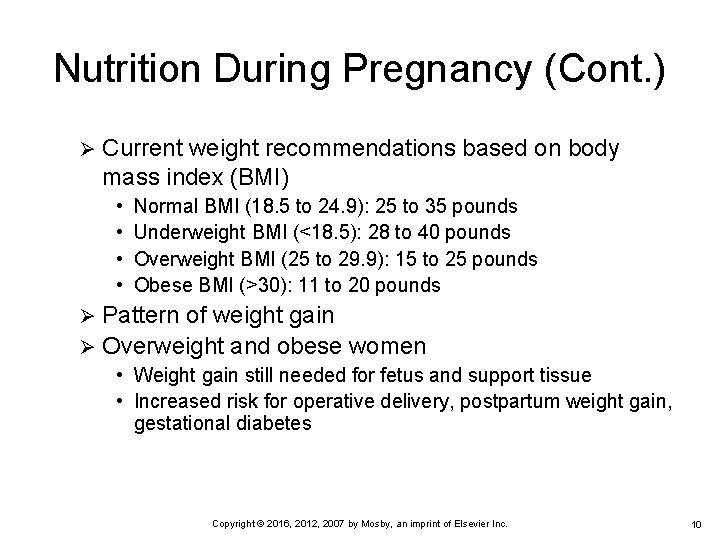
Nutrition During Pregnancy (Cont. ) Ø Current weight recommendations based on body mass index (BMI) • • Normal BMI (18. 5 to 24. 9): 25 to 35 pounds Underweight BMI (<18. 5): 28 to 40 pounds Overweight BMI (25 to 29. 9): 15 to 25 pounds Obese BMI (>30): 11 to 20 pounds Pattern of weight gain Ø Overweight and obese women Ø • Weight gain still needed for fetus and support tissue • Increased risk for operative delivery, postpartum weight gain, gestational diabetes Copyright © 2016, 2012, 2007 by Mosby, an imprint of Elsevier Inc. 10
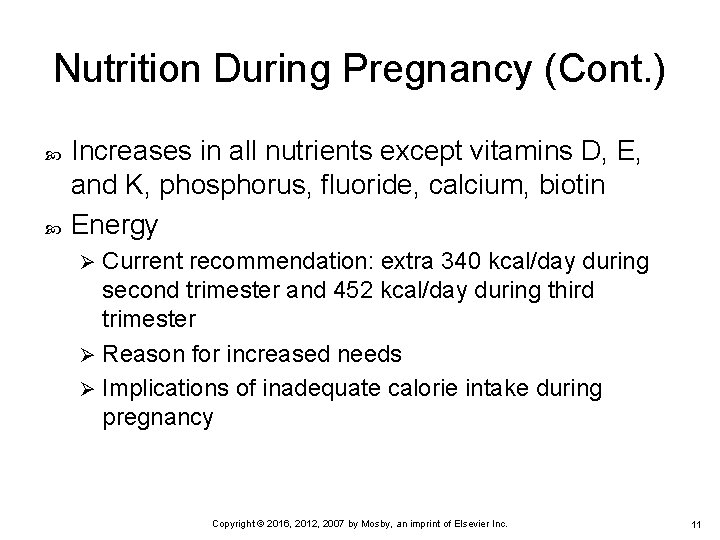
Nutrition During Pregnancy (Cont. ) Increases in all nutrients except vitamins D, E, and K, phosphorus, fluoride, calcium, biotin Energy Current recommendation: extra 340 kcal/day during second trimester and 452 kcal/day during third trimester Ø Reason for increased needs Ø Implications of inadequate calorie intake during pregnancy Ø Copyright © 2016, 2012, 2007 by Mosby, an imprint of Elsevier Inc. 11
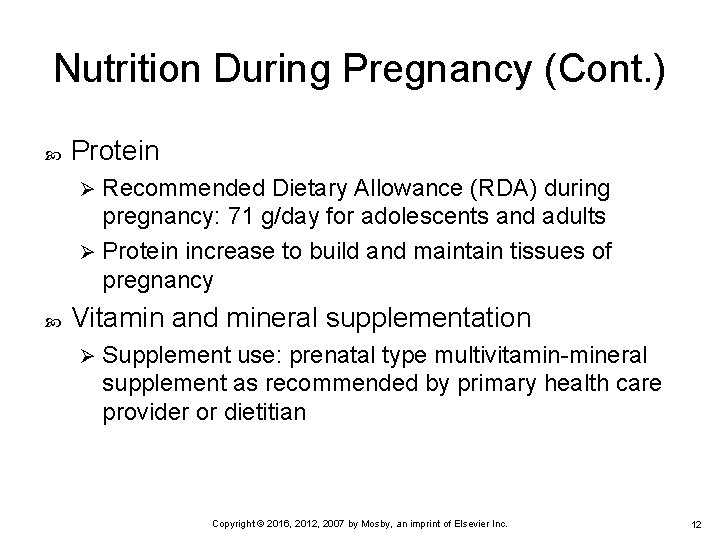
Nutrition During Pregnancy (Cont. ) Protein Recommended Dietary Allowance (RDA) during pregnancy: 71 g/day for adolescents and adults Ø Protein increase to build and maintain tissues of pregnancy Ø Vitamin and mineral supplementation Ø Supplement use: prenatal type multivitamin-mineral supplement as recommended by primary health care provider or dietitian Copyright © 2016, 2012, 2007 by Mosby, an imprint of Elsevier Inc. 12
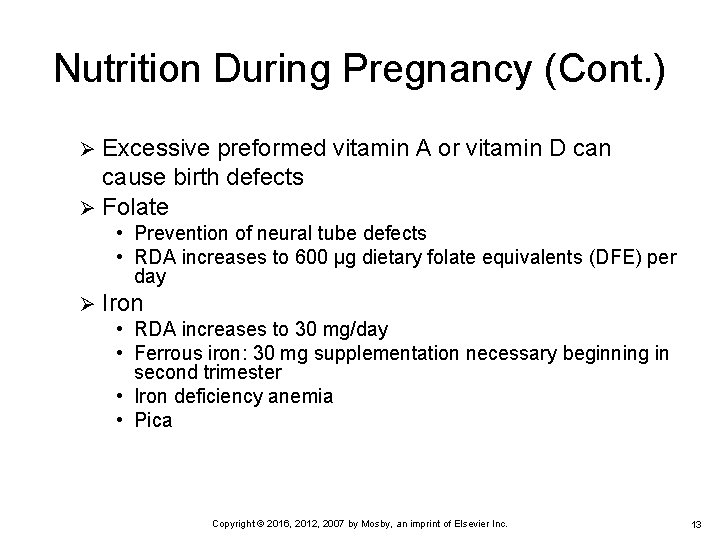
Nutrition During Pregnancy (Cont. ) Excessive preformed vitamin A or vitamin D can cause birth defects Ø Folate Ø • Prevention of neural tube defects • RDA increases to 600 µg dietary folate equivalents (DFE) per day Ø Iron • RDA increases to 30 mg/day • Ferrous iron: 30 mg supplementation necessary beginning in second trimester • Iron deficiency anemia • Pica Copyright © 2016, 2012, 2007 by Mosby, an imprint of Elsevier Inc. 13
Nutrition During Pregnancy (Cont. ) Vitamin and mineral supplementation, cont’d Ø Calcium • Adequate Intake (AI): 1000 mg for pregnant adult women; 1300 mg for pregnant adolescents (no increase over nonpregnant levels) • Use of maternal stores to provide needs of fetus Copyright © 2016, 2012, 2007 by Mosby, an imprint of Elsevier Inc. 14
Nutrition-Related Pregnancy Concerns Alcohol Ø Fetal alcohol syndrome (FAS)/fetal alcohol spectrum disorder (FASD); causes specific anatomic and central nervous system defects; no safe level Foodborne illness High risk for acquiring infections from Listeria monocytogenes, Salmonella species, and Toxoplasma gondii Copyright © 2016, 2012, 2007 by Mosby, an imprint of Elsevier Inc. 15
Nutrition-Related Pregnancy Concerns (Cont. ) Maternal age Ø Risk factors for adolescents • Growth pattern of mother; psychologic maturity • Lack of economic resources; delay in medical care • Nutrient intake: often poor Ø Risk factors for women older than 35 • Distinct nutrient needs; longer medical history • Gestational diabetes Copyright © 2016, 2012, 2007 by Mosby, an imprint of Elsevier Inc. 16
Nutrition-Related Pregnancy Concerns (Cont. ) Preeclampsia (pregnancy-induced hypertension) Some symptoms: sudden severe rise in arterial blood pressure; rapid weight gain; marked edema Ø Risk factors Ø Nutrition support: well-balanced diet, generous protein and sufficient energy intake Ø Experimental treatments Ø Copyright © 2016, 2012, 2007 by Mosby, an imprint of Elsevier Inc. 17
Nutrition-Related Pregnancy Concerns (Cont. ) Diabetes mellitus Preexisting diabetes (types 1 and 2 diabetes mellitus) necessitates specialized care Ø Risks to fetus Ø • Increased risk of birth defects, macrosomia, hyperbilirubinemia, and erythema • Risk of hypoglycemia after birth Ø Risks to diabetic mother Copyright © 2016, 2012, 2007 by Mosby, an imprint of Elsevier Inc. 18
Nutrition-Related Pregnancy Concerns (Cont. ) Control/treatment Decreased risks when diabetes is controlled Ø Blood glucose monitoring; adherence to diet; moderate exercise; prescribed insulin Ø Gestational diabetes mellitus Screening during second trimester Ø Treatment: dietary control with moderate exercise; insulin if needed Ø Risk factors Ø Copyright © 2016, 2012, 2007 by Mosby, an imprint of Elsevier Inc. 19
Nutrition-Related Pregnancy Concerns (Cont. ) Maternal phenylketonuria Inborn error of metabolism of phenylalanine Ø Mother: strict adherence to diet low in phenylalanine; infant: supplementation with tyrosine beginning in first week of life Ø Failure to detect disease or lack of compliance with dietary therapy: results in irreversible mental retardation Ø Copyright © 2016, 2012, 2007 by Mosby, an imprint of Elsevier Inc. 20
Nutrition-Related Pregnancy Concerns (Cont. ) Human immunodeficiency virus (HIV) infection Effects on immune system: immunosuppressive effects of hormones and proteins of pregnancy Ø Nutritional considerations Ø • Opportunistic infection increases need for kilocalories, protein, vitamins, and minerals Ø Weight gain must be strictly monitored • No specialized weight gain recommendations Copyright © 2016, 2012, 2007 by Mosby, an imprint of Elsevier Inc. 21
Common Nutrition-Related Discomforts of Pregnancy Nausea and vomiting Morning sickness Ø Hyperemesis gravidarum: severe and unrelenting vomiting Ø Strategies: Ø • • • Eat small frequent meals Drink liquids between, rather than with, meals Avoid fried and greasy foods Reduce coffee intake Avoid cooking odors Copyright © 2016, 2012, 2007 by Mosby, an imprint of Elsevier Inc. 22
Common Nutrition-Related Discomforts of Pregnancy (Cont. ) Heartburn Possible contributors Ø Strategies: Ø • • • Eat small, frequent meals Avoid foods high in fat Drink fluids between meals Limit spicy foods Avoid lying down after a meal Copyright © 2016, 2012, 2007 by Mosby, an imprint of Elsevier Inc. 23
Common Nutrition-Related Discomforts of Pregnancy (Cont. ) Constipation Common during first and third trimesters Ø Strategies: Ø • Increase fluid and fiber consumption • Perform moderate exercise Ø Hemorrhoids Copyright © 2016, 2012, 2007 by Mosby, an imprint of Elsevier Inc. 24
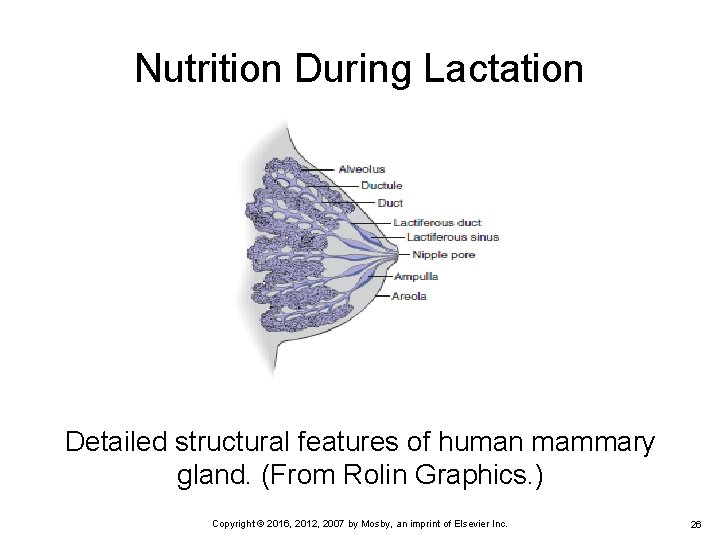
Nutrition During Lactation Introduction to breastfeeding History and incidence Ø Recommended: at least 6 months; ideally through first 12 months with appropriate weaning foods Ø Benefits of breastfeeding for mother and infant Ø Anatomy and physiology of lactation Anatomy: milk-producing glands Ø Changes during pregnancy Ø • Influence of progesterone Copyright © 2016, 2012, 2007 by Mosby, an imprint of Elsevier Inc. 25
Nutrition During Lactation Detailed structural features of human mammary gland. (From Rolin Graphics. ) Copyright © 2016, 2012, 2007 by Mosby, an imprint of Elsevier Inc. 26
Nutrition During Lactation (Cont. ) Ø Hormonal control of lactation • Prolactin: responsible for milk synthesis • Oxytocin: involved with milk ejection from breast: letdown reflex • Supply-and-demand mechanism Ø Promoting breastfeeding • Baby-Friendly Hospital Initiative • Cultural considerations: acceptability of lactation Copyright © 2016, 2012, 2007 by Mosby, an imprint of Elsevier Inc. 27
Nutrition During Lactation (Cont. ) Energy and nutrient needs during lactation Energy: 500 to 800 kcal expenditure to produce breast milk each day Ø Protein: 71 g/day Ø Fluid: 750 to 1000 m. L lost in milk production Ø Rapid weight loss discouraged Ø Nutrition-related concerns Contraindications to breastfeeding Ø Medications; HIV and acquired immunodeficiency syndrome (AIDS); maternal hepatitis C Ø Copyright © 2016, 2012, 2007 by Mosby, an imprint of Elsevier Inc. 28
Nutrition During Infancy Energy and nutrient needs Ø Energy: • Adequate energy reflected in satisfactory gains in length and weight • No low-fat diets • Omega-3 fatty acids Copyright © 2016, 2012, 2007 by Mosby, an imprint of Elsevier Inc. 29
Nutrition During Infancy (Cont. ) Ø Protein: needs highest during first 4 months; 1. 6 g/kg/day for second 6 months • Excess protein affects renal solute load Ø Vitamins and mineral supplementation • Provided by breast milk or commercial formulas Ø Iron: fetal iron stores depleted by age 4 months • Iron from breast milk more absorbable; no supplementation • If formula is iron fortified, no supplementation Copyright © 2016, 2012, 2007 by Mosby, an imprint of Elsevier Inc. 30
Nutrition During Infancy (Cont. ) Vitamin D: supplementation recommended for breastfed infants Ø Fluoride: supplementation not recommended before age 6 months; need dependent on water supply Ø Vitamin K: administered shortly after birth by injection or orally Ø Copyright © 2016, 2012, 2007 by Mosby, an imprint of Elsevier Inc. 31
Nutrition During Infancy (Cont. ) From birth to 4 to 6 months of age Breastfeeding: on demand versus schedules Ø Formula: types, preparation, and storage Ø Use of cow’s milk introduced after age 1 Ø • Reduced-fat or nonfat milk after age 2 Copyright © 2016, 2012, 2007 by Mosby, an imprint of Elsevier Inc. 32
Nutrition During Infancy (Cont. ) Introduction of solid food Ø Begin between ages 4 and 6 months How to introduce solids Developmental readiness signs for starting solids Ø Food to introduce at start Ø Satiety cues Ø Self-feeding: ages 9 to 12 months Ø Copyright © 2016, 2012, 2007 by Mosby, an imprint of Elsevier Inc. 33
Nutrition During Infancy (Cont. ) Appropriate solid foods during first year of life Second half of first year of life: transitional period Ø Allergies: introduce solid food gradually Ø Home-prepared foods, commercial foods, or both Ø Variety Ø Beverages during the first year of life Monitor fruit juice consumption. Ø All juices must be pasteurized. Ø Copyright © 2016, 2012, 2007 by Mosby, an imprint of Elsevier Inc. 34
Nutrition During Infancy (Cont. ) Nutrition-related concerns Ø Congenital or acquired health problems Premature and low-birth-weight infants Potential physiologic problems Ø Feeding options Ø Increased nutritional needs Ø Long-chain fatty acids Ø Copyright © 2016, 2012, 2007 by Mosby, an imprint of Elsevier Inc. 35
Nutrition During Infancy (Cont. ) Failure to thrive Organic Ø Nonorganic Ø Inborn errors of metabolism Phenylketonuria Ø Galactosemia Ø Copyright © 2016, 2012, 2007 by Mosby, an imprint of Elsevier Inc. 36
Pregnancy, Lactation, and Infancy Health Promotion Knowledge Familiarity with the changes and nutrient needs that occur during and after pregnancy Ø Infant nutrient needs provided by parents/caregivers Ø Techniques Ø Resources from government and medical associations Community Supports Special Supplemental Nutrition Program for Women, Infants, and Children (WIC) Ø Special interest groups such as La. Leche League Ø Copyright © 2016, 2012, 2007 by Mosby, an imprint of Elsevier Inc. 37
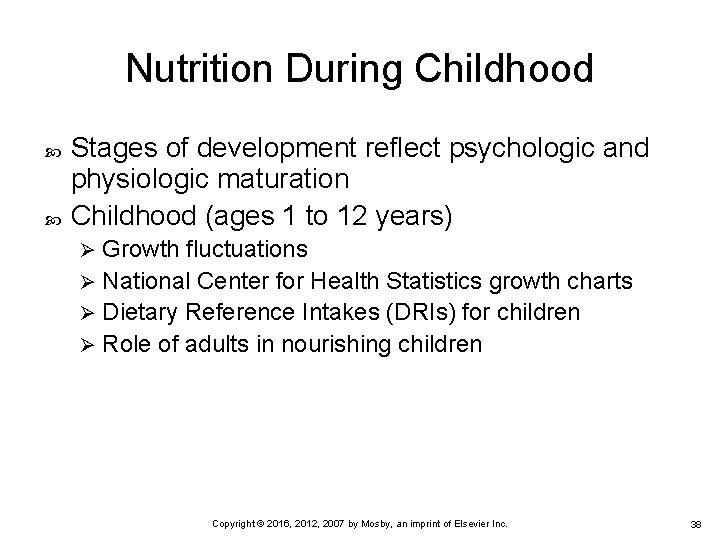
Nutrition During Childhood Stages of development reflect psychologic and physiologic maturation Childhood (ages 1 to 12 years) Growth fluctuations Ø National Center for Health Statistics growth charts Ø Dietary Reference Intakes (DRIs) for children Ø Role of adults in nourishing children Ø Copyright © 2016, 2012, 2007 by Mosby, an imprint of Elsevier Inc. 38
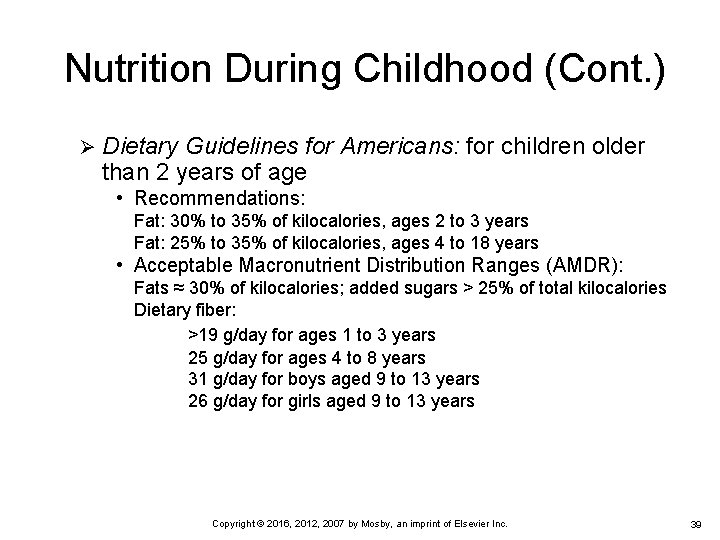
Nutrition During Childhood (Cont. ) Ø Dietary Guidelines for Americans: for children older than 2 years of age • Recommendations: Fat: 30% to 35% of kilocalories, ages 2 to 3 years Fat: 25% to 35% of kilocalories, ages 4 to 18 years • Acceptable Macronutrient Distribution Ranges (AMDR): Fats ≈ 30% of kilocalories; added sugars > 25% of total kilocalories Dietary fiber: >19 g/day for ages 1 to 3 years 25 g/day for ages 4 to 8 years 31 g/day for boys aged 9 to 13 years 26 g/day for girls aged 9 to 13 years Copyright © 2016, 2012, 2007 by Mosby, an imprint of Elsevier Inc. 39
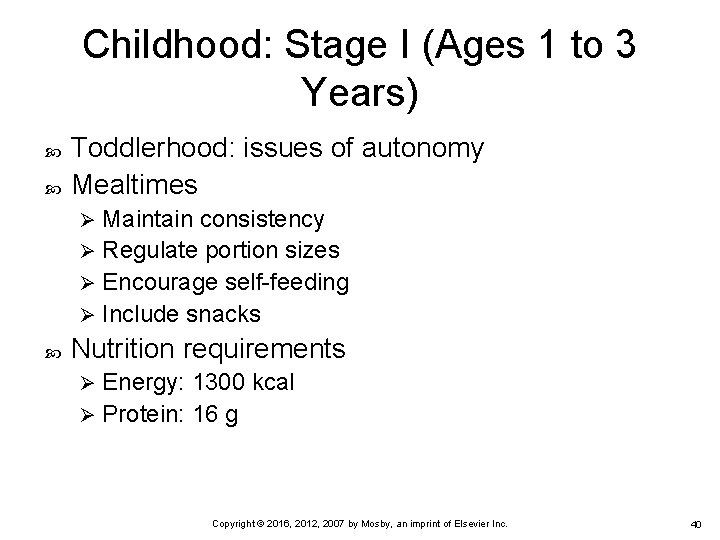
Childhood: Stage I (Ages 1 to 3 Years) Toddlerhood: issues of autonomy Mealtimes Maintain consistency Ø Regulate portion sizes Ø Encourage self-feeding Ø Include snacks Ø Nutrition requirements Energy: 1300 kcal Ø Protein: 16 g Ø Copyright © 2016, 2012, 2007 by Mosby, an imprint of Elsevier Inc. 40
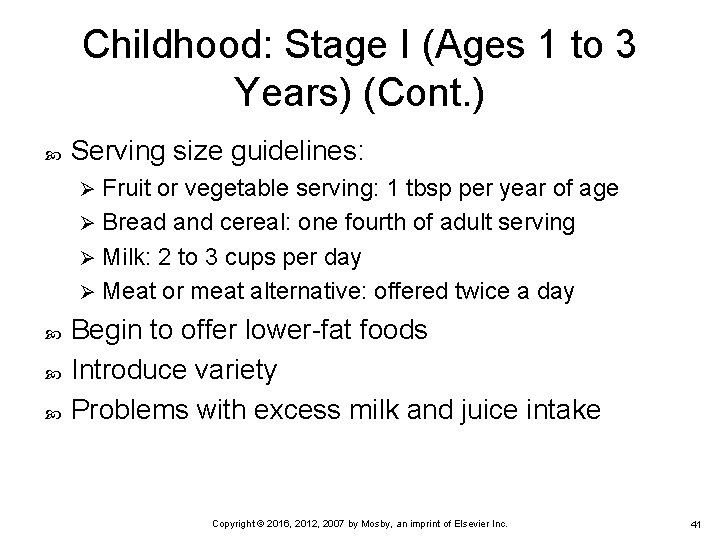
Childhood: Stage I (Ages 1 to 3 Years) (Cont. ) Serving size guidelines: Fruit or vegetable serving: 1 tbsp per year of age Ø Bread and cereal: one fourth of adult serving Ø Milk: 2 to 3 cups per day Ø Meat or meat alternative: offered twice a day Ø Begin to offer lower-fat foods Introduce variety Problems with excess milk and juice intake Copyright © 2016, 2012, 2007 by Mosby, an imprint of Elsevier Inc. 41
Childhood: Stage II (Ages 4 to 6 Years) Eating characteristics Independence Ø Variable hunger and appetite levels Ø Continued introduction of new foods Ø Food jags Ø Nutrition requirements Energy: 1800 kcal Ø Protein: 24 g Ø Copyright © 2016, 2012, 2007 by Mosby, an imprint of Elsevier Inc. 42
Childhood: Stage III (Ages 7 to 12 Years) Growth slows, but body is preparing for growth spurt of puberty Ø May be reflected in prepuberty weight gain Encourage staying in touch with internal cues of hunger and being physically active Peer influences increase Healthy snack options Copyright © 2016, 2012, 2007 by Mosby, an imprint of Elsevier Inc. 43
Childhood: Stage III (Ages 7 to 12 Years) (Cont. ) Nutrition requirements Energy: 2000 to 2200 kcal Ø Protein: 28 to 46 g, depending on sexual maturity Ø Calcium requirements: AI increases from 800 mg at age 8 to 1300 mg throughout adolescence Ø Iron and zinc requirements increase Ø Copyright © 2016, 2012, 2007 by Mosby, an imprint of Elsevier Inc. 44
Health Promotion During Childhood (Ages 1 to 12 Years) Knowledge Relationship of nutrients and kilocalories to growth needs Ø Role of adults in providing nourishment and health guidance Ø Techniques My. Plate Kids’ Place Ø Fruits & Veggies—More Matters Ø Copyright © 2016, 2012, 2007 by Mosby, an imprint of Elsevier Inc. 45
Health Promotion During Childhood (Ages 1 to 12 Years) (Cont. ) Community Supports Ø School food service • • • Ø Entitlement programs National School Lunch Program Lunch and breakfast programs Current recommendations for meal content Summer Food Service Program for Children Classroom nutrition education Copyright © 2016, 2012, 2007 by Mosby, an imprint of Elsevier Inc. 46
Nutrition During Adolescence (Ages 13 to 19 Years) Responsibility for own behavior increases, but adult guidance still required Ø Physical and emotional support of adults • Guidelines for dietary patterns • Providing food for consumption Adjusting to demands of college environment Ø Influence of fast food Ø Copyright © 2016, 2012, 2007 by Mosby, an imprint of Elsevier Inc. 47
Nutrition During Adolescence (Ages 13 to 19 Years) (Cont. ) Nutrition requirements Energy: 2300 to 2900 kcal for male adolescents; 2200 kcal for female adolescents Ø Protein: 45 to 59 g for male adolescents; 45 g for female adolescents Ø Calcium: AI, 1300 mg Ø Risk for diet-related disorders and eating disorders Copyright © 2016, 2012, 2007 by Mosby, an imprint of Elsevier Inc. 48
Health Promotion During Adolescence (Ages 13 to 19 Years) Knowledge High-energy needs for sports and growth Ø Calcium for bone mineralization Ø School-based curriculum on nutrient needs Ø Effects of disordered eating and substance abuse on nutritional status Ø Copyright © 2016, 2012, 2007 by Mosby, an imprint of Elsevier Inc. 49
Health Promotion During Adolescence (Ages 13 to 19 Years) (Cont. ) Techniques My. Plate Ø Fruits & Veggies—More Matters Ø Scheduling of meals Ø Inclusion in meal planning and food preparation Ø Community supports No specific programs for adolescents Ø Comprehensive school health programs Ø Copyright © 2016, 2012, 2007 by Mosby, an imprint of Elsevier Inc. 50
Nutrition-Related Concerns of Childhood and Adolescence Food asphyxiation Toddlers and elderly persons at higher risk Ø Foods associated with choking Ø Prevention and Heimlich maneuver Ø Copyright © 2016, 2012, 2007 by Mosby, an imprint of Elsevier Inc. 51
Nutrition-Related Concerns of Childhood and Adolescence (Cont. ) Lead poisoning Sources of lead Ø Consequences of lead poisoning Ø Relationship with iron-deficiency anemia Ø Role of nurses Ø • Awareness of high-risk factors • Lowering lead levels in the environment Copyright © 2016, 2012, 2007 by Mosby, an imprint of Elsevier Inc. 52
Nutrition-Related Concerns of Childhood and Adolescence (Cont. ) Obesity Increase among children and adolescents Ø Etiology: multifactorial Ø Clinical assessment and intervention Ø • Health history • Intervention: motivation/weight-associative disorders • Physical symptoms such as sleep apnea Copyright © 2016, 2012, 2007 by Mosby, an imprint of Elsevier Inc. 53
Nutrition-Related Concerns of Childhood and Adolescence (Cont. ) Type 2 diabetes mellitus Risk factors: overweight during childhood and lack of physical activity Ø Genetics and race: predispose some individuals Ø Prevention approaches: individual and public health Ø Copyright © 2016, 2012, 2007 by Mosby, an imprint of Elsevier Inc. 54
Nutrition-Related Concerns of Childhood and Adolescence (Cont. ) Ø Treatment • Include the family • Goal: maintain current weight while growth continues • Goal: develop and maintain a healthy lifestyle Ø Role of nurses • Sensitivity to emotional, social, and physical dimensions associated with weight and body composition Copyright © 2016, 2012, 2007 by Mosby, an imprint of Elsevier Inc. 55
Nutrition-Related Concerns of Childhood and Adolescence (Cont. ) Iron-deficiency anemia Ø Poverty: risk factor • Lead poisoning and chronic hunger increase risk. Affects ability to learn Ø Public health issue Ø Role of nurses Ø • Educate teaching staff about relationship between iron deficiency and learning ability. Copyright © 2016, 2012, 2007 by Mosby, an imprint of Elsevier Inc. 56
Nutrition During Adulthood Aging and nutrition Aging: gradual process that reflects influence of genetics, lifestyle, and environment over life span Ø Some body systems more affected than others Ø • Changes may begin to affect nutritional status In each stage of adulthood, particular life stressors that may affect adult nutritional status Copyright © 2016, 2012, 2007 by Mosby, an imprint of Elsevier Inc. 57
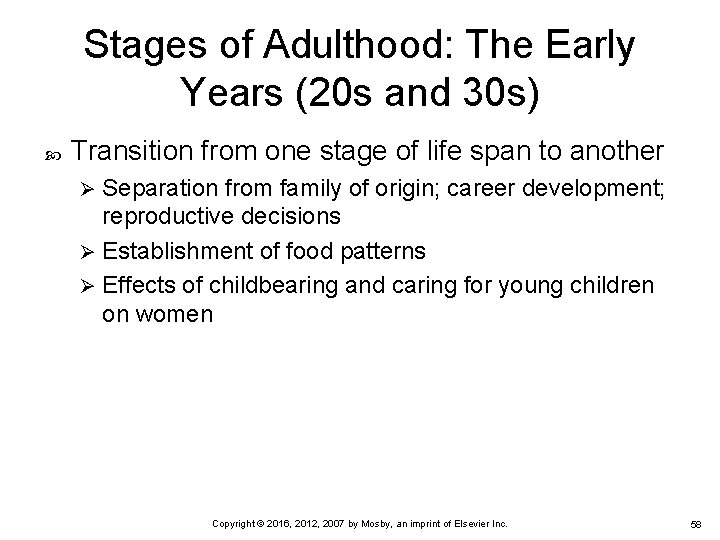
Stages of Adulthood: The Early Years (20 s and 30 s) Transition from one stage of life span to another Separation from family of origin; career development; reproductive decisions Ø Establishment of food patterns Ø Effects of childbearing and caring for young children on women Ø Copyright © 2016, 2012, 2007 by Mosby, an imprint of Elsevier Inc. 58
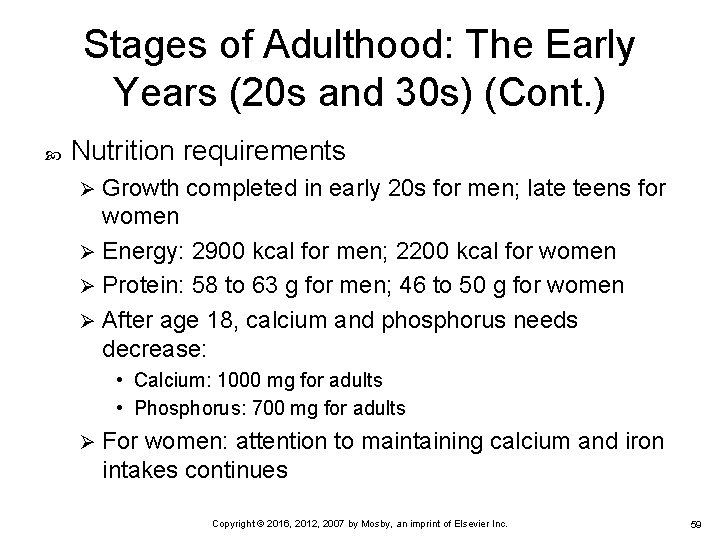
Stages of Adulthood: The Early Years (20 s and 30 s) (Cont. ) Nutrition requirements Growth completed in early 20 s for men; late teens for women Ø Energy: 2900 kcal for men; 2200 kcal for women Ø Protein: 58 to 63 g for men; 46 to 50 g for women Ø After age 18, calcium and phosphorus needs decrease: Ø • Calcium: 1000 mg for adults • Phosphorus: 700 mg for adults Ø For women: attention to maintaining calcium and iron intakes continues Copyright © 2016, 2012, 2007 by Mosby, an imprint of Elsevier Inc. 59
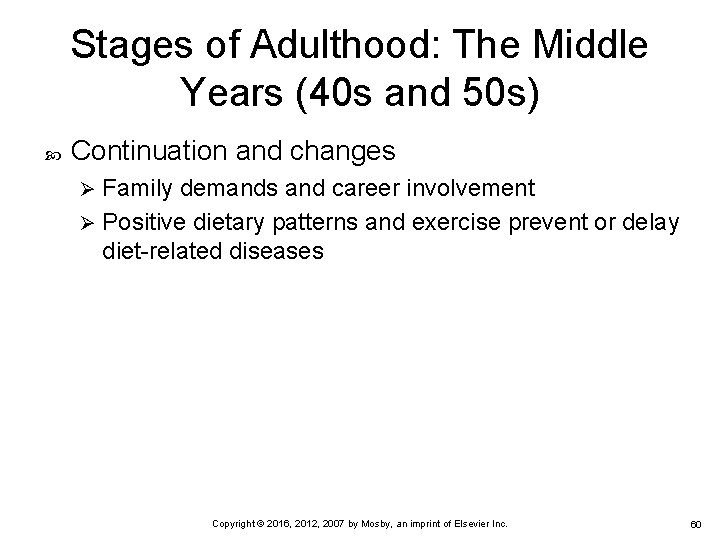
Stages of Adulthood: The Middle Years (40 s and 50 s) Continuation and changes Family demands and career involvement Ø Positive dietary patterns and exercise prevent or delay diet-related diseases Ø Copyright © 2016, 2012, 2007 by Mosby, an imprint of Elsevier Inc. 60
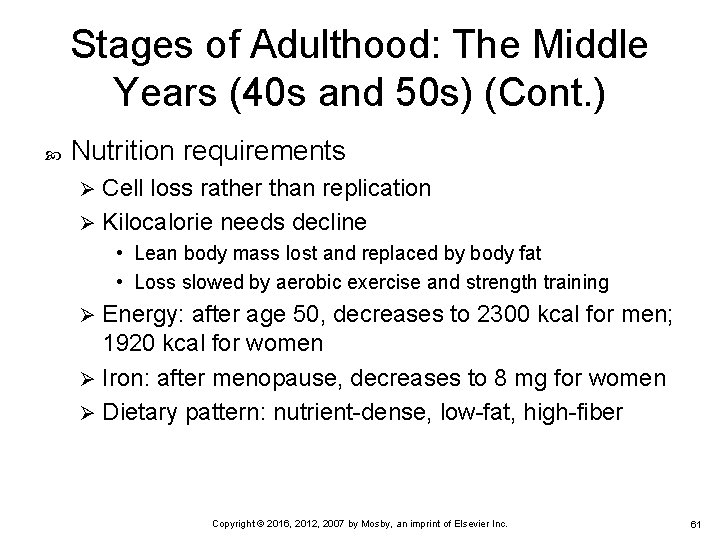
Stages of Adulthood: The Middle Years (40 s and 50 s) (Cont. ) Nutrition requirements Cell loss rather than replication Ø Kilocalorie needs decline Ø • Lean body mass lost and replaced by body fat • Loss slowed by aerobic exercise and strength training Energy: after age 50, decreases to 2300 kcal for men; 1920 kcal for women Ø Iron: after menopause, decreases to 8 mg for women Ø Dietary pattern: nutrient-dense, low-fat, high-fiber Ø Copyright © 2016, 2012, 2007 by Mosby, an imprint of Elsevier Inc. 61
Stages of Adulthood: The Older Years (60 s, 70 s, and 80 s) Shifting U. S. populations: increasing number of older adults; senescence Gerontology: study of aging Ø Consideration of social, economic, and physiologic aspects of aging Quality of life depends on health status Ø Level of wellness reflects health behaviors of previous life span stages Copyright © 2016, 2012, 2007 by Mosby, an imprint of Elsevier Inc. 62
Stages of Adulthood: The Older Years (60 s, 70 s, and 80 s) (Cont. ) Ø Older adults may be at nutritional risk because of demographic and lifestyle factors • • Gender Smoking Alcohol abuse Dietary patterns Educational level Dental health Chronic illnesses Living situations Copyright © 2016, 2012, 2007 by Mosby, an imprint of Elsevier Inc. 63
Stages of Adulthood: The Older Years (60 s, 70 s, and 80 s) (Cont. ) Physical, mental, and emotional functioning: Adjustment to retirement Ø Effects of death of family members and friends Ø Depression: may affect nutritional status Ø Economic realities Ø Alcohol abuse Ø Disorientation, memory loss or dementia Ø Fluids and dehydration Ø Copyright © 2016, 2012, 2007 by Mosby, an imprint of Elsevier Inc. 64
Stages of Adulthood: The Older Years (60 s, 70 s, and 80 s) (Cont. ) Nutritional well-being Ø Access to food and ability to prepare meals • Living arrangements • Preference for familiar foods Protein adequacy and micronutrients Ø Association between BMI and health risk in older adults Ø Copyright © 2016, 2012, 2007 by Mosby, an imprint of Elsevier Inc. 65
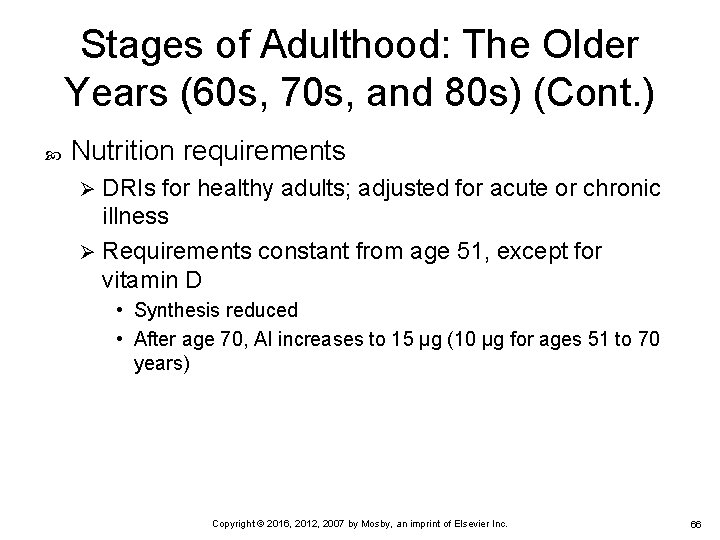
Stages of Adulthood: The Older Years (60 s, 70 s, and 80 s) (Cont. ) Nutrition requirements DRIs for healthy adults; adjusted for acute or chronic illness Ø Requirements constant from age 51, except for vitamin D Ø • Synthesis reduced • After age 70, AI increases to 15 µg (10 µg for ages 51 to 70 years) Copyright © 2016, 2012, 2007 by Mosby, an imprint of Elsevier Inc. 66
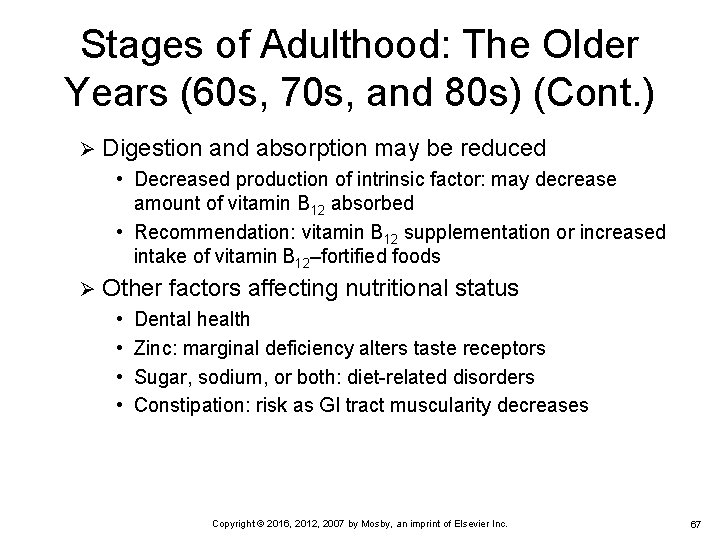
Stages of Adulthood: The Older Years (60 s, 70 s, and 80 s) (Cont. ) Ø Digestion and absorption may be reduced • Decreased production of intrinsic factor: may decrease amount of vitamin B 12 absorbed • Recommendation: vitamin B 12 supplementation or increased intake of vitamin B 12–fortified foods Ø Other factors affecting nutritional status • • Dental health Zinc: marginal deficiency alters taste receptors Sugar, sodium, or both: diet-related disorders Constipation: risk as GI tract muscularity decreases Copyright © 2016, 2012, 2007 by Mosby, an imprint of Elsevier Inc. 67
Stages of Adulthood: The Oldest Years (80 s and 90 s) Decreased ability to absorb or synthesize nutrients Nutrition requirements Concerns of malnutrition and underweight Ø Dehydration Ø Nutrition screening Ø Copyright © 2016, 2012, 2007 by Mosby, an imprint of Elsevier Inc. 68
Adult Health Promotion Knowledge Ø Health promotion • Adequate intake of nutrients found in food • Relationship between diet and disease • Moderate kilocalorie intake coupled with exercise Copyright © 2016, 2012, 2007 by Mosby, an imprint of Elsevier Inc. 69
Adult Health Promotion (Cont. ) Techniques Ø Strategies to promote positive health status and reduce risk of diet-related disorders • • • Shopping tips Reorganizing work and personal priorities Use of My. Plate and Fruits & Veggies—More Matters Consuming dietary sources of bone health nutrients Dietary pattern: low fat, low sodium, and high fiber Maintaining healthy body weight with diet and exercise Copyright © 2016, 2012, 2007 by Mosby, an imprint of Elsevier Inc. 70
Adult Health Promotion (Cont. ) Community supports U. S. Food and Drug Administration and nonprofit organizations such as the American Heart Association provide health and nutrition information Ø Corporate employee health promotion centers Ø Government programs: Ø • Including Child and Adult Care Food Program; Senior Nutrition Program (Congregate Meals and Home-Delivered Meals programs) Copyright © 2016, 2012, 2007 by Mosby, an imprint of Elsevier Inc. 71
Toward a Positive Nutrition Lifestyle: Rationalizing: a defense mechanism to assign reasonable explanations for a person’s behavior Ø Rationalizing poor eating habits Copyright © 2016, 2012, 2007 by Mosby, an imprint of Elsevier Inc. 72