
Chapter 10 Nucleic Acids Protein Synthesis DNA Deoxyribonucleic
Chapter 10 Nucleic Acids & Protein Synthesis
DNA (Deoxyribonucleic acid) �The primary function of DNA in organisms is to store & transmit genetic information for the synthesis of proteins �Group of macromolecules called nucleic acids �Organic compound �Made up of repeating subunits called nucleotides �Consists of 2 long chains of nucleotides
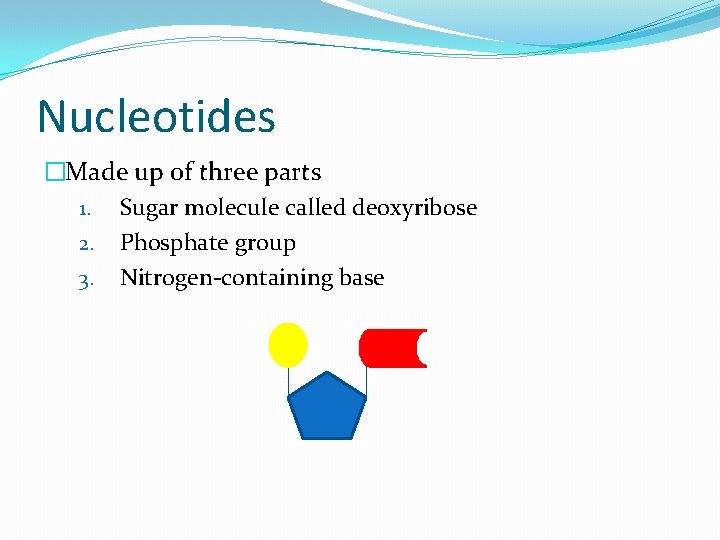
Nucleotides �Made up of three parts 1. Sugar molecule called deoxyribose 2. Phosphate group 3. Nitrogen-containing base

Nitrogen-containing Bases �There are 4 different bases which are classified by their size: o Purines (larger in size having 2 carbon rings): Adenine (A) and Guanine (G) o Pyrimidines (smaller in size having 1 carbon ring): Thymine (T) and Cytosine (C)

History of DNA �Johann Friedrich Miescher (1869), a Swiss biochemist, isolated DNA �Because the molecules were acidic in nature and found in the nucleus Miescher called them nucleic acids �Rosalind Franklin and Maurice Wilkins developed Xray photographs of DNA �The photographs indicated that DNA was a helix with a sugar-phosphate backbone
�In 1953, James Watson (an American biologist) and Francis Crick (a British physicist) suggested a model of DNA �They proposed that DNA was composed of 2 long chains of nucleotides coiled around each other to form a spiral staircase called a Double Helix
Watson & Crick’s DNA Model �It can be compared to a twisted ladder �The sides of the ladder are made of alternating deoxyribose sugar & phosphate groups connected by covalent bonds �The rungs of the ladder are made of paired nitrogen- containing bases connected by weak hydrogen bonds
�Erwin Chargoff, an American chemist, determined how the nitrogen-containing bases paired up �Pairs of bases are called Complementary Base Pairs �Base pairing rules 1. 2. Cytosine bonds with Guanine Thymine bonds with Adenine
�Cytosine and Guanine form three hydrogen bonds �Thymine and Adenine form two hydrogen bonds
�If one strand of DNA has a nitrogen base sequence of T-A-G-C-A-T, what would be the sequence of bases for the complementary strand?
�The sequence of nitrogen-containing bases in DNA make up the codes for specific amino acids and amino acids make up proteins �In order for a new cell to function properly, it must contain a complete set of genetic instructions. Every new cell must receive an exact copy of the DNA.

Replication of DNA �Replication is the process of copying DNA in a cell �During replication, the two nucleotide chains separate by unwinding and each chain serves as a template for a new nucleotide chain
Steps of Replication 1. The separation of the two nucleotide chains � The point at which the chains separate is called the Replication Fork � Enzymes called Helicases move along the DNA molecule and break the weak hydrogen bonds between the complementary nitrogencontaining bases
2. New chains of DNA are assembled � Enzymes called DNA polymerases bind to the separated chains of DNA � As they move along the chain, complementary nucleotides are joined together to assemble new DNA
3. The DNA strands twist back together creating two identical DNA molecules (double helixes) � Each DNA molecule is made of one chain from the original DNA and one newly replicated chain
�The replication process occurs at many points along the DNA molecule �This allows the copying of DNA to be completed faster �The cell is now ready to undergo cell division (Mitosis or Meiosis)

Accuracy and Repair �DNA replication if highly accurate � 1 error in every 10, 000 paired nucleotides �A change in the nucleotide sequence called a Mutation can occur at any spot along the DNA molecule
�Cells contain proofreading enzymes and repair processes that can detect and fix errors in the complementary base-pairing of DNA �Not all errors are detected or can be fixed by enzymes in the cell, therefore mutations can occur
�Mutations can either be genetic or environmental in nature
- Slides: 19