
Chapter 10 Negative Messages Business Communication Process and

Chapter 10 Negative Messages Business Communication: Process and Product, 6 e Mary Ellen Guffey Copyright © 2008 1

Negative Messages Communicating Bad News: Goals The Indirect Pattern The 3 -x-3 Writing Process Avoiding Legal Problems Delivering Bad News Sensitively Damage Control with Customers Mary Ellen Guffey, Business Communication: Process and Product, 6 e 2
Goals in Communicating Bad News Primary Goals § Make the receiver understand accept the bad news § Maintain a positive image of you and your organization © Tom Grill / Corbis Mary Ellen Guffey, Business Communication: Process and Product, 6 e 3
Goals in Communicating Bad News Secondary Goals © Tom Grill / Corbis § Reduce bad feelings § Convey fairness § Eliminate future correspondence § Avoid creating legal liability or responsibility for your organization. Mary Ellen Guffey, Business Communication: Process and Product, 6 e 4

The Indirect Pattern Buffer A neutral or positive opening that does not reveal the bad news Reasons An explanation of the causes for the bad news Bad News A clear but understated announcement of the bad news; may include alternative or compromise Closing A neutral or positive opening that does not reveal the bad news Mary Ellen Guffey, Business Communication: Process and Product, 6 e 5
Applying the Writing Process § Analyze the bad news. § Anticipate the effect of the Prewriting bad news on the receiver. § If the bad news is serious, Analyze use techniques to reduce Anticipate the pain. Adapt § If the bad news is minor, announce it directly. Mary Ellen Guffey, Business Communication: Process and Product, 6 e 6
Applying the Writing Process Writing Research Organize Compose § Gather information and brainstorm for ideas. § Jot down all reasons you have to explain the bad news. § List your strongest reasons first. § Outline the indirect pattern. Mary Ellen Guffey, Business Communication: Process and Product, 6 e 7
Applying the Writing Process Revising Edit Proofread Evaluate § Put yourself in the receiver’s shoes. § Is the message too blunt? Too subtle? Is it clear? § Proofread format, punctuation, and correctness. Mary Ellen Guffey, Business Communication: Process and Product, 6 e 8

Avoiding Three Causes of Legal Problems Abusive language Defamation Language that harms a person’s reputation Libel Written defamation Slander Spoken defamation Mary Ellen Guffey, Business Communication: Process and Product, 6 e 9
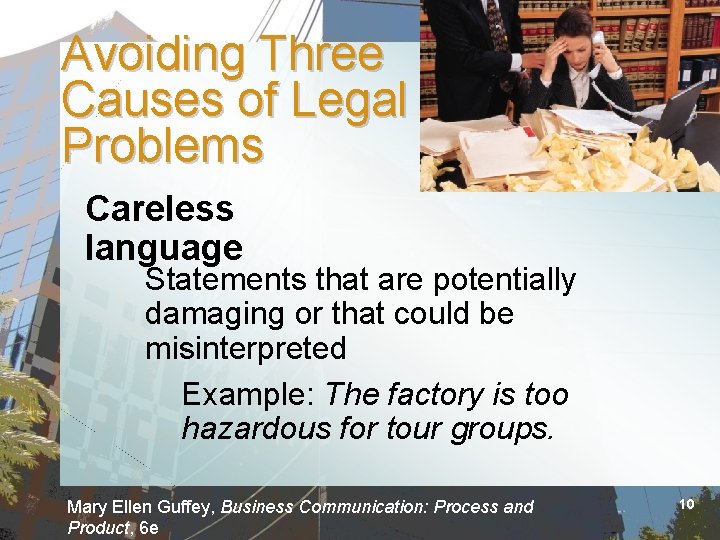
Avoiding Three Causes of Legal Problems Careless language Statements that are potentially damaging or that could be misinterpreted Example: The factory is too hazardous for tour groups. Mary Ellen Guffey, Business Communication: Process and Product, 6 e 10

Avoiding Three Causes of Legal Problems The good-guy syndrome Dangerous statements that ease your conscience or make you look good (I thought you were an excellent candidate, but we had to hire…). As an agent of the organization, express only views of the organization. Mary Ellen Guffey, Business Communication: Process and Product, 6 e 11

Avoiding Three Causes of Legal Problems § Use plain paper for your personal views or business. § Avoid supplying information that could be misused. Don’t admit or imply responsibility without checking with legal counsel. Mary Ellen Guffey, Business Communication: Process and Product, 6 e 12

Four-Part Strategy for Delivering Bad News Buffer Best news Compliment Appreciation Agreement Facts Understanding Apology Reasons Cautious explanation Reader or other benefits Company policy explanation Positive words Evidence that matter was considered fairly and seriously Mary Ellen Guffey, Business Communication: Process and Product, 6 e 13
Four-Part Strategy for Delivering Bad News Embedded placement Passive voice Implied refusal Compromise Alternative Closing Forward look Information about alternative Good wishes Freebies Resale Sales Promotion Mary Ellen Guffey, Business Communication: Process and Product, 6 e 14
Techniques for Delivering Bad News Sensitively Buffering the Opening § Start with the part of the message that represents the best news. § Pay a compliment, show appreciation for a past action, or refer to something mutually understood. Mary Ellen Guffey, Business Communication: Process and Product, 6 e 15
Techniques for Delivering Bad News Sensitively Buffering the Opening § Avoid raising false hopes or thanking the receiver for something you are about to refuse. § Consider apologizing if you or your company erred. If you apologize, do so sincerely and take responsibility. Mary Ellen Guffey, Business Communication: Process and Product, 6 e 16
Techniques for Delivering Bad News Sensitively Presenting the Reasons § Explain clearly why the request must be denied, without revealing the refusal. § Show your decision benefits the receiver or others, if possible. Mary Ellen Guffey, Business Communication: Process and Product, 6 e 17
Techniques for Delivering Bad News Sensitively Presenting the Reasons § Explain company policy without using it as an excuse. § Choose positive words. Avoid negative words such as cannot, claim, denied, error, failure, unwitting. § Show that the matter was treated seriously and fairly. Mary Ellen Guffey, Business Communication: Process and Product, 6 e 18
Techniques for Delivering Bad News Sensitively Cushioning the Bad News § Consider positioning the bad news strategically by sandwiching it between other sentences. § Consider subordinating the bad news (although we can’t loan our equipment, we wish you well in…) § Consider using the passive voice (although our equipment can’t be loaned…). Mary Ellen Guffey, Business Communication: Process and Product, 6 e 19
Techniques for Delivering Bad News Sensitively Cushioning the Bad News § Accentuate the positive by describing what you can do, not what you can’t do. § Consider implying the refusal, but be sure it is clear. § Suggest a compromise or an alternative, if available. Mary Ellen Guffey, Business Communication: Process and Product, 6 e 20
Techniques for Delivering Bad News Sensitively Closing Pleasantly § Look forward to future relations. § Supply more information about an alternative, if you have presented one. § Offer good wishes, compliments, or freebies (coupons, samples, gifts). § Avoid referring to the refusal. § Use resale or sales promotion if appropriate. Mary Ellen Guffey, Business Communication: Process and Product, 6 e 21
Damage Control: Dealing With Disappointed Customers 1. Call the individual involved. 2. Describe the problem and apologize. 3. Explain a. Why the problem occurred b. What you are doing to resolve it c. How you will prevent it from happening again. 4. Follow up with a letter that documents the phone call and promotes goodwill. Mary Ellen Guffey, Business Communication: Process and Product, 6 e 22
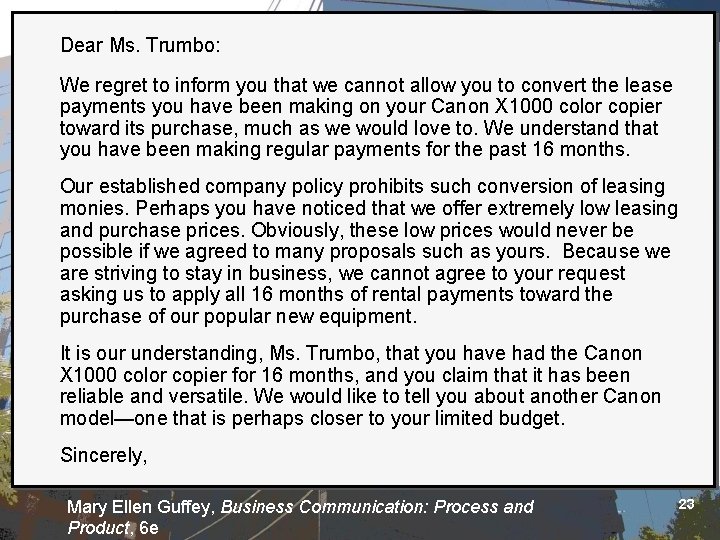
Dear Ms. Trumbo: “Before”—Ineffective Customer Request Refusal We regret to inform you that we cannot allow you to convert the lease payments you have been making on your Canon X 1000 color copier toward its purchase, much as we would love to. We understand that you have been making regular payments for the past 16 months. Our established company policy prohibits such conversion of leasing monies. Perhaps you have noticed that we offer extremely low leasing and purchase prices. Obviously, these low prices would never be possible if we agreed to many proposals such as yours. Because we are striving to stay in business, we cannot agree to your request asking us to apply all 16 months of rental payments toward the purchase of our popular new equipment. It is our understanding, Ms. Trumbo, that you have had the Canon X 1000 color copier for 16 months, and you claim that it has been reliable and versatile. We would like to tell you about another Canon model—one that is perhaps closer to your limited budget. Sincerely, Mary Ellen Guffey, Business Communication: Process and Product, 6 e 23
Critical Thinking Questions 1. What is the purpose of the letter? What goals should the sender have? 2. What prevents this letter from achieving those goals? 3. What pattern of development would work best for this letter? Has it been followed? Mary Ellen Guffey, Business Communication: Process and Product, 6 e 24
Critical Thinking Questions 4. What idea could be used as a buffer to open an improved version of this letter? Write a buffer. 5. How could the bad news be subordinated? Write a statement that subordinates the bad news. 6. What friendly news could be used in the closing? Write a Maryclosing Ellen Guffey, statement. Business Communication: Process and Product, 6 e 25

Dear Ms. Trumbo: We’re happy to learn that you are enjoying the use of the Canon X 1000 color copier you’ve been leasing for the past 16 months. “After”—Improved Refusal of Like our many other customers, Ms. Trumbo, you have discovered Request that Canon copiers supply remarkable versatility and reliability. One of the reasons we’re able to offer these outstanding copiers at such low leasing rates and equally low purchase prices is that we maintain a slim profit margin. If our program included a provision for applying lease payments toward purchase prices, our overall prices would have to be higher. Although lease payments cannot be credited toward purchase price, we can offer you other Canon models that are within your price range. The Canon 600 delivers the same reliability with nearly as many features as the top-of-the-line Canon X 1000. Please let us demonstrate the Canon 600 to your staff in your office, Ms. Trumbo. Our representative, Seth Simmons, will call you during the week of May 5 to arrange an appointment. Sincerely, Mary Ellen Guffey, Business Communication: Process and Product, 6 e 26
Managing Negative Organization News Buffer n Provide some good news (if possible), praise, appreciation, agreement, or understanding. n Discuss section. facts leading to the reasons Mary Ellen Guffey, Business Communication: Process and Product, 6 e 27
Managing Negative Organization News Reasons n Explain what caused the decision necessitating the bad news. n Use objective, nonjudgmental, and nondiscriminatory language. n Show empathy and fairness. Mary Ellen Guffey, Business Communication: Process and Product, 6 e 28
Managing Negative Organization News Bad News n Explain the bad news clearly, but don’t accentuate it. n Avoid negative language. Mary Ellen Guffey, Business Communication: Process and Product, 6 e 29
Managing Negative Organization News Closing n End n For on a positive, friendly note. job refusals, extend good wishes. Mary Ellen Guffey, Business Communication: Process and Product, 6 e 30
End Mary Ellen Guffey, Business Communication: Process and Product, 6 e 31 Ch. 10, Slide 31
- Slides: 31