
Chapter 10 Muscle Tissue Lecture Presentation by Lee
Chapter 10 Muscle Tissue Lecture Presentation by Lee Ann Frederick University of Texas at Arlington © 2015 Pearson Education, Inc.
10 -1 An Introduction to Muscle Tissue • Learning Outcomes • 10 -1 Specify the functions of skeletal muscle tissue. • 10 -2 Describe the organization of muscle at the tissue level. • 10 -3 Describe the characteristics of skeletal muscle fibers, and identify the structural components of a sarcomere. • 10 -4 Identify the components of the neuromuscular junction, and summarize the events involved in the neural control of skeletal muscle contraction and relaxation. © 2015 Pearson Education, Inc.
10 -1 An Introduction to Muscle Tissue • Learning Outcomes • 10 -5 Describe the mechanism responsible for tension production in a muscle fiber, and compare the different types of muscle contraction. • 10 -6 Describe the mechanisms by which muscle fibers obtain the energy to power contractions. • 10 -7 Relate the types of muscle fibers to muscle performance, and distinguish between aerobic and anaerobic endurance. © 2015 Pearson Education, Inc.
10 -1 An Introduction to Muscle Tissue • Learning Outcomes • 10 -8 Identify the structural and functional differences between skeletal muscle fibers and cardiac muscle cells. • 10 -9 Identify the structural and functional differences between skeletal muscle fibers and smooth muscle cells, and discuss the roles of smooth muscle tissue in systems throughout the body. © 2015 Pearson Education, Inc.
An Introduction to Muscle Tissue • A primary tissue type, divided into: • Skeletal muscle tissue • Cardiac muscle tissue • Smooth muscle tissue © 2015 Pearson Education, Inc.
10 -1 Functions of Skeletal Muscle Tissue Skeletal muscles are attached to the skeletal system and allow us to move • The muscular system includes only skeletal muscles Six Functions of Skeletal Muscle Tissue 1. 2. 3. 4. 5. 6. Produce skeletal movement Maintain posture and body position Support soft tissues Guard entrances and exits Maintain body temperature Store nutrient reserves © 2015 Pearson Education, Inc.
10 -2 Organization of Muscle • Skeletal Muscle • • Muscle tissue (muscle cells or fibers) Connective tissues Nerves Blood vessels © 2015 Pearson Education, Inc.
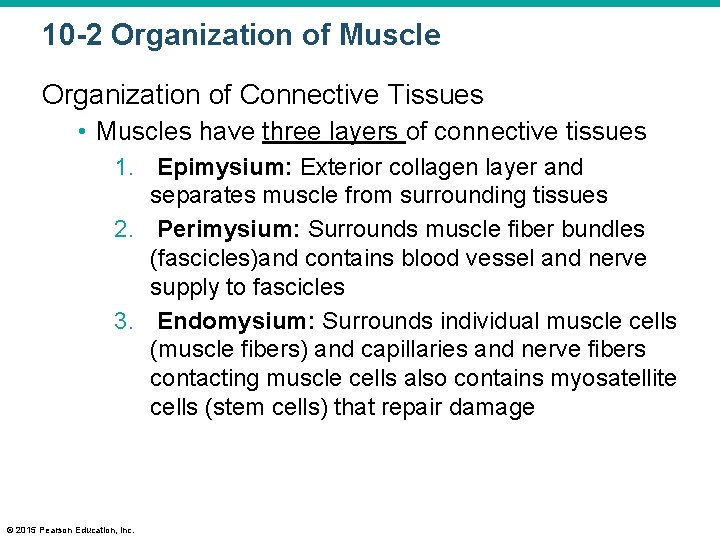
10 -2 Organization of Muscle Organization of Connective Tissues • Muscles have three layers of connective tissues 1. Epimysium: Exterior collagen layer and separates muscle from surrounding tissues 2. Perimysium: Surrounds muscle fiber bundles (fascicles)and contains blood vessel and nerve supply to fascicles 3. Endomysium: Surrounds individual muscle cells (muscle fibers) and capillaries and nerve fibers contacting muscle cells also contains myosatellite cells (stem cells) that repair damage © 2015 Pearson Education, Inc.
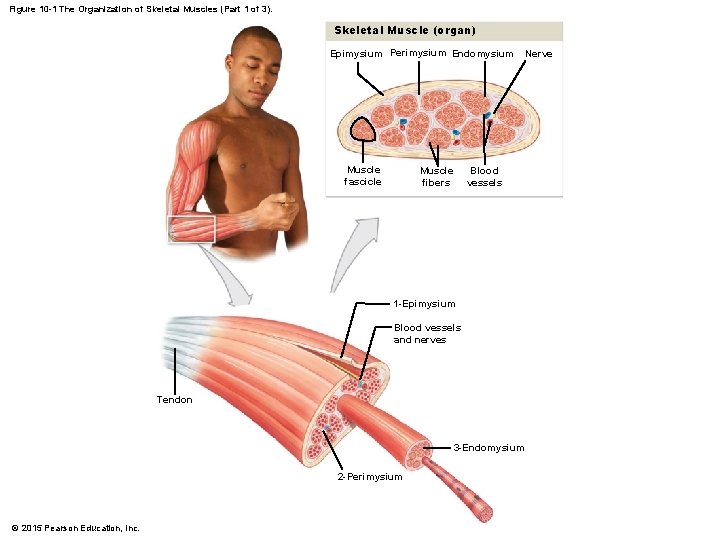
Figure 10 -1 The Organization of Skeletal Muscles (Part 1 of 3). Skeletal Muscle (organ) Epimysium Perimysium Endomysium Muscle fascicle Nerve Blood vessels Muscle fibers 1 -Epimysium Blood vessels and nerves Tendon 3 -Endomysium 2 -Perimysium © 2015 Pearson Education, Inc.
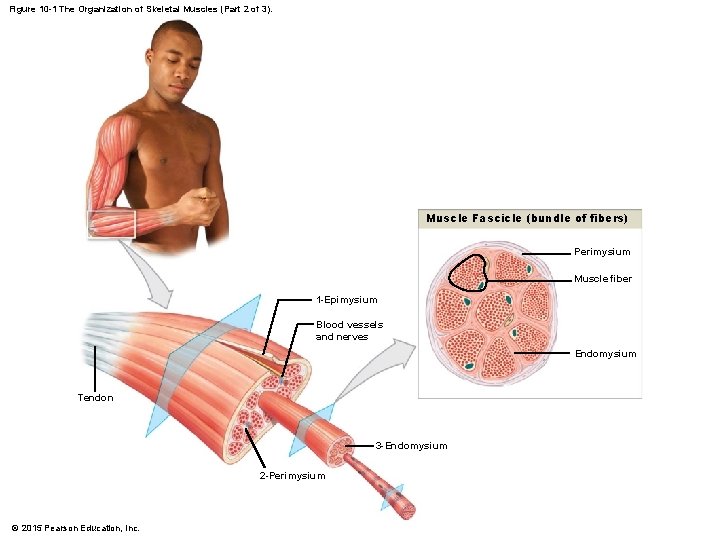
Figure 10 -1 The Organization of Skeletal Muscles (Part 2 of 3). Muscle Fascicle (bundle of fibers) Perimysium Muscle fiber 1 -Epimysium Blood vessels and nerves Endomysium Tendon 3 -Endomysium 2 -Perimysium © 2015 Pearson Education, Inc.
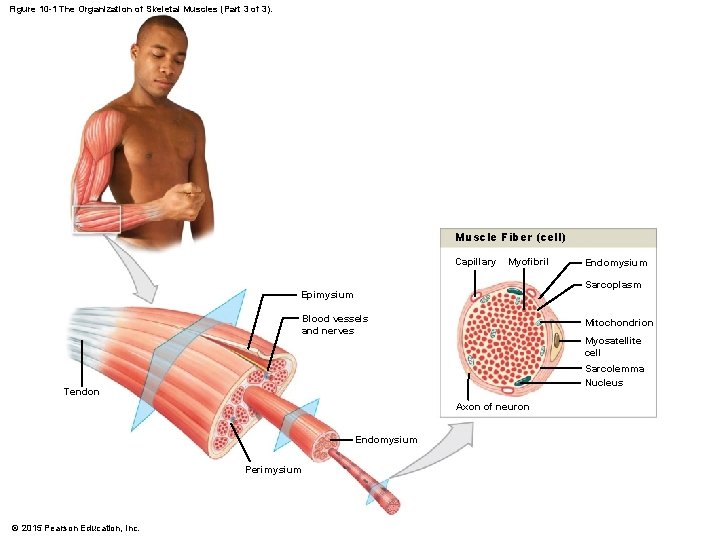
Figure 10 -1 The Organization of Skeletal Muscles (Part 3 of 3). Muscle Fiber (cell) Capillary Myofibril Sarcoplasm Epimysium Blood vessels and nerves Mitochondrion Myosatellite cell Sarcolemma Nucleus Tendon Axon of neuron Endomysium Perimysium © 2015 Pearson Education, Inc. Endomysium
10 -2 Organization of Muscle • Organization of Connective Tissues • Muscle Attachments • Endomysium, perimysium, and epimysium come together: At ends of muscles to form connective tissue attachment to bone matrix • i. e. , tendon (bundle) or aponeurosis (sheet) © 2015 Pearson Education, Inc.
10 -2 Organization of Muscle Blood Vessels and Nerves • Muscles have extensive vascular systems that supply large amounts of oxygen, nutrients, and carry away wastes • Skeletal muscles are voluntary muscles, controlled by nerves of the central nervous system (brain and spinal cord) Skeletal muscle cells are very long which develop through fusion of mesodermal cells (myoblasts) • Become very large • Contain hundreds of nuclei © 2015 Pearson Education, Inc.
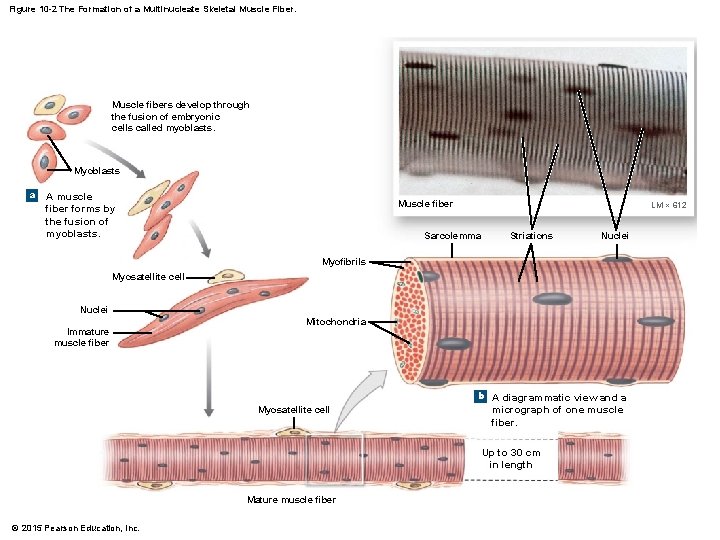
Figure 10 -2 The Formation of a Multinucleate Skeletal Muscle Fiber. Muscle fibers develop through the fusion of embryonic cells called myoblasts. Myoblasts a A muscle fiber forms by the fusion of myoblasts. Muscle fiber LM × 612 Sarcolemma Striations Nuclei Myofibrils Myosatellite cell Nuclei Immature muscle fiber Mitochondria b A diagrammatic view and a Myosatellite cell micrograph of one muscle fiber. Up to 30 cm in length Mature muscle fiber © 2015 Pearson Education, Inc.
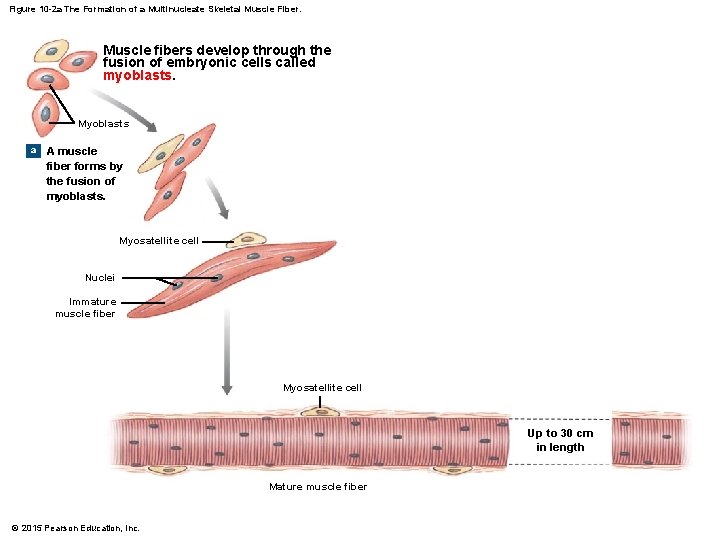
Figure 10 -2 a The Formation of a Multinucleate Skeletal Muscle Fiber. Muscle fibers develop through the fusion of embryonic cells called myoblasts. Myoblasts a A muscle fiber forms by the fusion of myoblasts. Myosatellite cell Nuclei Immature muscle fiber Myosatellite cell Up to 30 cm in length Mature muscle fiber © 2015 Pearson Education, Inc.
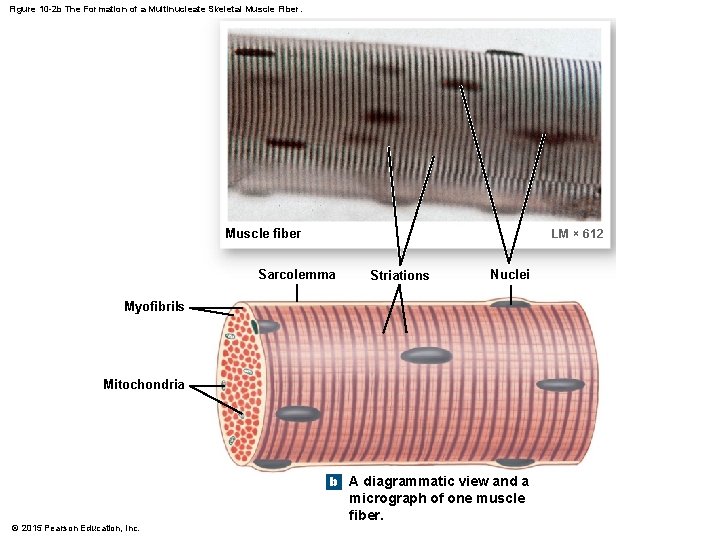
Figure 10 -2 b The Formation of a Multinucleate Skeletal Muscle Fiber. Muscle fiber LM × 612 Sarcolemma Striations Nuclei Myofibrils Mitochondria b A diagrammatic view and a © 2015 Pearson Education, Inc. micrograph of one muscle fiber.
10 -3 Characteristics of Skeletal Muscle Fibers The Sarcolemma and Transverse Tubules • sarcolemma: The cell membrane of a muscle fiber (cell) surrounds the sarcoplasm (cytoplasm of muscle fiber) and a change in transmembrane potential begins contractions • Transverse tubules (T tubules): Transmit action potential through cell which allow entire muscle fiber to contract simultaneously © 2015 Pearson Education, Inc.
10 -3 Characteristics of Skeletal Muscle Fibers • Myofibrils • Lengthwise subdivisions within muscle fiber • Made up of bundles of protein filaments (myofilaments) which are responsible for muscle contraction • Types of myofilaments: • Thin filaments: Made of the protein actin • Thick filaments: Made of the protein myosin © 2015 Pearson Education, Inc.
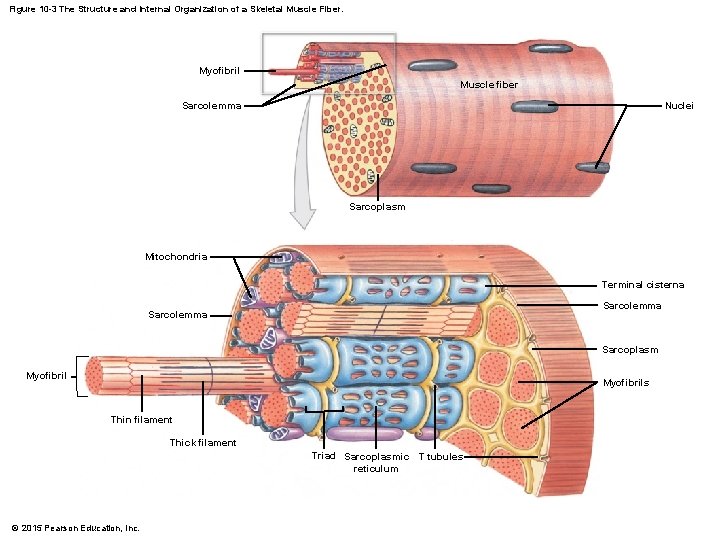
Figure 10 -3 The Structure and Internal Organization of a Skeletal Muscle Fiber. Myofibril Muscle fiber Sarcolemma Nuclei Sarcoplasm Mitochondria Terminal cisterna Sarcolemma Sarcoplasm Myofibrils Thin filament Thick filament Triad Sarcoplasmic T tubules reticulum © 2015 Pearson Education, Inc.
10 -3 Structural Components of a Sarcomere • Sarcomeres • • The contractile units of muscle Structural units of myofibrils Form visible patterns within myofibrils A striped or striated pattern within myofibrils • Alternating dark, thick filaments (A bands) and light, thin filaments (I bands) © 2015 Pearson Education, Inc.
10 -3 Structural Components of a Sarcomere • Sarcomeres • The A Band • M line • The center of the A band • At midline of sarcomere • The H Band • The area around the M line • Has thick filaments but no thin filaments • Zone of overlap • The densest, darkest area on a light micrograph • Where thick and thin filaments overlap © 2015 Pearson Education, Inc.
10 -3 Structural Components of a Sarcomere • Sarcomeres • The I Band • Z lines • The centers of the I bands • At two ends of sarcomere • Titin • Are strands of protein • Reach from tips of thick filaments to the Z line • Stabilize the filaments © 2015 Pearson Education, Inc.
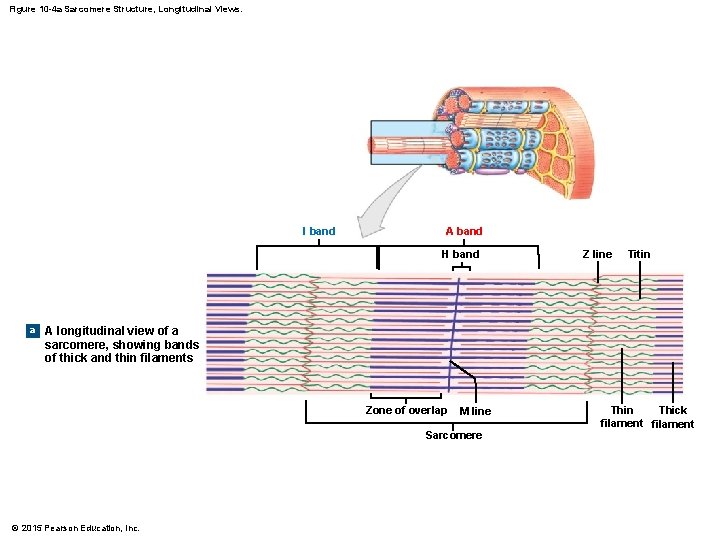
Figure 10 -4 a Sarcomere Structure, Longitudinal Views. I band A band H band a Z line Titin A longitudinal view of a sarcomere, showing bands of thick and thin filaments Zone of overlap M line Sarcomere © 2015 Pearson Education, Inc. Thin Thick filament
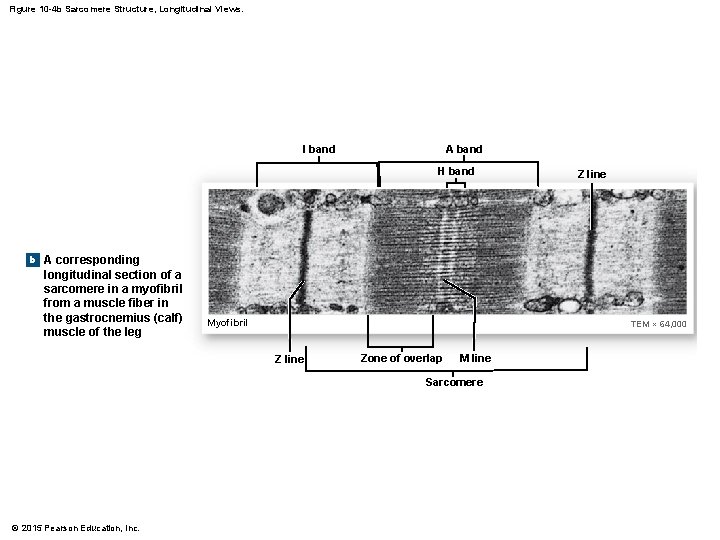
Figure 10 -4 b Sarcomere Structure, Longitudinal Views. I band A band H band b A corresponding longitudinal section of a sarcomere in a myofibril from a muscle fiber in the gastrocnemius (calf) muscle of the leg Myofibril TEM × 64, 000 Z line Zone of overlap M line Sarcomere © 2015 Pearson Education, Inc. Z line
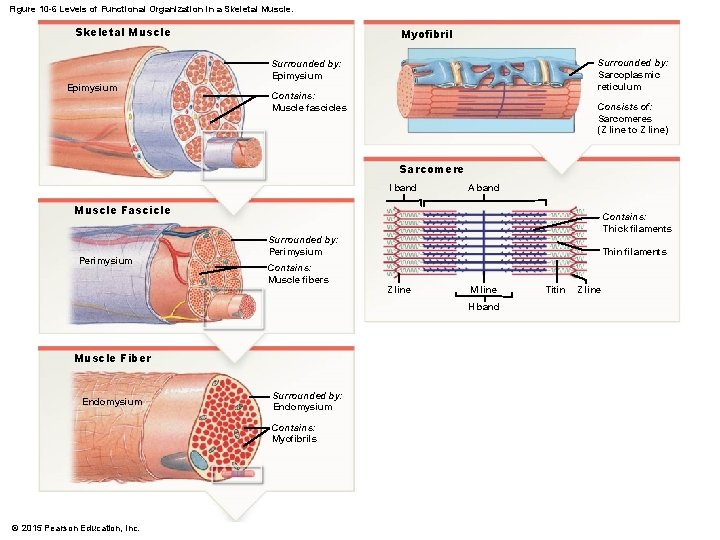
Figure 10 -6 Levels of Functional Organization in a Skeletal Muscle Myofibril Surrounded by: Sarcoplasmic reticulum Surrounded by: Epimysium Contains: Muscle fascicles Consists of: Sarcomeres (Z line to Z line) Sarcomere I band A band Muscle Fascicle Perimysium Contains: Thick filaments Surrounded by: Perimysium Contains: Muscle fibers Thin filaments Z line M line H band Muscle Fiber Endomysium Surrounded by: Endomysium Contains: Myofibrils © 2015 Pearson Education, Inc. Titin Z line
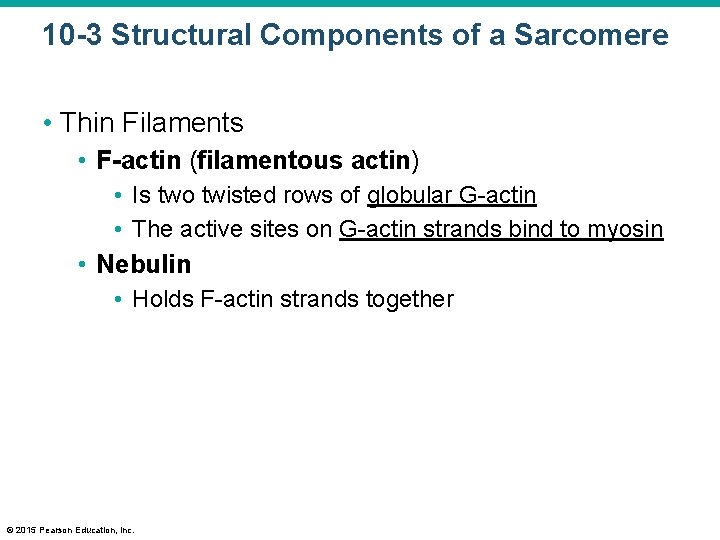
10 -3 Structural Components of a Sarcomere • Thin Filaments • F-actin (filamentous actin) • Is two twisted rows of globular G-actin • The active sites on G-actin strands bind to myosin • Nebulin • Holds F-actin strands together © 2015 Pearson Education, Inc.
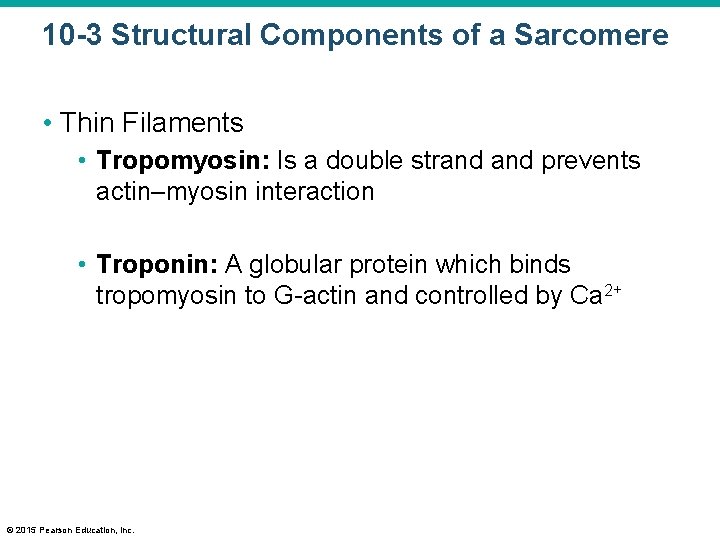
10 -3 Structural Components of a Sarcomere • Thin Filaments • Tropomyosin: Is a double strand prevents actin–myosin interaction • Troponin: A globular protein which binds tropomyosin to G-actin and controlled by Ca 2+ © 2015 Pearson Education, Inc.
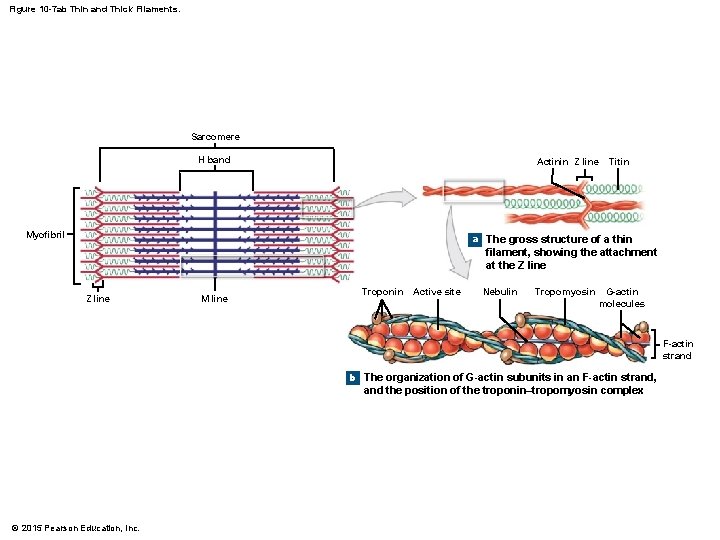
Figure 10 -7 ab Thin and Thick Filaments. Sarcomere H band Actinin Z line Myofibril Titin a The gross structure of a thin filament, showing the attachment at the Z line M line Troponin Active site Nebulin Tropomyosin G-actin molecules F-actin strand b The organization of G-actin subunits in an F-actin strand, and the position of the troponin–tropomyosin complex © 2015 Pearson Education, Inc.
10 -3 Structural Components of a Sarcomere • Initiating Contraction • Ca 2+ binds to receptor on troponin molecule • Troponin–tropomyosin complex changes • Exposes active site of F-actin © 2015 Pearson Education, Inc.
10 -3 Structural Components of a Sarcomere • Thick Filaments • Contain about 300 twisted myosin subunits • Contain titin strands that recoil after stretching • The mysosin molecule • Tail: Binds to other myosin molecules • Head: Made of two globular protein subunits reaches the nearest thin filament © 2015 Pearson Education, Inc.
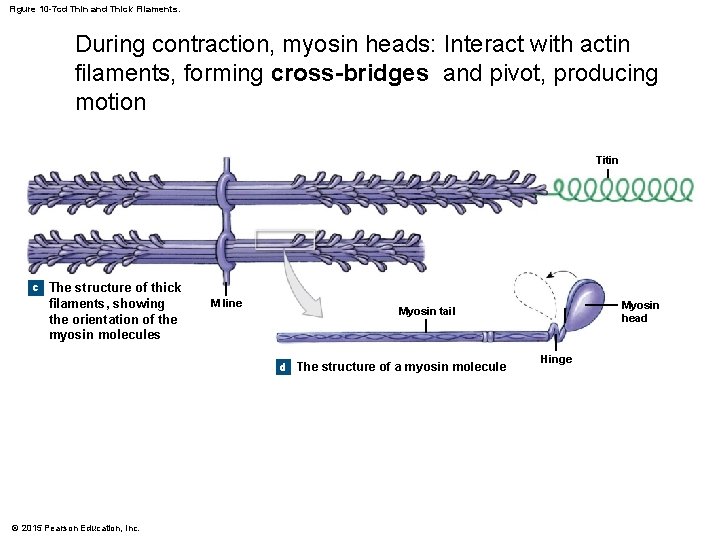
Figure 10 -7 cd Thin and Thick Filaments. During contraction, myosin heads: Interact with actin filaments, forming cross-bridges and pivot, producing motion Titin c The structure of thick filaments, showing the orientation of the myosin molecules M line d The structure of a myosin molecule © 2015 Pearson Education, Inc. Myosin head Myosin tail Hinge
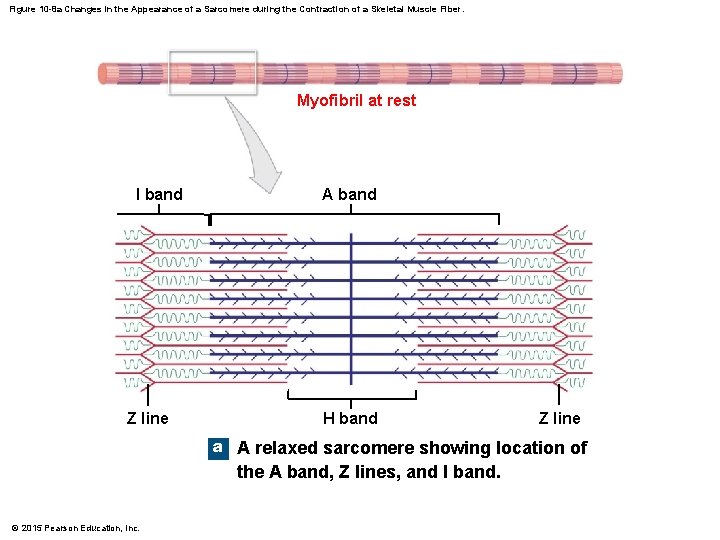
Figure 10 -8 a Changes in the Appearance of a Sarcomere during the Contraction of a Skeletal Muscle Fiber. Myofibril at rest I band Z line A band H band Z line a A relaxed sarcomere showing location of the A band, Z lines, and I band. © 2015 Pearson Education, Inc.
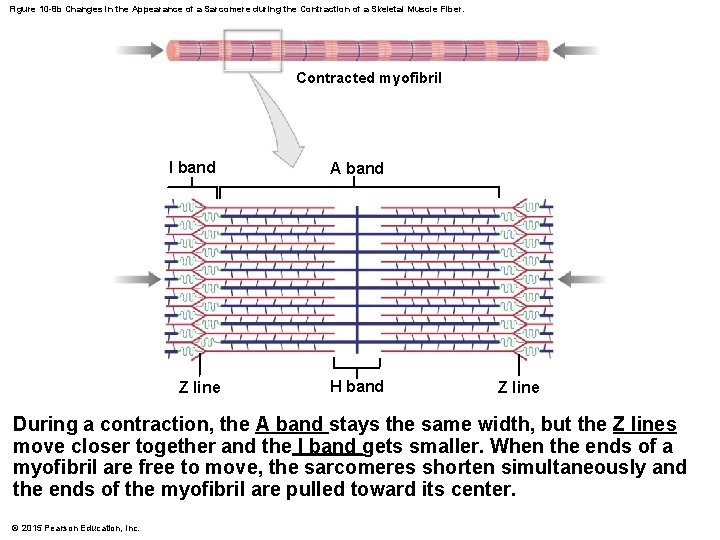
Figure 10 -8 b Changes in the Appearance of a Sarcomere during the Contraction of a Skeletal Muscle Fiber. Contracted myofibril I band A band Z line H band Z line During a contraction, the A band stays the same width, but the Z lines move closer together and the I band gets smaller. When the ends of a myofibril are free to move, the sarcomeres shorten simultaneously and the ends of the myofibril are pulled toward its center. © 2015 Pearson Education, Inc.
10 -3 Structural Components of a Sarcomere • Skeletal Muscle Contraction • Neural stimulation of sarcolemma causes excitation–contraction coupling • Muscle fiber contraction is the interaction of thick and thin filaments and produce tension • The neuromuscular junction (NMJ) • Special intercellular connection between the nervous system and skeletal muscle fiber which controls calcium ion release into the sarcoplasm © 2015 Pearson Education, Inc.
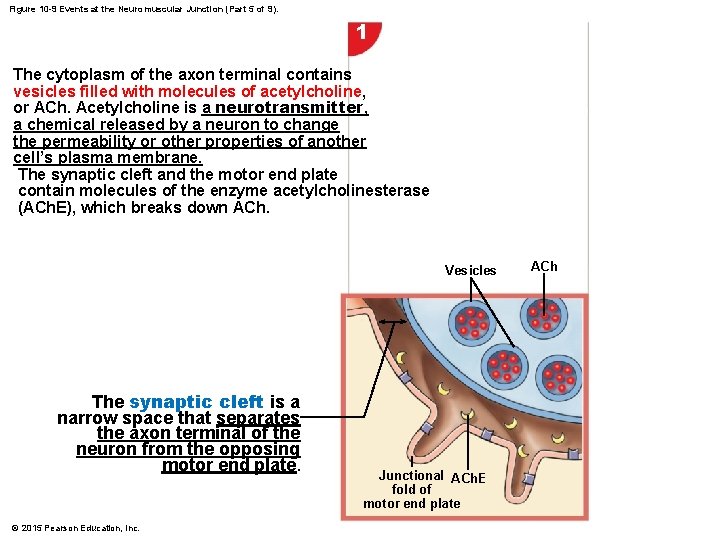
Figure 10 -9 Events at the Neuromuscular Junction (Part 5 of 9). 1 The cytoplasm of the axon terminal contains vesicles filled with molecules of acetylcholine, or ACh. Acetylcholine is a neurotransmitter, a chemical released by a neuron to change the permeability or other properties of another cell’s plasma membrane. The synaptic cleft and the motor end plate contain molecules of the enzyme acetylcholinesterase (ACh. E), which breaks down ACh. Vesicles The synaptic cleft is a narrow space that separates the axon terminal of the neuron from the opposing motor end plate. © 2015 Pearson Education, Inc. Junctional ACh. E fold of motor end plate ACh
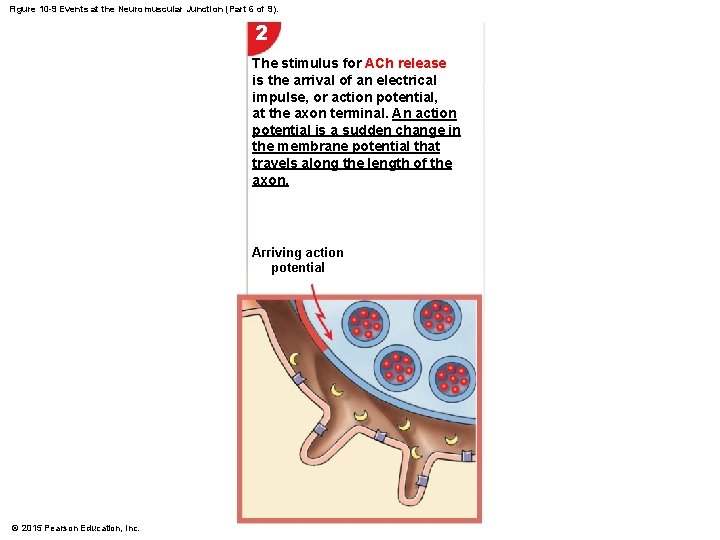
Figure 10 -9 Events at the Neuromuscular Junction (Part 6 of 9). 2 The stimulus for ACh release is the arrival of an electrical impulse, or action potential, at the axon terminal. An action potential is a sudden change in the membrane potential that travels along the length of the axon. Arriving action potential © 2015 Pearson Education, Inc.
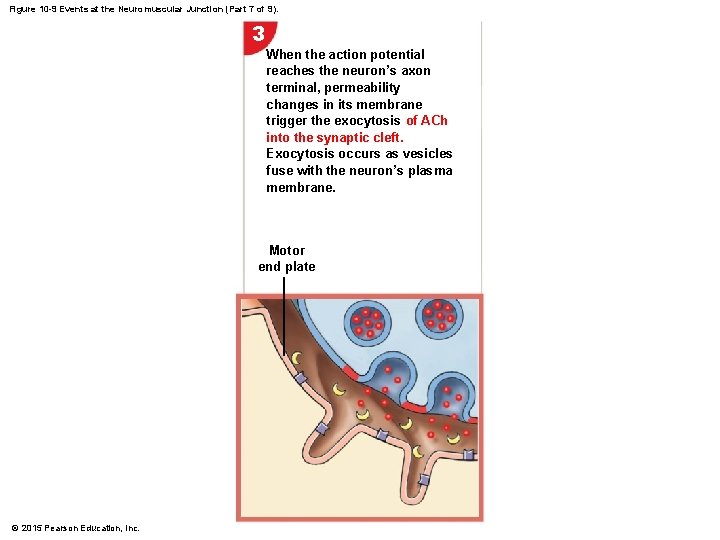
Figure 10 -9 Events at the Neuromuscular Junction (Part 7 of 9). 3 When the action potential reaches the neuron’s axon terminal, permeability changes in its membrane trigger the exocytosis of ACh into the synaptic cleft. Exocytosis occurs as vesicles fuse with the neuron’s plasma membrane. Motor end plate © 2015 Pearson Education, Inc.
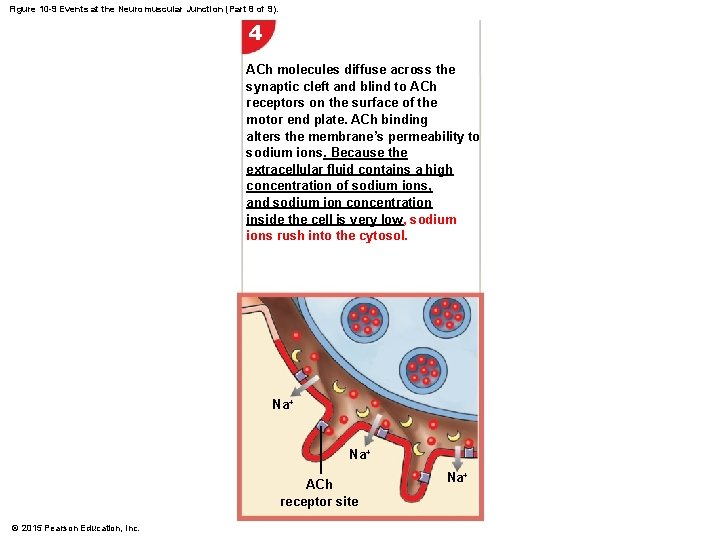
Figure 10 -9 Events at the Neuromuscular Junction (Part 8 of 9). 4 ACh molecules diffuse across the synaptic cleft and blind to ACh receptors on the surface of the motor end plate. ACh binding alters the membrane’s permeability to sodium ions. Because the extracellular fluid contains a high concentration of sodium ions, and sodium ion concentration inside the cell is very low, sodium ions rush into the cytosol. Na+ ACh receptor site © 2015 Pearson Education, Inc. Na+
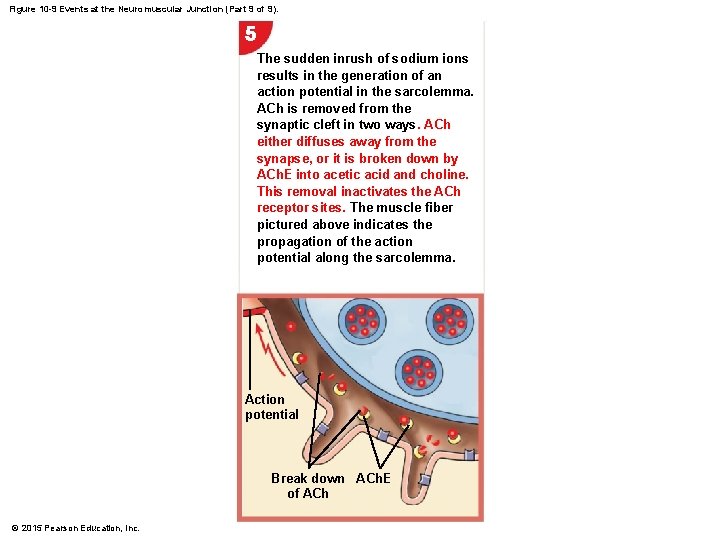
Figure 10 -9 Events at the Neuromuscular Junction (Part 9 of 9). 5 The sudden inrush of sodium ions results in the generation of an action potential in the sarcolemma. ACh is removed from the synaptic cleft in two ways. ACh either diffuses away from the synapse, or it is broken down by ACh. E into acetic acid and choline. This removal inactivates the ACh receptor sites. The muscle fiber pictured above indicates the propagation of the action potential along the sarcolemma. Action potential Break down ACh. E of ACh © 2015 Pearson Education, Inc.
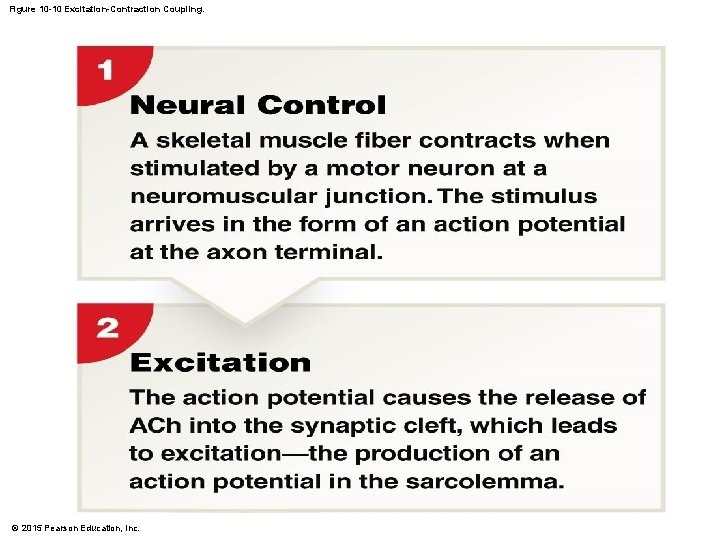
Figure 10 -10 Excitation-Contraction Coupling. © 2015 Pearson Education, Inc.
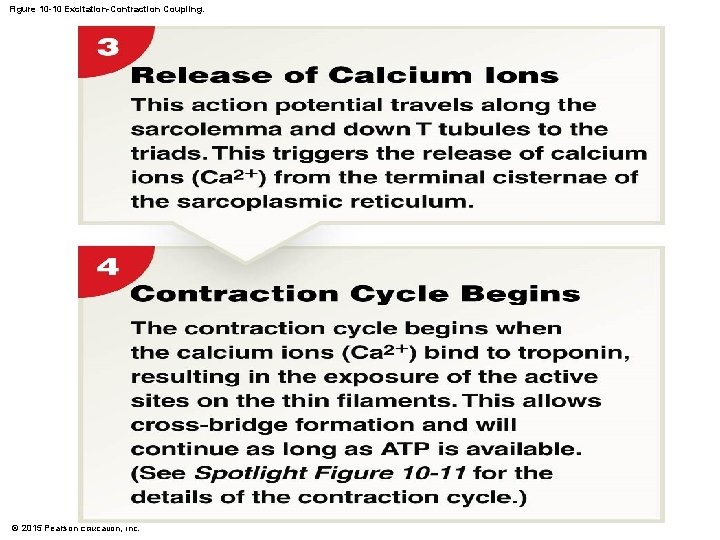
Figure 10 -10 Excitation-Contraction Coupling. © 2015 Pearson Education, Inc.
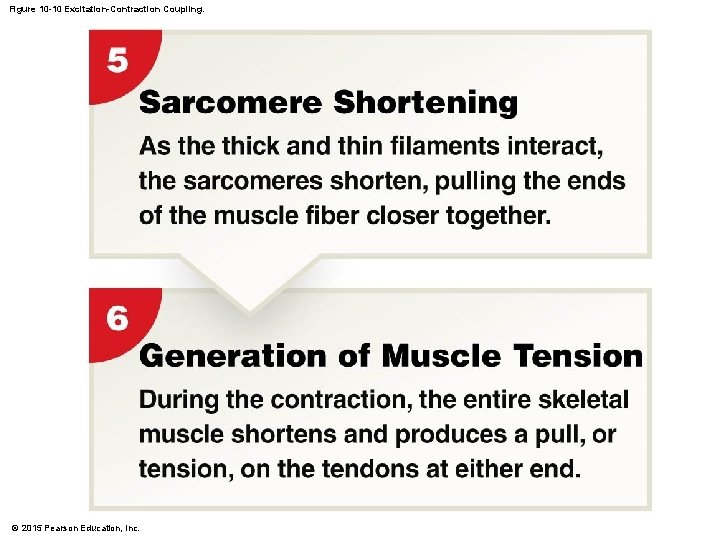
Figure 10 -10 Excitation-Contraction Coupling. © 2015 Pearson Education, Inc.
10 -4 Skeletal Muscle Contraction • The Contraction Cycle 1. 2. 3. 4. 5. 6. Contraction Cycle Begins Active-Site Exposure Cross-Bridge Formation Myosin Head Pivoting Cross-Bridge Detachment Myosin Reactivation © 2015 Pearson Education, Inc.
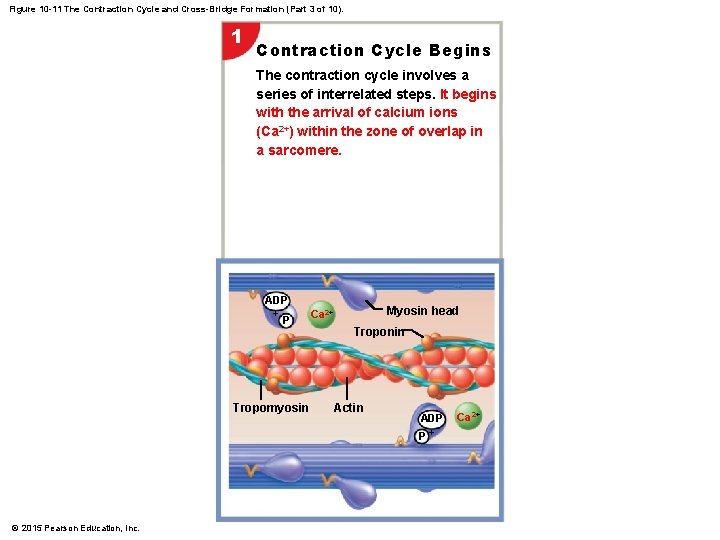
Figure 10 -11 The Contraction Cycle and Cross-Bridge Formation (Part 3 of 10). 1 Contraction Cycle Begins The contraction cycle involves a series of interrelated steps. It begins with the arrival of calcium ions (Ca 2+) within the zone of overlap in a sarcomere. ADP + P Tropomyosin © 2015 Pearson Education, Inc. Myosin head Ca 2+ Troponin Actin ADP P+ Ca 2+
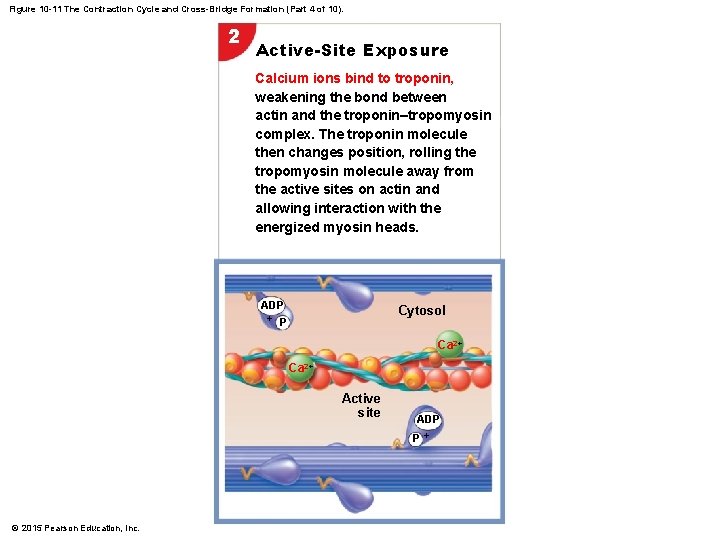
Figure 10 -11 The Contraction Cycle and Cross-Bridge Formation (Part 4 of 10). 2 Active-Site Exposure Calcium ions bind to troponin, weakening the bond between actin and the troponin–tropomyosin complex. The troponin molecule then changes position, rolling the tropomyosin molecule away from the active sites on actin and allowing interaction with the energized myosin heads. ADP + P Cytosol Ca 2+ Active site © 2015 Pearson Education, Inc. ADP P+
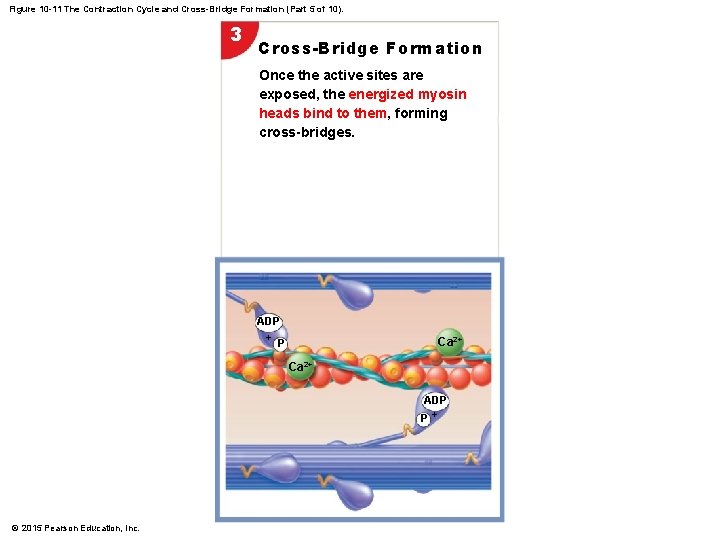
Figure 10 -11 The Contraction Cycle and Cross-Bridge Formation (Part 5 of 10). 3 Cross-Bridge Formation Once the active sites are exposed, the energized myosin heads bind to them, forming cross-bridges. ADP + P Ca 2+ ADP P+ © 2015 Pearson Education, Inc.
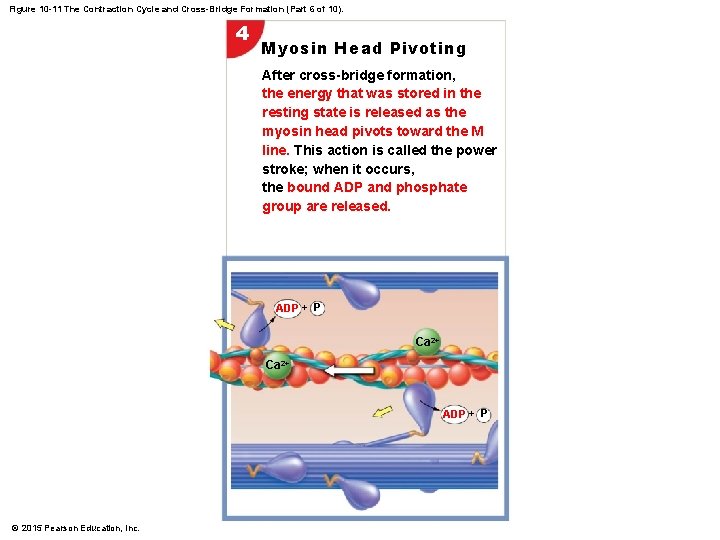
Figure 10 -11 The Contraction Cycle and Cross-Bridge Formation (Part 6 of 10). 4 Myosin Head Pivoting After cross-bridge formation, the energy that was stored in the resting state is released as the myosin head pivots toward the M line. This action is called the power stroke; when it occurs, the bound ADP and phosphate group are released. ADP + P Ca 2+ ADP + P © 2015 Pearson Education, Inc.
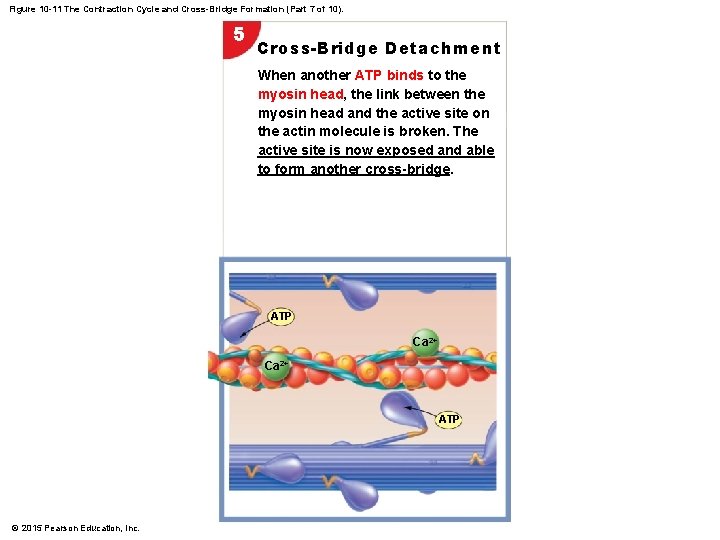
Figure 10 -11 The Contraction Cycle and Cross-Bridge Formation (Part 7 of 10). 5 Cross-Bridge Detachment When another ATP binds to the myosin head, the link between the myosin head and the active site on the actin molecule is broken. The active site is now exposed and able to form another cross-bridge. ATP Ca 2+ ATP © 2015 Pearson Education, Inc.
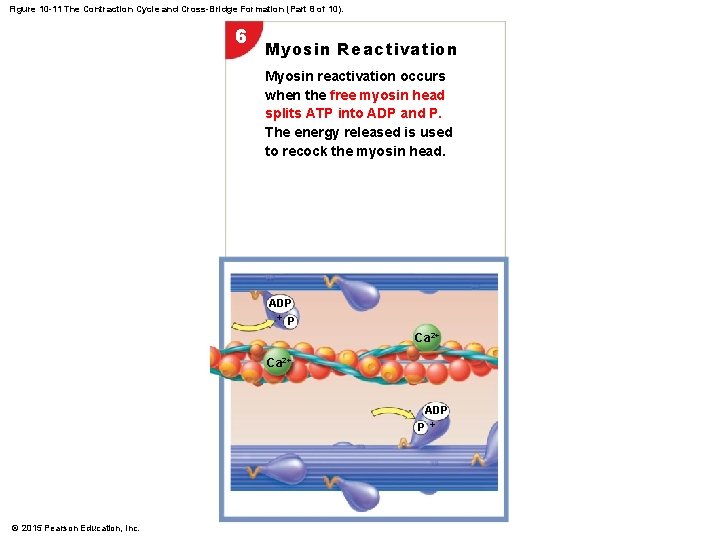
Figure 10 -11 The Contraction Cycle and Cross-Bridge Formation (Part 8 of 10). 6 Myosin Reactivation Myosin reactivation occurs when the free myosin head splits ATP into ADP and P. The energy released is used to recock the myosin head. ADP + P Ca 2+ ADP P+ © 2015 Pearson Education, Inc.
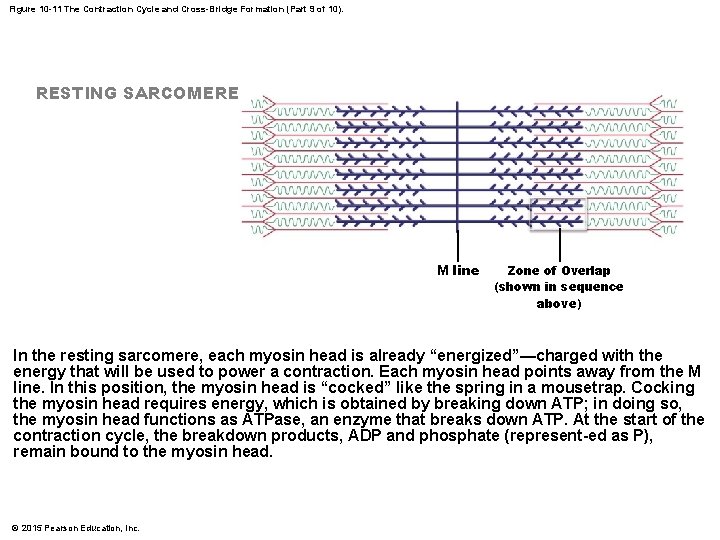
Figure 10 -11 The Contraction Cycle and Cross-Bridge Formation (Part 9 of 10). RESTING SARCOMERE M line Zone of Overlap (shown in sequence above) In the resting sarcomere, each myosin head is already “energized”—charged with the energy that will be used to power a contraction. Each myosin head points away from the M line. In this position, the myosin head is “cocked” like the spring in a mousetrap. Cocking the myosin head requires energy, which is obtained by breaking down ATP; in doing so, the myosin head functions as ATPase, an enzyme that breaks down ATP. At the start of the contraction cycle, the breakdown products, ADP and phosphate (represent-ed as P), remain bound to the myosin head. © 2015 Pearson Education, Inc.
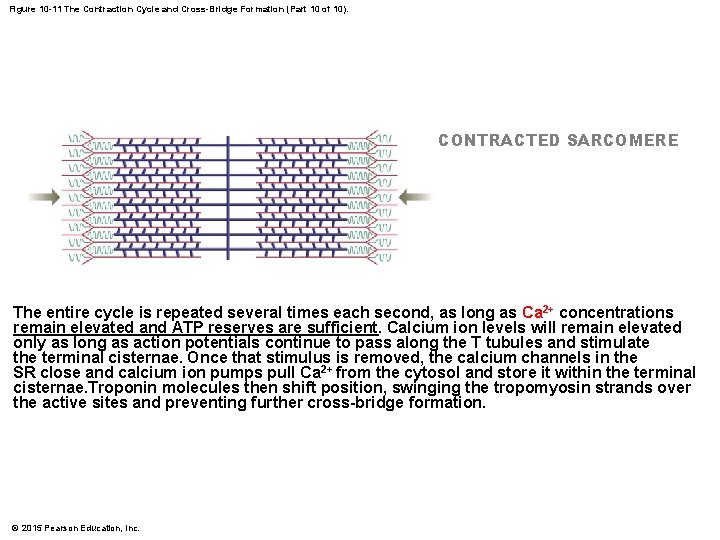
Figure 10 -11 The Contraction Cycle and Cross-Bridge Formation (Part 10 of 10). CONTRACTED SARCOMERE The entire cycle is repeated several times each second, as long as Ca 2+ concentrations remain elevated and ATP reserves are sufficient. Calcium ion levels will remain elevated only as long as action potentials continue to pass along the T tubules and stimulate the terminal cisternae. Once that stimulus is removed, the calcium channels in the SR close and calcium ion pumps pull Ca 2+ from the cytosol and store it within the terminal cisternae. Troponin molecules then shift position, swinging the tropomyosin strands over the active sites and preventing further cross-bridge formation. © 2015 Pearson Education, Inc.
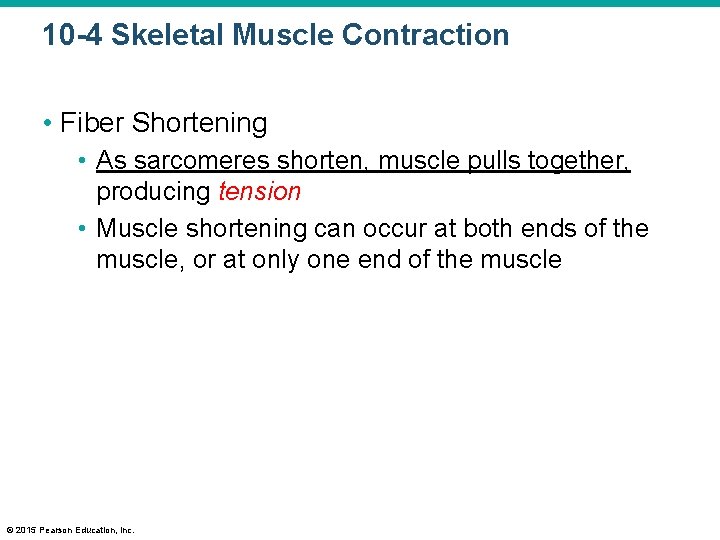
10 -4 Skeletal Muscle Contraction • Fiber Shortening • As sarcomeres shorten, muscle pulls together, producing tension • Muscle shortening can occur at both ends of the muscle, or at only one end of the muscle © 2015 Pearson Education, Inc.
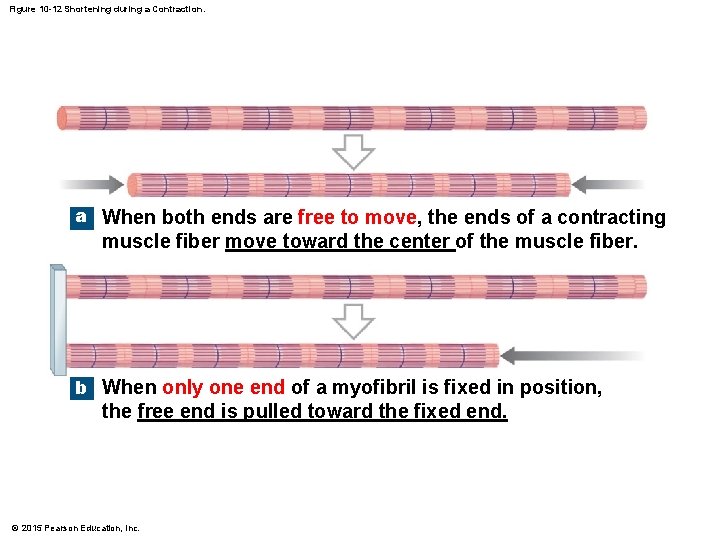
Figure 10 -12 Shortening during a Contraction. a When both ends are free to move, the ends of a contracting muscle fiber move toward the center of the muscle fiber. b When only one end of a myofibril is fixed in position, the free end is pulled toward the fixed end. © 2015 Pearson Education, Inc.
10 -4 Skeletal Muscle Relaxation • Contraction duration depends on: • Duration of neural stimulus • Number of free calcium ions in sarcoplasm • Availability of ATP © 2015 Pearson Education, Inc.
10 -4 Skeletal Muscle Contraction and Relaxation • Summary • Skeletal muscle fibers shorten as thin filaments slide between thick filaments • Free Ca 2+ in the sarcoplasm triggers contraction • Sarcoplasmic reticulum releases Ca 2+ when a motor neuron stimulates the muscle fiber • Contraction is an active process • Relaxation and return to resting length are passive © 2015 Pearson Education, Inc.
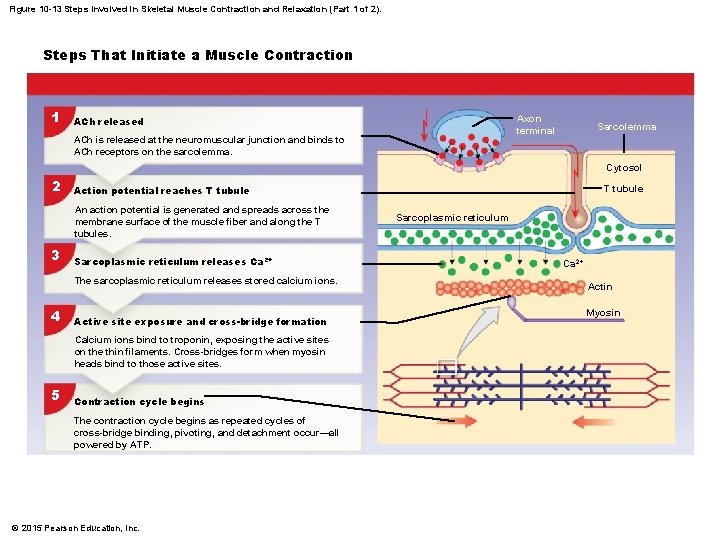
Figure 10 -13 Steps Involved in Skeletal Muscle Contraction and Relaxation (Part 1 of 2). Steps That Initiate a Muscle Contraction 1 Axon terminal ACh released ACh is released at the neuromuscular junction and binds to ACh receptors on the sarcolemma. Sarcolemma Cytosol 2 An action potential is generated and spreads across the membrane surface of the muscle fiber and along the T tubules. 3 Sarcoplasmic reticulum releases Ca 2+ The sarcoplasmic reticulum releases stored calcium ions. 4 Active site exposure and cross-bridge formation Calcium ions bind to troponin, exposing the active sites on the thin filaments. Cross-bridges form when myosin heads bind to those active sites. 5 T tubule Action potential reaches T tubule Contraction cycle begins The contraction cycle begins as repeated cycles of cross-bridge binding, pivoting, and detachment occur—all powered by ATP. © 2015 Pearson Education, Inc. Sarcoplasmic reticulum Ca 2+ Actin Myosin
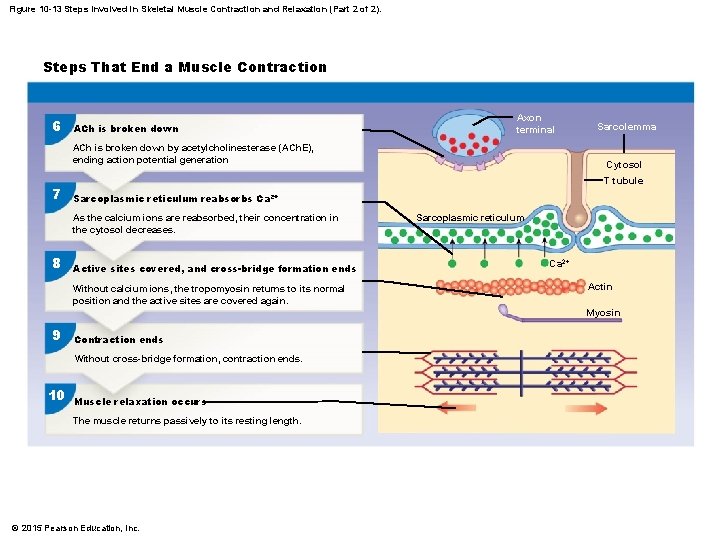
Figure 10 -13 Steps Involved in Skeletal Muscle Contraction and Relaxation (Part 2 of 2). Steps That End a Muscle Contraction 6 ACh is broken down Axon terminal ACh is broken down by acetylcholinesterase (ACh. E), ending action potential generation 7 Cytosol T tubule Sarcoplasmic reticulum reabsorbs Ca 2+ As the calcium ions are reabsorbed, their concentration in the cytosol decreases. 8 Sarcolemma Active sites covered, and cross-bridge formation ends Without calcium ions, the tropomyosin returns to its normal position and the active sites are covered again. Sarcoplasmic reticulum Ca 2+ Actin Myosin 9 Contraction ends Without cross-bridge formation, contraction ends. 10 Muscle relaxation occurs The muscle returns passively to its resting length. © 2015 Pearson Education, Inc.
10 -5 Tension Production and Contraction Types • Tension Production by Muscles Fibers • As a whole, a muscle fiber is either contracted or relaxed • Depends on: • The number of pivoting cross-bridges • The fiber’s resting length at the time of stimulation • The frequency of stimulation © 2015 Pearson Education, Inc.
10 -5 Tension Production and Contraction Types • Tension Production by Muscles Fibers • Length–Tension Relationships • Number of pivoting cross-bridges depends on: Amount of overlap between thick and thin fibers • Optimum overlap produces greatest amount of tension • Too much or too little reduces efficiency • Normal resting sarcomere length is 75 to 130 percent of optimal length © 2015 Pearson Education, Inc.
10 -5 Tension Production and Contraction Types • Tension Production by Muscle Fibers • The Frequency of Stimulation • A single contraction or twitch which lasts about 7– 100 msec. • Sustained muscular contractions • Require many repeated stimuli © 2015 Pearson Education, Inc.
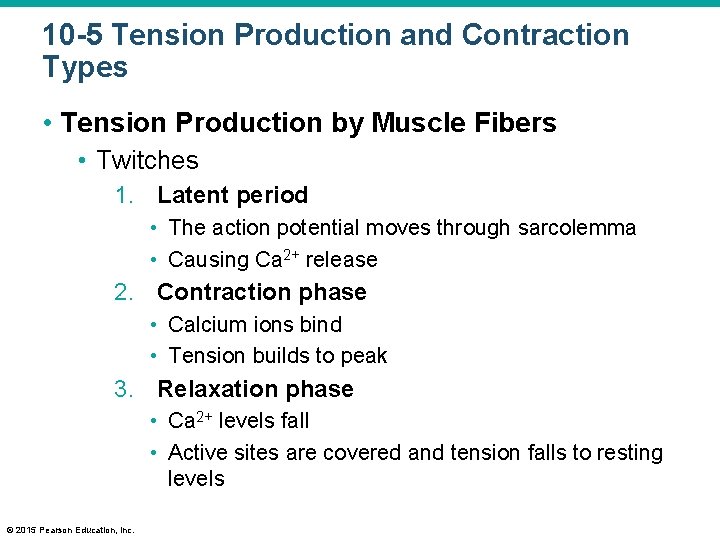
10 -5 Tension Production and Contraction Types • Tension Production by Muscle Fibers • Twitches 1. Latent period • The action potential moves through sarcolemma • Causing Ca 2+ release 2. Contraction phase • Calcium ions bind • Tension builds to peak 3. Relaxation phase • Ca 2+ levels fall • Active sites are covered and tension falls to resting levels © 2015 Pearson Education, Inc.
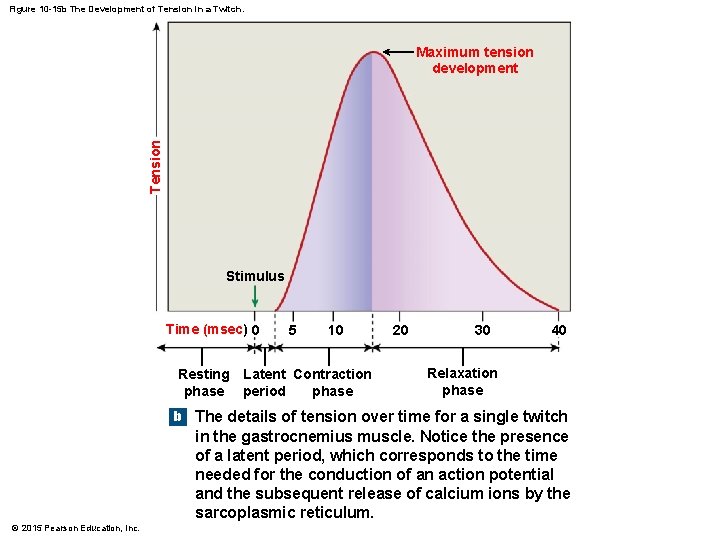
Figure 10 -15 b The Development of Tension in a Twitch. Tension Maximum tension development Stimulus Time (msec) 0 5 10 Resting Latent Contraction phase period phase 20 30 40 Relaxation phase b The details of tension over time for a single twitch in the gastrocnemius muscle. Notice the presence of a latent period, which corresponds to the time needed for the conduction of an action potential and the subsequent release of calcium ions by the sarcoplasmic reticulum. © 2015 Pearson Education, Inc.
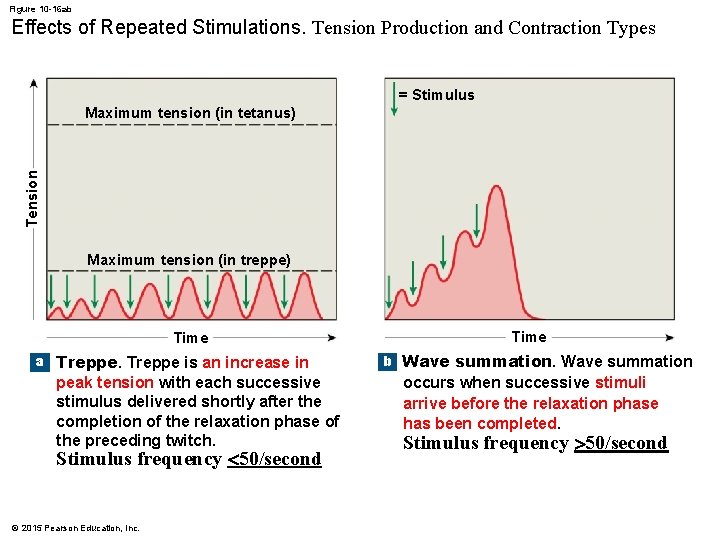
Figure 10 -16 ab Effects of Repeated Stimulations. Tension Production and Contraction Types = Stimulus Tension Maximum tension (in tetanus) Maximum tension (in treppe) Time a Treppe is an increase in peak tension with each successive stimulus delivered shortly after the completion of the relaxation phase of the preceding twitch. Stimulus frequency 50/second © 2015 Pearson Education, Inc. Time b Wave summation occurs when successive stimuli arrive before the relaxation phase has been completed. Stimulus frequency 50/second
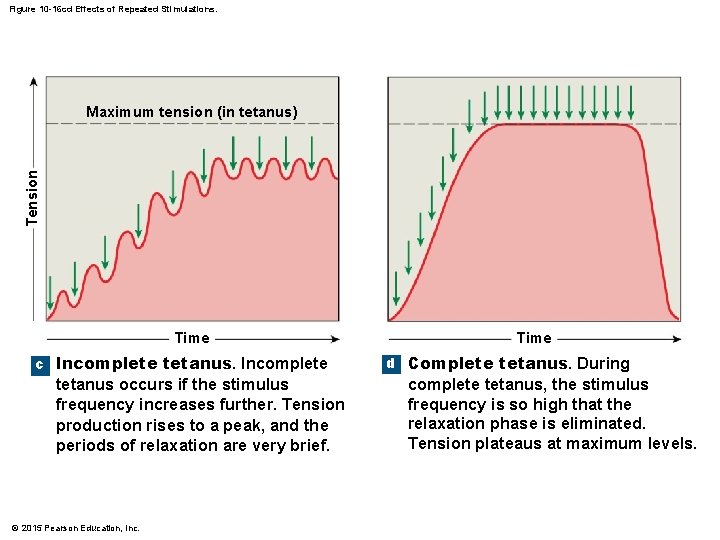
Figure 10 -16 cd Effects of Repeated Stimulations. Tension Maximum tension (in tetanus) Time c Incomplete tetanus occurs if the stimulus frequency increases further. Tension production rises to a peak, and the periods of relaxation are very brief. © 2015 Pearson Education, Inc. Time d Complete tetanus. During complete tetanus, the stimulus frequency is so high that the relaxation phase is eliminated. Tension plateaus at maximum levels.
10 -5 Tension Production and Contraction Types • Tension Production by Skeletal Muscles • Depends on: • Internal tension produced by muscle fibers • External tension exerted by muscle fibers on elastic extracellular fibers and number of muscle fibers stimulated © 2015 Pearson Education, Inc.
10 -5 Tension Production and Contraction Types • Motor Units and Tension Production • Motor units in a skeletal muscle: Contain hundreds of muscle fibers that contract at the same time and controlled by a single motor neuron • Recruitment (multiple motor unit summation): In a whole muscle or group of muscles, smooth motion and increasing tension are produced by slowly increasing the size or number of motor units stimulated © 2015 Pearson Education, Inc.
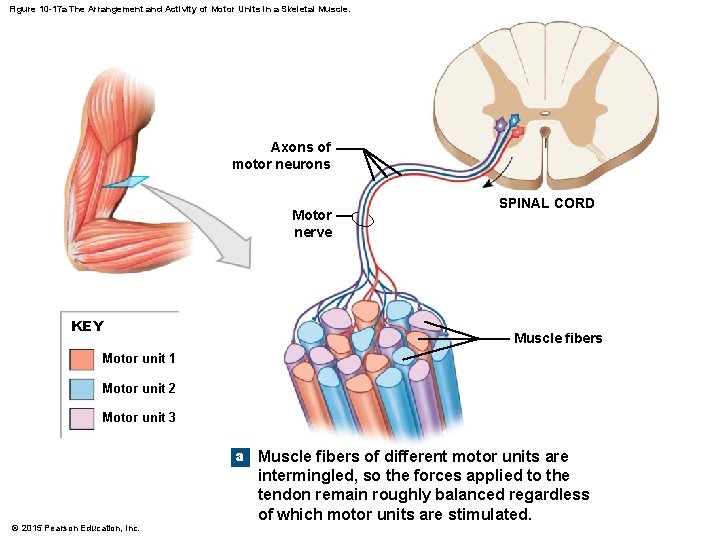
Figure 10 -17 a The Arrangement and Activity of Motor Units in a Skeletal Muscle. Axons of motor neurons Motor nerve KEY SPINAL CORD Muscle fibers Motor unit 1 Motor unit 2 Motor unit 3 a Muscle fibers of different motor units are © 2015 Pearson Education, Inc. intermingled, so the forces applied to the tendon remain roughly balanced regardless of which motor units are stimulated.
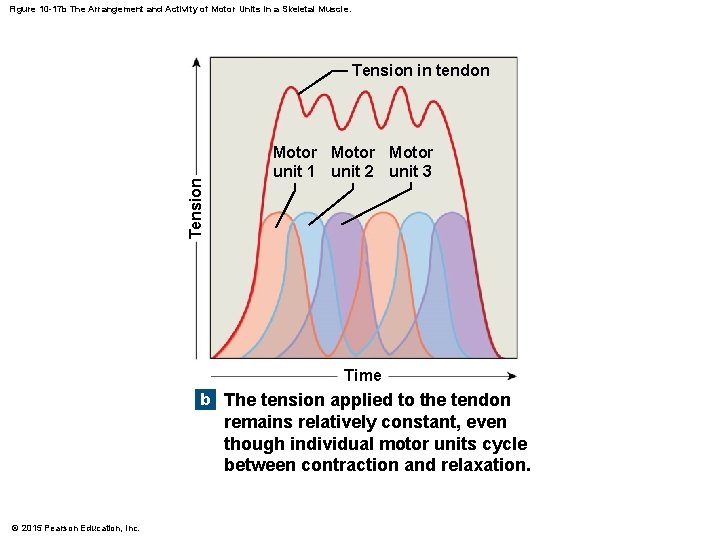
Figure 10 -17 b The Arrangement and Activity of Motor Units in a Skeletal Muscle. Tension in tendon Motor unit 1 unit 2 unit 3 Time b The tension applied to the tendon remains relatively constant, even though individual motor units cycle between contraction and relaxation. © 2015 Pearson Education, Inc.
10 -5 Tension Production and Contraction Types • Motor Units and Tension Production • Sustained tension: Is less than maximum tension and allows motor units to rest in rotation • Muscle tone • The normal tension and firmness of a muscle at rest • Muscle units actively maintain body position, without motion • Increasing muscle tone increases metabolic energy used, even at rest © 2015 Pearson Education, Inc.
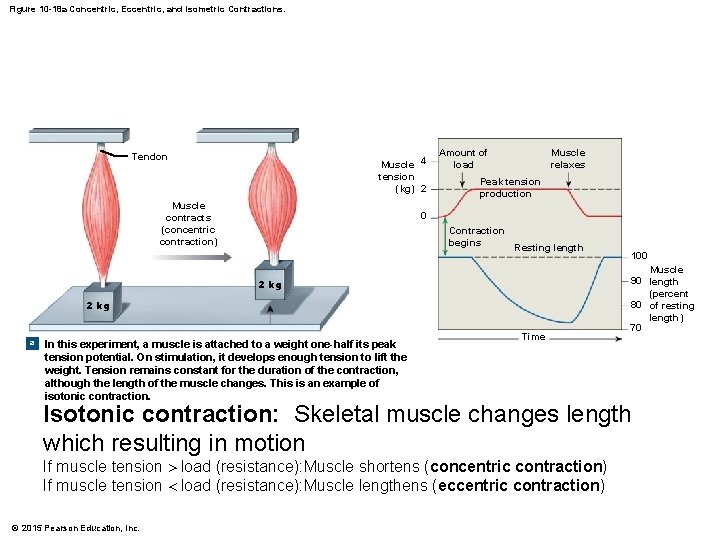
Figure 10 -18 a Concentric, Eccentric, and Isometric Contractions. Tendon Muscle 4 tension (kg) 2 Muscle contracts (concentric contraction) Amount of load Muscle relaxes Peak tension production 0 Contraction begins Resting length 2 kg a In this experiment, a muscle is attached to a weight one-half its peak tension potential. On stimulation, it develops enough tension to lift the weight. Tension remains constant for the duration of the contraction, although the length of the muscle changes. This is an example of isotonic contraction. Time 100 Muscle 90 length (percent 80 of resting length) 70 Isotonic contraction: Skeletal muscle changes length which resulting in motion If muscle tension load (resistance): Muscle shortens (concentric contraction) If muscle tension load (resistance): Muscle lengthens (eccentric contraction) © 2015 Pearson Education, Inc.
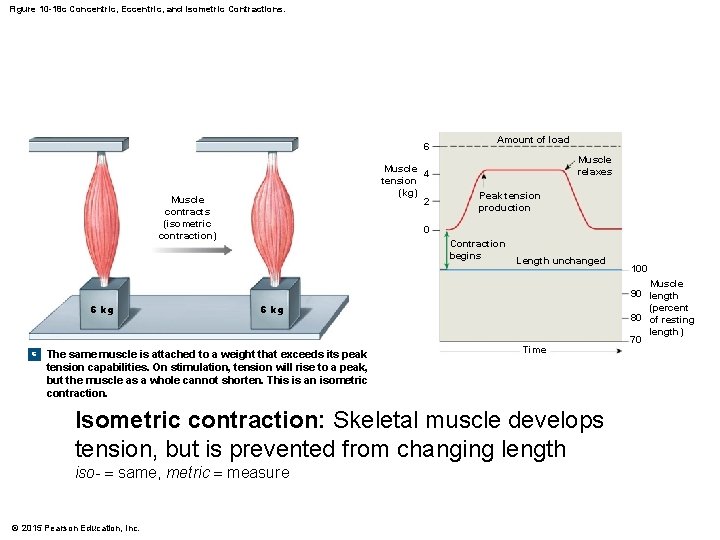
Figure 10 -18 c Concentric, Eccentric, and Isometric Contractions. 6 Muscle 4 tension (kg) 2 Muscle contracts (isometric contraction) 6 kg c Amount of load Muscle relaxes Peak tension production 0 Contraction begins Length unchanged 6 kg The same muscle is attached to a weight that exceeds its peak tension capabilities. On stimulation, tension will rise to a peak, but the muscle as a whole cannot shorten. This is an isometric contraction. Time Isometric contraction: Skeletal muscle develops tension, but is prevented from changing length iso- same, metric measure © 2015 Pearson Education, Inc. 100 Muscle 90 length (percent 80 of resting length) 70
10 -5 Tension Production and Contraction Types • Load and Speed of Contraction are inversely related • The heavier the load (resistance) on a muscle: • The longer it takes for shortening to begin • And the less the muscle will shorten © 2015 Pearson Education, Inc.
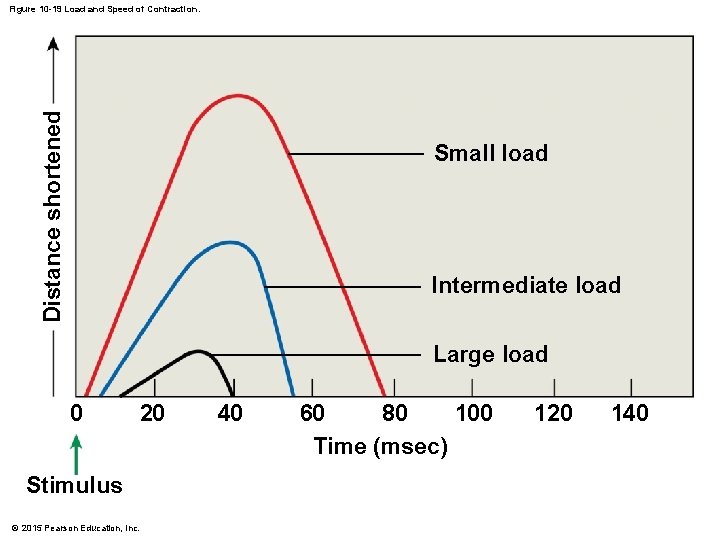
Distance shortened Figure 10 -19 Load and Speed of Contraction. Small load Intermediate load Large load 0 20 Stimulus © 2015 Pearson Education, Inc. 40 60 80 100 Time (msec) 120 140
10 -5 Tension Production and Contraction Types • Muscle Relaxation and the Return to Resting Length • Elastic forces: Is the pull of elastic elements (tendons and ligaments) which expands the sarcomeres to resting length • Opposing muscle contractions: Reverse the direction of the original motion are the work of opposing skeletal muscle pairs • Gravity: Can take the place of opposing muscle contraction to return a muscle to its resting state © 2015 Pearson Education, Inc.
10 -6 Energy to Power Contractions • ATP Provides Energy for Muscle Contraction • Sustained muscle contraction uses a lot of ATP energy also muscles store enough energy to start contraction and muscle fibers must manufacture more ATP as needed © 2015 Pearson Education, Inc.
10 -6 Energy to Power Contractions • ATP and Creatine Phoaphate Reserves • Adenosine triphosphate (ATP) is the active energy molecule • Creatine phosphate (CP): The storage molecule for excess ATP energy in resting muscle Cells produce ATP in two ways 1. Aerobic metabolism of fatty acids in the mitochondria which produces 34 ATP molecules per glucose molecule 2. Anaerobic glycolysis in the cytoplasm which produces 2 ATP molecules per molecule of glucose and breaks down glucose from glycogen stored in skeletal muscles © 2015 Pearson Education, Inc.
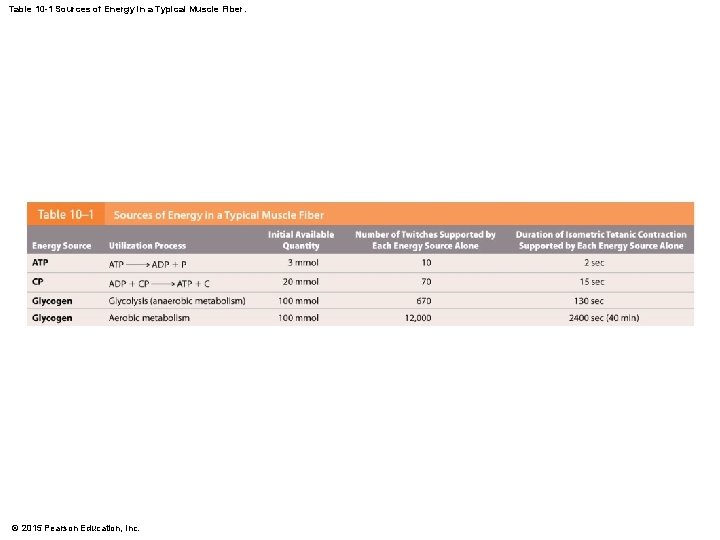
Table 10 -1 Sources of Energy in a Typical Muscle Fiber. © 2015 Pearson Education, Inc.
10 -6 Energy to Power Contractions • Energy Use and the Level of Muscular Activity • Skeletal muscles at rest metabolize fatty acids and store glycogen • During light activity, muscles generate ATP through anaerobic breakdown of carbohydrates, lipids, or amino acids • At peak activity, energy is provided by anaerobic reactions that generate lactic acid as a by-product © 2015 Pearson Education, Inc.
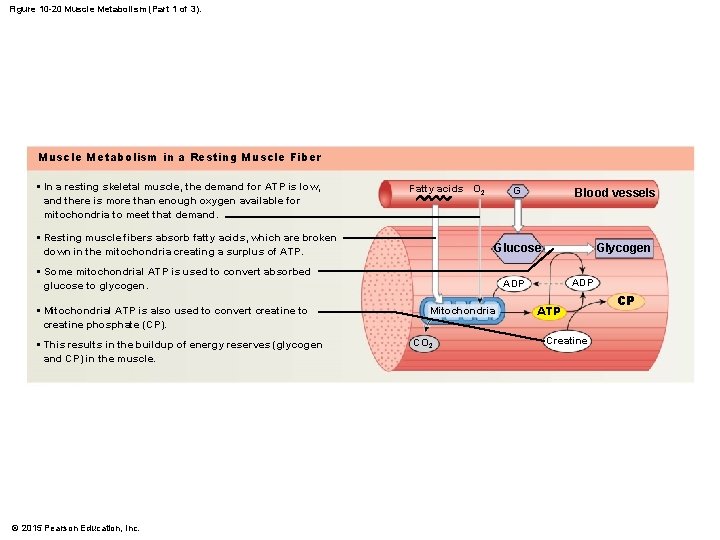
Figure 10 -20 Muscle Metabolism (Part 1 of 3). Muscle Metabolism in a Resting Muscle Fiber • In a resting skeletal muscle, the demand for ATP is low, and there is more than enough oxygen available for mitochondria to meet that demand. Fatty acids O 2 • Resting muscle fibers absorb fatty acids, which are broken down in the mitochondria creating a surplus of ATP. G • This results in the buildup of energy reserves (glycogen and CP) in the muscle. © 2015 Pearson Education, Inc. Glycogen Glucose • Some mitochondrial ATP is used to convert absorbed glucose to glycogen. • Mitochondrial ATP is also used to convert creatine to creatine phosphate (CP). Blood vessels ADP Mitochondria CO 2 ATP Creatine CP
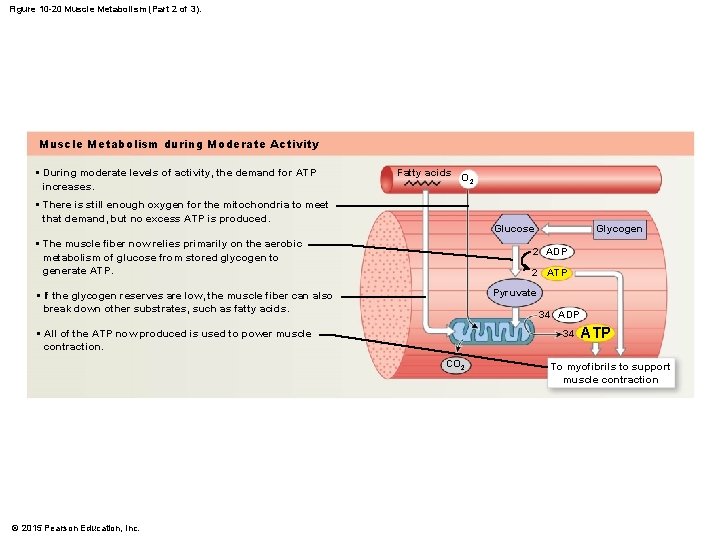
Figure 10 -20 Muscle Metabolism (Part 2 of 3). Muscle Metabolism during Moderate Activity • During moderate levels of activity, the demand for ATP increases. Fatty acids O 2 • There is still enough oxygen for the mitochondria to meet that demand, but no excess ATP is produced. Glucose • The muscle fiber now relies primarily on the aerobic metabolism of glucose from stored glycogen to generate ATP. 2 ADP 2 ATP Pyruvate • If the glycogen reserves are low, the muscle fiber can also break down other substrates, such as fatty acids. 34 ADP 34 • All of the ATP now produced is used to power muscle contraction. CO 2 © 2015 Pearson Education, Inc. Glycogen ATP To myofibrils to support muscle contraction
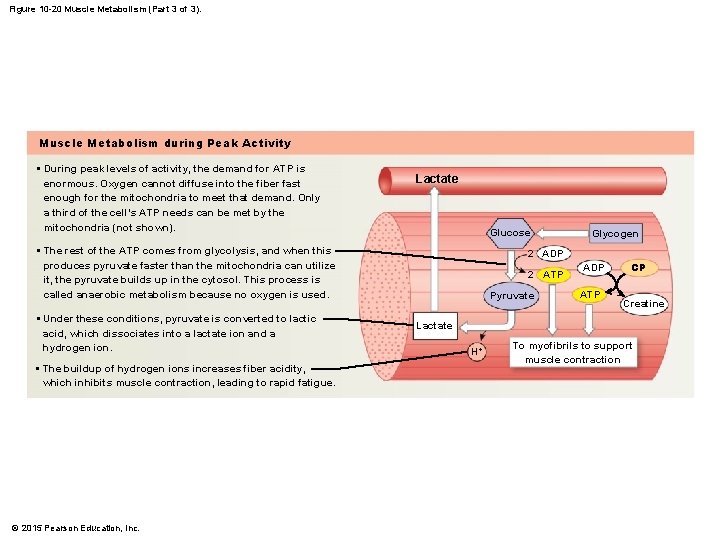
Figure 10 -20 Muscle Metabolism (Part 3 of 3). Muscle Metabolism during Peak Activity • During peak levels of activity, the demand for ATP is enormous. Oxygen cannot diffuse into the fiber fast enough for the mitochondria to meet that demand. Only a third of the cell’s ATP needs can be met by the mitochondria (not shown). Lactate Glucose • The rest of the ATP comes from glycolysis, and when this produces pyruvate faster than the mitochondria can utilize it, the pyruvate builds up in the cytosol. This process is called anaerobic metabolism because no oxygen is used. • Under these conditions, pyruvate is converted to lactic acid, which dissociates into a lactate ion and a hydrogen ion. • The buildup of hydrogen ions increases fiber acidity, which inhibits muscle contraction, leading to rapid fatigue. © 2015 Pearson Education, Inc. Glycogen 2 ADP 2 ATP Pyruvate ADP ATP CP Creatine Lactate H+ To myofibrils to support muscle contraction
10 -6 Energy to Power Contractions • Muscle Fatigue • When muscles can no longer perform a required activity, they are fatigued • Results of Muscle Fatigue 1. Depletion of metabolic reserves 2. Damage to sarcolemma and sarcoplasmic reticulum 3. Low p. H (lactic acid) 4. Muscle exhaustion and pain © 2015 Pearson Education, Inc.
10 -6 Energy to Power Contractions The Recovery Period • The time required after exertion for muscles to return to normal • Oxygen becomes available • Mitochondrial activity resumes The Cori Cycle • The removal and recycling of lactic acid by the liver • Liver converts lactate to pyruvate • Glucose is released to recharge muscle glycogen reserves © 2015 Pearson Education, Inc.
10 -6 Energy to Power Contractions The Oxygen Debt • After exercise or other exertion the body needs more oxygen than usual to normalize metabolic activities which resulting in heavy breathing also called excess postexercise oxygen consumption (EPOC) Heat Production and Loss • Active muscles produce heat • Up to 70 percent of muscle energy can be lost as heat, raising body temperature © 2015 Pearson Education, Inc.
10 -7 Types of Muscle Fibers and Endurance • Muscle Performance • Force: The maximum amount of tension produced • Endurance: The amount of time an activity can be sustained • Force and endurance depend on the types of muscle fibers and physical conditioning © 2015 Pearson Education, Inc.
10 -7 Types of Muscle Fibers and Endurance • Three Major Types of Skeletal Muscle Fibers 1. Fast fibers: Contract very quickly, have large diameter, large glycogen reserves, few mitochondria, strong contractions, and fatigue quickly 2. Slow fibers: Are slow to contract, slow to fatigue, have small diameter, more mitochondria, have high oxygen supply, and contain myoglobin (red pigment, binds oxygen) 3. Intermediate fibers: Are mid-sized, have low myoglobin, have more capillaries than fast fibers, and slower to fatigue © 2015 Pearson Education, Inc.
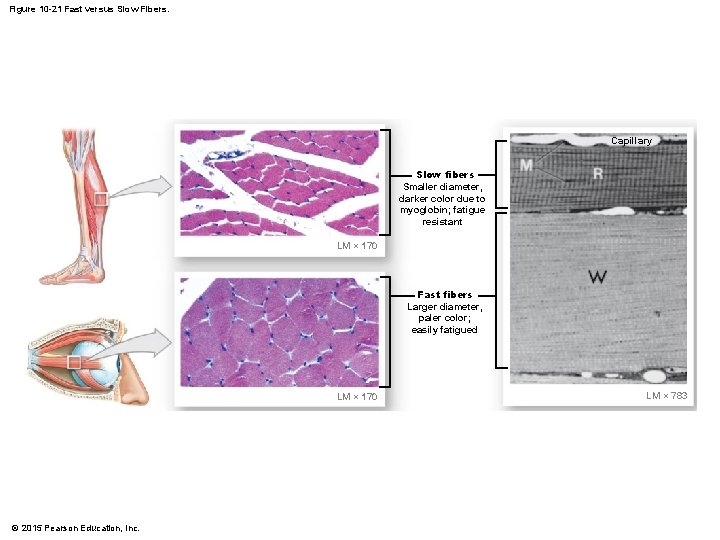
Figure 10 -21 Fast versus Slow Fibers. Capillary Slow fibers Smaller diameter, darker color due to myoglobin; fatigue resistant LM × 170 Fast fibers Larger diameter, paler color; easily fatigued LM × 170 © 2015 Pearson Education, Inc. LM × 783
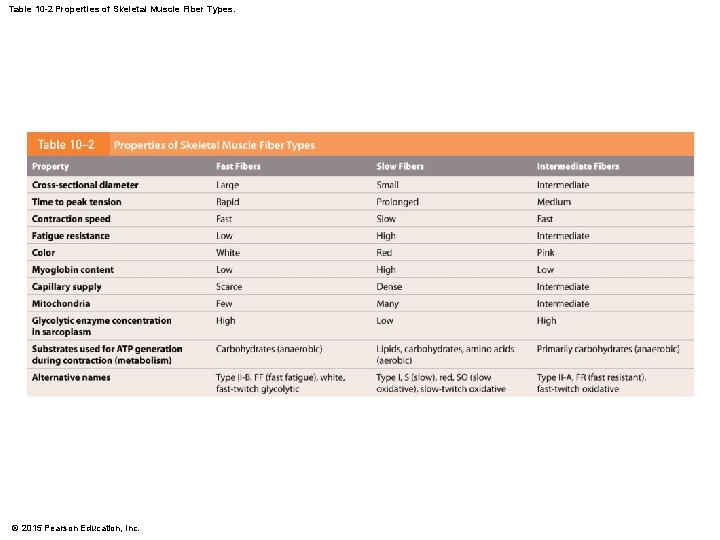
Table 10 -2 Properties of Skeletal Muscle Fiber Types. © 2015 Pearson Education, Inc.
10 -7 Types of Muscle Fibers and Endurance • Muscle Performance and the Distribution of Muscle Fibers • White muscles • Mostly fast fibers • Pale (e. g. , chicken breast) • Red muscles • Mostly slow fibers • Dark (e. g. , chicken legs) • Most human muscles • Mixed fibers • Pink © 2015 Pearson Education, Inc.
10 -7 Types of Muscle Fibers and Endurance • Muscle Hypertrophy • Muscle growth from heavy training • Increases diameter of muscle fibers • Increases number of myofibrils • Increases mitochondria, glycogen reserves • Muscle Atrophy • Lack of muscle activity and reduces muscle size, tone, and power © 2015 Pearson Education, Inc.
10 -7 Types of Muscle Fibers and Endurance • Physical Conditioning improves both power and endurance • Anaerobic activities (e. g. , 50 -meter dash, weightlifting) use fast fibers and fatigue quickly with strenuous activity • Aerobic activities (prolonged activity) supported by mitochondria and require oxygen and nutrients © 2015 Pearson Education, Inc.
10 -7 Types of Muscle Fibers and Endurance • Importance of Exercise 1. What you don’t use, you lose 2. Muscle tone indicates base activity in motor units of skeletal muscles 3. Muscles become flaccid when inactive for days or weeks 4. Muscle fibers break down proteins, become smaller and weaker 5. With prolonged inactivity, fibrous tissue may replace muscle fibers © 2015 Pearson Education, Inc.
10 -8 Cardiac Muscle Tissue • Cardiac muscle cells are striated and found only in the heart unlike skeletal muscle, cardiac muscle cells (cardiocytes) are small and have a single nucleus and short, wide T tubules • Are aerobic (high in myoglobin, mitochondria) • Have intercalated discs © 2015 Pearson Education, Inc.
10 -8 Cardiac Muscle Tissue • Intercalated Discs • Are specialized contact points between cardiocytes and join cell membranes of adjacent cardiocytes (gap junctions, desmosomes) • Functions of intercalated discs • Maintain structure • Enhance molecular and electrical connections • Conduct action potentials © 2015 Pearson Education, Inc.
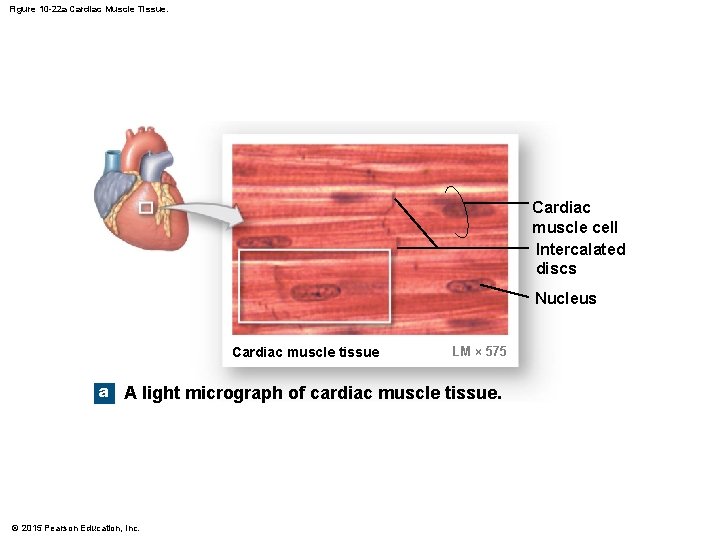
Figure 10 -22 a Cardiac Muscle Tissue. Cardiac muscle cell Intercalated discs Nucleus Cardiac muscle tissue LM × 575 a A light micrograph of cardiac muscle tissue. © 2015 Pearson Education, Inc.
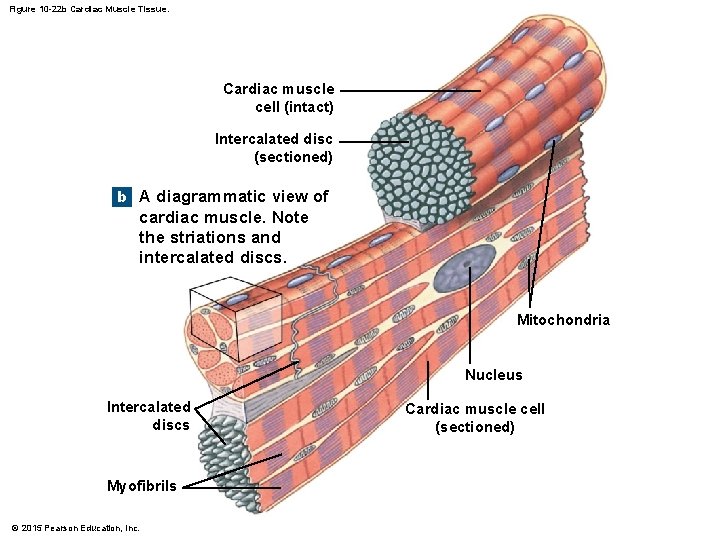
Figure 10 -22 b Cardiac Muscle Tissue. Cardiac muscle cell (intact) Intercalated disc (sectioned) b A diagrammatic view of cardiac muscle. Note the striations and intercalated discs. Mitochondria Nucleus Intercalated discs Myofibrils © 2015 Pearson Education, Inc. Cardiac muscle cell (sectioned)
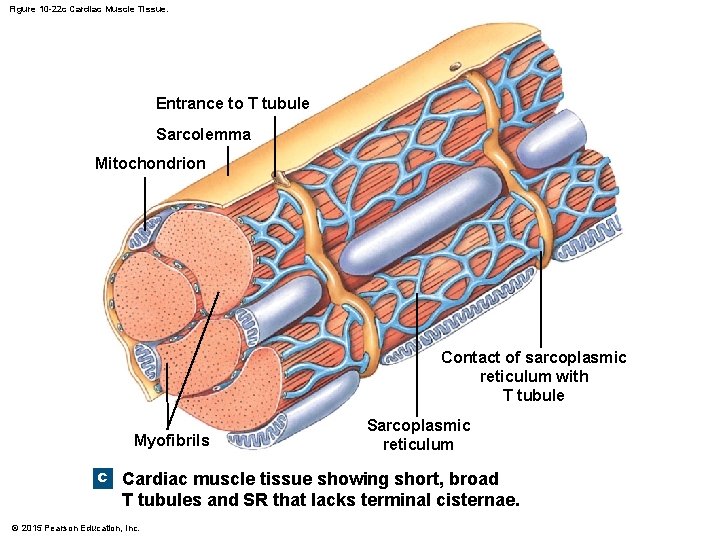
Figure 10 -22 c Cardiac Muscle Tissue. Entrance to T tubule Sarcolemma Mitochondrion Contact of sarcoplasmic reticulum with T tubule Myofibrils Sarcoplasmic reticulum c Cardiac muscle tissue showing short, broad T tubules and SR that lacks terminal cisternae. © 2015 Pearson Education, Inc.
10 -8 Cardiac Muscle Tissue • Functional Characteristics of Cardiac Muscle Tissue • Automaticity • Contraction without neural stimulation controlled by pacemaker cells • Variable contraction tension are controlled by nervous system • Prevention of wave summation and tetanic contractions by cell membranes which have long refractory period © 2015 Pearson Education, Inc.
10 -9 Smooth Muscle Tissue • Smooth Muscle in Body Systems • Forms around other tissues • In integumentary system, Arrector pili muscles cause “goose bumps” • In blood vessels and airways regulates blood pressure and airflow • In reproductive systems produces movements • In digestive and urinary systems produces contractions © 2015 Pearson Education, Inc.
10 -9 Smooth Muscle Tissue • Structural Characteristics of Smooth Muscle Tissue • Nonstriated tissue: Are different internal organization of actin and myosin and have different functional characteristics © 2015 Pearson Education, Inc.
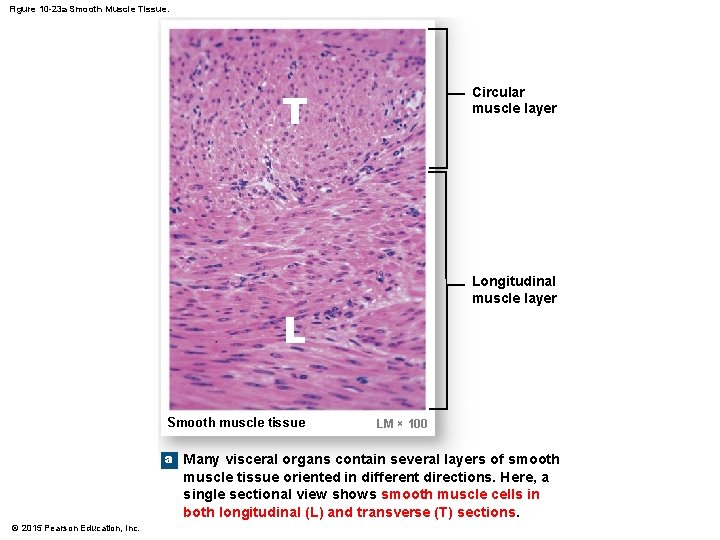
Figure 10 -23 a Smooth Muscle Tissue. T Circular muscle layer Longitudinal muscle layer L Smooth muscle tissue LM × 100 a Many visceral organs contain several layers of smooth muscle tissue oriented in different directions. Here, a single sectional view shows smooth muscle cells in both longitudinal (L) and transverse (T) sections. © 2015 Pearson Education, Inc.
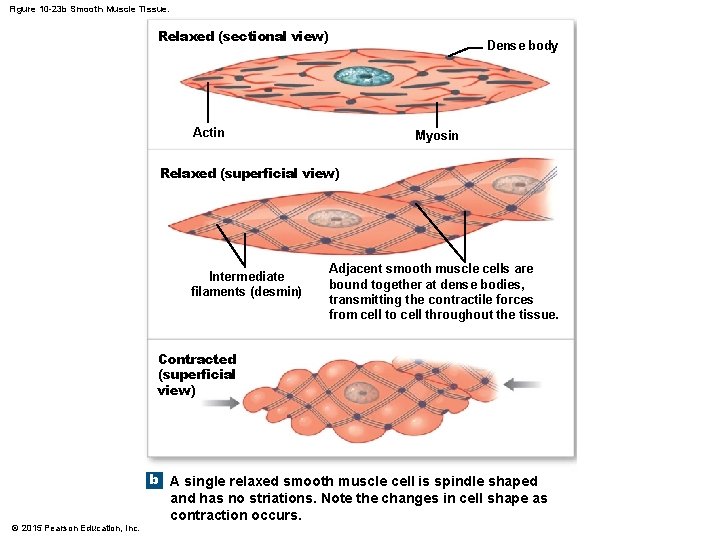
Figure 10 -23 b Smooth Muscle Tissue. Relaxed (sectional view) Actin Dense body Myosin Relaxed (superficial view) Intermediate filaments (desmin) Adjacent smooth muscle cells are bound together at dense bodies, transmitting the contractile forces from cell to cell throughout the tissue. Contracted (superficial view) b A single relaxed smooth muscle cell is spindle shaped © 2015 Pearson Education, Inc. and has no striations. Note the changes in cell shape as contraction occurs.
10 -9 Smooth Muscle Tissue • Characteristics of Smooth Muscle Cells • • Long, slender, and spindle shaped Have a single, central nucleus Have no T tubules, myofibrils, or sarcomeres Have no tendons or aponeuroses Have scattered myosin fibers Myosin fibers have more heads per thick filament Have thin filaments attached to dense bodies Dense bodies transmit contractions from cell to cell © 2015 Pearson Education, Inc.
10 -9 Smooth Muscle Tissue • Functional Characteristics of Smooth Muscle Tissue 1. Excitation–contraction coupling which enzyme breaks down ATP, initiates contraction 2. Length–tension relationships 3. Control of contractions 4. Smooth muscle tone © 2015 Pearson Education, Inc.
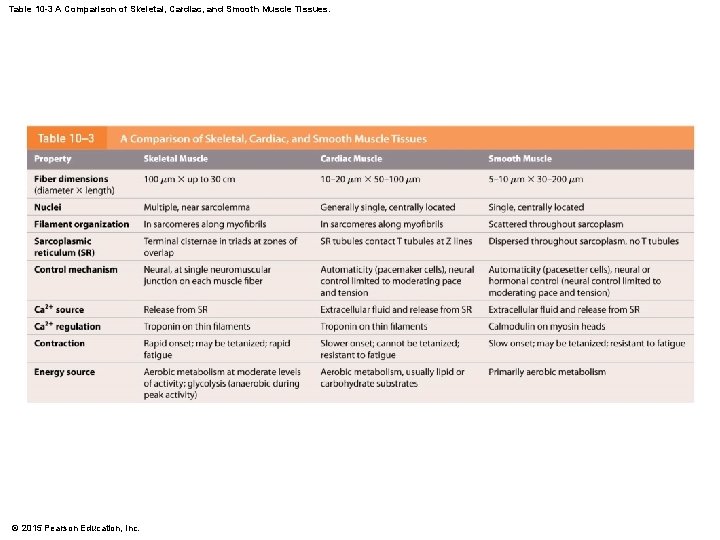
Table 10 -3 A Comparison of Skeletal, Cardiac, and Smooth Muscle Tissues. © 2015 Pearson Education, Inc.

http: //search. tb. ask. com/search/video. jhtml? n=782 b 46 d 7&p 2=%5 EY 6%5 Exdm 401%5 ES 17547%5 Eus&pg=video&pn=1&ptb=079 E 92 A 0 -736 E-426 A-B 927175 C 571 C 5 BE 4&qs=&searchfor=muscule+tissue+anatomy+and+physiology&si=CIe 41 vjg 7 M 8 CF UY 7 g. Qodcq. EHs. A&ss=sub&st=sb&tpr=sbt © 2015 Pearson Education, Inc.
- Slides: 106