
Chapter 10 Motivation Power Point Presentation by Charlie

Chapter 10 Motivation Power. Point Presentation by Charlie Cook Copyright © 2005 South-Western. All rights reserved.
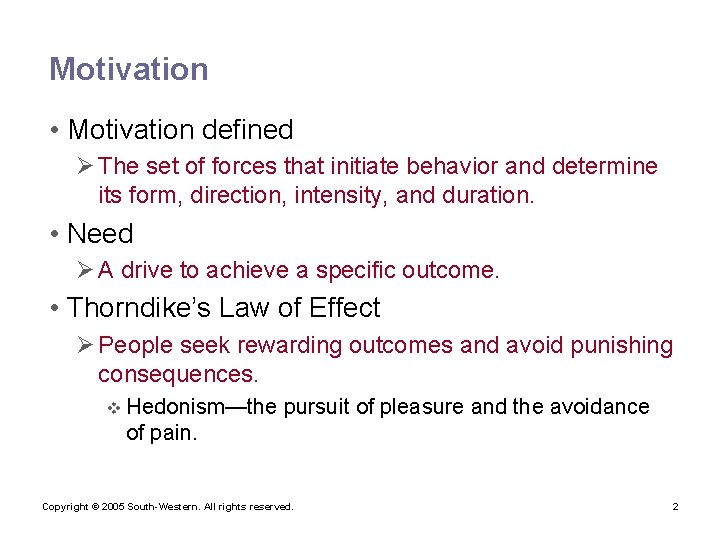
Motivation • Motivation defined Ø The set of forces that initiate behavior and determine its form, direction, intensity, and duration. • Need Ø A drive to achieve a specific outcome. • Thorndike’s Law of Effect Ø People seek rewarding outcomes and avoid punishing consequences. v Hedonism—the pursuit of pleasure and the avoidance of pain. Copyright © 2005 South-Western. All rights reserved. 2
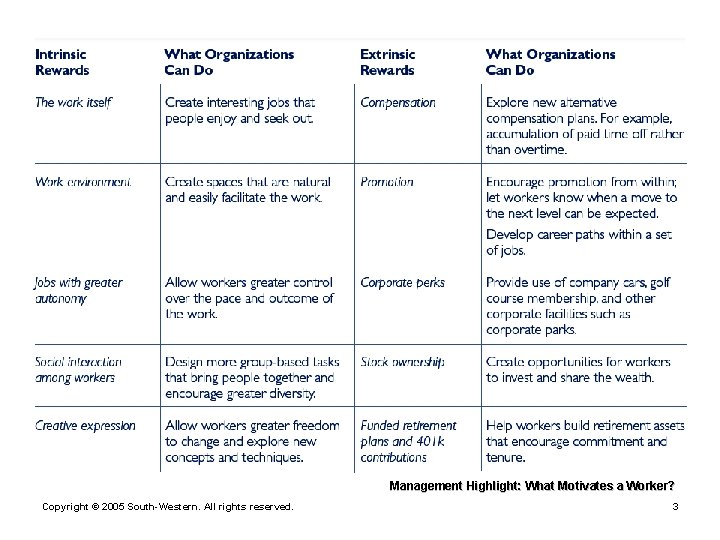
Management Highlight: What Motivates a Worker? Copyright © 2005 South-Western. All rights reserved. 3
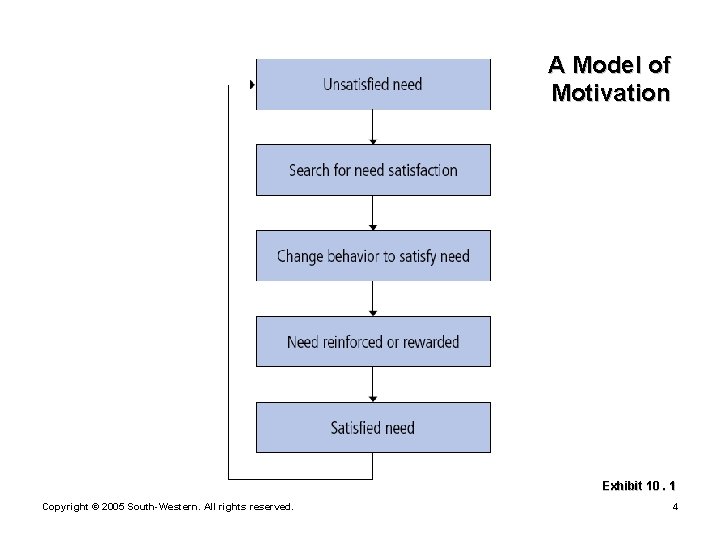
A Model of Motivation Exhibit 10. 1 Copyright © 2005 South-Western. All rights reserved. 4
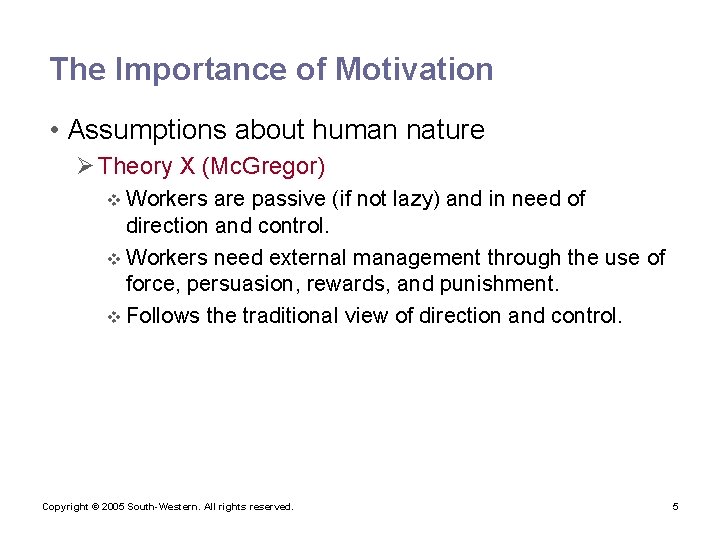
The Importance of Motivation • Assumptions about human nature Ø Theory X (Mc. Gregor) v Workers are passive (if not lazy) and in need of direction and control. v Workers need external management through the use of force, persuasion, rewards, and punishment. v Follows the traditional view of direction and control. Copyright © 2005 South-Western. All rights reserved. 5
The Importance of Motivation (cont’d) • Assumptions about human nature (cont’d) Ø Theory Y (Mc. Gregor) v Workers are eager to learn, responsible, and creative. v Workers’ capacities to learn are great and their abilities are underutilized. v If given the autonomy, workers are quite capable of selfdirection and self-control. v An organization’s reward system must be supportive of increased employee participation. Copyright © 2005 South-Western. All rights reserved. 6
The Importance of Motivation (cont’d) • The motivation process Ø Effective worker performance requires motivation, ability, and a reward system that encourages quality work. • Motivation process terms: Ø Need deprivation: a state of arousal induced by a need deficit. Ø Behavior: the specific work or task actions that result from a need-deficit–induced arousal. Ø Reward: an attractive or desired consequence or outcome (either intrinsic or extrinsic) of behavior. Copyright © 2005 South-Western. All rights reserved. 7
The Importance of Motivation (cont’d) • Motivation process terms (cont’d) Ø Feedback: knowledge about the cause-and-effect sequence that either stimulates or suppresses future states of arousal. Ø Intrinsic rewards: intangible psychological results of work, controlled by the worker, that may have a strong impact on job satisfaction. Ø Extrinsic rewards: externally administered and controlled rewards that occur apart from the actual performance of work. Ø Ability: the physical and mental characteristics required of a a worker to perform a task successfully. Copyright © 2005 South-Western. All rights reserved. 8

Content Theories of Motivation • Content (needs) theory Ø The idea that people are driven to meet basic needs that produce satisfaction when they’re met. Ø Theories include: v Maslow’s hierarchy of needs v Alderfer’s ERG theory v Herzberg’s two-factor theory v Mc. Clelland’s achievement motivation theory Copyright © 2005 South-Western. All rights reserved. 9
Content Theories of Motivation (cont’d) • Maslow’s hierarchy of needs Ø Key assumptions: v Behavior is triggered by a need deficit that drives the individual to reduce the tension it creates. v Different needs are active at different times, and only needs not yet satisfied can influence behavior. v Needs are arranged in a fixed order of importance called a hierarchy. – Prepotency: the idea that the most basic unsatisfied need (in the hierarchy) influences current behavior. Copyright © 2005 South-Western. All rights reserved. 10
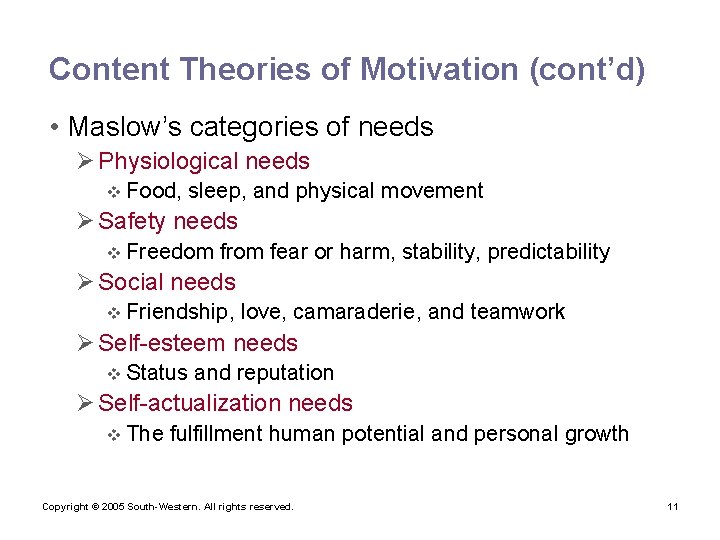
Content Theories of Motivation (cont’d) • Maslow’s categories of needs Ø Physiological needs v Food, sleep, and physical movement Ø Safety needs v Freedom from fear or harm, stability, predictability Ø Social needs v Friendship, love, camaraderie, and teamwork Ø Self-esteem needs v Status and reputation Ø Self-actualization needs v The fulfillment human potential and personal growth Copyright © 2005 South-Western. All rights reserved. 11
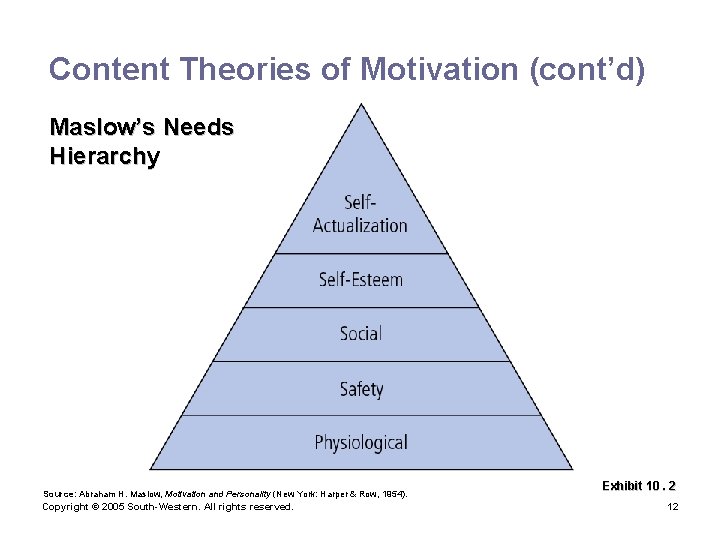
Content Theories of Motivation (cont’d) Maslow’s Needs Hierarchy Source: Abraham H. Maslow, Motivation and Personality (New York: Harper & Row, 1954). Copyright © 2005 South-Western. All rights reserved. Exhibit 10. 2 12
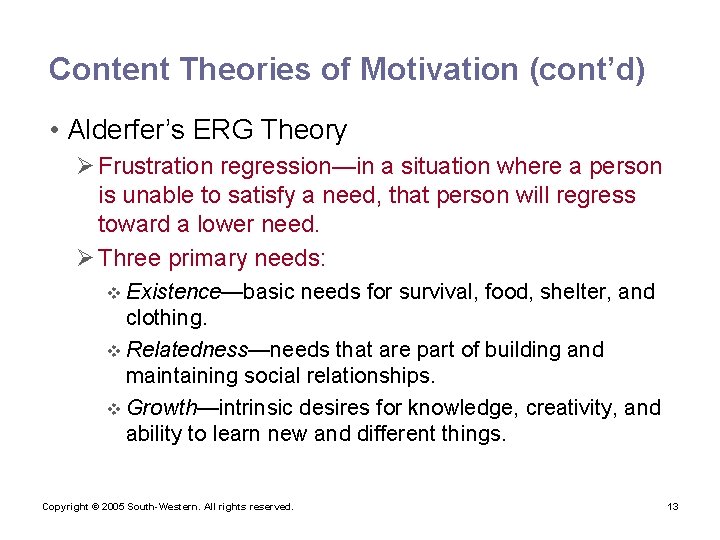
Content Theories of Motivation (cont’d) • Alderfer’s ERG Theory Ø Frustration regression—in a situation where a person is unable to satisfy a need, that person will regress toward a lower need. Ø Three primary needs: v Existence—basic needs for survival, food, shelter, and clothing. v Relatedness—needs that are part of building and maintaining social relationships. v Growth—intrinsic desires for knowledge, creativity, and ability to learn new and different things. Copyright © 2005 South-Western. All rights reserved. 13
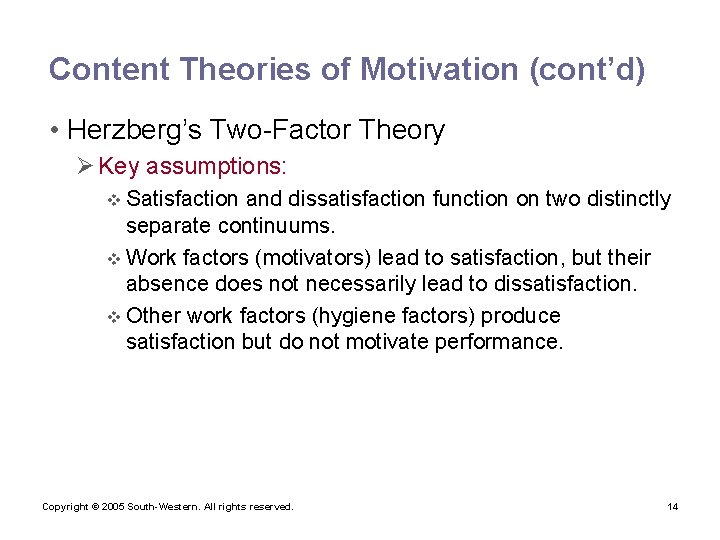
Content Theories of Motivation (cont’d) • Herzberg’s Two-Factor Theory Ø Key assumptions: v Satisfaction and dissatisfaction function on two distinctly separate continuums. v Work factors (motivators) lead to satisfaction, but their absence does not necessarily lead to dissatisfaction. v Other work factors (hygiene factors) produce satisfaction but do not motivate performance. Copyright © 2005 South-Western. All rights reserved. 14
Content Theories of Motivation (cont’d) • Herzberg’s Two-Factor Theory (cont’d) Ø Two factors separately explain satisfaction and dissatisfaction: v Hygiene (or maintenance) factors: extrinsic aspects of the job context that prevent dissatisfaction but do not cause satisfaction. v Motivators: factors, directly related to specific intrinsic aspects of the job (job content), that can produce high levels of motivation and lead to satisfaction. Copyright © 2005 South-Western. All rights reserved. 15
Content Theories of Motivation (cont’d) • Herzberg’s Two-Factor Theory (cont’d) Ø Hygiene factors include: v Company policy and administrative practices. v Technical supervision by the manager. v Interpersonal relations with the supervisor. v Worker salary, job status, and job security. v The worker’s personal life. v Physical conditions of the work setting (e. g. , air conditioning). Copyright © 2005 South-Western. All rights reserved. 16
Content Theories of Motivation (cont’d) • Herzberg’s Two-Factor Theory (cont’d) Ø Motivator factors include: v Achievement v Recognition v Advancement v The task or work itself v The worker’s potential for personal learning or growth v The worker’s responsibility for results Copyright © 2005 South-Western. All rights reserved. 17
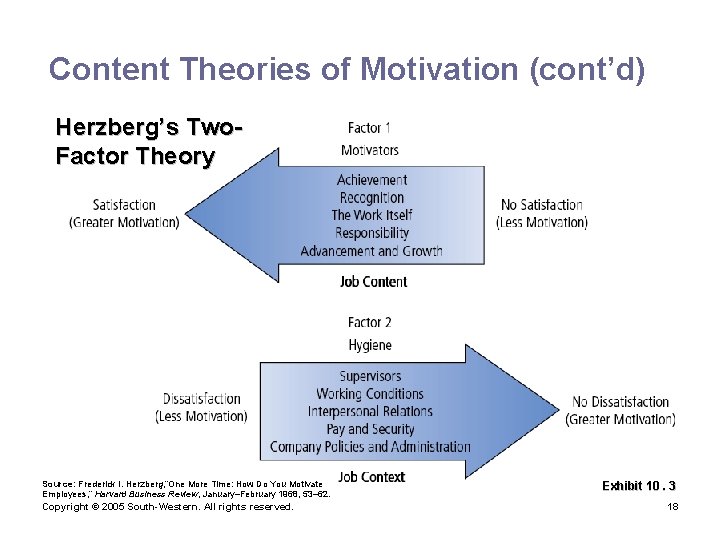
Content Theories of Motivation (cont’d) Herzberg’s Two. Factor Theory Source: Frederick I. Herzberg, “One More Time: How Do You Motivate Employees, ” Harvard Business Review, January–February 1968, 53– 62. Copyright © 2005 South-Western. All rights reserved. Exhibit 10. 3 18
Content Theories of Motivation (cont’d) • Criticisms of Herzberg’s Two-Factor Theory Ø Method of data collection v The information was collected via a potentially biased, structured interview format. Ø Individual differences v Individual differences were discovered to affect the two factors. Ø Limited sample v Conclusions were based primarily on studies of professionals (i. e. , engineers and accountants), whose tasks differ significantly from other kinds of workers. Copyright © 2005 South-Western. All rights reserved. 19
Content Theories of Motivation (cont’d) • Mc. Clelland’s Learned Needs Theory Ø Key assumptions: v Basic needs are transmitted or learned through culture and that the need for achievement is a powerful motivator. v A person’s unconscious mind is the key to unlocking his or her particular needs. v Once an individual’s dominant need is identified, it then becomes a matter of understanding how best to satisfy that need. Copyright © 2005 South-Western. All rights reserved. 20
Content Theories of Motivation (cont’d) • Mc. Clelland’s Learned Needs Theory (cont’d) Ø Identifying the need v. A subject’s written description of a picture was believed to reveal the writer’s needs and motives. Ø Measuring the need v Individual needs were measured using Mc. Clelland’s scoring system for the Thematic Apperception Test (TAT). Ø Motivating the individual v Once the dominant need of the individual is identified, a strategy can be developed to satisfy the need. Copyright © 2005 South-Western. All rights reserved. 21
Content Theories of Motivation (cont’d) • Mc. Clelland’s Learned Needs Theory (cont’d) Ø Dominant individual needs include: v Need for achievement—a measure of a person’s desire for clear, self-set, moderately difficult goals, with feedback given based on goal achievement. v Need for affiliation—the desire to work with others, to interact with and support others, and to learn the lessons of life through the experiences of others. v Need for power—the desire to have influence and control over others. Copyright © 2005 South-Western. All rights reserved. 22
Process Theories of Motivation • Process theory concerns Ø Motivation in relation to how workers’ explicit thought processes (cognitions) and conscious decisions cause them to select and pursue a specific alternative (choice). • Process theories: Ø Expectancy theory (Vroom) Ø Equity theory (Adams) Copyright © 2005 South-Western. All rights reserved. 23
Process Theories of Motivation (cont’d) • Vroom’s Expectancy (VIE) Theory Ø Process people use to evaluate the likelihood that their efforts will yield the desired outcome and how much they want the outcome; factors include: v Expectancy—an individual’s subjective assessment that an effort will lead to the desired results, or a first-order outcome. v Valence—the value of the outcome (i. e. , the reward) to the individual. v Instrumentality—the likelihood that successful task performance will lead to a second-order outcome or a desired reward. Copyright © 2005 South-Western. All rights reserved. 24
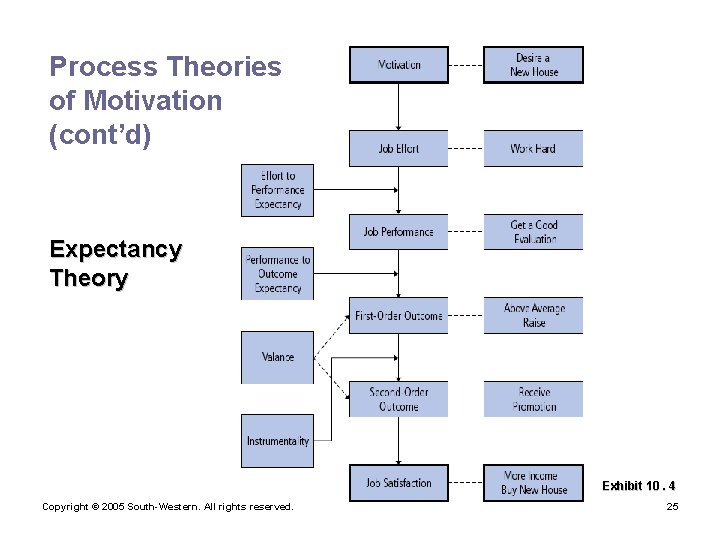
Process Theories of Motivation (cont’d) Expectancy Theory Exhibit 10. 4 Copyright © 2005 South-Western. All rights reserved. 25
Process Theories of Motivation (cont’d) • Applying expectancy theory Ø Ask what outcomes workers desire—workers often prefer rewards that differ from management’s assumptions. Ø Break down effort-to-performance barriers—provide workers with tools, information, and an effective production support system. Ø Clarify and communicate instrumentalities—workers who know that performance will lead to rewards are more likely to work hard. Ø Develop meaningful self-administered rewards—intrinsic rewards have a perfect instrumentality correlation (– 1. 0 or 1. 0) and require no management action to award them. Copyright © 2005 South-Western. All rights reserved. 26
Process Theories of Motivation (cont’d) • Equity theory Ø Key assumptions: v In an assessment process, employees make comparisons of their personal reward-to-effort ratio to the perceived ratios of other employees or organizational benchmarks. v Through an adjustment process, employees will seek to rebalance their reward-to-effort ratios when they perceive either an under-reward or over-reward (inequity) condition in their ratios. Copyright © 2005 South-Western. All rights reserved. 27
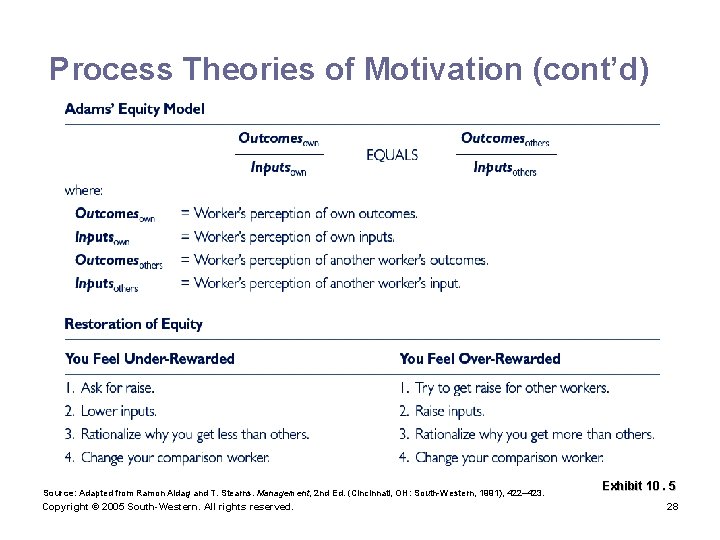
Process Theories of Motivation (cont’d) Source: Adapted from Ramon Aldag and T. Stearns. Management, 2 nd Ed. (Cincinnati, OH: South-Western, 1991), 422– 423. Copyright © 2005 South-Western. All rights reserved. Exhibit 10. 5 28
Environmental Theories of Motivation • Environmental theory concerns Ø How persons acquire knowledge used to express behavior that is rewarded and to avoid behavior that is punished by the environment acting directly on us. Ø How persons learn indirectly by observing the success or failures of others. • Environmental theories Ø Reinforcement theory Ø Social learning theory Copyright © 2005 South-Western. All rights reserved. 29
Environmental Theories (cont’d) • Reinforcement theory Ø Operant conditioning (reinforcement theory) v Behavior is a function of its consequences (Skinner). v Motivation is largely determined by external factors. – Workers are motivated by the consequences of their work behaviors. – Behaviors that have positive consequences are likely to be repeated, and those that have negative consequences are likely to be avoided in the future. – Reinforcement is the process of using contingent rewards to increase occurrences of a specific behavior. Copyright © 2005 South-Western. All rights reserved. 30
Environmental Theories (cont’d) • Reinforcement theory (cont’d) Ø Rewards v Contingent rewards: consequences (outcomes) that are distributed based on a specific, preceding behavior. v Noncontingent rewards: consequences (outcomes) that are not closely linked to any specific behavior. Copyright © 2005 South-Western. All rights reserved. 31
Environmental Theories (cont’d) • Reinforcement theory (cont’d) Ø Increasing the behavior v Positive reinforcement: occurs when a positive consequence (reward) is applied to a desired behavior to increase the frequency of the particular behavior that it follows. v Negative reinforcement: occurs when an unpleasant consequence is withdrawn after the desired behavior occurs. v Both positive and negative reinforcement increase the likelihood that a desired behavior will occur. Copyright © 2005 South-Western. All rights reserved. 32
Environmental Theories (cont’d) • Reinforcement theory (cont’d) Ø Decreasing behavior v Punishment: the process of administering an undesirable consequence for an undesirable behavior. v Hot stove rule: punishment should be swift, intense, impersonal, and consistent, and it should provide an alternative. v Extinction: the process of non-reinforcement of a behavior—if a behavior is unrewarded, its occurrence will diminish over time. Copyright © 2005 South-Western. All rights reserved. 33
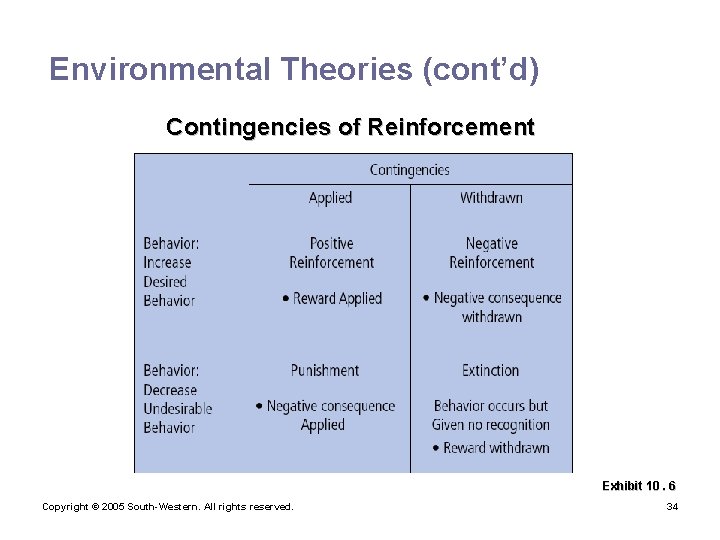
Environmental Theories (cont’d) Contingencies of Reinforcement Exhibit 10. 6 Copyright © 2005 South-Western. All rights reserved. 34
Environmental Theories (cont’d) • Managerial application of reinforcement Ø Immediate reinforcement v Reinforcement should coincide as closely as is practical with the completion of the target behavior. Ø Reinforcement size v The larger the reinforcement after a target behavior, the greater effect the reinforcement will have on frequency of the behavior in the future. Ø Relative reinforcement deprivation v The more a person is deprived of reinforcement, the greater the effect that reinforcement will have on future occurrence of the target behavior. Copyright © 2005 South-Western. All rights reserved. 35
Environmental Theories (cont’d) • Social learning theory (Bandura) Ø Key assumptions: v Motivated behavior is a function of observing the success of other people and then doing what worked for them. v Learning is influenced by an individual’s cognitive assessment of what behaviors were previously rewarded in the environment. Copyright © 2005 South-Western. All rights reserved. 36
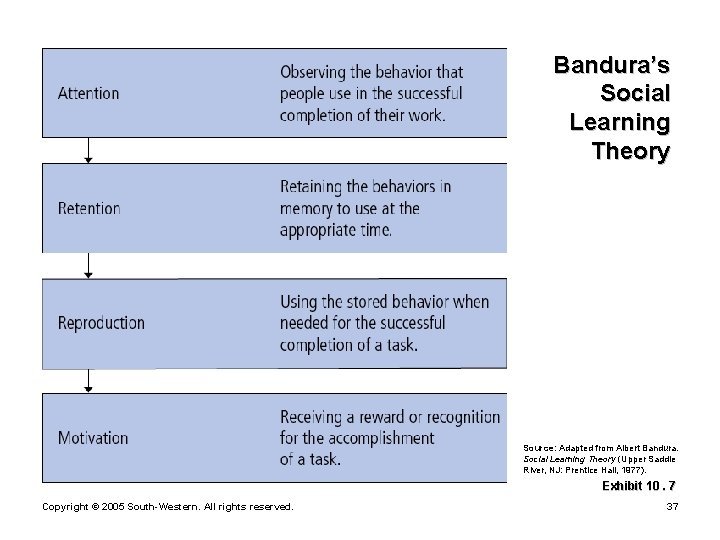
Bandura’s Social Learning Theory Source: Adapted from Albert Bandura. Social Learning Theory (Upper Saddle River, NJ: Prentice Hall, 1977). Exhibit 10. 7 Copyright © 2005 South-Western. All rights reserved. 37
Goal Setting: Applied Motivation Theory • Goal-setting theory Ø People who set goals outperform those who don’t set goals. Ø Goals are targeted levels of performance set before doing the work. Ø Goal setting is an organizational process: v Aligning personal and organizational goals. v Rewarding goal attainment. Copyright © 2005 South-Western. All rights reserved. 38

Goal Setting (cont’d) • Goal-setting programs Ø Management by objectives (MBO) Ø Self-management • Advantages of goal setting Ø Setting goals helps workers to translate general intentions into a specific action by: v Directing attention and action. v Mobilizing effort. v Creating persistent behavior over time. v Leading to strategies for goal attainment. Copyright © 2005 South-Western. All rights reserved. 39

Goal Setting (cont’d) • Attributes of effective goals Ø Goal specificity v Specific goals are more effective than ambiguous (such as “do your best”) goals. v Statements of specific goals include four elements: action verb, outcome, deadline, and cost. Ø Goal difficulty v Difficult but attainable goals lead to higher performance than easy goals. v A difficult but attainable goal is typically established based on relevant data, knowledge, and skills. Copyright © 2005 South-Western. All rights reserved. 40
Goal Setting (cont’d) • Attributes of effective goals (cont’d) Ø Goal feedback v Can occur at three levels: – In setting the goal (“What should I aim for? ”) – In ongoing feedback after the goal is set and work commences (“How am I doing? ”) – In evaluating the final result (“How did I do? ”) Ø Competition v Defining a worker’s or work group’s goal in relation to another worker or work group can increase the goal’s specificity and difficulty. Copyright © 2005 South-Western. All rights reserved. 41
Goal Setting (cont’d) • Attributes of effective goals (cont’d) Ø Participating in goal setting v Involvement in and control over setting goals encourages a higher degree of commitment to meeting those goals. Ø Types of goals: v Assigned goals v Interactive or negotiated goals v Self-set goals Copyright © 2005 South-Western. All rights reserved. 42
- Slides: 42