
Chapter 10 Motion Speed Velocity MOTION an objects
Chapter 10 Motion, Speed & Velocity
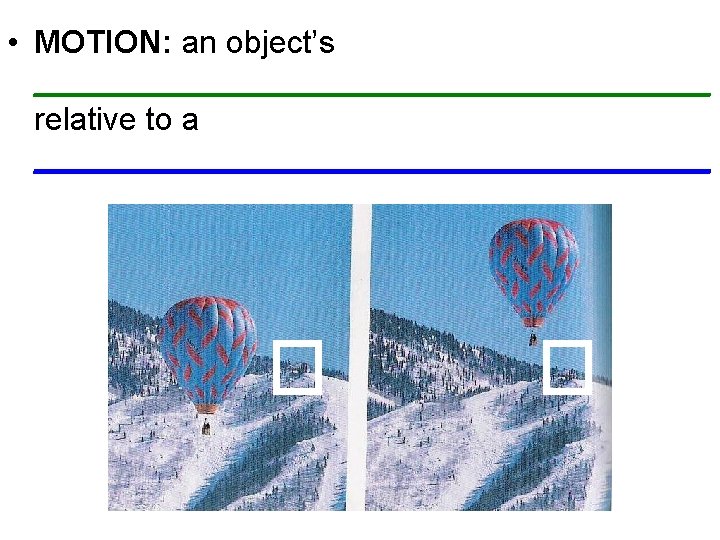
• MOTION: an object’s ___________________ relative to a ___________________
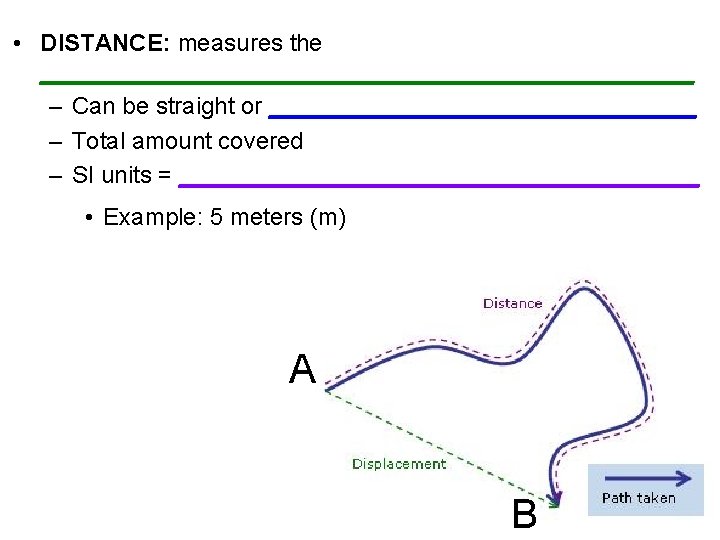
• DISTANCE: measures the _________________________ – Can be straight or ________________ – Total amount covered – SI units = ____________________ • Example: 5 meters (m) A B
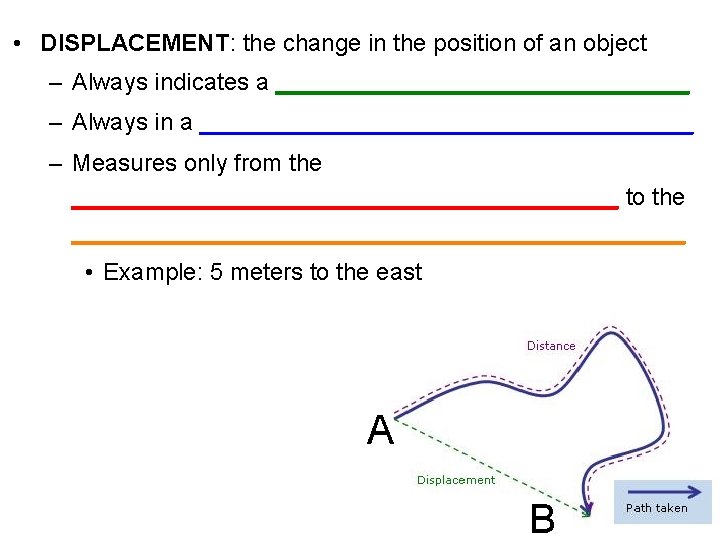
• DISPLACEMENT: the change in the position of an object – Always indicates a ________________ – Always in a ___________________ – Measures only from the _____________________ to the _______________________ • Example: 5 meters to the east A B
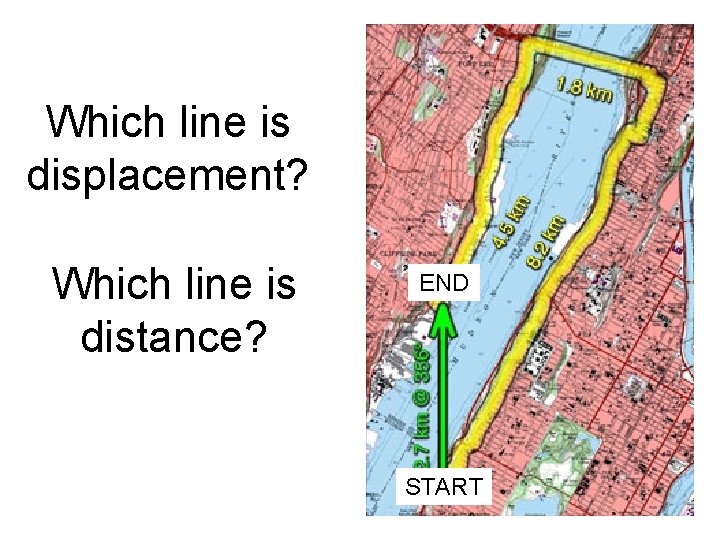
Which line is displacement? Which line is distance? END START
THINK! • Give one example of distance and one example of displacement (include units): • Distance: • Displacement:
• SPEED: distance traveled divided by the time during which motion occurred. – – Need to measure Length & Time – Can’t be _________________ – Common SI unit: ____________________ – ____________________
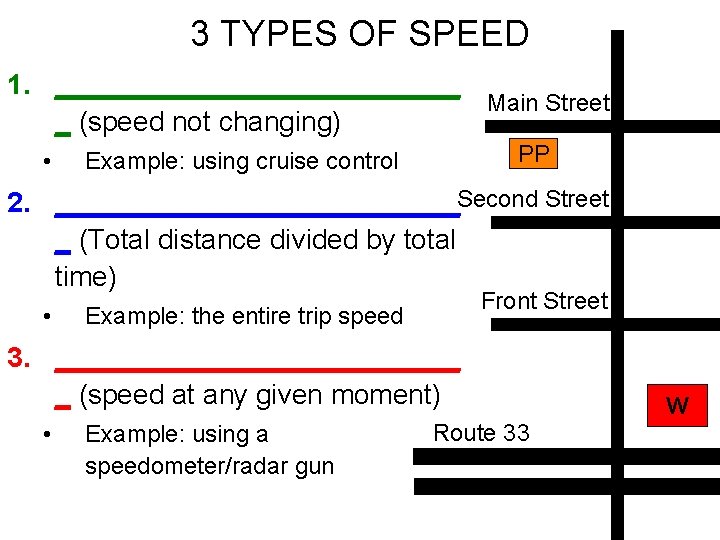
3 TYPES OF SPEED 1. _____________ Main Street _ (speed not changing) • PP Example: using cruise control 2. _____________Second Street _ (Total distance divided by total time) • Front Street Example: the entire trip speed 3. _____________ _ (speed at any given moment) • Example: using a speedometer/radar gun Route 33 W
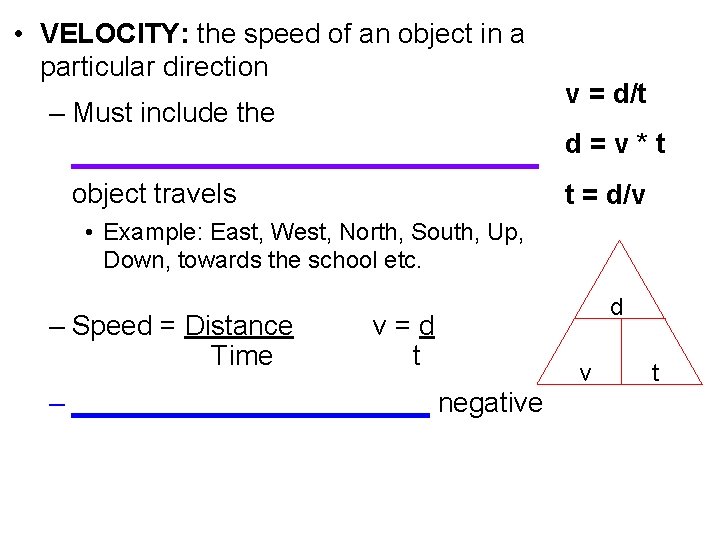
• VELOCITY: the speed of an object in a particular direction v = d/t – Must include the _______________ d = v * t object travels t = d/v • Example: East, West, North, South, Up, Down, towards the school etc. – Speed = Distance Time v=d t – ____________ negative d v t
RESULTANT VELOCITY: ___________________ velocities • Example: Boat moving on flowing river, Person walking on airplane, etc.
THINK! • How are velocity and speed the same? How are they different (include units)?
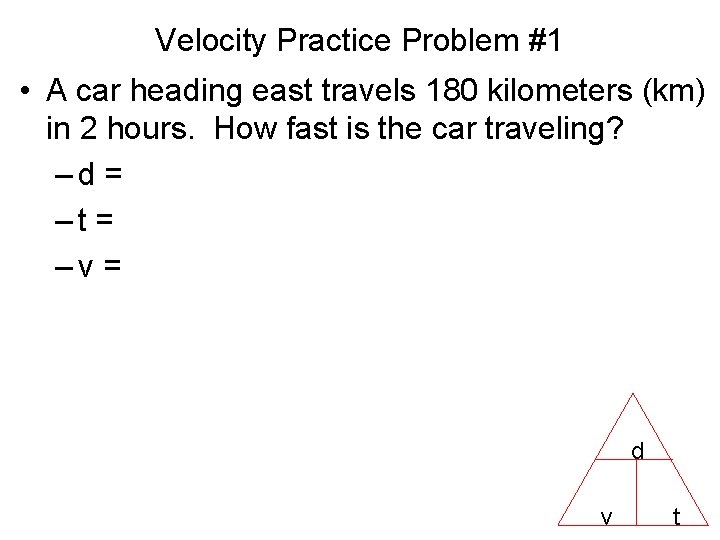
Velocity Practice Problem #1 • A car heading east travels 180 kilometers (km) in 2 hours. How fast is the car traveling? –d = –t = –v = d v t
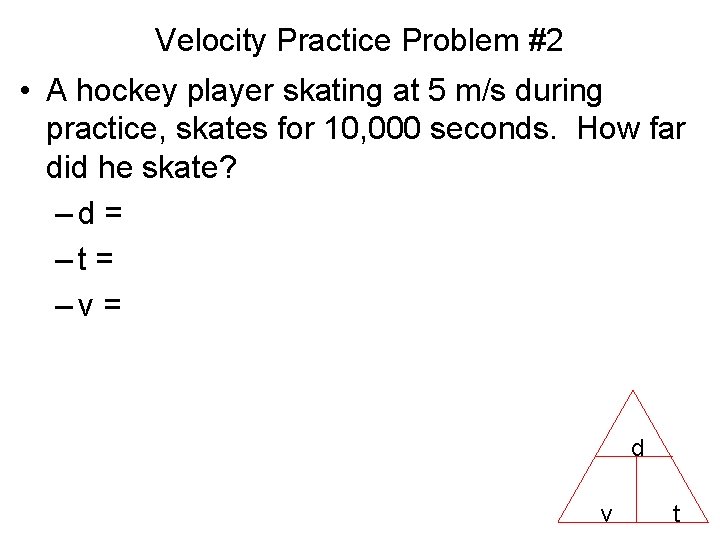
Velocity Practice Problem #2 • A hockey player skating at 5 m/s during practice, skates for 10, 000 seconds. How far did he skate? –d = –t = –v = d v t
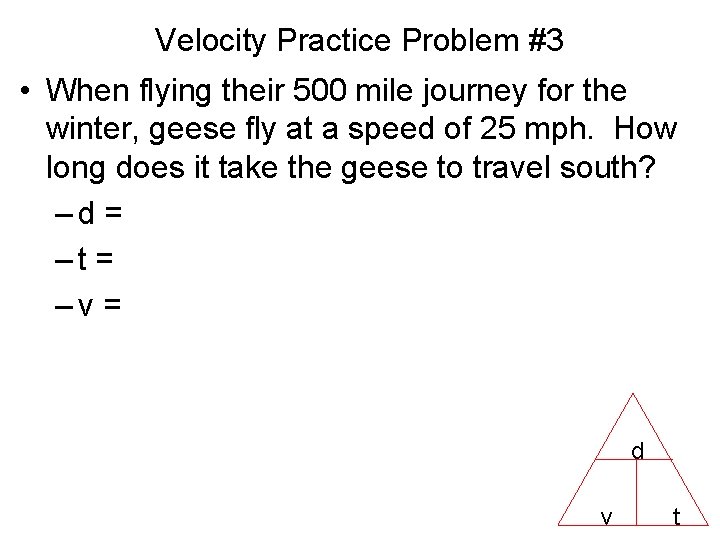
Velocity Practice Problem #3 • When flying their 500 mile journey for the winter, geese fly at a speed of 25 mph. How long does it take the geese to travel south? –d = –t = –v = d v t

Comparisons • Distance & Speed _____Direction (Scalar) ______negative Displacement & Velocity ____Direction (Vector)______neg ative

GRAPHING VELOCITY/SPEED • x-axis = time • y-axis = displacement (or distance) • slope = velocity/speed y-axis slope = velocity = d 2 – d 1 t 2 – t 1 faster slope = velocity d = displacement t = time Example for Top Line slope = velocity = 100 m – 0 m 60 s – 0 s slower = 100 m 60 s = 1. 67 m/s starting point x-axis
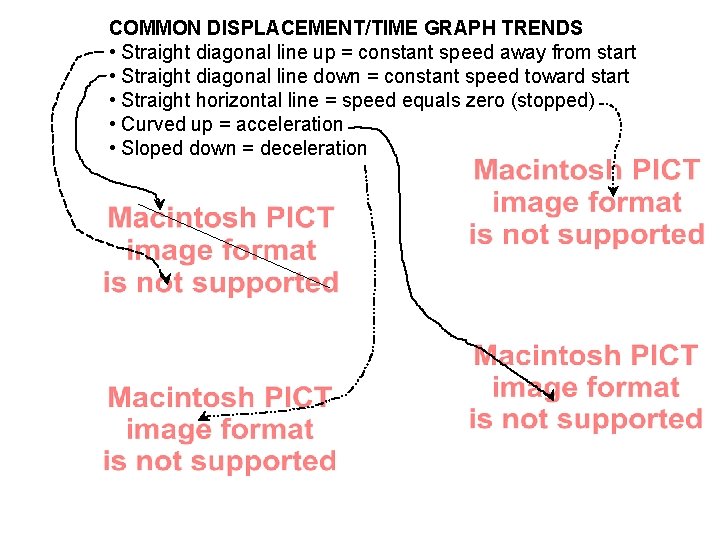
COMMON DISPLACEMENT/TIME GRAPH TRENDS • Straight diagonal line up = constant speed away from start • Straight diagonal line down = constant speed toward start • Straight horizontal line = speed equals zero (stopped) • Curved up = acceleration • Sloped down = deceleration
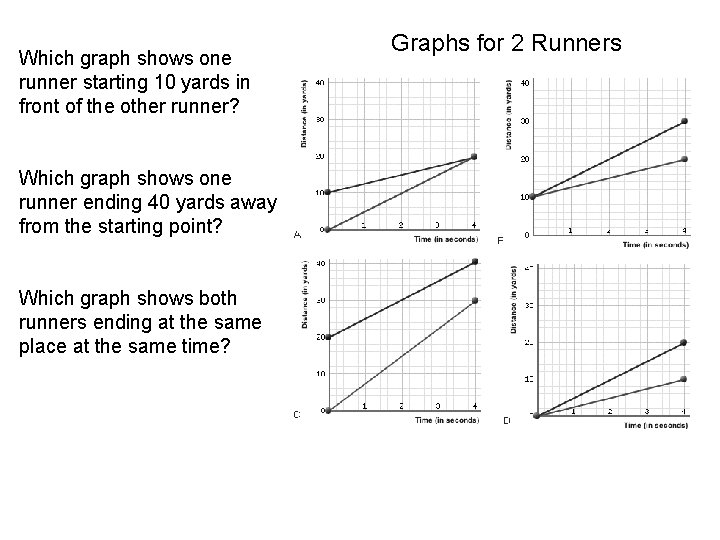
Which graph shows one runner starting 10 yards in front of the other runner? Which graph shows one runner ending 40 yards away from the starting point? Which graph shows both runners ending at the same place at the same time? Graphs for 2 Runners
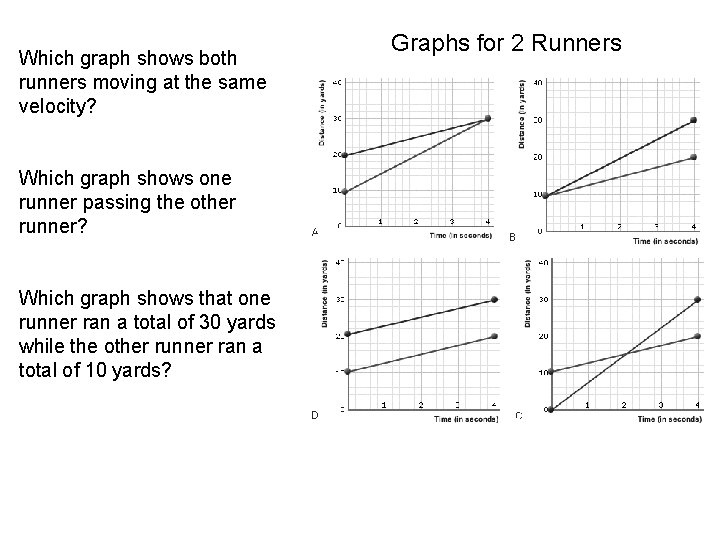
Which graph shows both runners moving at the same velocity? Which graph shows one runner passing the other runner? Which graph shows that one runner ran a total of 30 yards while the other runner ran a total of 10 yards? Graphs for 2 Runners
- Slides: 19