
Chapter 10 Mergers and Entry Barriers Vertical merger
Chapter 10 Mergers and Entry Barriers • Vertical merger • Horizontal merger • Entry Barrier © 2010 Institute of Information Management National Chiao Tung University
Mergers • The terms mergers, takeovers, acquisitions, and integration describe a situation where independently owned firms join under the same ownership • Three general categories of merger (Federal Trade Commission) – Horizontal merger: Firms in the same industry, producing identical or similar products and selling in the same geographical market, merge – Vertical merger: A firm producing an intermediate good merges with a firm producing the final good that use intermediate goods or two companies with seller-buyer relationship merge – Conglomerate merger: Firms producing less related products merge under the same ownership © 2010 Institute of Information Management National Chiao Tung University
Vertical merger • The intermediated-good suppliers is called as upstream firm. The final-good producers as downstream firm • Consider an industry structure in which there are two upstream firms selling an input to two downstream firms © 2010 Institute of Information Management National Chiao Tung University
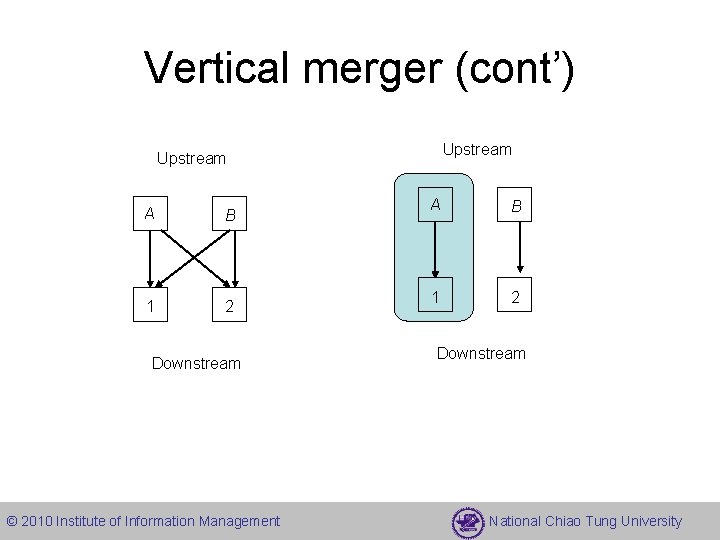
Vertical merger (cont’) Upstream A B 1 2 Downstream © 2010 Institute of Information Management A B 1 2 Downstream National Chiao Tung University
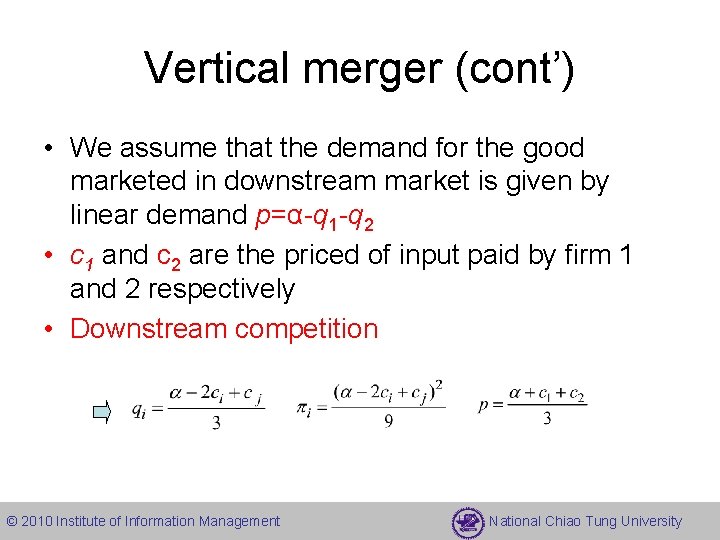
Vertical merger (cont’) • We assume that the demand for the good marketed in downstream market is given by linear demand p=α-q 1 -q 2 • c 1 and c 2 are the priced of input paid by firm 1 and 2 respectively • Downstream competition © 2010 Institute of Information Management National Chiao Tung University
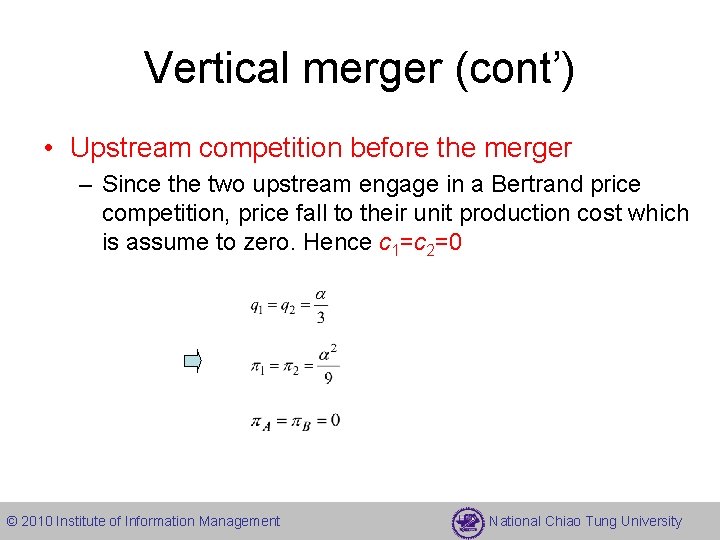
Vertical merger (cont’) • Upstream competition before the merger – Since the two upstream engage in a Bertrand price competition, price fall to their unit production cost which is assume to zero. Hence c 1=c 2=0 © 2010 Institute of Information Management National Chiao Tung University
![Vertical merger (cont’) • Upstream and downstream merge ([A]+[1]=[A 1]) – The input cost](http://slidetodoc.com/presentation_image_h2/37ba9c3424a4a79ba51d222f93f65360/image-7.jpg "Vertical merger (cont’) • Upstream and downstream merge ([A]+[1]=[A 1]) – The input cost")
Vertical merger (cont’) • Upstream and downstream merge ([A]+[1]=[A 1]) – The input cost of the merged firm A 1 is zero (c 1=0) – The upstream firm B is now a monopoly in the factor market. Firm B choose c 2 that solves © 2010 Institute of Information Management National Chiao Tung University
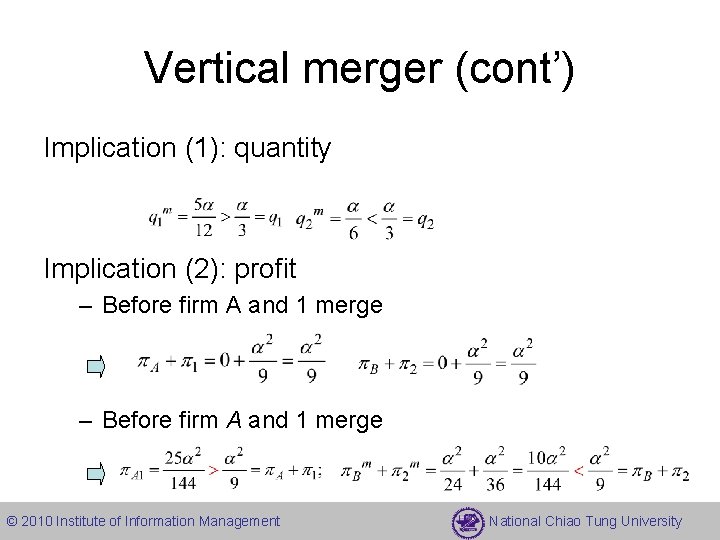
Vertical merger (cont’) Implication (1): quantity Implication (2): profit – Before firm A and 1 merge © 2010 Institute of Information Management National Chiao Tung University
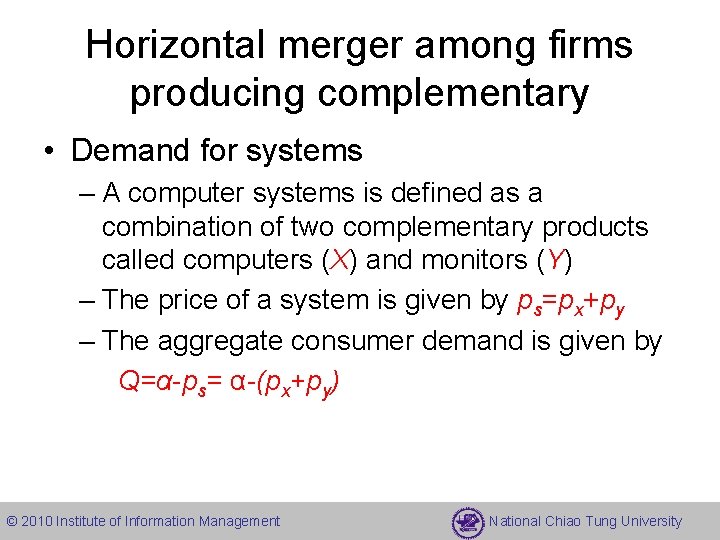
Horizontal merger among firms producing complementary • Demand for systems – A computer systems is defined as a combination of two complementary products called computers (X) and monitors (Y) – The price of a system is given by ps=px+py – The aggregate consumer demand is given by Q=α-ps= α-(px+py) © 2010 Institute of Information Management National Chiao Tung University
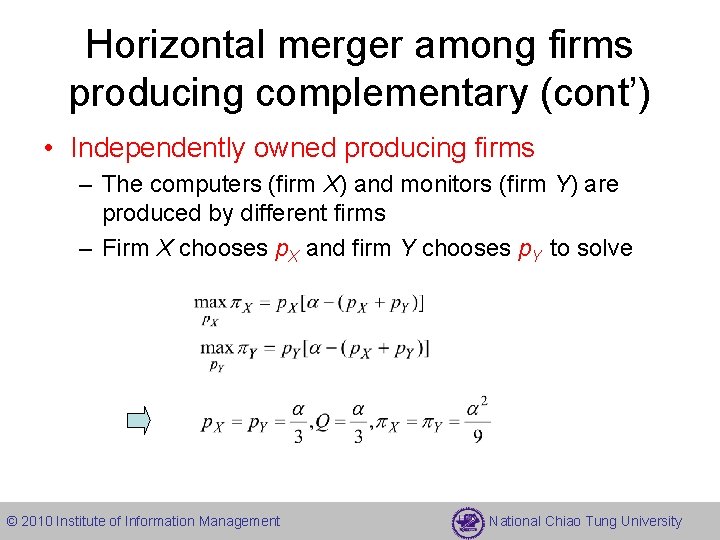
Horizontal merger among firms producing complementary (cont’) • Independently owned producing firms – The computers (firm X) and monitors (firm Y) are produced by different firms – Firm X chooses p. X and firm Y chooses p. Y to solve © 2010 Institute of Information Management National Chiao Tung University
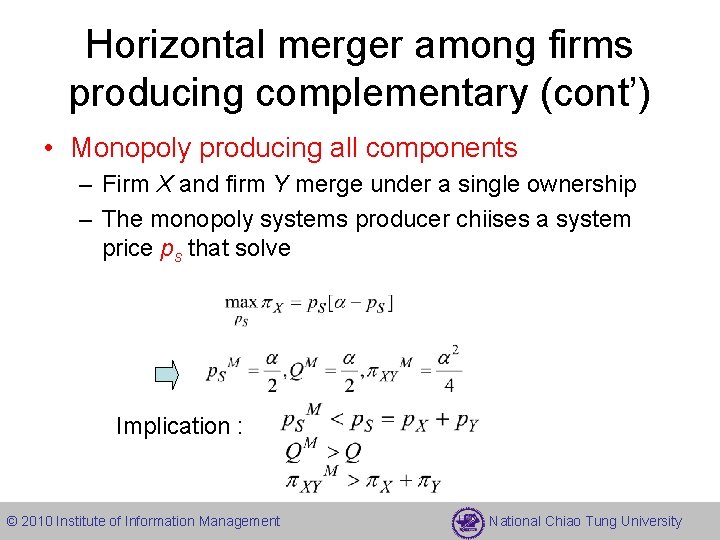
Horizontal merger among firms producing complementary (cont’) • Monopoly producing all components – Firm X and firm Y merge under a single ownership – The monopoly systems producer chiises a system price ps that solve Implication : © 2010 Institute of Information Management National Chiao Tung University
Entry Barriers • There can be many reasons why entry may not occur (Bain 1956) – Absolute cost advantage of incumbent firms – Economies of scale – Product-differentiation advantage of incumbent firms, such as reputation and goodwill © 2010 Institute of Information Management National Chiao Tung University
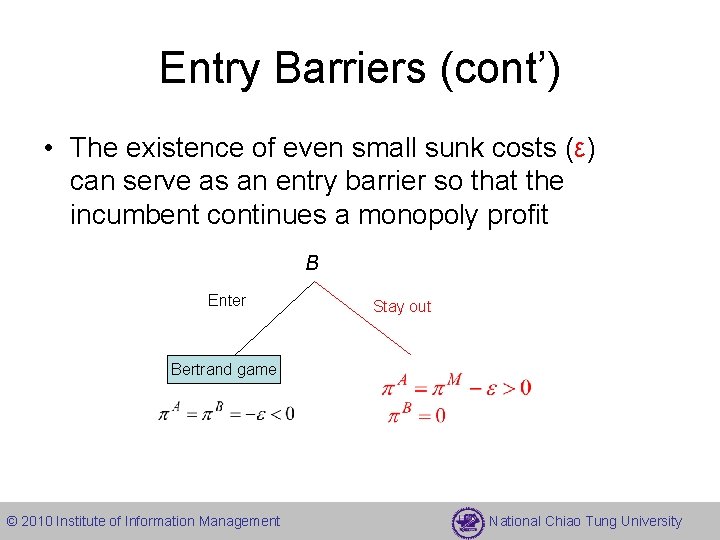
Entry Barriers (cont’) • The existence of even small sunk costs (ε) can serve as an entry barrier so that the incumbent continues a monopoly profit B Enter Stay out Bertrand game © 2010 Institute of Information Management National Chiao Tung University
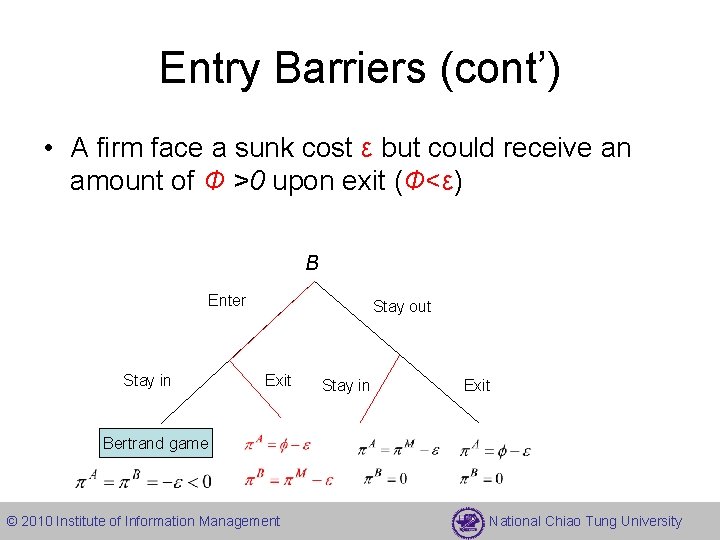
Entry Barriers (cont’) • A firm face a sunk cost ε but could receive an amount of Ф >0 upon exit (Ф<ε) B Enter Stay in Stay out Exit Stay in Exit Bertrand game © 2010 Institute of Information Management National Chiao Tung University
- Slides: 14