
CHAPTER 10 MEMORY AND THOUGHT SECTION 1 TAKING
- Slides: 30
CHAPTER 10: MEMORY AND THOUGHT
SECTION 1: TAKING IN AND STORING INFORMATION There are 3 processes involved in memory: encoding, storing, and retrieval
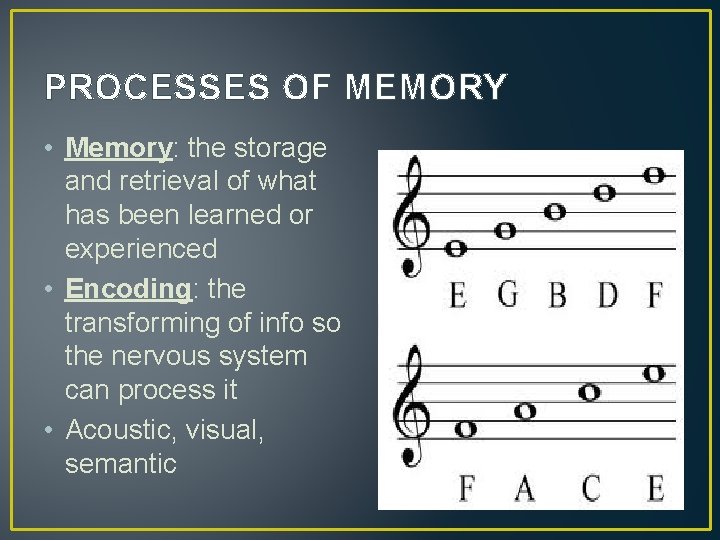
PROCESSES OF MEMORY • Memory: the storage and retrieval of what has been learned or experienced • Encoding: the transforming of info so the nervous system can process it • Acoustic, visual, semantic
PROCESSES CONTINUED • Storage: process by which info is maintained over a period of time • Retrieval: process of obtaining info that has been stored in memory
THREE STAGES OF MEMORY
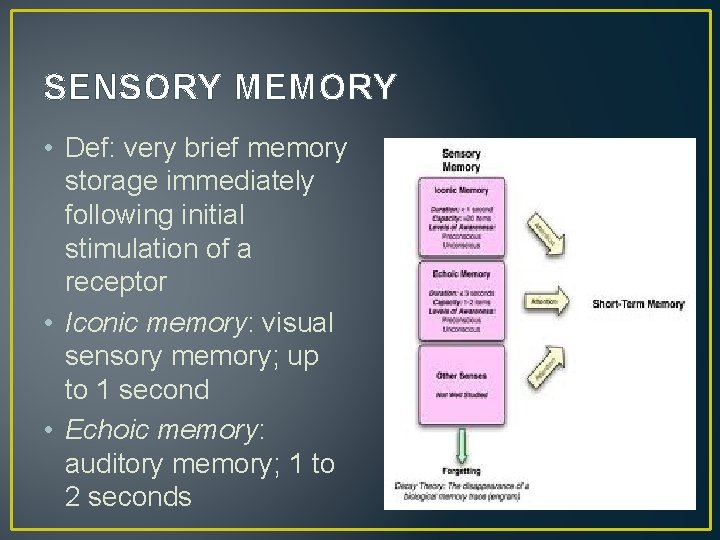
SENSORY MEMORY • Def: very brief memory storage immediately following initial stimulation of a receptor • Iconic memory: visual sensory memory; up to 1 second • Echoic memory: auditory memory; 1 to 2 seconds
FUNCTIONS OF SENSORY MEMORY • 3 functions • 1) prevents being overwhelmed by stimuli • 2) allows time for decision-making • 3) allows for continuity and stability in the world
SHORT-TERM MEMORY • Def: memory that is limited in capacity to about 7 items and in duration by the subject’s active rehearsal • Does not involve close attention
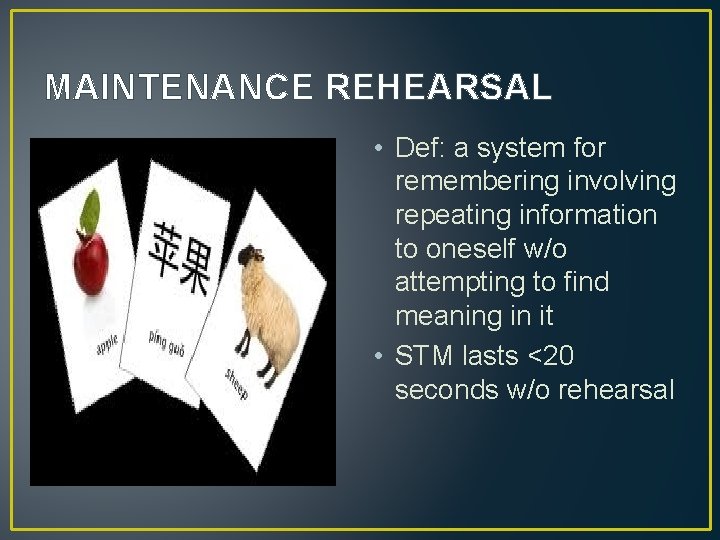
MAINTENANCE REHEARSAL • Def: a system for remembering involving repeating information to oneself w/o attempting to find meaning in it • STM lasts <20 seconds w/o rehearsal
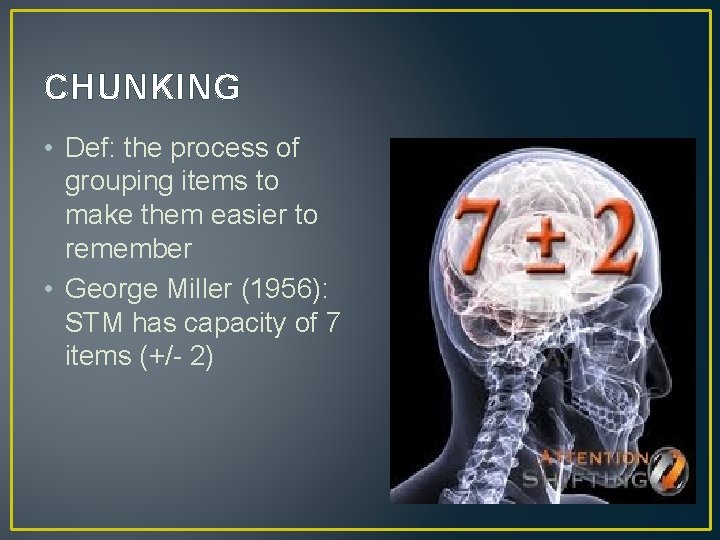
CHUNKING • Def: the process of grouping items to make them easier to remember • George Miller (1956): STM has capacity of 7 items (+/- 2)
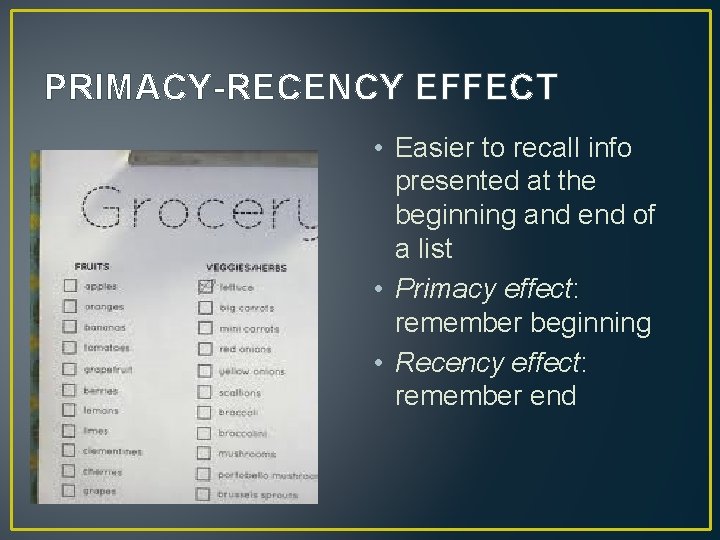
PRIMACY-RECENCY EFFECT • Easier to recall info presented at the beginning and end of a list • Primacy effect: remember beginning • Recency effect: remember end
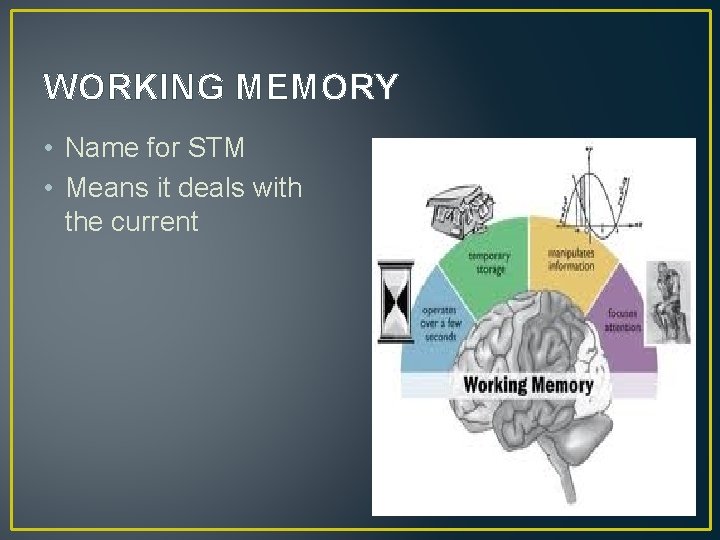
WORKING MEMORY • Name for STM • Means it deals with the current
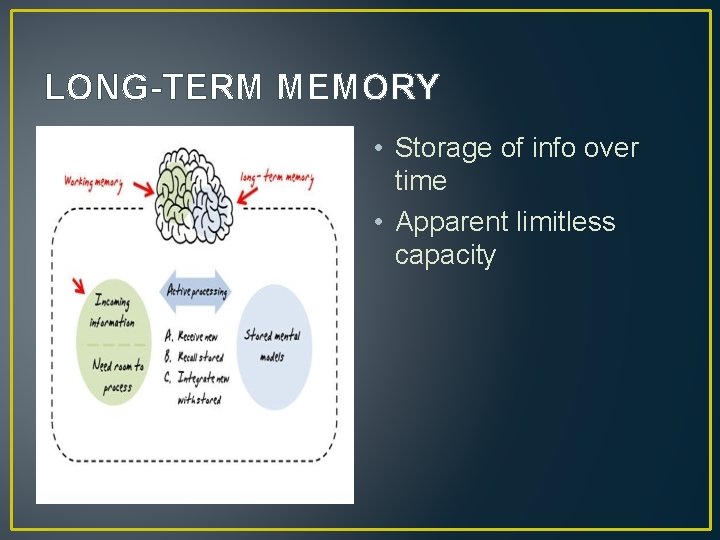
LONG-TERM MEMORY • Storage of info over time • Apparent limitless capacity
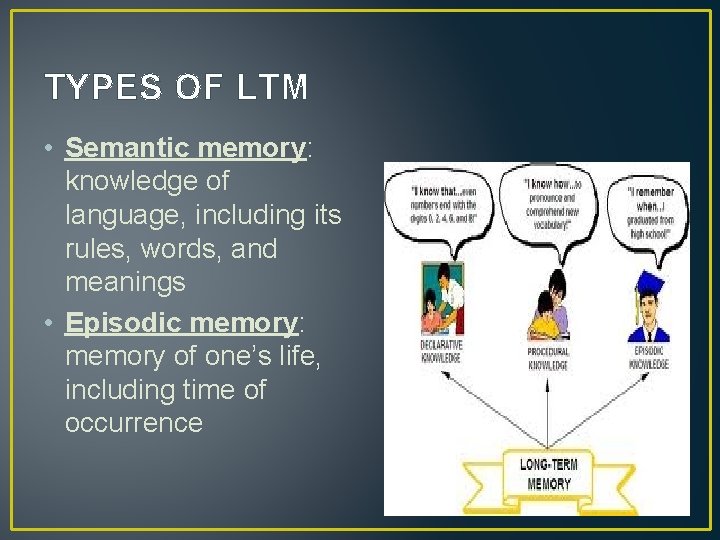
TYPES OF LTM • Semantic memory: knowledge of language, including its rules, words, and meanings • Episodic memory: memory of one’s life, including time of occurrence
LTM TYPES CONTINUED • Declarative memory: memory of knowledge that can be called forth consciously as need • Procedural memory: memory of learned skills that does not require conscious recollection
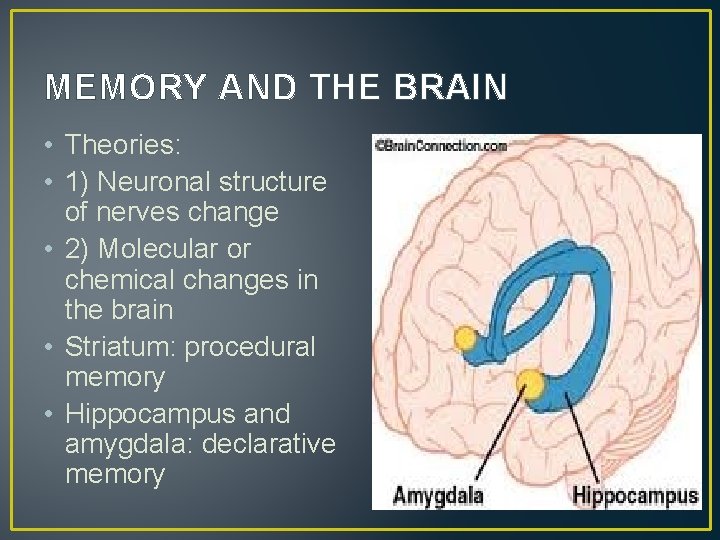
MEMORY AND THE BRAIN • Theories: • 1) Neuronal structure of nerves change • 2) Molecular or chemical changes in the brain • Striatum: procedural memory • Hippocampus and amygdala: declarative memory
SECTION 2: RETRIEVING INFORMATION Recognition, recall, and relearning
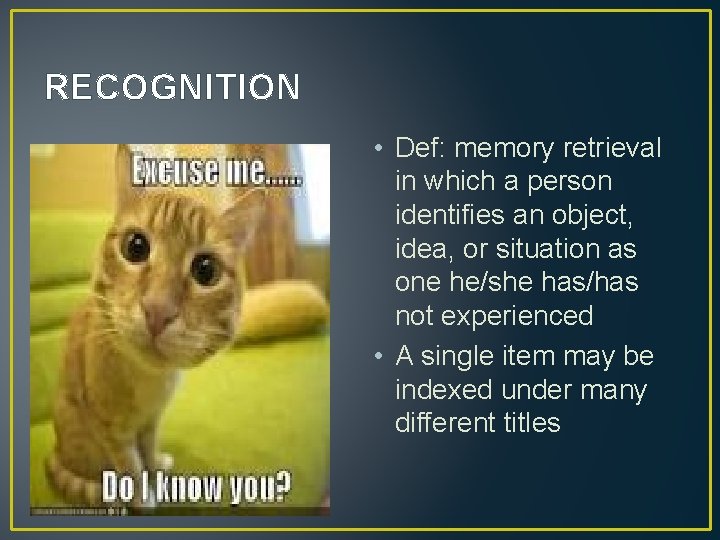
RECOGNITION • Def: memory retrieval in which a person identifies an object, idea, or situation as one he/she has/has not experienced • A single item may be indexed under many different titles
RECALL • Def: memory retrieval in which a person reconstructs previously learned material • Involves a person’s attitudes, knowledge, and expectations
RECALL • Influenced by: • Reconstructive processes: alteration of recalled memory that may be simplified, enriched, or distorted, depending on an individual’s experiences, attitudes, or inferences
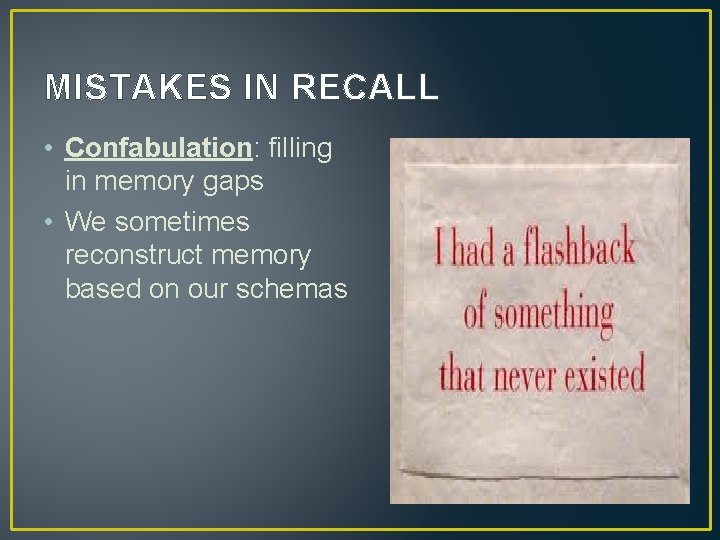
MISTAKES IN RECALL • Confabulation: filling in memory gaps • We sometimes reconstruct memory based on our schemas
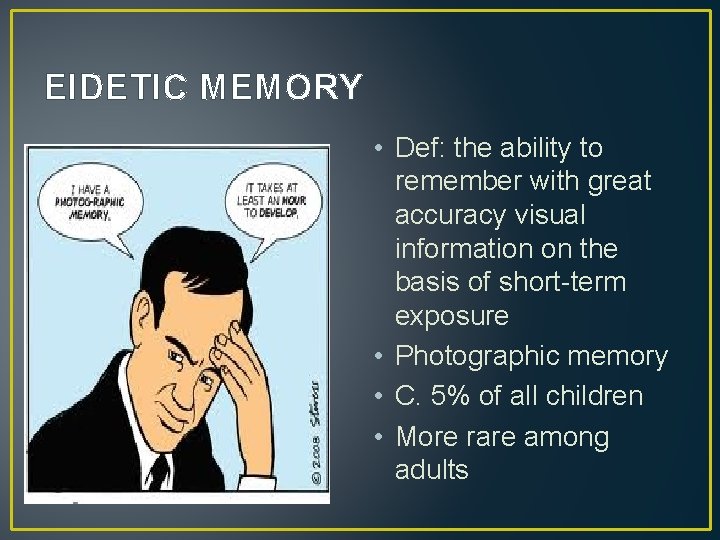
EIDETIC MEMORY • Def: the ability to remember with great accuracy visual information on the basis of short-term exposure • Photographic memory • C. 5% of all children • More rare among adults
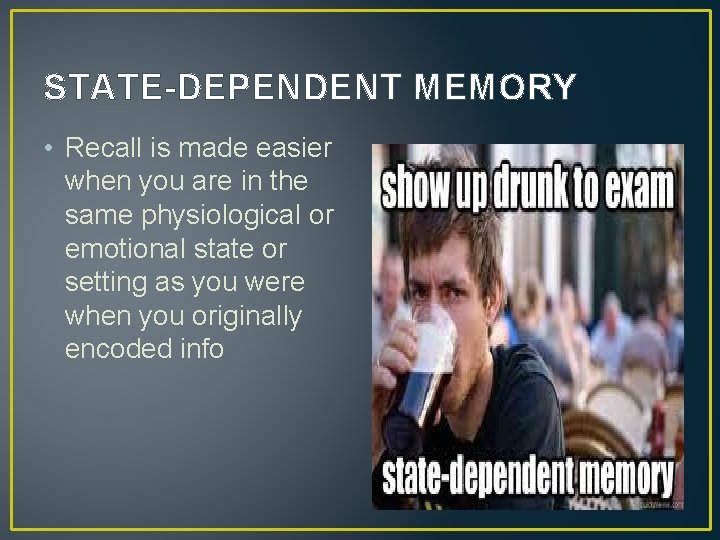
STATE-DEPENDENT MEMORY • Recall is made easier when you are in the same physiological or emotional state or setting as you were when you originally encoded info
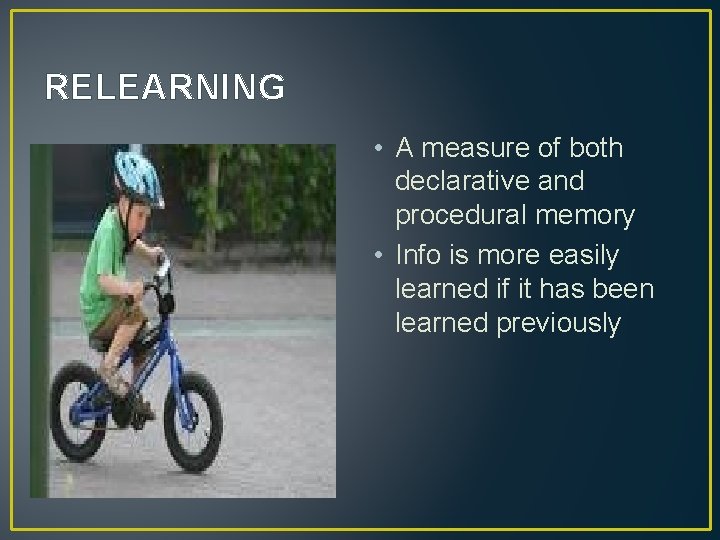
RELEARNING • A measure of both declarative and procedural memory • Info is more easily learned if it has been learned previously
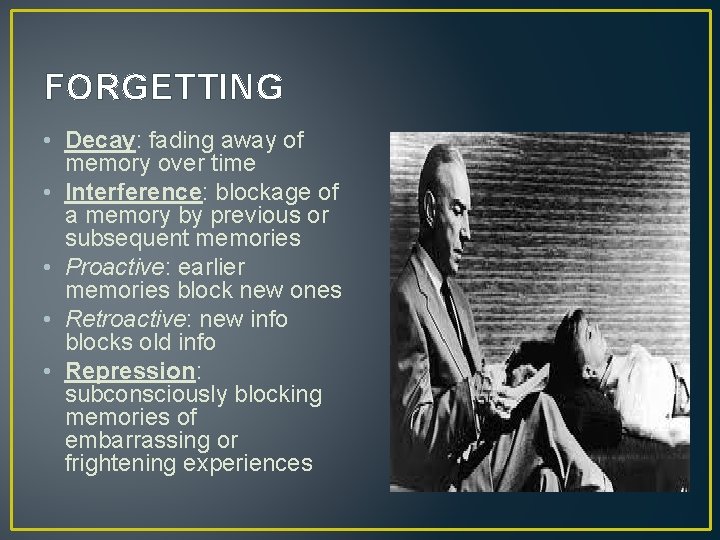
FORGETTING • Decay: fading away of memory over time • Interference: blockage of a memory by previous or subsequent memories • Proactive: earlier memories block new ones • Retroactive: new info blocks old info • Repression: subconsciously blocking memories of embarrassing or frightening experiences
AMNESIA • Def: loss of memory • Causes: blow to the head, drug use, stress • Infant amnesia: lack of early declarative memory • Freud: emotional trauma • Others: memories are nonverbal; hippocampus not fully developed
IMPROVING MEMORY
MEANINGFULNESS AND ASSOCIATION • Elaborative rehearsal: the linking of new info to material that is already known • The more meaningful, the easier it is to remember • The more indexes, the more accessible it is • The more senses it’s attached to, the easier it is to recall
STUDY HABITS • Don’t cram • Distributed practice: studying a little at a time • Too much info in one sitting creates too much interference
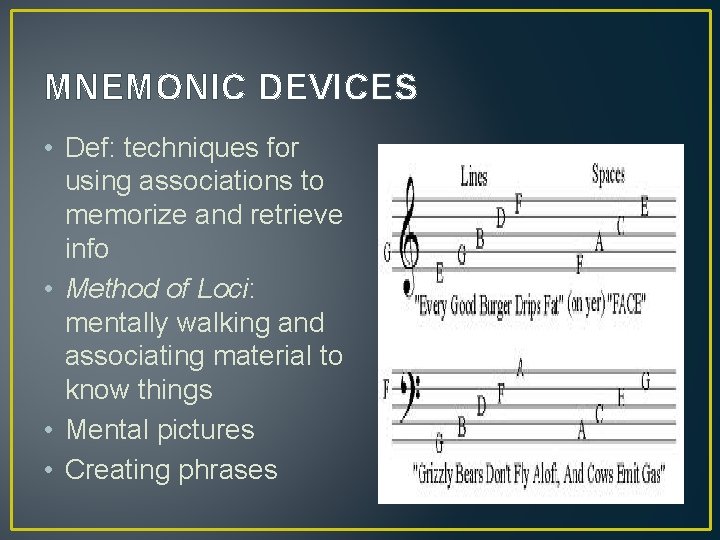
MNEMONIC DEVICES • Def: techniques for using associations to memorize and retrieve info • Method of Loci: mentally walking and associating material to know things • Mental pictures • Creating phrases